
ANALYSIS AND DESIGN OF
INFORMATION SYSTEM
Submitted by-
Name ID
Kanchon Kumar - 143-15-
Sonot Kumar - 143-15-
Sohel Al Mamun - 143-15-
Tuhinur Rahman - 143-15-
Submitted to-
Md. Sadekur Rahman
Dept. Of CSE
INTRODUCTION
• Information Systems Analysis and Design
• Complex organizational process whereby computer-
based information systems are developed and
maintained
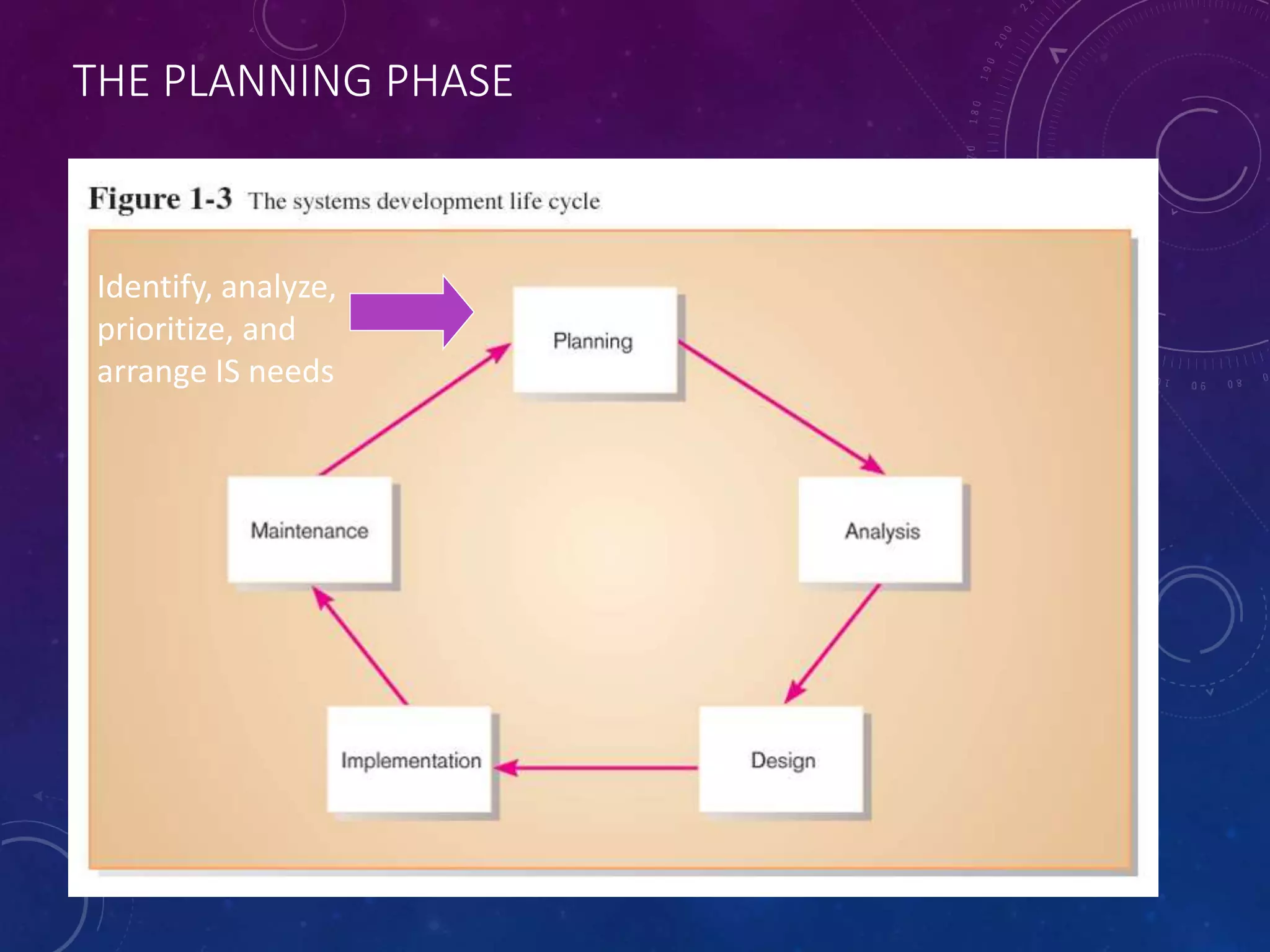
SYSTEM DEVELOPMENT LIFE CYCLE
• Traditional methodology for developing, maintaining, and
replacing information systems
• Phases in SDLC:
• Planning
• Analysis
• Design
• Implementation
• Maintenance
THE PLANNING PHASE
Identify, analyze,
prioritize, and
arrange IS needs
INTRODUCTION
ANALYSIS
• Analysis as ‘the breaking up of any whole so as to find out their nature,
function etc.
• Analysis gives the conceptual understanding of a system from the logical point
of view by detailing its functionality.
DESIGN
• Design as ’to make preliminary sketches of; to sketch a pattern or outline for;
to plan and carry out especially by artistic arrangement or in a skilful way.’
• Designing gives us the blueprint on the basis of which the actual system is
developed
ANALYSIS PRINCIPLES
• The domain of information in which the problem operates has to be
appreciated.
• The key functions of the system have to be defined.
• System must be modular. This is required to help create the system in a faster
way.
• System has to be defined in abstract term. This helps reduce complexity.
• The ambiguity in the system must be reduced to enable designer to focus on
the outcome clearly.
DESIGN PRINCIPLE
• It should have an overall macro view of the system rather than a tunnel view
• The design process should be logical.
• The design should reinvent the wheel.
• The design should be a very close abstraction of the problem.
• The design should be uniform and integrated
• The design should be structured
• The design should be reviewed on a real-time basis to minimize errors.
SYSTEM REQUIREMENT SPECIFICATION
• Information description : where the detailed information description is given.
• Functional description : where the functionality required from the system is
given.
• Validation description : this is the data validation and business rule
description required in the system.
DESIGN CONCEPT
• Abstraction
• Procedural abstraction
• Data abstraction
• Control abstraction
• Refinement
• Modularity
ABSTRACTION
• Abstraction is the conceptualization of an issue or problem or entity in terms
of some level of generalization without regarding to irrelevant low-level
details.
• Procedural abstraction : it is a named collection of several sequential
procedural steps.
• Data abstraction : this is name of a set of data that defines of an object.
• Control abstraction : this is a named control mechanism, which has several
steps.
REFINEMENT
• Refinement helps the designer in elaborating the system and bringing-out
lower-level details as the design progress.
• This is a top- down design strategy in which design is refined after each
successive step.
MODULARITY
• It helps the designer to compartmentalize the design into functional
compartments as the entire system can be conceived to be composed of a set
of modules, each having its own special feature and functionality rather than a
monolithic entity.
• Modularity helps the designer to comprehend the system better.
• Effective modular design in general reduces the complexity of the system by
dividing system into easily understandable modules.
TOOL FOR DESIGN
• Data flow diagram(DFD)
• Data dictionary(DD)
DATA FLOW DIAGRAM(DFD)
 The data flow diagram is a powerful tool to understand the
functional and information view of system.
 It can be two types – Logical data flow diagram and
Physical data flow diagram
• Logical data flow diagram deals with the functional views of the system.
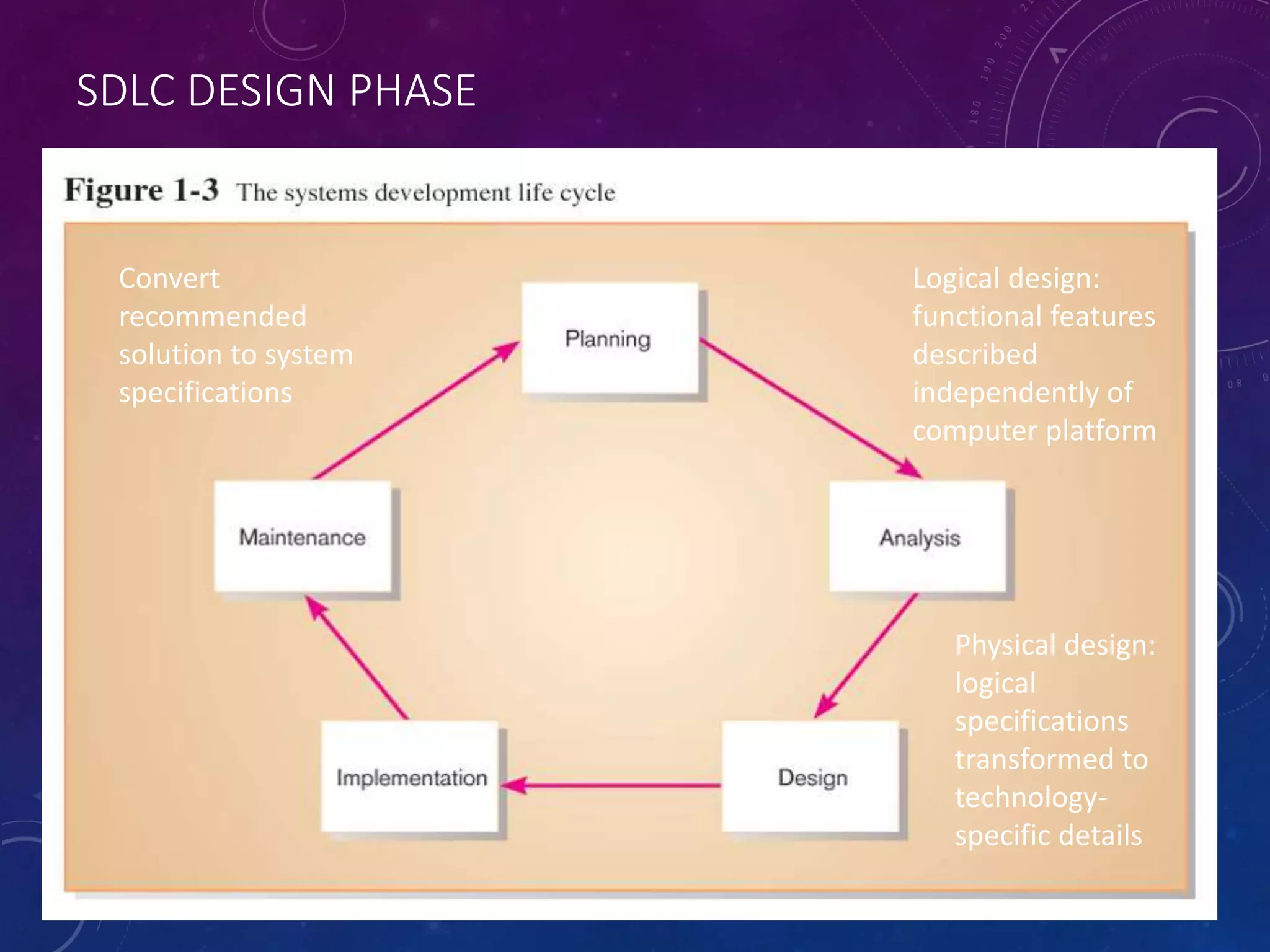
SDLC DESIGN PHASE
Convert
recommended
solution to system
specifications
Logical design:
functional features
described
independently of
computer platform
Physical design:
logical
specifications
transformed to
technology-
specific details
DATA DICTIONARY(DD)
 The data dictionary is a complete and comprehensive
definition of all the data element in the system.
 It is the source document for specifications of all inputs,
protocols, outputs, data structures, database structures,
meta data and algorithm.
THANK YOU……..

Analysis and design of information system

  • 1.
    ANALYSIS AND DESIGNOF INFORMATION SYSTEM
  • 2.
    Submitted by- Name ID KanchonKumar - 143-15- Sonot Kumar - 143-15- Sohel Al Mamun - 143-15- Tuhinur Rahman - 143-15- Submitted to- Md. Sadekur Rahman Dept. Of CSE
  • 3.
    INTRODUCTION • Information SystemsAnalysis and Design • Complex organizational process whereby computer- based information systems are developed and maintained
  • 4.
    SYSTEM DEVELOPMENT LIFECYCLE • Traditional methodology for developing, maintaining, and replacing information systems • Phases in SDLC: • Planning • Analysis • Design • Implementation • Maintenance
  • 5.
    THE PLANNING PHASE Identify,analyze, prioritize, and arrange IS needs
  • 6.
    INTRODUCTION ANALYSIS • Analysis as‘the breaking up of any whole so as to find out their nature, function etc. • Analysis gives the conceptual understanding of a system from the logical point of view by detailing its functionality.
  • 7.
    DESIGN • Design as’to make preliminary sketches of; to sketch a pattern or outline for; to plan and carry out especially by artistic arrangement or in a skilful way.’ • Designing gives us the blueprint on the basis of which the actual system is developed
  • 8.
    ANALYSIS PRINCIPLES • Thedomain of information in which the problem operates has to be appreciated. • The key functions of the system have to be defined. • System must be modular. This is required to help create the system in a faster way. • System has to be defined in abstract term. This helps reduce complexity. • The ambiguity in the system must be reduced to enable designer to focus on the outcome clearly.
  • 9.
    DESIGN PRINCIPLE • Itshould have an overall macro view of the system rather than a tunnel view • The design process should be logical. • The design should reinvent the wheel. • The design should be a very close abstraction of the problem. • The design should be uniform and integrated • The design should be structured • The design should be reviewed on a real-time basis to minimize errors.
  • 10.
    SYSTEM REQUIREMENT SPECIFICATION •Information description : where the detailed information description is given. • Functional description : where the functionality required from the system is given. • Validation description : this is the data validation and business rule description required in the system.
  • 11.
    DESIGN CONCEPT • Abstraction •Procedural abstraction • Data abstraction • Control abstraction • Refinement • Modularity
  • 12.
    ABSTRACTION • Abstraction isthe conceptualization of an issue or problem or entity in terms of some level of generalization without regarding to irrelevant low-level details. • Procedural abstraction : it is a named collection of several sequential procedural steps. • Data abstraction : this is name of a set of data that defines of an object. • Control abstraction : this is a named control mechanism, which has several steps.
  • 13.
    REFINEMENT • Refinement helpsthe designer in elaborating the system and bringing-out lower-level details as the design progress. • This is a top- down design strategy in which design is refined after each successive step.
  • 14.
    MODULARITY • It helpsthe designer to compartmentalize the design into functional compartments as the entire system can be conceived to be composed of a set of modules, each having its own special feature and functionality rather than a monolithic entity. • Modularity helps the designer to comprehend the system better. • Effective modular design in general reduces the complexity of the system by dividing system into easily understandable modules.
  • 15.
    TOOL FOR DESIGN •Data flow diagram(DFD) • Data dictionary(DD)
  • 16.
    DATA FLOW DIAGRAM(DFD) The data flow diagram is a powerful tool to understand the functional and information view of system.  It can be two types – Logical data flow diagram and Physical data flow diagram • Logical data flow diagram deals with the functional views of the system.
  • 17.
    SDLC DESIGN PHASE Convert recommended solutionto system specifications Logical design: functional features described independently of computer platform Physical design: logical specifications transformed to technology- specific details
  • 18.
    DATA DICTIONARY(DD)  Thedata dictionary is a complete and comprehensive definition of all the data element in the system.  It is the source document for specifications of all inputs, protocols, outputs, data structures, database structures, meta data and algorithm.
  • 19.