Welcome
to Our
Presentation
Priority
Scheduling
Algorithms
2
Submitted by-
Name ID
Asikul Islam 143-15-
Kanchon Kumar 143-15-
Saiful Islam 143-15-
Sonot Kumar 143-15-
Sohel Al Mamun 143-15-
Tuhinur Rahman 143-15-
Muine al Yamine
Submitted to-
Dept. Of CSE
Overview 4
 Basic Concepts
 Scheduling Criteria
 Scheduling Algorithms
 Example of Priority Scheduling
 Advantages & Disadvantages
Basic Concepts
 Main objective of multiprogramming is to keep on
running processes all the time for maximum CPU
utilization.
 Scheduling is fundamental function of OS.
 The task of selecting the processes in memory that are
ready to execute, and allocating them to the CPU is
performed by the CPU Scheduler.
5
CPU Scheduler
 CPU scheduling decisions may take place when
a process:
o 1. Switches from running to waiting state
o 2. Switches from running to ready state
o 3. Switches from waiting to ready
o 4. Terminates
 Scheduling under 1 and 4 is non preemptive.
 All other scheduling is preemptive.
6
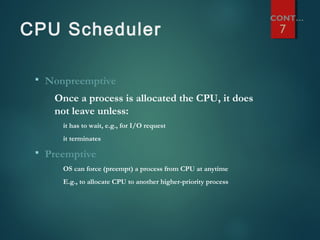
CPU Scheduler
 Nonpreemptive
Once a process is allocated the CPU, it does
not leave unless:
o it has to wait, e.g., for I/O request 
o it terminates  
 Preemptive
o OS can force (preempt) a process from CPU at anytime
o E.g., to allocate CPU to another higher-priority process 
7
CONT…
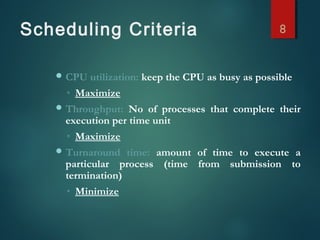
Scheduling Criteria
 CPU utilization: keep the CPU as busy as possible
◦ Maximize
 Throughput: No of processes that complete their
execution per time unit
◦ Maximize
 Turnaround time: amount of time to execute a
particular process (time from submission to
termination)
◦ Minimize
8
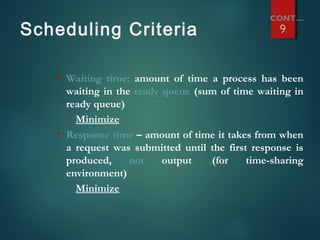
Scheduling Criteria 9
CONT…
 Waiting time: amount of time a process has been
waiting in the ready queue (sum of time waiting in
ready queue)
o Minimize
 Response time – amount of time it takes from when
a request was submitted until the first response is
produced, not output  (for time-sharing
environment)
o Minimize
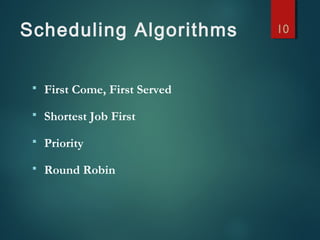
Scheduling Algorithms
 First Come, First Served
 Shortest Job First
 Priority
 Round Robin
10
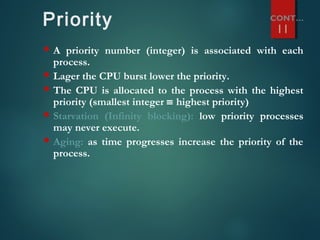
 A priority number (integer) is associated with each
process.
 Lager the CPU burst lower the priority.
 The CPU is allocated to the process with the highest
priority (smallest integer ≡ highest priority)
 Starvation (Infinity blocking): low priority processes
may never execute.
 Aging: as time progresses increase the priority of the
process.
Priority 11
CONT…
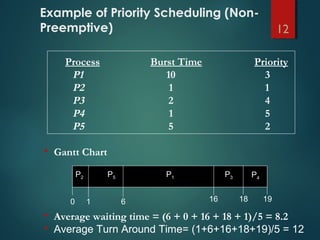
Example of Priority Scheduling (Non-
Preemptive) 12
Process Burst Time Priority
P1 10 3
P2 1 1
P3 2 4
P4 1 5
P5 5 2
 Gantt Chart
 Average waiting time = (6 + 0 + 16 + 18 + 1)/5 = 8.2
 Average Turn Around Time= (1+6+16+18+19)/5 = 12
P2 P1P5
61 160
P3
18
P4
19
Example of Priority Scheduling
(Preemptive)
Process Arrival Time Burst Time Priority
P1 0 5 2
P2 4 8 1
P3 6 2 4 p4
8 6 3
Average WT: ([(0-0)+(12-4)]+(4-4)+(19-6)+(13-8))/4
= (8+0+13+5)/4 = 6.5
Average TAT: ((5+8)+(8+0)+(2+13)+(6+5))/4
= (13+8+15+11)/4 = 47/4 = 11.75
P1
P4P2
4 190 13
P3
2112
P1
Advantages of Priority
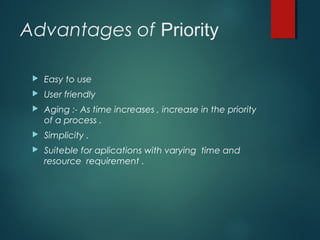
 Easy to use
 User friendly
 Aging :- As time increases , increase in the priority
of a process .
 Simplicity .
 Suiteble for aplications with varying time and
resource requirement .
Disadvantages of Priority
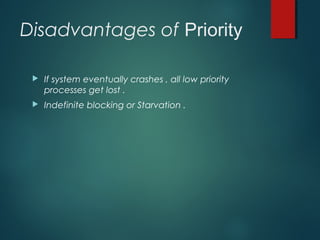
 If system eventually crashes , all low priority
processes get lost .
 Indefinite blocking or Starvation .
Preemptive vs nonpreemptive
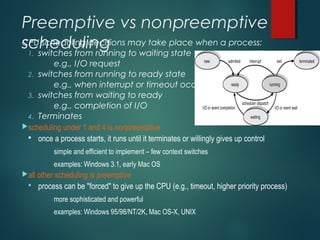
schedulingCPU scheduling decisions may take place when a process:
1. switches from running to waiting state
e.g., I/O request
2. switches from running to ready state
e.g., when interrupt or timeout occurs
3. switches from waiting to ready
e.g., completion of I/O
4. Terminates
scheduling under 1 and 4 is nonpreemptive
 once a process starts, it runs until it terminates or willingly gives up control
simple and efficient to implement – few context switches
examples: Windows 3.1, early Mac OS
all other scheduling is preemptive
 process can be "forced" to give up the CPU (e.g., timeout, higher priority process)
more sophisticated and powerful
examples: Windows 95/98/NT/2K, Mac OS-X, UNIX
 Preemptive vs Non-Preemptive Scheduling
 Scheduling is non-preemptive if once the CPU has been allocated
to a process, the process can keep the CPU until it releases it,
either by terminating or switching to the waiting state.
 Scheduling is preemptive if the CPU can be taken away from a
process during execution.
Priority scheduling
each process is assigned a numeric priority
 CPU is allocated to the process with the highest priority
 priorities can be external (set by user/admin) or internal
 (based on resources/history)
 SJF is priority scheduling where priority is the predicted
 next CPU burst time
priority scheduling may be preemptive or nonpreemptive
 priority scheduling is not fair
 starvation is possible – low priority processes may never execute
 can be made fair using aging – as time progresses, increase the
priority
 Aging is a technique of gradually increasing the priority of
processes that wait in the system for a long time
Priority scheduling algorithms

Priority scheduling algorithms

  • 1.
  • 2.
  • 3.
    Submitted by- Name ID AsikulIslam 143-15- Kanchon Kumar 143-15- Saiful Islam 143-15- Sonot Kumar 143-15- Sohel Al Mamun 143-15- Tuhinur Rahman 143-15- Muine al Yamine Submitted to- Dept. Of CSE
  • 4.
    Overview 4  BasicConcepts  Scheduling Criteria  Scheduling Algorithms  Example of Priority Scheduling  Advantages & Disadvantages
  • 5.
    Basic Concepts  Mainobjective of multiprogramming is to keep on running processes all the time for maximum CPU utilization.  Scheduling is fundamental function of OS.  The task of selecting the processes in memory that are ready to execute, and allocating them to the CPU is performed by the CPU Scheduler. 5
  • 6.
    CPU Scheduler  CPUscheduling decisions may take place when a process: o 1. Switches from running to waiting state o 2. Switches from running to ready state o 3. Switches from waiting to ready o 4. Terminates  Scheduling under 1 and 4 is non preemptive.  All other scheduling is preemptive. 6
  • 7.
    CPU Scheduler  Nonpreemptive Oncea process is allocated the CPU, it does not leave unless: o it has to wait, e.g., for I/O request  o it terminates    Preemptive o OS can force (preempt) a process from CPU at anytime o E.g., to allocate CPU to another higher-priority process  7 CONT…
  • 8.
    Scheduling Criteria  CPUutilization: keep the CPU as busy as possible ◦ Maximize  Throughput: No of processes that complete their execution per time unit ◦ Maximize  Turnaround time: amount of time to execute a particular process (time from submission to termination) ◦ Minimize 8
  • 9.
    Scheduling Criteria 9 CONT… Waiting time: amount of time a process has been waiting in the ready queue (sum of time waiting in ready queue) o Minimize  Response time – amount of time it takes from when a request was submitted until the first response is produced, not output  (for time-sharing environment) o Minimize
  • 10.
    Scheduling Algorithms  FirstCome, First Served  Shortest Job First  Priority  Round Robin 10
  • 11.
     A prioritynumber (integer) is associated with each process.  Lager the CPU burst lower the priority.  The CPU is allocated to the process with the highest priority (smallest integer ≡ highest priority)  Starvation (Infinity blocking): low priority processes may never execute.  Aging: as time progresses increase the priority of the process. Priority 11 CONT…
  • 12.
    Example of PriorityScheduling (Non- Preemptive) 12 Process Burst Time Priority P1 10 3 P2 1 1 P3 2 4 P4 1 5 P5 5 2  Gantt Chart  Average waiting time = (6 + 0 + 16 + 18 + 1)/5 = 8.2  Average Turn Around Time= (1+6+16+18+19)/5 = 12 P2 P1P5 61 160 P3 18 P4 19
  • 13.
    Example of PriorityScheduling (Preemptive) Process Arrival Time Burst Time Priority P1 0 5 2 P2 4 8 1 P3 6 2 4 p4 8 6 3 Average WT: ([(0-0)+(12-4)]+(4-4)+(19-6)+(13-8))/4 = (8+0+13+5)/4 = 6.5 Average TAT: ((5+8)+(8+0)+(2+13)+(6+5))/4 = (13+8+15+11)/4 = 47/4 = 11.75 P1 P4P2 4 190 13 P3 2112 P1
  • 14.
    Advantages of Priority Easy to use  User friendly  Aging :- As time increases , increase in the priority of a process .  Simplicity .  Suiteble for aplications with varying time and resource requirement .
  • 15.
    Disadvantages of Priority If system eventually crashes , all low priority processes get lost .  Indefinite blocking or Starvation .
  • 16.
    Preemptive vs nonpreemptive schedulingCPUscheduling decisions may take place when a process: 1. switches from running to waiting state e.g., I/O request 2. switches from running to ready state e.g., when interrupt or timeout occurs 3. switches from waiting to ready e.g., completion of I/O 4. Terminates scheduling under 1 and 4 is nonpreemptive  once a process starts, it runs until it terminates or willingly gives up control simple and efficient to implement – few context switches examples: Windows 3.1, early Mac OS all other scheduling is preemptive  process can be "forced" to give up the CPU (e.g., timeout, higher priority process) more sophisticated and powerful examples: Windows 95/98/NT/2K, Mac OS-X, UNIX
  • 17.
     Preemptive vsNon-Preemptive Scheduling  Scheduling is non-preemptive if once the CPU has been allocated to a process, the process can keep the CPU until it releases it, either by terminating or switching to the waiting state.  Scheduling is preemptive if the CPU can be taken away from a process during execution.
  • 18.
    Priority scheduling each processis assigned a numeric priority  CPU is allocated to the process with the highest priority  priorities can be external (set by user/admin) or internal  (based on resources/history)  SJF is priority scheduling where priority is the predicted  next CPU burst time priority scheduling may be preemptive or nonpreemptive  priority scheduling is not fair  starvation is possible – low priority processes may never execute  can be made fair using aging – as time progresses, increase the priority  Aging is a technique of gradually increasing the priority of processes that wait in the system for a long time

Editor's Notes

  • #13 Aging - Gradually increasing the priority of process that waits in the system for long time.