An Introduction to Cost
  terms and purpose
     Chapter 2
Accounting
 The art of recording, classifying and
 summarizing in a significant manner
 and in terms of money, transactions and
 events which are, in part at least of
 financial character and interpreting the
 results thereof.
Types of Accounting
   Financial Accounting is the process of
    summarizing financial data taken from an
    organization’s accounting records and
    publishing in the form of annual reports for
    the benefit of people outside the
    organization.
Types of Accounting
   Management Accounting is concerned
    with the provisions and use of
    accounting information to managers
    within an organizations, to provide them
    with the basis to make informed
    business decisions.
Cost
   Cost defined as resource sacrificed (used)
    or forgone to achieve a specific objective.

 A cost Object
 Actual cost
 Budgeted cost
Stages of costs
 Cost Accumulation is the collection of
  cost data in some organized way by
  means of accounting system
 Cost Assignment is a term that
  encompass both
  i. Tracing accumulated costs that have a
  direct relationship to a cost object
  ii. Allocating accumulated costs that have
  an indirect relationship to cost object
Types of Cost an its Behavior


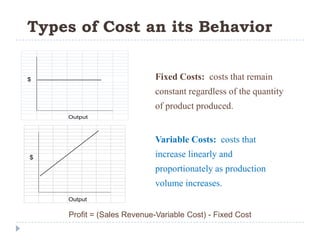
$                           Fixed Costs: costs that remain
                            constant regardless of the quantity
                            of product produced.
    Output


                            Variable Costs: costs that
$                           increase linearly and
                            proportionately as production
                            volume increases.
    Output

    Profit = (Sales Revenue-Variable Cost) - Fixed Cost
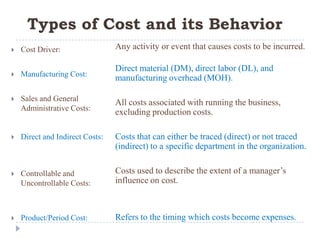
Types of Cost and its Behavior
   Cost Driver:                 Any activity or event that causes costs to be incurred.

                                 Direct material (DM), direct labor (DL), and
   Manufacturing Cost:
                                 manufacturing overhead (MOH).

   Sales and General
                                 All costs associated with running the business,
    Administrative Costs:
                                 excluding production costs.

   Direct and Indirect Costs:   Costs that can either be traced (direct) or not traced
                                 (indirect) to a specific department in the organization.


   Controllable and             Costs used to describe the extent of a manager’s
    Uncontrollable Costs:        influence on cost.


   Product/Period Cost:         Refers to the timing which costs become expenses.
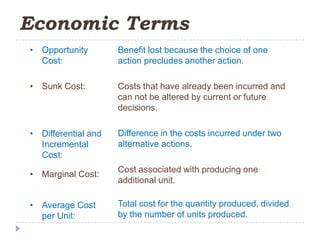
Economic Terms
• Opportunity        Benefit lost because the choice of one
  Cost:              action precludes another action.

• Sunk Cost:         Costs that have already been incurred and
                     can not be altered by current or future
                     decisions.

• Differential and   Difference in the costs incurred under two
  Incremental        alternative actions.
  Cost:
                     Cost associated with producing one
• Marginal Cost:
                     additional unit.

• Average Cost       Total cost for the quantity produced, divided
  per Unit:          by the number of units produced.
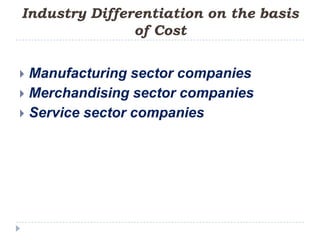
Industry Differentiation on the basis
               of Cost


 Manufacturing sector companies
 Merchandising sector companies
 Service sector companies
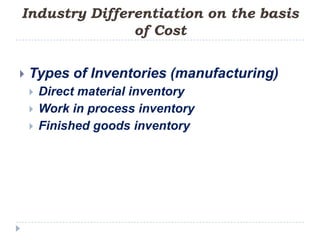
Industry Differentiation on the basis
               of Cost


   Types of Inventories (manufacturing)
       Direct material inventory
       Work in process inventory
       Finished goods inventory
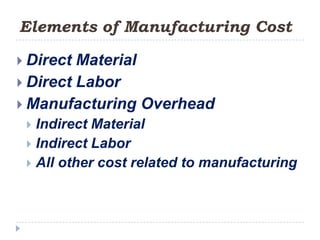
Elements of Manufacturing Cost

 Direct Material
 Direct Labor
 Manufacturing Overhead
  Indirect Material
  Indirect Labor
  All other cost related to manufacturing
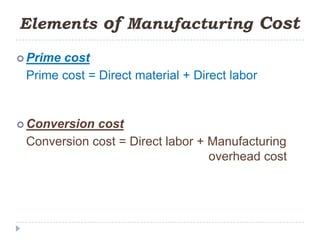
Elements of Manufacturing Cost

 Primecost
 Prime cost = Direct material + Direct labor


 Conversion cost
 Conversion cost = Direct labor + Manufacturing
                                  overhead cost
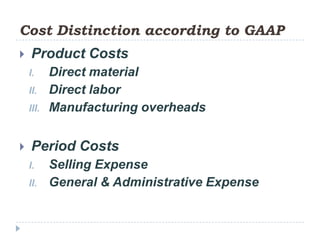
Cost Distinction according to GAAP
   Product Costs
    I.     Direct material
    II.    Direct labor
    III.   Manufacturing overheads


   Period Costs
    I.     Selling Expense
    II.    General & Administrative Expense
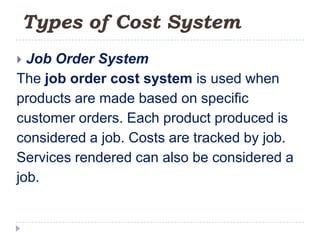
Types of Cost System
 Job Order System
The job order cost system is used when
products are made based on specific
customer orders. Each product produced is
considered a job. Costs are tracked by job.
Services rendered can also be considered a
job.
Types of Cost System

   Process Cost System
Process costing is used when products are
manufactured under conditions of
continuous processing or under mass
production methods. In fact, process costing
procedures are often termed "continuous
or mass production cost accounting
procedures".
CALCULATING COST OF GOODS
MANUFACTURED

 Step1: Calculation of direct material
  cost
 Step 2: Total manufacturing costs
 Step 3: Cost of goods manufactured
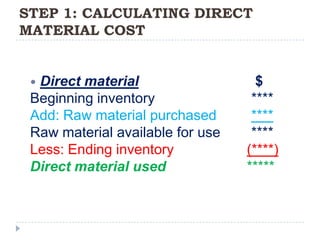
STEP 1: CALCULATING DIRECT
MATERIAL COST


 Direct material                   $
 Beginning inventory               ****
 Add: Raw material purchased       ****
 Raw material available for use    ****
 Less: Ending inventory           (****)
 Direct material used             *****
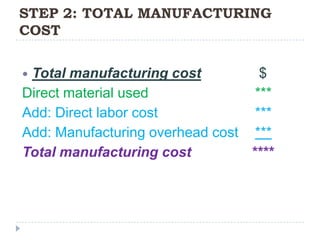
STEP 2: TOTAL MANUFACTURING
COST


Total manufacturing cost          $
Direct material used              ***
Add: Direct labor cost            ***
Add: Manufacturing overhead cost ***
Total manufacturing cost         ****
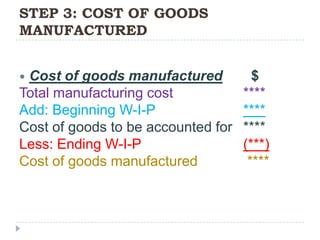
STEP 3: COST OF GOODS
MANUFACTURED


Cost of goods manufactured           $
Total manufacturing cost            ****
Add: Beginning W-I-P                ****
Cost of goods to be accounted for   ****
Less: Ending W-I-P                  (***)
Cost of goods manufactured           ****
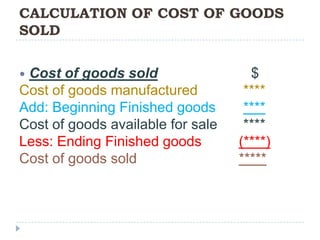
CALCULATION OF COST OF GOODS
SOLD


Cost of goods sold                  $
Cost of goods manufactured          ****
Add: Beginning Finished goods       ****
Cost of goods available for sale    ****
Less: Ending Finished goods        (****)
Cost of goods sold                 *****
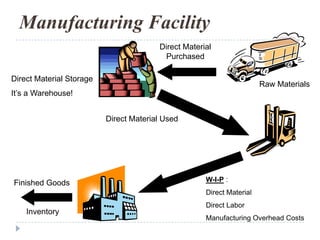
Manufacturing Facility
                                        Direct Material
                                          Purchased

Direct Material Storage
                                                                       Raw Materials
It’s a Warehouse!


                          Direct Material Used


Finished Goods                                       W-I-P :
                                                     Direct Material
                                                     Direct Labor
    Inventory
                                                     Manufacturing Overhead Costs

An introduction to cost terms and purpose

  • 1.
    An Introduction toCost terms and purpose Chapter 2
  • 2.
    Accounting The artof recording, classifying and summarizing in a significant manner and in terms of money, transactions and events which are, in part at least of financial character and interpreting the results thereof.
  • 3.
    Types of Accounting  Financial Accounting is the process of summarizing financial data taken from an organization’s accounting records and publishing in the form of annual reports for the benefit of people outside the organization.
  • 4.
    Types of Accounting  Management Accounting is concerned with the provisions and use of accounting information to managers within an organizations, to provide them with the basis to make informed business decisions.
  • 5.
    Cost  Cost defined as resource sacrificed (used) or forgone to achieve a specific objective.  A cost Object  Actual cost  Budgeted cost
  • 6.
    Stages of costs Cost Accumulation is the collection of cost data in some organized way by means of accounting system  Cost Assignment is a term that encompass both i. Tracing accumulated costs that have a direct relationship to a cost object ii. Allocating accumulated costs that have an indirect relationship to cost object
  • 7.
    Types of Costan its Behavior $ Fixed Costs: costs that remain constant regardless of the quantity of product produced. Output Variable Costs: costs that $ increase linearly and proportionately as production volume increases. Output Profit = (Sales Revenue-Variable Cost) - Fixed Cost
  • 8.
    Types of Costand its Behavior  Cost Driver: Any activity or event that causes costs to be incurred. Direct material (DM), direct labor (DL), and  Manufacturing Cost: manufacturing overhead (MOH).  Sales and General All costs associated with running the business, Administrative Costs: excluding production costs.  Direct and Indirect Costs: Costs that can either be traced (direct) or not traced (indirect) to a specific department in the organization.  Controllable and Costs used to describe the extent of a manager’s Uncontrollable Costs: influence on cost.  Product/Period Cost: Refers to the timing which costs become expenses.
  • 9.
    Economic Terms • Opportunity Benefit lost because the choice of one Cost: action precludes another action. • Sunk Cost: Costs that have already been incurred and can not be altered by current or future decisions. • Differential and Difference in the costs incurred under two Incremental alternative actions. Cost: Cost associated with producing one • Marginal Cost: additional unit. • Average Cost Total cost for the quantity produced, divided per Unit: by the number of units produced.
  • 10.
    Industry Differentiation onthe basis of Cost  Manufacturing sector companies  Merchandising sector companies  Service sector companies
  • 11.
    Industry Differentiation onthe basis of Cost  Types of Inventories (manufacturing)  Direct material inventory  Work in process inventory  Finished goods inventory
  • 12.
    Elements of ManufacturingCost  Direct Material  Direct Labor  Manufacturing Overhead  Indirect Material  Indirect Labor  All other cost related to manufacturing
  • 13.
    Elements of ManufacturingCost  Primecost Prime cost = Direct material + Direct labor  Conversion cost Conversion cost = Direct labor + Manufacturing overhead cost
  • 14.
    Cost Distinction accordingto GAAP  Product Costs I. Direct material II. Direct labor III. Manufacturing overheads  Period Costs I. Selling Expense II. General & Administrative Expense
  • 15.
    Types of CostSystem  Job Order System The job order cost system is used when products are made based on specific customer orders. Each product produced is considered a job. Costs are tracked by job. Services rendered can also be considered a job.
  • 16.
    Types of CostSystem  Process Cost System Process costing is used when products are manufactured under conditions of continuous processing or under mass production methods. In fact, process costing procedures are often termed "continuous or mass production cost accounting procedures".
  • 17.
    CALCULATING COST OFGOODS MANUFACTURED  Step1: Calculation of direct material cost  Step 2: Total manufacturing costs  Step 3: Cost of goods manufactured
  • 18.
    STEP 1: CALCULATINGDIRECT MATERIAL COST Direct material $ Beginning inventory **** Add: Raw material purchased **** Raw material available for use **** Less: Ending inventory (****) Direct material used *****
  • 19.
    STEP 2: TOTALMANUFACTURING COST Total manufacturing cost $ Direct material used *** Add: Direct labor cost *** Add: Manufacturing overhead cost *** Total manufacturing cost ****
  • 20.
    STEP 3: COSTOF GOODS MANUFACTURED Cost of goods manufactured $ Total manufacturing cost **** Add: Beginning W-I-P **** Cost of goods to be accounted for **** Less: Ending W-I-P (***) Cost of goods manufactured ****
  • 21.
    CALCULATION OF COSTOF GOODS SOLD Cost of goods sold $ Cost of goods manufactured **** Add: Beginning Finished goods **** Cost of goods available for sale **** Less: Ending Finished goods (****) Cost of goods sold *****
  • 22.
    Manufacturing Facility Direct Material Purchased Direct Material Storage Raw Materials It’s a Warehouse! Direct Material Used Finished Goods W-I-P : Direct Material Direct Labor Inventory Manufacturing Overhead Costs