1
Cost Accounting
2
Definition
Chartered Institute Of Management
Accountants ( CIMA London )
“Costing is the technique and process of
ascertaining cost”
3
Cost Accounting
• Cost accounting measures and reports information
relating to the cost of acquiring and utilizing resources
• Cost accounting provides information for management
and financial accounting
• Cost management describes the approaches and
activities of managers in short-run and long-run
planning and control decisions
• These decisions increase value of customers and lower
costs of products and services
• Cost management is an integral part of a company’s
strategy
4
Cost Accounting
It provides information for both management
accounting and financial accounting.
It measures and reports from financial
and non financial data.
5
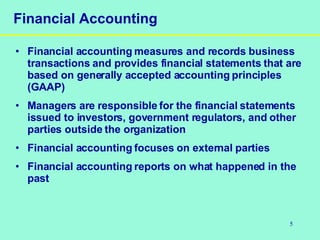
Financial Accounting
• Financial accounting measures and records business
transactions and provides financial statements that are
based on generally accepted accounting principles
(GAAP)
• Managers are responsible for the financial statements
issued to investors, government regulators, and other
parties outside the organization
• Financial accounting focuses on external parties
• Financial accounting reports on what happened in the
past
6
An Introduction to Cost Terms
7
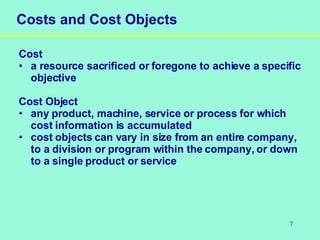
Costs and Cost Objects
Cost
• a resource sacrificed or foregone to achieve a specific
objective
Cost Object
• any product, machine, service or process for which
cost information is accumulated
• cost objects can vary in size from an entire company,
to a division or program within the company, or down
to a single product or service
8
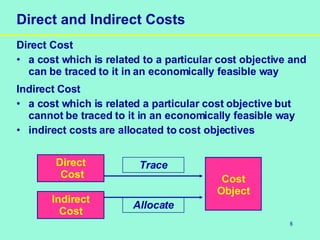
Direct and Indirect Costs
Direct Cost
• a cost which is related to a particular cost objective and
can be traced to it in an economically feasible way
Indirect Cost
• a cost which is related a particular cost objective but
cannot be traced to it in an economically feasible way
• indirect costs are allocated to cost objectives
Direct
Cost
Indirect
Cost
Cost
Object
Trace
Allocate
9
Cost Drivers and Cost Management
Cost driver (cost generator or cost determinant)
• a factor which causes the amount of cost incurred to
change
• production costs are driven by the number of products
produced, labour costs, number of setups required,
and the number of change orders
Cost Reduction Programs focus on two things:
2. Doing only value-added activities
3. Efficiently manage the use of cost drivers in those
value-added activities
10
Variable and Fixed Costs
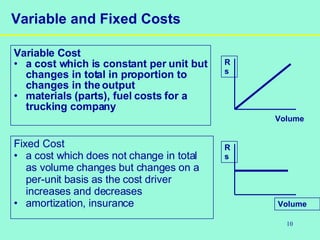
Variable Cost
• a cost which is constant per unit but
changes in total in proportion to
changes in the output
• materials (parts), fuel costs for a
trucking company
R
s
Volume
R
s
Volume
Fixed Cost
• a cost which does not change in total
as volume changes but changes on a
per-unit basis as the cost driver
increases and decreases
• amortization, insurance
11
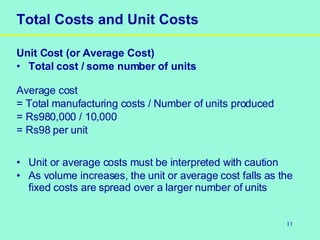
Total Costs and Unit Costs
Unit Cost (or Average Cost)
• Total cost / some number of units
Average cost
= Total manufacturing costs / Number of units produced
= Rs980,000 / 10,000
= Rs98 per unit
• Unit or average costs must be interpreted with caution
• As volume increases, the unit or average cost falls as the
fixed costs are spread over a larger number of units
12
Types of Inventory
• Direct material inventory (stock awaiting use in the
manufacturing process)
• Work-in process inventory (partially completed goods on
the shop floor)
• Finished goods inventory (goods completed but not yet
sold)
13
Period and Product Costs
Period Costs
• are expensed on the income statement as they are
incurred
• also called operating costs (excluding cost of goods
sold)
• examples: selling, general and administrative costs
Product Costs
• are inventoried on the balance sheet and expensed
only when the product or service is sold
• also called inventoriable costs
• Examples: materials and labour (manufacturing)
14
Costing System Terminology
Cost Object
• anything for which a separate measurement of costs
is desired
Cost Pool
• a grouping of individual cost items
Cost Allocation Base
• a factor that is the common denominator for
systematically linking an indirect cost or group of
indirect costs to a cost object
15
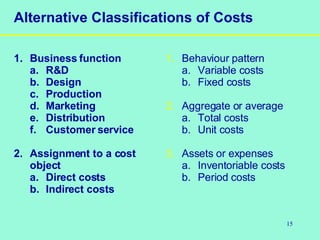
Alternative Classifications of Costs
1. Business function
a. R&D
b. Design
c. Production
d. Marketing
e. Distribution
f. Customer service
2. Assignment to a cost
object
a. Direct costs
b. Indirect costs
1. Behaviour pattern
a. Variable costs
b. Fixed costs
2. Aggregate or average
a. Total costs
b. Unit costs
3. Assets or expenses
a. Inventoriable costs
b. Period costs
16
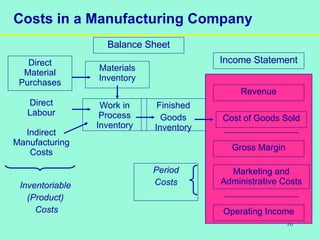
Costs in a Manufacturing Company
Inventoriable
(Product)
Costs
Direct
Material
Purchases
Work in
Process
Inventory
Cost of Goods Sold
Revenue
Gross Margin
Marketing and
Administrative Costs
Operating Income
Period
Costs
Income Statement
Balance Sheet
Materials
Inventory
Direct
Labour
Indirect
Manufacturing
Costs
Finished
Goods
Inventory
17
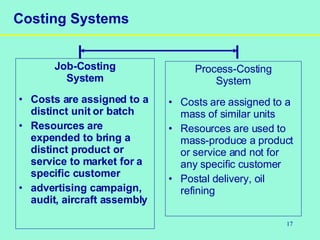
Costing Systems
Job-Costing
System
• Costs are assigned to a
distinct unit or batch
• Resources are
expended to bring a
distinct product or
service to market for a
specific customer
• advertising campaign,
audit, aircraft assembly
Process-Costing
System
• Costs are assigned to a
mass of similar units
• Resources are used to
mass-produce a product
or service and not for
any specific customer
• Postal delivery, oil
refining
18
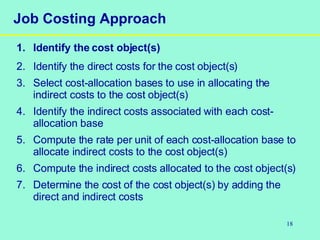
Job Costing Approach
1. Identify the cost object(s)
2. Identify the direct costs for the cost object(s)
3. Select cost-allocation bases to use in allocating the
indirect costs to the cost object(s)
4. Identify the indirect costs associated with each cost-
allocation base
5. Compute the rate per unit of each cost-allocation base to
allocate indirect costs to the cost object(s)
6. Compute the indirect costs allocated to the cost object(s)
7. Determine the cost of the cost object(s) by adding the
direct and indirect costs
19
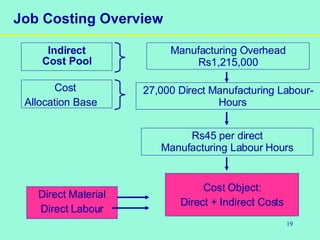
Job Costing Overview
Indirect
Cost Pool
Manufacturing Overhead
Rs1,215,000
Rs45 per direct
Manufacturing Labour Hours
Cost Object:
Direct + Indirect Costs
Direct Material
Direct Labour
Cost
Allocation Base
27,000 Direct Manufacturing Labour-
Hours
20
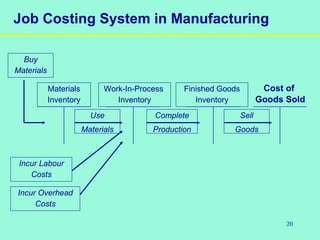
Job Costing System in Manufacturing
Cost of
Goods Sold
Finished Goods
Inventory
Work-In-Process
Inventory
Materials
Inventory
Buy
Materials
Use
Materials
Incur Labour
Costs
Incur Overhead
Costs
Complete
Production
Sell
Goods
21
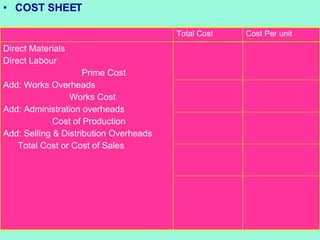
Cost Sheet
22
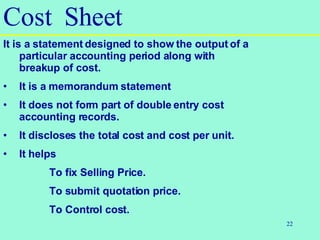
Cost Sheet
It is a statement designed to show the output of a
particular accounting period along with
breakup of cost.
• It is a memorandum statement
• It does not form part of double entry cost
accounting records.
• It discloses the total cost and cost per unit.
• It helps
To fix Selling Price.
To submit quotation price.
To Control cost.
23
• COST SHEET
Direct Materials
Direct Labour
Prime Cost
Add: Works Overheads
Works Cost
Add: Administration overheads
Cost of Production
Add: Selling & Distribution Overheads
Total Cost or Cost of Sales
Cost Per unitTotal Cost
24
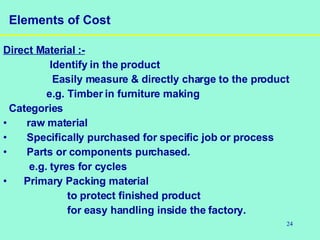
Elements of Cost
Direct Material :-
Identify in the product
Easily measure & directly charge to the product
e.g. Timber in furniture making
Categories
• raw material
• Specifically purchased for specific job or process
• Parts or components purchased.
e.g. tyres for cycles
• Primary Packing material
to protect finished product
for easy handling inside the factory.
25
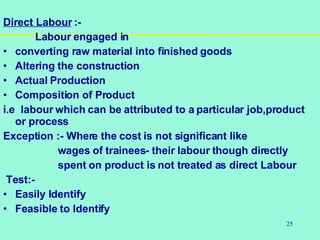
Direct Labour :-
Labour engaged in
• converting raw material into finished goods
• Altering the construction
• Actual Production
• Composition of Product
i.e labour which can be attributed to a particular job,product
or process
Exception :- Where the cost is not significant like
wages of trainees- their labour though directly
spent on product is not treated as direct Labour
Test:-
• Easily Identify
• Feasible to Identify
26
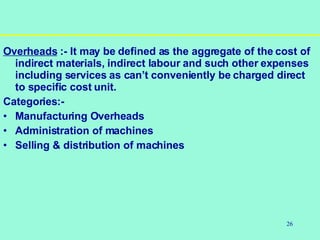
Overheads :- It may be defined as the aggregate of the cost of
indirect materials, indirect labour and such other expenses
including services as can’t conveniently be charged direct
to specific cost unit.
Categories:-
• Manufacturing Overheads
• Administration of machines
• Selling & distribution of machines
27
Standard Costing
28
Why is Standard Costing Used?
AA standardstandard is a preestablishedis a preestablished
benchmark for desirable performance.benchmark for desirable performance.
AA standard cost systemstandard cost system is one in which ais one in which a
company sets cost standards and thencompany sets cost standards and then
uses them to evaluate actual performance.uses them to evaluate actual performance.
AA variancevariance is the difference betweenis the difference between
actual performance and the standard.actual performance and the standard.
29
Favorable versus Unfavorable
AnAn unfavorableunfavorable variance occurs when actualvariance occurs when actual
performance falls below the standard.performance falls below the standard.
AA standardstandard is a preestablishedis a preestablished
benchmark for desirable performance.benchmark for desirable performance.
30
.. Standard cost is the Predetermined cost
based on a technical estimate for material, labor and
overhead for a selected period of time
and for a specified set of working conditions.
•Standard costing is the preparation of standard cost and
applying them to measure the variations from actual
costs and analyzing the causes of variations with a view
to maintain maximum efficiency in production
31
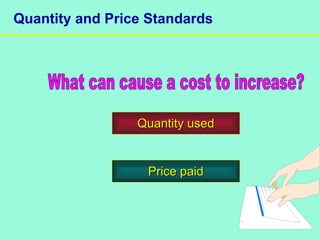
Quantity and Price Standards
Quantity usedQuantity used
Price paidPrice paid
32
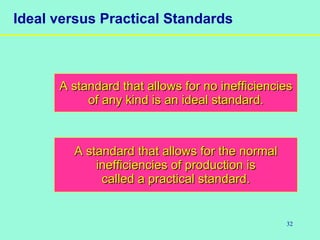
Ideal versus Practical Standards
A standard that allows for the normalA standard that allows for the normal
inefficiencies of production isinefficiencies of production is
called a practical standard.called a practical standard.
A standard that allows for no inefficienciesA standard that allows for no inefficiencies
of any kind is an ideal standard.of any kind is an ideal standard.
33
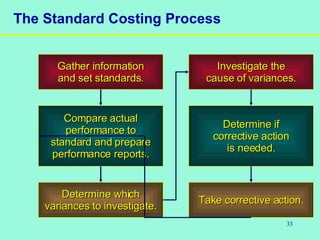
The Standard Costing Process
Gather informationGather information
and set standards.and set standards.
Compare actualCompare actual
performance toperformance to
standard and preparestandard and prepare
performance reports.performance reports.
Determine whichDetermine which
variances to investigate.variances to investigate.
Investigate theInvestigate the
cause of variances.cause of variances.
Take corrective action.Take corrective action.
Determine ifDetermine if
corrective actioncorrective action
is needed.is needed.
34
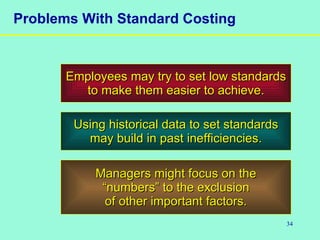
Problems With Standard Costing
Employees may try to set low standardsEmployees may try to set low standards
to make them easier to achieve.to make them easier to achieve.
Using historical data to set standardsUsing historical data to set standards
may build in past inefficiencies.may build in past inefficiencies.
Managers might focus on theManagers might focus on the
““numbers” to the exclusionnumbers” to the exclusion
of other important factors.of other important factors.
35
Problems With Standard Costing
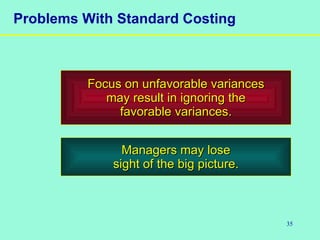
Focus on unfavorable variancesFocus on unfavorable variances
may result in ignoring themay result in ignoring the
favorable variances.favorable variances.
Managers may loseManagers may lose
sight of the big picture.sight of the big picture.
36
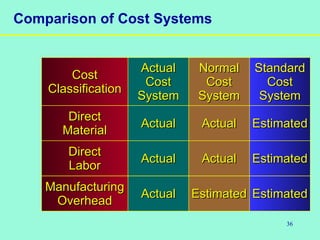
Comparison of Cost Systems
CostCost
ClassificationClassification
ActualActual
CostCost
SystemSystem
NormalNormal
CostCost
SystemSystem
StandardStandard
CostCost
SystemSystem
DirectDirect
MaterialMaterial
DirectDirect
LaborLabor
ManufacturingManufacturing
OverheadOverhead
ActualActual
ActualActual
ActualActual
ActualActual
ActualActual
EstimatedEstimated
EstimatedEstimated
EstimatedEstimated
EstimatedEstimated
37
Analysis of variance
38
Analysis of Variance may be done in
respect of each element of cost and sales:
1.Direct Material Variance
2.Direct Labor Variance
3.Overhead Variance
4.Sales Variance
Analysis of Variance
39
Material Variances
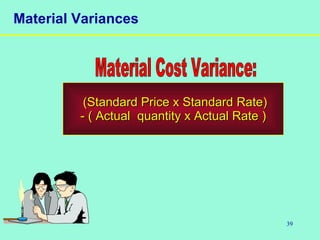
(Standard Price x Standard Rate)(Standard Price x Standard Rate)
- ( Actual quantity x Actual Rate )- ( Actual quantity x Actual Rate )
40
Direct Materials Variances
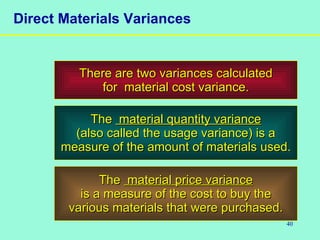
There are two variances calculatedThere are two variances calculated
for material cost variance.for material cost variance.
TheThe material quantity variancematerial quantity variance
(also called the usage variance) is a(also called the usage variance) is a
measure of the amount of materials used.measure of the amount of materials used.
TheThe material price variancematerial price variance
is a measure of the cost to buy theis a measure of the cost to buy the
various materials that were purchased.various materials that were purchased.
41
Material Variances
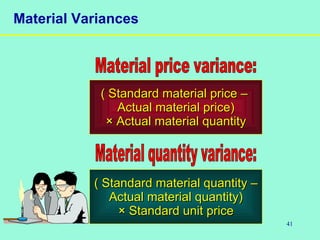
( Standard material price –( Standard material price –
Actual material price)Actual material price)
× Actual material quantity× Actual material quantity
( Standard material quantity –( Standard material quantity –
Actual material quantity)Actual material quantity)
× Standard unit price× Standard unit price
42
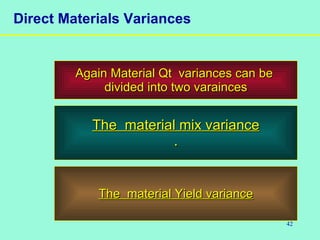
Direct Materials Variances
Again Material Qt variances can beAgain Material Qt variances can be
divided into two varaincesdivided into two varainces
The material mix varianceThe material mix variance
..
The material Yield varianceThe material Yield variance
43
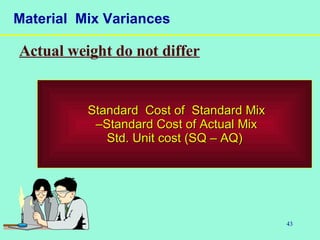
Material Mix Variances
Standard Cost of Standard MixStandard Cost of Standard Mix
––Standard Cost of Actual MixStandard Cost of Actual Mix
Std. Unit cost (SQ – AQ)Std. Unit cost (SQ – AQ)
Actual weight do not differ
44
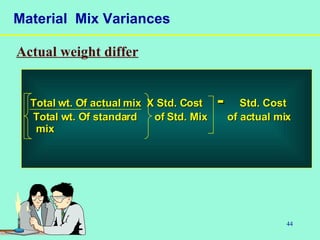
Material Mix Variances
Actual weight differ
Total wt. Of actual mix X Std. CostTotal wt. Of actual mix X Std. Cost -- Std. CostStd. Cost
Total wt. Of standard of Std. Mix of actual mixTotal wt. Of standard of Std. Mix of actual mix
mixmix
45
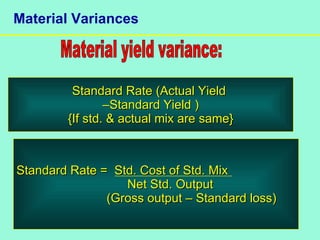
Material Variances
Standard Rate (Actual YieldStandard Rate (Actual Yield
––Standard Yield )Standard Yield )
{If std. & actual mix are same}{If std. & actual mix are same}
Standard Rate = Std. Cost of Std. MixStandard Rate = Std. Cost of Std. Mix
Net Std. OutputNet Std. Output
(Gross output – Standard loss)(Gross output – Standard loss)
46
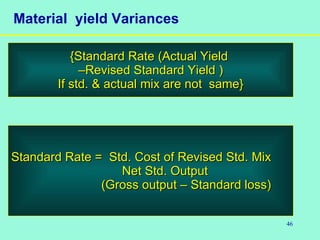
Material yield Variances
{Standard Rate (Actual Yield{Standard Rate (Actual Yield
––Revised Standard Yield )Revised Standard Yield )
If std. & actual mix are not same}If std. & actual mix are not same}
Standard Rate = Std. Cost of Revised Std. MixStandard Rate = Std. Cost of Revised Std. Mix
Net Std. OutputNet Std. Output
(Gross output – Standard loss)(Gross output – Standard loss)
47
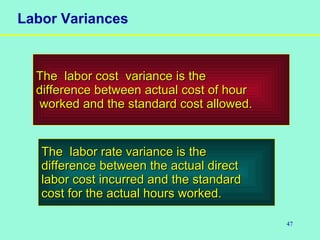
Labor Variances
The labor cost variance is theThe labor cost variance is the
difference between actual cost of hourdifference between actual cost of hour
worked and the standard cost allowed.worked and the standard cost allowed.
The labor rate variance is theThe labor rate variance is the
difference between the actual directdifference between the actual direct
labor cost incurred and the standardlabor cost incurred and the standard
cost for the actual hours worked.cost for the actual hours worked.
48
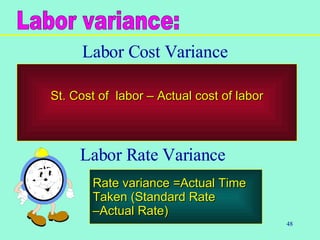
St. Cost of labor – Actual cost of laborSt. Cost of labor – Actual cost of labor
Rate variance =Actual TimeRate variance =Actual Time
Taken (Standard RateTaken (Standard Rate
––Actual Rate)Actual Rate)
Labor Cost Variance
Labor Rate Variance
49
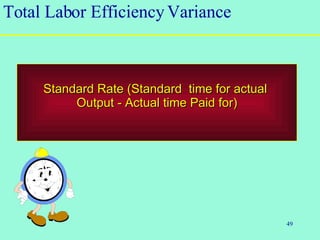
Standard Rate (Standard time for actualStandard Rate (Standard time for actual
Output - Actual time Paid for)Output - Actual time Paid for)
Total Labor EfficiencyVariance
50
Labor Variances
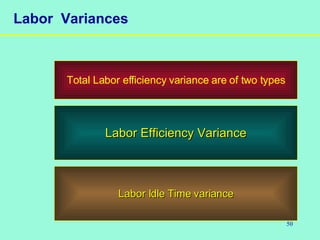
Total Labor efficiency variance are of two types
Labor Efficiency VarianceLabor Efficiency Variance
Labor Idle Time varianceLabor Idle Time variance
51
Labor Variances
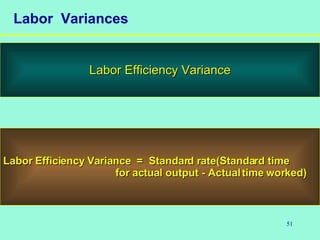
Labor Efficiency VarianceLabor Efficiency Variance
Labor Efficiency Variance = Standard rate(Standard timeLabor Efficiency Variance = Standard rate(Standard time
for actual output - Actualtime worked)for actual output - Actualtime worked)
52
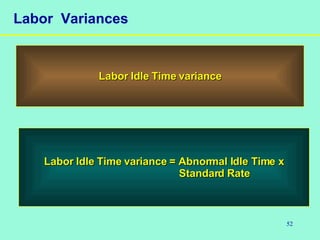
Labor Variances
Labor Idle Time variance = Abnormal Idle Time xLabor Idle Time variance = Abnormal Idle Time x
Standard RateStandard Rate
Labor Idle Time varianceLabor Idle Time variance
53
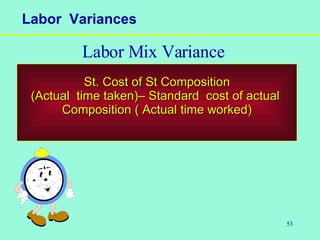
St. Cost of St CompositionSt. Cost of St Composition
(Actual time taken)– Standard cost of actual(Actual time taken)– Standard cost of actual
Composition ( Actual time worked)Composition ( Actual time worked)
Labor Mix Variance
Labor Variances
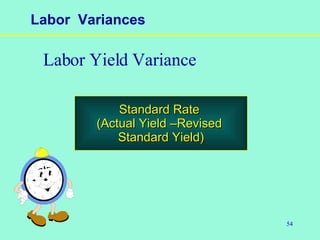
54
Standard RateStandard Rate
(Actual Yield –Revised(Actual Yield –Revised
Standard Yield)Standard Yield)
Labor Yield Variance
Labor Variances
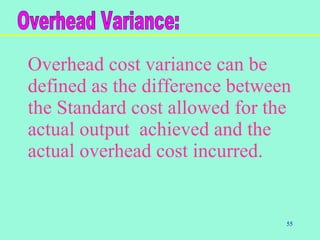
55
Overhead cost variance can be
defined as the difference between
the Standard cost allowed for the
actual output achieved and the
actual overhead cost incurred.
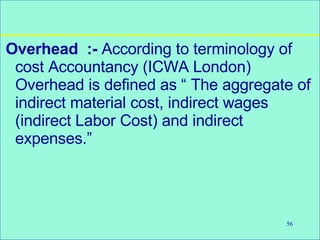
56
Overhead :- According to terminology of
cost Accountancy (ICWA London)
Overhead is defined as “ The aggregate of
indirect material cost, indirect wages
(indirect Labor Cost) and indirect
expenses.”
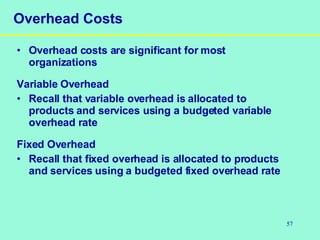
57
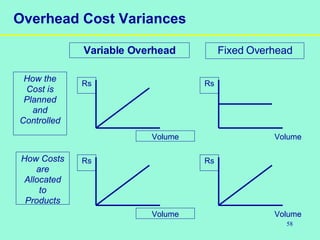
Overhead Costs
• Overhead costs are significant for most
organizations
Variable Overhead
• Recall that variable overhead is allocated to
products and services using a budgeted variable
overhead rate
Fixed Overhead
• Recall that fixed overhead is allocated to products
and services using a budgeted fixed overhead rate
58
Overhead Cost Variances
Variable Overhead Fixed Overhead
How the
Cost is
Planned
and
Controlled
How Costs
are
Allocated
to
Products
Rs
Volume
Rs
Volume
Rs
Volume
Rs
Volume
59
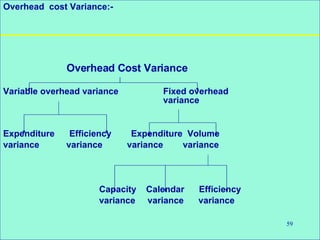
Overhead cost Variance:-
Overhead Cost Variance
Variable overhead variance Fixed overhead
variance
Expenditure Efficiency Expenditure Volume
variance variance variance variance
Capacity Calendar Efficiency
variance variance variance
60
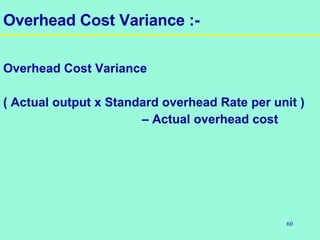
Overhead Cost Variance :-
Overhead Cost Variance
( Actual output x Standard overhead Rate per unit )
– Actual overhead cost
61
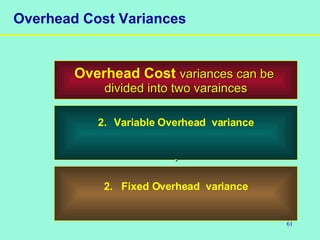
Overhead Cost Variances
Overhead Cost variancesvariances can becan be
divided into two varaincesdivided into two varainces
2. Variable Overhead variance
..
2. Fixed Overhead variance
62
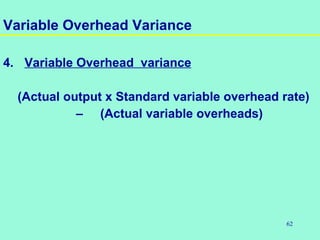
Variable Overhead Variance
4. Variable Overhead variance
(Actual output x Standard variable overhead rate)
– (Actual variable overheads)
63
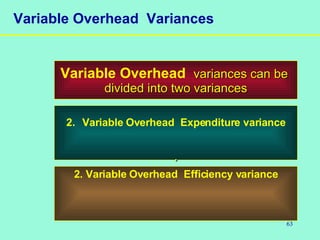
Variable Overhead Variances
Variable Overhead variancesvariances can becan be
divided into two variancesdivided into two variances
2. Variable Overhead Expenditure variance
..
2. Variable Overhead Efficiency variance
64
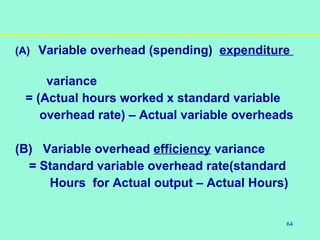
(A) Variable overhead (spending) expenditure
variance
= (Actual hours worked x standard variable
overhead rate) – Actual variable overheads
(B) Variable overhead efficiency variance
= Standard variable overhead rate(standard
Hours for Actual output – Actual Hours)
65
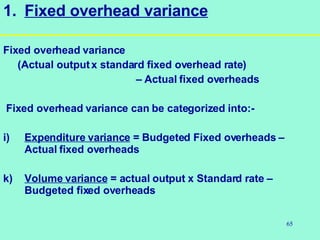
1. Fixed overhead variance
Fixed overhead variance
(Actual outputx standard fixed overhead rate)
– Actual fixed overheads
Fixed overhead variance can be categorized into:-
i) Expenditure variance = Budgeted Fixed overheads –
Actual fixed overheads
k) Volume variance = actual output x Standard rate –
Budgeted fixed overheads
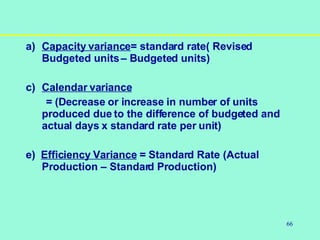
66
a) Capacity variance= standard rate( Revised
Budgeted units– Budgeted units)
c) Calendar variance
= (Decrease or increase in number of units
produced due to the difference of budgeted and
actual days x standard rate per unit)
e) Efficiency Variance = Standard Rate (Actual
Production – Standard Production)
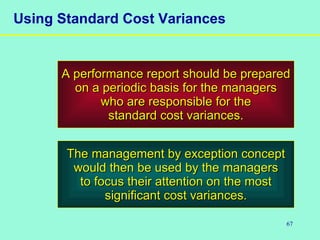
67
Using Standard Cost Variances
A performance report should be preparedA performance report should be prepared
on a periodic basis for the managerson a periodic basis for the managers
who are responsible for thewho are responsible for the
standard cost variances.standard cost variances.
The management by exception conceptThe management by exception concept
would then be used by the managerswould then be used by the managers
to focus their attention on the mostto focus their attention on the most
significant cost variances.significant cost variances.
68
Marginal Costing
69
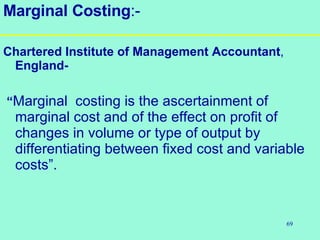
Marginal Costing:-
Chartered Institute of Management Accountant,
England-
“Marginal costing is the ascertainment of
marginal cost and of the effect on profit of
changes in volume or type of output by
differentiating between fixed cost and variable
costs”.
70
Features of Marginal Costing:
Cost is classified into :
Fixed Cost
Variable Cost
•Variable cost is only charged to production
•Fixed cost is recovered from contribution
•Valuation of stock of WIP and F.G. is done on the basis
of marginal cost.
•Selling price is based on marginal cost and contribution
•It is technique used to ascertain the marginal cost & to
know the impact of V.C. on volume of output
•Profit is calculated by deducting marginal cost and fixed
cost from sales
•C-V-P analysis is one of integral part of marginal costing
71
Costs
• Fixed (Indirect/Overheads) – are not influenced by the
quantity produced but can change in the long run e.g.,
insurance costs, administration, rent, some types of
labour costs (salaries), some types of energy costs,
equipment and machinery, buildings, advertising and
promotion costs.
• Variable (Direct) – vary directly with the quantity
produced, e.g., raw material costs, some direct labour
costs, some direct energy costs.
• Semi-fixed – Where costs not directly attributable to
either of the above, for example some types of energy
and labour costs.
72
Costs
• Total Costs (TC) = Fixed Costs (FC)+ Variable Costs
(VC)
• Average Costs = TC/Output (Q)
AC (unit costs) show the amount it costs to produce
one unit of output on average
• Marginal Costs (MC) – the cost of producing one
extra or one fewer units of production
MC = TCn – TCn-1
73
Revenue
• Total Revenue – also known as turnover,
sales revenue or ‘sales’ = Price x
Quantity Sold
• TR = P x Q
• Price – may be a variety of different
prices for different products in the
portfolio
• Quantity – Units sold
74
Profit
Profit = TR – TC
• Normal Profit – the minimum amount
required to keep a business in a
particular line of production
• Abnormal/Supernormal Profit – the amount
over and above the amount needed to
keep a business in its current line of
production
75
Marginal Cost Equation
•Sales = Variable Cost + Fixed Cost + Profit/Loss
•Sales - Variable Cost = Fixed Cost + Profit/Loss
•Sales - Variable Cost = Contribution
Therefore,
Contribution = S.P. – V.C. or
Contribution = Fixed Cost + Profit
76
Cost-Volume-Profit
(CVP) Analysis
77
Cost volume Profit Analysis
Cost volume Profit Analysis is a logical
extension of marginal costing
• C.V.P. analysis examines the relationship
of cost & profit to the volume of business to
maximize profits
• Indicates direct relationship between
volume & profit
• Indicates Indirect relationship between
volume & cost per unit (Inverse)
78
Cost-Volume-Profit Assumptions
and Terminology
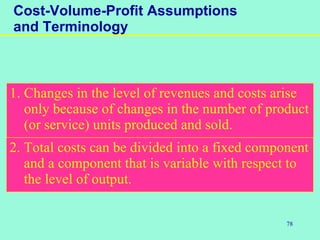
1. Changes in the level of revenues and costs arise
only because of changes in the number of product
(or service) units produced and sold.
2. Total costs can be divided into a fixed component
and a component that is variable with respect to
the level of output.
79
Cost-Volume-Profit Assumptions
and Terminology
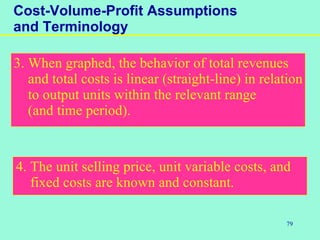
3. When graphed, the behavior of total revenues
and total costs is linear (straight-line) in relation
to output units within the relevant range
(and time period).
4. The unit selling price, unit variable costs, and
fixed costs are known and constant.
80
Abbreviations
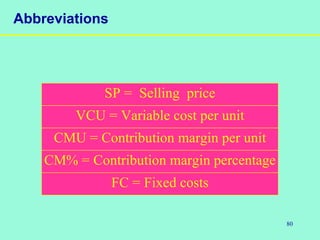
SP = Selling price
VCU = Variable cost per unit
CMU = Contribution margin per unit
CM% = Contribution margin percentage
FC = Fixed costs
81
Abbreviations
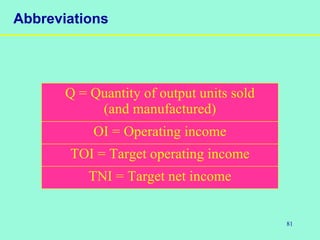
Q = Quantity of output units sold
(and manufactured)
OI = Operating income
TOI = Target operating income
TNI = Target net income
82
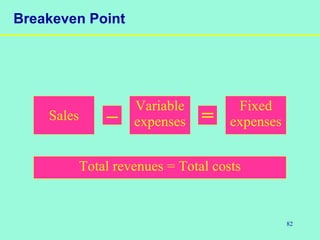
Breakeven Point
Sales
Variable
expenses
Fixed
expenses– =
Total revenues = Total costs
83
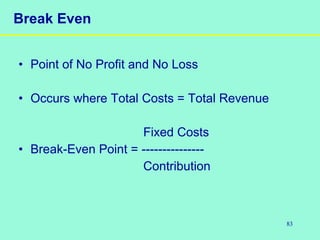
Break Even
• Point of No Profit and No Loss
• Occurs where Total Costs = Total Revenue
Fixed Costs
• Break-Even Point = ---------------
Contribution
84
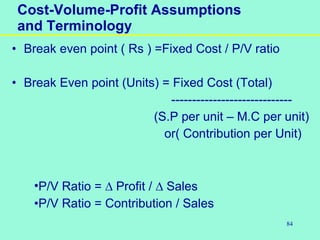
• Break even point ( Rs ) =Fixed Cost / P/V ratio
• Break Even point (Units) = Fixed Cost (Total)
-----------------------------
(S.P per unit – M.C per unit)
or( Contribution per Unit)
Cost-Volume-Profit Assumptions
and Terminology
•P/V Ratio =  Profit /  Sales
•P/V Ratio = Contribution / Sales
85
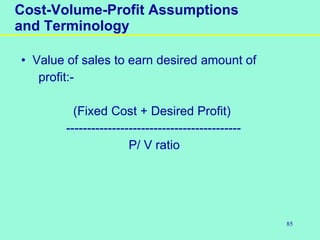
• Value of sales to earn desired amount of
profit:-
(Fixed Cost + Desired Profit)
------------------------------------------
P/ V ratio
Cost-Volume-Profit Assumptions
and Terminology
86
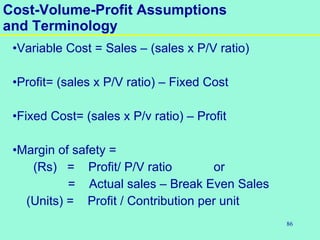
•Variable Cost = Sales – (sales x P/V ratio)
•Profit= (sales x P/V ratio) – Fixed Cost
•Fixed Cost= (sales x P/v ratio) – Profit
•Margin of safety =
(Rs) = Profit/ P/V ratio or
= Actual sales – Break Even Sales
(Units) = Profit / Contribution per unit
Cost-Volume-Profit Assumptions
and Terminology
87
Essentials of Cost-Volume-Profit
(CVP) Analysis Example
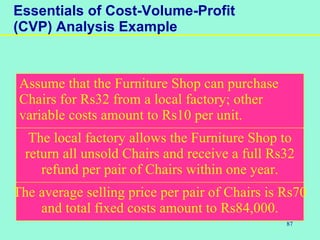
Assume that the Furniture Shop can purchase
Chairs for Rs32 from a local factory; other
variable costs amount to Rs10 per unit.
The local factory allows the Furniture Shop to
return all unsold Chairs and receive a full Rs32
refund per pair of Chairs within one year.
The average selling price per pair of Chairs is Rs70
and total fixed costs amount to Rs84,000.
88
Essentials of Cost-Volume-Profit
(CVP) Analysis Example
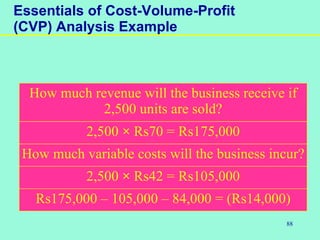
How much revenue will the business receive if
2,500 units are sold?
2,500 × Rs70 = Rs175,000
How much variable costs will the business incur?
2,500 × Rs42 = Rs105,000
Rs175,000 – 105,000 – 84,000 = (Rs14,000)
89
Essentials of Cost-Volume-Profit
(CVP) Analysis Example
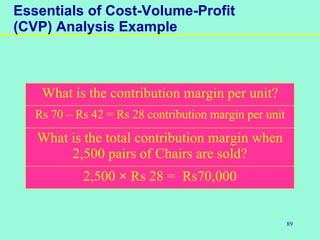
What is the contribution margin per unit?
Rs 70 – Rs 42 = Rs 28 contribution margin per unit
What is the total contribution margin when
2,500 pairs of Chairs are sold?
2,500 × Rs 28 = Rs70,000
90
Essentials of Cost-Volume-Profit
(CVP) Analysis Example
Contribution margin percentage (contribution
margin ratio) is the contribution margin per
unit divided by the selling price.
What is the contribution margin percentage?
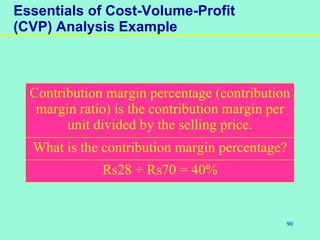
Rs28 ÷ Rs70 = 40%
91
Essentials of Cost-Volume-Profit
(CVP) Analysis Example
If the business sells 3,000 pairs of Chairs,
revenues will be Rs 210,000 and contribution
margin would equal 40% × Rs 210,000
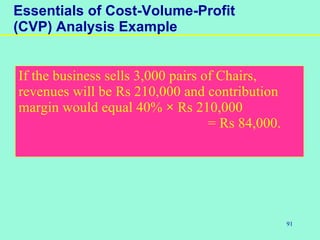
= Rs 84,000.
92
Equation Method
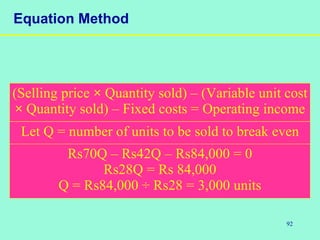
Rs70Q – Rs42Q – Rs84,000 = 0
Rs28Q = Rs 84,000
Q = Rs84,000 ÷ Rs28 = 3,000 units
Let Q = number of units to be sold to break even
(Selling price × Quantity sold) – (Variable unit cost
× Quantity sold) – Fixed costs = Operating income
93
Contribution Margin Method
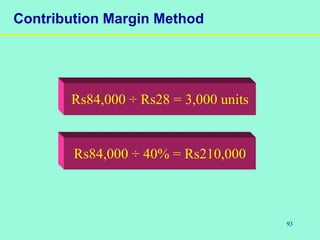
Rs84,000 ÷ Rs28 = 3,000 units
Rs84,000 ÷ 40% = Rs210,000
94
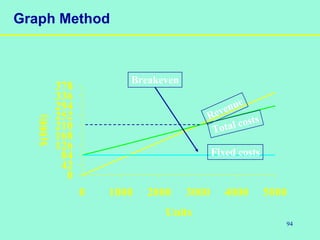
Graph Method
0
42
84
126
168
210
252
294
336
378
0 1000 2000 3000 4000 5000
Units
$(000)
Revenue
Total costs
Breakeven
Fixed costs
95
Target Operating Income
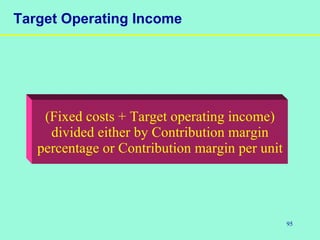
(Fixed costs + Target operating income)
divided either by Contribution margin
percentage or Contribution margin per unit
96
Target Operating Income
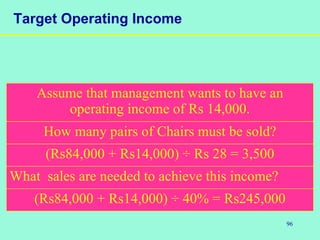
Assume that management wants to have an
operating income of Rs 14,000.
How many pairs of Chairs must be sold?
(Rs84,000 + Rs14,000) ÷ Rs 28 = 3,500
What sales are needed to achieve this income?
(Rs84,000 + Rs14,000) ÷ 40% = Rs245,000
97
Target Net Income
and Income Taxes Example
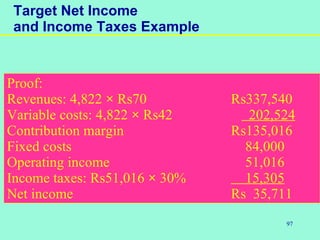
Proof:
Revenues: 4,822 × Rs70 Rs337,540
Variable costs: 4,822 × Rs42 202,524
Contribution margin Rs135,016
Fixed costs 84,000
Operating income 51,016
Income taxes: Rs51,016 × 30% 15,305
Net income Rs 35,711
98
Alternative Fixed/Variable Cost
Structures Example
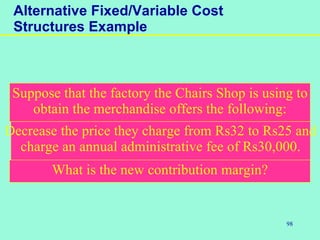
What is the new contribution margin?
Decrease the price they charge from Rs32 to Rs25 and
charge an annual administrative fee of Rs30,000.
Suppose that the factory the Chairs Shop is using to
obtain the merchandise offers the following:
99
Alternative Fixed/Variable Cost Structures
Example
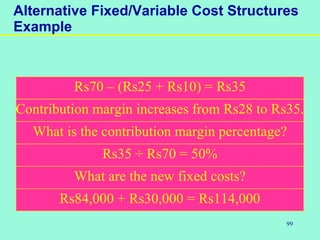
Rs70 – (Rs25 + Rs10) = Rs35
Contribution margin increases from Rs28 to Rs35.
What is the contribution margin percentage?
Rs35 ÷ Rs70 = 50%
What are the new fixed costs?
Rs84,000 + Rs30,000 = Rs114,000
100
Alternative Fixed/Variable Cost Structures
Example
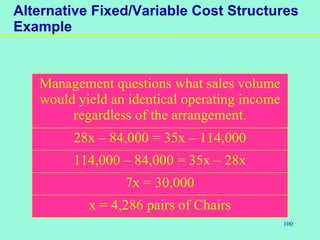
Management questions what sales volume
would yield an identical operating income
regardless of the arrangement.
28x – 84,000 = 35x – 114,000
114,000 – 84,000 = 35x – 28x
7x = 30,000
x = 4,286 pairs of Chairs
101
Alternative Fixed/Variable Cost Structures
Example
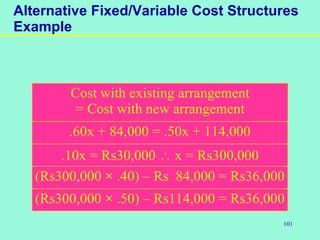
Cost with existing arrangement
= Cost with new arrangement
.60x + 84,000 = .50x + 114,000
.10x = Rs30,000  x = Rs300,000
(Rs300,000 × .40) – Rs 84,000 = Rs36,000
(Rs300,000 × .50) – Rs114,000 = Rs36,000
102
.
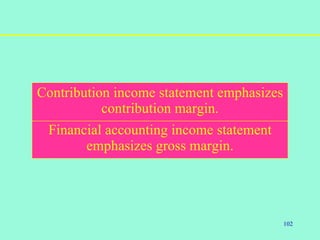
Financial accounting income statement
emphasizes gross margin.
Contribution income statement emphasizes
contribution margin.
103
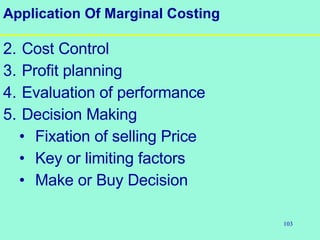
Application Of Marginal Costing
2. Cost Control
3. Profit planning
4. Evaluation of performance
5. Decision Making
• Fixation of selling Price
• Key or limiting factors
• Make or Buy Decision
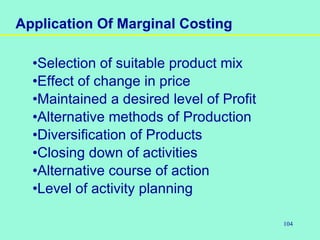
104
•Selection of suitable product mix
•Effect of change in price
•Maintained a desired level of Profit
•Alternative methods of Production
•Diversification of Products
•Closing down of activities
•Alternative course of action
•Level of activity planning
Application Of Marginal Costing
105
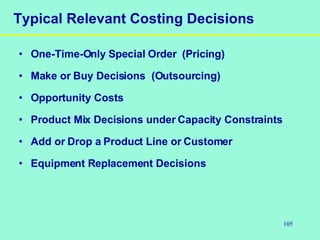
Typical Relevant Costing Decisions
• One-Time-Only Special Order (Pricing)
• Make or Buy Decisions (Outsourcing)
• Opportunity Costs
• Product Mix Decisions under Capacity Constraints
• Add or Drop a Product Line or Customer
• Equipment Replacement Decisions
106
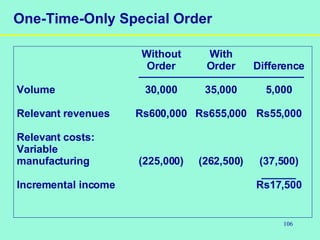
One-Time-Only Special Order
Without With
Order Order Difference
Volume 30,000 35,000 5,000
Relevant revenues Rs600,000 Rs655,000 Rs55,000
Relevant costs:
Variable
manufacturing (225,000) (262,500) (37,500)
Incremental income Rs17,500
107
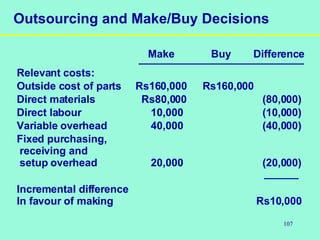
Outsourcing and Make/Buy Decisions
Make Buy Difference
Relevant costs:
Outside cost of parts Rs160,000 Rs160,000
Direct materials Rs80,000 (80,000)
Direct labour 10,000 (10,000)
Variable overhead 40,000 (40,000)
Fixed purchasing,
receiving and
setup overhead 20,000 (20,000)
Incremental difference
In favour of making Rs10,000
108
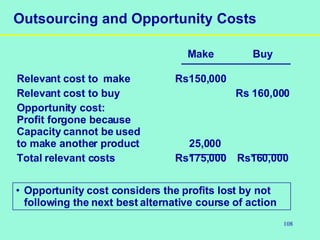
Outsourcing and Opportunity Costs
Make Buy
Relevant cost to make Rs150,000
Relevant cost to buy Rs 160,000
Opportunity cost:
Profit forgone because
Capacity cannot be used
to make another product 25,000
Total relevant costs Rs175,000 Rs160,000
• Opportunity cost considers the profits lost by not
following the next best alternative course of action
109
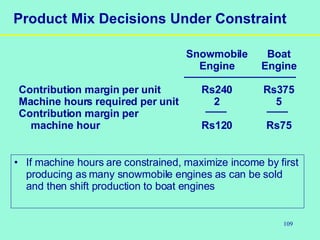
Product Mix Decisions Under Constraint
Snowmobile Boat
Engine Engine
Contribution margin per unit Rs240 Rs375
Machine hours required per unit 2 5
Contribution margin per
machine hour Rs120 Rs75
• If machine hours are constrained, maximize income by first
producing as many snowmobile engines as can be sold
and then shift production to boat engines
110
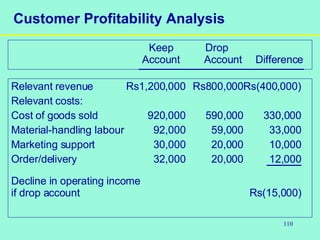
Customer Profitability Analysis
Keep Drop
Account Account Difference
Relevant revenue Rs1,200,000 Rs800,000Rs(400,000)
Relevant costs:
Cost of goods sold 920,000 590,000 330,000
Material-handling labour 92,000 59,000 33,000
Marketing support 30,000 20,000 10,000
Order/delivery 32,000 20,000 12,000
Decline in operating income
if drop account Rs(15,000)

Cost accounting By CA Ankush Gupta

  • 1.
  • 2.
    2 Definition Chartered Institute OfManagement Accountants ( CIMA London ) “Costing is the technique and process of ascertaining cost”
  • 3.
    3 Cost Accounting • Costaccounting measures and reports information relating to the cost of acquiring and utilizing resources • Cost accounting provides information for management and financial accounting • Cost management describes the approaches and activities of managers in short-run and long-run planning and control decisions • These decisions increase value of customers and lower costs of products and services • Cost management is an integral part of a company’s strategy
  • 4.
    4 Cost Accounting It providesinformation for both management accounting and financial accounting. It measures and reports from financial and non financial data.
  • 5.
    5 Financial Accounting • Financialaccounting measures and records business transactions and provides financial statements that are based on generally accepted accounting principles (GAAP) • Managers are responsible for the financial statements issued to investors, government regulators, and other parties outside the organization • Financial accounting focuses on external parties • Financial accounting reports on what happened in the past
  • 6.
  • 7.
    7 Costs and CostObjects Cost • a resource sacrificed or foregone to achieve a specific objective Cost Object • any product, machine, service or process for which cost information is accumulated • cost objects can vary in size from an entire company, to a division or program within the company, or down to a single product or service
  • 8.
    8 Direct and IndirectCosts Direct Cost • a cost which is related to a particular cost objective and can be traced to it in an economically feasible way Indirect Cost • a cost which is related a particular cost objective but cannot be traced to it in an economically feasible way • indirect costs are allocated to cost objectives Direct Cost Indirect Cost Cost Object Trace Allocate
  • 9.
    9 Cost Drivers andCost Management Cost driver (cost generator or cost determinant) • a factor which causes the amount of cost incurred to change • production costs are driven by the number of products produced, labour costs, number of setups required, and the number of change orders Cost Reduction Programs focus on two things: 2. Doing only value-added activities 3. Efficiently manage the use of cost drivers in those value-added activities
  • 10.
    10 Variable and FixedCosts Variable Cost • a cost which is constant per unit but changes in total in proportion to changes in the output • materials (parts), fuel costs for a trucking company R s Volume R s Volume Fixed Cost • a cost which does not change in total as volume changes but changes on a per-unit basis as the cost driver increases and decreases • amortization, insurance
  • 11.
    11 Total Costs andUnit Costs Unit Cost (or Average Cost) • Total cost / some number of units Average cost = Total manufacturing costs / Number of units produced = Rs980,000 / 10,000 = Rs98 per unit • Unit or average costs must be interpreted with caution • As volume increases, the unit or average cost falls as the fixed costs are spread over a larger number of units
  • 12.
    12 Types of Inventory •Direct material inventory (stock awaiting use in the manufacturing process) • Work-in process inventory (partially completed goods on the shop floor) • Finished goods inventory (goods completed but not yet sold)
  • 13.
    13 Period and ProductCosts Period Costs • are expensed on the income statement as they are incurred • also called operating costs (excluding cost of goods sold) • examples: selling, general and administrative costs Product Costs • are inventoried on the balance sheet and expensed only when the product or service is sold • also called inventoriable costs • Examples: materials and labour (manufacturing)
  • 14.
    14 Costing System Terminology CostObject • anything for which a separate measurement of costs is desired Cost Pool • a grouping of individual cost items Cost Allocation Base • a factor that is the common denominator for systematically linking an indirect cost or group of indirect costs to a cost object
  • 15.
    15 Alternative Classifications ofCosts 1. Business function a. R&D b. Design c. Production d. Marketing e. Distribution f. Customer service 2. Assignment to a cost object a. Direct costs b. Indirect costs 1. Behaviour pattern a. Variable costs b. Fixed costs 2. Aggregate or average a. Total costs b. Unit costs 3. Assets or expenses a. Inventoriable costs b. Period costs
  • 16.
    16 Costs in aManufacturing Company Inventoriable (Product) Costs Direct Material Purchases Work in Process Inventory Cost of Goods Sold Revenue Gross Margin Marketing and Administrative Costs Operating Income Period Costs Income Statement Balance Sheet Materials Inventory Direct Labour Indirect Manufacturing Costs Finished Goods Inventory
  • 17.
    17 Costing Systems Job-Costing System • Costsare assigned to a distinct unit or batch • Resources are expended to bring a distinct product or service to market for a specific customer • advertising campaign, audit, aircraft assembly Process-Costing System • Costs are assigned to a mass of similar units • Resources are used to mass-produce a product or service and not for any specific customer • Postal delivery, oil refining
  • 18.
    18 Job Costing Approach 1.Identify the cost object(s) 2. Identify the direct costs for the cost object(s) 3. Select cost-allocation bases to use in allocating the indirect costs to the cost object(s) 4. Identify the indirect costs associated with each cost- allocation base 5. Compute the rate per unit of each cost-allocation base to allocate indirect costs to the cost object(s) 6. Compute the indirect costs allocated to the cost object(s) 7. Determine the cost of the cost object(s) by adding the direct and indirect costs
  • 19.
    19 Job Costing Overview Indirect CostPool Manufacturing Overhead Rs1,215,000 Rs45 per direct Manufacturing Labour Hours Cost Object: Direct + Indirect Costs Direct Material Direct Labour Cost Allocation Base 27,000 Direct Manufacturing Labour- Hours
  • 20.
    20 Job Costing Systemin Manufacturing Cost of Goods Sold Finished Goods Inventory Work-In-Process Inventory Materials Inventory Buy Materials Use Materials Incur Labour Costs Incur Overhead Costs Complete Production Sell Goods
  • 21.
  • 22.
    22 Cost Sheet It isa statement designed to show the output of a particular accounting period along with breakup of cost. • It is a memorandum statement • It does not form part of double entry cost accounting records. • It discloses the total cost and cost per unit. • It helps To fix Selling Price. To submit quotation price. To Control cost.
  • 23.
    23 • COST SHEET DirectMaterials Direct Labour Prime Cost Add: Works Overheads Works Cost Add: Administration overheads Cost of Production Add: Selling & Distribution Overheads Total Cost or Cost of Sales Cost Per unitTotal Cost
  • 24.
    24 Elements of Cost DirectMaterial :- Identify in the product Easily measure & directly charge to the product e.g. Timber in furniture making Categories • raw material • Specifically purchased for specific job or process • Parts or components purchased. e.g. tyres for cycles • Primary Packing material to protect finished product for easy handling inside the factory.
  • 25.
    25 Direct Labour :- Labourengaged in • converting raw material into finished goods • Altering the construction • Actual Production • Composition of Product i.e labour which can be attributed to a particular job,product or process Exception :- Where the cost is not significant like wages of trainees- their labour though directly spent on product is not treated as direct Labour Test:- • Easily Identify • Feasible to Identify
  • 26.
    26 Overheads :- Itmay be defined as the aggregate of the cost of indirect materials, indirect labour and such other expenses including services as can’t conveniently be charged direct to specific cost unit. Categories:- • Manufacturing Overheads • Administration of machines • Selling & distribution of machines
  • 27.
  • 28.
    28 Why is StandardCosting Used? AA standardstandard is a preestablishedis a preestablished benchmark for desirable performance.benchmark for desirable performance. AA standard cost systemstandard cost system is one in which ais one in which a company sets cost standards and thencompany sets cost standards and then uses them to evaluate actual performance.uses them to evaluate actual performance. AA variancevariance is the difference betweenis the difference between actual performance and the standard.actual performance and the standard.
  • 29.
    29 Favorable versus Unfavorable AnAnunfavorableunfavorable variance occurs when actualvariance occurs when actual performance falls below the standard.performance falls below the standard. AA standardstandard is a preestablishedis a preestablished benchmark for desirable performance.benchmark for desirable performance.
  • 30.
    30 .. Standard costis the Predetermined cost based on a technical estimate for material, labor and overhead for a selected period of time and for a specified set of working conditions. •Standard costing is the preparation of standard cost and applying them to measure the variations from actual costs and analyzing the causes of variations with a view to maintain maximum efficiency in production
  • 31.
    31 Quantity and PriceStandards Quantity usedQuantity used Price paidPrice paid
  • 32.
    32 Ideal versus PracticalStandards A standard that allows for the normalA standard that allows for the normal inefficiencies of production isinefficiencies of production is called a practical standard.called a practical standard. A standard that allows for no inefficienciesA standard that allows for no inefficiencies of any kind is an ideal standard.of any kind is an ideal standard.
  • 33.
    33 The Standard CostingProcess Gather informationGather information and set standards.and set standards. Compare actualCompare actual performance toperformance to standard and preparestandard and prepare performance reports.performance reports. Determine whichDetermine which variances to investigate.variances to investigate. Investigate theInvestigate the cause of variances.cause of variances. Take corrective action.Take corrective action. Determine ifDetermine if corrective actioncorrective action is needed.is needed.
  • 34.
    34 Problems With StandardCosting Employees may try to set low standardsEmployees may try to set low standards to make them easier to achieve.to make them easier to achieve. Using historical data to set standardsUsing historical data to set standards may build in past inefficiencies.may build in past inefficiencies. Managers might focus on theManagers might focus on the ““numbers” to the exclusionnumbers” to the exclusion of other important factors.of other important factors.
  • 35.
    35 Problems With StandardCosting Focus on unfavorable variancesFocus on unfavorable variances may result in ignoring themay result in ignoring the favorable variances.favorable variances. Managers may loseManagers may lose sight of the big picture.sight of the big picture.
  • 36.
    36 Comparison of CostSystems CostCost ClassificationClassification ActualActual CostCost SystemSystem NormalNormal CostCost SystemSystem StandardStandard CostCost SystemSystem DirectDirect MaterialMaterial DirectDirect LaborLabor ManufacturingManufacturing OverheadOverhead ActualActual ActualActual ActualActual ActualActual ActualActual EstimatedEstimated EstimatedEstimated EstimatedEstimated EstimatedEstimated
  • 37.
  • 38.
    38 Analysis of Variancemay be done in respect of each element of cost and sales: 1.Direct Material Variance 2.Direct Labor Variance 3.Overhead Variance 4.Sales Variance Analysis of Variance
  • 39.
    39 Material Variances (Standard Pricex Standard Rate)(Standard Price x Standard Rate) - ( Actual quantity x Actual Rate )- ( Actual quantity x Actual Rate )
  • 40.
    40 Direct Materials Variances Thereare two variances calculatedThere are two variances calculated for material cost variance.for material cost variance. TheThe material quantity variancematerial quantity variance (also called the usage variance) is a(also called the usage variance) is a measure of the amount of materials used.measure of the amount of materials used. TheThe material price variancematerial price variance is a measure of the cost to buy theis a measure of the cost to buy the various materials that were purchased.various materials that were purchased.
  • 41.
    41 Material Variances ( Standardmaterial price –( Standard material price – Actual material price)Actual material price) × Actual material quantity× Actual material quantity ( Standard material quantity –( Standard material quantity – Actual material quantity)Actual material quantity) × Standard unit price× Standard unit price
  • 42.
    42 Direct Materials Variances AgainMaterial Qt variances can beAgain Material Qt variances can be divided into two varaincesdivided into two varainces The material mix varianceThe material mix variance .. The material Yield varianceThe material Yield variance
  • 43.
    43 Material Mix Variances StandardCost of Standard MixStandard Cost of Standard Mix ––Standard Cost of Actual MixStandard Cost of Actual Mix Std. Unit cost (SQ – AQ)Std. Unit cost (SQ – AQ) Actual weight do not differ
  • 44.
    44 Material Mix Variances Actualweight differ Total wt. Of actual mix X Std. CostTotal wt. Of actual mix X Std. Cost -- Std. CostStd. Cost Total wt. Of standard of Std. Mix of actual mixTotal wt. Of standard of Std. Mix of actual mix mixmix
  • 45.
    45 Material Variances Standard Rate(Actual YieldStandard Rate (Actual Yield ––Standard Yield )Standard Yield ) {If std. & actual mix are same}{If std. & actual mix are same} Standard Rate = Std. Cost of Std. MixStandard Rate = Std. Cost of Std. Mix Net Std. OutputNet Std. Output (Gross output – Standard loss)(Gross output – Standard loss)
  • 46.
    46 Material yield Variances {StandardRate (Actual Yield{Standard Rate (Actual Yield ––Revised Standard Yield )Revised Standard Yield ) If std. & actual mix are not same}If std. & actual mix are not same} Standard Rate = Std. Cost of Revised Std. MixStandard Rate = Std. Cost of Revised Std. Mix Net Std. OutputNet Std. Output (Gross output – Standard loss)(Gross output – Standard loss)
  • 47.
    47 Labor Variances The laborcost variance is theThe labor cost variance is the difference between actual cost of hourdifference between actual cost of hour worked and the standard cost allowed.worked and the standard cost allowed. The labor rate variance is theThe labor rate variance is the difference between the actual directdifference between the actual direct labor cost incurred and the standardlabor cost incurred and the standard cost for the actual hours worked.cost for the actual hours worked.
  • 48.
    48 St. Cost oflabor – Actual cost of laborSt. Cost of labor – Actual cost of labor Rate variance =Actual TimeRate variance =Actual Time Taken (Standard RateTaken (Standard Rate ––Actual Rate)Actual Rate) Labor Cost Variance Labor Rate Variance
  • 49.
    49 Standard Rate (Standardtime for actualStandard Rate (Standard time for actual Output - Actual time Paid for)Output - Actual time Paid for) Total Labor EfficiencyVariance
  • 50.
    50 Labor Variances Total Laborefficiency variance are of two types Labor Efficiency VarianceLabor Efficiency Variance Labor Idle Time varianceLabor Idle Time variance
  • 51.
    51 Labor Variances Labor EfficiencyVarianceLabor Efficiency Variance Labor Efficiency Variance = Standard rate(Standard timeLabor Efficiency Variance = Standard rate(Standard time for actual output - Actualtime worked)for actual output - Actualtime worked)
  • 52.
    52 Labor Variances Labor IdleTime variance = Abnormal Idle Time xLabor Idle Time variance = Abnormal Idle Time x Standard RateStandard Rate Labor Idle Time varianceLabor Idle Time variance
  • 53.
    53 St. Cost ofSt CompositionSt. Cost of St Composition (Actual time taken)– Standard cost of actual(Actual time taken)– Standard cost of actual Composition ( Actual time worked)Composition ( Actual time worked) Labor Mix Variance Labor Variances
  • 54.
    54 Standard RateStandard Rate (ActualYield –Revised(Actual Yield –Revised Standard Yield)Standard Yield) Labor Yield Variance Labor Variances
  • 55.
    55 Overhead cost variancecan be defined as the difference between the Standard cost allowed for the actual output achieved and the actual overhead cost incurred.
  • 56.
    56 Overhead :- Accordingto terminology of cost Accountancy (ICWA London) Overhead is defined as “ The aggregate of indirect material cost, indirect wages (indirect Labor Cost) and indirect expenses.”
  • 57.
    57 Overhead Costs • Overheadcosts are significant for most organizations Variable Overhead • Recall that variable overhead is allocated to products and services using a budgeted variable overhead rate Fixed Overhead • Recall that fixed overhead is allocated to products and services using a budgeted fixed overhead rate
  • 58.
    58 Overhead Cost Variances VariableOverhead Fixed Overhead How the Cost is Planned and Controlled How Costs are Allocated to Products Rs Volume Rs Volume Rs Volume Rs Volume
  • 59.
    59 Overhead cost Variance:- OverheadCost Variance Variable overhead variance Fixed overhead variance Expenditure Efficiency Expenditure Volume variance variance variance variance Capacity Calendar Efficiency variance variance variance
  • 60.
    60 Overhead Cost Variance:- Overhead Cost Variance ( Actual output x Standard overhead Rate per unit ) – Actual overhead cost
  • 61.
    61 Overhead Cost Variances OverheadCost variancesvariances can becan be divided into two varaincesdivided into two varainces 2. Variable Overhead variance .. 2. Fixed Overhead variance
  • 62.
    62 Variable Overhead Variance 4.Variable Overhead variance (Actual output x Standard variable overhead rate) – (Actual variable overheads)
  • 63.
    63 Variable Overhead Variances VariableOverhead variancesvariances can becan be divided into two variancesdivided into two variances 2. Variable Overhead Expenditure variance .. 2. Variable Overhead Efficiency variance
  • 64.
    64 (A) Variable overhead(spending) expenditure variance = (Actual hours worked x standard variable overhead rate) – Actual variable overheads (B) Variable overhead efficiency variance = Standard variable overhead rate(standard Hours for Actual output – Actual Hours)
  • 65.
    65 1. Fixed overheadvariance Fixed overhead variance (Actual outputx standard fixed overhead rate) – Actual fixed overheads Fixed overhead variance can be categorized into:- i) Expenditure variance = Budgeted Fixed overheads – Actual fixed overheads k) Volume variance = actual output x Standard rate – Budgeted fixed overheads
  • 66.
    66 a) Capacity variance=standard rate( Revised Budgeted units– Budgeted units) c) Calendar variance = (Decrease or increase in number of units produced due to the difference of budgeted and actual days x standard rate per unit) e) Efficiency Variance = Standard Rate (Actual Production – Standard Production)
  • 67.
    67 Using Standard CostVariances A performance report should be preparedA performance report should be prepared on a periodic basis for the managerson a periodic basis for the managers who are responsible for thewho are responsible for the standard cost variances.standard cost variances. The management by exception conceptThe management by exception concept would then be used by the managerswould then be used by the managers to focus their attention on the mostto focus their attention on the most significant cost variances.significant cost variances.
  • 68.
  • 69.
    69 Marginal Costing:- Chartered Instituteof Management Accountant, England- “Marginal costing is the ascertainment of marginal cost and of the effect on profit of changes in volume or type of output by differentiating between fixed cost and variable costs”.
  • 70.
    70 Features of MarginalCosting: Cost is classified into : Fixed Cost Variable Cost •Variable cost is only charged to production •Fixed cost is recovered from contribution •Valuation of stock of WIP and F.G. is done on the basis of marginal cost. •Selling price is based on marginal cost and contribution •It is technique used to ascertain the marginal cost & to know the impact of V.C. on volume of output •Profit is calculated by deducting marginal cost and fixed cost from sales •C-V-P analysis is one of integral part of marginal costing
  • 71.
    71 Costs • Fixed (Indirect/Overheads)– are not influenced by the quantity produced but can change in the long run e.g., insurance costs, administration, rent, some types of labour costs (salaries), some types of energy costs, equipment and machinery, buildings, advertising and promotion costs. • Variable (Direct) – vary directly with the quantity produced, e.g., raw material costs, some direct labour costs, some direct energy costs. • Semi-fixed – Where costs not directly attributable to either of the above, for example some types of energy and labour costs.
  • 72.
    72 Costs • Total Costs(TC) = Fixed Costs (FC)+ Variable Costs (VC) • Average Costs = TC/Output (Q) AC (unit costs) show the amount it costs to produce one unit of output on average • Marginal Costs (MC) – the cost of producing one extra or one fewer units of production MC = TCn – TCn-1
  • 73.
    73 Revenue • Total Revenue– also known as turnover, sales revenue or ‘sales’ = Price x Quantity Sold • TR = P x Q • Price – may be a variety of different prices for different products in the portfolio • Quantity – Units sold
  • 74.
    74 Profit Profit = TR– TC • Normal Profit – the minimum amount required to keep a business in a particular line of production • Abnormal/Supernormal Profit – the amount over and above the amount needed to keep a business in its current line of production
  • 75.
    75 Marginal Cost Equation •Sales= Variable Cost + Fixed Cost + Profit/Loss •Sales - Variable Cost = Fixed Cost + Profit/Loss •Sales - Variable Cost = Contribution Therefore, Contribution = S.P. – V.C. or Contribution = Fixed Cost + Profit
  • 76.
  • 77.
    77 Cost volume ProfitAnalysis Cost volume Profit Analysis is a logical extension of marginal costing • C.V.P. analysis examines the relationship of cost & profit to the volume of business to maximize profits • Indicates direct relationship between volume & profit • Indicates Indirect relationship between volume & cost per unit (Inverse)
  • 78.
    78 Cost-Volume-Profit Assumptions and Terminology 1.Changes in the level of revenues and costs arise only because of changes in the number of product (or service) units produced and sold. 2. Total costs can be divided into a fixed component and a component that is variable with respect to the level of output.
  • 79.
    79 Cost-Volume-Profit Assumptions and Terminology 3.When graphed, the behavior of total revenues and total costs is linear (straight-line) in relation to output units within the relevant range (and time period). 4. The unit selling price, unit variable costs, and fixed costs are known and constant.
  • 80.
    80 Abbreviations SP = Sellingprice VCU = Variable cost per unit CMU = Contribution margin per unit CM% = Contribution margin percentage FC = Fixed costs
  • 81.
    81 Abbreviations Q = Quantityof output units sold (and manufactured) OI = Operating income TOI = Target operating income TNI = Target net income
  • 82.
  • 83.
    83 Break Even • Pointof No Profit and No Loss • Occurs where Total Costs = Total Revenue Fixed Costs • Break-Even Point = --------------- Contribution
  • 84.
    84 • Break evenpoint ( Rs ) =Fixed Cost / P/V ratio • Break Even point (Units) = Fixed Cost (Total) ----------------------------- (S.P per unit – M.C per unit) or( Contribution per Unit) Cost-Volume-Profit Assumptions and Terminology •P/V Ratio =  Profit /  Sales •P/V Ratio = Contribution / Sales
  • 85.
    85 • Value ofsales to earn desired amount of profit:- (Fixed Cost + Desired Profit) ------------------------------------------ P/ V ratio Cost-Volume-Profit Assumptions and Terminology
  • 86.
    86 •Variable Cost =Sales – (sales x P/V ratio) •Profit= (sales x P/V ratio) – Fixed Cost •Fixed Cost= (sales x P/v ratio) – Profit •Margin of safety = (Rs) = Profit/ P/V ratio or = Actual sales – Break Even Sales (Units) = Profit / Contribution per unit Cost-Volume-Profit Assumptions and Terminology
  • 87.
    87 Essentials of Cost-Volume-Profit (CVP)Analysis Example Assume that the Furniture Shop can purchase Chairs for Rs32 from a local factory; other variable costs amount to Rs10 per unit. The local factory allows the Furniture Shop to return all unsold Chairs and receive a full Rs32 refund per pair of Chairs within one year. The average selling price per pair of Chairs is Rs70 and total fixed costs amount to Rs84,000.
  • 88.
    88 Essentials of Cost-Volume-Profit (CVP)Analysis Example How much revenue will the business receive if 2,500 units are sold? 2,500 × Rs70 = Rs175,000 How much variable costs will the business incur? 2,500 × Rs42 = Rs105,000 Rs175,000 – 105,000 – 84,000 = (Rs14,000)
  • 89.
    89 Essentials of Cost-Volume-Profit (CVP)Analysis Example What is the contribution margin per unit? Rs 70 – Rs 42 = Rs 28 contribution margin per unit What is the total contribution margin when 2,500 pairs of Chairs are sold? 2,500 × Rs 28 = Rs70,000
  • 90.
    90 Essentials of Cost-Volume-Profit (CVP)Analysis Example Contribution margin percentage (contribution margin ratio) is the contribution margin per unit divided by the selling price. What is the contribution margin percentage? Rs28 ÷ Rs70 = 40%
  • 91.
    91 Essentials of Cost-Volume-Profit (CVP)Analysis Example If the business sells 3,000 pairs of Chairs, revenues will be Rs 210,000 and contribution margin would equal 40% × Rs 210,000 = Rs 84,000.
  • 92.
    92 Equation Method Rs70Q –Rs42Q – Rs84,000 = 0 Rs28Q = Rs 84,000 Q = Rs84,000 ÷ Rs28 = 3,000 units Let Q = number of units to be sold to break even (Selling price × Quantity sold) – (Variable unit cost × Quantity sold) – Fixed costs = Operating income
  • 93.
    93 Contribution Margin Method Rs84,000÷ Rs28 = 3,000 units Rs84,000 ÷ 40% = Rs210,000
  • 94.
    94 Graph Method 0 42 84 126 168 210 252 294 336 378 0 10002000 3000 4000 5000 Units $(000) Revenue Total costs Breakeven Fixed costs
  • 95.
    95 Target Operating Income (Fixedcosts + Target operating income) divided either by Contribution margin percentage or Contribution margin per unit
  • 96.
    96 Target Operating Income Assumethat management wants to have an operating income of Rs 14,000. How many pairs of Chairs must be sold? (Rs84,000 + Rs14,000) ÷ Rs 28 = 3,500 What sales are needed to achieve this income? (Rs84,000 + Rs14,000) ÷ 40% = Rs245,000
  • 97.
    97 Target Net Income andIncome Taxes Example Proof: Revenues: 4,822 × Rs70 Rs337,540 Variable costs: 4,822 × Rs42 202,524 Contribution margin Rs135,016 Fixed costs 84,000 Operating income 51,016 Income taxes: Rs51,016 × 30% 15,305 Net income Rs 35,711
  • 98.
    98 Alternative Fixed/Variable Cost StructuresExample What is the new contribution margin? Decrease the price they charge from Rs32 to Rs25 and charge an annual administrative fee of Rs30,000. Suppose that the factory the Chairs Shop is using to obtain the merchandise offers the following:
  • 99.
    99 Alternative Fixed/Variable CostStructures Example Rs70 – (Rs25 + Rs10) = Rs35 Contribution margin increases from Rs28 to Rs35. What is the contribution margin percentage? Rs35 ÷ Rs70 = 50% What are the new fixed costs? Rs84,000 + Rs30,000 = Rs114,000
  • 100.
    100 Alternative Fixed/Variable CostStructures Example Management questions what sales volume would yield an identical operating income regardless of the arrangement. 28x – 84,000 = 35x – 114,000 114,000 – 84,000 = 35x – 28x 7x = 30,000 x = 4,286 pairs of Chairs
  • 101.
    101 Alternative Fixed/Variable CostStructures Example Cost with existing arrangement = Cost with new arrangement .60x + 84,000 = .50x + 114,000 .10x = Rs30,000  x = Rs300,000 (Rs300,000 × .40) – Rs 84,000 = Rs36,000 (Rs300,000 × .50) – Rs114,000 = Rs36,000
  • 102.
    102 . Financial accounting incomestatement emphasizes gross margin. Contribution income statement emphasizes contribution margin.
  • 103.
    103 Application Of MarginalCosting 2. Cost Control 3. Profit planning 4. Evaluation of performance 5. Decision Making • Fixation of selling Price • Key or limiting factors • Make or Buy Decision
  • 104.
    104 •Selection of suitableproduct mix •Effect of change in price •Maintained a desired level of Profit •Alternative methods of Production •Diversification of Products •Closing down of activities •Alternative course of action •Level of activity planning Application Of Marginal Costing
  • 105.
    105 Typical Relevant CostingDecisions • One-Time-Only Special Order (Pricing) • Make or Buy Decisions (Outsourcing) • Opportunity Costs • Product Mix Decisions under Capacity Constraints • Add or Drop a Product Line or Customer • Equipment Replacement Decisions
  • 106.
    106 One-Time-Only Special Order WithoutWith Order Order Difference Volume 30,000 35,000 5,000 Relevant revenues Rs600,000 Rs655,000 Rs55,000 Relevant costs: Variable manufacturing (225,000) (262,500) (37,500) Incremental income Rs17,500
  • 107.
    107 Outsourcing and Make/BuyDecisions Make Buy Difference Relevant costs: Outside cost of parts Rs160,000 Rs160,000 Direct materials Rs80,000 (80,000) Direct labour 10,000 (10,000) Variable overhead 40,000 (40,000) Fixed purchasing, receiving and setup overhead 20,000 (20,000) Incremental difference In favour of making Rs10,000
  • 108.
    108 Outsourcing and OpportunityCosts Make Buy Relevant cost to make Rs150,000 Relevant cost to buy Rs 160,000 Opportunity cost: Profit forgone because Capacity cannot be used to make another product 25,000 Total relevant costs Rs175,000 Rs160,000 • Opportunity cost considers the profits lost by not following the next best alternative course of action
  • 109.
    109 Product Mix DecisionsUnder Constraint Snowmobile Boat Engine Engine Contribution margin per unit Rs240 Rs375 Machine hours required per unit 2 5 Contribution margin per machine hour Rs120 Rs75 • If machine hours are constrained, maximize income by first producing as many snowmobile engines as can be sold and then shift production to boat engines
  • 110.
    110 Customer Profitability Analysis KeepDrop Account Account Difference Relevant revenue Rs1,200,000 Rs800,000Rs(400,000) Relevant costs: Cost of goods sold 920,000 590,000 330,000 Material-handling labour 92,000 59,000 33,000 Marketing support 30,000 20,000 10,000 Order/delivery 32,000 20,000 12,000 Decline in operating income if drop account Rs(15,000)