CHAPTER TWO
Cost Terminology and Cost Classification
Objectives: At the end of this chapter students
will be able to:
• Know the classification of costs
• Identify the flow of costs in manufacturing
enterprises
• Understand the reporting of costs in income
statement and balance sheet
2.1 Cost in General
A. Definition of Cost
• Cost is an expenditure that has actually been
incurred or that can be notionally attributed to a
specified thing or activity.
• CIMA defines cost as ''the amount of expenditure
(actual or notional) incurred on, or attributable to,
a specified thing or activity."
• An Actual Cost that has been incurred and
ascertained after it has been incurred
• A Notional Cost for which there has not been any
cash payment, but whose benefit has been enjoyed
in the process of production of a commodity.
B. Cost Object:
• Cost object is anything for which measurement of
cost is desired. Examples of cost object: product,
service, programme, activity, etc.
C. Cost Driver:
• A cost driver is any factor that affects total costs.
• Any change made in any of the cost drivers will
cause a change in the total cost.
• Examples of cost drivers: number of units
produced, number of items distributed, number of
advertisements, number of customers served, etc
D. Cost assignment – is a general term for
assigning costs to cost object
– It includes tracing direct costs and applying
indirect costs to a cost object.
2.2. Cost Classification
• Cost can be classified variously for different
objectives.
i. Based on traceability, Costs can be divided
in to:
• Direct costs
• Indirect costs
1. Direct Costs:
• Direct costs are those costs which are related to the particular cost
object and that can be easily and conveniently traced to it.
2. Indirect Costs:
• Indirect costs are those costs which are related to the particular cost
object but cannot be easily and conveniently traced to it. Examples
of indirect costs: rent of factory Building, managerial salaries,
depreciation on machinery etc., indirect costs are also termed as
factory overheads.
ii. Base on behavior costs can be classified as fixed costs and
variable costs:
1. Fixed Costs
Fixed costs are those costs which remain fixed in total amount with
increase or decrease in the volume of output for a given period of
time. However, fixed cost per unit decreases as production
increases, and fixed cost per unit increases as production decreases
2. Variable Costs
• Variable cost is so named because it varies in
direct proportion to changes in activity or volume
level.
• If the activity level doubles the variable costs also
double. For example the cost of direct materials
used during a period will vary, in total, in direct
proportion to the number of units produced.
3. Semi – variable costs:
• Semi –variable or semi-fixed costs are those
which contain the elements of both fixed and
variable costs
iii. Based on their functions costs can categorized into Product
costs and period costs:
1. Product Costs:
• Product costs are those costs which are traceable to the product
and each are included in inventory. Product costs are inventorial
costs and they become basis for product pricing. They comprise
direct materials, direct labor, and manufacturing over heads.
• A product cost is the total of the costs assigned to a product
(manufacturing cost).
2. Period Costs:
• Period costs are incurred on the basis of time, such as rent,
salaries etc. These are also known as operating costs and
sometimes called nonmanufacturing costs. These are all costs
associated with generating revenues other than cost of goods
sold such as Selling, General and Administrative expenses.
Manufacturing costs
• The language of cost accounting has specific terms for
manufacturing costs. They are
• Direct material costs.
• Direct manufacturing labor costs
• Indirect manufacturing costs
• 1 Direct Material Costs
• Direct materials are those materials which can be identified
with the product and can be conveniently measured and
directly charged to the product.
• Examples of Direct materials: wood in furniture making,
cloth in dress making, bricks in building a house, etc.,
• Acquisition costs of direct materials include freight in
charges, sales taxes and customs duties.
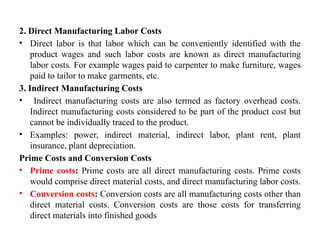
2. Direct Manufacturing Labor Costs
• Direct labor is that labor which can be conveniently identified with the
product wages and such labor costs are known as direct manufacturing
labor costs. For example wages paid to carpenter to make furniture, wages
paid to tailor to make garments, etc.
3. Indirect Manufacturing Costs
• Indirect manufacturing costs are also termed as factory overhead costs.
Indirect manufacturing costs considered to be part of the product cost but
cannot be individually traced to the product.
• Examples: power, indirect material, indirect labor, plant rent, plant
insurance, plant depreciation.
Prime Costs and Conversion Costs
• Prime costs: Prime costs are all direct manufacturing costs. Prime costs
would comprise direct material costs, and direct manufacturing labor costs.
• Conversion costs: Conversion costs are all manufacturing costs other than
direct material costs. Conversion costs are those costs for transferring
direct materials into finished goods
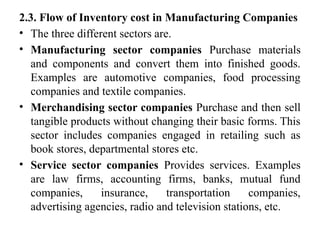
2.3. Flow of Inventory cost in Manufacturing Companies
• The three different sectors are.
• Manufacturing sector companies Purchase materials
and components and convert them into finished goods.
Examples are automotive companies, food processing
companies and textile companies.
• Merchandising sector companies Purchase and then sell
tangible products without changing their basic forms. This
sector includes companies engaged in retailing such as
book stores, departmental stores etc.
• Service sector companies Provides services. Examples
are law firms, accounting firms, banks, mutual fund
companies, insurance, transportation companies,
advertising agencies, radio and television stations, etc.
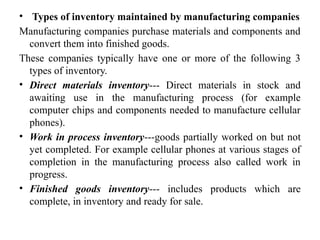
• Types of inventory maintained by manufacturing companies
Manufacturing companies purchase materials and components and
convert them into finished goods.
These companies typically have one or more of the following 3
types of inventory.
• Direct materials inventory--- Direct materials in stock and
awaiting use in the manufacturing process (for example
computer chips and components needed to manufacture cellular
phones).
• Work in process inventory---goods partially worked on but not
yet completed. For example cellular phones at various stages of
completion in the manufacturing process also called work in
progress.
• Finished goods inventory--- includes products which are
complete, in inventory and ready for sale.
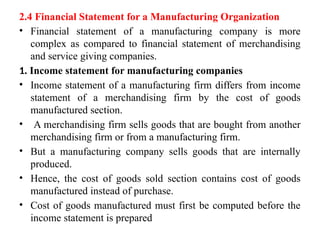
2.4 Financial Statement for a Manufacturing Organization
• Financial statement of a manufacturing company is more
complex as compared to financial statement of merchandising
and service giving companies.
1. Income statement for manufacturing companies
• Income statement of a manufacturing firm differs from income
statement of a merchandising firm by the cost of goods
manufactured section.
• A merchandising firm sells goods that are bought from another
merchandising firm or from a manufacturing firm.
• But a manufacturing company sells goods that are internally
produced.
• Hence, the cost of goods sold section contains cost of goods
manufactured instead of purchase.
• Cost of goods manufactured must first be computed before the
income statement is prepared
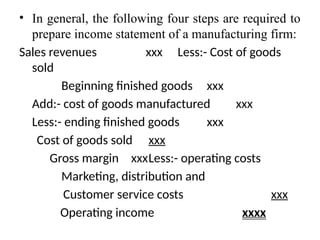
• In general, the following four steps are required to
prepare income statement of a manufacturing firm:
Sales revenues xxx Less:- Cost of goods
sold
Beginning finished goods xxx
Add:- cost of goods manufactured xxx
Less:- ending finished goods xxx
Cost of goods sold xxx
Gross margin xxxLess:- operating costs
Marketing, distribution and
Customer service costs xxx
Operating income xxxx
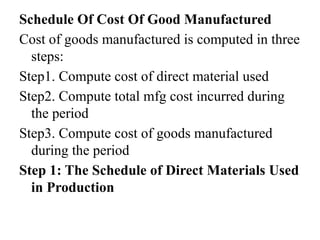
Schedule Of Cost Of Good Manufactured
Cost of goods manufactured is computed in three
steps:
Step1. Compute cost of direct material used
Step2. Compute total mfg cost incurred during
the period
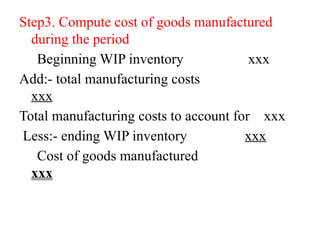
Step3. Compute cost of goods manufactured
during the period
Step 1: The Schedule of Direct Materials Used
in Production
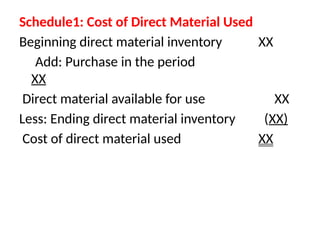
Schedule1: Cost of Direct Material Used
Beginning direct material inventory XX
Add: Purchase in the period
XX
Direct material available for use XX
Less: Ending direct material inventory (XX)
Cost of direct material used XX
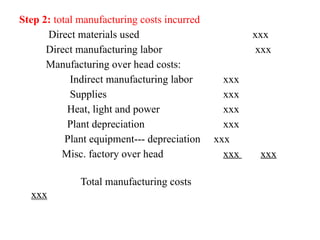
Step 2: total manufacturing costs incurred
Direct materials used xxx
Direct manufacturing labor xxx
Manufacturing over head costs:
Indirect manufacturing labor xxx
Supplies xxx
Heat, light and power xxx
Plant depreciation xxx
Plant equipment--- depreciation xxx
Misc. factory over head xxx xxx
Total manufacturing costs
xxx
Step3. Compute cost of goods manufactured
during the period
Beginning WIP inventory xxx
Add:- total manufacturing costs
xxx
Total manufacturing costs to account for xxx
Less:- ending WIP inventory xxx
Cost of goods manufactured
xxx
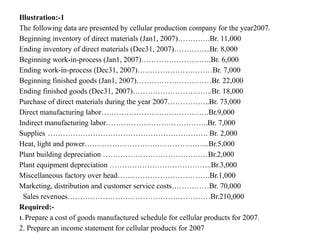
Illustration:-1
The following data are presented by cellular production company for the year2007.
Beginning inventory of direct materials (Jan1, 2007)………….Br. 11,000
Ending inventory of direct materials (Dec31, 2007)…………...Br. 8,000
Beginning work-in-process (Jan1, 2007)……………………….Br. 6,000
Ending work-in-process (Dec31, 2007)…………………………Br. 7,000
Beginning finished goods (Jan1, 2007)…………………………Br. 22,000
Ending finished goods (Dec31, 2007)…………………………..Br. 18,000
Purchase of direct materials during the year 2007……………..Br. 73,000
Direct manufacturing labor…………………………………….Br.9,000
Indirect manufacturing labor…………………………………..Br. 7,000
Supplies ………………………………………………………. Br. 2,000
Heat, light and power…………………………………………..Br.5,000
Plant building depreciation ……………………………………Br.2,000
Plant equipment depreciation …………………………………..Br.3,000
Miscellaneous factory over head……………………………….Br.1,000
Marketing, distribution and customer service costs……………Br. 70,000
Sales revenues…………………………………………………Br.210,000
Required:-
1. Prepare a cost of goods manufactured schedule for cellular products for 2007.
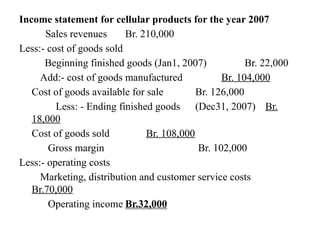
2. Prepare an income statement for cellular products for 2007
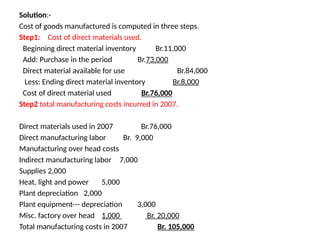
Solution:-
Cost of goods manufactured is computed in three steps.
Step1: Cost of direct materials used.
Beginning direct material inventory Br.11,000
Add: Purchase in the period Br.73,000
Direct material available for use Br.84,000
Less: Ending direct material inventory Br.8,000
Cost of direct material used Br.76,000
Step2 total manufacturing costs incurred in 2007.
Direct materials used in 2007 Br.76,000
Direct manufacturing labor Br. 9,000
Manufacturing over head costs
Indirect manufacturing labor 7,000
Supplies 2,000
Heat, light and power 5,000
Plant depreciation 2,000
Plant equipment--- depreciation 3,000
Misc. factory over head 1,000 Br. 20,000
Total manufacturing costs in 2007 Br. 105,000
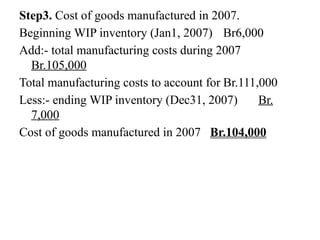
Step3. Cost of goods manufactured in 2007.
Beginning WIP inventory (Jan1, 2007) Br6,000
Add:- total manufacturing costs during 2007
Br.105,000
Total manufacturing costs to account for Br.111,000
Less:- ending WIP inventory (Dec31, 2007) Br.
7,000
Cost of goods manufactured in 2007 Br.104,000
Income statement for cellular products for the year 2007
Sales revenues Br. 210,000
Less:- cost of goods sold
Beginning finished goods (Jan1, 2007) Br. 22,000
Add:- cost of goods manufactured Br. 104,000
Cost of goods available for sale Br. 126,000
Less: - Ending finished goods (Dec31, 2007) Br.
18,000
Cost of goods sold Br. 108,000
Gross margin Br. 102,000
Less:- operating costs
Marketing, distribution and customer service costs
Br.70,000
Operating income Br.32,000
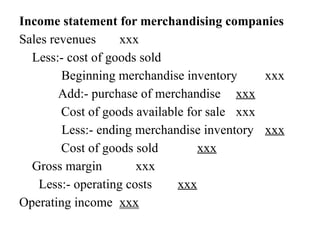
Income statement for merchandising companies
Sales revenues xxx
Less:- cost of goods sold
Beginning merchandise inventory xxx
Add:- purchase of merchandise xxx
Cost of goods available for sale xxx
Less:- ending merchandise inventory xxx
Cost of goods sold xxx
Gross margin xxx
Less:- operating costs xxx
Operating income xxx
End of chapter Two

chapter 2.pptxhfgxzdzdzdfffffffffffffffffg

  • 1.
    CHAPTER TWO Cost Terminologyand Cost Classification Objectives: At the end of this chapter students will be able to: • Know the classification of costs • Identify the flow of costs in manufacturing enterprises • Understand the reporting of costs in income statement and balance sheet
  • 2.
    2.1 Cost inGeneral A. Definition of Cost • Cost is an expenditure that has actually been incurred or that can be notionally attributed to a specified thing or activity. • CIMA defines cost as ''the amount of expenditure (actual or notional) incurred on, or attributable to, a specified thing or activity." • An Actual Cost that has been incurred and ascertained after it has been incurred • A Notional Cost for which there has not been any cash payment, but whose benefit has been enjoyed in the process of production of a commodity.
  • 3.
    B. Cost Object: •Cost object is anything for which measurement of cost is desired. Examples of cost object: product, service, programme, activity, etc. C. Cost Driver: • A cost driver is any factor that affects total costs. • Any change made in any of the cost drivers will cause a change in the total cost. • Examples of cost drivers: number of units produced, number of items distributed, number of advertisements, number of customers served, etc
  • 4.
    D. Cost assignment– is a general term for assigning costs to cost object – It includes tracing direct costs and applying indirect costs to a cost object. 2.2. Cost Classification • Cost can be classified variously for different objectives. i. Based on traceability, Costs can be divided in to: • Direct costs • Indirect costs
  • 5.
    1. Direct Costs: •Direct costs are those costs which are related to the particular cost object and that can be easily and conveniently traced to it. 2. Indirect Costs: • Indirect costs are those costs which are related to the particular cost object but cannot be easily and conveniently traced to it. Examples of indirect costs: rent of factory Building, managerial salaries, depreciation on machinery etc., indirect costs are also termed as factory overheads. ii. Base on behavior costs can be classified as fixed costs and variable costs: 1. Fixed Costs Fixed costs are those costs which remain fixed in total amount with increase or decrease in the volume of output for a given period of time. However, fixed cost per unit decreases as production increases, and fixed cost per unit increases as production decreases
  • 6.
    2. Variable Costs •Variable cost is so named because it varies in direct proportion to changes in activity or volume level. • If the activity level doubles the variable costs also double. For example the cost of direct materials used during a period will vary, in total, in direct proportion to the number of units produced. 3. Semi – variable costs: • Semi –variable or semi-fixed costs are those which contain the elements of both fixed and variable costs
  • 7.
    iii. Based ontheir functions costs can categorized into Product costs and period costs: 1. Product Costs: • Product costs are those costs which are traceable to the product and each are included in inventory. Product costs are inventorial costs and they become basis for product pricing. They comprise direct materials, direct labor, and manufacturing over heads. • A product cost is the total of the costs assigned to a product (manufacturing cost). 2. Period Costs: • Period costs are incurred on the basis of time, such as rent, salaries etc. These are also known as operating costs and sometimes called nonmanufacturing costs. These are all costs associated with generating revenues other than cost of goods sold such as Selling, General and Administrative expenses.
  • 8.
    Manufacturing costs • Thelanguage of cost accounting has specific terms for manufacturing costs. They are • Direct material costs. • Direct manufacturing labor costs • Indirect manufacturing costs • 1 Direct Material Costs • Direct materials are those materials which can be identified with the product and can be conveniently measured and directly charged to the product. • Examples of Direct materials: wood in furniture making, cloth in dress making, bricks in building a house, etc., • Acquisition costs of direct materials include freight in charges, sales taxes and customs duties.
  • 9.
    2. Direct ManufacturingLabor Costs • Direct labor is that labor which can be conveniently identified with the product wages and such labor costs are known as direct manufacturing labor costs. For example wages paid to carpenter to make furniture, wages paid to tailor to make garments, etc. 3. Indirect Manufacturing Costs • Indirect manufacturing costs are also termed as factory overhead costs. Indirect manufacturing costs considered to be part of the product cost but cannot be individually traced to the product. • Examples: power, indirect material, indirect labor, plant rent, plant insurance, plant depreciation. Prime Costs and Conversion Costs • Prime costs: Prime costs are all direct manufacturing costs. Prime costs would comprise direct material costs, and direct manufacturing labor costs. • Conversion costs: Conversion costs are all manufacturing costs other than direct material costs. Conversion costs are those costs for transferring direct materials into finished goods
  • 10.
    2.3. Flow ofInventory cost in Manufacturing Companies • The three different sectors are. • Manufacturing sector companies Purchase materials and components and convert them into finished goods. Examples are automotive companies, food processing companies and textile companies. • Merchandising sector companies Purchase and then sell tangible products without changing their basic forms. This sector includes companies engaged in retailing such as book stores, departmental stores etc. • Service sector companies Provides services. Examples are law firms, accounting firms, banks, mutual fund companies, insurance, transportation companies, advertising agencies, radio and television stations, etc.
  • 11.
    • Types ofinventory maintained by manufacturing companies Manufacturing companies purchase materials and components and convert them into finished goods. These companies typically have one or more of the following 3 types of inventory. • Direct materials inventory--- Direct materials in stock and awaiting use in the manufacturing process (for example computer chips and components needed to manufacture cellular phones). • Work in process inventory---goods partially worked on but not yet completed. For example cellular phones at various stages of completion in the manufacturing process also called work in progress. • Finished goods inventory--- includes products which are complete, in inventory and ready for sale.
  • 12.
    2.4 Financial Statementfor a Manufacturing Organization • Financial statement of a manufacturing company is more complex as compared to financial statement of merchandising and service giving companies. 1. Income statement for manufacturing companies • Income statement of a manufacturing firm differs from income statement of a merchandising firm by the cost of goods manufactured section. • A merchandising firm sells goods that are bought from another merchandising firm or from a manufacturing firm. • But a manufacturing company sells goods that are internally produced. • Hence, the cost of goods sold section contains cost of goods manufactured instead of purchase. • Cost of goods manufactured must first be computed before the income statement is prepared
  • 13.
    • In general,the following four steps are required to prepare income statement of a manufacturing firm: Sales revenues xxx Less:- Cost of goods sold Beginning finished goods xxx Add:- cost of goods manufactured xxx Less:- ending finished goods xxx Cost of goods sold xxx Gross margin xxxLess:- operating costs Marketing, distribution and Customer service costs xxx Operating income xxxx
  • 14.
    Schedule Of CostOf Good Manufactured Cost of goods manufactured is computed in three steps: Step1. Compute cost of direct material used Step2. Compute total mfg cost incurred during the period Step3. Compute cost of goods manufactured during the period Step 1: The Schedule of Direct Materials Used in Production
  • 15.
    Schedule1: Cost ofDirect Material Used Beginning direct material inventory XX Add: Purchase in the period XX Direct material available for use XX Less: Ending direct material inventory (XX) Cost of direct material used XX
  • 16.
    Step 2: totalmanufacturing costs incurred Direct materials used xxx Direct manufacturing labor xxx Manufacturing over head costs: Indirect manufacturing labor xxx Supplies xxx Heat, light and power xxx Plant depreciation xxx Plant equipment--- depreciation xxx Misc. factory over head xxx xxx Total manufacturing costs xxx
  • 17.
    Step3. Compute costof goods manufactured during the period Beginning WIP inventory xxx Add:- total manufacturing costs xxx Total manufacturing costs to account for xxx Less:- ending WIP inventory xxx Cost of goods manufactured xxx
  • 18.
    Illustration:-1 The following dataare presented by cellular production company for the year2007. Beginning inventory of direct materials (Jan1, 2007)………….Br. 11,000 Ending inventory of direct materials (Dec31, 2007)…………...Br. 8,000 Beginning work-in-process (Jan1, 2007)……………………….Br. 6,000 Ending work-in-process (Dec31, 2007)…………………………Br. 7,000 Beginning finished goods (Jan1, 2007)…………………………Br. 22,000 Ending finished goods (Dec31, 2007)…………………………..Br. 18,000 Purchase of direct materials during the year 2007……………..Br. 73,000 Direct manufacturing labor…………………………………….Br.9,000 Indirect manufacturing labor…………………………………..Br. 7,000 Supplies ………………………………………………………. Br. 2,000 Heat, light and power…………………………………………..Br.5,000 Plant building depreciation ……………………………………Br.2,000 Plant equipment depreciation …………………………………..Br.3,000 Miscellaneous factory over head……………………………….Br.1,000 Marketing, distribution and customer service costs……………Br. 70,000 Sales revenues…………………………………………………Br.210,000 Required:- 1. Prepare a cost of goods manufactured schedule for cellular products for 2007. 2. Prepare an income statement for cellular products for 2007
  • 19.
    Solution:- Cost of goodsmanufactured is computed in three steps. Step1: Cost of direct materials used. Beginning direct material inventory Br.11,000 Add: Purchase in the period Br.73,000 Direct material available for use Br.84,000 Less: Ending direct material inventory Br.8,000 Cost of direct material used Br.76,000 Step2 total manufacturing costs incurred in 2007. Direct materials used in 2007 Br.76,000 Direct manufacturing labor Br. 9,000 Manufacturing over head costs Indirect manufacturing labor 7,000 Supplies 2,000 Heat, light and power 5,000 Plant depreciation 2,000 Plant equipment--- depreciation 3,000 Misc. factory over head 1,000 Br. 20,000 Total manufacturing costs in 2007 Br. 105,000
  • 20.
    Step3. Cost ofgoods manufactured in 2007. Beginning WIP inventory (Jan1, 2007) Br6,000 Add:- total manufacturing costs during 2007 Br.105,000 Total manufacturing costs to account for Br.111,000 Less:- ending WIP inventory (Dec31, 2007) Br. 7,000 Cost of goods manufactured in 2007 Br.104,000
  • 21.
    Income statement forcellular products for the year 2007 Sales revenues Br. 210,000 Less:- cost of goods sold Beginning finished goods (Jan1, 2007) Br. 22,000 Add:- cost of goods manufactured Br. 104,000 Cost of goods available for sale Br. 126,000 Less: - Ending finished goods (Dec31, 2007) Br. 18,000 Cost of goods sold Br. 108,000 Gross margin Br. 102,000 Less:- operating costs Marketing, distribution and customer service costs Br.70,000 Operating income Br.32,000
  • 22.
    Income statement formerchandising companies Sales revenues xxx Less:- cost of goods sold Beginning merchandise inventory xxx Add:- purchase of merchandise xxx Cost of goods available for sale xxx Less:- ending merchandise inventory xxx Cost of goods sold xxx Gross margin xxx Less:- operating costs xxx Operating income xxx
  • 23.