Chapter Eight MANAGEMENT ACCOUNTING
Outline Difference between  managerial  and  financial  accounting. Purpose and importance of managerial accounting information for decision making. Cost concept Preparing statement for goods manufactured. Preparing financial statement for manufacturing companies
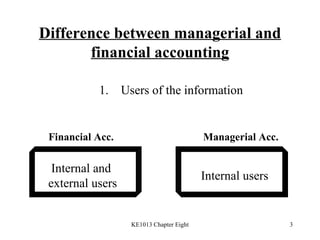
Difference between managerial and financial accounting 1.  Users of the information Internal and  external users Internal users Financial Acc. Managerial Acc.
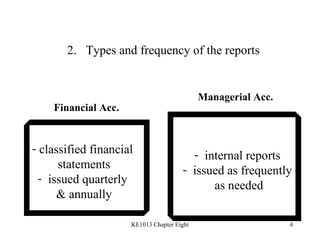
2.  Types and frequency of the reports classified financial  statements issued quarterly  & annually internal reports issued as frequently as needed Financial Acc. Managerial Acc.
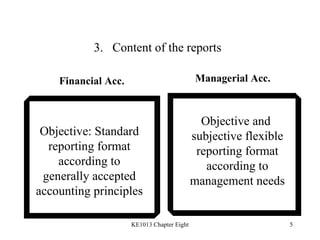
3.  Content of the reports Objective: Standard reporting format according to generally accepted accounting principles Objective and  subjective flexible reporting format according to management needs Financial Acc. Managerial Acc.
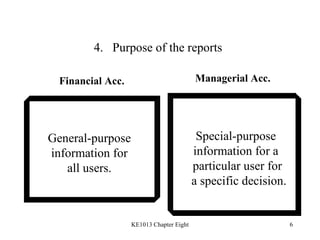
4.  Purpose of the reports General-purpose information for  all users. Special-purpose  information for a  particular user for a specific decision. Financial Acc. Managerial Acc.
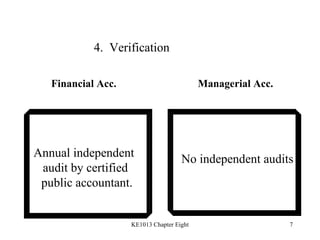
4.  Verification  Annual independent  audit by certified  public accountant. No independent audits Financial Acc. Managerial Acc.
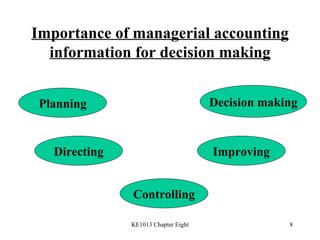
Importance of managerial accounting information for decision making Planning Directing Controlling Improving Decision making
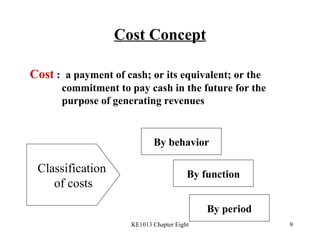
Cost Concept Cost  :  a payment of cash; or its equivalent; or the  commitment to pay cash in the future for the  purpose of generating revenues Classification  of costs By behavior By function By period
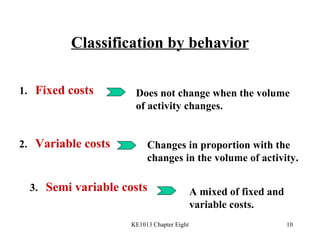
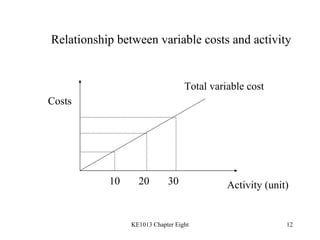
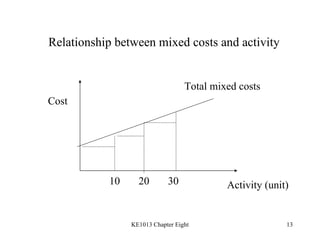
Classification by behavior 1.  Fixed costs 3.  Semi variable costs 2.  Variable costs Does not change when the volume of activity changes. Changes in proportion with the changes in the volume of activity. A mixed of fixed and variable costs.
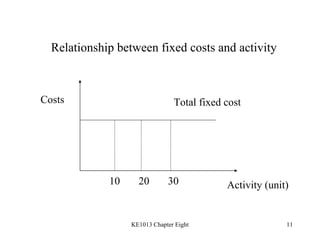
Relationship between fixed costs and activity Costs Activity (unit) Total fixed cost 10 20 30
Relationship between variable costs and activity Costs Activity (unit) Total variable cost 10 20 30
Relationship between mixed costs and activity Cost Activity (unit) Total mixed costs 10 20 30
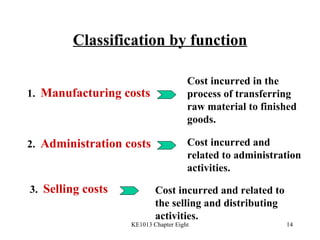
Classification by function 1.  Manufacturing costs 2.  Administration costs 3.  Selling costs Cost incurred in the process of transferring raw material to finished goods. Cost incurred and related to administration activities. Cost incurred and related to the selling and distributing activities.
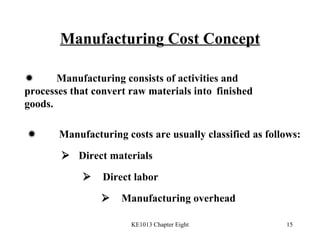
Manufacturing Cost Concept  Manufacturing consists of activities and  processes that convert raw materials into  finished  goods.   Manufacturing costs are usually classified as follows:    Direct materials    Direct labor    Manufacturing overhead
Manufacturing Cost : Direct Materials  Raw  materials   are the basic materials and parts  that are to be used in the manufacturing process.  Raw materials that can be physically and directly  associated with the finished product during the  manufacturing process are called  direct  materials .
Manufacturing Cost : Indirect Materials  Some raw materials cannot be easily associated  with the finished product. These are considered  indirect materials .   Are accounted for as part of manufacturing  overhead and : do not physically become part of the finished product;  or 2   cannot be traced because their physical association with the finished product is too small in terms of cost .
Manufacturing Cost : Direct Labor  Direct labor   is the work of factory employees  that can be physically and directly associated with  converting raw materials into finished goods.  The wages of maintenance people, timekeepers,  and supervisors are usually identified as indirect  labor. Their efforts have no physical association  with the finished product.  Like indirect materials, indirect labor is  part of manufacturing overhead.
Manufacturing Cost :  Overhead  Manufacturing overhead consists of costs that  are  indirectly associated with the manufacture of  the  finished product.  These costs may also be manufacturing costs that  cannot be classified as direct materials or direct  labor.  Manufacturing overhead includes 1  indirect materials; 2  indirect labor; 3  depreciation on factory buildings and machines 4  insurance, taxes, and maintenance on    factory facilities.
Product Cost vs. Period Cost  Product costs   include each of the  manufacturing cost elements (direct materials,  direct labor, and manufacturing overhead);  they are costs that are a necessary and integral  part of producing the finished product.  These costs are not expensed to cost of goods  sold under the matching principle until the  finished goods inventory is sold.
Product Cost vs. Period Cost  Direct materials  and  direct labor  are often  referred to  as  prime costs  due to their direct association with  the manufacturing of the finished product.  Direct labor  and  manufacturing overhead  are  often referred to as  conversion costs  since they  are incurred in converting raw materials into  finished goods.
Product Cost vs. Period Cost    Period costs:   are identifiable with a specific time period, relate to non-manufacturing non-inventoriable costs,  and  include selling and administrative expenses.
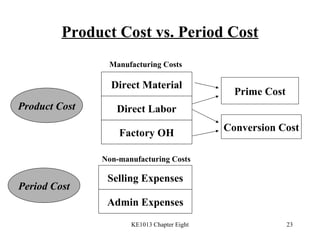
Product Cost vs. Period Cost Direct Material Direct Labor Factory OH Prime Cost Conversion Cost Selling Expenses Admin Expenses Product Cost Period Cost Manufacturing Costs Non-manufacturing Costs
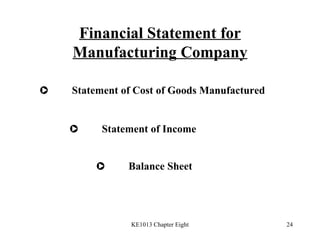
Financial Statement for Manufacturing Company  Statement of Cost of Goods Manufactured  Statement of Income  Balance Sheet
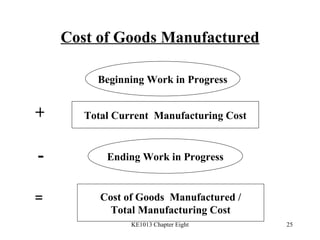
Cost of Goods Manufactured Total Current  Manufacturing Cost Beginning Work in Progress + - Ending Work in Progress = Cost of Goods  Manufactured / Total Manufacturing Cost
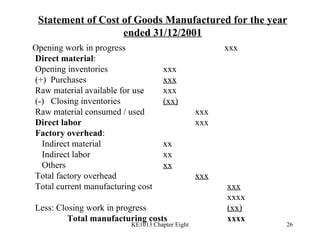
Statement of Cost of Goods Manufactured for the year ended 31/12/2001 Opening work in progress xxx Direct material : Opening inventories xxx (+)  Purchases xxx Raw material available for use xxx (-)  Closing inventories (xx) Raw material consumed / used xxx Direct labor xxx Factory overhead : Indirect material xx Indirect labor xx Others xx Total factory overhead xxx Total current manufacturing cost xxx xxxx Less: Closing work in progress (xx) Total manufacturing costs xxxx
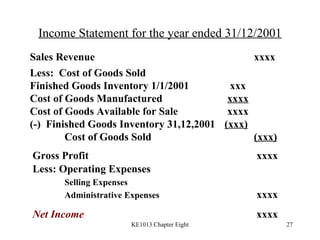
Income Statement for the year ended 31/12/2001 Sales Revenue xxxx Less:  Cost of Goods Sold Finished Goods Inventory 1/1/2001     xxx Cost of Goods Manufactured     xxxx   Cost of Goods Available for Sale     xxxx (-)  Finished Goods Inventory 31,12,2001   (xxx)   Cost of Goods Sold (xxx) Gross Profit xxxx Less: Operating Expenses Selling Expenses Administrative Expenses xxxx Net Income xxxx
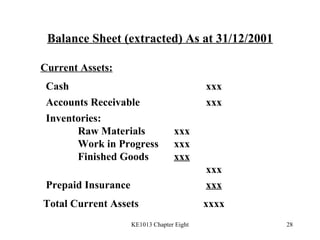
Balance Sheet (extracted) As at 31/12/2001 Current Assets: Cash xxx Accounts Receivable xxx Inventories: Raw Materials xxx Work in Progress xxx Finished Goods xxx xxx Prepaid Insurance xxx Total Current Assets xxxx
Thank You

Akaun Chapter 8

  • 1.
  • 2.
    Outline Difference between managerial and financial accounting. Purpose and importance of managerial accounting information for decision making. Cost concept Preparing statement for goods manufactured. Preparing financial statement for manufacturing companies
  • 3.
    Difference between managerialand financial accounting 1. Users of the information Internal and external users Internal users Financial Acc. Managerial Acc.
  • 4.
    2. Typesand frequency of the reports classified financial statements issued quarterly & annually internal reports issued as frequently as needed Financial Acc. Managerial Acc.
  • 5.
    3. Contentof the reports Objective: Standard reporting format according to generally accepted accounting principles Objective and subjective flexible reporting format according to management needs Financial Acc. Managerial Acc.
  • 6.
    4. Purposeof the reports General-purpose information for all users. Special-purpose information for a particular user for a specific decision. Financial Acc. Managerial Acc.
  • 7.
    4. Verification Annual independent audit by certified public accountant. No independent audits Financial Acc. Managerial Acc.
  • 8.
    Importance of managerialaccounting information for decision making Planning Directing Controlling Improving Decision making
  • 9.
    Cost Concept Cost : a payment of cash; or its equivalent; or the commitment to pay cash in the future for the purpose of generating revenues Classification of costs By behavior By function By period
  • 10.
    Classification by behavior1. Fixed costs 3. Semi variable costs 2. Variable costs Does not change when the volume of activity changes. Changes in proportion with the changes in the volume of activity. A mixed of fixed and variable costs.
  • 11.
    Relationship between fixedcosts and activity Costs Activity (unit) Total fixed cost 10 20 30
  • 12.
    Relationship between variablecosts and activity Costs Activity (unit) Total variable cost 10 20 30
  • 13.
    Relationship between mixedcosts and activity Cost Activity (unit) Total mixed costs 10 20 30
  • 14.
    Classification by function1. Manufacturing costs 2. Administration costs 3. Selling costs Cost incurred in the process of transferring raw material to finished goods. Cost incurred and related to administration activities. Cost incurred and related to the selling and distributing activities.
  • 15.
    Manufacturing Cost Concept Manufacturing consists of activities and processes that convert raw materials into finished goods.  Manufacturing costs are usually classified as follows:  Direct materials  Direct labor  Manufacturing overhead
  • 16.
    Manufacturing Cost :Direct Materials  Raw materials are the basic materials and parts that are to be used in the manufacturing process.  Raw materials that can be physically and directly associated with the finished product during the manufacturing process are called direct materials .
  • 17.
    Manufacturing Cost :Indirect Materials  Some raw materials cannot be easily associated with the finished product. These are considered indirect materials .  Are accounted for as part of manufacturing overhead and : do not physically become part of the finished product; or 2 cannot be traced because their physical association with the finished product is too small in terms of cost .
  • 18.
    Manufacturing Cost :Direct Labor  Direct labor is the work of factory employees that can be physically and directly associated with converting raw materials into finished goods.  The wages of maintenance people, timekeepers, and supervisors are usually identified as indirect labor. Their efforts have no physical association with the finished product.  Like indirect materials, indirect labor is part of manufacturing overhead.
  • 19.
    Manufacturing Cost : Overhead  Manufacturing overhead consists of costs that are indirectly associated with the manufacture of the finished product.  These costs may also be manufacturing costs that cannot be classified as direct materials or direct labor.  Manufacturing overhead includes 1 indirect materials; 2 indirect labor; 3 depreciation on factory buildings and machines 4 insurance, taxes, and maintenance on factory facilities.
  • 20.
    Product Cost vs.Period Cost  Product costs include each of the manufacturing cost elements (direct materials, direct labor, and manufacturing overhead); they are costs that are a necessary and integral part of producing the finished product.  These costs are not expensed to cost of goods sold under the matching principle until the finished goods inventory is sold.
  • 21.
    Product Cost vs.Period Cost  Direct materials and direct labor are often referred to as prime costs due to their direct association with the manufacturing of the finished product.  Direct labor and manufacturing overhead are often referred to as conversion costs since they are incurred in converting raw materials into finished goods.
  • 22.
    Product Cost vs.Period Cost  Period costs: are identifiable with a specific time period, relate to non-manufacturing non-inventoriable costs, and include selling and administrative expenses.
  • 23.
    Product Cost vs.Period Cost Direct Material Direct Labor Factory OH Prime Cost Conversion Cost Selling Expenses Admin Expenses Product Cost Period Cost Manufacturing Costs Non-manufacturing Costs
  • 24.
    Financial Statement forManufacturing Company  Statement of Cost of Goods Manufactured  Statement of Income  Balance Sheet
  • 25.
    Cost of GoodsManufactured Total Current Manufacturing Cost Beginning Work in Progress + - Ending Work in Progress = Cost of Goods Manufactured / Total Manufacturing Cost
  • 26.
    Statement of Costof Goods Manufactured for the year ended 31/12/2001 Opening work in progress xxx Direct material : Opening inventories xxx (+) Purchases xxx Raw material available for use xxx (-) Closing inventories (xx) Raw material consumed / used xxx Direct labor xxx Factory overhead : Indirect material xx Indirect labor xx Others xx Total factory overhead xxx Total current manufacturing cost xxx xxxx Less: Closing work in progress (xx) Total manufacturing costs xxxx
  • 27.
    Income Statement forthe year ended 31/12/2001 Sales Revenue xxxx Less: Cost of Goods Sold Finished Goods Inventory 1/1/2001 xxx Cost of Goods Manufactured xxxx Cost of Goods Available for Sale xxxx (-) Finished Goods Inventory 31,12,2001 (xxx) Cost of Goods Sold (xxx) Gross Profit xxxx Less: Operating Expenses Selling Expenses Administrative Expenses xxxx Net Income xxxx
  • 28.
    Balance Sheet (extracted)As at 31/12/2001 Current Assets: Cash xxx Accounts Receivable xxx Inventories: Raw Materials xxx Work in Progress xxx Finished Goods xxx xxx Prepaid Insurance xxx Total Current Assets xxxx
  • 29.