Management Accounting: Introduction Cost Flows Cost terms & purposes
Cost: Definition Monetary measure of resources given up to attain an objective (such as acquiring a good or service)  – Barfield, Raiborn, Kinney At the time of acquisition, the cost incurred is for present or future benefits.  When these benefits are utilized, the costs become expenses.  An  expense  is defined as a cost that has given a benefit and is now expired.  Unexpired costs that give future benefits are classified as assets. –  Polimeni, Fabozzi, Adelberg
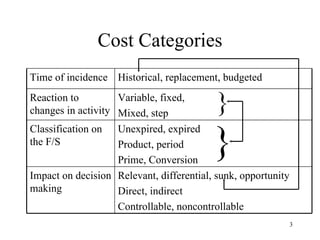
Cost Categories } } Relevant, differential, sunk, opportunity Direct, indirect Controllable, noncontrollable Impact on decision making Unexpired, expired Product, period Prime, Conversion Classification on the F/S Variable, fixed,  Mixed, step Reaction to changes in activity Historical, replacement, budgeted Time of incidence
Basic Cost Terms: Cost Objects and Drivers Cost A sacrifice of resources.  Distinguish from “expense”. Cost Object Any activity or item for which a separate measurement of costs is desired. Cost Driver Any factor whose change “causes” a change in the total cost of a related cost object. (Note: Cost drivers can be factors other than volume.) From:  ocw.mit.edu
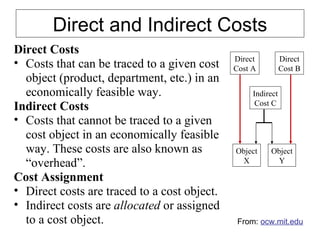
Direct and Indirect Costs Direct Costs Costs that can be traced to a given cost object (product, department, etc.) in an economically feasible way. Indirect Costs Costs that cannot be traced to a given cost object in an economically feasible way. These costs are also known as “overhead”. Cost Assignment Direct costs are traced to a cost object. Indirect costs are  allocated  or assigned to a cost object. Direct Cost A Direct Cost B Indirect Cost C Object X Object Y From:  ocw.mit.edu
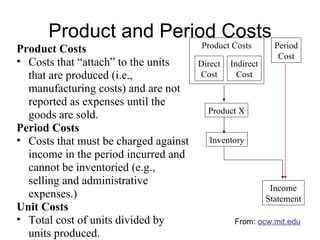
Product and Period Costs Product Costs Costs that “attach” to the units that are produced (i.e., manufacturing costs) and are not reported as expenses until the goods are sold. Period Costs Costs that must be charged against income in the period incurred and cannot be inventoried (e.g., selling and administrative expenses.) Unit Costs Total cost of units divided by units produced. Product Costs Period Cost Direct Cost Indirect Cost Product X Inventory Income Statement From:  ocw.mit.edu
Cost Behavior Variable Costs Costs that change directly in proportion to changes in the related cost driver. Fixed Costs Costs that remain unchanged for a given time period regardless of change in the related cost driver. Other common functions for Cost Behavior Semi-variable costs (part variable and part fixed). Step costs (give examples) Main Assumptions needed to define fixed/variable: Cost object, Time span, Linear functional form. Relevant range = the band of cost driver activity in which a specific relationship between a cost and a driver holds. From:  ocw.mit.edu
Basic Cost Terms Product costs can be  Direct  or  Indirect (Overhead) Not all  Direct  costs are variable The depreciation of a special piece of equipment bought to manufacture a single product line. Not all  Overheads  are fixed Processing of raw material purchase orders Electricity used in operating production equipment. From:  ocw.mit.edu
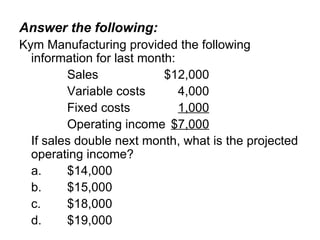
Answer the following: Kym Manufacturing provided the following information for last month: Sales $12,000 Variable costs 4,000 Fixed costs 1,000 Operating income $7,000 If sales double next month, what is the projected operating income? a. $14,000 b. $15,000 c. $18,000 d. $19,000
Prime Costs and Conversion Costs Prime Costs all direct manufacturing costs. (would comprise direct material costs and direct manufacturing labor costs) As information-gathering technology improves, companies may add additional direct-cost categories. Conversion Costs all manufacturing costs other than direct materials costs. These costs are for transforming direct materials into finished goods. (would comprise direct manufacturing labor costs and indirect manufacturing costs)
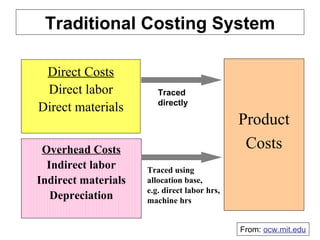
Traditional Costing System Product Costs Direct Costs Direct labor Direct materials Overhead Costs Indirect labor Indirect materials Depreciation Traced directly Traced using allocation base, e.g. direct labor hrs, machine hrs From:  ocw.mit.edu
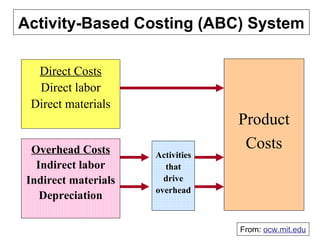
Activity-Based Costing (ABC) System Product Costs Direct Costs Direct labor Direct materials Overhead Costs Indirect labor Indirect materials Depreciation Activities that drive overhead From:  ocw.mit.edu
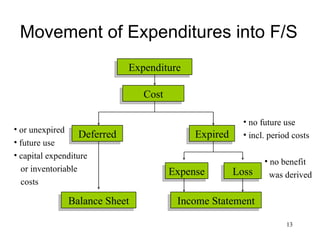
Movement of Expenditures into F/S Expenditure Cost Deferred Balance Sheet Expired Income Statement Expense Loss or unexpired future use capital expenditure or inventoriable costs no future use incl. period costs no benefit  was derived
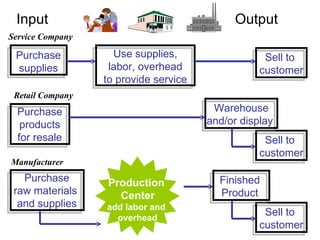
Service Company Input Output Retail Company Production Center add labor and overhead Manufacturer Purchase supplies Use supplies, labor, overhead to provide service Sell to  customer Purchase products for resale Sell to  customer Warehouse and/or display  Purchase raw materials  and supplies Sell to  customer Finished  Product
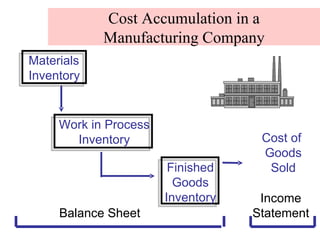
Cost Accumulation in a Manufacturing Company Cost of  Goods Sold Balance Sheet Income Statement Materials Inventory Work in Process Inventory Finished Goods Inventory
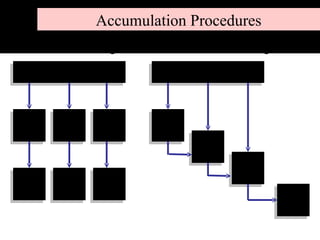
Accumulation Procedures DM  DL  FOH WIP Job #1 WIP Job #2 WIP Job #3 FG Job #1 FG Job #2 FG Job #3 WIP Dept 1 WIP Dept 2 WIP Dept 3 FG Inv. DM  DL  FOH Job Order Costing  Process Costing
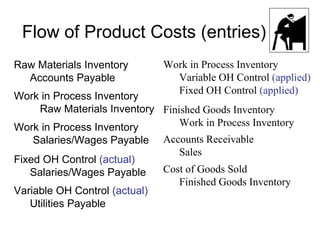
Flow of Product Costs (entries) Raw Materials Inventory Accounts Payable Work in Process Inventory Raw Materials Inventory Work in Process Inventory Salaries/Wages Payable Fixed OH Control  (actual) Salaries/Wages Payable Variable OH Control  (actual) Utilities Payable Work in Process Inventory Variable OH Control  (applied) Fixed OH Control  (applied) Finished Goods Inventory Work in Process Inventory Accounts Receivable Sales Cost of Goods Sold Finished Goods Inventory
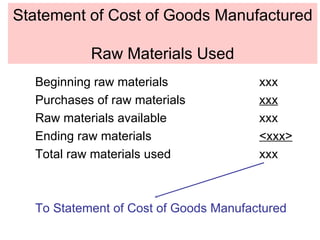
Statement of Cost of Goods Manufactured  Raw Materials Used Beginning raw materials xxx Purchases of raw materials xxx Raw materials available xxx Ending raw materials     <xxx> Total raw materials used xxx To Statement of Cost of Goods Manufactured
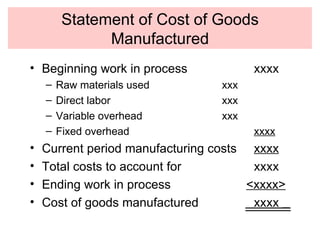
Statement of Cost of Goods Manufactured Beginning work in process xxxx Raw materials used   xxx Direct labor xxx Variable overhead xxx Fixed overhead xxxx Current period manufacturing costs xxxx Total costs to account for xxxx Ending work in process   <xxxx> Cost of goods manufactured xxxx
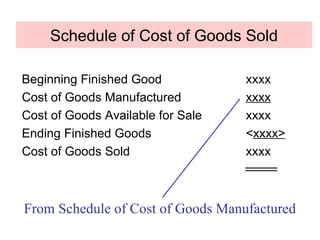
Schedule of Cost of Goods Sold Beginning Finished Good xxxx Cost of Goods Manufactured xxxx Cost of Goods Available for Sale xxxx Ending Finished Goods < xxxx> Cost of Goods Sold xxxx From Schedule of Cost of Goods Manufactured
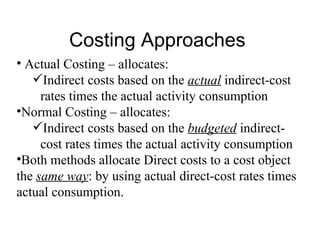
Costing Approaches Actual Costing – allocates: Indirect costs based on the  actual  indirect-cost rates times the actual activity consumption Normal Costing – allocates: Indirect costs based on the  budgeted  indirect-cost rates times the actual activity consumption Both methods allocate Direct costs to a cost object the  same way : by using actual direct-cost rates times actual consumption.
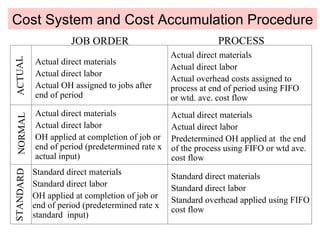
Cost System and Cost Accumulation Procedure ACTUAL NORMAL STANDARD JOB ORDER PROCESS Actual direct materials Actual direct labor Actual OH assigned to jobs after end of period Actual direct materials Actual direct labor Actual overhead costs assigned to process at end of period using FIFO or wtd. ave. cost flow Actual direct materials Actual direct labor OH applied at completion of job or end of period (predetermined rate x actual input) Actual direct materials Actual direct labor Predetermined OH applied at  the end of the process using FIFO or wtd ave. cost flow Standard direct materials Standard direct labor OH applied at completion of job or end of period (predetermined rate x standard  input) Standard direct materials Standard direct labor Standard overhead applied using FIFO cost flow
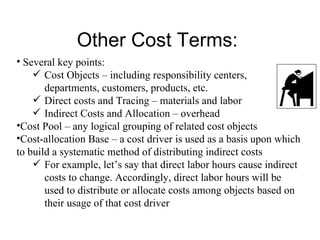
Other Cost Terms: Several key points: Cost Objects – including responsibility centers, departments, customers, products, etc. Direct costs and Tracing – materials and labor Indirect Costs and Allocation – overhead Cost Pool – any logical grouping of related cost objects Cost-allocation Base – a cost driver is used as a basis upon which to build a systematic method of distributing indirect costs For example, let’s say that direct labor hours cause indirect costs to change. Accordingly, direct labor hours will be used to distribute or allocate costs among objects based on their usage of that cost driver

Cost terms & purposes

  • 1.
    Management Accounting: IntroductionCost Flows Cost terms & purposes
  • 2.
    Cost: Definition Monetarymeasure of resources given up to attain an objective (such as acquiring a good or service) – Barfield, Raiborn, Kinney At the time of acquisition, the cost incurred is for present or future benefits. When these benefits are utilized, the costs become expenses. An expense is defined as a cost that has given a benefit and is now expired. Unexpired costs that give future benefits are classified as assets. – Polimeni, Fabozzi, Adelberg
  • 3.
    Cost Categories }} Relevant, differential, sunk, opportunity Direct, indirect Controllable, noncontrollable Impact on decision making Unexpired, expired Product, period Prime, Conversion Classification on the F/S Variable, fixed, Mixed, step Reaction to changes in activity Historical, replacement, budgeted Time of incidence
  • 4.
    Basic Cost Terms:Cost Objects and Drivers Cost A sacrifice of resources. Distinguish from “expense”. Cost Object Any activity or item for which a separate measurement of costs is desired. Cost Driver Any factor whose change “causes” a change in the total cost of a related cost object. (Note: Cost drivers can be factors other than volume.) From: ocw.mit.edu
  • 5.
    Direct and IndirectCosts Direct Costs Costs that can be traced to a given cost object (product, department, etc.) in an economically feasible way. Indirect Costs Costs that cannot be traced to a given cost object in an economically feasible way. These costs are also known as “overhead”. Cost Assignment Direct costs are traced to a cost object. Indirect costs are allocated or assigned to a cost object. Direct Cost A Direct Cost B Indirect Cost C Object X Object Y From: ocw.mit.edu
  • 6.
    Product and PeriodCosts Product Costs Costs that “attach” to the units that are produced (i.e., manufacturing costs) and are not reported as expenses until the goods are sold. Period Costs Costs that must be charged against income in the period incurred and cannot be inventoried (e.g., selling and administrative expenses.) Unit Costs Total cost of units divided by units produced. Product Costs Period Cost Direct Cost Indirect Cost Product X Inventory Income Statement From: ocw.mit.edu
  • 7.
    Cost Behavior VariableCosts Costs that change directly in proportion to changes in the related cost driver. Fixed Costs Costs that remain unchanged for a given time period regardless of change in the related cost driver. Other common functions for Cost Behavior Semi-variable costs (part variable and part fixed). Step costs (give examples) Main Assumptions needed to define fixed/variable: Cost object, Time span, Linear functional form. Relevant range = the band of cost driver activity in which a specific relationship between a cost and a driver holds. From: ocw.mit.edu
  • 8.
    Basic Cost TermsProduct costs can be Direct or Indirect (Overhead) Not all Direct costs are variable The depreciation of a special piece of equipment bought to manufacture a single product line. Not all Overheads are fixed Processing of raw material purchase orders Electricity used in operating production equipment. From: ocw.mit.edu
  • 9.
    Answer the following:Kym Manufacturing provided the following information for last month: Sales $12,000 Variable costs 4,000 Fixed costs 1,000 Operating income $7,000 If sales double next month, what is the projected operating income? a. $14,000 b. $15,000 c. $18,000 d. $19,000
  • 10.
    Prime Costs andConversion Costs Prime Costs all direct manufacturing costs. (would comprise direct material costs and direct manufacturing labor costs) As information-gathering technology improves, companies may add additional direct-cost categories. Conversion Costs all manufacturing costs other than direct materials costs. These costs are for transforming direct materials into finished goods. (would comprise direct manufacturing labor costs and indirect manufacturing costs)
  • 11.
    Traditional Costing SystemProduct Costs Direct Costs Direct labor Direct materials Overhead Costs Indirect labor Indirect materials Depreciation Traced directly Traced using allocation base, e.g. direct labor hrs, machine hrs From: ocw.mit.edu
  • 12.
    Activity-Based Costing (ABC)System Product Costs Direct Costs Direct labor Direct materials Overhead Costs Indirect labor Indirect materials Depreciation Activities that drive overhead From: ocw.mit.edu
  • 13.
    Movement of Expendituresinto F/S Expenditure Cost Deferred Balance Sheet Expired Income Statement Expense Loss or unexpired future use capital expenditure or inventoriable costs no future use incl. period costs no benefit was derived
  • 14.
    Service Company InputOutput Retail Company Production Center add labor and overhead Manufacturer Purchase supplies Use supplies, labor, overhead to provide service Sell to customer Purchase products for resale Sell to customer Warehouse and/or display Purchase raw materials and supplies Sell to customer Finished Product
  • 15.
    Cost Accumulation ina Manufacturing Company Cost of Goods Sold Balance Sheet Income Statement Materials Inventory Work in Process Inventory Finished Goods Inventory
  • 16.
    Accumulation Procedures DM DL FOH WIP Job #1 WIP Job #2 WIP Job #3 FG Job #1 FG Job #2 FG Job #3 WIP Dept 1 WIP Dept 2 WIP Dept 3 FG Inv. DM DL FOH Job Order Costing Process Costing
  • 17.
    Flow of ProductCosts (entries) Raw Materials Inventory Accounts Payable Work in Process Inventory Raw Materials Inventory Work in Process Inventory Salaries/Wages Payable Fixed OH Control (actual) Salaries/Wages Payable Variable OH Control (actual) Utilities Payable Work in Process Inventory Variable OH Control (applied) Fixed OH Control (applied) Finished Goods Inventory Work in Process Inventory Accounts Receivable Sales Cost of Goods Sold Finished Goods Inventory
  • 18.
    Statement of Costof Goods Manufactured Raw Materials Used Beginning raw materials xxx Purchases of raw materials xxx Raw materials available xxx Ending raw materials <xxx> Total raw materials used xxx To Statement of Cost of Goods Manufactured
  • 19.
    Statement of Costof Goods Manufactured Beginning work in process xxxx Raw materials used xxx Direct labor xxx Variable overhead xxx Fixed overhead xxxx Current period manufacturing costs xxxx Total costs to account for xxxx Ending work in process <xxxx> Cost of goods manufactured xxxx
  • 20.
    Schedule of Costof Goods Sold Beginning Finished Good xxxx Cost of Goods Manufactured xxxx Cost of Goods Available for Sale xxxx Ending Finished Goods < xxxx> Cost of Goods Sold xxxx From Schedule of Cost of Goods Manufactured
  • 21.
    Costing Approaches ActualCosting – allocates: Indirect costs based on the actual indirect-cost rates times the actual activity consumption Normal Costing – allocates: Indirect costs based on the budgeted indirect-cost rates times the actual activity consumption Both methods allocate Direct costs to a cost object the same way : by using actual direct-cost rates times actual consumption.
  • 22.
    Cost System andCost Accumulation Procedure ACTUAL NORMAL STANDARD JOB ORDER PROCESS Actual direct materials Actual direct labor Actual OH assigned to jobs after end of period Actual direct materials Actual direct labor Actual overhead costs assigned to process at end of period using FIFO or wtd. ave. cost flow Actual direct materials Actual direct labor OH applied at completion of job or end of period (predetermined rate x actual input) Actual direct materials Actual direct labor Predetermined OH applied at the end of the process using FIFO or wtd ave. cost flow Standard direct materials Standard direct labor OH applied at completion of job or end of period (predetermined rate x standard input) Standard direct materials Standard direct labor Standard overhead applied using FIFO cost flow
  • 23.
    Other Cost Terms:Several key points: Cost Objects – including responsibility centers, departments, customers, products, etc. Direct costs and Tracing – materials and labor Indirect Costs and Allocation – overhead Cost Pool – any logical grouping of related cost objects Cost-allocation Base – a cost driver is used as a basis upon which to build a systematic method of distributing indirect costs For example, let’s say that direct labor hours cause indirect costs to change. Accordingly, direct labor hours will be used to distribute or allocate costs among objects based on their usage of that cost driver

Editor's Notes

  • #3 BA 116 - Chapter 1 - Introduction 2002 SSRICO
  • #4 BA 116 - Chapter 1 - Introduction 2002 SSRICO
  • #10 Answer: b
  • #14 BA 116 - Chapter 1 - Introduction 2002 SSRICO
  • #15 BA 116 - Chapter 1 - Introduction 2002 SSRICO
  • #16 BA 116 - Chapter 1 - Introduction 2002 SSRICO
  • #17 BA 116 - Chapter 1 - Introduction 2002 SSRICO
  • #18 BA 116 - Chapter 1 - Introduction 2002 SSRICO
  • #19 BA 116 - Chapter 1 - Introduction 2002 SSRICO
  • #20 BA 116 - Chapter 1 - Introduction 2002 SSRICO
  • #21 BA 116 - Chapter 1 - Introduction 2002 SSRICO
  • #22 BA 116 - Chapter 1 - Introduction 2002 SSRICO
  • #23 BA 116 - Chapter 1 - Introduction 2002 SSRICO
  • #24 BA 116 - Chapter 1 - Introduction 2002 SSRICO