a mphiox us
By
Dr. Priti D.Diwan
Assistant Professor
Department of Zoology
J.D.Patil Sangludkar Mahavidyalay
Daryapur
introduction
Organisms under Subphylum
Cephalochordata:
Has no distinct head
But has a notochord thatextendstothehead part of
thebody.
introduction:
Amphioxus:
-means “sharp atboth ends”
-a living amphioxus is semitransparent butbecomes
opaque whenimmersedin preserving fluids.
Amphioxus and the Vertebrates
No cephalization
No paired sense organs
Has notochord that remains throughout life
Has no vertebral column
Notochord
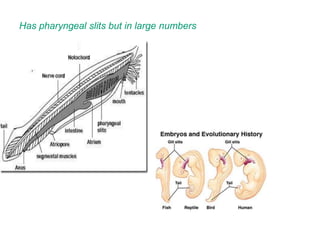
Has pharyngeal slits but in large numbers
Dorsal, hollow nervous system
No brain or cranium
Metameric muscles (myomeres) but extendes to the
anterior tip of the head
Two-layered skin – epidermis and dermis
But outer layer is one-cell thick
Well-developed circulatory system Lack blood
cells, muscular heart Pulsating blood vessels
Is coelomate But gretly
restricted
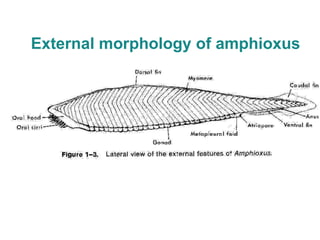
External morphology of amphioxus
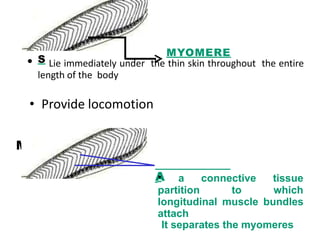
MYOMERE
• S Lie immediately under the thin skin throughout the entire
length of the body
• Provide locomotion
MYOSEPT
A
• a connective tissue
partition to which
longitudinal muscle bundles
attach
It separates the myomeres
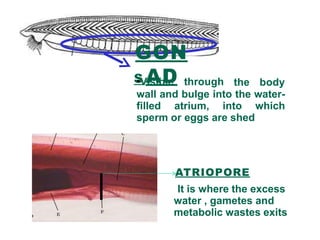
GON
AD
S
•Visible through the body
wall and bulge into the water-
filled atrium, into which
sperm or eggs are shed
ATRIOPORE
It is where the excess
water , gametes and
metabolic wastes exits
BUCCAL
CIRRI
Partially strain the water as it enters
the vestibule and monitor it
chemically
Dorsal and ventral fin rays:
maintains balance during
locomotion
EYESPOT OCELLI
WHEEL
ORGAN
GILL SLITS
GILL BARS
GILL SLITS : where water goes through;
where strings of mucus travelling across
them trap tiny food particles
GILL BARS : supports between gill slits
OCELLI : light-sensitive organ; it assist in
orienting the animal as it burrows in the
sand
WHEEL ORGAN : retrieves
some of the heavier food particle
that miss the mouth, and it
directs these through the mouth
and into the pharynx along with
the water stream
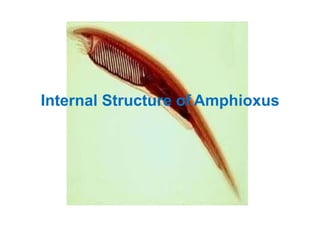
Internal Structure of Amphioxus
Parts and Function
Notochord: protects and support the dorsal nerve
cord; serves as the major skeletal support
throughout life
Nerve cord: serves as central nervous system.
Pharynx: passage way for water, food and air.
Atrium: serves as a collecting chamber for
respiratory water that has passed over the gills.
Intestine: major site for digestion of food.
Anus: excretion of waste
Anterior end
Vestibule: collecting chamber for sea water
Oral hood: serves as entrance and storage
Velum: works as valve and filter; surrounds the
mouth
Velar tentacles: prevent undesirable objects from
entering the digestive cavity
Amphioxus
spend much
of their time
buried in
gravel or
mud on the
ocean
bottom
When feeding, they let the anterior part of the
body project from the surface of the gravel so
that they can filter food particles from water
passing through their gill slits.
FEEDING:
Once the food is in the pharynx it is processed as
follows.
Feeding:
Hypobranchial
groove or
endostyle
Epibranchial
groove
They burrow into
sand using
rapid
movements of
the body
The continuity of
the notochord
to the very tip
of the rostrum
may be an
adaptation for
burrowing in
sand.
The animals swim by contracting the muscle
blocks, or myomeres, that run from end to
end on each side of the body.
The blocks on each side are staggered,
producing a side-to-side movement of the
body when swimming.

amphioxus