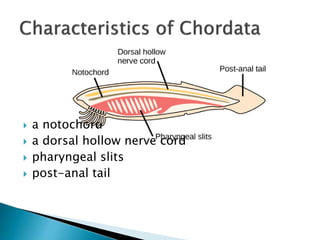
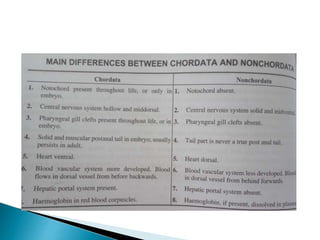
 a notochord
 a dorsal hollow nerve cord
 pharyngeal slits
 post-anal tail
 These characteristics are sometimes present
only during embryonic development in some
chordates.
 The notochord provides skeletal support, gives
the phylum its name, and develops into the
vertebral column in vertebrates.
 The dorsal hollow nerve cord develops into the
central nervous system: the brain and spine.
 Pharyngeal slits are openings in the pharynx
that develop into gill arches in bony fish and
into the jaw and inner ear in terrestrial animals.
 The post-anal tail is absent in humans and
apes, although present during embryonic
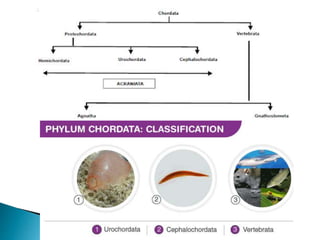
 Urochordata
 Cephalaochordata
 Vertebrata
 The first two phyla have very few species in
between them.
 The major subphylum is Vertebrata, where
you come across a variety of fishes, reptiles,
birds and animals.
 The subphylum Urochordata
and Cephalochordata are
collectively known
as protochordates, which are
marine animals.
 They are invertebrates but
they share attributes of
chordates.
 https://www.youtube.com/wat
 Hemichordata is bilaterally symmetrical and triploblastic animal.
 They are exclusively marine animals.
 They can be solitary or in colonies.
 Hemichordata have a true body cavity or coelom.
 The digestive tract is complete with an anus and can be in the form
of a U shaped tube or straight.
 A buccal diverticulum is present in the proboscis.
 Body is divided into three regions – Proboscis, Collar and Trunk.
 Circulatory system in open type.
 Respiration occurs through gills.
 The proboscis has a glomerulus, which is the excretory organ.
 A primitive nervous system is present.
 Sexes are separate or united.
 Reproduction is mostly sexual reproduction.
 Fertilization is external.
 Development is mostly indirect. But a few species exhibit direct
development.
Subphylum Urochordata
Characteristics of Urochordata:-
The adults are fixed to the substratum.
Possesses a Notochord,a hollow nerve cord seen only in the larval
stage and disappears in the adults.
A post anal tail is present.
Body has more than two cell layers and includes tissues and organs.
Has a U shaped gut.
Body has no coelomic body cavity.
Are hermaphroditic, normally with only one ovary and testis.
Has no excretory organs.
Has a distinct larval stage. The larva can move and undergoes
metamorphosis.
All are filter feeders.
Live in marine environments.
About 2,000 species currently known.
 The atrium is present.
 Motile adult and larval stage.
 The tail is present throughout life.
 They show progressive metamorphosis.
 The notochord is found throughout life.
 A large number of well-developed pharyngeal gill
slits are present.
 For eg., Lancelets possess the notochord and
nerve cord throughout their life. However, they
lack the brain and bony vertebral column like
Branchiostoma.
 These are advanced chordates and have cranium
around the brain.
 The notochord is replaced by a vertebral column in
adults. This is why it is said that ‘all vertebrates are
chordates but all chordates are not vertebrates’.
 A high degree of cephalization is observed.
 The epidermis is multi-layered.
 They have a well-developed coelom.
 The alimentary canal is complete.
 The heart is three or four-chambered.
 They have well-developed respiratory and excretory
systems
 Endocrine glands are present in all.
 They are unisexual and reproduce sexually
 For eg., humans.
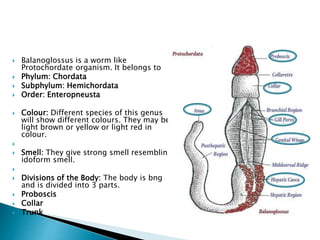
 Balanoglossus is a worm like
Protochordate organism. It belongs to
 Phylum: Chordata
 Subphylum: Hemichordata
 Order: Enteropneusta
 Colour: Different species of this genus
will show different colours. They may be
light brown or yellow or light red in
colour.

 Smell: They give strong smell resembling
idoform smell.

 Divisions of the Body: The body is bng
and is divided into 3 parts.
 Proboscis
 Collar
 Trunk
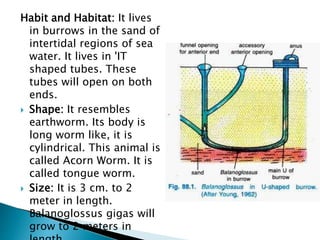
Habit and Habitat: It lives
in burrows in the sand of
intertidal regions of sea
water. It lives in 'IT
shaped tubes. These
tubes will open on both
ends.
 Shape: It resembles
earthworm. Its body is
long worm like, it is
cylindrical. This animal is
called Acorn Worm. It is
called tongue worm.
 Size: It is 3 cm. to 2
meter in length.
Balanoglossus gigas will
grow to 2 meters in
 Presence of worm like-body.
 Presence of burrowing or tubicolous habit.
 Presence of dorsal heart.
 Presence of similar blood vascular system in
both groups.
 Presence of ventral nerve cord.
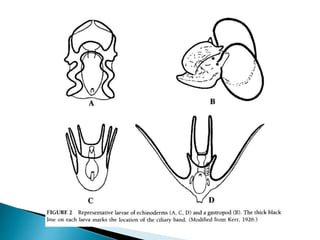
 Tornaria resembles trochophore larva of
annelids.
 Resemblences:
Presence of poorly developed nervous system.
 Tornaria resembles Bipinnaria of echinoderm.
Resemblences:
 Presence of notochord.
 Presence of dorsal tubular nerve cord.
 Presence of pharyngeal gills.
 The structure of pharynx resemble in both
groups.
 The stomochord of Balanoglossus should not
be compared with the notochord. Stomochord
is present only in the proboscis. It is not
covered by sheaths. It is hoilow. It will not
give strength hence it should not be called
notochord.
 Balanoglossus will show ventral nerve cord.
 Balanoglossus dorsal nerve cord is hollow in
the collar region only.
 In Balanoglossus the gills are present towards
dorsal side, but in chordales they are lateral .
 Most probably Hemichordates and chordates
might have evolved from the same ancestor.
 Newman kept this group in between
echinoderma and chordate.
 Hyman considered them as invertebrates
 Pisces
 Amphibia
 Reptilia
 Aves
 Mammalia
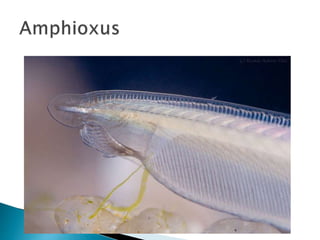
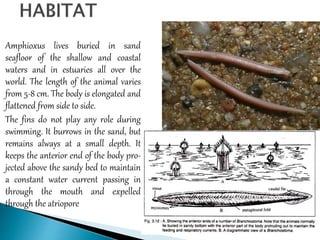
 Amphioxus lives buried in sand
seafloor of the shallow and coastal
waters and in estuaries all over the
world. The length of the animal varies
from 5-8 cm. The body is elongated and
flattened from side to side.
 The fins do not play any role during
swimming. It burrows in the sand, but
remains always at a small depth. It
keeps the anterior end of the body pro-
jected above the sandy bed to maintain
a constant water current passing in
through the mouth and expelled
through the atriopore
 All the features of Chordata visible,
 Notochord: dorsal bar placed under the nervous system with a skeletal
function.
 Epineuria: dorsal position of nerve cord.
 Endostyle: ventral groove in the pharynx that produce mucus to catch
food and also produce iodized compounds. This gives thyroid.
 Caudal fin: locomotive appendix.
 (1) Head with paired sense organs.
 (2) Brain enclosed in cranium with 10 pairs of cranial nerves.
 (3) Muscular three chambered heart.
 (4) Leucocytes and erythrocytes in the blood.
 (5) Lymphatic vessels.
 (6) Sympathetic nervous system.
 (7) Lateral line sense organs.
 (8) Mesonephros type of kidney in the adult.
 (9) Bilobed liver with gall-bladder.
 (10) Beginning of segmented vertebral column.
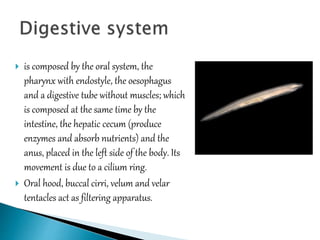
 is composed by the oral system, the
pharynx with endostyle, the oesophagus
and a digestive tube without muscles; which
is composed at the same time by the
intestine, the hepatic cecum (produce
enzymes and absorb nutrients) and the
anus, placed in the left side of the body. Its
movement is due to a cilium ring.
 Oral hood, buccal cirri, velum and velar
tentacles act as filtering apparatus.
 Circulatory system doesn’t have heart and
consists on two circuits: the ventral circuit
goes from caudal fin to head and the dorsal,
the other way around. The circulatory liquid
goes to pharynx fissures to become
oxygenated and has amebocytes, but it has
not respiratory pigments, so breathing takes
places by diffusion.
 1. Notochord extends from anterior projection to posterior and persists throughout
life.
 2. Single-layered epidermis.
 3. Myotomic segmentation.
 4. The alimentary canal is straight and without loops.
 5. The liver diverticulum is simple.
 6. Ciliary mode of feeding.
 7. Simple circulatory system without a specialised heart.
 8. Segmental nephridia which have no coelomoducts.
 9. Presence of endostyle.
 10. Dorsal and ventral roots of spinal nerves are separate.
 11. Gonads are segmentally arranged and without ducts.
 12. Absence of biting jaws.
 13. Absence of paired fins.
 14. Formation of anterior coelomic pouches.
 15. Eggs are small and almost yolkless.
 16. Blastula is hollow and spherical.
 17. Gastrulation embolic.
 18. Sedentary in habit.
 19. Reduced brain and sense organs.
 20. Notochord extending far to the cerebral vesicle.
 1. Large spacious pharynx.
 2. Large number of gill-slits as compared with the body segments.
 3. Oral hood, buccal cirri, velum and velar tentacles act as filtering
apparatus.
 4. Development of atrium reduces and displaces the coelom.
 Similarities:
 (i) The body is bilaterally symmetrical and segmented;
 (ii) Nephridia are segmentally arranged and are provided with solenocytes;
 (iii) Presence of well-formed coelom;
 (iv) Similarity in the disposition of the blood vascular system.
 Dissimilarities:
 (i) In annelids, segmentation is present throughout the length of the body, whereas in
Branchiostoma the segmentation is restricted only to the myotomal region;
 (ii) The development of coelom is also different. It is schizocoelic in annelids and enterocoelic
in Branchiostoma;
 (iii) Although the arrangement of the main longitudinal blood vessels is more or less similar
in both, the direction of the flow of blood is opposite;
 (iv) Branchiostoma possesses all the diagnostic features of the chordates, like the notochord,
dorsal tubular nerve cord and gill-slits. None of these three structures are observed in
annelids.
 The ciliary modes of feeding and respiratory mechanism in
Branchiostoma resemble closely that of oysters. At the time of its
discovery, Pallas (1778) regarded the specimen to be a slug and named it
Limax. The segmentation in Branchiostoma is a very important
characteristic, but in molluscs the body is mostly un-segmented. The
molluscan locomotor organ (foot) has no parallel in Branchiostoma.
 The anatomy of Branchiostoma is completely different from that of
molluscs. The superficial resemblances in the feeding and respiratory
mechanisms may be interpreted as the result of physiological con-
vergence for similar mode of living and it has no phylogenetic
significance.
Proto chordata

Proto chordata

  • 1.
     a notochord a dorsal hollow nerve cord  pharyngeal slits  post-anal tail
  • 2.
     These characteristicsare sometimes present only during embryonic development in some chordates.  The notochord provides skeletal support, gives the phylum its name, and develops into the vertebral column in vertebrates.  The dorsal hollow nerve cord develops into the central nervous system: the brain and spine.  Pharyngeal slits are openings in the pharynx that develop into gill arches in bony fish and into the jaw and inner ear in terrestrial animals.  The post-anal tail is absent in humans and apes, although present during embryonic
  • 5.
     Urochordata  Cephalaochordata Vertebrata  The first two phyla have very few species in between them.  The major subphylum is Vertebrata, where you come across a variety of fishes, reptiles, birds and animals.
  • 6.
     The subphylumUrochordata and Cephalochordata are collectively known as protochordates, which are marine animals.  They are invertebrates but they share attributes of chordates.  https://www.youtube.com/wat
  • 7.
     Hemichordata isbilaterally symmetrical and triploblastic animal.  They are exclusively marine animals.  They can be solitary or in colonies.  Hemichordata have a true body cavity or coelom.  The digestive tract is complete with an anus and can be in the form of a U shaped tube or straight.  A buccal diverticulum is present in the proboscis.  Body is divided into three regions – Proboscis, Collar and Trunk.  Circulatory system in open type.  Respiration occurs through gills.  The proboscis has a glomerulus, which is the excretory organ.  A primitive nervous system is present.  Sexes are separate or united.  Reproduction is mostly sexual reproduction.  Fertilization is external.  Development is mostly indirect. But a few species exhibit direct development.
  • 8.
    Subphylum Urochordata Characteristics ofUrochordata:- The adults are fixed to the substratum. Possesses a Notochord,a hollow nerve cord seen only in the larval stage and disappears in the adults. A post anal tail is present. Body has more than two cell layers and includes tissues and organs. Has a U shaped gut. Body has no coelomic body cavity. Are hermaphroditic, normally with only one ovary and testis. Has no excretory organs. Has a distinct larval stage. The larva can move and undergoes metamorphosis. All are filter feeders. Live in marine environments. About 2,000 species currently known.
  • 9.
     The atriumis present.  Motile adult and larval stage.  The tail is present throughout life.  They show progressive metamorphosis.  The notochord is found throughout life.  A large number of well-developed pharyngeal gill slits are present.  For eg., Lancelets possess the notochord and nerve cord throughout their life. However, they lack the brain and bony vertebral column like Branchiostoma.
  • 10.
     These areadvanced chordates and have cranium around the brain.  The notochord is replaced by a vertebral column in adults. This is why it is said that ‘all vertebrates are chordates but all chordates are not vertebrates’.  A high degree of cephalization is observed.  The epidermis is multi-layered.  They have a well-developed coelom.  The alimentary canal is complete.  The heart is three or four-chambered.  They have well-developed respiratory and excretory systems  Endocrine glands are present in all.  They are unisexual and reproduce sexually  For eg., humans.
  • 11.
     Balanoglossus isa worm like Protochordate organism. It belongs to  Phylum: Chordata  Subphylum: Hemichordata  Order: Enteropneusta  Colour: Different species of this genus will show different colours. They may be light brown or yellow or light red in colour.   Smell: They give strong smell resembling idoform smell.   Divisions of the Body: The body is bng and is divided into 3 parts.  Proboscis  Collar  Trunk
  • 12.
    Habit and Habitat:It lives in burrows in the sand of intertidal regions of sea water. It lives in 'IT shaped tubes. These tubes will open on both ends.  Shape: It resembles earthworm. Its body is long worm like, it is cylindrical. This animal is called Acorn Worm. It is called tongue worm.  Size: It is 3 cm. to 2 meter in length. Balanoglossus gigas will grow to 2 meters in
  • 13.
     Presence ofworm like-body.  Presence of burrowing or tubicolous habit.  Presence of dorsal heart.  Presence of similar blood vascular system in both groups.  Presence of ventral nerve cord.  Tornaria resembles trochophore larva of annelids.
  • 14.
     Resemblences: Presence ofpoorly developed nervous system.  Tornaria resembles Bipinnaria of echinoderm.
  • 15.
    Resemblences:  Presence ofnotochord.  Presence of dorsal tubular nerve cord.  Presence of pharyngeal gills.  The structure of pharynx resemble in both groups.
  • 16.
     The stomochordof Balanoglossus should not be compared with the notochord. Stomochord is present only in the proboscis. It is not covered by sheaths. It is hoilow. It will not give strength hence it should not be called notochord.  Balanoglossus will show ventral nerve cord.  Balanoglossus dorsal nerve cord is hollow in the collar region only.  In Balanoglossus the gills are present towards dorsal side, but in chordales they are lateral .
  • 17.
     Most probablyHemichordates and chordates might have evolved from the same ancestor.  Newman kept this group in between echinoderma and chordate.  Hyman considered them as invertebrates
  • 18.
     Pisces  Amphibia Reptilia  Aves  Mammalia
  • 20.
     Amphioxus livesburied in sand seafloor of the shallow and coastal waters and in estuaries all over the world. The length of the animal varies from 5-8 cm. The body is elongated and flattened from side to side.  The fins do not play any role during swimming. It burrows in the sand, but remains always at a small depth. It keeps the anterior end of the body pro- jected above the sandy bed to maintain a constant water current passing in through the mouth and expelled through the atriopore
  • 21.
     All thefeatures of Chordata visible,  Notochord: dorsal bar placed under the nervous system with a skeletal function.  Epineuria: dorsal position of nerve cord.  Endostyle: ventral groove in the pharynx that produce mucus to catch food and also produce iodized compounds. This gives thyroid.  Caudal fin: locomotive appendix.
  • 22.
     (1) Headwith paired sense organs.  (2) Brain enclosed in cranium with 10 pairs of cranial nerves.  (3) Muscular three chambered heart.  (4) Leucocytes and erythrocytes in the blood.  (5) Lymphatic vessels.  (6) Sympathetic nervous system.  (7) Lateral line sense organs.  (8) Mesonephros type of kidney in the adult.  (9) Bilobed liver with gall-bladder.  (10) Beginning of segmented vertebral column.
  • 23.
     is composedby the oral system, the pharynx with endostyle, the oesophagus and a digestive tube without muscles; which is composed at the same time by the intestine, the hepatic cecum (produce enzymes and absorb nutrients) and the anus, placed in the left side of the body. Its movement is due to a cilium ring.  Oral hood, buccal cirri, velum and velar tentacles act as filtering apparatus.
  • 24.
     Circulatory systemdoesn’t have heart and consists on two circuits: the ventral circuit goes from caudal fin to head and the dorsal, the other way around. The circulatory liquid goes to pharynx fissures to become oxygenated and has amebocytes, but it has not respiratory pigments, so breathing takes places by diffusion.
  • 25.
     1. Notochordextends from anterior projection to posterior and persists throughout life.  2. Single-layered epidermis.  3. Myotomic segmentation.  4. The alimentary canal is straight and without loops.  5. The liver diverticulum is simple.  6. Ciliary mode of feeding.  7. Simple circulatory system without a specialised heart.  8. Segmental nephridia which have no coelomoducts.  9. Presence of endostyle.  10. Dorsal and ventral roots of spinal nerves are separate.  11. Gonads are segmentally arranged and without ducts.  12. Absence of biting jaws.  13. Absence of paired fins.  14. Formation of anterior coelomic pouches.  15. Eggs are small and almost yolkless.  16. Blastula is hollow and spherical.  17. Gastrulation embolic.  18. Sedentary in habit.  19. Reduced brain and sense organs.  20. Notochord extending far to the cerebral vesicle.
  • 26.
     1. Largespacious pharynx.  2. Large number of gill-slits as compared with the body segments.  3. Oral hood, buccal cirri, velum and velar tentacles act as filtering apparatus.  4. Development of atrium reduces and displaces the coelom.
  • 27.
     Similarities:  (i)The body is bilaterally symmetrical and segmented;  (ii) Nephridia are segmentally arranged and are provided with solenocytes;  (iii) Presence of well-formed coelom;  (iv) Similarity in the disposition of the blood vascular system.  Dissimilarities:  (i) In annelids, segmentation is present throughout the length of the body, whereas in Branchiostoma the segmentation is restricted only to the myotomal region;  (ii) The development of coelom is also different. It is schizocoelic in annelids and enterocoelic in Branchiostoma;  (iii) Although the arrangement of the main longitudinal blood vessels is more or less similar in both, the direction of the flow of blood is opposite;  (iv) Branchiostoma possesses all the diagnostic features of the chordates, like the notochord, dorsal tubular nerve cord and gill-slits. None of these three structures are observed in annelids.
  • 28.
     The ciliarymodes of feeding and respiratory mechanism in Branchiostoma resemble closely that of oysters. At the time of its discovery, Pallas (1778) regarded the specimen to be a slug and named it Limax. The segmentation in Branchiostoma is a very important characteristic, but in molluscs the body is mostly un-segmented. The molluscan locomotor organ (foot) has no parallel in Branchiostoma.  The anatomy of Branchiostoma is completely different from that of molluscs. The superficial resemblances in the feeding and respiratory mechanisms may be interpreted as the result of physiological con- vergence for similar mode of living and it has no phylogenetic significance.