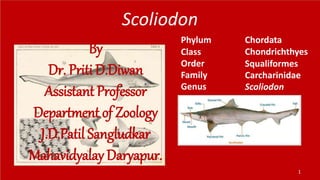
Scoliodon
Phylum
Class
Order
Family
Genus
Chordata
Chondrichthyes
Squaliformes
Carcharinidae
Scoliodon
1
By
Dr. Priti D.Diwan
Assistant Professor
Department of Zoology
J.D.Patil Sangludkar
Mahavidyalay Daryapur.
Habits and habitat
• Marine
• Carnivorous
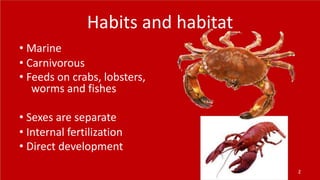
• Feeds on crabs, lobsters,
worms and fishes
• Sexes are separate
• Internal fertilization
• Direct development
2
Body
• Elongated, fusiform (spindle shaped) body.
• Fully grown fish measures about 60 cm.
• Body divided into head, trunk and tail.
• Fins: fins are flap like outgrowth of the body wall, internally
supported by cartilaginous rods.
• Fins are both paired and unpaired.
3
Skin
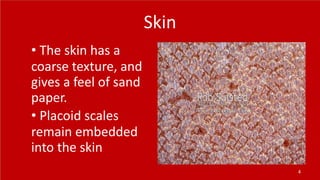
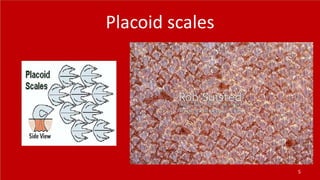
• The skin has a
coarse texture, and
gives a feel of sand
paper.
• Placoid scales
remain embedded
into the skin
4
Placoid scales
5
Digestive system
• The digestive system includes the alimentary
canal or gut and the glands that open into it
• Digestion is the process of simplification
of the complex food material, which can be
absorbed and assimilated by the body
6
Alimentary canal
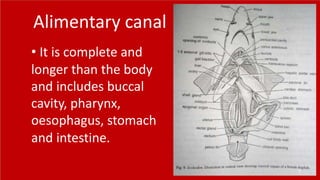
• It is complete and
longer than the body
and includes buccal
cavity, pharynx,
oesophagus, stomach
and intestine.
7
Mouth
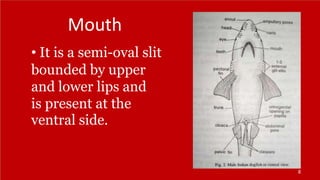
• It is a semi-oval slit
bounded by upper
and lower lips and
is present at the
ventral side.
8
Buccal cavity
• Mouth leads into a spacious dorso-ventrally flattened
mouth cavity bordered by the jaws. Teeth are homodont
and are embedded in the skin, sharply pointed and
directed backwards.
• They are polyphyodont (replaced several times during the
life) and arranged in many rows. Teeth help in grasping
the prey.
• On the floor of the buccal cavity lies the so called tongue.
It is merely a thick, flat, non-muscular, non-glandular and
non-protrusible fold of mucous membrane supported
internally by the flat cartilage
9
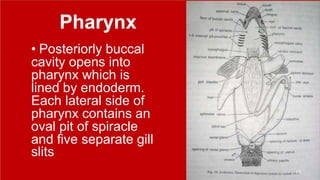
Pharynx
• Posteriorly buccal
cavity opens into
pharynx which is
lined by endoderm.
Each lateral side of
pharynx contains an
oval pit of spiracle
and five separate gill
slits
10
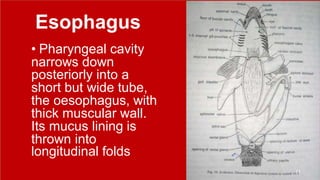
Esophagus
• Pharyngeal cavity
narrows down
posteriorly into a
short but wide tube,
the oesophagus, with
thick muscular wall.
Its mucus lining is
thrown into
longitudinal folds
11
Stomach
•
•
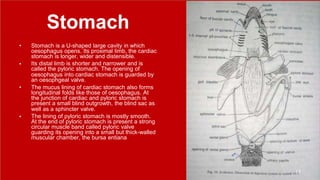
Stomach is a U-shaped large cavity in which
oesophagus opens. Its proximal limb, the cardiac
stomach is longer, wider and distensible.
Its distal limb is shorter and narrower and is
called the pyloric stomach. The opening of
oesophagus into cardiac stomach is guarded by
an oesophgeal valve.
•
•
The mucus lining of cardiac stomach also forms
longitudinal folds like those of oesophagus. At
the junction of cardiac and pyloric stomach is
present a small blind outgrowth, the blind sac as
well as a sphincter valve.
The lining of pyloric stomach is mostly smooth.
At the end of pyloric stomach is present a strong
circular muscle band called pyloric valve
guarding its opening into a small but thick-walled
muscular chamber, the bursa entiana
12
Intestine
•
•
•
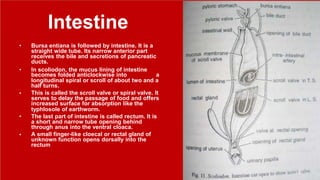
Bursa entiana is followed by intestine. It is a
straight wide tube. Its narrow anterior part
receives the bile and secretions of pancreatic
ducts.
In scoliodon, the mucus lining of intestine
becomes folded anticlockwise into a
longitudinal spiral or scroll of about two and a
half turns.
This is called the scroll valve or spiral valve. It
serves to delay the passage of food and offers
increased surface for absorption like the
typhlosole of earthworm.
•
•
The last part of intestine is called rectum. It is
a short and narrow tube opening behind
through anus into the ventral cloaca.
A small finger-like cloecal or rectal gland of
unknown function opens dorsally into the
rectum
13
Glands of
alimentary
canal
Liver
• It is a massive yellowish bilobed gland. The two lobes extend backward
freely into abdominal cavity, but they are united anteriorly and are attached
to septum transversum by a ligament.
• A V-shaped thin walled gall bladder, in which bile is collected, lies
embedded in the right lobe of liver.
• A narrow bile duct, about 3 cm long, leaves the gall bladder and opens into
the anterior end of the intestine.
• Bile duct also receives branches from the lobes of liver. It secretes bile,
stores glycogen and fat and destroys worn out erythrocytes of blood
14
Pancreas
• It is a compact whitish or pale bilobed gland
consisting of a longer dorsal lobe running
parallel to the posterior part of cardiac
stomach and a smaller ventral lobe closely
applied to the pyloric stomach. The small
pancreatic duct traverses the entire length of
the gland to open into the intestine just
opposite the opening of the bile duct
15
Caecal or rectal gland
• It is a small finger like body attached by its
duct to the dorsal side of rectum into which
it opens. It is highly vascular and
composed of lymphoid tissue. Its function
is unknown
16
Food and feeding
• It is carnivorous, feeding on crustacean, annelids
and small fishes. It is voracious feeder and can
smell the food from long distances.
• Due to ventral position of mouth it has to turn to
one side to capture prey. The lower jaw is opened
by coraco mandibular muscles. The escape of
struggling prey is prevented by backward directed
teeth.
17
Food and physiology of
digestion
• Scoliodon is a predaceous carnivore feeding mainly on other
fishes. Its diet may also include crabs, lobsters and worms.
• Food as a whole is swallowed; no digestion takes place in
buccal cavity. Main digestion occurs in the stomach by the
action of Pepsin and HCI of gastric juice.
• Bile and pancreatic juice containing trypsinogen, amylopsin
and lipase act upon the semi-digested food in the intestine.
• Scroll valve in intestine serves to retard the speed of passage
of food to extend the time of digestion and increase the
surface of absorption
18
References
• Kotpal, R. L. (2010), Modern text book of
Zoology: Vertebrates, Rastogi Publications,
New Delhi, India
19
End
20

scoliodon

  • 1.
  • 2.
    Habits and habitat •Marine • Carnivorous • Feeds on crabs, lobsters, worms and fishes • Sexes are separate • Internal fertilization • Direct development 2
  • 3.
    Body • Elongated, fusiform(spindle shaped) body. • Fully grown fish measures about 60 cm. • Body divided into head, trunk and tail. • Fins: fins are flap like outgrowth of the body wall, internally supported by cartilaginous rods. • Fins are both paired and unpaired. 3
  • 4.
    Skin • The skinhas a coarse texture, and gives a feel of sand paper. • Placoid scales remain embedded into the skin 4
  • 5.
  • 6.
    Digestive system • Thedigestive system includes the alimentary canal or gut and the glands that open into it • Digestion is the process of simplification of the complex food material, which can be absorbed and assimilated by the body 6
  • 7.
    Alimentary canal • Itis complete and longer than the body and includes buccal cavity, pharynx, oesophagus, stomach and intestine. 7
  • 8.
    Mouth • It isa semi-oval slit bounded by upper and lower lips and is present at the ventral side. 8
  • 9.
    Buccal cavity • Mouthleads into a spacious dorso-ventrally flattened mouth cavity bordered by the jaws. Teeth are homodont and are embedded in the skin, sharply pointed and directed backwards. • They are polyphyodont (replaced several times during the life) and arranged in many rows. Teeth help in grasping the prey. • On the floor of the buccal cavity lies the so called tongue. It is merely a thick, flat, non-muscular, non-glandular and non-protrusible fold of mucous membrane supported internally by the flat cartilage 9
  • 10.
    Pharynx • Posteriorly buccal cavityopens into pharynx which is lined by endoderm. Each lateral side of pharynx contains an oval pit of spiracle and five separate gill slits 10
  • 11.
    Esophagus • Pharyngeal cavity narrowsdown posteriorly into a short but wide tube, the oesophagus, with thick muscular wall. Its mucus lining is thrown into longitudinal folds 11
  • 12.
    Stomach • • Stomach is aU-shaped large cavity in which oesophagus opens. Its proximal limb, the cardiac stomach is longer, wider and distensible. Its distal limb is shorter and narrower and is called the pyloric stomach. The opening of oesophagus into cardiac stomach is guarded by an oesophgeal valve. • • The mucus lining of cardiac stomach also forms longitudinal folds like those of oesophagus. At the junction of cardiac and pyloric stomach is present a small blind outgrowth, the blind sac as well as a sphincter valve. The lining of pyloric stomach is mostly smooth. At the end of pyloric stomach is present a strong circular muscle band called pyloric valve guarding its opening into a small but thick-walled muscular chamber, the bursa entiana 12
  • 13.
    Intestine • • • Bursa entiana isfollowed by intestine. It is a straight wide tube. Its narrow anterior part receives the bile and secretions of pancreatic ducts. In scoliodon, the mucus lining of intestine becomes folded anticlockwise into a longitudinal spiral or scroll of about two and a half turns. This is called the scroll valve or spiral valve. It serves to delay the passage of food and offers increased surface for absorption like the typhlosole of earthworm. • • The last part of intestine is called rectum. It is a short and narrow tube opening behind through anus into the ventral cloaca. A small finger-like cloecal or rectal gland of unknown function opens dorsally into the rectum 13
  • 14.
    Glands of alimentary canal Liver • Itis a massive yellowish bilobed gland. The two lobes extend backward freely into abdominal cavity, but they are united anteriorly and are attached to septum transversum by a ligament. • A V-shaped thin walled gall bladder, in which bile is collected, lies embedded in the right lobe of liver. • A narrow bile duct, about 3 cm long, leaves the gall bladder and opens into the anterior end of the intestine. • Bile duct also receives branches from the lobes of liver. It secretes bile, stores glycogen and fat and destroys worn out erythrocytes of blood 14
  • 15.
    Pancreas • It isa compact whitish or pale bilobed gland consisting of a longer dorsal lobe running parallel to the posterior part of cardiac stomach and a smaller ventral lobe closely applied to the pyloric stomach. The small pancreatic duct traverses the entire length of the gland to open into the intestine just opposite the opening of the bile duct 15
  • 16.
    Caecal or rectalgland • It is a small finger like body attached by its duct to the dorsal side of rectum into which it opens. It is highly vascular and composed of lymphoid tissue. Its function is unknown 16
  • 17.
    Food and feeding •It is carnivorous, feeding on crustacean, annelids and small fishes. It is voracious feeder and can smell the food from long distances. • Due to ventral position of mouth it has to turn to one side to capture prey. The lower jaw is opened by coraco mandibular muscles. The escape of struggling prey is prevented by backward directed teeth. 17
  • 18.
    Food and physiologyof digestion • Scoliodon is a predaceous carnivore feeding mainly on other fishes. Its diet may also include crabs, lobsters and worms. • Food as a whole is swallowed; no digestion takes place in buccal cavity. Main digestion occurs in the stomach by the action of Pepsin and HCI of gastric juice. • Bile and pancreatic juice containing trypsinogen, amylopsin and lipase act upon the semi-digested food in the intestine. • Scroll valve in intestine serves to retard the speed of passage of food to extend the time of digestion and increase the surface of absorption 18
  • 19.
    References • Kotpal, R.L. (2010), Modern text book of Zoology: Vertebrates, Rastogi Publications, New Delhi, India 19
  • 20.