Amina
Senyawa Organik Basa
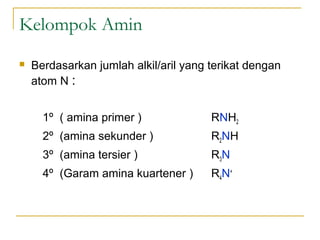
Kelompok Amin
 Berdasarkan jumlah alkil/aril yang terikat dengan
atom N :
1º ( amina primer ) RNH2
2º (amina sekunder ) R2NH
3º (amina tersier ) R3N
4º (Garam amina kuartener ) R4N+
Penamaan amina sederhana
 Amina primer sederhanan “alkilamina”
 Contoh :
 metillamina CH3NH2
 etilamin CH3CH2NH2
 butilamin CH3CH2CH2CH2NH2
 Amina 2º atau 3º simetris “dialkilamina” atau
“trialkiamina”
 Contoh:
 dietilamina (CH3CH2)2NH; trimetilamina (CH3)3N
Penamaan amina lebih lanjut
 Amina dengan lebih dari satu jenis gugus alkil
dinamai N-subtituen amina primer . Rantai alkil
terpanjang menentukan nama dasar .
 Contoh
 N-methylpropylamine CH3NHCH2CH2CH3
 N,N-dimethylethylamine (CH3)2NCH2CH3
Penamaan lebih lanjut
 Amina yang mempunyai lebih dari satu gugus fungsi
menggunakan namanya “amino” sebagai substituen
pada molekul induknya
 Prioritas N paling rendah dibandingkan dengan gugus
fungsi lainnya : amina < etanol, maka N-amino----
 Examples:
 2-aminoethanol H2NCH2CH2OH
 4-aminobutanoic acid H2NCH2CH2CH2CO2H
Amina Heterosiklik
 Amina yang unsur N merupakan bagian dari
penyusun cincin . Penamaannya tidak sistemantik
(non-systematic),
NH2
N N
N
N
H
N
N
H
N
H
N
N
H
N
aniline pyridine pyrimidine pyrrole
quinoline indole imidazole benzimidazole
Struktur amines
 Amina mempunyai sp3
hybridized nitrogen
 In principle, tertiary amines with three different R
groups should be chiral (i.e., have a stereocenter).
 However, rapid pyramidal inversion of the amine
nitrogen prevents isolation of the enantiomers
except where the nitrogen is part of a ring or has
other geometrical constraint.
N
Y
Z
X
N
Y
Z
X
fast
Properties of amines
 Amines are moderately polar and are capable of
hydrogen bonding.
 Low MW amines (up to about C5) are soluble in
water; higher MW amines will dissolve in acidic
solution (as their conjugate acid).
 Many amines have foul odors.
 Amines are weak bases.
Contoh amina biologically active
H2NCH2CH2CH2CH2NH2 putrescine H2NCH2CH2CH2CH2CH2NH2 cadaverine
H2NCH2CH2CH2CH2NCH2CH2CH2CH2NH2
spermidineH
H2N(CH2)N(CH2)4N(CH2)3NH2
spermineH H
NHCH3
OHH
HO
HO
epinephrine
(adrenaline)
NH2
OHH
HO
HO
norepinephrine
(noradrenaline)
NH2HO
HO
dopamine
Lanjut …
NH2
CH3H
amphetamine
(benzadrine)
N
CH2CH2NH2
HO
H
NHCH3
CH3H
methamphetamine
(speed)
serotonin
mescaline
NH2CH3O
CH3O
OCH3
N
CO2H
nicotinic acid
(niacin)
NN
CH2CH2NH2
H
histamine
Lanjut-----
H2N C OCH2CH3
O
benzocaine
(a topical anesthetic)
Cl
N
N
H
O
O
diazepam (Valium)
N
N
O
N
N
CH3
CH2CH2CH3
H
SO
O
N
N
CH3
CH3CH2O
Sildenafil (Viagra)
Lanjut-----
R'O
O
RO
NCH3
codeine (R = CH3, R' = H)
morphine (R and R' = H)
heroin (R and R' = COCH3)
mepiridine
(Demerol)
N
N
N
N
O
O
CH3
H3C
CH3
caffeine
N
N
CH3
H
nicotine
N
H3C
C
O
H
O
C
O
H
OCH3
cocaine
NCH3C
O
CH3CH2O
Methadone
C6H5 NCH3C
O
CH3CH2
CH3
CH3
Lanjut -----
N
HO
H
N
H
H
quinine
N
O
N
O
H
H
strychnine
N
N
H
C
O
(CH3CH2)2N
CH3
lysergic acid diethylamide (LSD)
N
H
CH2CH2CH3
H
coniin (the poison from
hemlock used to kill Socrates)
Kebassan amina
 Amin sedikit basa, karena mempunyai pasangan
elektron bebas dapat mendonorkan ke proton,
bersifat nucleophiles.
 Amina mempunyai nilai Kb = 10-3
to 10-4
RNH2 + H OH RNH3 + OH
Kb =
[RNH3 ] [OH ]
[RNH2]
Kebasaan amina -------
 Biasa digunakan nilai Ka asam konjugat amina
 Asam konjugat lebih lemah, lebih basa (amina)
 Amina sejenis mempunyai Ka values (conjugate
acids) dari 10-10
sampai 10-11
(nilai pKa 10 sampai
11.)
RNH3 RNH2 + H Ka =
[RNH3 ]
[RNH2] [H ]
Nilai pKa asam konjugat amina
CH3NH2 10.7
CH3CH2NH2 10.8
(CH3)2NH 10.7
(CH3CH2)2NH 10.5
(CH3)3N 9.8
(CH3CH2)3N 11.0
pKa = 14 – pKb atau pKb = 14 - pKa
Semua nya mempunyai nilai
yang sama .
Efek substituen sama
menstabilkan karbokation,
maka .
Gugus pelepas elektron
(alkil) , pada nitrogen
menaikkan kebasaan
N nya lebih banyak mengikat
substituen gugs alkil nilai
pKa lebih rendah (kurang
asam atau lebih basa)
Kebasaan amina
 1. Jika amina bebas terstabilkan terhadap
kationnya, maka amina merupakan basa
yang lebih lemah
 2. Jika kation itu relatf terstabilkan terhadap
amina bebasnya , maka aminanya basa lebih
kuat
Amina basanya lemah
(conj. acid)
 Anilin basa lemah karena adanya delokalisasi
elektron melalui resonansi
 Pyridine is weaker because it is an imine (C=N).
 Pyrrole is much weaker because the lp of electrons is
delocalized with the other π electrons to make 6 π e-.
Therefore, the lp is unavailable to act as a base.
aniline pyridine pyrrole
pKa = 4.6 5.2 0.4
NH2
N
N
H
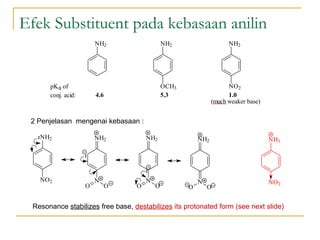
Efek Substituent pada kebasaan anilin
Resonance stabilizes free base, destabilizes its protonated form (see next slide)
2 Penjelasan mengenai kebasaan :
NH2 NH2
OCH3
NH2
NO2pKa of
conj. acid: 5.3 1.04.6
(much weaker base)
NH2
NO2
NH2
N
OO
NH2
N
OO
NH2
N
OO
NH3
NO2
Pengaruh Substituent pada kebassan
Anilin
NH3
NH3CH3O
NH3O2N
Reaction progress (protonation)
Energy
Amina yang tingkat kebasan lebih kuat
 Hanya satu jenis amine : basanya lebih kuat
 Basa guanidin Guanidine basa kuat karena asam
konjugatnya terstabilkan melalui resonansi
guanidine
pKa = 13.6
(conj. acid)
A guanidine group is part of the structure of the amino acid arginine.
NH
C
H2N NH2
NH2
C
H2N NH2
NH2
C
H2N NH2
NH2
C
H2N NH2
NH2
C
H2N NH2
Amina terprotonasi pada pH Physiological
 Persamaan Henderson-Hasselbalch :
 Consider the neurotransmitter dopamine, a typical amine (having a pKa of its
conjugate acid = 10.6) in a living cell (buffered at pH = 7.3):
 That is, the concentration of the protonated amine is 2000x that of the
neutral amine! Typical amines are >99.9% protonated at physiological pH.
pH = pKa + log
[RNH2]
[RNH3
+
]
7.3 = 10.6 + log
[RNH2]
[RNH3
+
]
log
[RNH2]
[RNH3
+
]
-3.3 =
[RNH2]
[RNH3
+
]
2 x 10
3
=
;
;
[RNH2]
[RNH3
+
]
5 x 10
- 4
=
Sintesis Amina
 Sintesis amina, melalui :
reaksi Substitusi, reaksi reduksi dan
penataan ulang
a. Substitusi Nu :
SN2 OH-
a. RX + NH3 RNH3
+
X-
RNH2
b. Reduksi
c. Penataan ulang amida :
Chapter 19 24
Electrophilic Substitution
of Aniline
 -NH2 is strong activator, o-,p-directing.
 May trisubstitute with excess reagent.
 H+
changes -NH2 to -NH3
+
, a meta-directing
deactivator.
 Attempt to nitrate aniline may explode.
=>
Chapter 19 25
Aniline Substitution
=>
Chapter 19 26
Electrophilic Substitution
of Pyridine
 Strongly deactivated by electronegative N.
 Substitutes in the 3-position.
 Electrons on N react with electrophile.
N
fuming H2SO4
HgSO4, 230
o
C
N
SO3H
=>
Chapter 19 27
Nucleophilic Substitution
of Pyridine
 Deactivated toward electrophilic attack.
 Activated toward nucleophilic attack.
 Nucleophile will replace a good leaving
group in the 2- or 4-position.
N Cl
OCH3
_
N OCH3
+ Cl
_
=>
Chapter 19 28
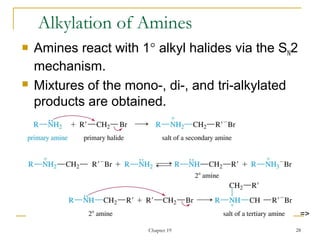
Alkylation of Amines
 Amines react with 1° alkyl halides via the SN2
mechanism.
 Mixtures of the mono-, di-, and tri-alkylated
products are obtained.
=>
Chapter 19 29
Useful Alkylations
 Exhaustive alkylation to form the
tetraalkylammonium salt.
CH3CH2CHCH2CH2CH3
N(CH3)3
CH3CH2CHCH2CH2CH3
NH2
3 CH3I
NaHCO3
+ _
I
• Reaction with large excess of NH3 to
form the primary amine.
CH3CH2CH2Br
NH3 (xs)
CH3CH2CH2NH2 + NH4Br
=>
Chapter 19 30
Acylation of Amines
by Acid Chlorides
 Amine attacks C=O, chloride ion leaves.
 Product is amide, neutral, not basic.
 Useful for decreasing activity of aniline toward
electrophilic aromatic substitution.
NH2
CH3 C
O
Cl
N
H
C
O
CH3
N
to remove HCl
=>
Chapter 19 31
Formation of Sulfonamides
 Primary or secondary amines react with
sulfonyl chloride.
R NH2 S
O
O
R' Cl S
O
O
R' NH R
H
+
Cl
_
base S
O
O
R' NH R
• Sulfa drugs are sulfonamides
that are antibacterial agents.
NH2
S OO
NH2
=>
Chapter 19 32
Oxidation of Amines
 Amines are easily oxidized, even in air.
 Common oxidizing agents: H2O2 , MCPBA.
 2° Amines oxidize to hydroxylamine (-NOH)
 3° Amines oxidize to amine oxide (-N+
-O-
)
=>
Chapter 19 33
Nitrous Acid Reagent
 Nitrous acid is produced in situ by mixing
sodium nitrite with HCl.
 The nitrous acid is protonated, loses water
to form the nitrosonium ion.
H O N O
H
+
H O N O
H
+
H2O + N O
+
N O
+
=>
Chapter 19 34
Reaction with Nitrous Acid
 1° Amines form diazonium salts, R-N+
≡N.
 Alkyldiazonium salts are unstable, but
arenediazonium salts are widely used for
synthesis.
 2° Amines form N-nitrosoamines, R2N-N=O,
found to cause cancer in laboratory animals.
=>
Chapter 19 35
Arenediazonium Salts
 Stable in solution at 0°–10°C.
 The -+
N≡N group is easily replaced by
many different groups.
 Nitrogen gas, N2, is a by-product.
HBF4 (KI)
H3O
+
CuCl (Br)
CuCN
H3PO2
H Ar'
Ar N N
+
Ar OH
Ar Cl
Ar C N
Ar F
Ar H
Ar N N Ar'
(Br)
(I)
phenols
aryl halides
benzonitriles
aryl halides
benzene
azo dyes =>
Chapter 19 36
Synthesis by
Reductive Amination
 To produce a 1° amine, react an aldehyde
or ketone with hydroxylamine, then reduce
the oxime.
 To produce a 2° amine, react an aldehyde
or ketone with a 1° amine, then reduce the
imine.
 To produce a 3° amine, react an aldehyde
or ketone with a 2° amine, then reduce the
imine salt. =>
Chapter 19 37
Examples
primary amine
CH3CH2CH2 CH
NH2
CH3
Ni
H2
CH3CH2CH2 C
N
CH3
OH
H
+
NH2 OH
CH3CH2CH2 C
O
CH3
secondary amine
CH3 CH
NHCH3
CH3
2)
1)
H2O
LiAlH4
CH3 C
NCH3
CH3
H
+
CH3NH2
CH3 C
O
CH3
tertiary amine
=>
C
N
H
CH3H3C
H
Na(CH3COO)3BHC
N
H
CH3H3C
+
H
+
HN(CH3)2C
O
H
CH3COOH
Chapter 19 38
Acylation-Reduction
 An acid chloride reacts with ammonia or a 1°
amine or a 2° amine to form an amide.
 The C=O of the amide is reduced to CH2
with lithium aluminum hydride.
 Ammonia yields a 1° amine.
 A 1° amine yields a 2° amine.
 A 2° amine yields a 3° amine.
=>
Chapter 19 39
Examples
CH3 C
O
Cl
NH3
CH3 C
O
NH2
LiAlH4
H2O
1)
2)
CH3 CH2 NH2
primary amine
LiAlH4
H2O
1)
2)
C
O
Cl
HN(CH3)2
C
O
N(CH3)2
CH2 N(CH3)2
tertiary amine
=>
Chapter 19 40
Direct Alkylation (1°)
 Use a large excess (10:1) of ammonia with
a primary alkyl halide or tosylate.
 Reaction mechanism is SN2.
CH3CH2CH2 Br
NH3
+CH3CH2CH2 NH2 NH4Br
=>
Chapter 19 41
Azide Reduction (1°)
 Azide ion, N3
-
, is a good nucleophile.
 React azide with unhindered 1° or 2° halide
or tosylate (SN2).
 Alkyl azides are explosive! Do not isolate.
Br
NaN3
N3
LiAlH4
H2O
1)
2)
NH2
=>
Chapter 19 42
Nitrile Reduction (1°)
 Nitrile, -C≡N, is a good SN2 nucleophile.
 Reduction with H2 or LiAlH4 adds -CH2NH2.
Br
NaCN
CN
LiAlH4
H2O
1)
2)
CH2NH2
=>
Chapter 19 43
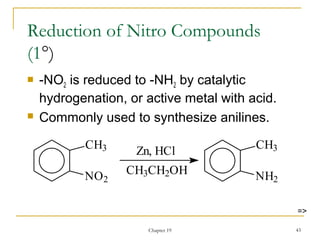
Reduction of Nitro Compounds
(1°)
 -NO2 is reduced to -NH2 by catalytic
hydrogenation, or active metal with acid.
 Commonly used to synthesize anilines.
CH3
NO2
Zn, HCl
CH3CH2OH
CH3
NH2
=>
Chapter 19 44
Hofmann Rearrangement of Amides
(1°)
In the presence of a strong base, primary
amides react with chlorine or bromine to
form amines with one less C.
C
O
NH2
H2O
Br2, OH
_
NH2
=>
Chapter 19 45
Gabriel Synthesis (1°)
 Use the phthalimide anion as a form of
ammonia that can only alkylate once.
 React the anion with a good SN2 substrate,
then heat with hydrazine.
+N
O
O
_
R X
N
O
O
R H2N NH2
heat
NH
NH
O
O
R NH2
=>

Amina baru

  • 1.
  • 2.
    Kelompok Amin  Berdasarkanjumlah alkil/aril yang terikat dengan atom N : 1º ( amina primer ) RNH2 2º (amina sekunder ) R2NH 3º (amina tersier ) R3N 4º (Garam amina kuartener ) R4N+
  • 3.
    Penamaan amina sederhana Amina primer sederhanan “alkilamina”  Contoh :  metillamina CH3NH2  etilamin CH3CH2NH2  butilamin CH3CH2CH2CH2NH2  Amina 2º atau 3º simetris “dialkilamina” atau “trialkiamina”  Contoh:  dietilamina (CH3CH2)2NH; trimetilamina (CH3)3N
  • 4.
    Penamaan amina lebihlanjut  Amina dengan lebih dari satu jenis gugus alkil dinamai N-subtituen amina primer . Rantai alkil terpanjang menentukan nama dasar .  Contoh  N-methylpropylamine CH3NHCH2CH2CH3  N,N-dimethylethylamine (CH3)2NCH2CH3
  • 5.
    Penamaan lebih lanjut Amina yang mempunyai lebih dari satu gugus fungsi menggunakan namanya “amino” sebagai substituen pada molekul induknya  Prioritas N paling rendah dibandingkan dengan gugus fungsi lainnya : amina < etanol, maka N-amino----  Examples:  2-aminoethanol H2NCH2CH2OH  4-aminobutanoic acid H2NCH2CH2CH2CO2H
  • 6.
    Amina Heterosiklik  Aminayang unsur N merupakan bagian dari penyusun cincin . Penamaannya tidak sistemantik (non-systematic), NH2 N N N N H N N H N H N N H N aniline pyridine pyrimidine pyrrole quinoline indole imidazole benzimidazole
  • 7.
    Struktur amines  Aminamempunyai sp3 hybridized nitrogen  In principle, tertiary amines with three different R groups should be chiral (i.e., have a stereocenter).  However, rapid pyramidal inversion of the amine nitrogen prevents isolation of the enantiomers except where the nitrogen is part of a ring or has other geometrical constraint. N Y Z X N Y Z X fast
  • 8.
    Properties of amines Amines are moderately polar and are capable of hydrogen bonding.  Low MW amines (up to about C5) are soluble in water; higher MW amines will dissolve in acidic solution (as their conjugate acid).  Many amines have foul odors.  Amines are weak bases.
  • 9.
    Contoh amina biologicallyactive H2NCH2CH2CH2CH2NH2 putrescine H2NCH2CH2CH2CH2CH2NH2 cadaverine H2NCH2CH2CH2CH2NCH2CH2CH2CH2NH2 spermidineH H2N(CH2)N(CH2)4N(CH2)3NH2 spermineH H NHCH3 OHH HO HO epinephrine (adrenaline) NH2 OHH HO HO norepinephrine (noradrenaline) NH2HO HO dopamine
  • 10.
  • 11.
    Lanjut----- H2N C OCH2CH3 O benzocaine (atopical anesthetic) Cl N N H O O diazepam (Valium) N N O N N CH3 CH2CH2CH3 H SO O N N CH3 CH3CH2O Sildenafil (Viagra)
  • 12.
    Lanjut----- R'O O RO NCH3 codeine (R =CH3, R' = H) morphine (R and R' = H) heroin (R and R' = COCH3) mepiridine (Demerol) N N N N O O CH3 H3C CH3 caffeine N N CH3 H nicotine N H3C C O H O C O H OCH3 cocaine NCH3C O CH3CH2O Methadone C6H5 NCH3C O CH3CH2 CH3 CH3
  • 13.
    Lanjut ----- N HO H N H H quinine N O N O H H strychnine N N H C O (CH3CH2)2N CH3 lysergic aciddiethylamide (LSD) N H CH2CH2CH3 H coniin (the poison from hemlock used to kill Socrates)
  • 14.
    Kebassan amina  Aminsedikit basa, karena mempunyai pasangan elektron bebas dapat mendonorkan ke proton, bersifat nucleophiles.  Amina mempunyai nilai Kb = 10-3 to 10-4 RNH2 + H OH RNH3 + OH Kb = [RNH3 ] [OH ] [RNH2]
  • 15.
    Kebasaan amina ------- Biasa digunakan nilai Ka asam konjugat amina  Asam konjugat lebih lemah, lebih basa (amina)  Amina sejenis mempunyai Ka values (conjugate acids) dari 10-10 sampai 10-11 (nilai pKa 10 sampai 11.) RNH3 RNH2 + H Ka = [RNH3 ] [RNH2] [H ]
  • 16.
    Nilai pKa asamkonjugat amina CH3NH2 10.7 CH3CH2NH2 10.8 (CH3)2NH 10.7 (CH3CH2)2NH 10.5 (CH3)3N 9.8 (CH3CH2)3N 11.0 pKa = 14 – pKb atau pKb = 14 - pKa Semua nya mempunyai nilai yang sama . Efek substituen sama menstabilkan karbokation, maka . Gugus pelepas elektron (alkil) , pada nitrogen menaikkan kebasaan N nya lebih banyak mengikat substituen gugs alkil nilai pKa lebih rendah (kurang asam atau lebih basa)
  • 17.
    Kebasaan amina  1.Jika amina bebas terstabilkan terhadap kationnya, maka amina merupakan basa yang lebih lemah  2. Jika kation itu relatf terstabilkan terhadap amina bebasnya , maka aminanya basa lebih kuat
  • 18.
    Amina basanya lemah (conj.acid)  Anilin basa lemah karena adanya delokalisasi elektron melalui resonansi  Pyridine is weaker because it is an imine (C=N).  Pyrrole is much weaker because the lp of electrons is delocalized with the other π electrons to make 6 π e-. Therefore, the lp is unavailable to act as a base. aniline pyridine pyrrole pKa = 4.6 5.2 0.4 NH2 N N H
  • 19.
    Efek Substituent padakebasaan anilin Resonance stabilizes free base, destabilizes its protonated form (see next slide) 2 Penjelasan mengenai kebasaan : NH2 NH2 OCH3 NH2 NO2pKa of conj. acid: 5.3 1.04.6 (much weaker base) NH2 NO2 NH2 N OO NH2 N OO NH2 N OO NH3 NO2
  • 20.
    Pengaruh Substituent padakebassan Anilin NH3 NH3CH3O NH3O2N Reaction progress (protonation) Energy
  • 21.
    Amina yang tingkatkebasan lebih kuat  Hanya satu jenis amine : basanya lebih kuat  Basa guanidin Guanidine basa kuat karena asam konjugatnya terstabilkan melalui resonansi guanidine pKa = 13.6 (conj. acid) A guanidine group is part of the structure of the amino acid arginine. NH C H2N NH2 NH2 C H2N NH2 NH2 C H2N NH2 NH2 C H2N NH2 NH2 C H2N NH2
  • 22.
    Amina terprotonasi padapH Physiological  Persamaan Henderson-Hasselbalch :  Consider the neurotransmitter dopamine, a typical amine (having a pKa of its conjugate acid = 10.6) in a living cell (buffered at pH = 7.3):  That is, the concentration of the protonated amine is 2000x that of the neutral amine! Typical amines are >99.9% protonated at physiological pH. pH = pKa + log [RNH2] [RNH3 + ] 7.3 = 10.6 + log [RNH2] [RNH3 + ] log [RNH2] [RNH3 + ] -3.3 = [RNH2] [RNH3 + ] 2 x 10 3 = ; ; [RNH2] [RNH3 + ] 5 x 10 - 4 =
  • 23.
    Sintesis Amina  Sintesisamina, melalui : reaksi Substitusi, reaksi reduksi dan penataan ulang a. Substitusi Nu : SN2 OH- a. RX + NH3 RNH3 + X- RNH2 b. Reduksi c. Penataan ulang amida :
  • 24.
    Chapter 19 24 ElectrophilicSubstitution of Aniline  -NH2 is strong activator, o-,p-directing.  May trisubstitute with excess reagent.  H+ changes -NH2 to -NH3 + , a meta-directing deactivator.  Attempt to nitrate aniline may explode. =>
  • 25.
    Chapter 19 25 AnilineSubstitution =>
  • 26.
    Chapter 19 26 ElectrophilicSubstitution of Pyridine  Strongly deactivated by electronegative N.  Substitutes in the 3-position.  Electrons on N react with electrophile. N fuming H2SO4 HgSO4, 230 o C N SO3H =>
  • 27.
    Chapter 19 27 NucleophilicSubstitution of Pyridine  Deactivated toward electrophilic attack.  Activated toward nucleophilic attack.  Nucleophile will replace a good leaving group in the 2- or 4-position. N Cl OCH3 _ N OCH3 + Cl _ =>
  • 28.
    Chapter 19 28 Alkylationof Amines  Amines react with 1° alkyl halides via the SN2 mechanism.  Mixtures of the mono-, di-, and tri-alkylated products are obtained. =>
  • 29.
    Chapter 19 29 UsefulAlkylations  Exhaustive alkylation to form the tetraalkylammonium salt. CH3CH2CHCH2CH2CH3 N(CH3)3 CH3CH2CHCH2CH2CH3 NH2 3 CH3I NaHCO3 + _ I • Reaction with large excess of NH3 to form the primary amine. CH3CH2CH2Br NH3 (xs) CH3CH2CH2NH2 + NH4Br =>
  • 30.
    Chapter 19 30 Acylationof Amines by Acid Chlorides  Amine attacks C=O, chloride ion leaves.  Product is amide, neutral, not basic.  Useful for decreasing activity of aniline toward electrophilic aromatic substitution. NH2 CH3 C O Cl N H C O CH3 N to remove HCl =>
  • 31.
    Chapter 19 31 Formationof Sulfonamides  Primary or secondary amines react with sulfonyl chloride. R NH2 S O O R' Cl S O O R' NH R H + Cl _ base S O O R' NH R • Sulfa drugs are sulfonamides that are antibacterial agents. NH2 S OO NH2 =>
  • 32.
    Chapter 19 32 Oxidationof Amines  Amines are easily oxidized, even in air.  Common oxidizing agents: H2O2 , MCPBA.  2° Amines oxidize to hydroxylamine (-NOH)  3° Amines oxidize to amine oxide (-N+ -O- ) =>
  • 33.
    Chapter 19 33 NitrousAcid Reagent  Nitrous acid is produced in situ by mixing sodium nitrite with HCl.  The nitrous acid is protonated, loses water to form the nitrosonium ion. H O N O H + H O N O H + H2O + N O + N O + =>
  • 34.
    Chapter 19 34 Reactionwith Nitrous Acid  1° Amines form diazonium salts, R-N+ ≡N.  Alkyldiazonium salts are unstable, but arenediazonium salts are widely used for synthesis.  2° Amines form N-nitrosoamines, R2N-N=O, found to cause cancer in laboratory animals. =>
  • 35.
    Chapter 19 35 ArenediazoniumSalts  Stable in solution at 0°–10°C.  The -+ N≡N group is easily replaced by many different groups.  Nitrogen gas, N2, is a by-product. HBF4 (KI) H3O + CuCl (Br) CuCN H3PO2 H Ar' Ar N N + Ar OH Ar Cl Ar C N Ar F Ar H Ar N N Ar' (Br) (I) phenols aryl halides benzonitriles aryl halides benzene azo dyes =>
  • 36.
    Chapter 19 36 Synthesisby Reductive Amination  To produce a 1° amine, react an aldehyde or ketone with hydroxylamine, then reduce the oxime.  To produce a 2° amine, react an aldehyde or ketone with a 1° amine, then reduce the imine.  To produce a 3° amine, react an aldehyde or ketone with a 2° amine, then reduce the imine salt. =>
  • 37.
    Chapter 19 37 Examples primaryamine CH3CH2CH2 CH NH2 CH3 Ni H2 CH3CH2CH2 C N CH3 OH H + NH2 OH CH3CH2CH2 C O CH3 secondary amine CH3 CH NHCH3 CH3 2) 1) H2O LiAlH4 CH3 C NCH3 CH3 H + CH3NH2 CH3 C O CH3 tertiary amine => C N H CH3H3C H Na(CH3COO)3BHC N H CH3H3C + H + HN(CH3)2C O H CH3COOH
  • 38.
    Chapter 19 38 Acylation-Reduction An acid chloride reacts with ammonia or a 1° amine or a 2° amine to form an amide.  The C=O of the amide is reduced to CH2 with lithium aluminum hydride.  Ammonia yields a 1° amine.  A 1° amine yields a 2° amine.  A 2° amine yields a 3° amine. =>
  • 39.
    Chapter 19 39 Examples CH3C O Cl NH3 CH3 C O NH2 LiAlH4 H2O 1) 2) CH3 CH2 NH2 primary amine LiAlH4 H2O 1) 2) C O Cl HN(CH3)2 C O N(CH3)2 CH2 N(CH3)2 tertiary amine =>
  • 40.
    Chapter 19 40 DirectAlkylation (1°)  Use a large excess (10:1) of ammonia with a primary alkyl halide or tosylate.  Reaction mechanism is SN2. CH3CH2CH2 Br NH3 +CH3CH2CH2 NH2 NH4Br =>
  • 41.
    Chapter 19 41 AzideReduction (1°)  Azide ion, N3 - , is a good nucleophile.  React azide with unhindered 1° or 2° halide or tosylate (SN2).  Alkyl azides are explosive! Do not isolate. Br NaN3 N3 LiAlH4 H2O 1) 2) NH2 =>
  • 42.
    Chapter 19 42 NitrileReduction (1°)  Nitrile, -C≡N, is a good SN2 nucleophile.  Reduction with H2 or LiAlH4 adds -CH2NH2. Br NaCN CN LiAlH4 H2O 1) 2) CH2NH2 =>
  • 43.
    Chapter 19 43 Reductionof Nitro Compounds (1°)  -NO2 is reduced to -NH2 by catalytic hydrogenation, or active metal with acid.  Commonly used to synthesize anilines. CH3 NO2 Zn, HCl CH3CH2OH CH3 NH2 =>
  • 44.
    Chapter 19 44 HofmannRearrangement of Amides (1°) In the presence of a strong base, primary amides react with chlorine or bromine to form amines with one less C. C O NH2 H2O Br2, OH _ NH2 =>
  • 45.
    Chapter 19 45 GabrielSynthesis (1°)  Use the phthalimide anion as a form of ammonia that can only alkylate once.  React the anion with a good SN2 substrate, then heat with hydrazine. +N O O _ R X N O O R H2N NH2 heat NH NH O O R NH2 =>