IBOC TECHNOLOGY


          PRESENTED BY,
          MARIA JOSEPH


                          1
CONTENTS

   Introduction
   Why Digital Radio?
   What is IBOC
   Eureka 147
   Block diagram
   IBOC modes of operation
   IBOC implementation Techniques
   Benefits of DAB
   Why delay in adoption?
                                     2
INTRODUCTION

 Digital radio, also called digital audio broadcasting
  (DAB), is transmission and reception of radio signals in
  the digital domain, as opposed to the traditional
  analogue transmission/reception by AM and FM systems.
 Digital radio is similar to hooking up the digital output
  from a CD player directly to a radio transmitter. At the
  other end is a digital-to-analogue converter (DAC), which
  converts the digital signal back into analogue mode so
  that it can be heard on the audio system as it was
  recorded.
 In practice, the CD player is hooked up to a control board,
  which, in turn, routes the signal as part of the feed to the
  radio station’s transmitter.
                                                                 3
 The signal is either impressed onto a signal
  carrier and transmitted via uplink to a satellite
  or transmitted across the land.
 In both the cases, the signal is received and
  converted into analogue by a specialized DAC
  within the radio’s tuner circuit.
 Currently, digital radio broadcasts are
  available in select countries, including the UK ,
  Germany and Canada.


                                                      4
Why Digital Radio?

 The main advantage of digital radio is that it doesn’t
  have the usual distortion associated with analogue radio
  such as hissing, popping and phasing.
 It is immune to distortion from multipath, adjacent
  stations.
 User get a new array of data-rich services including
  traffic information, sports score and weather updates,
  stock prices, etc..
 The data is displayed on the LCD in the form of text,
  images and video. Thus multimedia radio becomes
  reality.
                                                             5
Contd…

 To explain, in analogue radio, a large number of radio
  signals can exist in the atmosphere at any time. However
  each of them is being transmitted on a different radio
  frequency. Stations that share the same radio frequency
  are usually far apart so that they don’t interface with
  each other. In order to receive a station within its
  transmission range, all we have to do is tune the receiver
  to its frequency.
 The drawback of this analogue mode is that the signals in
  close proximity in terms of frequency can interfere with
  each other to some extent, depending on the modulation
  pattern of the radio station and the ability of the radio
  receiver to reject interfering adjacent signals.
                                                               6
What is IBOC?

 In-band on -channel (IBOC) is a hybrid
 method of transmitting digital radio and
 analog radio broadcast signals
 simultaneously on the same frequency.


                                            7
IBOC: a new system

 The IBOC technology allows digital audio broadcasting
  without the need for new spectrum allocations for the
  digital signal.
 The IBOC system will be compatible with existing tuners
  as it utilizes the existing AM and FM bands by attaching a
  digital side band signal to the standard analogue signal.
 For digital compression, the IBOC uses a perceptual
  audio coder (PAC) developed by Lucent Technology.
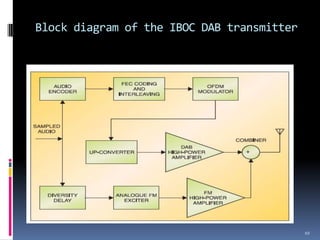
 The USADR AM IBOC DAB system basically comprises
  the codec, forward error correction(FEC) coding, and
  interleaving section, modem and blender.

                                                               8
Eureka 147: The digital radio
system in use
 Uses at much higher frequencies than standard 88-
    108Mhz FM band and 0.525-1.705MHz AM band.
   UK utilizes Band III (174-240 MHz)
   Canada uses L-Band (1452-1492MHz)
   The eureka system broadcasts multiple stations and
    services over a single frequency in something called a
    multiplex.
   The bandwidth within the multiplex is allotted to stations
    as needed.
   Stereo programming is typically broadcast at 192kilobits.

                                                                 9
Block diagram of the IBOC DAB transmitter


                                            10
IBOC modes of operation

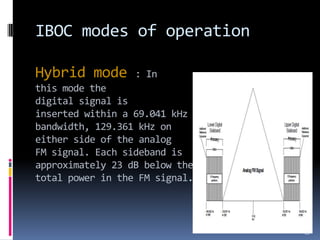
Hybrid mode       : In
this mode the
digital signal is
inserted within a 69.041 kHz
bandwidth, 129.361 kHz on
either side of the analog
FM signal. Each sideband is
approximately 23 dB below the
total power in the FM signal.


                                11
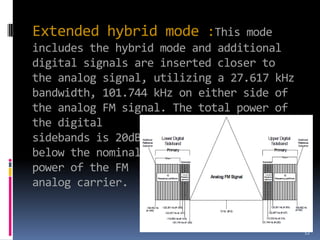
Extended hybrid mode :This        mode
includes the hybrid mode and additional
digital signals are inserted closer to
the analog signal, utilizing a 27.617 kHz
bandwidth, 101.744 kHz on either side of
the analog FM signal. The total power of
the digital
sidebands is 20dB
below the nominal
power of the FM
analog carrier.


                                            12
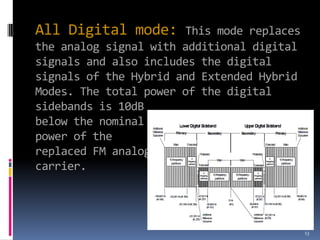
All Digital mode:      This mode replaces
the analog signal with additional digital
signals and also includes the digital
signals of the Hybrid and Extended Hybrid
Modes. The total power of the digital
sidebands is 10dB
below the nominal
power of the
replaced FM analog
carrier.


                                            13
IBOC implementation Technique

 The requirement for FM-to-IBOC isolation is also
 somewhat difficult to achieve in practice because of the
 power ratio between FM and IBOC(100:1).

 In a combiner that has to deal with a 1:1 power
 combining ratio, a 26 dB isolation seems to be fine.

 There are a few techniques used to combine FM and
 IBOC signals.


                                                            14
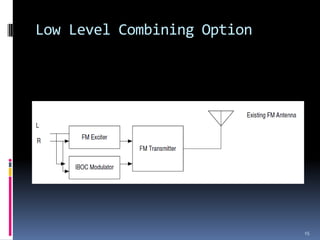
Low Level Combining Option


                             15
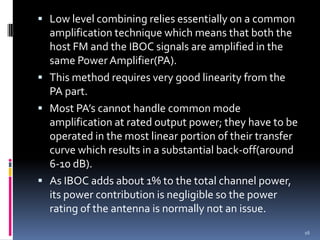
 Low level combining relies essentially on a common
  amplification technique which means that both the
  host FM and the IBOC signals are amplified in the
  same Power Amplifier(PA).
 This method requires very good linearity from the
  PA part.
 Most PA’s cannot handle common mode
  amplification at rated output power; they have to be
  operated in the most linear portion of their transfer
  curve which results in a substantial back-off(around
  6-10 dB).
 As IBOC adds about 1% to the total channel power,
  its power contribution is negligible so the power
  rating of the antenna is normally not an issue.
                                                          16
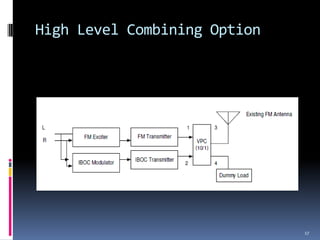
High Level Combining Option


                              17
 High level combining is based on the use of
  distinct power amplifiers for the Host FM and
  the IBOC signals.
 This technique uses an IBOC Power injector
  which is basically an inverted directional
  coupler
 Its power ratio is selected to minimize the
  loss on the host path, typically 0.5 dB.
 Such an injector offers a loss of about 10 dB
  on the IBOC path


                                                  18
Benefits of Digital Audio
Broadcasting
 High quality digital audio
 Reliable delivery to fixed, portable and mobile receivers
    for interference-free reception.
   Efficient use of the limited radio frequency spectrum
    available.
   Easy to use receivers.
   Flexibility and choice of programmes for listeners.
   Added-value system features such as multimedia.


                                                              19
Why delay in adoption?

 Low power FM stations are prone to
  interference.
 IBOC licensing, and service rules have not
  been adopted yet.
 Cost is high.


                                               20
REFERENCES

 http://www.fcc.gov/encyclopedia/iboc-digital-radio-
  broadcasting-am-and-fm-radio-broadcast-stations
 http://transition.fcc.gov/mb/audio/includes/23-
  digital.htm
 http://www.ibiquity.com/
 http://www.fcc.gov/mb/audio/digital.html
 http://www.worlddab.org/introduction_to_digital_broad
  casting/dab_plus_digital_radio
 http://www.owdjim.gen.nz/chris/radio/DRM/


                                                          21

IBOC TECHNOLOGY

  • 1.
    IBOC TECHNOLOGY PRESENTED BY, MARIA JOSEPH 1
  • 2.
    CONTENTS  Introduction  Why Digital Radio?  What is IBOC  Eureka 147  Block diagram  IBOC modes of operation  IBOC implementation Techniques  Benefits of DAB  Why delay in adoption? 2
  • 3.
    INTRODUCTION  Digital radio,also called digital audio broadcasting (DAB), is transmission and reception of radio signals in the digital domain, as opposed to the traditional analogue transmission/reception by AM and FM systems.  Digital radio is similar to hooking up the digital output from a CD player directly to a radio transmitter. At the other end is a digital-to-analogue converter (DAC), which converts the digital signal back into analogue mode so that it can be heard on the audio system as it was recorded.  In practice, the CD player is hooked up to a control board, which, in turn, routes the signal as part of the feed to the radio station’s transmitter. 3
  • 4.
     The signalis either impressed onto a signal carrier and transmitted via uplink to a satellite or transmitted across the land.  In both the cases, the signal is received and converted into analogue by a specialized DAC within the radio’s tuner circuit.  Currently, digital radio broadcasts are available in select countries, including the UK , Germany and Canada. 4
  • 5.
    Why Digital Radio? The main advantage of digital radio is that it doesn’t have the usual distortion associated with analogue radio such as hissing, popping and phasing.  It is immune to distortion from multipath, adjacent stations.  User get a new array of data-rich services including traffic information, sports score and weather updates, stock prices, etc..  The data is displayed on the LCD in the form of text, images and video. Thus multimedia radio becomes reality. 5
  • 6.
    Contd…  To explain,in analogue radio, a large number of radio signals can exist in the atmosphere at any time. However each of them is being transmitted on a different radio frequency. Stations that share the same radio frequency are usually far apart so that they don’t interface with each other. In order to receive a station within its transmission range, all we have to do is tune the receiver to its frequency.  The drawback of this analogue mode is that the signals in close proximity in terms of frequency can interfere with each other to some extent, depending on the modulation pattern of the radio station and the ability of the radio receiver to reject interfering adjacent signals. 6
  • 7.
    What is IBOC? In-band on -channel (IBOC) is a hybrid method of transmitting digital radio and analog radio broadcast signals simultaneously on the same frequency. 7
  • 8.
    IBOC: a newsystem  The IBOC technology allows digital audio broadcasting without the need for new spectrum allocations for the digital signal.  The IBOC system will be compatible with existing tuners as it utilizes the existing AM and FM bands by attaching a digital side band signal to the standard analogue signal.  For digital compression, the IBOC uses a perceptual audio coder (PAC) developed by Lucent Technology.  The USADR AM IBOC DAB system basically comprises the codec, forward error correction(FEC) coding, and interleaving section, modem and blender. 8
  • 9.
    Eureka 147: Thedigital radio system in use  Uses at much higher frequencies than standard 88- 108Mhz FM band and 0.525-1.705MHz AM band.  UK utilizes Band III (174-240 MHz)  Canada uses L-Band (1452-1492MHz)  The eureka system broadcasts multiple stations and services over a single frequency in something called a multiplex.  The bandwidth within the multiplex is allotted to stations as needed.  Stereo programming is typically broadcast at 192kilobits. 9
  • 10.
    Block diagram ofthe IBOC DAB transmitter 10
  • 11.
    IBOC modes ofoperation Hybrid mode : In this mode the digital signal is inserted within a 69.041 kHz bandwidth, 129.361 kHz on either side of the analog FM signal. Each sideband is approximately 23 dB below the total power in the FM signal. 11
  • 12.
    Extended hybrid mode:This mode includes the hybrid mode and additional digital signals are inserted closer to the analog signal, utilizing a 27.617 kHz bandwidth, 101.744 kHz on either side of the analog FM signal. The total power of the digital sidebands is 20dB below the nominal power of the FM analog carrier. 12
  • 13.
    All Digital mode: This mode replaces the analog signal with additional digital signals and also includes the digital signals of the Hybrid and Extended Hybrid Modes. The total power of the digital sidebands is 10dB below the nominal power of the replaced FM analog carrier. 13
  • 14.
    IBOC implementation Technique The requirement for FM-to-IBOC isolation is also somewhat difficult to achieve in practice because of the power ratio between FM and IBOC(100:1). In a combiner that has to deal with a 1:1 power combining ratio, a 26 dB isolation seems to be fine. There are a few techniques used to combine FM and IBOC signals. 14
  • 15.
  • 16.
     Low levelcombining relies essentially on a common amplification technique which means that both the host FM and the IBOC signals are amplified in the same Power Amplifier(PA).  This method requires very good linearity from the PA part.  Most PA’s cannot handle common mode amplification at rated output power; they have to be operated in the most linear portion of their transfer curve which results in a substantial back-off(around 6-10 dB).  As IBOC adds about 1% to the total channel power, its power contribution is negligible so the power rating of the antenna is normally not an issue. 16
  • 17.
  • 18.
     High levelcombining is based on the use of distinct power amplifiers for the Host FM and the IBOC signals.  This technique uses an IBOC Power injector which is basically an inverted directional coupler  Its power ratio is selected to minimize the loss on the host path, typically 0.5 dB.  Such an injector offers a loss of about 10 dB on the IBOC path 18
  • 19.
    Benefits of DigitalAudio Broadcasting  High quality digital audio  Reliable delivery to fixed, portable and mobile receivers for interference-free reception.  Efficient use of the limited radio frequency spectrum available.  Easy to use receivers.  Flexibility and choice of programmes for listeners.  Added-value system features such as multimedia. 19
  • 20.
    Why delay inadoption?  Low power FM stations are prone to interference.  IBOC licensing, and service rules have not been adopted yet.  Cost is high. 20
  • 21.
    REFERENCES  http://www.fcc.gov/encyclopedia/iboc-digital-radio- broadcasting-am-and-fm-radio-broadcast-stations  http://transition.fcc.gov/mb/audio/includes/23- digital.htm  http://www.ibiquity.com/  http://www.fcc.gov/mb/audio/digital.html  http://www.worlddab.org/introduction_to_digital_broad casting/dab_plus_digital_radio  http://www.owdjim.gen.nz/chris/radio/DRM/ 21