Pulmonary gas exchange
Presented by - Dr. Mahtab Alam (JR1)
Moderator - Dr. Satish Kumar (MD)
Pulmonary gaseous exchange
The importance of pulmonary gas exchange - the
inhalational agents depend on the lung for uptake and
elimination
Physical principle of gas exchange
• Partial pressure
– The pressure exerted by each type of gas in a
mixture
• Concentration of a gas in a liquid
– determined by its partial pressure and its
solubility coefficient
Pulmonary gas exchange
. Therefore, the pressure exerted by any one gas in a
mixture of gases (its partial pressure) is equal to the
total pressure times the fraction of the total amount
of gas it represents.
 pio2 = Pb × Fio2
Pulmonary gas exchange
 Two general rules can also be used: •
 Partial pressure in milimeters of mercury
approximates the percentage × 7 •
 Partial pressure in kilopascals is approximately the
same as the percentage
Pulmonary gas exchange
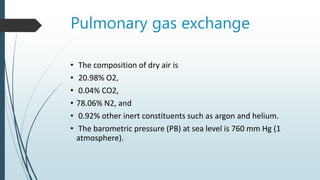
• The composition of dry air is
• 20.98% O2,
• 0.04% CO2,
• 78.06% N2, and
• 0.92% other inert constituents such as argon and helium.
• The barometric pressure (PB) at sea level is 760 mm Hg (1
atmosphere).
Pulmonary gas exchange
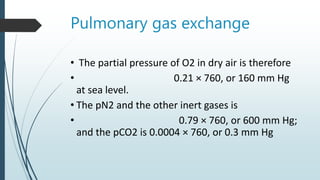
• The partial pressure of O2 in dry air is therefore
• 0.21 × 760, or 160 mm Hg
at sea level.
• The pN2 and the other inert gases is
• 0.79 × 760, or 600 mm Hg;
and the pCO2 is 0.0004 × 760, or 0.3 mm Hg
Pulmonary gas exchange
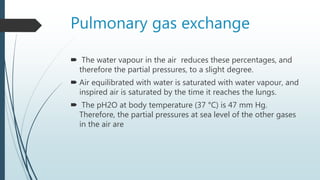
 The water vapour in the air reduces these percentages, and
therefore the partial pressures, to a slight degree.
 Air equilibrated with water is saturated with water vapour, and
inspired air is saturated by the time it reaches the lungs.
 The pH2O at body temperature (37 °C) is 47 mm Hg.
Therefore, the partial pressures at sea level of the other gases
in the air are
Pulmonary gas exchange
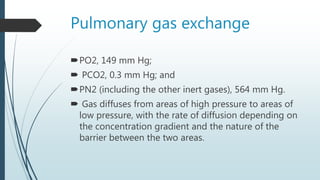
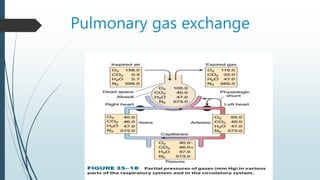
PO2, 149 mm Hg;
 PCO2, 0.3 mm Hg; and
PN2 (including the other inert gases), 564 mm Hg.
 Gas diffuses from areas of high pressure to areas of
low pressure, with the rate of diffusion depending on
the concentration gradient and the nature of the
barrier between the two areas.
Pulmonary gas exchange
•Henry’s Law:
• The rate of gas diffusion into a liquid depends
on:
1)Pressure differential between the gas above
the fluid and gas dissolved in fluid
2)Solubility (dissolving power) of the gas in the
fluid
Pulmonary gas exchange
Partial Pressure of Gases in Fluids
Each gas has a specific solubility
O2 Solubility coefficient = 0.003 ml/100 ml Blood
C02 = 0.06 ml/100 ml Blood (x 20 of 02)
Gases dissolve in fluids by moving down a
Partial Pressure gradient rather than a
concentration gradient
Pulmonary gas exchange
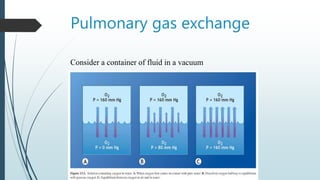
Consider a container of fluid in a vacuum
After a short time,
the number of molecules the number of molecules
ENTERING = LEAVING
At equilibrium, if the gas phase has a PO2 = 100 mm Hg,
the liquid phase also has a PO2 = 100 mm Hg
Pulmonary gas exchange
Alveolar oxygen tension
normally it is 100 mmHg
Pulmonary end capillary oxygen tension (Pc’o2)
Practically its similar to pAo2
pAo2 - Pc’o2 gradient is normally very less
Pc’o2 is dependent on – rate of oxygen diffusion
pulmonary blood flow
transit time (normal .80 sec )
Maximum Pc’o2 is usually attained after .3 sec
Pulmonary gas exchange
 The binding of O 2 to haemoglobin is the principal rate-limiting factor in
the transfer of O 2 from alveolar gas to blood.
 Therefore, pulmonary diffusing capacity reflects the capacity and
permeability of the alveolar–capillary membrane and pulmonary blood
flow.
 O 2 uptake is normally limited by pulmonary blood flow, not O 2
diffusion across the alveolar–capillary membrane;
 diffusion across the alveolar–capillary membrane may become significant
during exercise in normal individuals at high altitudes and in patients with
extensive destruction of the alveolar–capillary membrane
Arterial oxygen tension (PaO2)
 The alveolar-to-arterial O 2 partial pressure gradient (A–a gradient) is normally
less than 15 mm Hg
,this gradient increases with age up to 20–30 mm Hg.
Arterial O 2 tension can be calculated by the following formula (in mm Hg): Pao2 =
120 − Age/ 3
The most common mechanism for hypoxemia is an increased alveolar–arterial
gradient.
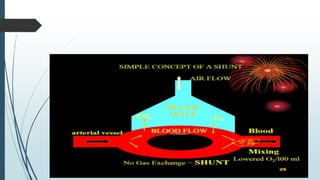
The A–a gradient for O 2 depends on the amount of right- to-left shunting, the
amount of V/Q scatter, and the mixed venous O 2 tension
Pulmonary gas exchange
 the mixed venous O 2 tension depend on cardiac output, O 2 consumption, and
haemoglobin concentration
 The A–a gradient for O 2 is directly proportional to shunt, but inversely
proportional to mixed venous O 2 tension
 greater the shunt, the less likely the possibility that an increase in Fi o 2 will
prevent hypoxemia.
Pulmonary gas exchange
 The effect of cardiac output on the A–a gradient
Cardiac output is directly proportional to mixed venous
O2 tension and inversely proportional to intra pulmonary
shunting
 O2 consumption and haemoglobin concentration can
also affect Pao2 through their secondary effects on
mixed venous O 2 tension .
Mixed venous oxygen tension
 Normal mixed venous O 2 tension ( Pvo2 ) is about
40 mm Hg and represents the overall balance
between O 2 consumption and O 2 delivery
Mixed venous CO2 tension
 Mixed venous CO2 tension
 Normally it is 46 mmhg
Alveolar CO2 tension
 generally considered to represent the balance
between total CO 2 production ( Vco2 ) and alveolar
ventilation (elimination):
 In reality, Paco2 is related to CO2 elimination rather than
production. Although the two are equal in a steady state.
Pulmonary gas exchange
 Pulmonary End-Capillary Carbon
Dioxide Tension
Pulmonary end-capillary CO2
tension (Pc′Co2) is virtually identical to
pAco2
 the diffusion rate for CO2 across the alveolar–
capillary membrane is 20 times that of O2 .
Pulmonary gas exchange
 Arterial Carbon Dioxide Tension
. Normal paco2 is 38 ± 4 mm Hg (5.1 ± 0.5 kPa); in
practice, 40 mm Hg is usually considered normal.
 low V/Q ratios tend to increase Paco2, whereas
high V/Q ratios tend to decrease it .
Pulmonary gas exchange
 End-Tidal Carbon Dioxide Tension
 End-tidal gas is primarily alveolar gas and
 PAco2 is virtually identical to Paco2,
 so end-tidal CO2 tension (pETco2) is used clinically as an
estimate of Paco2
 . The PAco2 – pETco2 gradient is normally less than 5 mm Hg
and represents dilution of alveolar gas with CO2 -free gas
from non perfused alveoli (alveolar dead space).
Thank you

pulmonary gaseous exchange

  • 1.
    Pulmonary gas exchange Presentedby - Dr. Mahtab Alam (JR1) Moderator - Dr. Satish Kumar (MD)
  • 2.
    Pulmonary gaseous exchange Theimportance of pulmonary gas exchange - the inhalational agents depend on the lung for uptake and elimination
  • 3.
    Physical principle ofgas exchange • Partial pressure – The pressure exerted by each type of gas in a mixture • Concentration of a gas in a liquid – determined by its partial pressure and its solubility coefficient
  • 4.
    Pulmonary gas exchange .Therefore, the pressure exerted by any one gas in a mixture of gases (its partial pressure) is equal to the total pressure times the fraction of the total amount of gas it represents.  pio2 = Pb × Fio2
  • 5.
    Pulmonary gas exchange Two general rules can also be used: •  Partial pressure in milimeters of mercury approximates the percentage × 7 •  Partial pressure in kilopascals is approximately the same as the percentage
  • 6.
    Pulmonary gas exchange •The composition of dry air is • 20.98% O2, • 0.04% CO2, • 78.06% N2, and • 0.92% other inert constituents such as argon and helium. • The barometric pressure (PB) at sea level is 760 mm Hg (1 atmosphere).
  • 7.
    Pulmonary gas exchange •The partial pressure of O2 in dry air is therefore • 0.21 × 760, or 160 mm Hg at sea level. • The pN2 and the other inert gases is • 0.79 × 760, or 600 mm Hg; and the pCO2 is 0.0004 × 760, or 0.3 mm Hg
  • 8.
    Pulmonary gas exchange The water vapour in the air reduces these percentages, and therefore the partial pressures, to a slight degree.  Air equilibrated with water is saturated with water vapour, and inspired air is saturated by the time it reaches the lungs.  The pH2O at body temperature (37 °C) is 47 mm Hg. Therefore, the partial pressures at sea level of the other gases in the air are
  • 9.
    Pulmonary gas exchange PO2,149 mm Hg;  PCO2, 0.3 mm Hg; and PN2 (including the other inert gases), 564 mm Hg.  Gas diffuses from areas of high pressure to areas of low pressure, with the rate of diffusion depending on the concentration gradient and the nature of the barrier between the two areas.
  • 10.
    Pulmonary gas exchange •Henry’sLaw: • The rate of gas diffusion into a liquid depends on: 1)Pressure differential between the gas above the fluid and gas dissolved in fluid 2)Solubility (dissolving power) of the gas in the fluid
  • 11.
    Pulmonary gas exchange PartialPressure of Gases in Fluids Each gas has a specific solubility O2 Solubility coefficient = 0.003 ml/100 ml Blood C02 = 0.06 ml/100 ml Blood (x 20 of 02) Gases dissolve in fluids by moving down a Partial Pressure gradient rather than a concentration gradient
  • 12.
    Pulmonary gas exchange Considera container of fluid in a vacuum
  • 13.
    After a shorttime, the number of molecules the number of molecules ENTERING = LEAVING At equilibrium, if the gas phase has a PO2 = 100 mm Hg, the liquid phase also has a PO2 = 100 mm Hg
  • 14.
  • 15.
    Alveolar oxygen tension normallyit is 100 mmHg Pulmonary end capillary oxygen tension (Pc’o2) Practically its similar to pAo2 pAo2 - Pc’o2 gradient is normally very less Pc’o2 is dependent on – rate of oxygen diffusion pulmonary blood flow transit time (normal .80 sec ) Maximum Pc’o2 is usually attained after .3 sec
  • 16.
    Pulmonary gas exchange The binding of O 2 to haemoglobin is the principal rate-limiting factor in the transfer of O 2 from alveolar gas to blood.  Therefore, pulmonary diffusing capacity reflects the capacity and permeability of the alveolar–capillary membrane and pulmonary blood flow.  O 2 uptake is normally limited by pulmonary blood flow, not O 2 diffusion across the alveolar–capillary membrane;  diffusion across the alveolar–capillary membrane may become significant during exercise in normal individuals at high altitudes and in patients with extensive destruction of the alveolar–capillary membrane
  • 17.
    Arterial oxygen tension(PaO2)  The alveolar-to-arterial O 2 partial pressure gradient (A–a gradient) is normally less than 15 mm Hg ,this gradient increases with age up to 20–30 mm Hg. Arterial O 2 tension can be calculated by the following formula (in mm Hg): Pao2 = 120 − Age/ 3 The most common mechanism for hypoxemia is an increased alveolar–arterial gradient. The A–a gradient for O 2 depends on the amount of right- to-left shunting, the amount of V/Q scatter, and the mixed venous O 2 tension
  • 18.
    Pulmonary gas exchange the mixed venous O 2 tension depend on cardiac output, O 2 consumption, and haemoglobin concentration  The A–a gradient for O 2 is directly proportional to shunt, but inversely proportional to mixed venous O 2 tension  greater the shunt, the less likely the possibility that an increase in Fi o 2 will prevent hypoxemia.
  • 20.
    Pulmonary gas exchange The effect of cardiac output on the A–a gradient Cardiac output is directly proportional to mixed venous O2 tension and inversely proportional to intra pulmonary shunting  O2 consumption and haemoglobin concentration can also affect Pao2 through their secondary effects on mixed venous O 2 tension .
  • 21.
    Mixed venous oxygentension  Normal mixed venous O 2 tension ( Pvo2 ) is about 40 mm Hg and represents the overall balance between O 2 consumption and O 2 delivery
  • 22.
    Mixed venous CO2tension  Mixed venous CO2 tension  Normally it is 46 mmhg Alveolar CO2 tension  generally considered to represent the balance between total CO 2 production ( Vco2 ) and alveolar ventilation (elimination):  In reality, Paco2 is related to CO2 elimination rather than production. Although the two are equal in a steady state.
  • 23.
    Pulmonary gas exchange Pulmonary End-Capillary Carbon Dioxide Tension Pulmonary end-capillary CO2 tension (Pc′Co2) is virtually identical to pAco2  the diffusion rate for CO2 across the alveolar– capillary membrane is 20 times that of O2 .
  • 24.
    Pulmonary gas exchange Arterial Carbon Dioxide Tension . Normal paco2 is 38 ± 4 mm Hg (5.1 ± 0.5 kPa); in practice, 40 mm Hg is usually considered normal.  low V/Q ratios tend to increase Paco2, whereas high V/Q ratios tend to decrease it .
  • 25.
    Pulmonary gas exchange End-Tidal Carbon Dioxide Tension  End-tidal gas is primarily alveolar gas and  PAco2 is virtually identical to Paco2,  so end-tidal CO2 tension (pETco2) is used clinically as an estimate of Paco2  . The PAco2 – pETco2 gradient is normally less than 5 mm Hg and represents dilution of alveolar gas with CO2 -free gas from non perfused alveoli (alveolar dead space).
  • 26.