SMELTING REDUCTION : AN ALTERNATIVE TO PIG IRON PRODUCTION
PRESENTED BY:
NISHANT KR. MEHTA(NIT JSR 2K18-2K22)
Future Challenges
RESOURCE DEPLETION
RISING ENERGY
DEMAND
ENVIRONMENTAL
CARE
TOPICS , IRON MAKERS SHOULD CONSIDER
FUTURE RISKS
INCREASE RAW MATERIALCOST
INCREASING ENERGY COST
ENFORCED ENVIRONMENTAL
LAWS
EMERGING SCENARIOIN IRONMAKING
 More than 90% of world iron production is through Blast
Furnace technology route.
 Driving forces: Alternative Iron Making Technologies:
Costly and scarce coking coal : Need to look beyond
coking coal
Possibility to use iron ore fines directly.
Environmental considerations.
Eliminate pollution-intensive sintering and coke making
process.
High capital cost
Possible Solution
 Direct Reduced Iron(DRI)
Reduction of ferrous oxide in solid state.
SL/RN , Midrex, Ausiron etc.
 Smelting Reduction Of Iron
COREX, FINEX ,HISMELT etc
Using non coking coal
Obviating the needs for coke oven batteries and
sinter plants
FINEX PROCESS
To overcome the pellet or sinter
requirement of the Corex process, the
2 step Finex process has been
developed by the Research Institute of
Science and Technology, Korea (POSCO)
and Primetals Technologies (Formerly
VAI).
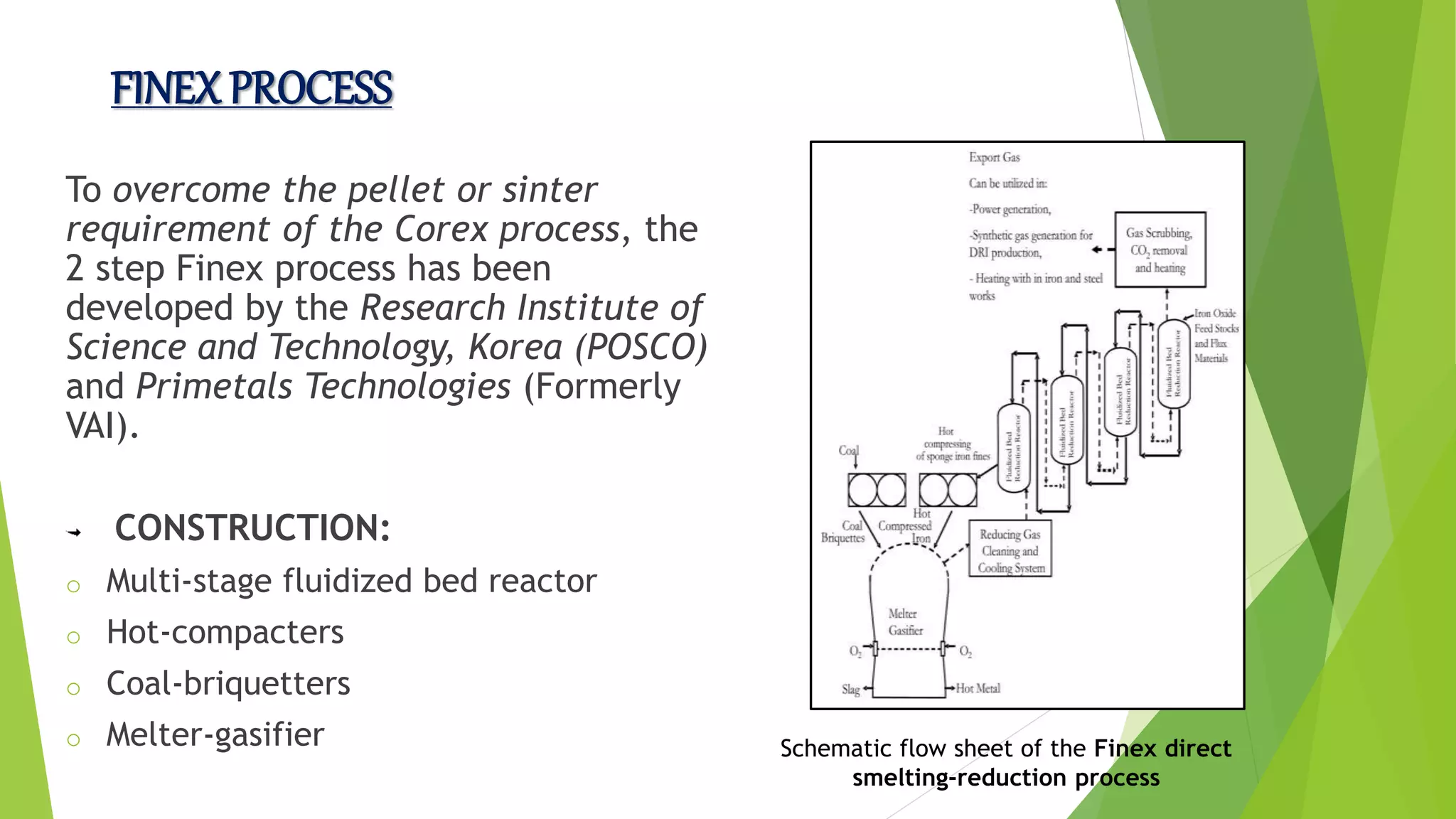
CONSTRUCTION:
o Multi-stage fluidized bed reactor
o Hot-compacters
o Coal-briquetters
o Melter-gasifier Schematic flow sheet of the Finex direct
smelting-reduction process
DEVELOPMENT TIMELINE :
• After a series of scale ups,
first demonstration
plant
• However high fuel
consumption (1100
kg/thm)
• First commercial
plant (715 kg/thm)
• PCI and offgas
recycling systems
ADVANTAGES:
 No blending of raw materials (coke and iron-ores) is required
 Use of low-grade coal. The coal-briquetting technology increases the range of
allowable coal blends.
 Independent control of reduction and melting processes.
 Lower emissions of nitrates and sulphates as sintering and coke-oven facilities are
not required, which are major sources of emissions.
DISADVANTAGES:
FINEX process requires a large amount of oxygen.
Though it provides flexibility in terms of grade of coal used, but still certain
constraints need to be followed, like:
 Fix carbon content at minimum of 55%
 Ash content upto 25%
 Good thermal stabiity
INRED PROCESS
INRED (Intensive Reduction) is a novel
process of producing hot metal of blast
furnace quality. Started in 1972, the
process reached the demonstration
stage, and was set up (now
abandoned) at MEFOS, the Foundation
for Metallurgical Research, at Lulea,
Sweden.
CONSTRUCTION:
o Flash Smelting chamber
o Submerged Arc furnace chamber
Schematic flow sheet of the INRED (intensive
reduction) process.
ADVANTAGES:
 Heavy purge of sulfur, allowing use of high sulfur coal and ore.
 Low volume of gas generation, which facilitates gas cleaning and sulfur dioxide removal.
 The steam produced during flash smelting stage can be reused in turbines and in the EAF.
 Use of cheaper, non-coking coals.
DISADVANTAGES:
The iron produced by the process is lower in carbon and silicon when compared
with blast furnace pig iron.
The precise control of a rapid, flash smelting process is always likely to be difficult
ELRED PROCESS
This process, advocated by ASEA and Stora
Kopparbergs Barglags in Sweden, was
designed to produce pig iron by two stage
reduction of iron ore concentrates and/or
waste oxide with coal. Any Further work on
its development is suspended.
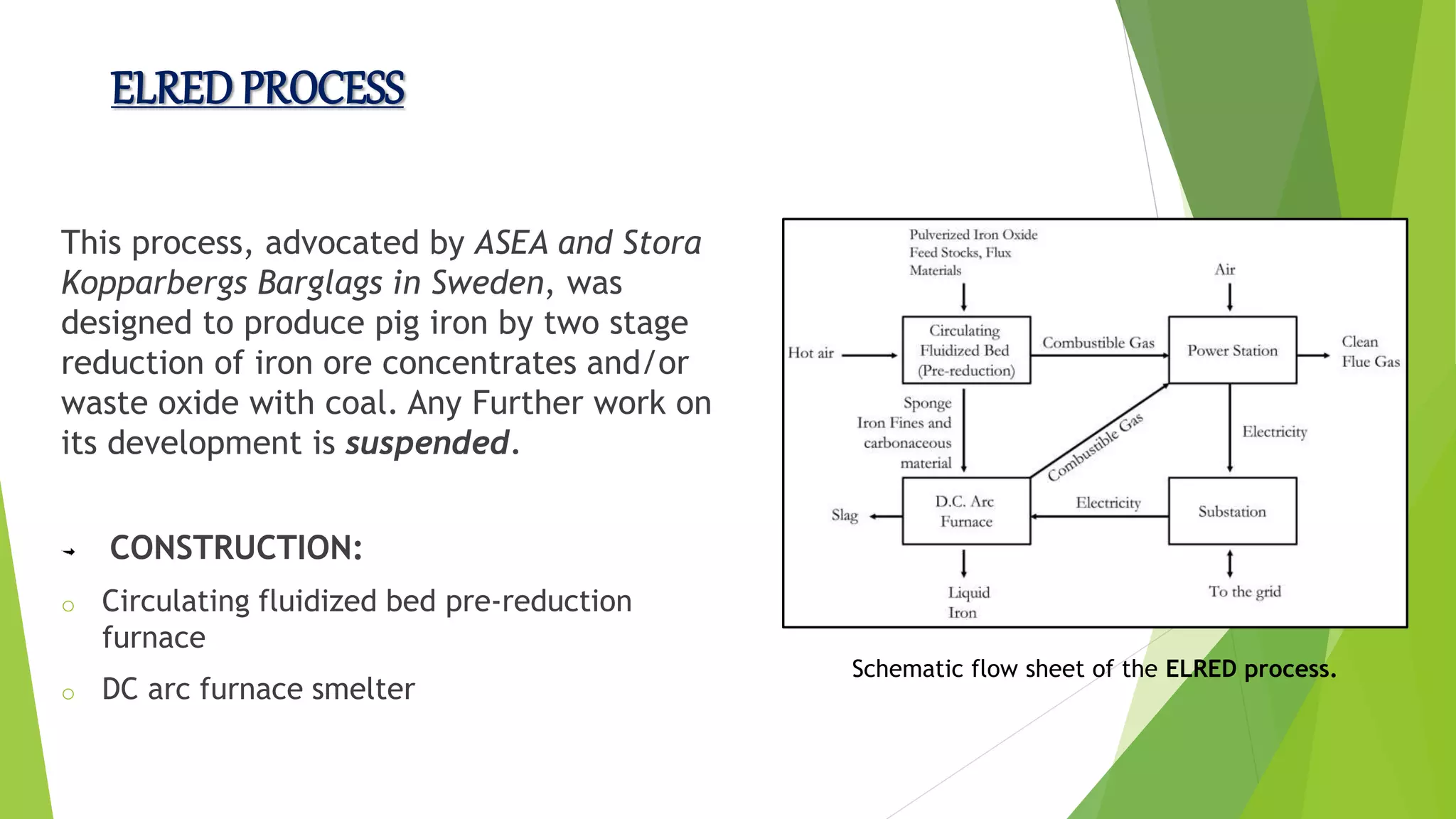
CONSTRUCTION:
o Circulating fluidized bed pre-reduction
furnace
o DC arc furnace smelter
Schematic flow sheet of the ELRED process.
ADVANTAGES:
 excess of carbon in the fluidized bed and the high gas velocity prevent sticking of
material.
 The vigorous material circulation in the bed results in uniform temperature distribution.
 The electricity required for the DC smelter is produced by utilizing the combustible gases
from the pre-reduction and smelting reactors
DISADVANTAGES:
The economic operation of this process is dependent on the onsite production of
electricity from the combustible flue gases.
Iron rich fines need to be used as feed, since high gangue particles would mean
greater consumption of electricity.
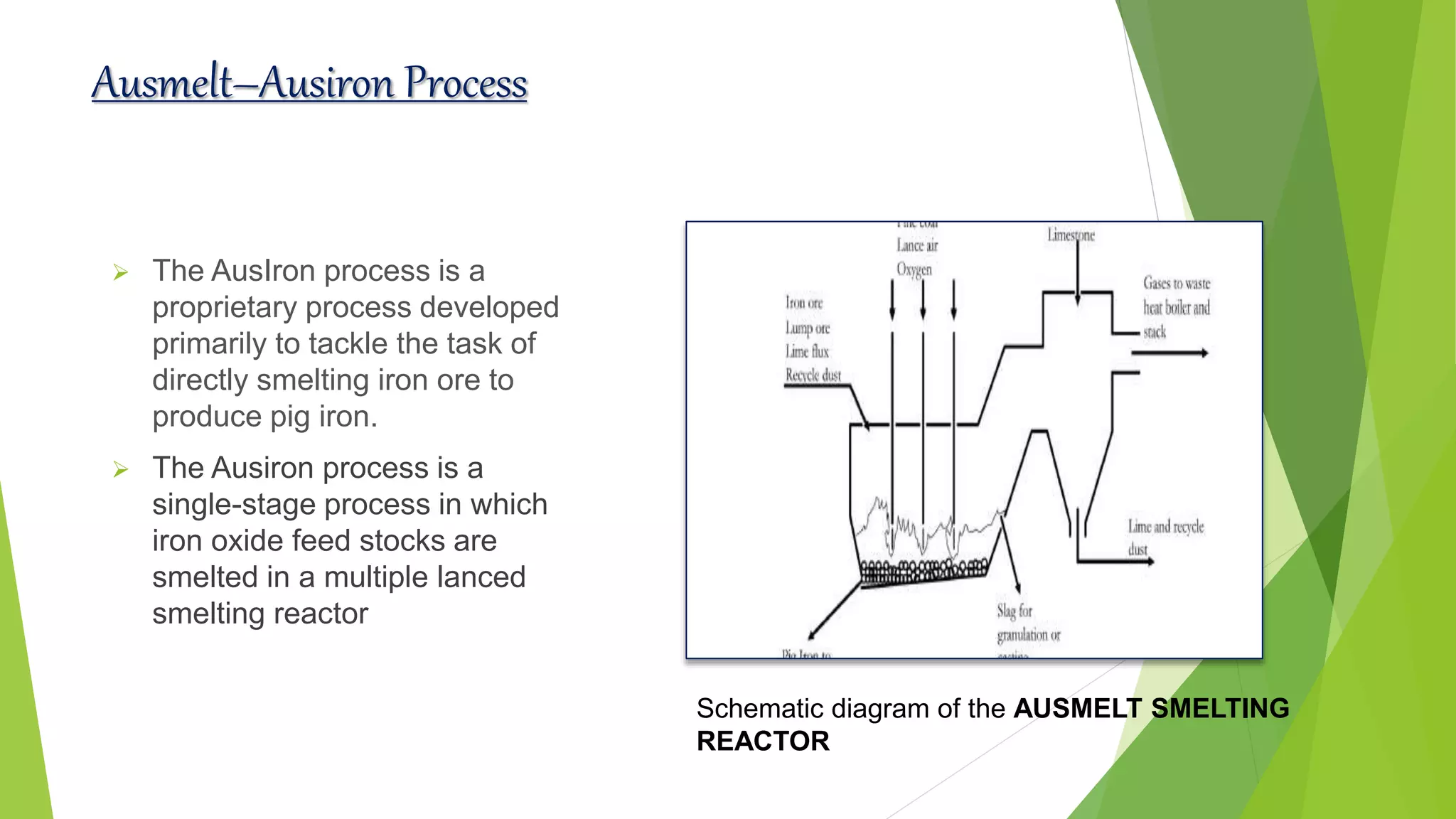
Ausmelt–Ausiron Process
 The AusIron process is a
proprietary process developed
primarily to tackle the task of
directly smelting iron ore to
produce pig iron.
 The Ausiron process is a
single-stage process in which
iron oxide feed stocks are
smelted in a multiple lanced
smelting reactor
Schematic diagram of the AUSMELT SMELTING
REACTOR
Process
 The process takes place within a smelter vessel, equipped with multiple lances. Each lance burns coal with oxygen-enriched air at
the lance tip, which is submerged in the smelter slag bath. The lance tip combustion conditions are controlled to prevent bath
oxidation, and optimized for maximum energy release to the bath. Reductant coal, ferrous feed and fluxes are fed by gravity to the
smelter slag bath through ports in the furnace roof.
 Figure shows the three reaction zones in AusIron while Table shows the location and descriptions of the resultant three zones.
ADVANTAGES:
 Simple use of ferrous materials, no pelletising or sintering is required.
 High quality metal product suitable for both electric and oxygen steelmaking.
 The furnace operates at sub atmospheric pressure allowing simple feeding and tapping
arrangements. Lances can be raised clear of the furnace simplifying maintenance
 Low capital. The use of a single stage, highly efficient smelter reduces capital
requirements for new ironmaking capacity and permits effective use at smaller scales of
operation than conventional processes.
DISADVANTAGES:
 The efficiency of the process is highly independent on the injection of air-oxygen
mixtures,which enables the combustion of fuel.
 The economic efficiency of the process is dependent on the recovery of the energy
contained in the flue gases
HIsmelt Process
 HIsmelt process is an air based direct
smelting technology which is simple yet
innovative. The process is for the production
of liquid iron (hot metal) using iron ore fines
or any other appropriate ferrous feed
material.
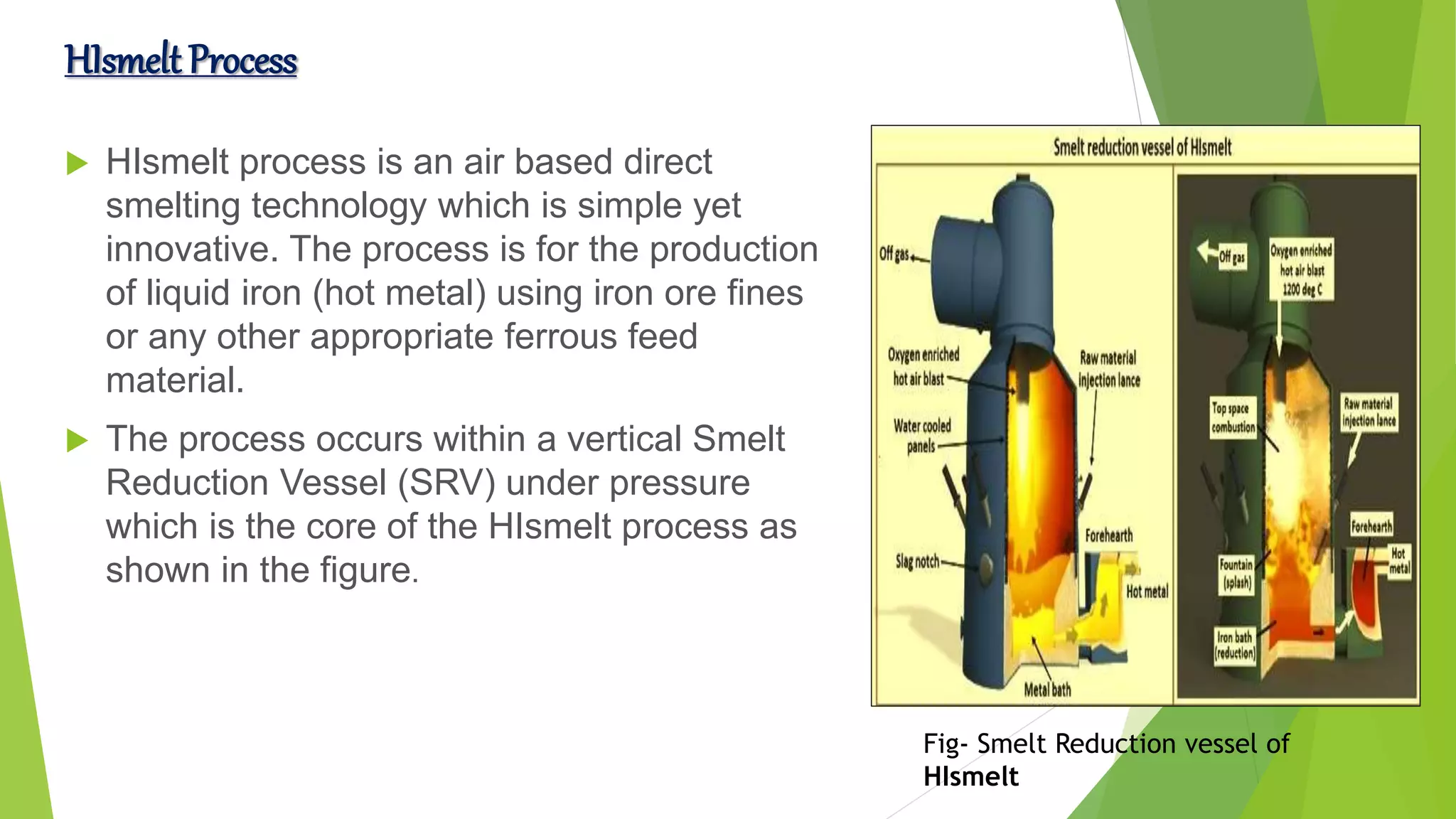
 The process occurs within a vertical Smelt
Reduction Vessel (SRV) under pressure
which is the core of the HIsmelt process as
shown in the figure.
Fig- Smelt Reduction vessel of
HIsmelt
Process
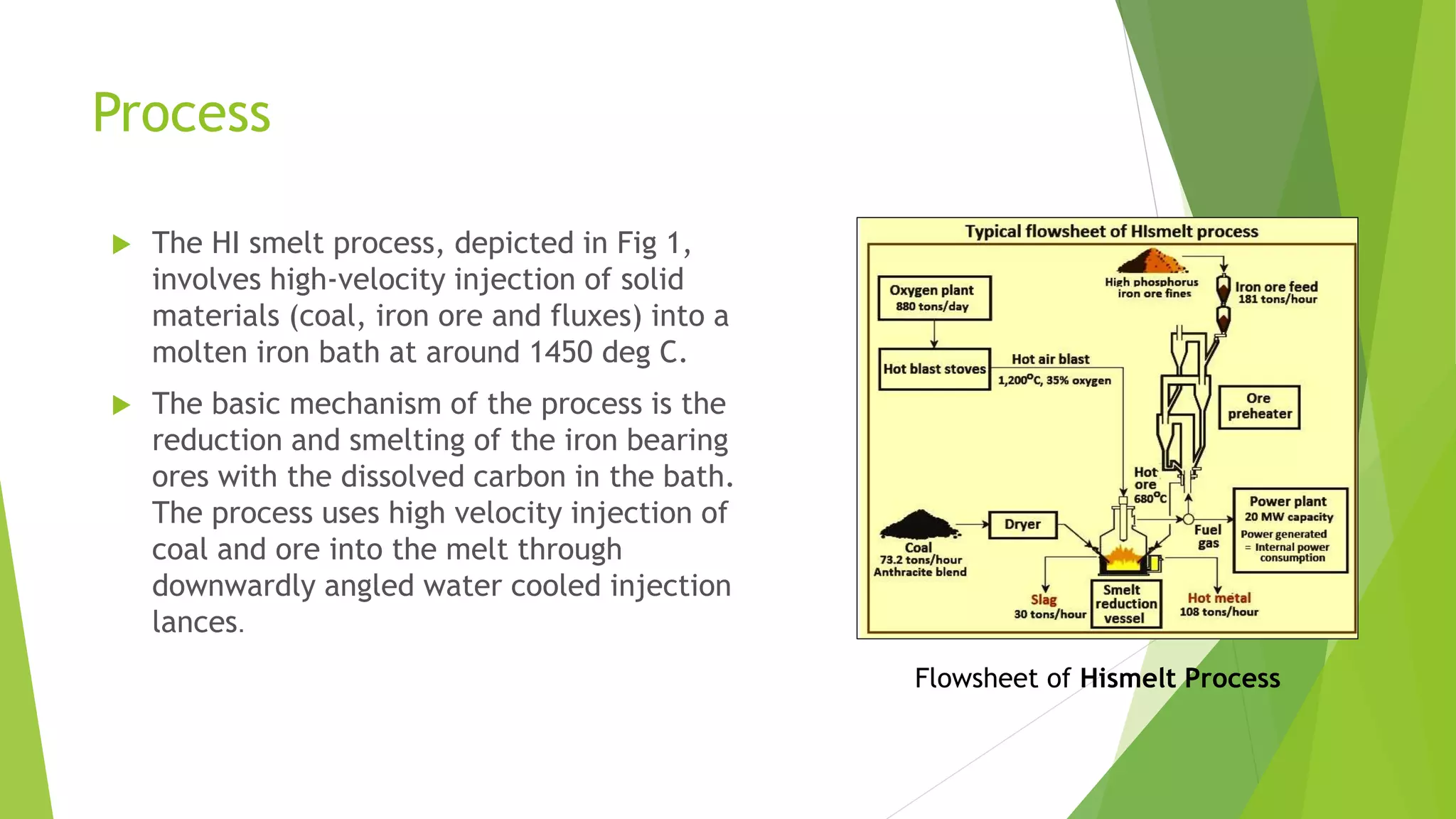
 The HI smelt process, depicted in Fig 1,
involves high-velocity injection of solid
materials (coal, iron ore and fluxes) into a
molten iron bath at around 1450 deg C.
 The basic mechanism of the process is the
reduction and smelting of the iron bearing
ores with the dissolved carbon in the bath.
The process uses high velocity injection of
coal and ore into the melt through
downwardly angled water cooled injection
lances.
Flowsheet of Hismelt Process
ADVANTAGES:
 low cost raw materials since ferrous feed agglomeration and coke making processes are
eliminated.
 flexible feed stocks since the process operates on a wide range of iron ore fines and waste
oxide materials, together with high and low volatile coals,.
 production flexibility and better product quality,
 minimized total energy consumption and simplified engineering and process configuration,.
DISADVANTAGES:
 For the same sulfur input,Hismelt will have two or three times higher sulfur content when
compared with blast furnace pig iron.
 Thus ,the Hismelt pig iron should be desulfurized prior to utilization.
COREX PROCESS
 It was earlier known as the KR
(Kohl-Reduction) process and is the
only smelting-reduction process that
operates at a commercial scale in
the early phase.
 In India Corex plants available at
 . Jindal Vijayanagar Steel (Module
1), located in India, with an annual
capacity of 0.8 million tons, started
its operation at 1999.
 Jindal Vijayanagar Steel (Module
2), located in India, with a capacity
of 128 tons of pig iron per hour,
started its operation at 2001
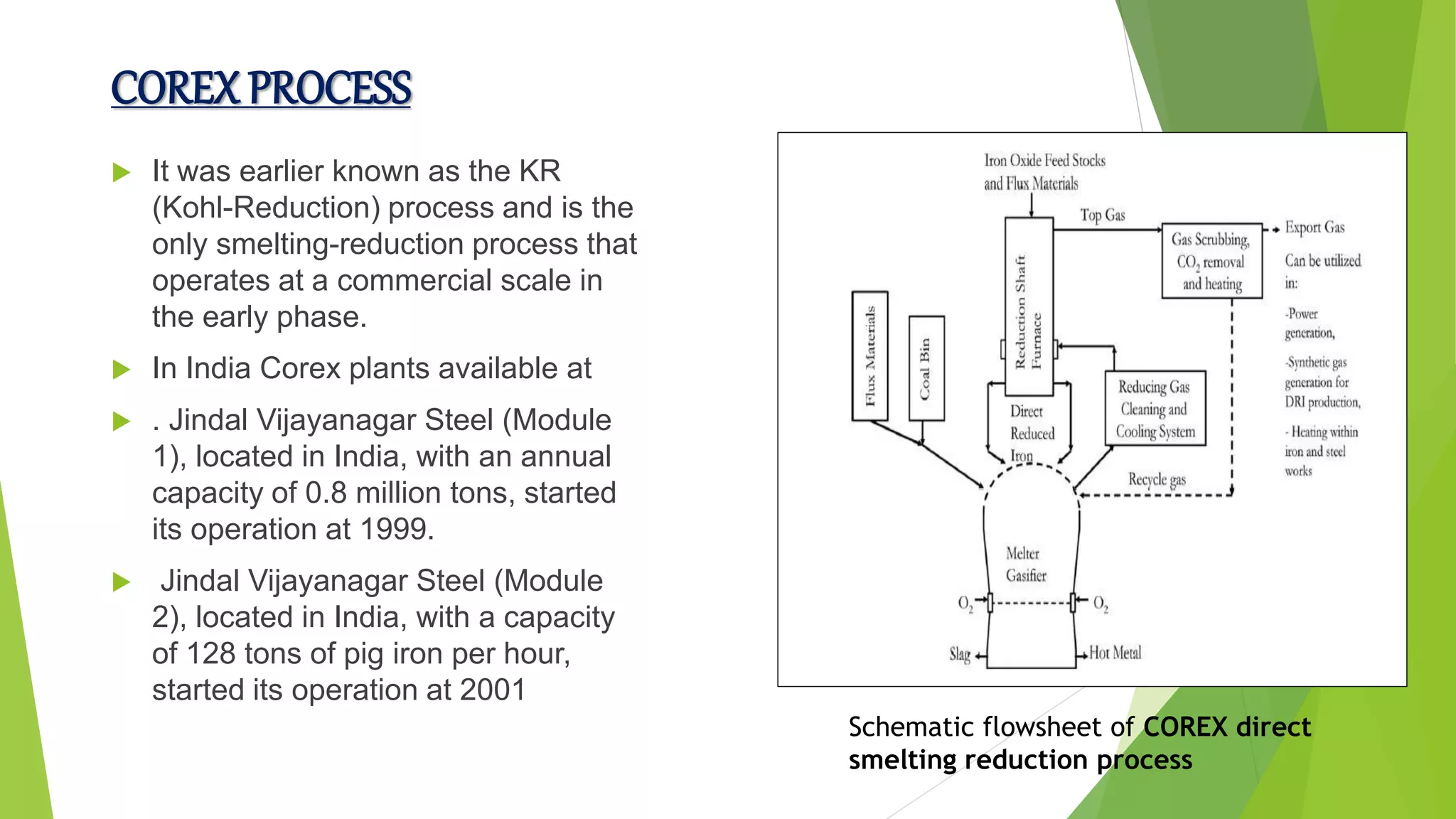
Schematic flowsheet of COREX direct
smelting reduction process
Details of COREX Process
 Throughout the process, iron oxide feed stocks are
first reduced in a shaft-reduction furnace and then
smelted in a melter–gasifier reactor.
 The reducing agent required for reduction reactions
in the shaft furnace and smelting reactions in the
melter–gasifier are produced in the melter–gasifier
reactor.
 Corex process distinguishes itself from the blast
furnace route by (i) direct use of non-coking coal as
reducing agent and energy source, (ii) Iron ore can
be directly and feasibly charged to the process in
form of lump ore, and pellets, and (iii) use of pure
oxygen instead of nitrogen rich hot blast. Direct use
of non-coking coal is possible since the coal is
charred inside the melter gasifier.
COREX melter gasifier and its
operational zone
ADVANTAGES:
 reduction in the specific investment cost compared with conventional blast furnace route of
production
 better environmental performance because of lower emissions and discharges
 higher calorific value of export gas makes it suitable for use in a wide range of applications
 flexible with regards to the raw material uses since a wide variety of iron ores and coals can
be used,
 good operational flexibility with respect to production capacity, production stops and raw
material changes
DISADVANTAGES:
 Melter-gasifier is subjected to high occurrence of pressure peaks on account of use of raw
coal with poor char bed conditions resulting into jamming of dust recycling systems as well as
gas cleaning systems,
 absence of post combustion results into the loss of the chemical energy in the export gases
resulting into high consumption of coal,
 optimized distribution of coal and DRI is needed in the melter-gasifier to avoid peripheral flow
of hot gases
LITERATURE REVIEW
 B. Anameric & S. Komar Kawatra (2008) DIRECT IRON SMELTING
REDUCTION PROCESSES, Mineral Processing and Extractive Metallurgy
Review: An International Journal, 30:1, 1-51
 Sang-Ho Yi, Moo-Eob Choi, Do-Hyung Kim, Chang-Kuk Ko, Woo-Il Park &
Sun-Young Kim (2019): FINEX® as an environmentally sustainable
ironmaking process, Ironmaking & Steelmaking
 https://www.industry.guru/2020/06/finex-process-smelting-reduction-
technology-of-ironmaking-features-merits-and
limitations.html#:~:text=Some%20of%20the%20limitations
%20%28disadvantages%29%20are%20-
%20Ease,FINEX%20processes%20need%20a%20large%20
amount%20of%20oxygen.
 Chatterjee, A., 1994a, Beyond the Blast Furnace, Boca Raton, FL: CRC.

SMELTING REDUCTION:AN ALTERNATIVE TO PIG IRON PRODUCTION

  • 1.
    SMELTING REDUCTION :AN ALTERNATIVE TO PIG IRON PRODUCTION PRESENTED BY: NISHANT KR. MEHTA(NIT JSR 2K18-2K22)
  • 2.
    Future Challenges RESOURCE DEPLETION RISINGENERGY DEMAND ENVIRONMENTAL CARE TOPICS , IRON MAKERS SHOULD CONSIDER
  • 3.
    FUTURE RISKS INCREASE RAWMATERIALCOST INCREASING ENERGY COST ENFORCED ENVIRONMENTAL LAWS
  • 4.
    EMERGING SCENARIOIN IRONMAKING More than 90% of world iron production is through Blast Furnace technology route.  Driving forces: Alternative Iron Making Technologies: Costly and scarce coking coal : Need to look beyond coking coal Possibility to use iron ore fines directly. Environmental considerations. Eliminate pollution-intensive sintering and coke making process. High capital cost
  • 5.
    Possible Solution  DirectReduced Iron(DRI) Reduction of ferrous oxide in solid state. SL/RN , Midrex, Ausiron etc.  Smelting Reduction Of Iron COREX, FINEX ,HISMELT etc Using non coking coal Obviating the needs for coke oven batteries and sinter plants
  • 6.
    FINEX PROCESS To overcomethe pellet or sinter requirement of the Corex process, the 2 step Finex process has been developed by the Research Institute of Science and Technology, Korea (POSCO) and Primetals Technologies (Formerly VAI). CONSTRUCTION: o Multi-stage fluidized bed reactor o Hot-compacters o Coal-briquetters o Melter-gasifier Schematic flow sheet of the Finex direct smelting-reduction process
  • 7.
    DEVELOPMENT TIMELINE : •After a series of scale ups, first demonstration plant • However high fuel consumption (1100 kg/thm) • First commercial plant (715 kg/thm) • PCI and offgas recycling systems
  • 8.
    ADVANTAGES:  No blendingof raw materials (coke and iron-ores) is required  Use of low-grade coal. The coal-briquetting technology increases the range of allowable coal blends.  Independent control of reduction and melting processes.  Lower emissions of nitrates and sulphates as sintering and coke-oven facilities are not required, which are major sources of emissions. DISADVANTAGES: FINEX process requires a large amount of oxygen. Though it provides flexibility in terms of grade of coal used, but still certain constraints need to be followed, like:  Fix carbon content at minimum of 55%  Ash content upto 25%  Good thermal stabiity
  • 9.
    INRED PROCESS INRED (IntensiveReduction) is a novel process of producing hot metal of blast furnace quality. Started in 1972, the process reached the demonstration stage, and was set up (now abandoned) at MEFOS, the Foundation for Metallurgical Research, at Lulea, Sweden. CONSTRUCTION: o Flash Smelting chamber o Submerged Arc furnace chamber Schematic flow sheet of the INRED (intensive reduction) process.
  • 10.
    ADVANTAGES:  Heavy purgeof sulfur, allowing use of high sulfur coal and ore.  Low volume of gas generation, which facilitates gas cleaning and sulfur dioxide removal.  The steam produced during flash smelting stage can be reused in turbines and in the EAF.  Use of cheaper, non-coking coals. DISADVANTAGES: The iron produced by the process is lower in carbon and silicon when compared with blast furnace pig iron. The precise control of a rapid, flash smelting process is always likely to be difficult
  • 11.
    ELRED PROCESS This process,advocated by ASEA and Stora Kopparbergs Barglags in Sweden, was designed to produce pig iron by two stage reduction of iron ore concentrates and/or waste oxide with coal. Any Further work on its development is suspended. CONSTRUCTION: o Circulating fluidized bed pre-reduction furnace o DC arc furnace smelter Schematic flow sheet of the ELRED process.
  • 12.
    ADVANTAGES:  excess ofcarbon in the fluidized bed and the high gas velocity prevent sticking of material.  The vigorous material circulation in the bed results in uniform temperature distribution.  The electricity required for the DC smelter is produced by utilizing the combustible gases from the pre-reduction and smelting reactors DISADVANTAGES: The economic operation of this process is dependent on the onsite production of electricity from the combustible flue gases. Iron rich fines need to be used as feed, since high gangue particles would mean greater consumption of electricity.
  • 13.
    Ausmelt–Ausiron Process  TheAusIron process is a proprietary process developed primarily to tackle the task of directly smelting iron ore to produce pig iron.  The Ausiron process is a single-stage process in which iron oxide feed stocks are smelted in a multiple lanced smelting reactor Schematic diagram of the AUSMELT SMELTING REACTOR
  • 14.
    Process  The processtakes place within a smelter vessel, equipped with multiple lances. Each lance burns coal with oxygen-enriched air at the lance tip, which is submerged in the smelter slag bath. The lance tip combustion conditions are controlled to prevent bath oxidation, and optimized for maximum energy release to the bath. Reductant coal, ferrous feed and fluxes are fed by gravity to the smelter slag bath through ports in the furnace roof.  Figure shows the three reaction zones in AusIron while Table shows the location and descriptions of the resultant three zones.
  • 15.
    ADVANTAGES:  Simple useof ferrous materials, no pelletising or sintering is required.  High quality metal product suitable for both electric and oxygen steelmaking.  The furnace operates at sub atmospheric pressure allowing simple feeding and tapping arrangements. Lances can be raised clear of the furnace simplifying maintenance  Low capital. The use of a single stage, highly efficient smelter reduces capital requirements for new ironmaking capacity and permits effective use at smaller scales of operation than conventional processes. DISADVANTAGES:  The efficiency of the process is highly independent on the injection of air-oxygen mixtures,which enables the combustion of fuel.  The economic efficiency of the process is dependent on the recovery of the energy contained in the flue gases
  • 16.
    HIsmelt Process  HIsmeltprocess is an air based direct smelting technology which is simple yet innovative. The process is for the production of liquid iron (hot metal) using iron ore fines or any other appropriate ferrous feed material.  The process occurs within a vertical Smelt Reduction Vessel (SRV) under pressure which is the core of the HIsmelt process as shown in the figure. Fig- Smelt Reduction vessel of HIsmelt
  • 17.
    Process  The HIsmelt process, depicted in Fig 1, involves high-velocity injection of solid materials (coal, iron ore and fluxes) into a molten iron bath at around 1450 deg C.  The basic mechanism of the process is the reduction and smelting of the iron bearing ores with the dissolved carbon in the bath. The process uses high velocity injection of coal and ore into the melt through downwardly angled water cooled injection lances. Flowsheet of Hismelt Process
  • 18.
    ADVANTAGES:  low costraw materials since ferrous feed agglomeration and coke making processes are eliminated.  flexible feed stocks since the process operates on a wide range of iron ore fines and waste oxide materials, together with high and low volatile coals,.  production flexibility and better product quality,  minimized total energy consumption and simplified engineering and process configuration,. DISADVANTAGES:  For the same sulfur input,Hismelt will have two or three times higher sulfur content when compared with blast furnace pig iron.  Thus ,the Hismelt pig iron should be desulfurized prior to utilization.
  • 19.
    COREX PROCESS  Itwas earlier known as the KR (Kohl-Reduction) process and is the only smelting-reduction process that operates at a commercial scale in the early phase.  In India Corex plants available at  . Jindal Vijayanagar Steel (Module 1), located in India, with an annual capacity of 0.8 million tons, started its operation at 1999.  Jindal Vijayanagar Steel (Module 2), located in India, with a capacity of 128 tons of pig iron per hour, started its operation at 2001 Schematic flowsheet of COREX direct smelting reduction process
  • 20.
    Details of COREXProcess  Throughout the process, iron oxide feed stocks are first reduced in a shaft-reduction furnace and then smelted in a melter–gasifier reactor.  The reducing agent required for reduction reactions in the shaft furnace and smelting reactions in the melter–gasifier are produced in the melter–gasifier reactor.  Corex process distinguishes itself from the blast furnace route by (i) direct use of non-coking coal as reducing agent and energy source, (ii) Iron ore can be directly and feasibly charged to the process in form of lump ore, and pellets, and (iii) use of pure oxygen instead of nitrogen rich hot blast. Direct use of non-coking coal is possible since the coal is charred inside the melter gasifier. COREX melter gasifier and its operational zone
  • 21.
    ADVANTAGES:  reduction inthe specific investment cost compared with conventional blast furnace route of production  better environmental performance because of lower emissions and discharges  higher calorific value of export gas makes it suitable for use in a wide range of applications  flexible with regards to the raw material uses since a wide variety of iron ores and coals can be used,  good operational flexibility with respect to production capacity, production stops and raw material changes DISADVANTAGES:  Melter-gasifier is subjected to high occurrence of pressure peaks on account of use of raw coal with poor char bed conditions resulting into jamming of dust recycling systems as well as gas cleaning systems,  absence of post combustion results into the loss of the chemical energy in the export gases resulting into high consumption of coal,  optimized distribution of coal and DRI is needed in the melter-gasifier to avoid peripheral flow of hot gases
  • 22.
    LITERATURE REVIEW  B.Anameric & S. Komar Kawatra (2008) DIRECT IRON SMELTING REDUCTION PROCESSES, Mineral Processing and Extractive Metallurgy Review: An International Journal, 30:1, 1-51  Sang-Ho Yi, Moo-Eob Choi, Do-Hyung Kim, Chang-Kuk Ko, Woo-Il Park & Sun-Young Kim (2019): FINEX® as an environmentally sustainable ironmaking process, Ironmaking & Steelmaking  https://www.industry.guru/2020/06/finex-process-smelting-reduction- technology-of-ironmaking-features-merits-and limitations.html#:~:text=Some%20of%20the%20limitations %20%28disadvantages%29%20are%20- %20Ease,FINEX%20processes%20need%20a%20large%20 amount%20of%20oxygen.  Chatterjee, A., 1994a, Beyond the Blast Furnace, Boca Raton, FL: CRC.