“MY HEART IS TRUE AS
STEEL”
- WILLIAM SHAKESPEARE
“INDUSTRIAL
INVESTIGATION OF STEEL
USED IN MANUFACTURING
OF LIGHT WEIGHT
AUTOMOBILES”
BIRD’S EYE VIEW
An insight into the steel being used in the
automotive industry.
Evaluation of modern steel making and
advanced manufacturing processes.
Descriptive comparison of steel with
aluminium and carbon fiber reinforced
polymer.
 Theoretical analysis of advanced steel refining
processes.
Case studies of automotive companies reacting
to steel.
HISTORY AND DEVELOPMENT
OF STEEL
 Iron is the sixth most abundant element found in
the universe.
 Pure iron has a hardness of about 80 BHN as
compared to 140 BHN of steel.
 Iron with a carbon content ranging between 0.20 –
2.15% by weight is termed as steel.
 Manganese, Chromium, Vanadium & Tungsten
are added to improve the properties.
 Steel is slag free, while wrought iron has 1–3% of
slag present in it.
IRON-CARBON EQUILLIBRIUM
DIAGRAM
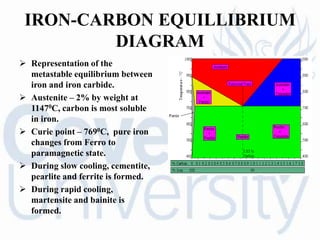
 Representation of the
metastable equilibrium between
iron and iron carbide.
 Austenite – 2% by weight at
11470C, carbon is most soluble
in iron.
 Curie point – 7690C, pure iron
changes from Ferro to
paramagnetic state.
 During slow cooling, cementite,
pearlite and ferrite is formed.
 During rapid cooling,
martensite and bainite is
formed.
EARLY STEEL
MANUFACTURING PROCESSES
BLAST FURNACE
 Smelting of iron from iron
ore.
 Iron ore contains Hematite
and Magnetite with
50-70% of iron.
 Reduction of the oxides
from the iron ore, pellets
and sinter mixture
forming pig iron.
BESSEMERS PROCESS
 First steel making process
of mass production.
 Conversion of all
impurities to their oxides.
 Spiegeleisen- An alloy of
carbon-iron-manganese
used as an additive to give
the molten metal the
necessary characteristics.
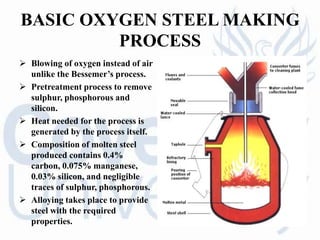
BASIC OXYGEN STEEL MAKING
PROCESS
 Blowing of oxygen instead of air
unlike the Bessemer’s process.
 Pretreatment process to remove
sulphur, phosphorous and
silicon.
 Heat needed for the process is
generated by the process itself.
 Composition of molten steel
produced contains 0.4%
carbon, 0.075% manganese,
0.03% silicon, and negligible
traces of sulphur, phosphorous.
 Alloying takes place to provide
steel with the required
properties.
HEAT TREATMENT PROCESS
To alter the mechanical and physical properties
without changing the actual product shape.
The softening process includes: Annealing,
Spheroidizing, Normalising, Tempering,
Austempering and Martempering.
 The hardening process includes: Surface
hardening methods, Induction hardening and
Flame hardening.
Material modification processes includes:
Cryogenics and Stress relieving.
COMPARISON OF STEEL WITH
OTHER AUTOMOTIVE MATERIALS
STEEL
 Diffuse Necking – strength retained
during necking gives additional
safety.
 High Modulus Elasticity – easy to
form shapes as less spring back.
 Uniform Strain deformation.
 Have high Fatigue strength.
 Easy for welding processes.
 After the Bake-hardening process
greater strain hardening is
achieved.
 Lower tooling costs.
 Steel gives better resistivity to
surface damage in material
handling.
ALUMINIUM
 Localized Necking – fracture occurs
after uniform elongation.
 Low Modulus Elasticity – greater
amount of elastic strain leads to
difficulty in forming.
 Non-uniform strain deformation
resulting in strain concentration.
 Have low Fatigue strength.
 Unable to withstand high dynamic
loads – difficulty in welding.
 The rate of increase in strain
hardening is less than steel.
 Higher tooling costs.
 Less resistivity due to lower
hardness and Yield strength.
COMPARISON OF STEEL WITH
OTHER AUTOMOTIVE MATERIALS
STEEL
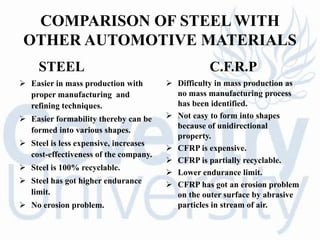
 Easier in mass production with
proper manufacturing and
refining techniques.
 Easier formability thereby can be
formed into various shapes.
 Steel is less expensive, increases
cost-effectiveness of the company.
 Steel is 100% recyclable.
 Steel has got higher endurance
limit.
 No erosion problem.
C.F.R.P
 Difficulty in mass production as
no mass manufacturing process
has been identified.
 Not easy to form into shapes
because of unidirectional
property.
 CFRP is expensive.
 CFRP is partially recyclable.
 Lower endurance limit.
 CFRP has got an erosion problem
on the outer surface by abrasive
particles in stream of air.
ADVANCED STEEL REFINING
PROCESSES
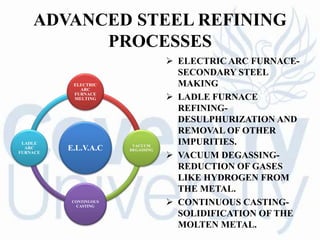
E.L.V.A.C
ELECTRIC
ARC
FURNACE
MELTING
VACUUM
DEGASSING
CONTINUOUS
CASTING
LADLE
ARC
FURNACE
 ELECTRIC ARC FURNACE-
SECONDARY STEEL
MAKING
 LADLE FURNACE
REFINING-
DESULPHURIZATION AND
REMOVAL OF OTHER
IMPURITIES.
 VACUUM DEGASSING-
REDUCTION OF GASES
LIKE HYDROGEN FROM
THE METAL.
 CONTINUOUS CASTING-
SOLIDIFICATION OF THE
MOLTEN METAL.
ADVANTAGES OF E.L.V.A.C
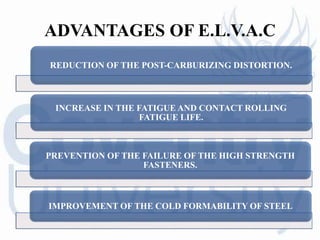
REDUCTION OF THE POST-CARBURIZING DISTORTION.
INCREASE IN THE FATIGUE AND CONTACT ROLLING
FATIGUE LIFE.
PREVENTION OF THE FAILURE OF THE HIGH STRENGTH
FASTENERS.
IMPROVEMENT OF THE COLD FORMABILITY OF STEEL
TAILOR WELDED BLANKS
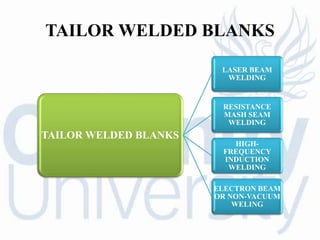
LASER BEAM
WELDING
RESISTANCE
MASH SEAM
WELDING
HIGH-
FREQUENCY
INDUCTION
WELDING
ELECTRON BEAM
OR NON-VACUUM
WELING
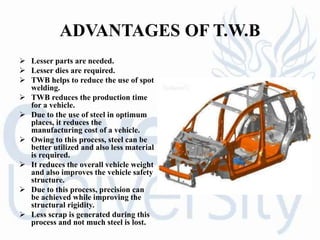
ADVANTAGES OF T.W.B
 Lesser parts are needed.
 Lesser dies are required.
 TWB helps to reduce the use of spot
welding.
 TWB reduces the production time
for a vehicle.
 Due to the use of steel in optimum
places, it reduces the
manufacturing cost of a vehicle.
 Owing to this process, steel can be
better utilized and also less material
is required.
 It reduces the overall vehicle weight
and also improves the vehicle safety
structure.
 Due to this process, precision can
be achieved while improving the
structural rigidity.
 Less scrap is generated during this
process and not much steel is lost.
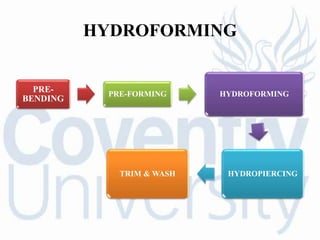
HYDROFORMING
PRE-
BENDING
PRE-FORMING HYDROFORMING
HYDROPIERCINGTRIM & WASH
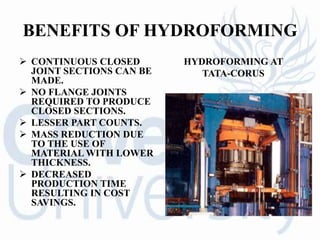
BENEFITS OF HYDROFORMING
 CONTINUOUS CLOSED
JOINT SECTIONS CAN BE
MADE.
 NO FLANGE JOINTS
REQUIRED TO PRODUCE
CLOSED SECTIONS.
 LESSER PART COUNTS.
 MASS REDUCTION DUE
TO THE USE OF
MATERIAL WITH LOWER
THICKNESS.
 DECREASED
PRODUCTION TIME
RESULTING IN COST
SAVINGS.
HYDROFORMING AT
TATA-CORUS
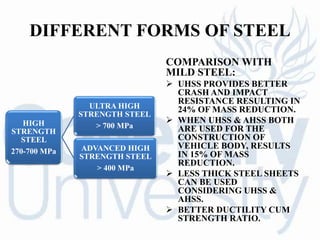
DIFFERENT FORMS OF STEEL
COMPARISON WITH
MILD STEEL:
 UHSS PROVIDES BETTER
CRASH AND IMPACT
RESISTANCE RESULTING IN
24% OF MASS REDUCTION.
 WHEN UHSS & AHSS BOTH
ARE USED FOR THE
CONSTRUCTION OF
VEHICLE BODY, RESULTS
IN 15% OF MASS
REDUCTION.
 LESS THICK STEEL SHEETS
CAN BE USED
CONSIDERING UHSS &
AHSS.
 BETTER DUCTILITY CUM
STRENGTH RATIO.
HIGH
STRENGTH
STEEL
270-700 MPa
ULTRA HIGH
STRENGTH STEEL
> 700 MPa
ADVANCED HIGH
STRENGTH STEEL
> 400 MPa
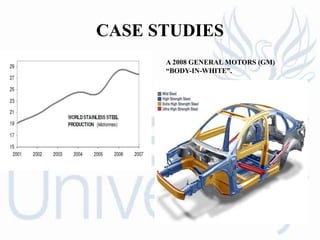
CASE STUDIES
A 2008 GENERAL MOTORS (GM)
“BODY-IN-WHITE”.
CASE STUDIES
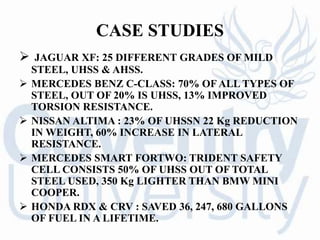
 JAGUAR XF: 25 DIFFERENT GRADES OF MILD
STEEL, UHSS & AHSS.
 MERCEDES BENZ C-CLASS: 70% OF ALL TYPES OF
STEEL, OUT OF 20% IS UHSS, 13% IMPROVED
TORSION RESISTANCE.
 NISSAN ALTIMA : 23% OF UHSSN 22 Kg REDUCTION
IN WEIGHT, 60% INCREASE IN LATERAL
RESISTANCE.
 MERCEDES SMART FORTWO: TRIDENT SAFETY
CELL CONSISTS 50% OF UHSS OUT OF TOTAL
STEEL USED, 350 Kg LIGHTER THAN BMW MINI
COOPER.
 HONDA RDX & CRV : SAVED 36, 247, 680 GALLONS
OF FUEL IN A LIFETIME.
CASE STUDIES
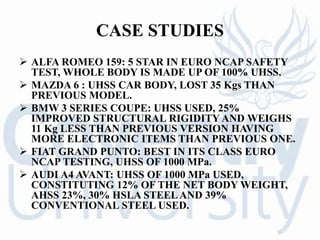
 ALFA ROMEO 159: 5 STAR IN EURO NCAP SAFETY
TEST, WHOLE BODY IS MADE UP OF 100% UHSS.
 MAZDA 6 : UHSS CAR BODY, LOST 35 Kgs THAN
PREVIOUS MODEL.
 BMW 3 SERIES COUPE: UHSS USED, 25%
IMPROVED STRUCTURAL RIGIDITY AND WEIGHS
11 Kg LESS THAN PREVIOUS VERSION HAVING
MORE ELECTRONIC ITEMS THAN PREVIOUS ONE.
 FIAT GRAND PUNTO: BEST IN ITS CLASS EURO
NCAP TESTING, UHSS OF 1000 MPa.
 AUDI A4 AVANT: UHSS OF 1000 MPa USED,
CONSTITUTING 12% OF THE NET BODY WEIGHT,
AHSS 23%, 30% HSLA STEELAND 39%
CONVENTIONAL STEEL USED.
CONCLUSION
 BETTER UNDERSTANDING OF THE I-C
EQUILIBRIUM DUE TO WORLD WIDE RESEARCH.
IRON HAS GOT ABUNDANT AVAILABILITY.
 BOS PROCESS PROVIDES SLAG FREE STEEL
FOLLOWED BY NEW HEAT TREATMENT
PROCESSES TO INDUCE DESIRED PROPERTIES IN
STEEL.
 COST EFFECTIVENESS OF STEELAS COMPARED
TO ALUMINIUM AND CFRP.
 NEW ADVANCED REFINING PROCESSES BEING
INTRODUCED FACILITATING THE ULSAB
PROJECT.
 RECOMMENDED METAL MATRIX COMPOSITE
BEING SUITABLE FOR AUTOMOTIVE USE BUT YET
TO PROVE ITS CREDIBILITY.
“THANK YOU”

Project presentation

  • 1.
    “MY HEART ISTRUE AS STEEL” - WILLIAM SHAKESPEARE
  • 2.
    “INDUSTRIAL INVESTIGATION OF STEEL USEDIN MANUFACTURING OF LIGHT WEIGHT AUTOMOBILES”
  • 3.
    BIRD’S EYE VIEW Aninsight into the steel being used in the automotive industry. Evaluation of modern steel making and advanced manufacturing processes. Descriptive comparison of steel with aluminium and carbon fiber reinforced polymer.  Theoretical analysis of advanced steel refining processes. Case studies of automotive companies reacting to steel.
  • 4.
    HISTORY AND DEVELOPMENT OFSTEEL  Iron is the sixth most abundant element found in the universe.  Pure iron has a hardness of about 80 BHN as compared to 140 BHN of steel.  Iron with a carbon content ranging between 0.20 – 2.15% by weight is termed as steel.  Manganese, Chromium, Vanadium & Tungsten are added to improve the properties.  Steel is slag free, while wrought iron has 1–3% of slag present in it.
  • 5.
    IRON-CARBON EQUILLIBRIUM DIAGRAM  Representationof the metastable equilibrium between iron and iron carbide.  Austenite – 2% by weight at 11470C, carbon is most soluble in iron.  Curie point – 7690C, pure iron changes from Ferro to paramagnetic state.  During slow cooling, cementite, pearlite and ferrite is formed.  During rapid cooling, martensite and bainite is formed.
  • 6.
    EARLY STEEL MANUFACTURING PROCESSES BLASTFURNACE  Smelting of iron from iron ore.  Iron ore contains Hematite and Magnetite with 50-70% of iron.  Reduction of the oxides from the iron ore, pellets and sinter mixture forming pig iron. BESSEMERS PROCESS  First steel making process of mass production.  Conversion of all impurities to their oxides.  Spiegeleisen- An alloy of carbon-iron-manganese used as an additive to give the molten metal the necessary characteristics.
  • 7.
    BASIC OXYGEN STEELMAKING PROCESS  Blowing of oxygen instead of air unlike the Bessemer’s process.  Pretreatment process to remove sulphur, phosphorous and silicon.  Heat needed for the process is generated by the process itself.  Composition of molten steel produced contains 0.4% carbon, 0.075% manganese, 0.03% silicon, and negligible traces of sulphur, phosphorous.  Alloying takes place to provide steel with the required properties.
  • 8.
    HEAT TREATMENT PROCESS Toalter the mechanical and physical properties without changing the actual product shape. The softening process includes: Annealing, Spheroidizing, Normalising, Tempering, Austempering and Martempering.  The hardening process includes: Surface hardening methods, Induction hardening and Flame hardening. Material modification processes includes: Cryogenics and Stress relieving.
  • 9.
    COMPARISON OF STEELWITH OTHER AUTOMOTIVE MATERIALS STEEL  Diffuse Necking – strength retained during necking gives additional safety.  High Modulus Elasticity – easy to form shapes as less spring back.  Uniform Strain deformation.  Have high Fatigue strength.  Easy for welding processes.  After the Bake-hardening process greater strain hardening is achieved.  Lower tooling costs.  Steel gives better resistivity to surface damage in material handling. ALUMINIUM  Localized Necking – fracture occurs after uniform elongation.  Low Modulus Elasticity – greater amount of elastic strain leads to difficulty in forming.  Non-uniform strain deformation resulting in strain concentration.  Have low Fatigue strength.  Unable to withstand high dynamic loads – difficulty in welding.  The rate of increase in strain hardening is less than steel.  Higher tooling costs.  Less resistivity due to lower hardness and Yield strength.
  • 10.
    COMPARISON OF STEELWITH OTHER AUTOMOTIVE MATERIALS STEEL  Easier in mass production with proper manufacturing and refining techniques.  Easier formability thereby can be formed into various shapes.  Steel is less expensive, increases cost-effectiveness of the company.  Steel is 100% recyclable.  Steel has got higher endurance limit.  No erosion problem. C.F.R.P  Difficulty in mass production as no mass manufacturing process has been identified.  Not easy to form into shapes because of unidirectional property.  CFRP is expensive.  CFRP is partially recyclable.  Lower endurance limit.  CFRP has got an erosion problem on the outer surface by abrasive particles in stream of air.
  • 11.
    ADVANCED STEEL REFINING PROCESSES E.L.V.A.C ELECTRIC ARC FURNACE MELTING VACUUM DEGASSING CONTINUOUS CASTING LADLE ARC FURNACE ELECTRIC ARC FURNACE- SECONDARY STEEL MAKING  LADLE FURNACE REFINING- DESULPHURIZATION AND REMOVAL OF OTHER IMPURITIES.  VACUUM DEGASSING- REDUCTION OF GASES LIKE HYDROGEN FROM THE METAL.  CONTINUOUS CASTING- SOLIDIFICATION OF THE MOLTEN METAL.
  • 12.
    ADVANTAGES OF E.L.V.A.C REDUCTIONOF THE POST-CARBURIZING DISTORTION. INCREASE IN THE FATIGUE AND CONTACT ROLLING FATIGUE LIFE. PREVENTION OF THE FAILURE OF THE HIGH STRENGTH FASTENERS. IMPROVEMENT OF THE COLD FORMABILITY OF STEEL
  • 13.
    TAILOR WELDED BLANKS TAILORWELDED BLANKS LASER BEAM WELDING RESISTANCE MASH SEAM WELDING HIGH- FREQUENCY INDUCTION WELDING ELECTRON BEAM OR NON-VACUUM WELING
  • 14.
    ADVANTAGES OF T.W.B Lesser parts are needed.  Lesser dies are required.  TWB helps to reduce the use of spot welding.  TWB reduces the production time for a vehicle.  Due to the use of steel in optimum places, it reduces the manufacturing cost of a vehicle.  Owing to this process, steel can be better utilized and also less material is required.  It reduces the overall vehicle weight and also improves the vehicle safety structure.  Due to this process, precision can be achieved while improving the structural rigidity.  Less scrap is generated during this process and not much steel is lost.
  • 15.
  • 16.
    BENEFITS OF HYDROFORMING CONTINUOUS CLOSED JOINT SECTIONS CAN BE MADE.  NO FLANGE JOINTS REQUIRED TO PRODUCE CLOSED SECTIONS.  LESSER PART COUNTS.  MASS REDUCTION DUE TO THE USE OF MATERIAL WITH LOWER THICKNESS.  DECREASED PRODUCTION TIME RESULTING IN COST SAVINGS. HYDROFORMING AT TATA-CORUS
  • 17.
    DIFFERENT FORMS OFSTEEL COMPARISON WITH MILD STEEL:  UHSS PROVIDES BETTER CRASH AND IMPACT RESISTANCE RESULTING IN 24% OF MASS REDUCTION.  WHEN UHSS & AHSS BOTH ARE USED FOR THE CONSTRUCTION OF VEHICLE BODY, RESULTS IN 15% OF MASS REDUCTION.  LESS THICK STEEL SHEETS CAN BE USED CONSIDERING UHSS & AHSS.  BETTER DUCTILITY CUM STRENGTH RATIO. HIGH STRENGTH STEEL 270-700 MPa ULTRA HIGH STRENGTH STEEL > 700 MPa ADVANCED HIGH STRENGTH STEEL > 400 MPa
  • 18.
    CASE STUDIES A 2008GENERAL MOTORS (GM) “BODY-IN-WHITE”.
  • 19.
    CASE STUDIES  JAGUARXF: 25 DIFFERENT GRADES OF MILD STEEL, UHSS & AHSS.  MERCEDES BENZ C-CLASS: 70% OF ALL TYPES OF STEEL, OUT OF 20% IS UHSS, 13% IMPROVED TORSION RESISTANCE.  NISSAN ALTIMA : 23% OF UHSSN 22 Kg REDUCTION IN WEIGHT, 60% INCREASE IN LATERAL RESISTANCE.  MERCEDES SMART FORTWO: TRIDENT SAFETY CELL CONSISTS 50% OF UHSS OUT OF TOTAL STEEL USED, 350 Kg LIGHTER THAN BMW MINI COOPER.  HONDA RDX & CRV : SAVED 36, 247, 680 GALLONS OF FUEL IN A LIFETIME.
  • 20.
    CASE STUDIES  ALFAROMEO 159: 5 STAR IN EURO NCAP SAFETY TEST, WHOLE BODY IS MADE UP OF 100% UHSS.  MAZDA 6 : UHSS CAR BODY, LOST 35 Kgs THAN PREVIOUS MODEL.  BMW 3 SERIES COUPE: UHSS USED, 25% IMPROVED STRUCTURAL RIGIDITY AND WEIGHS 11 Kg LESS THAN PREVIOUS VERSION HAVING MORE ELECTRONIC ITEMS THAN PREVIOUS ONE.  FIAT GRAND PUNTO: BEST IN ITS CLASS EURO NCAP TESTING, UHSS OF 1000 MPa.  AUDI A4 AVANT: UHSS OF 1000 MPa USED, CONSTITUTING 12% OF THE NET BODY WEIGHT, AHSS 23%, 30% HSLA STEELAND 39% CONVENTIONAL STEEL USED.
  • 21.
    CONCLUSION  BETTER UNDERSTANDINGOF THE I-C EQUILIBRIUM DUE TO WORLD WIDE RESEARCH. IRON HAS GOT ABUNDANT AVAILABILITY.  BOS PROCESS PROVIDES SLAG FREE STEEL FOLLOWED BY NEW HEAT TREATMENT PROCESSES TO INDUCE DESIRED PROPERTIES IN STEEL.  COST EFFECTIVENESS OF STEELAS COMPARED TO ALUMINIUM AND CFRP.  NEW ADVANCED REFINING PROCESSES BEING INTRODUCED FACILITATING THE ULSAB PROJECT.  RECOMMENDED METAL MATRIX COMPOSITE BEING SUITABLE FOR AUTOMOTIVE USE BUT YET TO PROVE ITS CREDIBILITY.
  • 22.