Presented by
Mainak Saha
Saumya Ranjan Jha
Sumit Katiyar
Department of Metallurgical and Materials Engineering
NIT Durgapur
Guide: Dr. Amit Ganguly
Ministry of Steel Chair Professor (NIT Durgapur)
Govt of India
Primary Energy Mix data
showing Coal as the
majority shareholder as per
2013 statistics
Raw Coal Usage in various
sectors of Industry for usage
as source of energy
Role of coal in present scenario in Iron
and steel plants
Coke(composition:Carbon content 80 – 90%, Volatile
Content 1 – 5% and Sulfur Content 0.5 – 1.5%. ) is used
widely as
• main fuel for Blast furnace in ironmaking(0.75-1.5’’).
• Pet coke in EAFs,coke breeze(<0.75’’)
• Fuel in cupola(5’’x2’’)
• Calcined pet coke in induction furnaces.
Its abrasive and this is determined by its M40
index(micum index)
Role of coal in present scenario in Iron
and steel plants
• Anthracite Coal – low cost per ton of fixed
carbon, low sulfur content.
• Metallurgical Coke – low cost per ton of fixed
carbon, low sulfur content.
• Calcined Pet Coke – high fixed carbon content
but not normally used because of high price.
• Synthetic Graphite – high fixed carbon
content, low sulfur and gas levels but not
normally used because of high price.
Report from Coal India limited
Coal Production
Grades Fiscal
2013 2014 2015 2016 2017
Raw coal
production
Mill Te
% of
Raw coal
production
Raw coal
production
Mill Te
% of
Raw coal
production
Raw coal
production
Mill Te
% of
Raw coal
production
Raw coal
production
Mill Te
% of
Raw coal
production
Raw coal
production
Mill Te
% of
Raw coal
production
Non
Coking
Coal 1
408.56 90.3 413.50 89.4 443.67 89.8 484.93 90.0 499.49 90.1
Coking
Coal 2
43.66 9.7 48.92 10.6 50.57 10.2 53.83 10.0 54.65 9.9
Total 452.21 100.0 462.42 100.0 494.24 100.0 538.75 100.0 554.14 100.0
INDIA’S COKING COAL PRODUCTION
SCENARIO
Present Status and Future Projections
from Ministry of Steel, Govt. of India
• World Steel Production : 1527 MT
• Indian Steel Production : 72 MT
• World Ranking in Production : 4th
• World Ranking in Consumption : 3rd
• Projected Capacity by 2016-17 : 150 MT
• Projected Capacity by 2019-20 : 200 MT
• Projected Capacity by 2030 : 500 MT
SUPPLY SIDE PROBLEMS OF COKING COAL
• The quality of coal is poor with high ash and
moisture content.
• Coking coal is very scarce, being imported
• Coal mining suffers from multiple obstacles
like environmental clearance, tribal resistance,
Left wing extremism domination etc.
• Poor technology is causing excessive wastages.
DEMAND SIDE PROBLEMS OF COKING COAL
• Domestic demand is shrinking as their major
buyers i.e. Power companies are suffering
losses due to non recovery.
• With amendment to Coal act there is an
oversupply of coal in the market.
• Dumping of steel in indian market by China
has severely hurt Coal sector.
Report from Ministry of Coal, Govt of India
Major coking coal supplying countries
to India
Coking Coal-future global scenario
• Global metallurgical Coal Supplies are limitedƒ
• Significant investment in Mines and Infrastructure
will be required In traditional and emerging basins to
ensure that adequate supplies will be available after
2017
• ƒAfter 2020, supply will struggle to keep up with
demand–prices will increase in real terms
Reduction of Coking coal consumption
in Blast furnace
• Pulverised Coal Injection(PCI): Mixing powdered coal with hot blast to
lower the combustion temperature and also replacing expensive
coking coal with cheaper non-coking coal.
• Oxyfuel injection:
using oxygen enrichment in the air for combustion in the hot stoves
offers three
Advantages:
• First, the hot blast temperature may be increased due to higher flame
temperature which reduces the blast furnace reductant consumption.
• Secondly, the lower volume of flue gas reduces the loss of sensible
heat via the flue gas.
• Thirdly, COG or other higher value fuels may be used more effectively
elsewhere.
Alternatives
• Non-coking coal usage : RKDR/Corex/Hismelt,etc.(smelting Redn.)
• Coal Gasification Based DR :
1. SAIL-CSIR Project (Dr AG as Coordinator in 1983: Iron & Steel
International,London, Univ Of Miami Energy Conf., etc.)
2. MXCOL Process for Midrex(originally NG-based)
3. Iron Carbide Research(AG’s group)
4. Fine coal, both as energy and reducer, Injected into recirculating
molten iron bath , for smelting of iron ore fines(AG, U of Minnesota
clean coal project : Steel Research, Germany, 1992).
Carbon utilisation in direct smelting
systems - Minnesota gas lift mechanism
• Coal fines, injected directly into vigorously
moving molten iron bath, along with iron ore
and oxygen.
• Serves 2 functions:
- coal fines undergo easy combustion
- Reduction of iron ore by coal fines
Not yet commercialised.
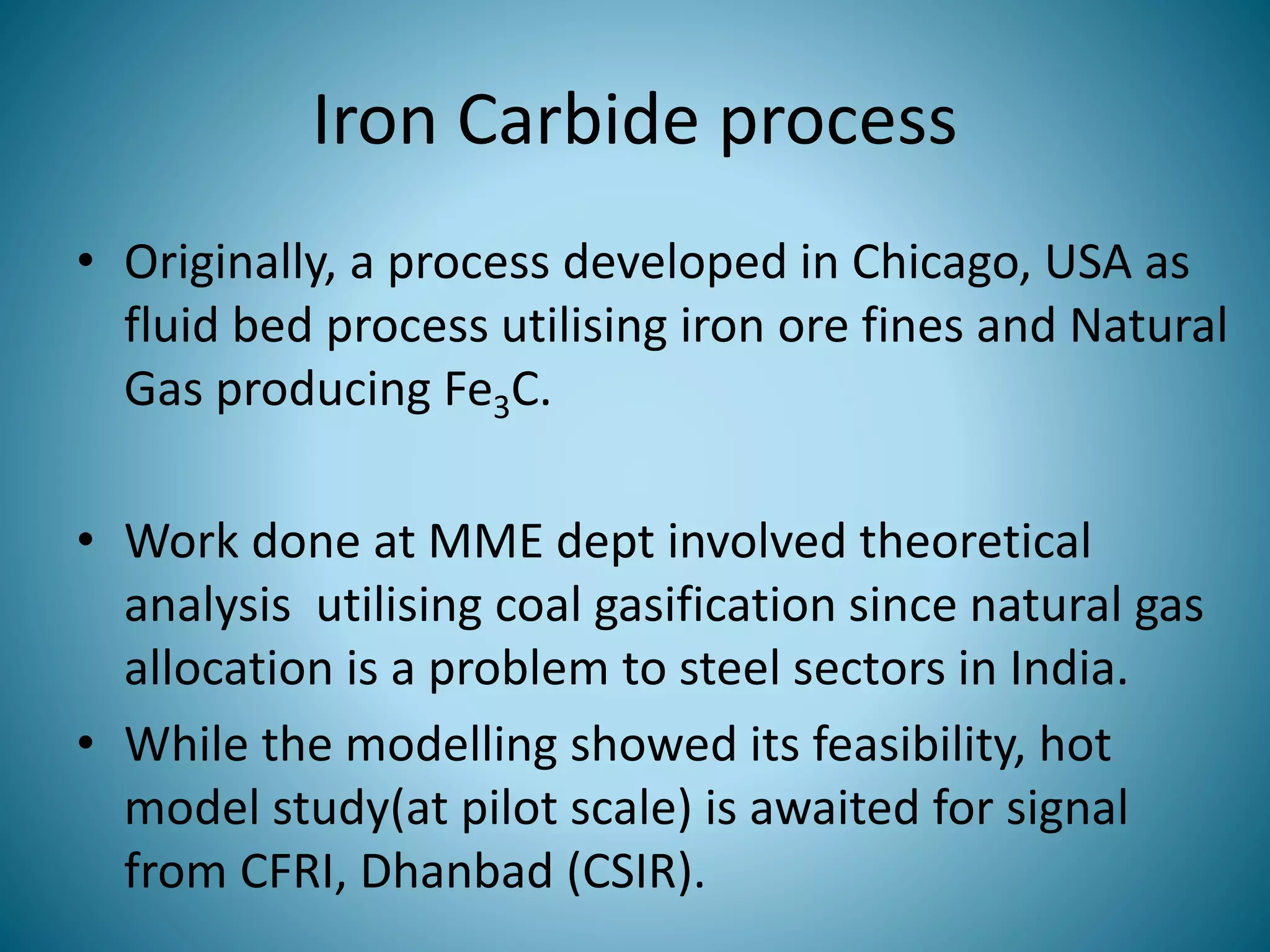
Iron Carbide process
• Originally, a process developed in Chicago, USA as
fluid bed process utilising iron ore fines and Natural
Gas producing Fe3C.
• Work done at MME dept involved theoretical
analysis utilising coal gasification since natural gas
allocation is a problem to steel sectors in India.
• While the modelling showed its feasibility, hot
model study(at pilot scale) is awaited for signal
from CFRI, Dhanbad (CSIR).
advantages
• Bonus 6-7% carbon content, injectable.
• Foamy slag possible
• No problems like Scrap, DRI.
• Environmental friendly.
• Not yet commercialised like in FINEX or FIOR.
2016 world DRI production
MIDREX
HYL/energiron
other gas
Rotary Kiln(coal based)
DRI production over the years by
different processes
process/percentage 2014 2015 2016
MIDREX 63.2 63.1 64.8
HYL/Energiron 16.2 16 17.4
Other Gas 0 0.7 0.3
Rotary Kiln/coal-
based) 20.6 20.2 17.5
0
10
20
30
40
50
60
70
percentageproduction
process
process vs percentage production
Series1
Series2
Series3
COG to produce DRI
• COG(Coke oven gas) contains valuable
components to be used for shaft furnace base
on DRI.
• The first one in India has been set up at JSPL,
Angul.
• Challenge: long chain and cyclic hydrocarbons in
COG may be detrimental to the gasification
process.
MXCOL Plant
Air separation
plant
Coal gasifier
O2
Gas cleaning and
conditioning
Gas heater
coal
Syngas
Shaft furnace
DRI/HBI
Iron Oxide
Scrubber
CO2 removal
MXCOL COG flow sheet
COG
preheater
Thermal reactor
Syngas
MIDREX shaft
furnaceIron oxide
Scrubber CO2 removal
Gas heater
Air separation
plant
O2
Coke oven gas
DRI/HBI
COREX-CEMENT-POWER PLANT COMPLEX
ORE COAL FLUX OXYGEN
COREX HOT METAL
SLAG
EXPORT GAS
POWER PLANT
POWER
CEMENT POWER
POWER
SLAG CEMENT
COREX coals should have at
least 25% ash, 35% volatile
matter, about 67% carbon
Direction of project work
• Utilisation of as much less energy as possible
in steel plants else live with the reality.
• Search for alternatives.
Energy consumption trends with
technological advancement
• Energy constitutes a significant portion of the cost of steel
production, from 20% to 40% in some countries. Thus,
improvements in energy efficiency result in reduced production
costs and thereby improved competitiveness.
• The energy efficiency of steelmaking facilities vary depending on
production route, type of iron ore and coal used, the steel product
mix, operation control technology, and material efficiency.
• Energy is also consumed indirectly for the mining, preparation,
and transportation of raw materials (about 8% of the total energy
required to produce the steel - including raw material extraction
and steel production processes.
• About 50% of an integrated facility’s energy input comes from
coal, 35% from electricity, 5% from natural gas and 5% from other
gases
Energy inputs and associated costs
Hydrogen
as an alternative
source of energy
In 2009, R & D dept of TATA Steel conducted a pilot trial on
the H2H process, hydrogen-rich gas is produced by the
thermo-chemical decomposition of water in the presence
of catalytic fluxes. The hot slag plays two roles:
(1) It provides heat for the water decomposition reaction
(2) It prevents the reverse reaction between hydrogen and
oxygen gases as the metal particles and suboxides present
in the slag react with the oxygen.
The team opted for simulation of the conditions inside the
H2H reactor, using computational fluid dynamic modelling
tools, with the help of Tata Research Development and
Design Centre, to simulate the rate and flow of products of
various reactions inside the reactor.
Pioneering work in Hydrogen recovery
Hydrogen Production Technologies
 Reforming of Carbonaceous Sources
 Pyrolysis of Biomass and reformation of bio-
oil and gaseous products
 Gasification of Renewable Biomass and its
Reformation
 Electrolysis of Water
 Bio-Hydrogen Process
 Thermochemical splitting of water
Advantages of using Hydrogen as fuel
The success of the hydrogen harvesting process has several
remarkable implications for the steel industry:
• It creates a clean fuel source at a low cost by using waste
heat and waste water.
• Hydrogen fuel cells are a new product area with uses in
transport and other industries.
• The process has the potential of increasing revenue as well
as added benefits in terms of carbon credits and patents.
• The gas can be used as a fuel in drying furnaces, reheating
furnaces, ladle pre-heaters, captive power plants, etc.
With this, consumption of coal and other fossil fuels
reduces and CO2 emissions can come down by about 25kg
per tonne of steel.
Advantages of using Hydrogen as fuel
PLASMA
as an alternative
source of energy
What is Plasma?
A plasma is a hot ionized gas consisting of approximately equal
numbers of positively charged ions and negatively charged
electrons. The characteristics of plasmas are significantly different
from those of ordinary neutral gases so that plasmas are
considered a distinct "fourth state of matter."
Diatomic gases like H2, N2
Plasma subjection
Dissociated atoms
which are chemically more active
than root diatomic molecules
Temperature at which gases significantly ionised:
5000 – 25000 K
This large temperature could be exploitable for
carrying out smelting operations
Iron & Steel industry
Thermal Plasma category
High intensity arcs
(based on)
shockwaves
High pressure
radio frequency
discharges
(field strength to
pressure ratio is small)
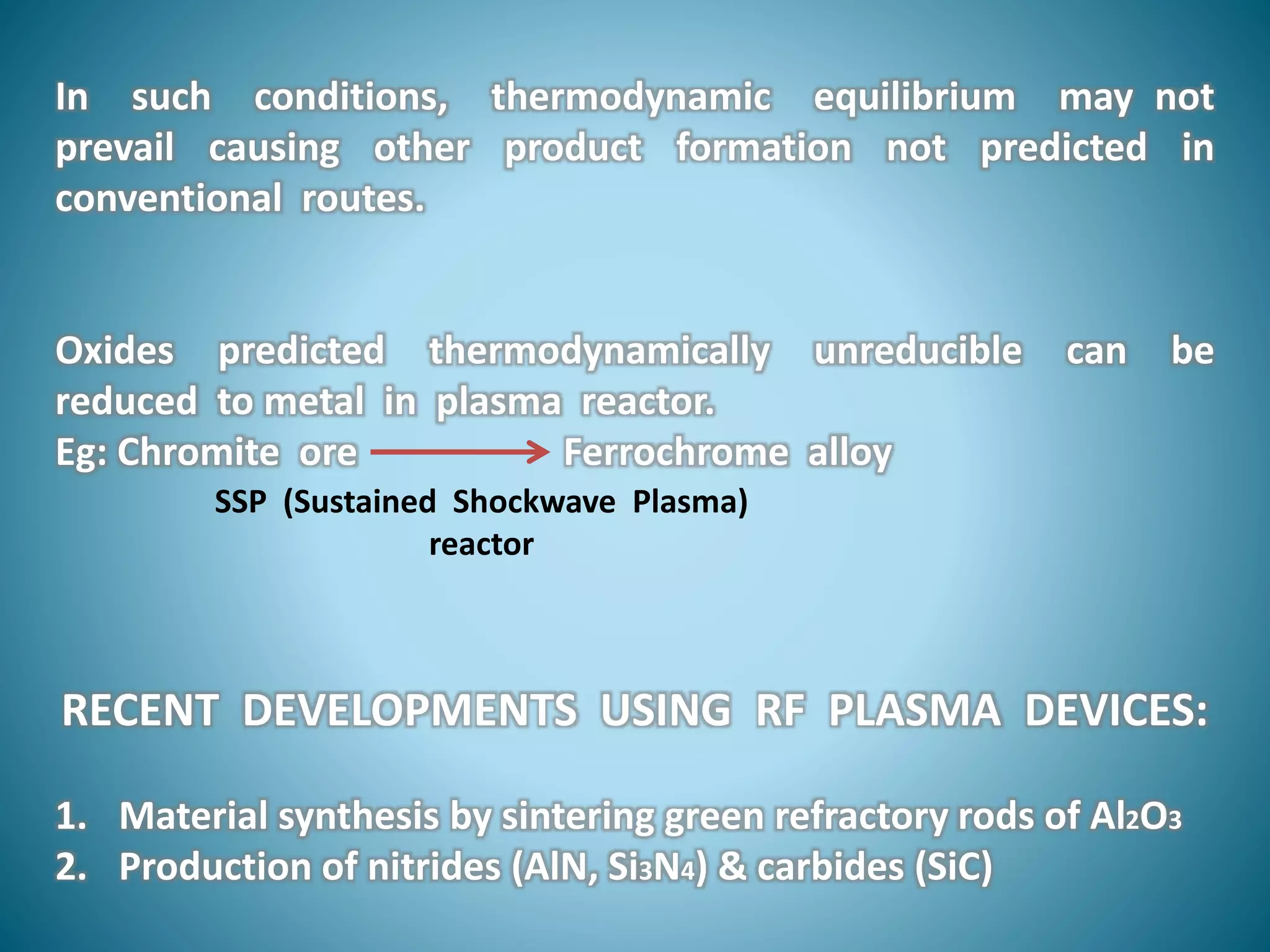
In such conditions, thermodynamic equilibrium may not
prevail causing other product formation not predicted in
conventional routes.
Oxides predicted thermodynamically unreducible can be
reduced to metal in plasma reactor.
Eg: Chromite ore Ferrochrome alloy
SSP (Sustained Shockwave Plasma)
reactor
RECENT DEVELOPMENTS USING RF PLASMA DEVICES:
1. Material synthesis by sintering green refractory rods of Al2O3
2. Production of nitrides (AlN, Si3N4) & carbides (SiC)
Schematic of plasma powered reducer
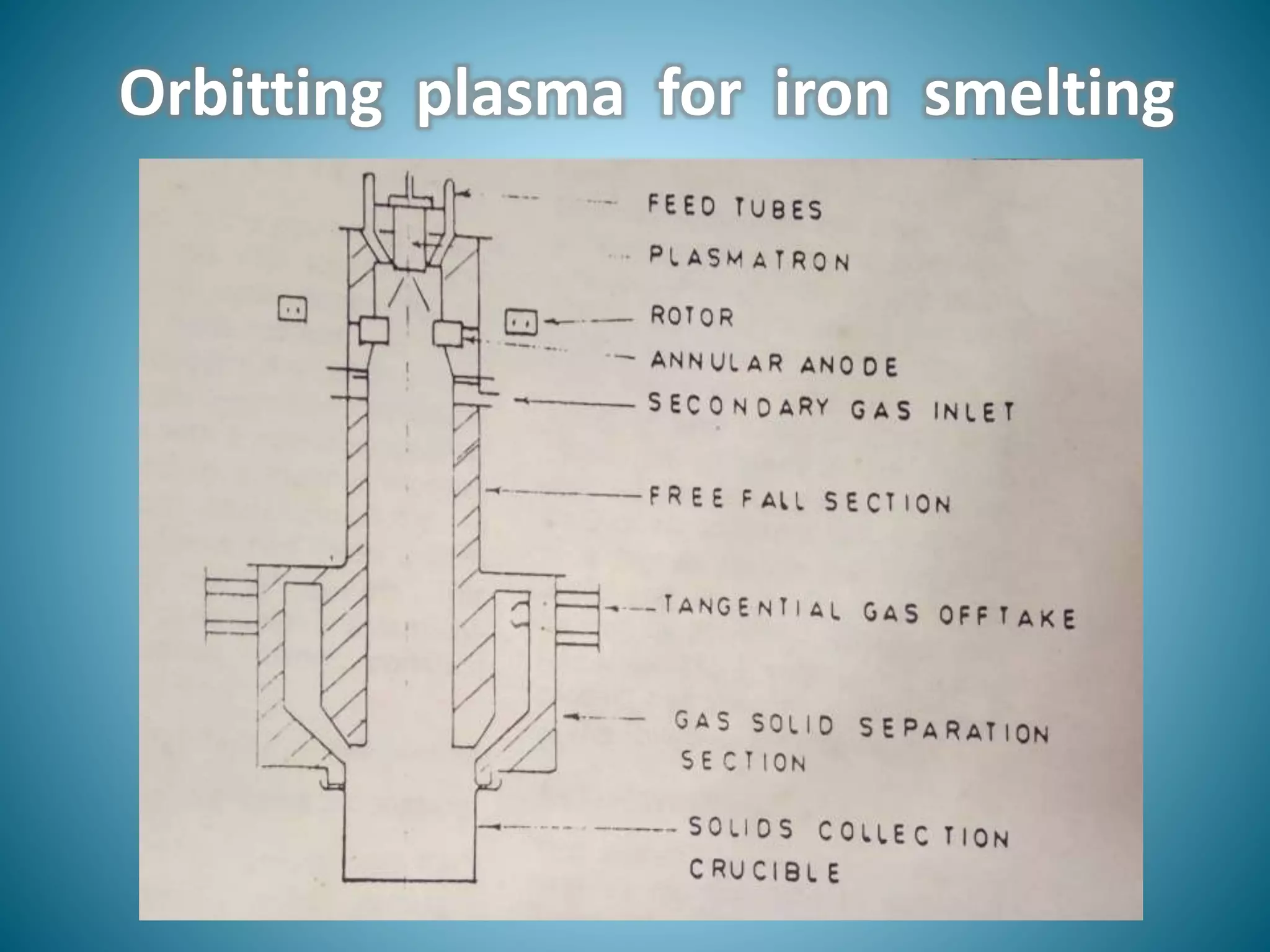
Orbitting plasma for iron smelting
 Attempts made at University Of Minnesota to
utilise plasma produced through electrical
shockwaves not only as a heat source but also
as a thermodynamic & kinetic medium for
smelting, using iron ore and coal fines.
 Also for circulation, a magnetic system is
utilized between cathodic and anodic segments.
(Ref. AG, U of M, steel times
international, London, 1986.)
Orbitting plasma for iron smelting
NATURAL GAS
as an alternative
source of energy
Availability of Natural Gas is a limitation
in Indian context
Availability of Natural Gas is a limitation
in Indian context
Natural gas application in iron carbide process
 Utilising iron ore fines in fluid bed with natural
gas
 Iron carbide produced is A substitute material
for charging into EAF (Chicago, USA)
 However for Indian conditions, NG being not
available and naphtha being not suitable, coal
gasification has been resorted to in a
conceptual project by Dr A.G. Group. (CFRI,
Dhanbad under CSIR). (Presented at EEC, Venice
2016)
NUCLEAR ENERGY
as an alternative
source of energy
Schematic showing generation of electricity
by Nuclear reactor
Unique features of fission energy & nuclear fuels
 High energy density
 Carbon free minimum volume of waste generation
 High base load electricity and plant load factor
 High capital cost but low maintenance costs
 Produce new fuel/fissile material from fertile
material, consuming fissile one
 Radioactivity & health hazard
Sources
of energy
used for
Industry
and
manufacturing,
2010
Predicted Energy resource consumption
Conclusively,
Deeper investigative studies shall be
undertaken to bring out ways and means
of establishing areas of application in the
ferrous sector, during the span of my
research project.
By-
Sumit Katiyar
Guided By-
Dr. Amit Ganguly
Introduction:
Iron and Steel Industry in India is on an
upswing because of the strong global and
domestic demand. India's rapid economic
growth and soaring demand by sectors like
infrastructure, real estate and automobiles,
at home and abroad, has put Indian steel
industry on the global map. According to the
latest report by International Iron and Steel
Institute (IISI), India is the 4th largest
steel producer in the world.
The present scenario of the industry
India has one of the richest reserves of all the raw
materials required for the industry, namely land, capital,
cheap labour, iron ore, power, coal etc. Yet we are 4th in
the world ranking for production of steel. We produced
66.8 million tonnes in 2010-11, while China, at the top
of the list, produced 626.7 million tonnes. Our per
capita consumption of steel in India (at 50 kg per
annum) is well below the world average (at about 200
kg per annum) and much below that of the developed
world (around 350 kg per annum).
Vision of the Steel Industry in India
The National Steel Policy – 2005 aims at increasing the
total steel production of the country to 110 million
tonnes per year (in 2019-20) from 38 million tonnes
(in 2004-05). This was supposed to require a
compounded annual growth of about 7.3%. The total
production in 2010 was 66.8 million tonnes. The
compounded annual growth from 2005 to 2010 has
been more than 9% which is better than the expected
growth. But most of these are a result of the
brownfield expansion projects of the existing steel
companies. But to continue with the same growth
rate, we need new Greenfield projects.
As per report of Ministry of Steel ,India
National Steel policy setup a production target of 110 million tonnes. Domestic
Demand of steels as tabulated follows:
Item 2010-11(Million tonnes) 2016-17(Million
Tonnes)
Carbon steel 62.14 108.3
Alloy/Stainless steel 3.47 5.0
Total domestic demand 65.61 113.3
Export 3.34 2.0
Net production 62.27 115.3
India’s export of Iron and Steel
Imports:
 Iron and steel are freely important as per extant policy.
 Last five year’s import of total finished steel (alloy +non alloy)
is given below:-
Indian steel Industry :Imports( in million tonnes)
Category 2007-
08
2008-
09
2009-
10
2010-
11
2011-
12*
Total Finished
steel (alloy +non
alloy)
7.03 5.84 7.38 6.66 6.83
Source: Joint Plant Committee; *provisional
Industry structure
The Iron and steel Industry in India has two separate divisions:
 Integrated producers
 Secondary producers
Integrated Producers: Amongst the Integrated producers, the
major producers include Tata Iron and Steel Company Limited (TISCO),
Rashtriya Ispat Nigam Limited (RINL) and Steel Authority of India
Limited (SAIL), who generate steel by converting iron ore.
Secondary Producers: The Secondary producers like Ispat
Industries, Lloyds steel and Essar Steel, create steel through the
process of melting scrap iron. These are mainly small steel plants and
produce steel in electric furnaces, using scrap and sponge iron. They
produce both mild steel and alloy steel of given specifications.
Main Problems of steel Industries
 Raw Materials Issues - depletion of iron ore and coal reserves
A. Iron Ore
 Resources and Reserves of Iron Ore in India as on 1.4.2010
(Million Tonnes)
Grade Reserves Remaining
Resources
Total
Resources
Haematite 8093.5 9788.6 17882.1
Magnetite 21.8 10622.3 10644.1
Total 8115.3 20410.9 28526.2
B. Coals
 As on 01.04.2011, India has total coking coal reserves of 33.474 billion
tonnes, out of which 17.67 billion tonnes is of proved category. Out of
this, prime coking coal is only 4.61 billion tonnes. Majority of coking
coal reserves in the country have high ash content, which is not
suitable for steel industry.
 As on 01.04.2011, India has total non-coking coal reserves of 252.39
billion tonnes, out of which 96.33 billion tonnes is of proved category.
 Coking coal quality problems, consequently, have forced the Indian
blast furnace based steel makers to get increasingly dependent on
imported coking coal and the high price of this critical raw material in
the international market has sharply eroded their competitive position.
 Infrastructure problem for steel industry and associated mining industry
 Steel manufacturing involves bulk movement of raw
materials and finished products over long distances and
across the country. Movement of raw materials requires
special attention as extraction of mineral resources is
largely confined to remote and relatively inaccessible
areas in the eastern and southern regions of India. Mining
areas in general are characterized by poor transport and
logistics network, power shortage and water scarcity.
These infrastructural constraints continue to dent steel
industry‘s competitiveness on account of higher
transportation cost, higher tariffs, and long delays.
Process Routes of Production of Iron & Steel
i) Coke Oven - Blast Furnace (BF) -Basic Oxygen Furnace (BOF) using Coking
Coal and Iron Ore (Lumps/Sinters) as basic inputs for production of steel flat
& long products.
ii) COREX – Basic Oxygen Furnace (BOF) using non-coking coal and iron ore
(lumps/pellets) as basic inputs for production of steel flat product.
iii) Direct Reduced Iron (DRI) – Electric Arc Furnace (EAF)using Natural
Gas/Non coking Coal and iron ore (lumps/pellets) as basic inputs for steel
production.
iv) Mini Blast Furnace (MBF) – Energy Optimizing Furnace (EOF) using coke and
iron ore lumps and scrap as basic inputs for steel production.
vi) Stand-alone Electric Arc Furnaces using steel scrap and purchased sponge iron
as basic inputs mainly for production of steel semis & long products.
vii) Standalone Electric Induction Furnaces using steel scrap and sponge iron as
basic inputs mainly for production of steel semis & long products.
viii) Standalone Mini Blast Furnaces using mostly iron ore lumps and coke as basic
inputs for pig iron and ductile iron spun pipe production.
ix) Stand alone Gas/Coal DRI Furnaces using iron ore lumps/pellets and Natural
Gas/ Non Coking Coal as basic inputs for production of Direct Reduced Iron
(Sponge iron).
x) Stand alone Rolling /Processing Mills using purchased/imported inputs for
production of long & flat rolled steel products including coated sheet products.
A TYPICAL CASE STUDY FOR INNOVATIVE TECHNOLOGIES LEADING TO
PROFITABILITY
 Improving operating parameters in EAF based on HBI utilization.
 HBI (HOT BRIQUETTED IRON) Developed based on preventing DRI re-
oxidation problems (spontaneous combustion resulting from high porosity
of DRI).
 The compact, dense material became a better charge material for
substituting scrap (HBI) in EAF which was developed by collaboration of
Industry named MIDREX, USA and UNIVERSITY OF PITTSBURGH in whose
team Dr. Amit Ganguly was one of the participants from UNIVERSITY OF
PITTSBURGH as a post-doc fellow.
 While utilising HBI, a great deal optimisation had to be struck to improve
consumption figures , through radical improvements in design and
development.
HOT BRIQUETTING SYSTEM
Controlling HBI related factors to control Energy rise in EAF
Superior DR Technology
HBI of high DOM
Less Impurities
Suitable ReductantHigh Grade Iron Ores
Optimum Charge
Control of energy in HBI-EAF Route
Continuous charging of HBI
Optimum HBI Ratio
In Charge mixture
Effect of continuous charging on HBI
EAF Steel Making Improvements
Future Plans for steel Plants
 Iron-making process which does not require coking coal –
Emerging Alternative Iron making processes
 Conversion of non-metallurgical coal into coking variety
 Improve washing to increase yield and reduce ash for coking and
non coking coals
 Beneficiation of lean / fine and friable iron ores and suitable
agglomeration for iron making
 Use of mine wastes
 Recycling of Steel Plant wastes to reduce / conserve the raw
material inputs
 Refractory life of steelmaking furnace e.g. refractory quality,
sintering characteristics, brick making, recycling etc.
 Standardization and optimization of EAF with hot metal charge to
improve overall performance of EAF
 Re-use and recycling of LD slag
 . New process/technology for ferro-alloy making to reduce the cost and CO2
emission
unit Co2 t/ton steel
Mining 0.2
Coking 0.1
Sintering 0.3-0.4
Iron making 0.7- 1.1
Steel making 0.1-0.2
Continuous casting 0.1
Hot rolling 0.1-0.2
Total 1.2-2.3
Co2 emission in integrated steel plant
Conclusion :
EAF has adopted HBI as feed constituent to supplement scrap
when needed and to dilute residuals to enhance steel quality when
required.
The rising trend in energy consumption generally confronting the
steelmaker while utilizing HBI needs to be largely offset to make it
a viable charge.
Innovations for energy utilisation in iron&steel plants

Innovations for energy utilisation in iron&steel plants

  • 1.
    Presented by Mainak Saha SaumyaRanjan Jha Sumit Katiyar Department of Metallurgical and Materials Engineering NIT Durgapur Guide: Dr. Amit Ganguly Ministry of Steel Chair Professor (NIT Durgapur) Govt of India
  • 2.
    Primary Energy Mixdata showing Coal as the majority shareholder as per 2013 statistics Raw Coal Usage in various sectors of Industry for usage as source of energy
  • 3.
    Role of coalin present scenario in Iron and steel plants Coke(composition:Carbon content 80 – 90%, Volatile Content 1 – 5% and Sulfur Content 0.5 – 1.5%. ) is used widely as • main fuel for Blast furnace in ironmaking(0.75-1.5’’). • Pet coke in EAFs,coke breeze(<0.75’’) • Fuel in cupola(5’’x2’’) • Calcined pet coke in induction furnaces. Its abrasive and this is determined by its M40 index(micum index)
  • 4.
    Role of coalin present scenario in Iron and steel plants • Anthracite Coal – low cost per ton of fixed carbon, low sulfur content. • Metallurgical Coke – low cost per ton of fixed carbon, low sulfur content. • Calcined Pet Coke – high fixed carbon content but not normally used because of high price. • Synthetic Graphite – high fixed carbon content, low sulfur and gas levels but not normally used because of high price.
  • 5.
    Report from CoalIndia limited Coal Production Grades Fiscal 2013 2014 2015 2016 2017 Raw coal production Mill Te % of Raw coal production Raw coal production Mill Te % of Raw coal production Raw coal production Mill Te % of Raw coal production Raw coal production Mill Te % of Raw coal production Raw coal production Mill Te % of Raw coal production Non Coking Coal 1 408.56 90.3 413.50 89.4 443.67 89.8 484.93 90.0 499.49 90.1 Coking Coal 2 43.66 9.7 48.92 10.6 50.57 10.2 53.83 10.0 54.65 9.9 Total 452.21 100.0 462.42 100.0 494.24 100.0 538.75 100.0 554.14 100.0
  • 6.
    INDIA’S COKING COALPRODUCTION SCENARIO
  • 7.
    Present Status andFuture Projections from Ministry of Steel, Govt. of India • World Steel Production : 1527 MT • Indian Steel Production : 72 MT • World Ranking in Production : 4th • World Ranking in Consumption : 3rd • Projected Capacity by 2016-17 : 150 MT • Projected Capacity by 2019-20 : 200 MT • Projected Capacity by 2030 : 500 MT
  • 8.
    SUPPLY SIDE PROBLEMSOF COKING COAL • The quality of coal is poor with high ash and moisture content. • Coking coal is very scarce, being imported • Coal mining suffers from multiple obstacles like environmental clearance, tribal resistance, Left wing extremism domination etc. • Poor technology is causing excessive wastages.
  • 9.
    DEMAND SIDE PROBLEMSOF COKING COAL • Domestic demand is shrinking as their major buyers i.e. Power companies are suffering losses due to non recovery. • With amendment to Coal act there is an oversupply of coal in the market. • Dumping of steel in indian market by China has severely hurt Coal sector.
  • 11.
    Report from Ministryof Coal, Govt of India
  • 12.
    Major coking coalsupplying countries to India
  • 13.
    Coking Coal-future globalscenario • Global metallurgical Coal Supplies are limitedƒ • Significant investment in Mines and Infrastructure will be required In traditional and emerging basins to ensure that adequate supplies will be available after 2017 • ƒAfter 2020, supply will struggle to keep up with demand–prices will increase in real terms
  • 14.
    Reduction of Cokingcoal consumption in Blast furnace • Pulverised Coal Injection(PCI): Mixing powdered coal with hot blast to lower the combustion temperature and also replacing expensive coking coal with cheaper non-coking coal. • Oxyfuel injection: using oxygen enrichment in the air for combustion in the hot stoves offers three Advantages: • First, the hot blast temperature may be increased due to higher flame temperature which reduces the blast furnace reductant consumption. • Secondly, the lower volume of flue gas reduces the loss of sensible heat via the flue gas. • Thirdly, COG or other higher value fuels may be used more effectively elsewhere.
  • 15.
    Alternatives • Non-coking coalusage : RKDR/Corex/Hismelt,etc.(smelting Redn.) • Coal Gasification Based DR : 1. SAIL-CSIR Project (Dr AG as Coordinator in 1983: Iron & Steel International,London, Univ Of Miami Energy Conf., etc.) 2. MXCOL Process for Midrex(originally NG-based) 3. Iron Carbide Research(AG’s group) 4. Fine coal, both as energy and reducer, Injected into recirculating molten iron bath , for smelting of iron ore fines(AG, U of Minnesota clean coal project : Steel Research, Germany, 1992).
  • 16.
    Carbon utilisation indirect smelting systems - Minnesota gas lift mechanism • Coal fines, injected directly into vigorously moving molten iron bath, along with iron ore and oxygen. • Serves 2 functions: - coal fines undergo easy combustion - Reduction of iron ore by coal fines Not yet commercialised.
  • 17.
    Iron Carbide process •Originally, a process developed in Chicago, USA as fluid bed process utilising iron ore fines and Natural Gas producing Fe3C. • Work done at MME dept involved theoretical analysis utilising coal gasification since natural gas allocation is a problem to steel sectors in India. • While the modelling showed its feasibility, hot model study(at pilot scale) is awaited for signal from CFRI, Dhanbad (CSIR).
  • 18.
    advantages • Bonus 6-7%carbon content, injectable. • Foamy slag possible • No problems like Scrap, DRI. • Environmental friendly. • Not yet commercialised like in FINEX or FIOR.
  • 19.
    2016 world DRIproduction MIDREX HYL/energiron other gas Rotary Kiln(coal based)
  • 20.
    DRI production overthe years by different processes process/percentage 2014 2015 2016 MIDREX 63.2 63.1 64.8 HYL/Energiron 16.2 16 17.4 Other Gas 0 0.7 0.3 Rotary Kiln/coal- based) 20.6 20.2 17.5
  • 21.
  • 22.
    COG to produceDRI • COG(Coke oven gas) contains valuable components to be used for shaft furnace base on DRI. • The first one in India has been set up at JSPL, Angul. • Challenge: long chain and cyclic hydrocarbons in COG may be detrimental to the gasification process.
  • 23.
    MXCOL Plant Air separation plant Coalgasifier O2 Gas cleaning and conditioning Gas heater coal Syngas Shaft furnace DRI/HBI Iron Oxide Scrubber CO2 removal
  • 24.
    MXCOL COG flowsheet COG preheater Thermal reactor Syngas MIDREX shaft furnaceIron oxide Scrubber CO2 removal Gas heater Air separation plant O2 Coke oven gas DRI/HBI
  • 25.
    COREX-CEMENT-POWER PLANT COMPLEX ORECOAL FLUX OXYGEN COREX HOT METAL SLAG EXPORT GAS POWER PLANT POWER CEMENT POWER POWER SLAG CEMENT COREX coals should have at least 25% ash, 35% volatile matter, about 67% carbon
  • 26.
    Direction of projectwork • Utilisation of as much less energy as possible in steel plants else live with the reality. • Search for alternatives.
  • 27.
    Energy consumption trendswith technological advancement
  • 28.
    • Energy constitutesa significant portion of the cost of steel production, from 20% to 40% in some countries. Thus, improvements in energy efficiency result in reduced production costs and thereby improved competitiveness. • The energy efficiency of steelmaking facilities vary depending on production route, type of iron ore and coal used, the steel product mix, operation control technology, and material efficiency. • Energy is also consumed indirectly for the mining, preparation, and transportation of raw materials (about 8% of the total energy required to produce the steel - including raw material extraction and steel production processes. • About 50% of an integrated facility’s energy input comes from coal, 35% from electricity, 5% from natural gas and 5% from other gases Energy inputs and associated costs
  • 29.
  • 30.
    In 2009, R& D dept of TATA Steel conducted a pilot trial on the H2H process, hydrogen-rich gas is produced by the thermo-chemical decomposition of water in the presence of catalytic fluxes. The hot slag plays two roles: (1) It provides heat for the water decomposition reaction (2) It prevents the reverse reaction between hydrogen and oxygen gases as the metal particles and suboxides present in the slag react with the oxygen. The team opted for simulation of the conditions inside the H2H reactor, using computational fluid dynamic modelling tools, with the help of Tata Research Development and Design Centre, to simulate the rate and flow of products of various reactions inside the reactor. Pioneering work in Hydrogen recovery
  • 31.
    Hydrogen Production Technologies Reforming of Carbonaceous Sources  Pyrolysis of Biomass and reformation of bio- oil and gaseous products  Gasification of Renewable Biomass and its Reformation  Electrolysis of Water  Bio-Hydrogen Process  Thermochemical splitting of water
  • 32.
    Advantages of usingHydrogen as fuel
  • 33.
    The success ofthe hydrogen harvesting process has several remarkable implications for the steel industry: • It creates a clean fuel source at a low cost by using waste heat and waste water. • Hydrogen fuel cells are a new product area with uses in transport and other industries. • The process has the potential of increasing revenue as well as added benefits in terms of carbon credits and patents. • The gas can be used as a fuel in drying furnaces, reheating furnaces, ladle pre-heaters, captive power plants, etc. With this, consumption of coal and other fossil fuels reduces and CO2 emissions can come down by about 25kg per tonne of steel. Advantages of using Hydrogen as fuel
  • 34.
  • 35.
    What is Plasma? Aplasma is a hot ionized gas consisting of approximately equal numbers of positively charged ions and negatively charged electrons. The characteristics of plasmas are significantly different from those of ordinary neutral gases so that plasmas are considered a distinct "fourth state of matter."
  • 36.
    Diatomic gases likeH2, N2 Plasma subjection Dissociated atoms which are chemically more active than root diatomic molecules Temperature at which gases significantly ionised: 5000 – 25000 K This large temperature could be exploitable for carrying out smelting operations
  • 37.
    Iron & Steelindustry Thermal Plasma category High intensity arcs (based on) shockwaves High pressure radio frequency discharges (field strength to pressure ratio is small)
  • 38.
    In such conditions,thermodynamic equilibrium may not prevail causing other product formation not predicted in conventional routes. Oxides predicted thermodynamically unreducible can be reduced to metal in plasma reactor. Eg: Chromite ore Ferrochrome alloy SSP (Sustained Shockwave Plasma) reactor RECENT DEVELOPMENTS USING RF PLASMA DEVICES: 1. Material synthesis by sintering green refractory rods of Al2O3 2. Production of nitrides (AlN, Si3N4) & carbides (SiC)
  • 39.
    Schematic of plasmapowered reducer
  • 40.
    Orbitting plasma foriron smelting  Attempts made at University Of Minnesota to utilise plasma produced through electrical shockwaves not only as a heat source but also as a thermodynamic & kinetic medium for smelting, using iron ore and coal fines.  Also for circulation, a magnetic system is utilized between cathodic and anodic segments. (Ref. AG, U of M, steel times international, London, 1986.)
  • 41.
    Orbitting plasma foriron smelting
  • 42.
    NATURAL GAS as analternative source of energy
  • 43.
    Availability of NaturalGas is a limitation
  • 44.
    Availability of NaturalGas is a limitation in Indian context
  • 45.
    Availability of NaturalGas is a limitation in Indian context
  • 46.
    Natural gas applicationin iron carbide process  Utilising iron ore fines in fluid bed with natural gas  Iron carbide produced is A substitute material for charging into EAF (Chicago, USA)  However for Indian conditions, NG being not available and naphtha being not suitable, coal gasification has been resorted to in a conceptual project by Dr A.G. Group. (CFRI, Dhanbad under CSIR). (Presented at EEC, Venice 2016)
  • 47.
    NUCLEAR ENERGY as analternative source of energy
  • 51.
    Schematic showing generationof electricity by Nuclear reactor
  • 53.
    Unique features offission energy & nuclear fuels  High energy density  Carbon free minimum volume of waste generation  High base load electricity and plant load factor  High capital cost but low maintenance costs  Produce new fuel/fissile material from fertile material, consuming fissile one  Radioactivity & health hazard
  • 55.
  • 56.
  • 57.
    Conclusively, Deeper investigative studiesshall be undertaken to bring out ways and means of establishing areas of application in the ferrous sector, during the span of my research project.
  • 58.
  • 59.
    Introduction: Iron and SteelIndustry in India is on an upswing because of the strong global and domestic demand. India's rapid economic growth and soaring demand by sectors like infrastructure, real estate and automobiles, at home and abroad, has put Indian steel industry on the global map. According to the latest report by International Iron and Steel Institute (IISI), India is the 4th largest steel producer in the world.
  • 60.
    The present scenarioof the industry India has one of the richest reserves of all the raw materials required for the industry, namely land, capital, cheap labour, iron ore, power, coal etc. Yet we are 4th in the world ranking for production of steel. We produced 66.8 million tonnes in 2010-11, while China, at the top of the list, produced 626.7 million tonnes. Our per capita consumption of steel in India (at 50 kg per annum) is well below the world average (at about 200 kg per annum) and much below that of the developed world (around 350 kg per annum).
  • 61.
    Vision of theSteel Industry in India The National Steel Policy – 2005 aims at increasing the total steel production of the country to 110 million tonnes per year (in 2019-20) from 38 million tonnes (in 2004-05). This was supposed to require a compounded annual growth of about 7.3%. The total production in 2010 was 66.8 million tonnes. The compounded annual growth from 2005 to 2010 has been more than 9% which is better than the expected growth. But most of these are a result of the brownfield expansion projects of the existing steel companies. But to continue with the same growth rate, we need new Greenfield projects.
  • 62.
    As per reportof Ministry of Steel ,India National Steel policy setup a production target of 110 million tonnes. Domestic Demand of steels as tabulated follows: Item 2010-11(Million tonnes) 2016-17(Million Tonnes) Carbon steel 62.14 108.3 Alloy/Stainless steel 3.47 5.0 Total domestic demand 65.61 113.3 Export 3.34 2.0 Net production 62.27 115.3
  • 63.
    India’s export ofIron and Steel
  • 64.
    Imports:  Iron andsteel are freely important as per extant policy.  Last five year’s import of total finished steel (alloy +non alloy) is given below:- Indian steel Industry :Imports( in million tonnes) Category 2007- 08 2008- 09 2009- 10 2010- 11 2011- 12* Total Finished steel (alloy +non alloy) 7.03 5.84 7.38 6.66 6.83 Source: Joint Plant Committee; *provisional
  • 65.
    Industry structure The Ironand steel Industry in India has two separate divisions:  Integrated producers  Secondary producers Integrated Producers: Amongst the Integrated producers, the major producers include Tata Iron and Steel Company Limited (TISCO), Rashtriya Ispat Nigam Limited (RINL) and Steel Authority of India Limited (SAIL), who generate steel by converting iron ore. Secondary Producers: The Secondary producers like Ispat Industries, Lloyds steel and Essar Steel, create steel through the process of melting scrap iron. These are mainly small steel plants and produce steel in electric furnaces, using scrap and sponge iron. They produce both mild steel and alloy steel of given specifications.
  • 66.
    Main Problems ofsteel Industries  Raw Materials Issues - depletion of iron ore and coal reserves A. Iron Ore  Resources and Reserves of Iron Ore in India as on 1.4.2010 (Million Tonnes) Grade Reserves Remaining Resources Total Resources Haematite 8093.5 9788.6 17882.1 Magnetite 21.8 10622.3 10644.1 Total 8115.3 20410.9 28526.2
  • 67.
    B. Coals  Ason 01.04.2011, India has total coking coal reserves of 33.474 billion tonnes, out of which 17.67 billion tonnes is of proved category. Out of this, prime coking coal is only 4.61 billion tonnes. Majority of coking coal reserves in the country have high ash content, which is not suitable for steel industry.  As on 01.04.2011, India has total non-coking coal reserves of 252.39 billion tonnes, out of which 96.33 billion tonnes is of proved category.  Coking coal quality problems, consequently, have forced the Indian blast furnace based steel makers to get increasingly dependent on imported coking coal and the high price of this critical raw material in the international market has sharply eroded their competitive position.
  • 68.
     Infrastructure problemfor steel industry and associated mining industry  Steel manufacturing involves bulk movement of raw materials and finished products over long distances and across the country. Movement of raw materials requires special attention as extraction of mineral resources is largely confined to remote and relatively inaccessible areas in the eastern and southern regions of India. Mining areas in general are characterized by poor transport and logistics network, power shortage and water scarcity. These infrastructural constraints continue to dent steel industry‘s competitiveness on account of higher transportation cost, higher tariffs, and long delays.
  • 69.
    Process Routes ofProduction of Iron & Steel i) Coke Oven - Blast Furnace (BF) -Basic Oxygen Furnace (BOF) using Coking Coal and Iron Ore (Lumps/Sinters) as basic inputs for production of steel flat & long products. ii) COREX – Basic Oxygen Furnace (BOF) using non-coking coal and iron ore (lumps/pellets) as basic inputs for production of steel flat product. iii) Direct Reduced Iron (DRI) – Electric Arc Furnace (EAF)using Natural Gas/Non coking Coal and iron ore (lumps/pellets) as basic inputs for steel production. iv) Mini Blast Furnace (MBF) – Energy Optimizing Furnace (EOF) using coke and iron ore lumps and scrap as basic inputs for steel production.
  • 70.
    vi) Stand-alone ElectricArc Furnaces using steel scrap and purchased sponge iron as basic inputs mainly for production of steel semis & long products. vii) Standalone Electric Induction Furnaces using steel scrap and sponge iron as basic inputs mainly for production of steel semis & long products. viii) Standalone Mini Blast Furnaces using mostly iron ore lumps and coke as basic inputs for pig iron and ductile iron spun pipe production. ix) Stand alone Gas/Coal DRI Furnaces using iron ore lumps/pellets and Natural Gas/ Non Coking Coal as basic inputs for production of Direct Reduced Iron (Sponge iron). x) Stand alone Rolling /Processing Mills using purchased/imported inputs for production of long & flat rolled steel products including coated sheet products.
  • 71.
    A TYPICAL CASESTUDY FOR INNOVATIVE TECHNOLOGIES LEADING TO PROFITABILITY  Improving operating parameters in EAF based on HBI utilization.  HBI (HOT BRIQUETTED IRON) Developed based on preventing DRI re- oxidation problems (spontaneous combustion resulting from high porosity of DRI).  The compact, dense material became a better charge material for substituting scrap (HBI) in EAF which was developed by collaboration of Industry named MIDREX, USA and UNIVERSITY OF PITTSBURGH in whose team Dr. Amit Ganguly was one of the participants from UNIVERSITY OF PITTSBURGH as a post-doc fellow.  While utilising HBI, a great deal optimisation had to be struck to improve consumption figures , through radical improvements in design and development.
  • 72.
  • 73.
    Controlling HBI relatedfactors to control Energy rise in EAF Superior DR Technology HBI of high DOM Less Impurities Suitable ReductantHigh Grade Iron Ores Optimum Charge Control of energy in HBI-EAF Route Continuous charging of HBI Optimum HBI Ratio In Charge mixture
  • 74.
    Effect of continuouscharging on HBI
  • 76.
    EAF Steel MakingImprovements
  • 77.
    Future Plans forsteel Plants  Iron-making process which does not require coking coal – Emerging Alternative Iron making processes  Conversion of non-metallurgical coal into coking variety  Improve washing to increase yield and reduce ash for coking and non coking coals  Beneficiation of lean / fine and friable iron ores and suitable agglomeration for iron making  Use of mine wastes  Recycling of Steel Plant wastes to reduce / conserve the raw material inputs  Refractory life of steelmaking furnace e.g. refractory quality, sintering characteristics, brick making, recycling etc.  Standardization and optimization of EAF with hot metal charge to improve overall performance of EAF
  • 78.
     Re-use andrecycling of LD slag  . New process/technology for ferro-alloy making to reduce the cost and CO2 emission unit Co2 t/ton steel Mining 0.2 Coking 0.1 Sintering 0.3-0.4 Iron making 0.7- 1.1 Steel making 0.1-0.2 Continuous casting 0.1 Hot rolling 0.1-0.2 Total 1.2-2.3 Co2 emission in integrated steel plant
  • 79.
    Conclusion : EAF hasadopted HBI as feed constituent to supplement scrap when needed and to dilute residuals to enhance steel quality when required. The rising trend in energy consumption generally confronting the steelmaker while utilizing HBI needs to be largely offset to make it a viable charge.