INTERNATIONAL CONFERENCE
INDIAN STEEL INDUSTRY: CHALLENGES &
OPPORTUNITIES
TECHNOLOGY ROAD MAP
FOR INDIAN STEEL INDUSTRY
23rd March 20123
A C R Das
Industrial Adviser
Ministry of Steel
PRESENT STATUS AND FUTURE PROJECTIONS
 World Steel Production : 1527 MT
 Indian Steel Production : 72 MT
 World Ranking in Production : 4th
 World Ranking in Consumption : 3rd
 Projected Capacity by 2016-17 : 150 MT
 Projected Capacity by 2019-20 : 200 MT
 Projected Capacity by 2030 : 500 MT
Indian Steel Production is bound to grow manifold
in years to come to sustain Growth in infrastructure
/Construction, Automotive , Capital Goods and
Consumer Durable Sector i.e economic growth .
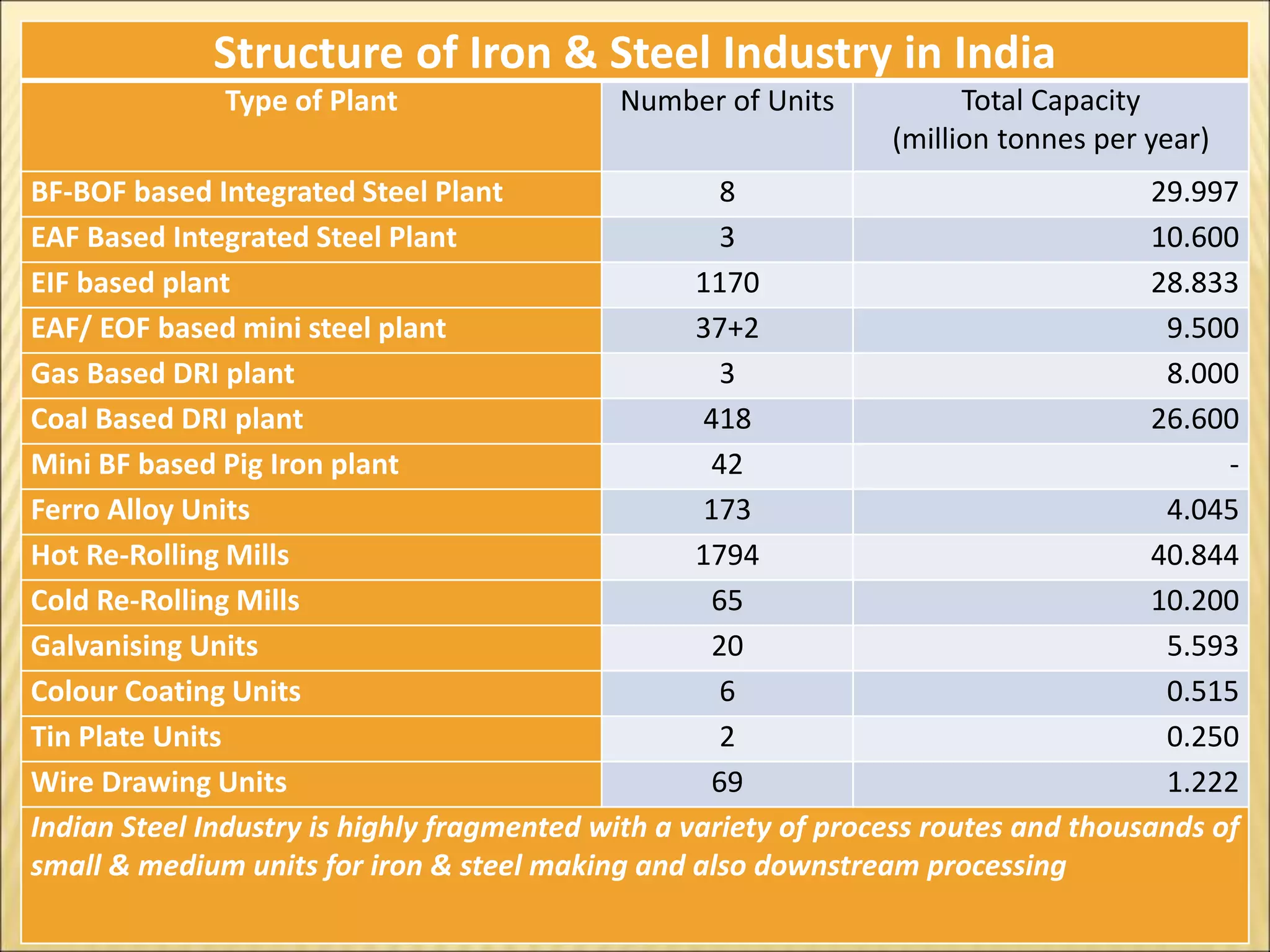
Structure of Iron & Steel Industry in India
Type of Plant Number of Units Total Capacity
(million tonnes per year)
BF-BOF based Integrated Steel Plant 8 29.997
EAF Based Integrated Steel Plant 3 10.600
EIF based plant 1170 28.833
EAF/ EOF based mini steel plant 37+2 9.500
Gas Based DRI plant 3 8.000
Coal Based DRI plant 418 26.600
Mini BF based Pig Iron plant 42 -
Ferro Alloy Units 173 4.045
Hot Re-Rolling Mills 1794 40.844
Cold Re-Rolling Mills 65 10.200
Galvanising Units 20 5.593
Colour Coating Units 6 0.515
Tin Plate Units 2 0.250
Wire Drawing Units 69 1.222
Indian Steel Industry is highly fragmented with a variety of process routes and thousands of
small & medium units for iron & steel making and also downstream processing
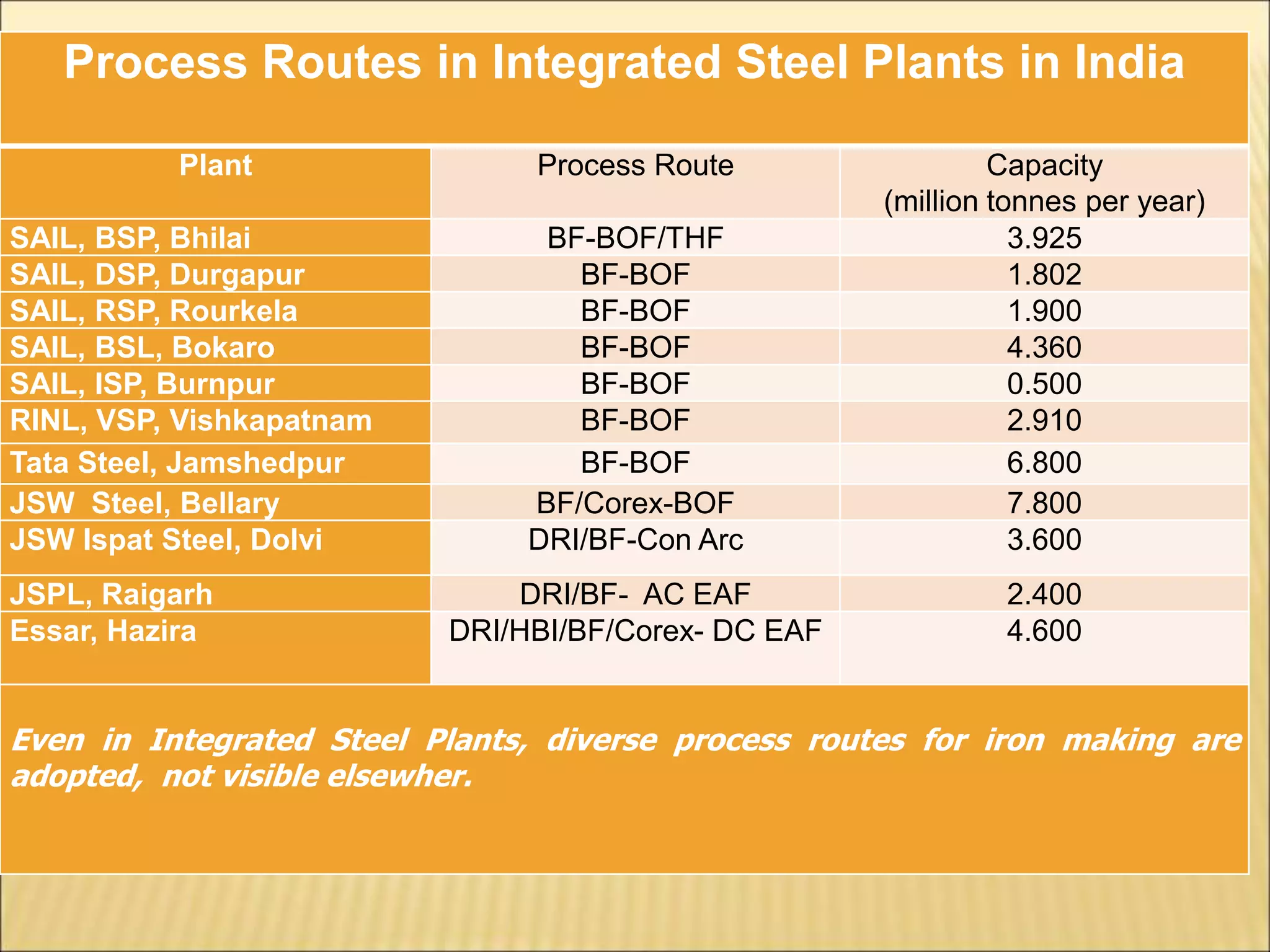
Process Routes in Integrated Steel Plants in India
Plant Process Route Capacity
(million tonnes per year)
SAIL, BSP, Bhilai BF-BOF/THF 3.925
SAIL, DSP, Durgapur BF-BOF 1.802
SAIL, RSP, Rourkela BF-BOF 1.900
SAIL, BSL, Bokaro BF-BOF 4.360
SAIL, ISP, Burnpur BF-BOF 0.500
RINL, VSP, Vishkapatnam BF-BOF 2.910
Tata Steel, Jamshedpur BF-BOF 6.800
JSW Steel, Bellary BF/Corex-BOF 7.800
JSW Ispat Steel, Dolvi DRI/BF-Con Arc 3.600
JSPL, Raigarh DRI/BF- AC EAF 2.400
Essar, Hazira DRI/HBI/BF/Corex- DC EAF 4.600
Even in Integrated Steel Plants, diverse process routes for iron making are
adopted, not visible elsewher.
SHARE OF PROCESS ROUTES IN STEEL
PRODUCTION
World: 2 main process routes
• Basic Oxygen Furnace (BOF): ~ 70%
• Electric Arc Furnace (EAF): ~ 29%
• Others: ~ 1%
India: 3 main process routes
• Oxygen Furnace (BOF/THF): ~ 45%
• Electric Arc Furnace (EAF): ~ 23%
• Electric Induction Furnace (EIF): ~ 32%
 Induction Furnace Play dominant role in steel
production in India-a unique feature. Quality issue remain
unresolved
 BF-BOF route is likely to gain momentum.
STEEL MAKING AND CLIMATE CHANGE
• Iron & Steel Making is resource intensive and Energy
Intensive and have environmental Ramifications.
• Globally 18 Tonnes of CO2 /tcs is emitted. India 2.5-3 T/tcs
• Global CO2 emission is around 30 billion tonnes /year.
• India’s contribution is around 1.15 billion tonnes/ year (4%), of
which
• Steel sector contributes 117 million tonnes/ year (10%).
• Integrated steel plants largest point sources of CO2 emission
and 85% of CO2 is from iron making.
• With the increase in production, energy consumption and
GHG emissions will also increase correspondingly adding to
Global Warming: an issue of international criticism.
• Therefore, it is necessary that along with capacity build-up,
suitable mitigation strategies are inbuilt into the strategy.
ENERGY EFFICIENCY & GHG EMISSION:
GLOBAL SCENARIO
• Advanced steel plants in the world already operate close
to theoretical limits.
• There is ambitious target to cut CO2 emission by 50% by
2050 which is not possible adopting conventional
technologies and would require Breakthrough
Technologies.
• Steel Making countries/ regions have embarked on
programmes to achieve targeted CO2 emission:
 ULCOS (EU)
 COURSE 50 (Japan)
 CO2 Breakthrough Programme (USA)
 POSCO Breakthrough Technology Programme (Korea)
• Breakthrough Technologies being explored are:
innovations in BF (Oxygen Operation), Hydrogen
Reduction, Electron Reduction, Use of Biomass, Carbon
Capture & Storage (CCS) etc.
ENERGY EFFICIENCY & GHG EMISSION: INDIAN
SCENARIO
• The Specific Energy Consumption (SEC) in Indian
Steel Plants have declined substantially from 10
Gcal/MT in 1990 to 6-6.5 Gcal/MT in 2009 and are
still declining.
• Best available technologies indicate SEC of
around 4.5-5 Gcal/MT for BF-BOF route and 4
Gcal/Tcs for gas based DRI-EAF unit.
• Integrated steel plants in India are 50% more
energy intensive than global average.
• The same holds good for CO2 emission also.
• There remains large scope for improvement of
energy intensity & reduction of CO2 emission even
without pursuing breakthrough technologies.
VOLUNTARY INITIATIVES & REGULATORY
FRAMEWORK
• India is committed to reduce GHG Emission Intensity of its
GDP by 20-25% by 2020 over 2005 level, through pursuits of
proactive policies.
• Voluntary Initiatives by Steel Plants under Corporate
Responsibility for Environment Protection (CREP) for energy
efficiency improvement and reduction of GHG emission.
• National Mission for Enhanced Energy Efficiency (NMEEE)
under National Action Plan for Climate Change for energy
efficiency improvement.
• Perform Achieve and Trade (PAT), a flagship market based
mechanism to enhance cost effectiveness in improvements in
energy efficiency in energy intensive large industries.
• PAT is legally binding and there are penalties for non fulfillment
of earmarked targets.
• GOI Sustainability Development Guidelines: 5% of total MOU
score for large PSUs to cover sustainability projects with
expenditure of 0.1 % of profit (after tax).
ROAD AHEAD AND STRATEGIES
Gradually transform the technological face of the Indian steel
industry to achieve international benchmarks in long term
perspective through:
• Modernisation & Technological upgradation of the existing plants to
phase out old/ obsolete/ energy inefficient/ polluting production facilities.
• Adoption of State-of-the-art technologies in Green Field Plants.
• Harnessing of Waste Heat at every step of the production process.
• Guidelines of modern/ state of art technologies are available in several
reference documents: SOACT Handbook of APP, BAT Handbook of EU.
• Numerous commercially established energy conservation technologies:
Sinter Cooler Waste Heat Recovery, Coke Dry Quenching (CDQ), Coal
Moisture Control (CMC) in Coke Ovens, BF Top Pressure Recovery
Turbine (TRT), waste heat recovery from BF stove waste gases, OG
boiler in BOF, Regenerative Burners, Near Net Shape casting etc.:
agenda for immediate adoption.
• Strategies to ensure Raw material security- utilisation of low grade ore
through beneficiation & agglomeration or through Direct Smelting,
beneficiation of high ash coal and other inputs.
• Pursuing Research & Development Programmes for Low Carbon
Footprints and production of value added/ high performance steel.
• Securing talent and skilled manpower to support the above strategies.
STRATEGIES FOR BF IRON MAKING
BF is the most energy intensive units and call for specially directed
initiatives to improve the productivity and energy efficiency:
• Process improvements viz. revamping/conveyorization of stock house and
increasing screening efficiency of ore, sinter and coke, strengthening stoves
capacity, increasing blast volume and flow rate, increasing oxygen enrichment of
blast, higher hot blast temperatures of at-least 11000 C etc.
• High level of alternate fuels injection to drastically reduce coke rate: incorporation of
technologies for injecting pulverized/ granulated coal (+ 200 kg/thm), oil (100
kg/thm), Natural gas (100 kg/thm) and waste plastics granules.
• Adoption of energy efficiency measures in existing and new blast furnaces e.g. Top
pressure Recovery Turbine, use of waste heat stove gas for preheating of gas, high
efficiency stoves etc.
• Increase in campaign life by introduction of various measures like copper staves,
Silicon carbide and monolithic linings in stack and bosh, closed circuit
demineralized water and provisions for regular monitoring of heat flux all along the
furnace height and cross-section, use of titanium bearing material as a regular
hearth protection measure etc.
• Application of sophisticated probes (under and overburden probes, vertical probes
etc), models and computerized expert system for process analysis, control and
optimization are very important tools for bringing about quantum jump in
productivity levels of Indian blast furnaces.
• Efficient casting practice through up-gradation of cast house equipment, clay mass
and liquid disposal system, incorporation of powerful mud gun and drilling machines
etc.
ALTERNATIVE IRON MAKING TECHNOLOGIES
Direct Reduced Iron (DRI)
• Accounts for 45% of iron production in India– 25% gas based & 75% coal
based
• Technology of Natural Gas based plants world class and energy
consumption in Gas DRI-EAF is the lowest, but no growth because of non
availability of natural gas.
• Technology of Coal based plant is mixed and energy consumption in Coal
DRI-EAF units highest. Technological obsolescence, Poor quality of
inputs/products and higher environmental emissions are issues of concern.
• Solutions:
 Syn-gas based DRI plant ( Economic Viability?)
 Improving energy efficiency and reduction of environmental emission in coal
based DRI plants failing which gradual shut down of inefficient& polluting plants
 Jumbo Rotary Kiln of Outotech: a ray of hope.
 FASTMET: Reduction of ore-coal composite pellets in RHF using coal, coke
breeze and carbon bearing waste as a reductant. DRI with high degree of
metallization can be charged in EAF in SME sector.
 ITmk3: Flexible and environment friendly technology for smelting iron ore fines
using non-coking coal to produce iron nuggets with 96-97% iron in a RHF. Ideal
ALTERNATIVE IRON MAKING TECHNOLOGIES
CONTD..
Smelting Reduction Processes
 Primary objective is to produce liquid iron directly
from iron ore (fines & concentrates) and non coking
coal, by-passing agglomeration and coke making
requirements (reduced investment cost : 10-15%).
• Plant emissions contain only insignificant amounts
of NOx, SO2, dust, phenols, sulfides and,
ammonium besides far lower waste-water
emissions.
• The promising alternative technologies which have
been commercialized/ are in the process of
commercialization and appear to be relevant are
COREX, FINEX, HISMELT, HISARNA,
COREX PROCESS
Process
Characteristics
Merits/Demerits Status
Corex is a two-stage
process: in the first
stage (Reduction
Shaft), iron ore is
reduced to DRI using
the reduction gas (65-
70% CO + 20-25% H2)
from the Melter
Gasifier and in the
second stage (Melter
Gasifier), DRI
produced in
reduction shaft is
melted to produce
hot metal.
Merits: Cost saving (up to 15%)
and Environment friendly vis-à-vis
Coke oven-sinter plant.-BF route
Demerits: Limited modular size
(largest corex plant is of 1.5 million
tonne capacity), Dependence on
lumps/ pellets/ coke/ weak coking
coal, high consumption (cost) of
oxygen, necessity of gainful
utilization of Corex gas and
generated coal fines.
COREX is a proven
smelting-reduction (SR)
process developed by
Siemens VAI for the cost-
effective and environment
friendly production of hot
metal.
Well established in India
and abroad- JSW Steel
and Essar steel
successfully adopted the
Corex process (C-2000
Module) .
FINEX PROCESS
Process Characteristics Merits/Demerits Status
FINEX: an innovative iron
making technology
developed by Siemens VAI
and POSCO.
Like Corex, Finex also
involves two reactors-
Fluidised Bed Reactors
(FBR) and Melter Gasifier
(MG). In the FBR, iron ore
fines are reduced to sponge
iron fines which are
compacted to produce Hot
Compacted Iron (HCI). The
HCI is then charged in MG
where non coking coal
briquettes (65%) are also
charged. The balance (35%)
coal is injected in the MG as
PCI. The top gas from the
FBRs is treated to remove
CO2 and part of gas (30%) is
re-cycled for use in the
Merits: Direct use of iron ore
fines, no need of lumps/pellets.
Significant reduction of SOx,
NOx and dust emissions.
Limitations: i) Necessity of
inputs in melter gasifier largely in
lumpy form (lumps/ briquettes)
ii) Need of either lumpy coal or
coal briquettes.
iii) Like Corex gas, Finex gas is
also of high calorific value and
needs to be utilized gainfully to
make the process economically
viable.
iv) The claims on lower CO2
emission vis-à-vis Blast Furnace
route is yet to be established and
needs further investigation.
The FINEX process has
been successfully
demonstrated at
Pohang, POSCO in two
modules- at 0.75 MTPA
and 1.5 MTPA.
Adoption of this process
is also being considered
for POSCO’s venture in
Orissa.
SAIL has signed an
MOU with POSCO to
incorporate the
technology under JV for
creating a 2.5 – 3.0
MTPA additional
capacity at Bokaro Steel
Plant.
HISMELT PROCESS
Process Characteristics Merits/Demerits Status
Direct use of iron ore
and coal fines in a single
step reactor.
Involves moderate to
high degree (70% and
above) of post
combustion. The gas
generated during the
reactions is post
combusted to around
50% just above the bath
and the heat energy of
the post combustion is
transferred back to the
main process through
the liquid fountain of
molten iron bath, instead
of recovering it as export
gas.
This reduces the coal
and oxygen requirement
of the process.
A distinguishing feature of
the process is oxidation
level of the slag bath (5%
FeO in slag), which helps
in partitioning of a large
portion of phosphorous to
slag.
Further, silicon is
practically absent, making
the hot metal an ideal feed
for BOF.
Being a bed less process,
problem faced in BF in
handling high alumina ore
is resolved to a large
extent.
The process seems to
have considerable promise
in Indian context.
However, Process is not yet
fully proven
1st demonstration plant 0.8
MTPA commissioned in 2005 at
Kwinana, Western Australia.
Major shut down in February,
2006 for modification. Since its
restart in March, 2006, the Plant
achieved a capacity utilisation of
about 60%. Plans to scale up
the size (internal diameters) of
the SRV from 6m to 8m for
achieving a production of 2
MTPA from the single module.
However, due to market
softening in 2008, the
demonstration unit was put down
without any definite plan for
restart. Remains closed .
JSPL signed an agreement with
RIO Tinto for the transfer of the
existing plant to JSPL site to take
the development forward.
HISARNA PROCESS
Process Merits/Demerits Status
Combines coal
preheating and partial
pyrolysis in a reactor, a
Cyclone Furnace for
ore melting of partially
reduced ore and a
Smelter Reduction
Vessel for final ore
reduction and iron
production.
The three separate
technologies
associated with
Hisarna have been
proven independently
at small scale.
Significantly less
coal usage and thus
reduces the amount
of carbon dioxide
(CO2) emissions.
A flexible process
that allows partial
substitution of coal
by biomass, natural
gas or even
hydrogen (H2).
Developed as part of the EU-
ULCOS programme, can
produce hot metal from iron
ore fines (incl. slime) using
non-coking or thermal coal or
charcoal. Rio Tinto and Tata
Steel have commissioned a
65,000 tpa pilot plant at the
IJmuiden Steel Works in
Netherlands.
The process is claimed to most
energy efficient with least CO2
emission having a 20%
reduction in CO2 emission and
50% when combined with
CCS.
TECHNORED PROCESS
Process Characteristics Merits/Demerits Present Status
A ne approach to iron making
using cold bonded self
reducing pellets /briquettes
produced from iron ore fines,
low met DRI or iron bearing
residues plus low cost solid
fuels (green pet coke fines,
high ash coal/coke, charcoal/
biomass or carbon bearing
residues.
Pellets/Briquettes smelted in a
high efficiency of unique Shaft
Furnace with very low stack
height using combination of
hot & cold blast requiring no
additional Oxygen.
Merits: Flexibility to
used different types of
raw materials.
Eliminates need of
Coke oven, sinter
plant and tonnage
oxygen plant i.e lower
investment and
opration cost (30%) .
Clean & Green
Technology.
Demerits: Limited
module size but
flexible to be
combined to add up
capacity.
A Demo plant of
75,000 tpa is under
operation in Sao
Paulo, Brazil.
Technology still at
first stage of maturity.
Proposal to set up a
300,000 tpa
industrial plant ( 4
modules of 75000
tpa) in next two
years.
CONCLUSIONS
 Steel has a future in India & and there are strong fundamentals
to support the growth.
 Indian steel production is growing and is expected to grow at 8-
10% decadal growth rate.
 Helping hand required from Government to resolve contentious
issues like land acquisition, amicable policies for environment
& forest clearance and creating an investment friendly
atmosphere.
 Technological Upgradation to adopt commercially available
energy efficient clean and green technologies in all production
units to maximise productivity with minimum damage to the
environment and minimise energy consumption an CO2
emission .
 New Plants must adopt stat-of-the-art technologies.
 BF most established route of iron production and likely to
grow, followed by DRI & SR routes.
 Raw material upgradation and new Product development have
to be given due importance.
 Increased R&D investment development of design &
engineering capabilities necessary to support long term growth
THANK YOU

Mr.A.C.R.Das-Ministry-of-Steel.ppt

  • 1.
    INTERNATIONAL CONFERENCE INDIAN STEELINDUSTRY: CHALLENGES & OPPORTUNITIES TECHNOLOGY ROAD MAP FOR INDIAN STEEL INDUSTRY 23rd March 20123 A C R Das Industrial Adviser Ministry of Steel
  • 2.
    PRESENT STATUS ANDFUTURE PROJECTIONS  World Steel Production : 1527 MT  Indian Steel Production : 72 MT  World Ranking in Production : 4th  World Ranking in Consumption : 3rd  Projected Capacity by 2016-17 : 150 MT  Projected Capacity by 2019-20 : 200 MT  Projected Capacity by 2030 : 500 MT Indian Steel Production is bound to grow manifold in years to come to sustain Growth in infrastructure /Construction, Automotive , Capital Goods and Consumer Durable Sector i.e economic growth .
  • 3.
    Structure of Iron& Steel Industry in India Type of Plant Number of Units Total Capacity (million tonnes per year) BF-BOF based Integrated Steel Plant 8 29.997 EAF Based Integrated Steel Plant 3 10.600 EIF based plant 1170 28.833 EAF/ EOF based mini steel plant 37+2 9.500 Gas Based DRI plant 3 8.000 Coal Based DRI plant 418 26.600 Mini BF based Pig Iron plant 42 - Ferro Alloy Units 173 4.045 Hot Re-Rolling Mills 1794 40.844 Cold Re-Rolling Mills 65 10.200 Galvanising Units 20 5.593 Colour Coating Units 6 0.515 Tin Plate Units 2 0.250 Wire Drawing Units 69 1.222 Indian Steel Industry is highly fragmented with a variety of process routes and thousands of small & medium units for iron & steel making and also downstream processing
  • 4.
    Process Routes inIntegrated Steel Plants in India Plant Process Route Capacity (million tonnes per year) SAIL, BSP, Bhilai BF-BOF/THF 3.925 SAIL, DSP, Durgapur BF-BOF 1.802 SAIL, RSP, Rourkela BF-BOF 1.900 SAIL, BSL, Bokaro BF-BOF 4.360 SAIL, ISP, Burnpur BF-BOF 0.500 RINL, VSP, Vishkapatnam BF-BOF 2.910 Tata Steel, Jamshedpur BF-BOF 6.800 JSW Steel, Bellary BF/Corex-BOF 7.800 JSW Ispat Steel, Dolvi DRI/BF-Con Arc 3.600 JSPL, Raigarh DRI/BF- AC EAF 2.400 Essar, Hazira DRI/HBI/BF/Corex- DC EAF 4.600 Even in Integrated Steel Plants, diverse process routes for iron making are adopted, not visible elsewher.
  • 5.
    SHARE OF PROCESSROUTES IN STEEL PRODUCTION World: 2 main process routes • Basic Oxygen Furnace (BOF): ~ 70% • Electric Arc Furnace (EAF): ~ 29% • Others: ~ 1% India: 3 main process routes • Oxygen Furnace (BOF/THF): ~ 45% • Electric Arc Furnace (EAF): ~ 23% • Electric Induction Furnace (EIF): ~ 32%  Induction Furnace Play dominant role in steel production in India-a unique feature. Quality issue remain unresolved  BF-BOF route is likely to gain momentum.
  • 6.
    STEEL MAKING ANDCLIMATE CHANGE • Iron & Steel Making is resource intensive and Energy Intensive and have environmental Ramifications. • Globally 18 Tonnes of CO2 /tcs is emitted. India 2.5-3 T/tcs • Global CO2 emission is around 30 billion tonnes /year. • India’s contribution is around 1.15 billion tonnes/ year (4%), of which • Steel sector contributes 117 million tonnes/ year (10%). • Integrated steel plants largest point sources of CO2 emission and 85% of CO2 is from iron making. • With the increase in production, energy consumption and GHG emissions will also increase correspondingly adding to Global Warming: an issue of international criticism. • Therefore, it is necessary that along with capacity build-up, suitable mitigation strategies are inbuilt into the strategy.
  • 7.
    ENERGY EFFICIENCY &GHG EMISSION: GLOBAL SCENARIO • Advanced steel plants in the world already operate close to theoretical limits. • There is ambitious target to cut CO2 emission by 50% by 2050 which is not possible adopting conventional technologies and would require Breakthrough Technologies. • Steel Making countries/ regions have embarked on programmes to achieve targeted CO2 emission:  ULCOS (EU)  COURSE 50 (Japan)  CO2 Breakthrough Programme (USA)  POSCO Breakthrough Technology Programme (Korea) • Breakthrough Technologies being explored are: innovations in BF (Oxygen Operation), Hydrogen Reduction, Electron Reduction, Use of Biomass, Carbon Capture & Storage (CCS) etc.
  • 8.
    ENERGY EFFICIENCY &GHG EMISSION: INDIAN SCENARIO • The Specific Energy Consumption (SEC) in Indian Steel Plants have declined substantially from 10 Gcal/MT in 1990 to 6-6.5 Gcal/MT in 2009 and are still declining. • Best available technologies indicate SEC of around 4.5-5 Gcal/MT for BF-BOF route and 4 Gcal/Tcs for gas based DRI-EAF unit. • Integrated steel plants in India are 50% more energy intensive than global average. • The same holds good for CO2 emission also. • There remains large scope for improvement of energy intensity & reduction of CO2 emission even without pursuing breakthrough technologies.
  • 9.
    VOLUNTARY INITIATIVES &REGULATORY FRAMEWORK • India is committed to reduce GHG Emission Intensity of its GDP by 20-25% by 2020 over 2005 level, through pursuits of proactive policies. • Voluntary Initiatives by Steel Plants under Corporate Responsibility for Environment Protection (CREP) for energy efficiency improvement and reduction of GHG emission. • National Mission for Enhanced Energy Efficiency (NMEEE) under National Action Plan for Climate Change for energy efficiency improvement. • Perform Achieve and Trade (PAT), a flagship market based mechanism to enhance cost effectiveness in improvements in energy efficiency in energy intensive large industries. • PAT is legally binding and there are penalties for non fulfillment of earmarked targets. • GOI Sustainability Development Guidelines: 5% of total MOU score for large PSUs to cover sustainability projects with expenditure of 0.1 % of profit (after tax).
  • 10.
    ROAD AHEAD ANDSTRATEGIES Gradually transform the technological face of the Indian steel industry to achieve international benchmarks in long term perspective through: • Modernisation & Technological upgradation of the existing plants to phase out old/ obsolete/ energy inefficient/ polluting production facilities. • Adoption of State-of-the-art technologies in Green Field Plants. • Harnessing of Waste Heat at every step of the production process. • Guidelines of modern/ state of art technologies are available in several reference documents: SOACT Handbook of APP, BAT Handbook of EU. • Numerous commercially established energy conservation technologies: Sinter Cooler Waste Heat Recovery, Coke Dry Quenching (CDQ), Coal Moisture Control (CMC) in Coke Ovens, BF Top Pressure Recovery Turbine (TRT), waste heat recovery from BF stove waste gases, OG boiler in BOF, Regenerative Burners, Near Net Shape casting etc.: agenda for immediate adoption. • Strategies to ensure Raw material security- utilisation of low grade ore through beneficiation & agglomeration or through Direct Smelting, beneficiation of high ash coal and other inputs. • Pursuing Research & Development Programmes for Low Carbon Footprints and production of value added/ high performance steel. • Securing talent and skilled manpower to support the above strategies.
  • 11.
    STRATEGIES FOR BFIRON MAKING BF is the most energy intensive units and call for specially directed initiatives to improve the productivity and energy efficiency: • Process improvements viz. revamping/conveyorization of stock house and increasing screening efficiency of ore, sinter and coke, strengthening stoves capacity, increasing blast volume and flow rate, increasing oxygen enrichment of blast, higher hot blast temperatures of at-least 11000 C etc. • High level of alternate fuels injection to drastically reduce coke rate: incorporation of technologies for injecting pulverized/ granulated coal (+ 200 kg/thm), oil (100 kg/thm), Natural gas (100 kg/thm) and waste plastics granules. • Adoption of energy efficiency measures in existing and new blast furnaces e.g. Top pressure Recovery Turbine, use of waste heat stove gas for preheating of gas, high efficiency stoves etc. • Increase in campaign life by introduction of various measures like copper staves, Silicon carbide and monolithic linings in stack and bosh, closed circuit demineralized water and provisions for regular monitoring of heat flux all along the furnace height and cross-section, use of titanium bearing material as a regular hearth protection measure etc. • Application of sophisticated probes (under and overburden probes, vertical probes etc), models and computerized expert system for process analysis, control and optimization are very important tools for bringing about quantum jump in productivity levels of Indian blast furnaces. • Efficient casting practice through up-gradation of cast house equipment, clay mass and liquid disposal system, incorporation of powerful mud gun and drilling machines etc.
  • 12.
    ALTERNATIVE IRON MAKINGTECHNOLOGIES Direct Reduced Iron (DRI) • Accounts for 45% of iron production in India– 25% gas based & 75% coal based • Technology of Natural Gas based plants world class and energy consumption in Gas DRI-EAF is the lowest, but no growth because of non availability of natural gas. • Technology of Coal based plant is mixed and energy consumption in Coal DRI-EAF units highest. Technological obsolescence, Poor quality of inputs/products and higher environmental emissions are issues of concern. • Solutions:  Syn-gas based DRI plant ( Economic Viability?)  Improving energy efficiency and reduction of environmental emission in coal based DRI plants failing which gradual shut down of inefficient& polluting plants  Jumbo Rotary Kiln of Outotech: a ray of hope.  FASTMET: Reduction of ore-coal composite pellets in RHF using coal, coke breeze and carbon bearing waste as a reductant. DRI with high degree of metallization can be charged in EAF in SME sector.  ITmk3: Flexible and environment friendly technology for smelting iron ore fines using non-coking coal to produce iron nuggets with 96-97% iron in a RHF. Ideal
  • 13.
    ALTERNATIVE IRON MAKINGTECHNOLOGIES CONTD.. Smelting Reduction Processes  Primary objective is to produce liquid iron directly from iron ore (fines & concentrates) and non coking coal, by-passing agglomeration and coke making requirements (reduced investment cost : 10-15%). • Plant emissions contain only insignificant amounts of NOx, SO2, dust, phenols, sulfides and, ammonium besides far lower waste-water emissions. • The promising alternative technologies which have been commercialized/ are in the process of commercialization and appear to be relevant are COREX, FINEX, HISMELT, HISARNA,
  • 14.
    COREX PROCESS Process Characteristics Merits/Demerits Status Corexis a two-stage process: in the first stage (Reduction Shaft), iron ore is reduced to DRI using the reduction gas (65- 70% CO + 20-25% H2) from the Melter Gasifier and in the second stage (Melter Gasifier), DRI produced in reduction shaft is melted to produce hot metal. Merits: Cost saving (up to 15%) and Environment friendly vis-à-vis Coke oven-sinter plant.-BF route Demerits: Limited modular size (largest corex plant is of 1.5 million tonne capacity), Dependence on lumps/ pellets/ coke/ weak coking coal, high consumption (cost) of oxygen, necessity of gainful utilization of Corex gas and generated coal fines. COREX is a proven smelting-reduction (SR) process developed by Siemens VAI for the cost- effective and environment friendly production of hot metal. Well established in India and abroad- JSW Steel and Essar steel successfully adopted the Corex process (C-2000 Module) .
  • 15.
    FINEX PROCESS Process CharacteristicsMerits/Demerits Status FINEX: an innovative iron making technology developed by Siemens VAI and POSCO. Like Corex, Finex also involves two reactors- Fluidised Bed Reactors (FBR) and Melter Gasifier (MG). In the FBR, iron ore fines are reduced to sponge iron fines which are compacted to produce Hot Compacted Iron (HCI). The HCI is then charged in MG where non coking coal briquettes (65%) are also charged. The balance (35%) coal is injected in the MG as PCI. The top gas from the FBRs is treated to remove CO2 and part of gas (30%) is re-cycled for use in the Merits: Direct use of iron ore fines, no need of lumps/pellets. Significant reduction of SOx, NOx and dust emissions. Limitations: i) Necessity of inputs in melter gasifier largely in lumpy form (lumps/ briquettes) ii) Need of either lumpy coal or coal briquettes. iii) Like Corex gas, Finex gas is also of high calorific value and needs to be utilized gainfully to make the process economically viable. iv) The claims on lower CO2 emission vis-à-vis Blast Furnace route is yet to be established and needs further investigation. The FINEX process has been successfully demonstrated at Pohang, POSCO in two modules- at 0.75 MTPA and 1.5 MTPA. Adoption of this process is also being considered for POSCO’s venture in Orissa. SAIL has signed an MOU with POSCO to incorporate the technology under JV for creating a 2.5 – 3.0 MTPA additional capacity at Bokaro Steel Plant.
  • 16.
    HISMELT PROCESS Process CharacteristicsMerits/Demerits Status Direct use of iron ore and coal fines in a single step reactor. Involves moderate to high degree (70% and above) of post combustion. The gas generated during the reactions is post combusted to around 50% just above the bath and the heat energy of the post combustion is transferred back to the main process through the liquid fountain of molten iron bath, instead of recovering it as export gas. This reduces the coal and oxygen requirement of the process. A distinguishing feature of the process is oxidation level of the slag bath (5% FeO in slag), which helps in partitioning of a large portion of phosphorous to slag. Further, silicon is practically absent, making the hot metal an ideal feed for BOF. Being a bed less process, problem faced in BF in handling high alumina ore is resolved to a large extent. The process seems to have considerable promise in Indian context. However, Process is not yet fully proven 1st demonstration plant 0.8 MTPA commissioned in 2005 at Kwinana, Western Australia. Major shut down in February, 2006 for modification. Since its restart in March, 2006, the Plant achieved a capacity utilisation of about 60%. Plans to scale up the size (internal diameters) of the SRV from 6m to 8m for achieving a production of 2 MTPA from the single module. However, due to market softening in 2008, the demonstration unit was put down without any definite plan for restart. Remains closed . JSPL signed an agreement with RIO Tinto for the transfer of the existing plant to JSPL site to take the development forward.
  • 17.
    HISARNA PROCESS Process Merits/DemeritsStatus Combines coal preheating and partial pyrolysis in a reactor, a Cyclone Furnace for ore melting of partially reduced ore and a Smelter Reduction Vessel for final ore reduction and iron production. The three separate technologies associated with Hisarna have been proven independently at small scale. Significantly less coal usage and thus reduces the amount of carbon dioxide (CO2) emissions. A flexible process that allows partial substitution of coal by biomass, natural gas or even hydrogen (H2). Developed as part of the EU- ULCOS programme, can produce hot metal from iron ore fines (incl. slime) using non-coking or thermal coal or charcoal. Rio Tinto and Tata Steel have commissioned a 65,000 tpa pilot plant at the IJmuiden Steel Works in Netherlands. The process is claimed to most energy efficient with least CO2 emission having a 20% reduction in CO2 emission and 50% when combined with CCS.
  • 18.
    TECHNORED PROCESS Process CharacteristicsMerits/Demerits Present Status A ne approach to iron making using cold bonded self reducing pellets /briquettes produced from iron ore fines, low met DRI or iron bearing residues plus low cost solid fuels (green pet coke fines, high ash coal/coke, charcoal/ biomass or carbon bearing residues. Pellets/Briquettes smelted in a high efficiency of unique Shaft Furnace with very low stack height using combination of hot & cold blast requiring no additional Oxygen. Merits: Flexibility to used different types of raw materials. Eliminates need of Coke oven, sinter plant and tonnage oxygen plant i.e lower investment and opration cost (30%) . Clean & Green Technology. Demerits: Limited module size but flexible to be combined to add up capacity. A Demo plant of 75,000 tpa is under operation in Sao Paulo, Brazil. Technology still at first stage of maturity. Proposal to set up a 300,000 tpa industrial plant ( 4 modules of 75000 tpa) in next two years.
  • 19.
    CONCLUSIONS  Steel hasa future in India & and there are strong fundamentals to support the growth.  Indian steel production is growing and is expected to grow at 8- 10% decadal growth rate.  Helping hand required from Government to resolve contentious issues like land acquisition, amicable policies for environment & forest clearance and creating an investment friendly atmosphere.  Technological Upgradation to adopt commercially available energy efficient clean and green technologies in all production units to maximise productivity with minimum damage to the environment and minimise energy consumption an CO2 emission .  New Plants must adopt stat-of-the-art technologies.  BF most established route of iron production and likely to grow, followed by DRI & SR routes.  Raw material upgradation and new Product development have to be given due importance.  Increased R&D investment development of design & engineering capabilities necessary to support long term growth
  • 20.