Reduction in specific energy
requirements through optimization of
charge in Hismelt(Ironmaking) Process
Presented by
Mainak Saha
Department of Metallurgical and Materials
Engineering
NIT Durgapur
Guide: Dr. Amit Ganguly
M.O.S. Chair Professor
NIT Durgapur
Problems in the BF-route in the Indian
scenario
• Poor quality of domestic coking coals leading to
a high dependence on coal imports.
• High Al2O3 content of ore degrading the sinter
quality.
• High Si content in hot metal due to unfavourable
cohesive zone formation due to poor sinter
properties.
Driving force behind Hismelt
• Ability to utilise cheaper and more abundant raw
materials like non-coking coals and non-
agglomerated ores.
• Smaller economic plant sizes.
• Competitive capital and operating costs.
• Environment friendly- elimination of oke ovens
and sinter/pellet plants.
• Flexibility of operation.
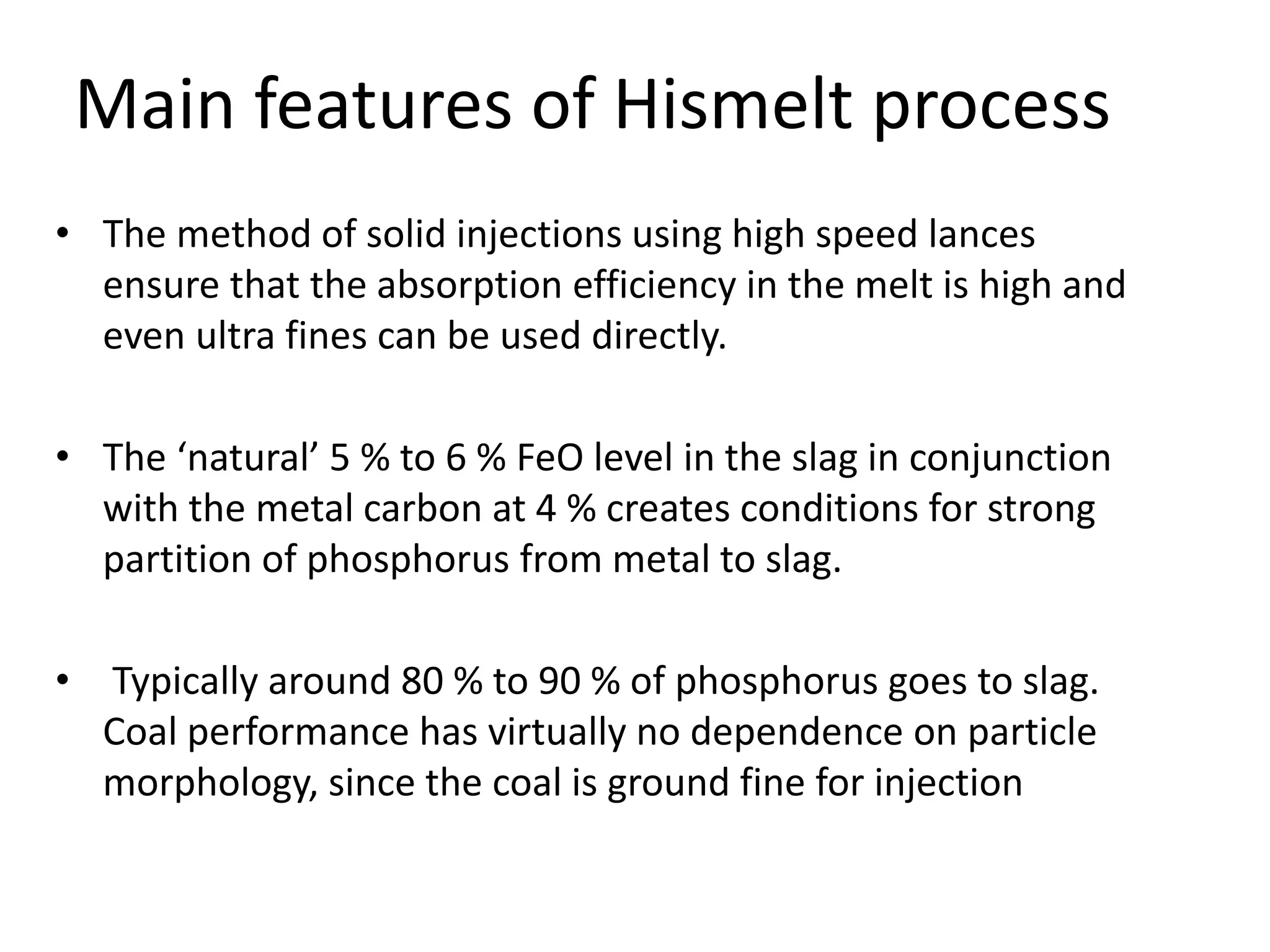
Main features of Hismelt process
• The method of solid injections using high speed lances
ensure that the absorption efficiency in the melt is high and
even ultra fines can be used directly.
• The ‘natural’ 5 % to 6 % FeO level in the slag in conjunction
with the metal carbon at 4 % creates conditions for strong
partition of phosphorus from metal to slag.
• Typically around 80 % to 90 % of phosphorus goes to slag.
Coal performance has virtually no dependence on particle
morphology, since the coal is ground fine for injection
Main features of Hismelt process
• The method of solid injections using high speed lances
ensure that the absorption efficiency in the melt is high and
even ultra fines can be used directly.
• The ‘natural’ 5 % to 6 % FeO level in the slag in conjunction
with the metal carbon at 4 % creates conditions for strong
partition of phosphorus from metal to slag.
• Typically around 80 % to 90 % of phosphorus goes to slag.
Coal performance has virtually no dependence on particle
morphology, since the coal is ground fine for injection
Smelting Reduction Vessel(SRV) for
HIsmelt
Courtesy: Kwinana,
Australia
HIsmelt process- Operation
• Fountain of molten metal, largely containing slag,
erupts into top space by rapid expulsion of CO,H2
, N2 from molten bath.
• Hot air at 1200⁰C is blasted to top space through
a water-cooled lance.
• CO and H2 are post-combusted with oxygen from
hot blast.
• Heated metal and slag fall back into bath,
providing energy for direct smelting of iron ore.
• Slag coats water-cooled panels , minimising
energy losses.
HIsmelt process-Operation
• Iron ore fines, coal and fluxes are injected
directly into molten iron bath in reactor.
• Upon contact, rapid dissolution of C (in coal)
occurs into the bath.
• C reacts with oxides in iron bearing feeds to
release CO.
• Rapid heating of coal also causes cracking of
coal volatiles, releasing hydrogen.
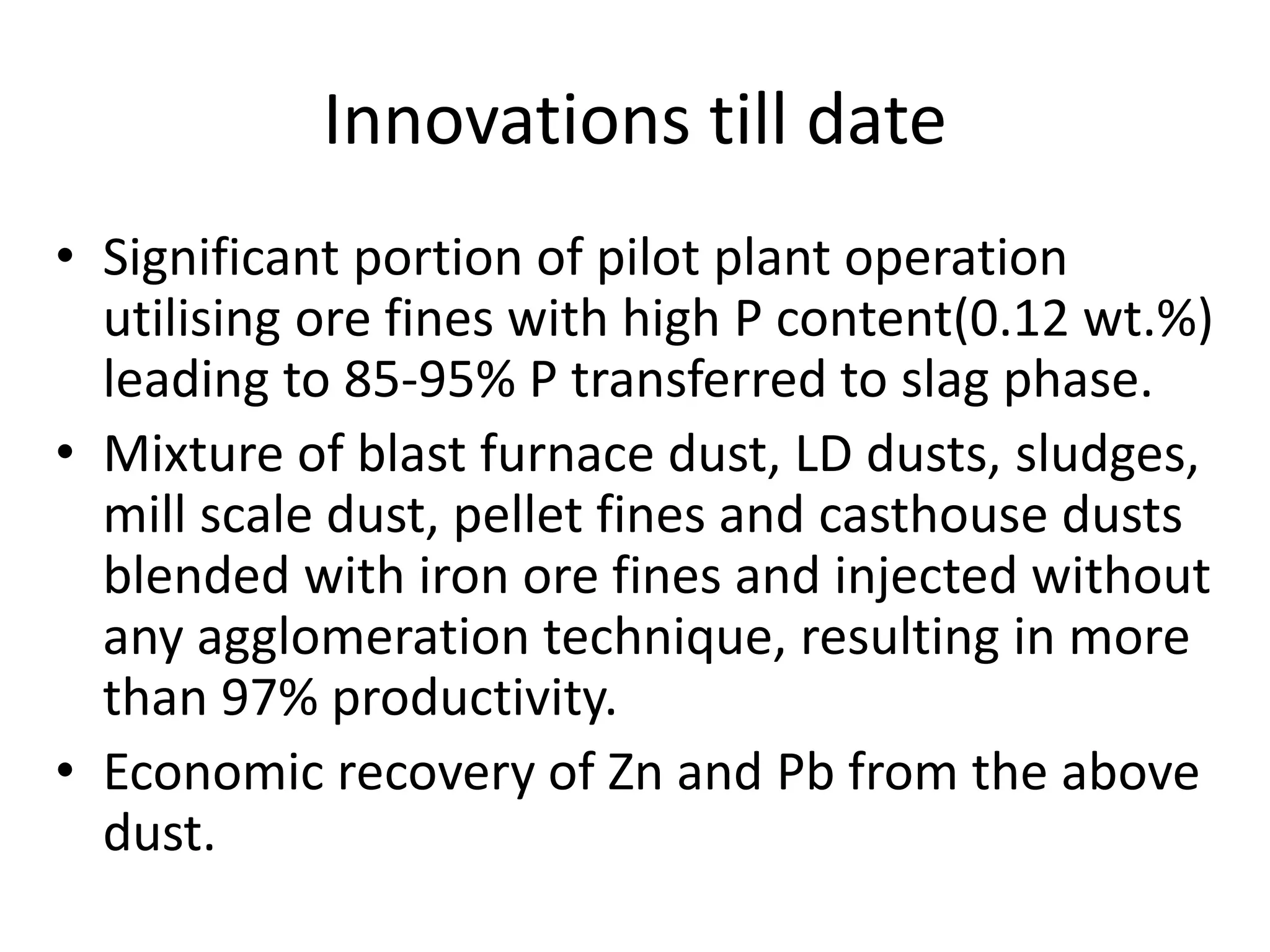
Innovations till date
• Initially, set up as a horizontal reactor in
Kwinana, West Australia, as a 10,000 tpa
horizontal reactor.
• Soon, replaced with an SRV (in collaboration
with Prof. R.J. Fruehan, CMU) which
-Allowed injection of solids through water cooled
top injection lances, as opposed to submerged
tuyeres.
-This simplified operational issues.
Innovations till date
• Intermediate levels of pre-reduction, tested by
blending ore fines with DRI
• Oxygen reduction of hot air blast(upto 30%
oxygen content) utilised to increase
productivity.
• Post-combustion in the range of 60-80%
achieved routinely with cold iron ore fines as
ferrous feed,
-coal rates of around 880 kg/thm with an ore
preheater.
Innovations till date
• Significant portion of pilot plant operation
utilising ore fines with high P content(0.12 wt.%)
leading to 85-95% P transferred to slag phase.
• Mixture of blast furnace dust, LD dusts, sludges,
mill scale dust, pellet fines and casthouse dusts
blended with iron ore fines and injected without
any agglomeration technique, resulting in more
than 97% productivity.
• Economic recovery of Zn and Pb from the above
dust.
Aim of the present work
• To optimise the electricity requirement as well
as the charge rate with poorest quality of non
coking coal, in India and ore fines as charge,
with increase in productivity at the same time.
Grades of Coal and iron ore fines for
HIsmelt
Ferrous charge % Fe %C Silica+Alumina
(%)
Fines(0.075% P) 61.0 7.5
Fines(0.12% P) 62.4 5.6
DRI 90.5 5.5
Steel plant
wastes
53.3 10.1 5.5
Coals Fixed %C Volatiles (%) Ash
(%)
CV(GJ/t)
Coal A 73.2 9.8 12.0 28.3
Coal B 69.3 16.8 6.9 30.5
Coal C 68.8 25.7 4.8 32.9
Coal D 49.9 38.5 9.4 30.2
Courtesy:
Coal India
Ltd.
Courtesy:
Kwinana,
West
Australia
Mass and energy balance of typical
HM composition
Elements
(wt.%)
C Si S P Mn
Mass% 4±0.2 - 0.1±0.02 0.03±0.01 0.1
• Composition of Hot metal(Basis: 1 T of HM)
• Composition of Hismelt slag
elem
ents
FeO SiO2 CaO Al2O3 P4O10 MgO V2O3 TiO2 Slag
viscosity
Mass
%
5 30 37 15 0.8 10 - 0.7 3.3 poise
Plant Capacity: 75 tpd
Working temperature: 1465⁰C-1495⁰C
Coal rate(t/thm) with fines(0.075% P)
Grade D(1) C(2) B(3) A(4)
Coal rate 2.3 2.1 1.84 1.62
y = -0.488x + 1.955
R² = 0.8862
0
0.2
0.4
0.6
0.8
1
1.2
1.4
1.6
0 0.5 1 1.5 2 2.5 3 3.5 4 4.5
Coalrate()t/thm
Coal grades
Series1
Linear (Series1)
Coal rate(t/thm) with fines(0.12% P)
Grade D(1) C(2) B(3) A(4)
Coal rate 2.78 2.54 1.53 0.88
y = -0.488x + 1.955
R² = 0.8862
0
0.2
0.4
0.6
0.8
1
1.2
1.4
1.6
0 1 2 3 4 5
Coalrate()t/thm
Coal grades
Series1
Linear (Series1)
Coal rate(t/thm) with LD dust, sludge
and pellet fines
Grade D(1) C(2) B(3) A(4)
Coal rate 1.4 1.22 0.21 0.11
y = -0.488x + 1.955
R² = 0.8862
0
0.2
0.4
0.6
0.8
1
1.2
1.4
1.6
0 1 2 3 4 5
Coalrate()t/thm
Coal grades
Series1
Linear (Series1)
Comparison of Demand for Oxygen between BF, COREX and
HIsmelt(for the same plant capacity and HM composition)
Route BF Hismelt COREX
Oxygen
demand(in t)
7.8 Only
preheated air
0.5-2.1
Comparison of Electricity requirement between BF, COREX and
HIsmelt (for the same plant capacity and HM composition)
Route BF Hismelt COREX
Electricity
requirement(in kWh)
210 109 125
Comparison of Heat from off-gases between BF, COREX and
HIsmelt (for the same plant capacity and HM composition)
Route BF Hismelt COREX
Heat from off-
gases(in
GJ/thm)
14.2 7.352 11.5-12.9
Courtesy: Recent
Developments in Iron
and Steelmaking,
IIM(1996)
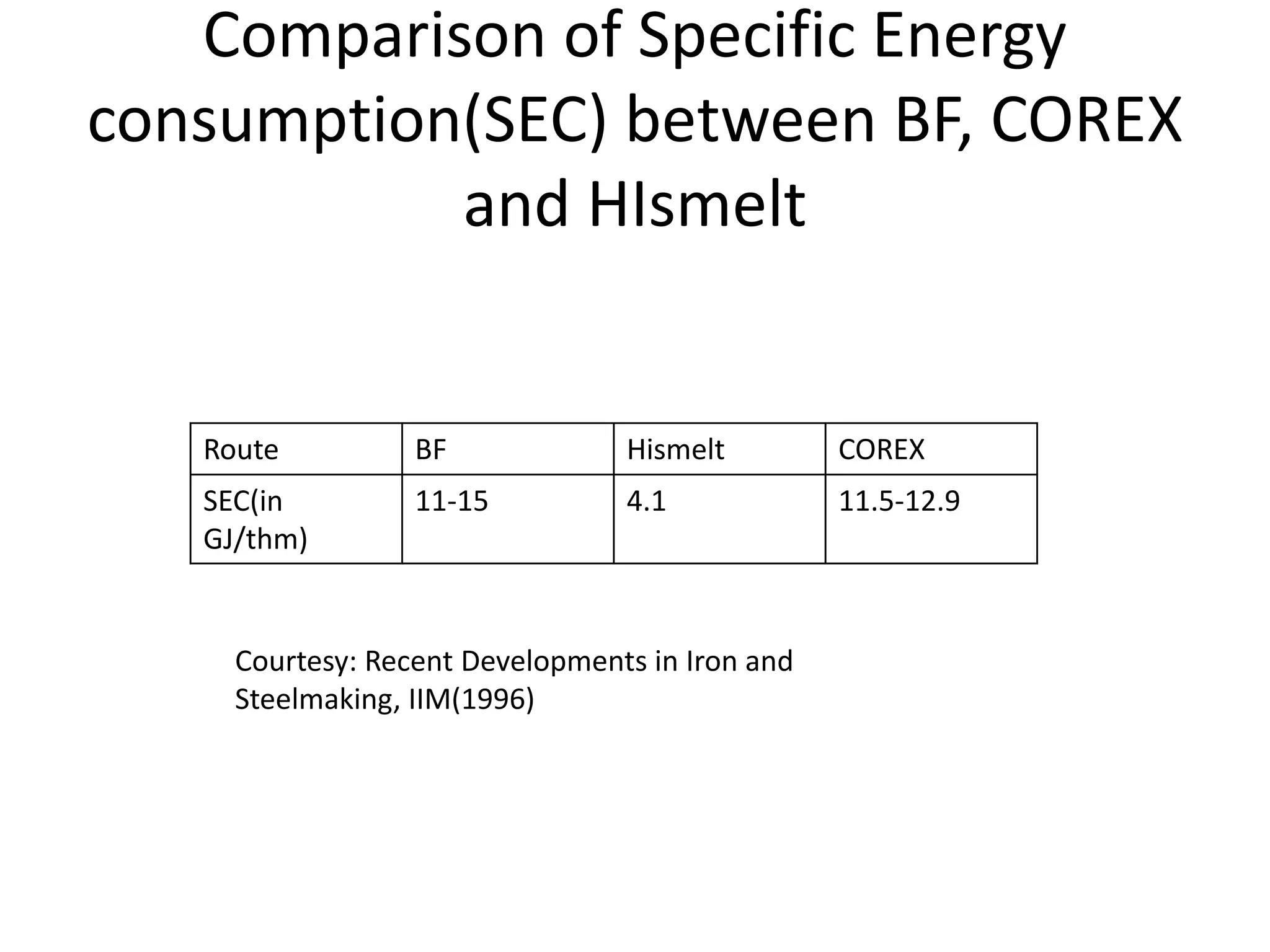
Comparison of Specific Energy
consumption(SEC) between BF, COREX
and HIsmelt
Route BF Hismelt COREX
SEC(in
GJ/thm)
11-15 4.1 11.5-12.9
Courtesy: Recent Developments in Iron and
Steelmaking, IIM(1996)
Off-gas analysis for the same HM
composition and tonnage of BF, COREX
and HIsmelt under Indian conditions
Gas analysis(in %) BF Hismelt COREX
CO 22-25 53-56 40-45
CO2 16-20 7-13 30-32
H2 - 6.4-7.5 18-20
CH4 - - 1.7-2.1
N2 51-55 32-36 -
O2 0.2-0.5 0.1-0.3 -
Courtesy: Rio Tinto Ltd
Comparing operating cost between a BF,
and Hismelt process(for the same
tonnage)
Courtesy: HRDF, Kwinana, Western Australia
Comparison between HM quality of BF,
COREX and Hismelt under Indian
conditions
Typical analysis(%) BF Hismelt COREX
C 4.5 4.4±0.15 4.5±0.3
Si 0.5±0.3 <0.01 0.2±0.01
Mn 04±0.2 <0.02 0.06±0.01
P 0.09±0.02 0.02±0.01 0.07
S 0.04±0.02 0.1±0.05 0.015
Temperature 1430-1500⁰C 1420⁰C 1470⁰C-1520⁰C
Courtesy: Rio Tinto Ltd
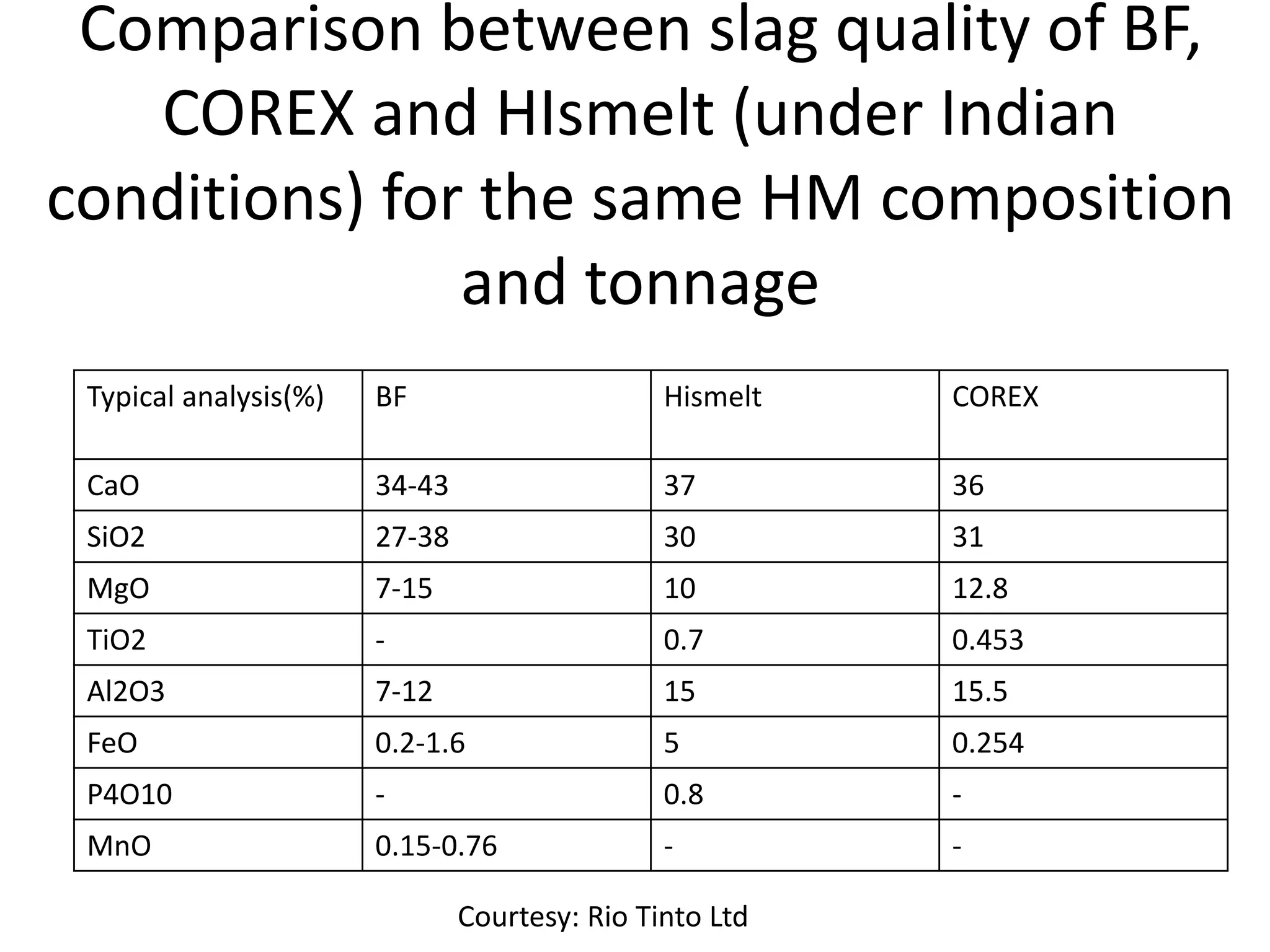
Comparison between slag quality of BF,
COREX and HIsmelt (under Indian
conditions) for the same HM composition
and tonnage
Typical analysis(%) BF Hismelt COREX
CaO 34-43 37 36
SiO2 27-38 30 31
MgO 7-15 10 12.8
TiO2 - 0.7 0.453
Al2O3 7-12 15 15.5
FeO 0.2-1.6 5 0.254
P4O10 - 0.8 -
MnO 0.15-0.76 - -
Courtesy: Rio Tinto Ltd
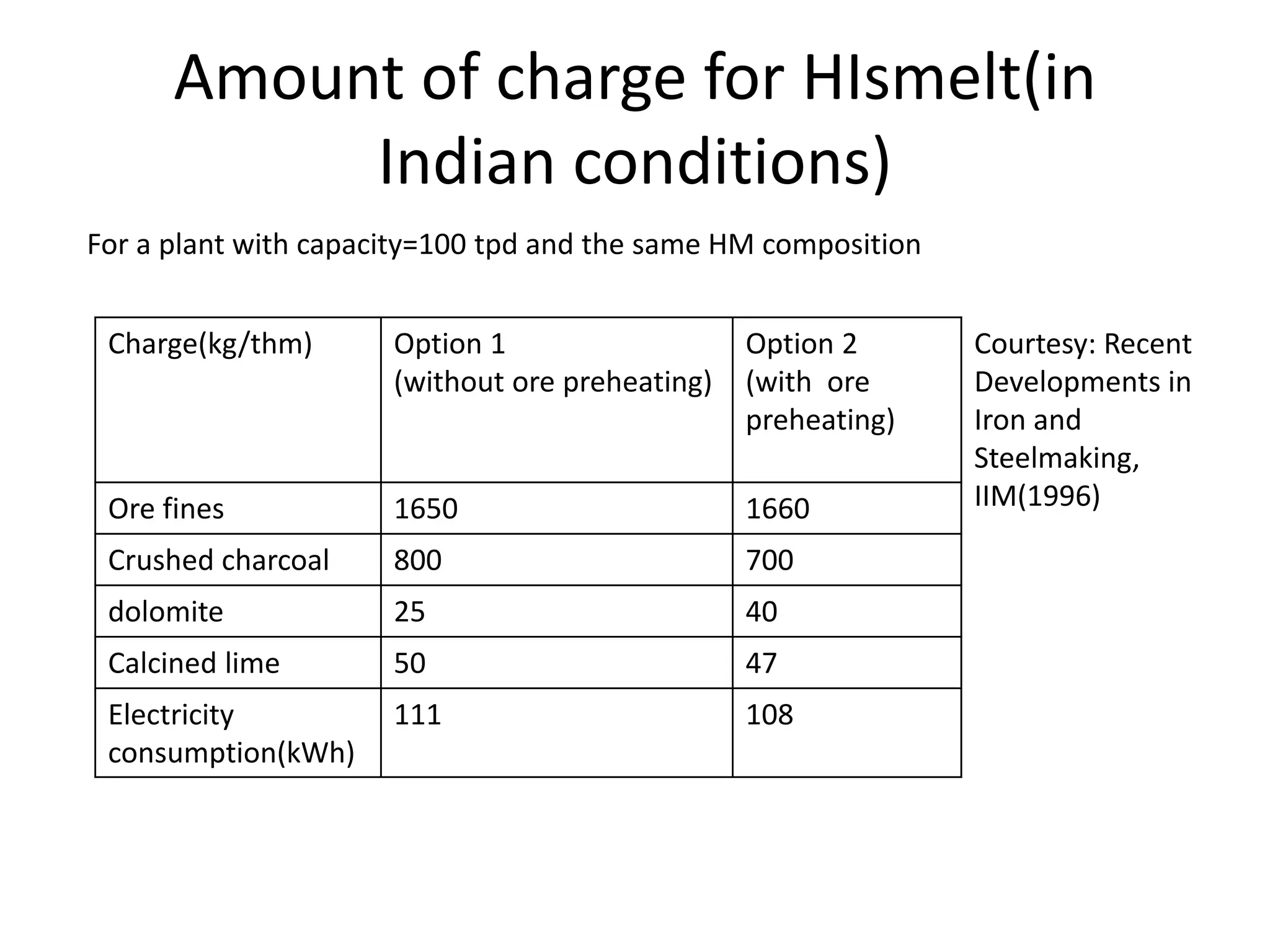
Amount of charge for HIsmelt(in
Indian conditions)
Charge(kg/thm) Option 1
(without ore preheating)
Option 2
(with ore
preheating)
Ore fines 1650 1660
Crushed charcoal 800 700
dolomite 25 40
Calcined lime 50 47
Electricity
consumption(kWh)
111 108
For a plant with capacity=100 tpd and the same HM composition
Courtesy: Recent
Developments in
Iron and
Steelmaking,
IIM(1996)
Future work
• To optimise the electricity requirement as well
as the charge rate with poorest quality of non
coking coal, in India and ore fines(with and
without ore preheating) as charge, with
increase in productivity at the same time,
through improvement in HTE from off-gases.
THANK YOU

Hismelt (ironmaking) process

  • 1.
    Reduction in specificenergy requirements through optimization of charge in Hismelt(Ironmaking) Process Presented by Mainak Saha Department of Metallurgical and Materials Engineering NIT Durgapur Guide: Dr. Amit Ganguly M.O.S. Chair Professor NIT Durgapur
  • 2.
    Problems in theBF-route in the Indian scenario • Poor quality of domestic coking coals leading to a high dependence on coal imports. • High Al2O3 content of ore degrading the sinter quality. • High Si content in hot metal due to unfavourable cohesive zone formation due to poor sinter properties.
  • 3.
    Driving force behindHismelt • Ability to utilise cheaper and more abundant raw materials like non-coking coals and non- agglomerated ores. • Smaller economic plant sizes. • Competitive capital and operating costs. • Environment friendly- elimination of oke ovens and sinter/pellet plants. • Flexibility of operation.
  • 4.
    Main features ofHismelt process • The method of solid injections using high speed lances ensure that the absorption efficiency in the melt is high and even ultra fines can be used directly. • The ‘natural’ 5 % to 6 % FeO level in the slag in conjunction with the metal carbon at 4 % creates conditions for strong partition of phosphorus from metal to slag. • Typically around 80 % to 90 % of phosphorus goes to slag. Coal performance has virtually no dependence on particle morphology, since the coal is ground fine for injection
  • 5.
    Main features ofHismelt process • The method of solid injections using high speed lances ensure that the absorption efficiency in the melt is high and even ultra fines can be used directly. • The ‘natural’ 5 % to 6 % FeO level in the slag in conjunction with the metal carbon at 4 % creates conditions for strong partition of phosphorus from metal to slag. • Typically around 80 % to 90 % of phosphorus goes to slag. Coal performance has virtually no dependence on particle morphology, since the coal is ground fine for injection
  • 6.
    Smelting Reduction Vessel(SRV)for HIsmelt Courtesy: Kwinana, Australia
  • 7.
    HIsmelt process- Operation •Fountain of molten metal, largely containing slag, erupts into top space by rapid expulsion of CO,H2 , N2 from molten bath. • Hot air at 1200⁰C is blasted to top space through a water-cooled lance. • CO and H2 are post-combusted with oxygen from hot blast. • Heated metal and slag fall back into bath, providing energy for direct smelting of iron ore. • Slag coats water-cooled panels , minimising energy losses.
  • 8.
    HIsmelt process-Operation • Ironore fines, coal and fluxes are injected directly into molten iron bath in reactor. • Upon contact, rapid dissolution of C (in coal) occurs into the bath. • C reacts with oxides in iron bearing feeds to release CO. • Rapid heating of coal also causes cracking of coal volatiles, releasing hydrogen.
  • 9.
    Innovations till date •Initially, set up as a horizontal reactor in Kwinana, West Australia, as a 10,000 tpa horizontal reactor. • Soon, replaced with an SRV (in collaboration with Prof. R.J. Fruehan, CMU) which -Allowed injection of solids through water cooled top injection lances, as opposed to submerged tuyeres. -This simplified operational issues.
  • 10.
    Innovations till date •Intermediate levels of pre-reduction, tested by blending ore fines with DRI • Oxygen reduction of hot air blast(upto 30% oxygen content) utilised to increase productivity. • Post-combustion in the range of 60-80% achieved routinely with cold iron ore fines as ferrous feed, -coal rates of around 880 kg/thm with an ore preheater.
  • 11.
    Innovations till date •Significant portion of pilot plant operation utilising ore fines with high P content(0.12 wt.%) leading to 85-95% P transferred to slag phase. • Mixture of blast furnace dust, LD dusts, sludges, mill scale dust, pellet fines and casthouse dusts blended with iron ore fines and injected without any agglomeration technique, resulting in more than 97% productivity. • Economic recovery of Zn and Pb from the above dust.
  • 12.
    Aim of thepresent work • To optimise the electricity requirement as well as the charge rate with poorest quality of non coking coal, in India and ore fines as charge, with increase in productivity at the same time.
  • 13.
    Grades of Coaland iron ore fines for HIsmelt Ferrous charge % Fe %C Silica+Alumina (%) Fines(0.075% P) 61.0 7.5 Fines(0.12% P) 62.4 5.6 DRI 90.5 5.5 Steel plant wastes 53.3 10.1 5.5 Coals Fixed %C Volatiles (%) Ash (%) CV(GJ/t) Coal A 73.2 9.8 12.0 28.3 Coal B 69.3 16.8 6.9 30.5 Coal C 68.8 25.7 4.8 32.9 Coal D 49.9 38.5 9.4 30.2 Courtesy: Coal India Ltd. Courtesy: Kwinana, West Australia
  • 14.
    Mass and energybalance of typical HM composition Elements (wt.%) C Si S P Mn Mass% 4±0.2 - 0.1±0.02 0.03±0.01 0.1 • Composition of Hot metal(Basis: 1 T of HM) • Composition of Hismelt slag elem ents FeO SiO2 CaO Al2O3 P4O10 MgO V2O3 TiO2 Slag viscosity Mass % 5 30 37 15 0.8 10 - 0.7 3.3 poise Plant Capacity: 75 tpd Working temperature: 1465⁰C-1495⁰C
  • 15.
    Coal rate(t/thm) withfines(0.075% P) Grade D(1) C(2) B(3) A(4) Coal rate 2.3 2.1 1.84 1.62 y = -0.488x + 1.955 R² = 0.8862 0 0.2 0.4 0.6 0.8 1 1.2 1.4 1.6 0 0.5 1 1.5 2 2.5 3 3.5 4 4.5 Coalrate()t/thm Coal grades Series1 Linear (Series1)
  • 16.
    Coal rate(t/thm) withfines(0.12% P) Grade D(1) C(2) B(3) A(4) Coal rate 2.78 2.54 1.53 0.88 y = -0.488x + 1.955 R² = 0.8862 0 0.2 0.4 0.6 0.8 1 1.2 1.4 1.6 0 1 2 3 4 5 Coalrate()t/thm Coal grades Series1 Linear (Series1)
  • 17.
    Coal rate(t/thm) withLD dust, sludge and pellet fines Grade D(1) C(2) B(3) A(4) Coal rate 1.4 1.22 0.21 0.11 y = -0.488x + 1.955 R² = 0.8862 0 0.2 0.4 0.6 0.8 1 1.2 1.4 1.6 0 1 2 3 4 5 Coalrate()t/thm Coal grades Series1 Linear (Series1)
  • 18.
    Comparison of Demandfor Oxygen between BF, COREX and HIsmelt(for the same plant capacity and HM composition) Route BF Hismelt COREX Oxygen demand(in t) 7.8 Only preheated air 0.5-2.1 Comparison of Electricity requirement between BF, COREX and HIsmelt (for the same plant capacity and HM composition) Route BF Hismelt COREX Electricity requirement(in kWh) 210 109 125 Comparison of Heat from off-gases between BF, COREX and HIsmelt (for the same plant capacity and HM composition) Route BF Hismelt COREX Heat from off- gases(in GJ/thm) 14.2 7.352 11.5-12.9 Courtesy: Recent Developments in Iron and Steelmaking, IIM(1996)
  • 19.
    Comparison of SpecificEnergy consumption(SEC) between BF, COREX and HIsmelt Route BF Hismelt COREX SEC(in GJ/thm) 11-15 4.1 11.5-12.9 Courtesy: Recent Developments in Iron and Steelmaking, IIM(1996)
  • 20.
    Off-gas analysis forthe same HM composition and tonnage of BF, COREX and HIsmelt under Indian conditions Gas analysis(in %) BF Hismelt COREX CO 22-25 53-56 40-45 CO2 16-20 7-13 30-32 H2 - 6.4-7.5 18-20 CH4 - - 1.7-2.1 N2 51-55 32-36 - O2 0.2-0.5 0.1-0.3 - Courtesy: Rio Tinto Ltd
  • 21.
    Comparing operating costbetween a BF, and Hismelt process(for the same tonnage) Courtesy: HRDF, Kwinana, Western Australia
  • 22.
    Comparison between HMquality of BF, COREX and Hismelt under Indian conditions Typical analysis(%) BF Hismelt COREX C 4.5 4.4±0.15 4.5±0.3 Si 0.5±0.3 <0.01 0.2±0.01 Mn 04±0.2 <0.02 0.06±0.01 P 0.09±0.02 0.02±0.01 0.07 S 0.04±0.02 0.1±0.05 0.015 Temperature 1430-1500⁰C 1420⁰C 1470⁰C-1520⁰C Courtesy: Rio Tinto Ltd
  • 23.
    Comparison between slagquality of BF, COREX and HIsmelt (under Indian conditions) for the same HM composition and tonnage Typical analysis(%) BF Hismelt COREX CaO 34-43 37 36 SiO2 27-38 30 31 MgO 7-15 10 12.8 TiO2 - 0.7 0.453 Al2O3 7-12 15 15.5 FeO 0.2-1.6 5 0.254 P4O10 - 0.8 - MnO 0.15-0.76 - - Courtesy: Rio Tinto Ltd
  • 24.
    Amount of chargefor HIsmelt(in Indian conditions) Charge(kg/thm) Option 1 (without ore preheating) Option 2 (with ore preheating) Ore fines 1650 1660 Crushed charcoal 800 700 dolomite 25 40 Calcined lime 50 47 Electricity consumption(kWh) 111 108 For a plant with capacity=100 tpd and the same HM composition Courtesy: Recent Developments in Iron and Steelmaking, IIM(1996)
  • 25.
    Future work • Tooptimise the electricity requirement as well as the charge rate with poorest quality of non coking coal, in India and ore fines(with and without ore preheating) as charge, with increase in productivity at the same time, through improvement in HTE from off-gases.
  • 26.