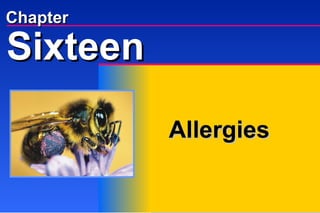
Chapter Allergies Sixteen
Chapter How to identify a patient   experiencing an allergic reaction Differences between a mild allergic   reaction and anaphylaxis How to treat the patient   experiencing  an allergic reaction Who should be assisted with an   epinephrine auto-injector CORE CONCEPTS Sixteen
Allergic Reaction An exaggerated reaction by the body’s immune system to any substance Anaphylaxis A life-threatening allergic reaction  that causes shock (hypoperfusion) and airway swelling K EY TERMS
Insect Stings Foods Medications Plants Common Causes of Allergic Reactions
Skin (Continued) Signs and Symptoms Itching Hives Flushing Warm, tingling feeling Swelling  (especially face,   neck, hands, feet, tongue)
Tightness in throat/chest Cough Rapid, labored, noisy    breathing Hoarseness Stridor and wheezing Respiratory Signs and Symptoms (Continued)
Increased heart rate Low blood pressure Cardiac (Continued) Signs and Symptoms
Itchy, watery eyes and  Generalized Findings runny nose Headache Sense of impending    doom (Continued) Signs and Symptoms
Decreasing mental status Signs and symptoms of shock (hypoperfusion) or respiratory distress Signs and Symptoms
Patient  ASSESSMENT Allergic Reactions Signs and Symptoms Initial assessment Focused history and physical exam Baseline vital signs and SAMPLE  history (Continued)
Patient  ASSESSMENT Allergic Reactions Signs and Symptoms What  is patient allergic to? What  was patient exposed to? How  was the patient exposed? What  signs and symptoms  does patient have? (Continued)
Patient  ASSESSMENT Allergic Reactions Signs and Symptoms How have the signs and symptoms progressed? What  interventions  has  patient received?
Obtain SAMPLE history. Take vital signs.
Apply  high-   concentration  oxygen. If the patient meets criteria, assist in patient’s own epi-pen®  administration.
Patient  CARE Allergic Reactions Emergency Care Steps Reassess in 2 minutes. Record reassessment findings. If patient does not have epinephrine auto-injector, transport immediately. (Continued)
Patient  CARE Allergic Reactions Emergency Care Steps Epinephrine is needed if patient: Has come in contact with something   that caused an allergic reaction in  the past. (Continued)
Patient  CARE Allergic Reactions Emergency Care Steps Epinephrine is needed if patient: Shows signs and symptoms of  Complains of respiratory distress. shock (hypoperfusion) (Continued) Sometimes patient exhibits BOTH. OR
Patient  CARE Allergic Reactions Emergency Care Steps Epinephrine is needed if patient: Has a prescribed epinephrine auto-injector. (Continued)
Patient  CARE Allergic Reactions Emergency Care Steps When  the  patient does  not  have    respiratory distress or shock   (hypoperfusion): Continue with focused  Do   not  give epinephrine. assessment.
A IRWAY MANAGEMENT IN ALLERGIC REACTIONS
Note The patient may need aggressive airway management immediately, or very soon, because of swelling in the airway or respiratory compromise.
Patent shows signs of Indications epinephrine to patient. Medical direction authorizes epinephrine. Epinephrine Auto-Injector allergic reaction. Physician has prescribed
NONE, when used in life-threatening situations Contraindications Epinephrine
Auto-injector Medication Form Epinephrine
Adult Dosage Child One auto-injector One pediatric auto-injector Epinephrine
Injector prescribed for Administration this patient? Expiration date past? Liquid cloudy  or discolored? Epinephrine
If medical direction  authorizes epi,  remove safety cap. Place injector against  patient’s mid-thigh, push and hold for 10 seconds.
Dispose of injector and record administration.
Epinephrine auto-injectors use needles to administer epinephrine.  Injectable drugs are not commonly used  at the EMT-B level. This truly life-saving drug is an exception.  There are two important points to stress to a new EMT-B: After the auto-injector is placed against the patient’s thigh, it must be held in place to allow the medication to be injected.  Simply pressing and immediately removing the device will be ineffective.  After the device is used, it must be considered a contaminated sharp and treated accordingly:  disposed of in a sharps container!   P RECEPTOR  P EARL
Actions Dilates bronchioles Constricts blood vessels Epinephrine
Increased heart rate Pallor and dizziness Chest pain Headache, excitability,    and anxiety Nausea and vomiting Side Effects Epinephrine
Transport. Continue focused Reassessment Strategies assessment of airway, breathing, and circulation. Epinephrine
If patient’s condition WORSENS: Reassessment Strategies Consult medical direction about another dose. Treat for shock. Be prepared to use CPR/AED. Epinephrine
Reassessment  Strategies If patient’s condition  IMPROVES: Continue oxygen. Treat for shock   (hypoperfusion). Epinephrine
1. Explain how to identify a patient   experiencing an allergic reaction. 2. What are the differences between a mild   allergic reaction and anaphylaxis? 3. How is an allergic reaction treated? 4. When and how should the EMT-B assist a   patient with an epinephrine auto-injector? R EVIEW QUESTIONS

Allergies

  • 1.
  • 2.
    Chapter How toidentify a patient experiencing an allergic reaction Differences between a mild allergic reaction and anaphylaxis How to treat the patient experiencing an allergic reaction Who should be assisted with an epinephrine auto-injector CORE CONCEPTS Sixteen
  • 3.
    Allergic Reaction Anexaggerated reaction by the body’s immune system to any substance Anaphylaxis A life-threatening allergic reaction that causes shock (hypoperfusion) and airway swelling K EY TERMS
  • 4.
    Insect Stings FoodsMedications Plants Common Causes of Allergic Reactions
  • 5.
    Skin (Continued) Signsand Symptoms Itching Hives Flushing Warm, tingling feeling Swelling (especially face, neck, hands, feet, tongue)
  • 6.
    Tightness in throat/chestCough Rapid, labored, noisy breathing Hoarseness Stridor and wheezing Respiratory Signs and Symptoms (Continued)
  • 7.
    Increased heart rateLow blood pressure Cardiac (Continued) Signs and Symptoms
  • 8.
    Itchy, watery eyesand Generalized Findings runny nose Headache Sense of impending doom (Continued) Signs and Symptoms
  • 9.
    Decreasing mental statusSigns and symptoms of shock (hypoperfusion) or respiratory distress Signs and Symptoms
  • 10.
    Patient ASSESSMENTAllergic Reactions Signs and Symptoms Initial assessment Focused history and physical exam Baseline vital signs and SAMPLE history (Continued)
  • 11.
    Patient ASSESSMENTAllergic Reactions Signs and Symptoms What is patient allergic to? What was patient exposed to? How was the patient exposed? What signs and symptoms does patient have? (Continued)
  • 12.
    Patient ASSESSMENTAllergic Reactions Signs and Symptoms How have the signs and symptoms progressed? What interventions has patient received?
  • 13.
    Obtain SAMPLE history.Take vital signs.
  • 14.
    Apply high- concentration oxygen. If the patient meets criteria, assist in patient’s own epi-pen® administration.
  • 15.
    Patient CAREAllergic Reactions Emergency Care Steps Reassess in 2 minutes. Record reassessment findings. If patient does not have epinephrine auto-injector, transport immediately. (Continued)
  • 16.
    Patient CAREAllergic Reactions Emergency Care Steps Epinephrine is needed if patient: Has come in contact with something that caused an allergic reaction in the past. (Continued)
  • 17.
    Patient CAREAllergic Reactions Emergency Care Steps Epinephrine is needed if patient: Shows signs and symptoms of Complains of respiratory distress. shock (hypoperfusion) (Continued) Sometimes patient exhibits BOTH. OR
  • 18.
    Patient CAREAllergic Reactions Emergency Care Steps Epinephrine is needed if patient: Has a prescribed epinephrine auto-injector. (Continued)
  • 19.
    Patient CAREAllergic Reactions Emergency Care Steps When the patient does not have respiratory distress or shock (hypoperfusion): Continue with focused Do not give epinephrine. assessment.
  • 20.
    A IRWAY MANAGEMENTIN ALLERGIC REACTIONS
  • 21.
    Note The patientmay need aggressive airway management immediately, or very soon, because of swelling in the airway or respiratory compromise.
  • 22.
    Patent shows signsof Indications epinephrine to patient. Medical direction authorizes epinephrine. Epinephrine Auto-Injector allergic reaction. Physician has prescribed
  • 23.
    NONE, when usedin life-threatening situations Contraindications Epinephrine
  • 24.
  • 25.
    Adult Dosage ChildOne auto-injector One pediatric auto-injector Epinephrine
  • 26.
    Injector prescribed forAdministration this patient? Expiration date past? Liquid cloudy or discolored? Epinephrine
  • 27.
    If medical direction authorizes epi, remove safety cap. Place injector against patient’s mid-thigh, push and hold for 10 seconds.
  • 28.
    Dispose of injectorand record administration.
  • 29.
    Epinephrine auto-injectors useneedles to administer epinephrine. Injectable drugs are not commonly used at the EMT-B level. This truly life-saving drug is an exception. There are two important points to stress to a new EMT-B: After the auto-injector is placed against the patient’s thigh, it must be held in place to allow the medication to be injected. Simply pressing and immediately removing the device will be ineffective. After the device is used, it must be considered a contaminated sharp and treated accordingly: disposed of in a sharps container! P RECEPTOR P EARL
  • 30.
    Actions Dilates bronchiolesConstricts blood vessels Epinephrine
  • 31.
    Increased heart ratePallor and dizziness Chest pain Headache, excitability, and anxiety Nausea and vomiting Side Effects Epinephrine
  • 32.
    Transport. Continue focusedReassessment Strategies assessment of airway, breathing, and circulation. Epinephrine
  • 33.
    If patient’s conditionWORSENS: Reassessment Strategies Consult medical direction about another dose. Treat for shock. Be prepared to use CPR/AED. Epinephrine
  • 34.
    Reassessment StrategiesIf patient’s condition IMPROVES: Continue oxygen. Treat for shock (hypoperfusion). Epinephrine
  • 35.
    1. Explain howto identify a patient experiencing an allergic reaction. 2. What are the differences between a mild allergic reaction and anaphylaxis? 3. How is an allergic reaction treated? 4. When and how should the EMT-B assist a patient with an epinephrine auto-injector? R EVIEW QUESTIONS