Assessment of the Medical Patient Nine Chapter
How to perform a focused history and   physical exam for a medical patient Differences in assessments of responsive   and unresponsive medical patients How to perform an ongoing assessment   for a medical patient Nine Chapter CORE CONCEPTS
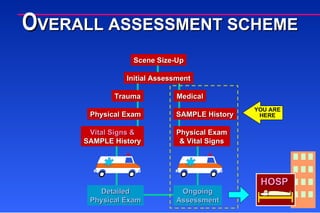
Scene Size-Up Initial Assessment Trauma Medical Physical Exam Vital Signs & SAMPLE History SAMPLE History Physical Exam & Vital Signs Detailed Physical Exam Ongoing Assessment HOSP O VERALL ASSESSMENT SCHEME
F OCUSED HISTORY AND PHYSICAL EXAM: RESPONSIVE MEDICAL PATIENT
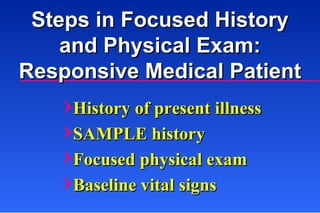
Steps in Focused History and Physical Exam: Responsive Medical Patient History of present illness SAMPLE history Focused physical exam Baseline vital signs
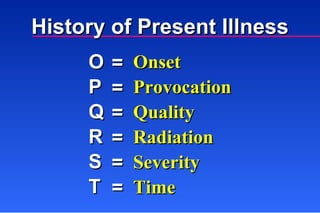
History of Present Illness Onset Provocation Quality Radiation Severity Time = = = = = = O P Q R S T
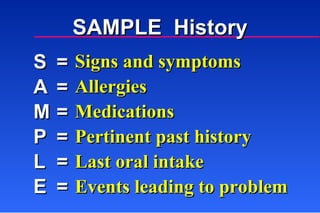
SAMPLE  History Signs and symptoms Allergies Medications Pertinent past history Last oral intake Events leading to problem = = = = = = S  A  M  P  L  E
Focused Physical Exam Head Neck Chest Abdomen Pelvis Extremities Posterior As appropriate, assess:
Baseline Vital Signs Respirations Pulse Skin color, temperature, condition Pupils Blood pressure
When the patient has a chief complaint  for which you can administer treatment,  you will need to get certain additional information. (Continued) Additional Information
Get additional information for: Chest pain Difficulty breathing Allergies Altered mental status Poisoning and overdose Exposure to heat or cold
P RECEPTOR  P EARL The assessment and management of a medical patient need to incorporate as much pertinent information as you can obtain about the patient’s medical history, medications, and recent illnesses. It is not uncommon for patients to have multiple overlapping medical conditions that may contribute to today’s problem.
F OCUSED HISTORY AND PHYSICAL EXAM: UNRESPONSIVE MEDICAL PATIENT
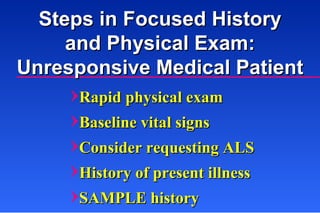
Rapid physical exam Baseline vital signs Consider requesting ALS History of present illness SAMPLE history Steps in Focused History and Physical Exam: Unresponsive Medical Patient
Position patient to correct airway. Initial Step
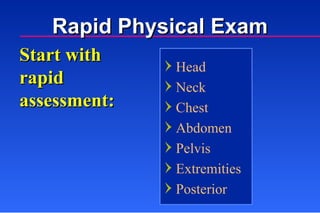
Head Neck Chest Abdomen Pelvis Extremities Posterior Rapid Physical Exam Start with rapid  assessment:
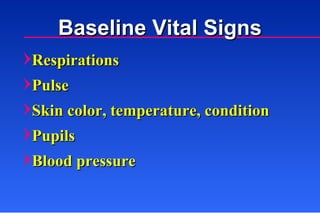
Baseline Vital Signs Respirations Pulse Skin color, temperature, condition Pupils Blood pressure
SAMPLE History Get SAMPLE history from bystanders, family, or friends.
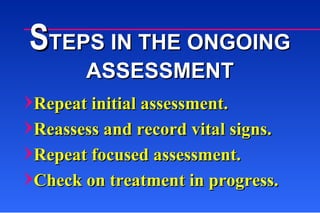
S TEPS IN THE ONGOING ASSESSMENT Repeat initial assessment. Reassess and record vital signs. Repeat focused assessment. Check on treatment in progress.
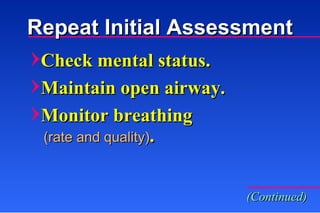
Repeat Initial Assessment Check mental status. Maintain open airway. Monitor breathing (rate and quality) . (Continued)
Reassess pulse  (rate and quality) . Monitor skin  (color, temperature, condition) . Reevaluate patient’s priority. Repeat Initial Assessment
Observing Trends Trends are changes over time. Changes noted over time are   significant (e.g., changes in blood   pressure or pulse). Repeated assessments are  required to observe trends.
Check Interventions (look at bag on NRB) . Adequacy of oxygen delivery Adequacy of artificial ventilation (make sure you see visible chest rise) . (Continued)
External bleeding  (look for new blood) . Check splinted extremities for distal pulse, movement, and sensation (PMS). Check Interventions
1. How is the focused history and physical    exam performed for a medical patient? 2. What is the difference between the    assessments of responsive and    unresponsive medical patients? 3. What is done in the ongoing assessment    of the medical patient? R EVIEW QUESTIONS

Ch09 eec3

  • 1.
    Assessment of theMedical Patient Nine Chapter
  • 2.
    How to performa focused history and physical exam for a medical patient Differences in assessments of responsive and unresponsive medical patients How to perform an ongoing assessment for a medical patient Nine Chapter CORE CONCEPTS
  • 3.
    Scene Size-Up InitialAssessment Trauma Medical Physical Exam Vital Signs & SAMPLE History SAMPLE History Physical Exam & Vital Signs Detailed Physical Exam Ongoing Assessment HOSP O VERALL ASSESSMENT SCHEME
  • 4.
    F OCUSED HISTORYAND PHYSICAL EXAM: RESPONSIVE MEDICAL PATIENT
  • 5.
    Steps in FocusedHistory and Physical Exam: Responsive Medical Patient History of present illness SAMPLE history Focused physical exam Baseline vital signs
  • 6.
    History of PresentIllness Onset Provocation Quality Radiation Severity Time = = = = = = O P Q R S T
  • 7.
    SAMPLE HistorySigns and symptoms Allergies Medications Pertinent past history Last oral intake Events leading to problem = = = = = = S A M P L E
  • 8.
    Focused Physical ExamHead Neck Chest Abdomen Pelvis Extremities Posterior As appropriate, assess:
  • 9.
    Baseline Vital SignsRespirations Pulse Skin color, temperature, condition Pupils Blood pressure
  • 10.
    When the patienthas a chief complaint for which you can administer treatment, you will need to get certain additional information. (Continued) Additional Information
  • 11.
    Get additional informationfor: Chest pain Difficulty breathing Allergies Altered mental status Poisoning and overdose Exposure to heat or cold
  • 12.
    P RECEPTOR P EARL The assessment and management of a medical patient need to incorporate as much pertinent information as you can obtain about the patient’s medical history, medications, and recent illnesses. It is not uncommon for patients to have multiple overlapping medical conditions that may contribute to today’s problem.
  • 13.
    F OCUSED HISTORYAND PHYSICAL EXAM: UNRESPONSIVE MEDICAL PATIENT
  • 14.
    Rapid physical examBaseline vital signs Consider requesting ALS History of present illness SAMPLE history Steps in Focused History and Physical Exam: Unresponsive Medical Patient
  • 15.
    Position patient tocorrect airway. Initial Step
  • 16.
    Head Neck ChestAbdomen Pelvis Extremities Posterior Rapid Physical Exam Start with rapid assessment:
  • 17.
    Baseline Vital SignsRespirations Pulse Skin color, temperature, condition Pupils Blood pressure
  • 18.
    SAMPLE History GetSAMPLE history from bystanders, family, or friends.
  • 19.
    S TEPS INTHE ONGOING ASSESSMENT Repeat initial assessment. Reassess and record vital signs. Repeat focused assessment. Check on treatment in progress.
  • 20.
    Repeat Initial AssessmentCheck mental status. Maintain open airway. Monitor breathing (rate and quality) . (Continued)
  • 21.
    Reassess pulse (rate and quality) . Monitor skin (color, temperature, condition) . Reevaluate patient’s priority. Repeat Initial Assessment
  • 22.
    Observing Trends Trendsare changes over time. Changes noted over time are significant (e.g., changes in blood pressure or pulse). Repeated assessments are required to observe trends.
  • 23.
    Check Interventions (lookat bag on NRB) . Adequacy of oxygen delivery Adequacy of artificial ventilation (make sure you see visible chest rise) . (Continued)
  • 24.
    External bleeding (look for new blood) . Check splinted extremities for distal pulse, movement, and sensation (PMS). Check Interventions
  • 25.
    1. How isthe focused history and physical exam performed for a medical patient? 2. What is the difference between the assessments of responsive and unresponsive medical patients? 3. What is done in the ongoing assessment of the medical patient? R EVIEW QUESTIONS