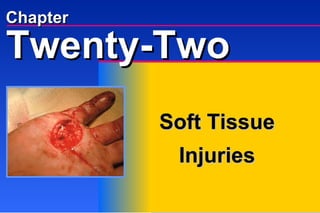
Chapter Soft Tissue  Injuries Twenty-Two
Chapter Open vs. closed wounds Treatment of various types of    open and closed wounds Care of specific injuries    (amputations, impaled objects,    neck wounds, chest injuries, burns) Principles of dressing and    bandaging  Twenty-Two CORE CONCEPTS
Soft Tissues
C LOSED WOUNDS
Closed Wound Internal injury with no open pathway from the outside to the injured site K EY TERM
Closed Wounds Contusion Hematoma Crush injury (Continued)
Closed Wound  Contusion
Patient  ASSESSMENT Closed Wounds Signs and Symptoms Assess for: Mechanism of injury Complaints of pain or tenderness Bruising or discoloration of the skin Swelling Deformity
Patient  CARE Closed Wounds Emergency Care Steps Take appropriate BSI precautions. Manage airway; apply oxygen. If shock is suspected, treat it. (Continued)
Patient  CARE Closed Wounds Emergency Care Steps Splint painful, swollen, or deformed extremities. Transport.
O PEN WOUNDS
Open Wound An injury in which the skin is interrupted (broken), exposing  the tissue underneath K EY TERM
Abrasions Laceration (Smooth Edges)
Laceration (Jagged Edges) Avulsion
Puncture Open Wound: Amputation
Entrance and Exit Wounds
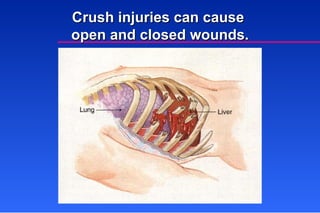
Crush injuries can cause  open and closed wounds.
Patient  ASSESSMENT Open Wounds Signs and Symptoms Assess for: Bleeding severity Amputations or avulsions Open wounds to chest or neck that may   require an occlusive dressing Open wounds to abdomen that may have   caused an evisceration of abdominal organs
Patient  CARE Open Wounds Emergency Care Steps BSI precautions: Gloves Eye protection Gown Hand washing (Continued)
Patient  CARE Open Wounds Emergency Care Steps Expose the wound. Clean the wound surface. Control bleeding. Treat for shock. (Continued)
Patient  CARE Open Wounds Emergency Care Steps Prevent further contamination. Bandage dressing in place, after   bleeding is controlled. Keep patient lying still. Reassure the patient.
Chest wounds may cause damage to lungs.
Patient  ASSESSMENT Chest Wounds Signs and Symptoms Wound or trauma to the chest Sucking sound Gasping for air (possible open wounds)
Patient  CARE Chest Wounds Emergency Care Steps Apply occlusive dressings to open  wounds. Place in position of comfort (if no spine injury suspected) .
Flutter Valve  Inspiration
Flutter Valve  Exhalation
Patient  CARE Closed Chest Wound Emergency Care Steps Monitor airway; administer oxygen. Suspect damage to underlying organs. Suspect and treat for shock.
Patient  CARE Impaled Object Emergency Care Steps Do not remove object unless: Through the cheek. Interferes with chest compression. Interferes with transport. (Continued)
Patient  CARE Impaled Object Emergency Care Steps Manually stabilize object. Expose area. Control bleeding. Stabilize with bulky dressing. Bandage.
Impaled Object  Cheek
Manually stabilize object in place. Use bulky dressings and bandage to  stabilize.
Impaled Object in the Eye
Patient  CARE Closed Abdominal Wound Emergency Care Steps Monitor airway; give oxygen. Be alert for vomiting. Flexing patient’s knees may reduce pain. Treat for shock. Transport.
Patient  CARE Emergency Care Steps Do not touch exposed organs. Do not try to replace organs. Cover exposed organs/wound with dressing moistened with sterile saline. Abdominal Evisceration
Abdominal Evisceration Expose the wound.
Cover with sterile dressing. Follow local protocols.
Tell new EMT-Bs that the old textbooks describe using aluminum foil as the airtight dressing for eviscerations. Today, plastic wrap is preferred as an occlusive dressing, because the sharp edges of the aluminum foil may cause further damage to abdominal organs.  P RECEPTOR  P EARL
Patient  CARE Amputations Emergency Care Steps Wrap the amputated part in  sterile dressing. Wrap part in plastic.  Keep cool. Transport part with patient if possible. (Continued)
Patient  CARE Amputations Emergency Care Steps Monitor airway; administer oxygen. Control bleeding. Do not complete partial amputations. Treat for shock.
Patient  CARE Open Neck Wound Emergency Care Steps May cause air embolism. Cover with occlusive dressing. Do not compress both carotids at  same time.
Cover wound  with gloved hand. Place occlusive dressing over wound.
Place dressing  over occlusive  dressing. Bandage. Do not  compress both carotids or restrict  breathing.
B URNS
Patient  ASSESSMENT Burn Depth: Superficial Signs and Symptoms Reddened skin Pain at burn site Involves only epidermis
Patient  ASSESSMENT Burn Depth: Partial-Thickness Signs and Symptoms Intense pain White to red skin Blisters Involves epidermis and dermis
Patient  ASSESSMENT Burn Depth: Full-Thickness Signs and Symptoms Dry, leathery skin Loss of sensation All dermal layers/tissue may be   involved (white, dark brown, or charred) (little pain)
Superficial Full- Thickness Partial- Thickness Classifying Burns by Depth
Skin Reddened Blisters Charring Classifying Burns by Depth
Patient  ASSESSMENT Burn Severity Signs and Symptoms Body Surface Area A burn equal to the size of the  patient’s hand is equal to 1% BSA.
Rule of Nines  Adult
Rule of Nines  Child and Infant
Tell new EMT-Bs that an alternative way to determine the BSA estimate is the “Rule of Palm,” which uses the patient’s palm surface area as a unit of measurement.  The patient’s palm is considered equal to approximately 1% of the BSA.  Using this method, you can mentally estimate a burn area on any age patient.  For example, if the burn area is equal to “7 palm surface areas,” the burn would be estimated at 7% BSA.  P RECEPTOR  P EARL
Patient  ASSESSMENT Burn Severity Signs and Symptoms Burns to these areas are  Face, upper airway Hands and feet Genitalia considered serious: (Continued)
Patient  ASSESSMENT Burn Severity Signs and Symptoms Preexisting medical conditions Age of patient Conditions That May Affect Severity: Less than 5 Greater than 55 (Continued)
Patient  ASSESSMENT Burn Severity Signs and Symptoms Full-thickness burns involving face, hands, feet, or genitalia Burns complicated by respiratory injury (Continued) Full-thickness burns greater than    10% BSA
Patient  ASSESSMENT Burn Severity Signs and Symptoms Partial-thickness burns greater Critical Burns than 30% BSA Burns complicated by painful, swollen, or deformed extremity (Continued)
Patient  ASSESSMENT Burn Severity Signs and Symptoms Moderate burns in young or Critical Burns elderly patients Burns encircling any body part (arm, chest, etc.) (Continued)
Patient  ASSESSMENT Burn Severity Signs and Symptoms Full-thickness burns 2–10% BSA Superficial burns greater than Moderate Burns 50%  BSA (Continued)
Patient  ASSESSMENT Burn Severity Signs and Symptoms Full-thickness burns less than Minor Burns 2% BSA Partial-thickness burns less than 15% BSA (Continued)
Patient  ASSESSMENT Breathing Adequacy Signs and Symptoms Greater surface area in relation Infants and Children to total size Greater fluid and heat loss Higher risk for shock May be a result of abuse
Infants and Children Burn Severity Critical Any full-thickness burns Partial-thickness >20% BSA or involving hands, feet, face,  genitalia Moderate Partial-thickness, 10 – 20% BSA Minor Partial-thickness, <10% BSA
Patient  CARE Burns Emergency Care Steps Use BSI, protective gear. Stop the burning process with water or saline. Remove smoldering clothing    and jewelry.  (Continued)
Patient  CARE Burns Emergency Care Steps Monitor the airway for closure. Prevent further contamination (from chemicals) . Cover burn area with dry,  sterile dressing. (Continued)
Patient  CARE Burns Emergency Care Steps Do not use ointments/lotions. Do not break blisters. Transport. Follow local transport protocols.
Chemical Burns Protect yourself from exposure. Wear appropriate protective gear. Activate hazmat team if necessary.
Patient  CARE Chemical Burns Emergency Care Steps Brush dry powders off skin before flushing. Flush with large amounts of water. Do not contaminate uninjured areas while flushing. Continue flushing en route to hospital.
Electrical Burns Do not touch a patient who is in contact with electrical source. Contact trained personnel for rescue.
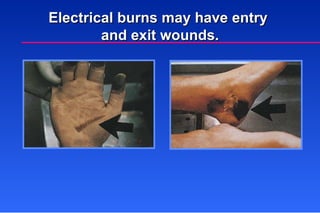
Electrical burns may have entry  and exit wounds.
Special Areas of Concern Burns to the eyes Do not attempt to open burned eyelids. Assure burn is thermal, not chemical. Apply dry, sterile dressing to both eyes to   prevent simultaneous movement. Flush chemical burns with water for at    least 20 minutes while en route to hospital. Flush from medial to lateral side of eye (to avoid injury to other eye) . (Continued)
Special Areas of Concern Burns of the hands and toes Remove all jewelry. Separate all digits with dry,    sterile dressings to prevent    digits from adhering to    each other.
Patient  CARE Electrical Burns Emergency Care Steps Administer oxygen. Watch for respiratory, cardiac arrest. Internal injuries are often more severe than external ones. Treat soft tissue injuries. Transport patient as soon as possible.
Purposes Stop bleeding. Protect wound from further Prevent contamination and  damage. infection. Dressing and Bandaging
Sterile, directly covering wound 4  x  4 gauze Universal or combination Occlusive Dressings
Hold dressings in place Roller gauze Triangular bandage Tape, air splints Bandages
Dressings and Bandages
Dressing/Bandage: Forehead Dressing/Bandage:  Elbow
Dressing/Bandage: Hand Dressing/Bandage: Shoulder
1. What is the difference between an open    wound and a closed wound? Amputations Impaled objects Neck wounds Chest injuries Burns 2. What is the treatment for: R EVIEW QUESTIONS

Soft Tissue Injuries

  • 1.
    Chapter Soft Tissue Injuries Twenty-Two
  • 2.
    Chapter Open vs.closed wounds Treatment of various types of open and closed wounds Care of specific injuries (amputations, impaled objects, neck wounds, chest injuries, burns) Principles of dressing and bandaging Twenty-Two CORE CONCEPTS
  • 3.
  • 4.
  • 5.
    Closed Wound Internalinjury with no open pathway from the outside to the injured site K EY TERM
  • 6.
    Closed Wounds ContusionHematoma Crush injury (Continued)
  • 7.
    Closed Wound Contusion
  • 8.
    Patient ASSESSMENTClosed Wounds Signs and Symptoms Assess for: Mechanism of injury Complaints of pain or tenderness Bruising or discoloration of the skin Swelling Deformity
  • 9.
    Patient CAREClosed Wounds Emergency Care Steps Take appropriate BSI precautions. Manage airway; apply oxygen. If shock is suspected, treat it. (Continued)
  • 10.
    Patient CAREClosed Wounds Emergency Care Steps Splint painful, swollen, or deformed extremities. Transport.
  • 11.
  • 12.
    Open Wound Aninjury in which the skin is interrupted (broken), exposing the tissue underneath K EY TERM
  • 13.
  • 14.
  • 15.
  • 16.
  • 17.
    Crush injuries cancause open and closed wounds.
  • 18.
    Patient ASSESSMENTOpen Wounds Signs and Symptoms Assess for: Bleeding severity Amputations or avulsions Open wounds to chest or neck that may require an occlusive dressing Open wounds to abdomen that may have caused an evisceration of abdominal organs
  • 19.
    Patient CAREOpen Wounds Emergency Care Steps BSI precautions: Gloves Eye protection Gown Hand washing (Continued)
  • 20.
    Patient CAREOpen Wounds Emergency Care Steps Expose the wound. Clean the wound surface. Control bleeding. Treat for shock. (Continued)
  • 21.
    Patient CAREOpen Wounds Emergency Care Steps Prevent further contamination. Bandage dressing in place, after bleeding is controlled. Keep patient lying still. Reassure the patient.
  • 22.
    Chest wounds maycause damage to lungs.
  • 23.
    Patient ASSESSMENTChest Wounds Signs and Symptoms Wound or trauma to the chest Sucking sound Gasping for air (possible open wounds)
  • 24.
    Patient CAREChest Wounds Emergency Care Steps Apply occlusive dressings to open wounds. Place in position of comfort (if no spine injury suspected) .
  • 25.
    Flutter Valve Inspiration
  • 26.
    Flutter Valve Exhalation
  • 27.
    Patient CAREClosed Chest Wound Emergency Care Steps Monitor airway; administer oxygen. Suspect damage to underlying organs. Suspect and treat for shock.
  • 28.
    Patient CAREImpaled Object Emergency Care Steps Do not remove object unless: Through the cheek. Interferes with chest compression. Interferes with transport. (Continued)
  • 29.
    Patient CAREImpaled Object Emergency Care Steps Manually stabilize object. Expose area. Control bleeding. Stabilize with bulky dressing. Bandage.
  • 30.
  • 31.
    Manually stabilize objectin place. Use bulky dressings and bandage to stabilize.
  • 32.
  • 33.
    Patient CAREClosed Abdominal Wound Emergency Care Steps Monitor airway; give oxygen. Be alert for vomiting. Flexing patient’s knees may reduce pain. Treat for shock. Transport.
  • 34.
    Patient CAREEmergency Care Steps Do not touch exposed organs. Do not try to replace organs. Cover exposed organs/wound with dressing moistened with sterile saline. Abdominal Evisceration
  • 35.
  • 36.
    Cover with steriledressing. Follow local protocols.
  • 37.
    Tell new EMT-Bsthat the old textbooks describe using aluminum foil as the airtight dressing for eviscerations. Today, plastic wrap is preferred as an occlusive dressing, because the sharp edges of the aluminum foil may cause further damage to abdominal organs. P RECEPTOR P EARL
  • 38.
    Patient CAREAmputations Emergency Care Steps Wrap the amputated part in sterile dressing. Wrap part in plastic. Keep cool. Transport part with patient if possible. (Continued)
  • 39.
    Patient CAREAmputations Emergency Care Steps Monitor airway; administer oxygen. Control bleeding. Do not complete partial amputations. Treat for shock.
  • 40.
    Patient CAREOpen Neck Wound Emergency Care Steps May cause air embolism. Cover with occlusive dressing. Do not compress both carotids at same time.
  • 41.
    Cover wound with gloved hand. Place occlusive dressing over wound.
  • 42.
    Place dressing over occlusive dressing. Bandage. Do not compress both carotids or restrict breathing.
  • 43.
  • 44.
    Patient ASSESSMENTBurn Depth: Superficial Signs and Symptoms Reddened skin Pain at burn site Involves only epidermis
  • 45.
    Patient ASSESSMENTBurn Depth: Partial-Thickness Signs and Symptoms Intense pain White to red skin Blisters Involves epidermis and dermis
  • 46.
    Patient ASSESSMENTBurn Depth: Full-Thickness Signs and Symptoms Dry, leathery skin Loss of sensation All dermal layers/tissue may be involved (white, dark brown, or charred) (little pain)
  • 47.
    Superficial Full- ThicknessPartial- Thickness Classifying Burns by Depth
  • 48.
    Skin Reddened BlistersCharring Classifying Burns by Depth
  • 49.
    Patient ASSESSMENTBurn Severity Signs and Symptoms Body Surface Area A burn equal to the size of the patient’s hand is equal to 1% BSA.
  • 50.
  • 51.
    Rule of Nines Child and Infant
  • 52.
    Tell new EMT-Bsthat an alternative way to determine the BSA estimate is the “Rule of Palm,” which uses the patient’s palm surface area as a unit of measurement. The patient’s palm is considered equal to approximately 1% of the BSA. Using this method, you can mentally estimate a burn area on any age patient. For example, if the burn area is equal to “7 palm surface areas,” the burn would be estimated at 7% BSA. P RECEPTOR P EARL
  • 53.
    Patient ASSESSMENTBurn Severity Signs and Symptoms Burns to these areas are Face, upper airway Hands and feet Genitalia considered serious: (Continued)
  • 54.
    Patient ASSESSMENTBurn Severity Signs and Symptoms Preexisting medical conditions Age of patient Conditions That May Affect Severity: Less than 5 Greater than 55 (Continued)
  • 55.
    Patient ASSESSMENTBurn Severity Signs and Symptoms Full-thickness burns involving face, hands, feet, or genitalia Burns complicated by respiratory injury (Continued) Full-thickness burns greater than 10% BSA
  • 56.
    Patient ASSESSMENTBurn Severity Signs and Symptoms Partial-thickness burns greater Critical Burns than 30% BSA Burns complicated by painful, swollen, or deformed extremity (Continued)
  • 57.
    Patient ASSESSMENTBurn Severity Signs and Symptoms Moderate burns in young or Critical Burns elderly patients Burns encircling any body part (arm, chest, etc.) (Continued)
  • 58.
    Patient ASSESSMENTBurn Severity Signs and Symptoms Full-thickness burns 2–10% BSA Superficial burns greater than Moderate Burns 50% BSA (Continued)
  • 59.
    Patient ASSESSMENTBurn Severity Signs and Symptoms Full-thickness burns less than Minor Burns 2% BSA Partial-thickness burns less than 15% BSA (Continued)
  • 60.
    Patient ASSESSMENTBreathing Adequacy Signs and Symptoms Greater surface area in relation Infants and Children to total size Greater fluid and heat loss Higher risk for shock May be a result of abuse
  • 61.
    Infants and ChildrenBurn Severity Critical Any full-thickness burns Partial-thickness >20% BSA or involving hands, feet, face, genitalia Moderate Partial-thickness, 10 – 20% BSA Minor Partial-thickness, <10% BSA
  • 62.
    Patient CAREBurns Emergency Care Steps Use BSI, protective gear. Stop the burning process with water or saline. Remove smoldering clothing and jewelry. (Continued)
  • 63.
    Patient CAREBurns Emergency Care Steps Monitor the airway for closure. Prevent further contamination (from chemicals) . Cover burn area with dry, sterile dressing. (Continued)
  • 64.
    Patient CAREBurns Emergency Care Steps Do not use ointments/lotions. Do not break blisters. Transport. Follow local transport protocols.
  • 65.
    Chemical Burns Protectyourself from exposure. Wear appropriate protective gear. Activate hazmat team if necessary.
  • 66.
    Patient CAREChemical Burns Emergency Care Steps Brush dry powders off skin before flushing. Flush with large amounts of water. Do not contaminate uninjured areas while flushing. Continue flushing en route to hospital.
  • 67.
    Electrical Burns Donot touch a patient who is in contact with electrical source. Contact trained personnel for rescue.
  • 68.
    Electrical burns mayhave entry and exit wounds.
  • 69.
    Special Areas ofConcern Burns to the eyes Do not attempt to open burned eyelids. Assure burn is thermal, not chemical. Apply dry, sterile dressing to both eyes to prevent simultaneous movement. Flush chemical burns with water for at least 20 minutes while en route to hospital. Flush from medial to lateral side of eye (to avoid injury to other eye) . (Continued)
  • 70.
    Special Areas ofConcern Burns of the hands and toes Remove all jewelry. Separate all digits with dry, sterile dressings to prevent digits from adhering to each other.
  • 71.
    Patient CAREElectrical Burns Emergency Care Steps Administer oxygen. Watch for respiratory, cardiac arrest. Internal injuries are often more severe than external ones. Treat soft tissue injuries. Transport patient as soon as possible.
  • 72.
    Purposes Stop bleeding.Protect wound from further Prevent contamination and damage. infection. Dressing and Bandaging
  • 73.
    Sterile, directly coveringwound 4 x 4 gauze Universal or combination Occlusive Dressings
  • 74.
    Hold dressings inplace Roller gauze Triangular bandage Tape, air splints Bandages
  • 75.
  • 76.
  • 77.
  • 78.
    1. What isthe difference between an open wound and a closed wound? Amputations Impaled objects Neck wounds Chest injuries Burns 2. What is the treatment for: R EVIEW QUESTIONS