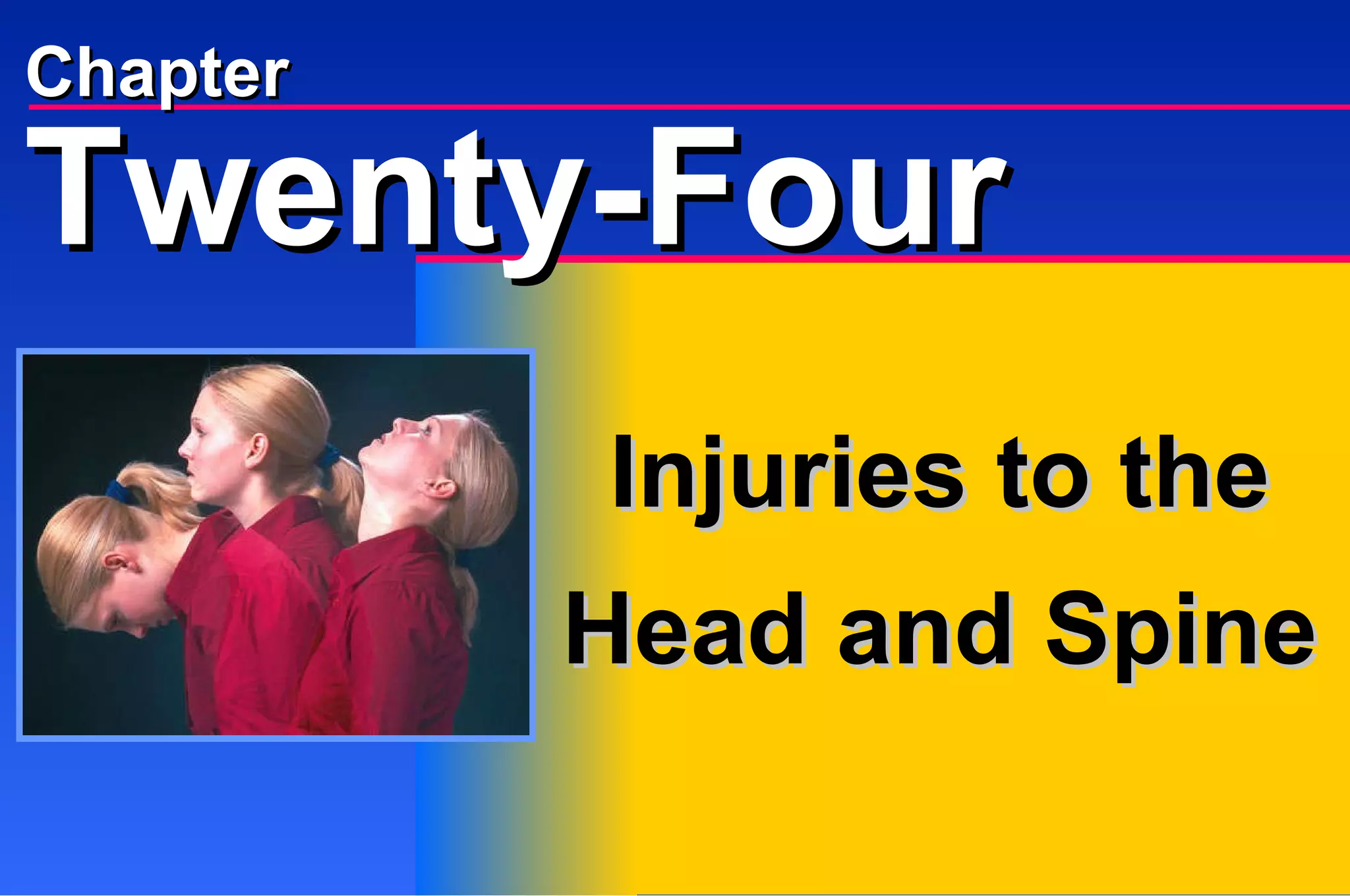
Chapter Injuries to the Head and Spine Twenty-Four
Chapter Mechanism of head and spine injury How to stabilize the cervical spine Proper application of a cervical spine    immobilization device for patients    found standing, seated, or supine How and when to do rapid extrication Procedures for helmet removal Proper immobilization of child in    car seat Twenty-Four CORE CONCEPTS
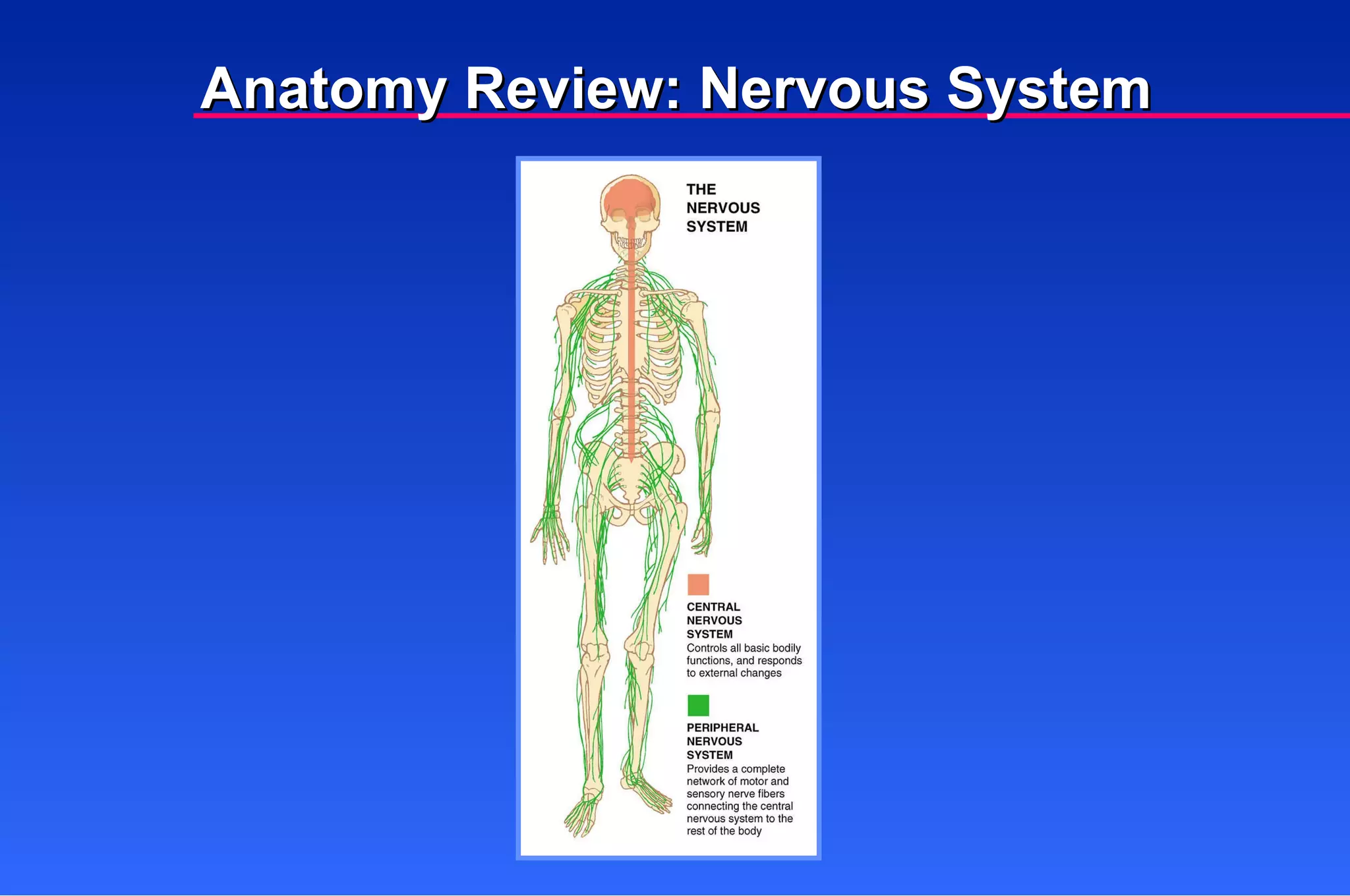
Anatomy Review: Nervous System
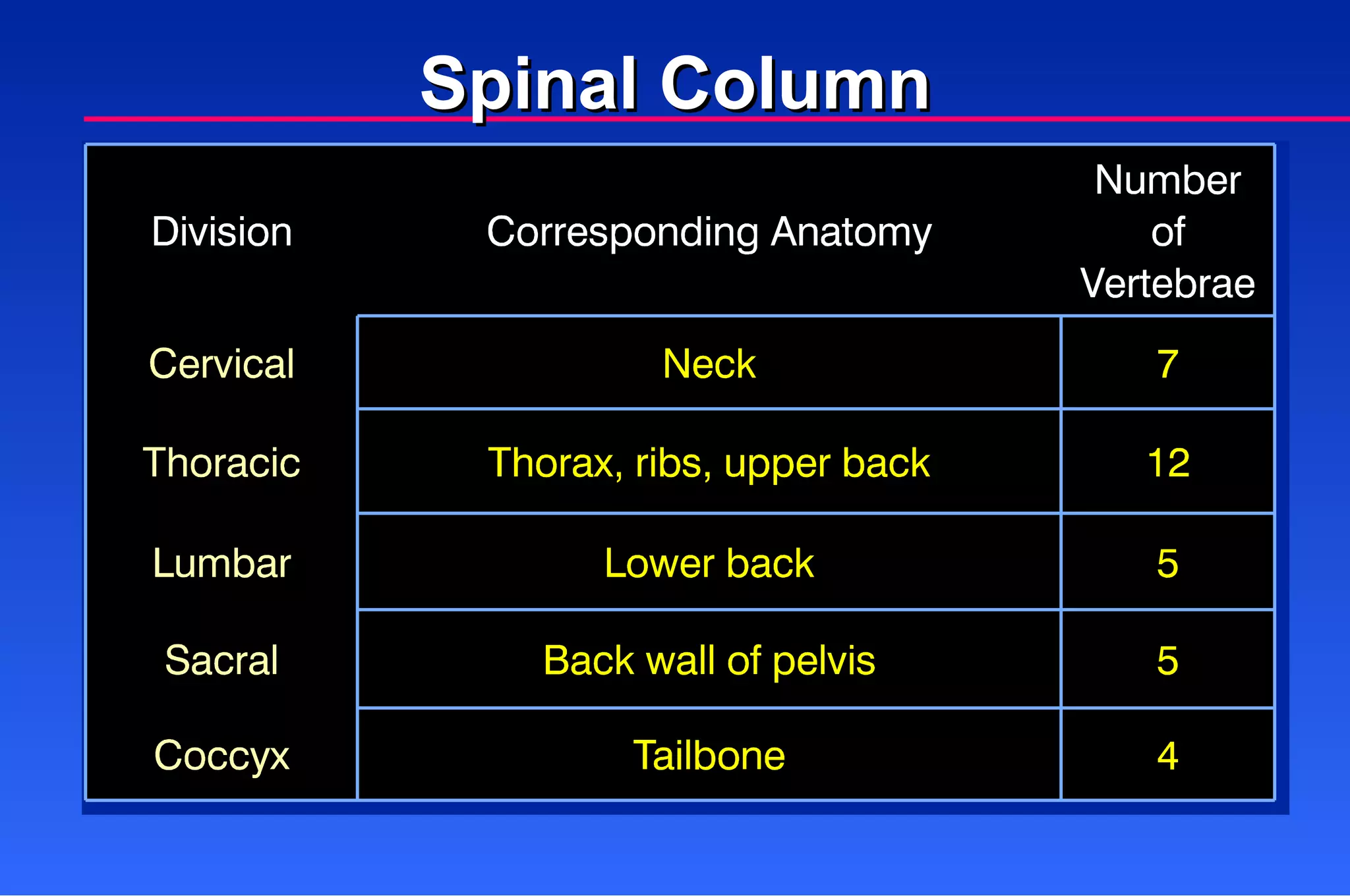
Spinal Column
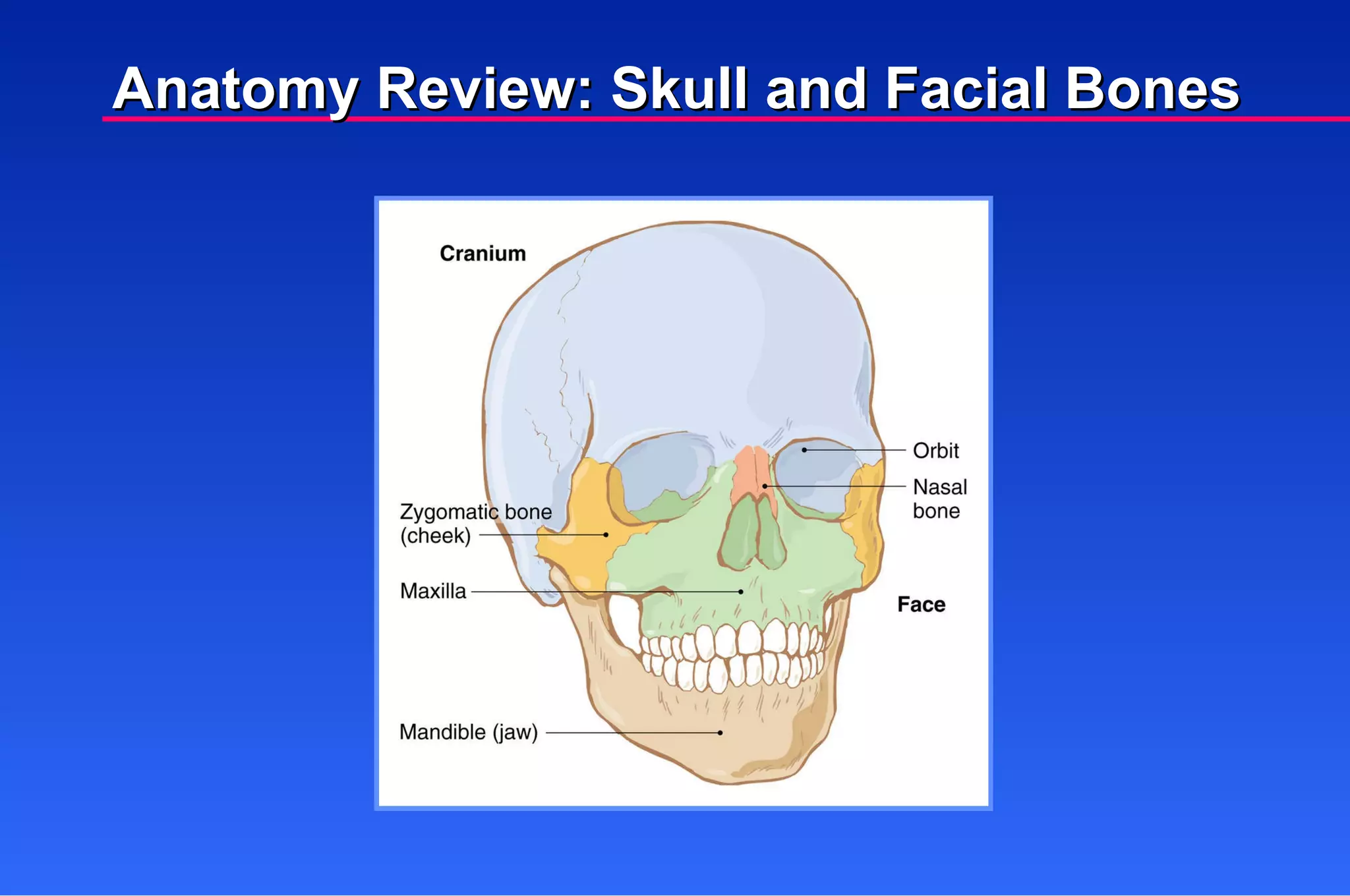
Anatomy Review: Skull and Facial Bones
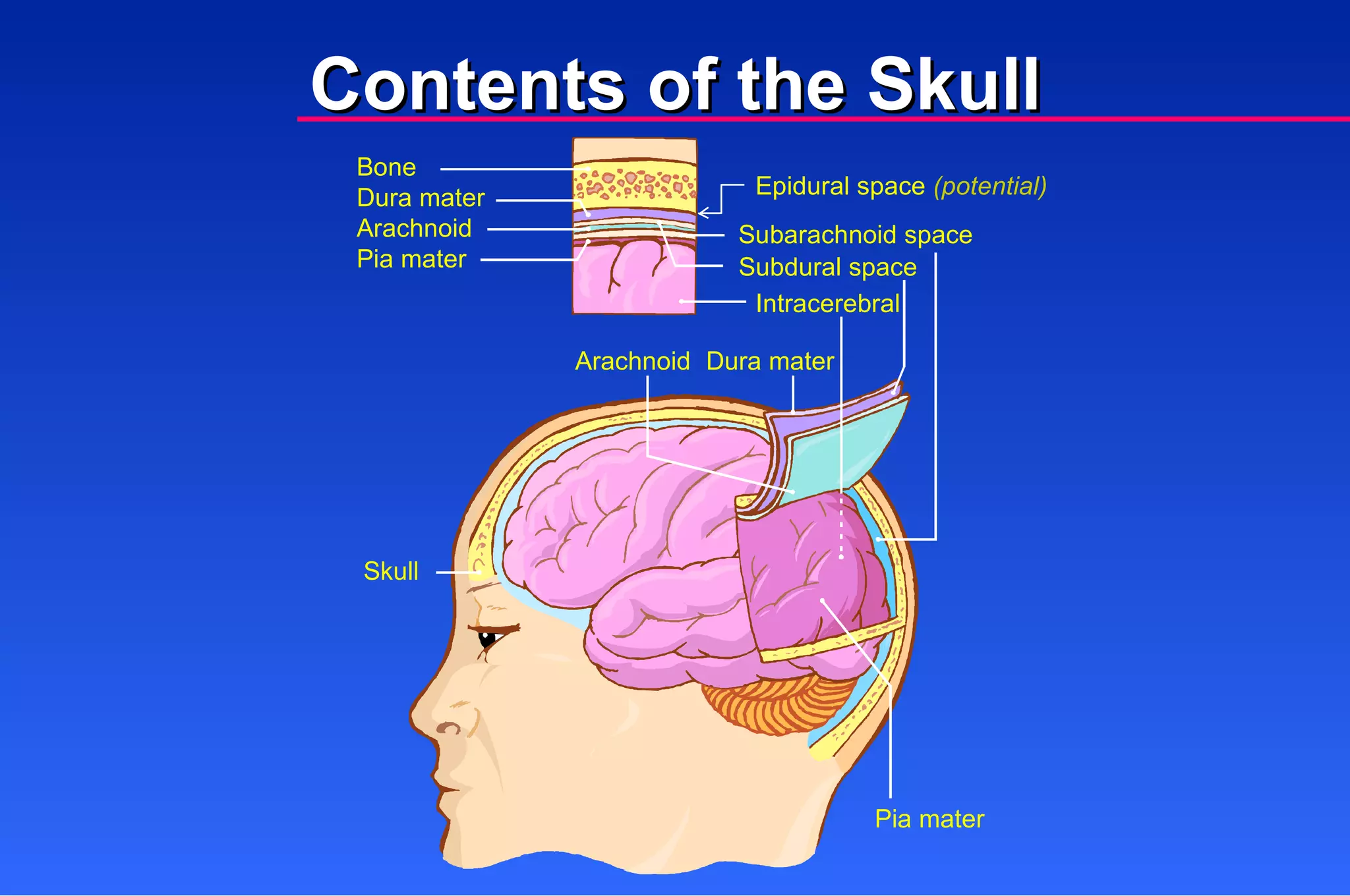
Bone Dura mater Arachnoid Pia mater Subarachnoid space Subdural space Intracerebral Dura mater Arachnoid Skull Pia mater Contents of the Skull Epidural space  (potential)
I NJURIES TO THE HEAD
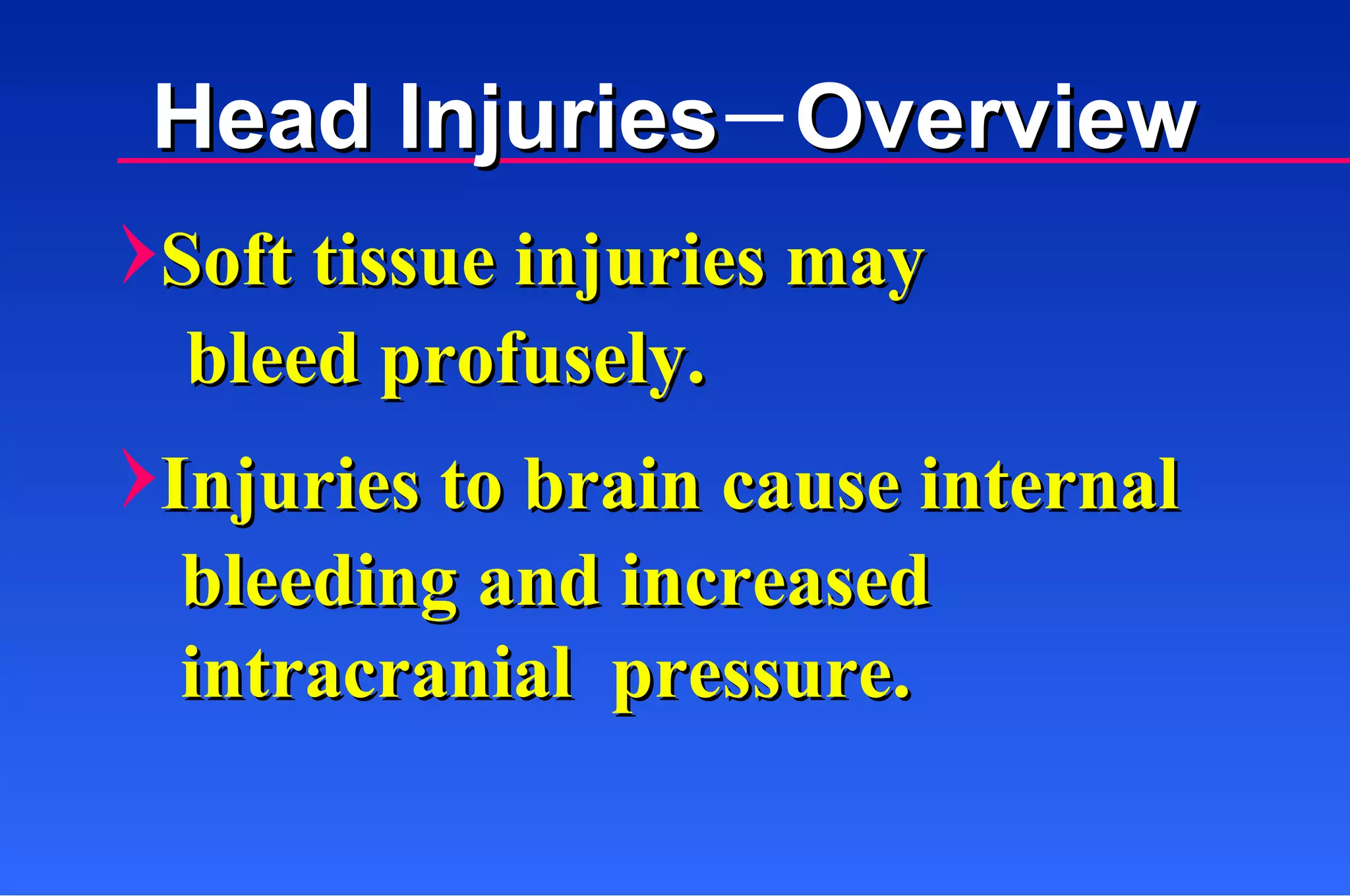
Soft tissue injuries may  Injuries to brain cause internal bleed profusely. bleeding and increased  intracranial  pressure. Head Injuries  Overview
Direct   Occurs when the brain is lacerated, punctured, or bruised by the broken bones of the skull, by bone fragments, or by foreign objects. Brain Injury Indirect   Can be the result of closed injuries to the skull and certain types of open skull injuries.
May occur due to clot  Can cause altered mental status. or hemorrhage. Signs and symptoms are similar to traumatic injury  (but no trauma) . Brain Injury  Nontraumatic
Patient  ASSESSMENT Head Injury Signs and Symptoms Altered or decreased mental status Irregular breathing patterns Mechanism of injury present (Continued)
Patient  ASSESSMENT Head Injury Signs and Symptoms Contusions, lacerations, or    hematomas Deformity of skull Blood/fluid from ears or nose Bruising around eyes, behind ears (Continued)
Patient  ASSESSMENT Head Injury Signs and Symptoms Neurologic disability Nausea and/or vomiting Unequal pupil size with altered mental status Seizures
Patient  CARE Head Injury Emergency Care Steps Body substance isolation Airway, ventilation, oxygen Initial assessment with C-spine stabilization (Continued)
Patient  CARE Head Injury Emergency Care Steps Complete assessment. Immobilize spine. Monitor airway, breathing, pulse, mental status closely. (Continued)
Patient  CARE Head Injury Emergency Care Steps Control bleeding. Do not apply pressure to open or depressed skull injury. Dress and bandage wound. (Continued)
Patient  CARE Head Injury Emergency Care Steps Be prepared for changes in  Transport immediately. Monitor vital signs every 5 minutes patient condition. en route.
Tell new EMT-Bs that an epidural hematoma  is often associated with severe blows to the temporal regions of the head.  If they recognize an epidural hematoma in its early stages and promptly transport the patient to a trauma center, it can make the difference between life and death.  Tell them to be aggressive if they suspect an epidural hematoma may be developing. P RECEPTOR  P EARL
I NJURIES TO  THE SPINE
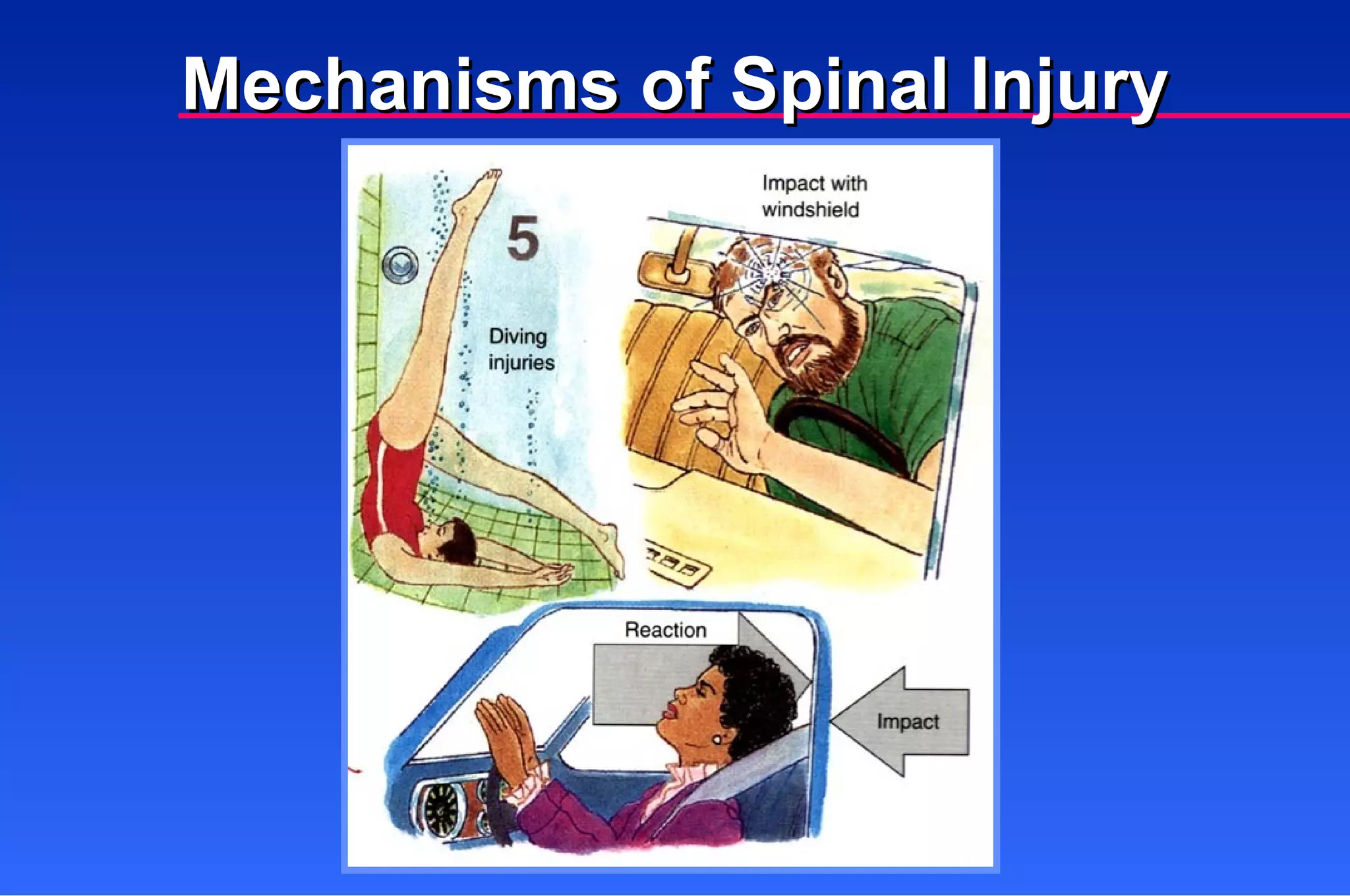
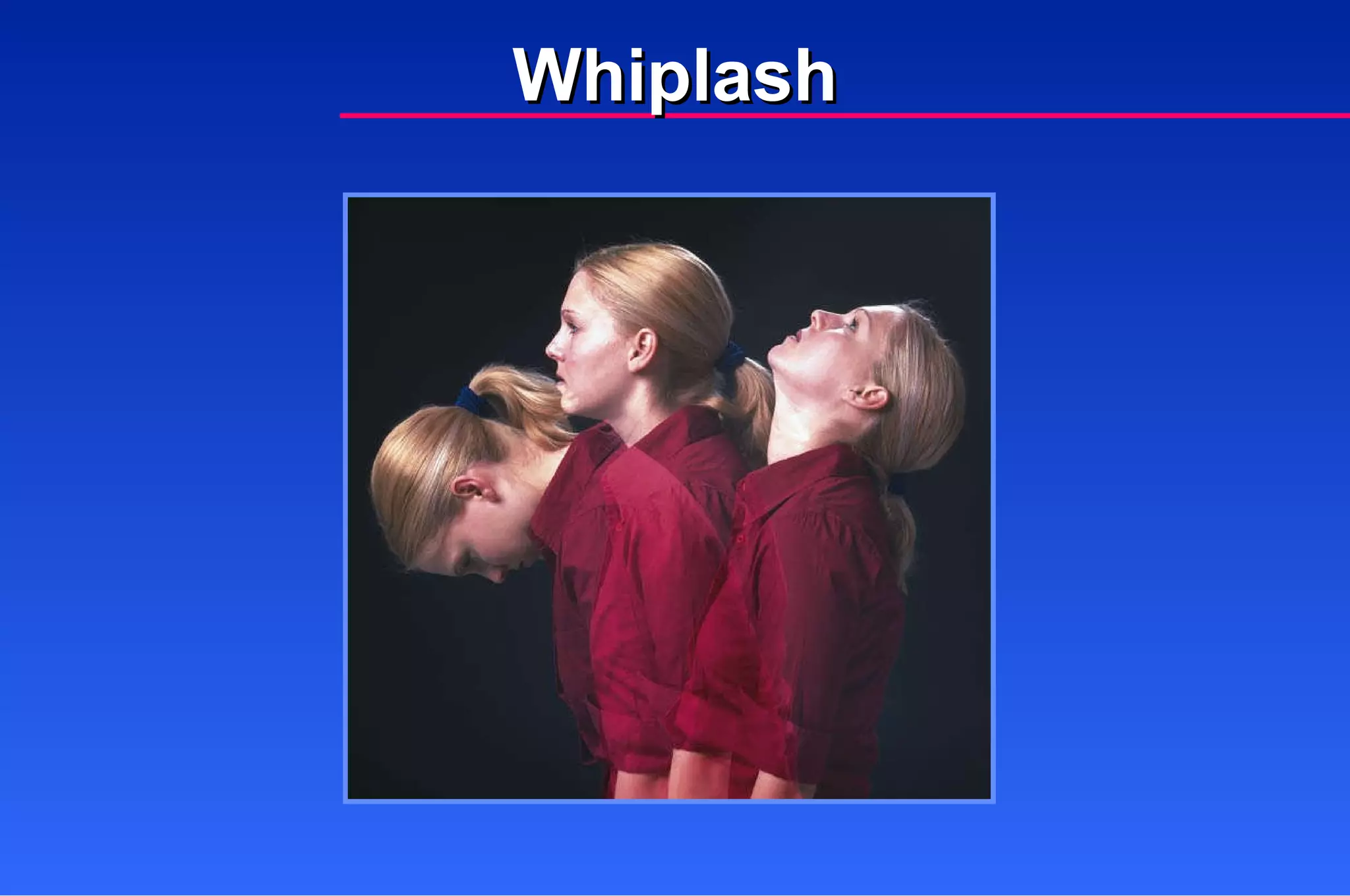
Motor vehicle crashes Auto-pedestrian collisions Falls Blunt or penetrating trauma Motorcycle crashes Hangings Diving accidents Unconscious trauma patients Mechanisms of Spinal Injury
Mechanisms of Spinal Injury
Whiplash
Tell new EMT-Bs that as a rule of thumb, they should assume any fall three times the patient’s height or with enough force to cause open PSDEs to the ankles will also be accompanied by a spine injury. P RECEPTOR  P EARL
Compression Distraction  (pulling apart) Lateral bending Flexion, rotation, extension Types of Spinal Injuries
Patient  ASSESSMENT Spinal Injury Signs and Symptoms Pain and tenderness Deformity of spine upon palpation Numbness, weakness, or tingling in extremities (Continued)
Patient  ASSESSMENT Spinal Injury Signs and Symptoms Pain upon movement: Never move or allow a patient to move in order to elicit a pain response. (Continued)
Patient  ASSESSMENT Spinal Injury Signs and Symptoms Loss of sensation or paralysis In extremities Below level of injury (Continued)
Patient  ASSESSMENT Spinal Injury Signs and Symptoms (Continued) Impaired breathing: “ C-3, -4, -5 keep the diaphragm alive”
Patient  ASSESSMENT Spinal Injury Signs and Symptoms Soft-tissue injuries associated  with trauma Incontinence (Continued) Priapism
Patient  ASSESSMENT Spinal Injury Signs and Symptoms Instruct the patient not to move. Stabilize cervical spine during  initial assessment. Evaluate mechanism of injury. (Continued)
Patient  ASSESSMENT Spinal Injury Signs and Symptoms Ask: What happened? Where does it hurt? Does your neck or back hurt? (Continued)
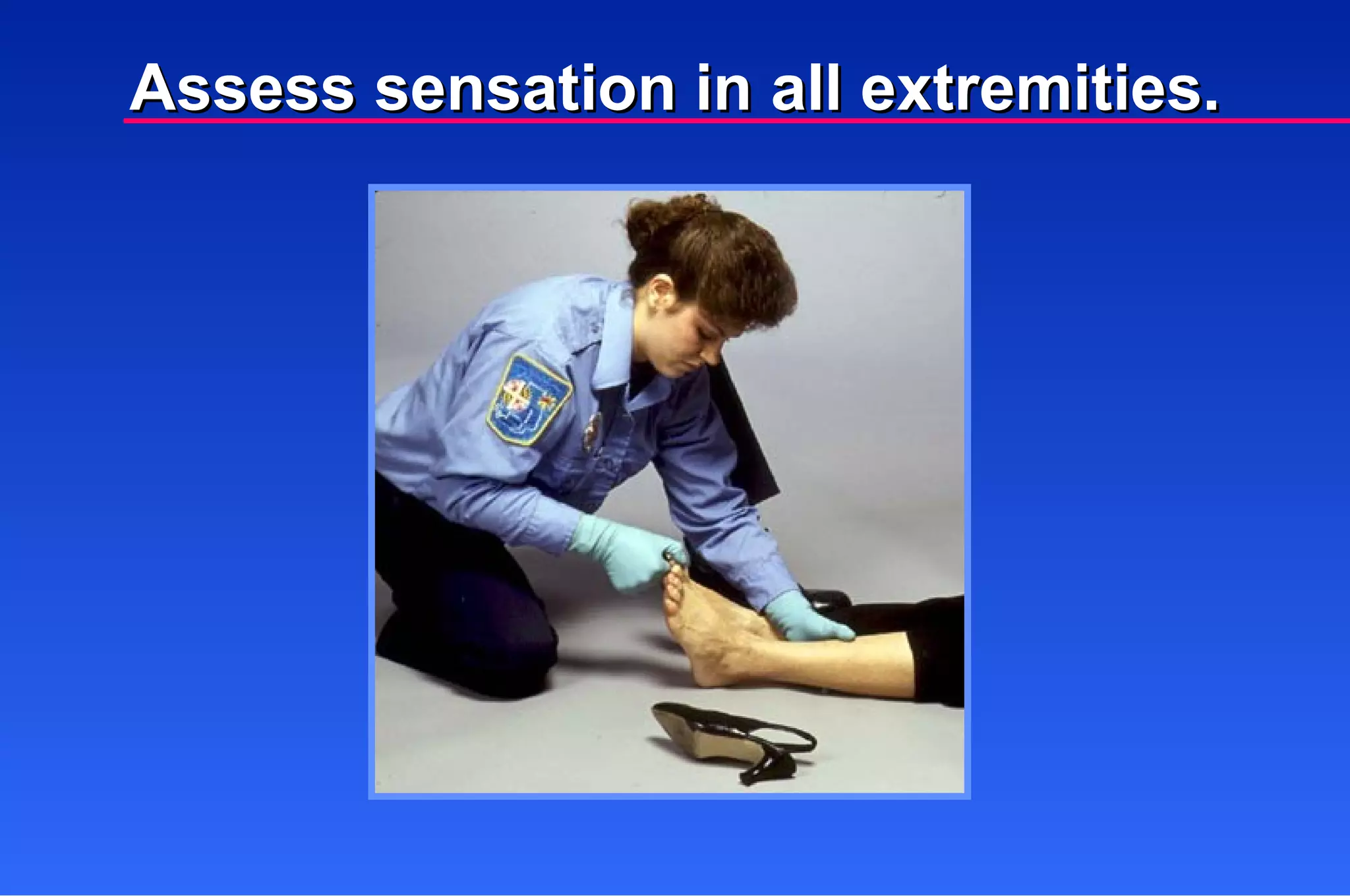
Patient  ASSESSMENT Spinal Injury Signs and Symptoms Ask: Can you move your hands and feet? Can you feel me touching your  fingers?  Toes?
Assess sensation in all extremities.
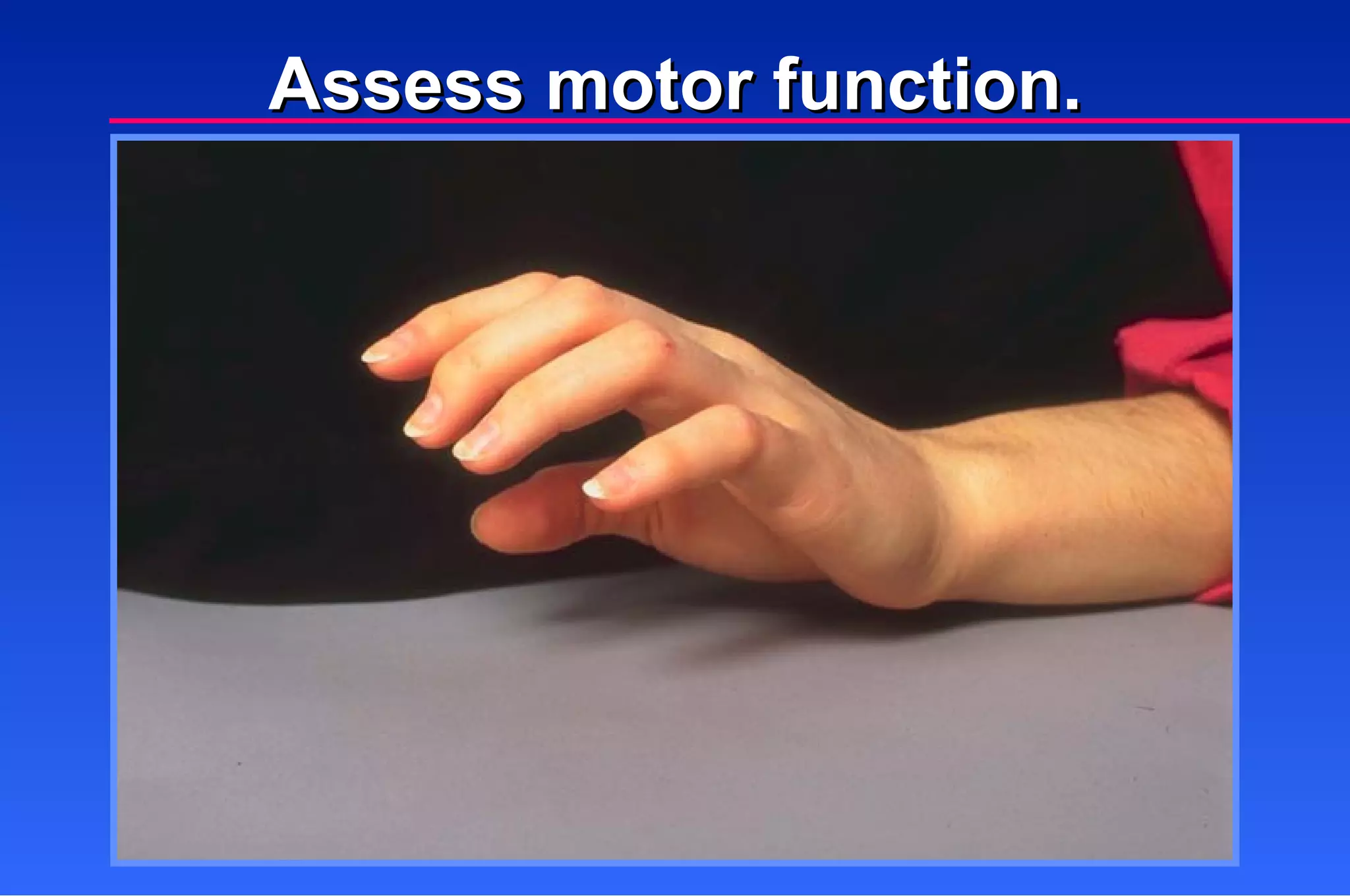
Assess motor function.
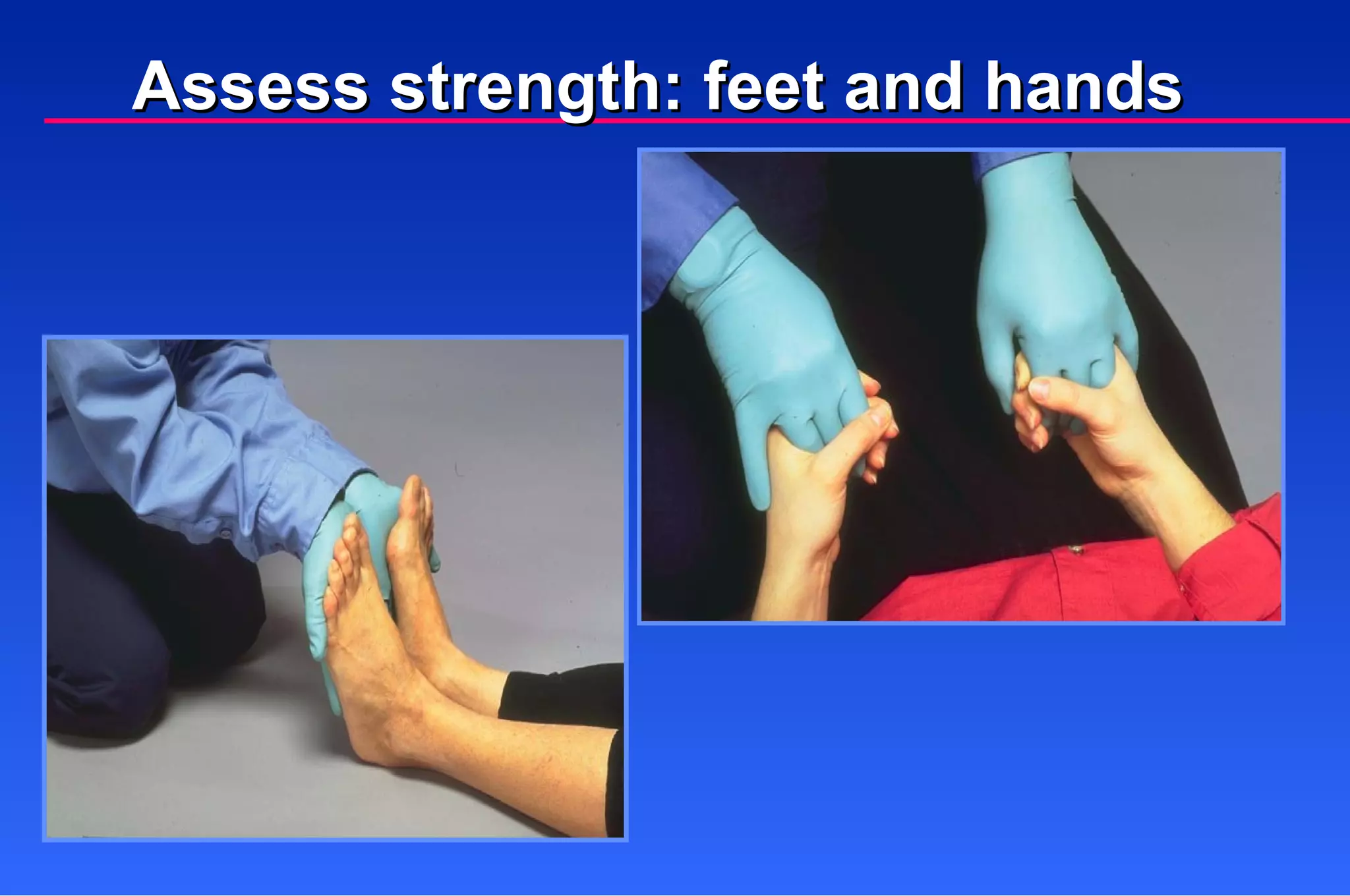
Assess strength: feet and hands
Patient  ASSESSMENT Spinal Injury Signs and Symptoms Inspect. Palpate. Assess strength of extremities. Complications of spinal injury: May cause paralysis. May affect respiratory effort.
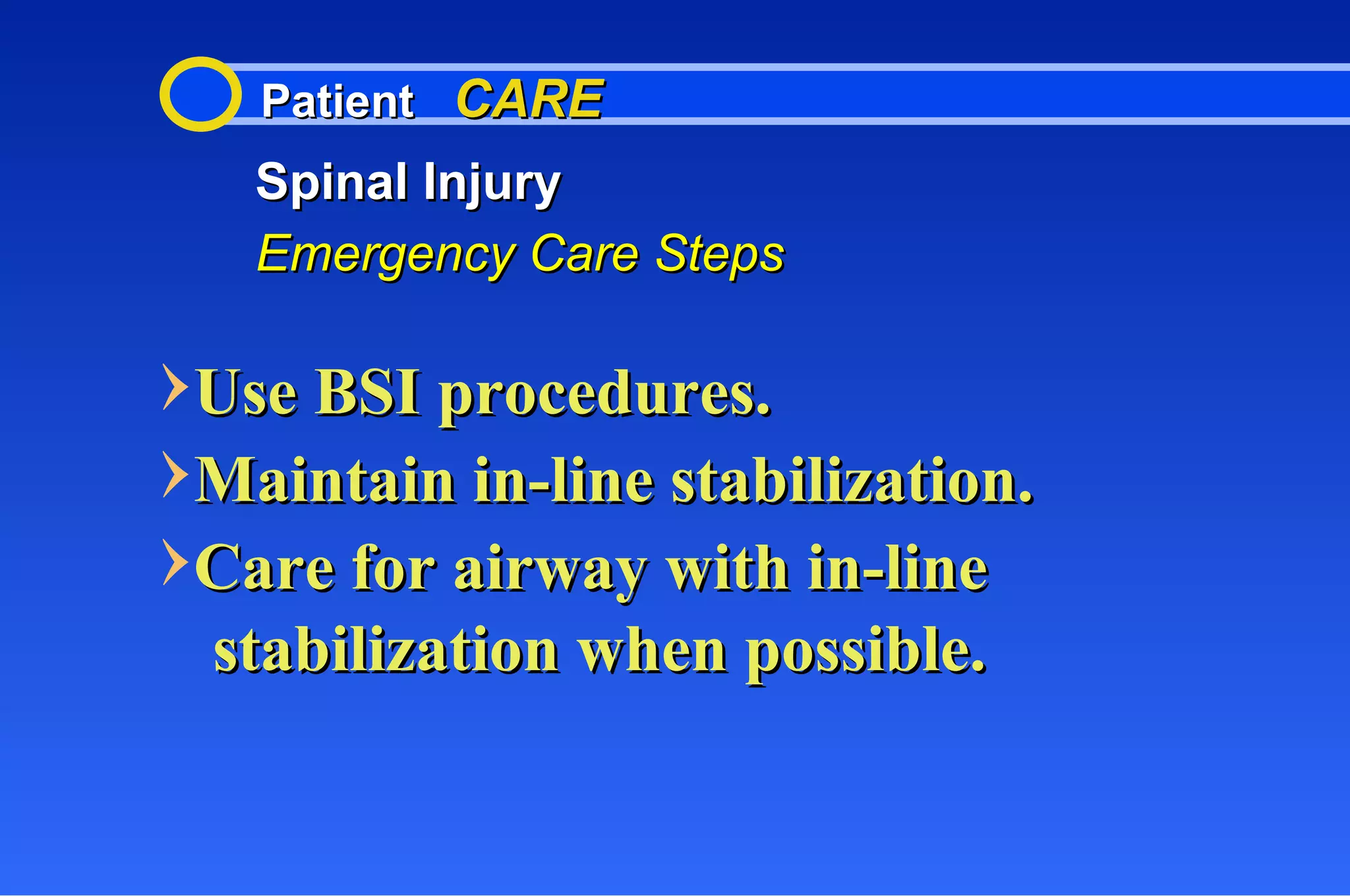
Patient  CARE Spinal Injury Emergency Care Steps Use BSI procedures. Maintain in-line stabilization. Care for airway with in-line stabilization when possible.
Patient  CARE Breathing Adequacy Emergency Care Steps Assess pulse, movement, and sensation in extremities. Assess the neck and spine. Administer oxygen via nonrebreather mask.
Patient  CARE Spinal Injury Emergency Care Steps Apply properly sized cervical spine immobilization device. Apply and secure patient to appropriate immobilization device. (Continued)
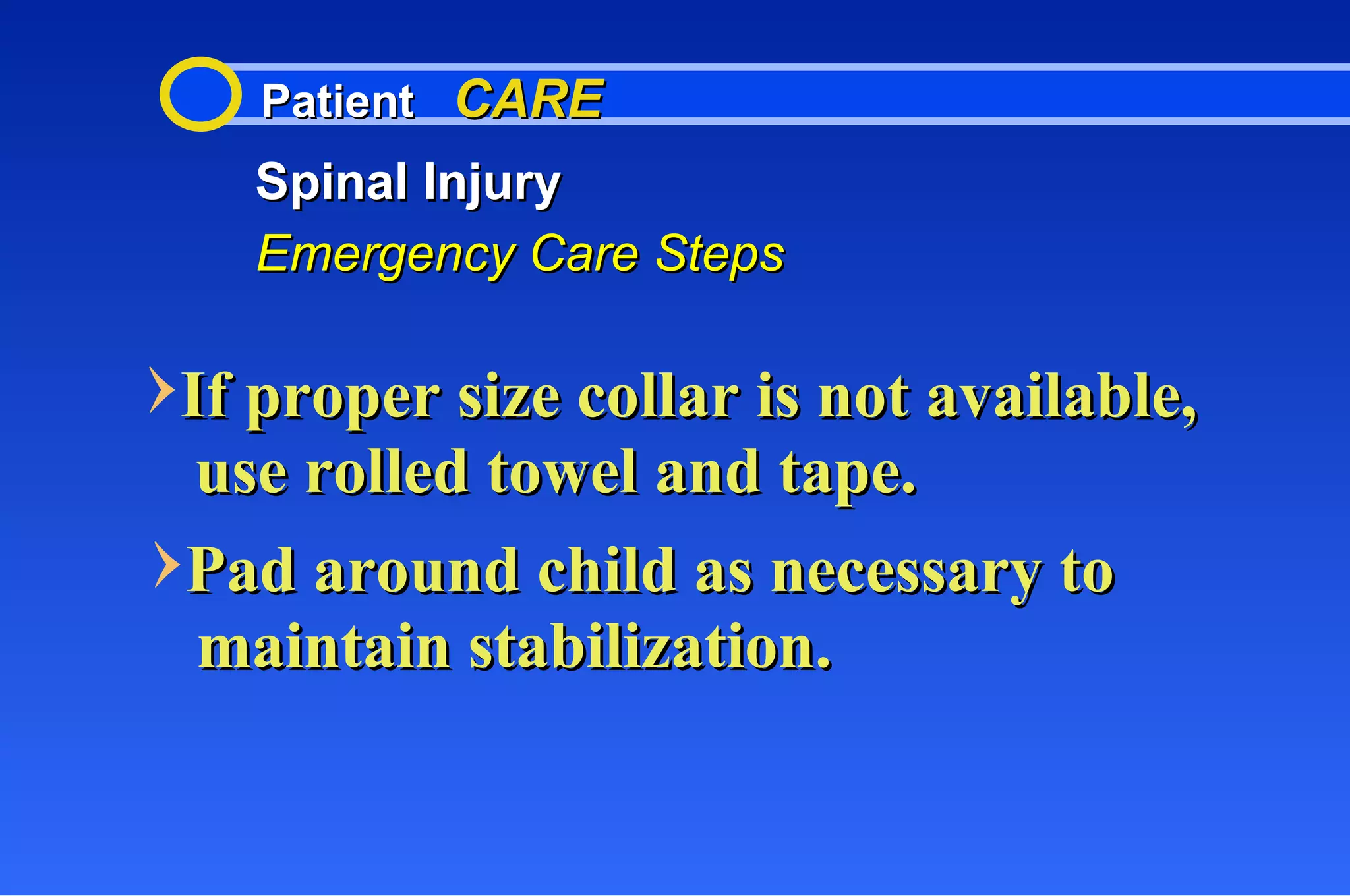
Patient  CARE Spinal Injury Emergency Care Steps If proper size collar is not available, use rolled towel and tape. Pad around child as necessary to maintain stabilization.
S PINAL IMMOBILIZATION
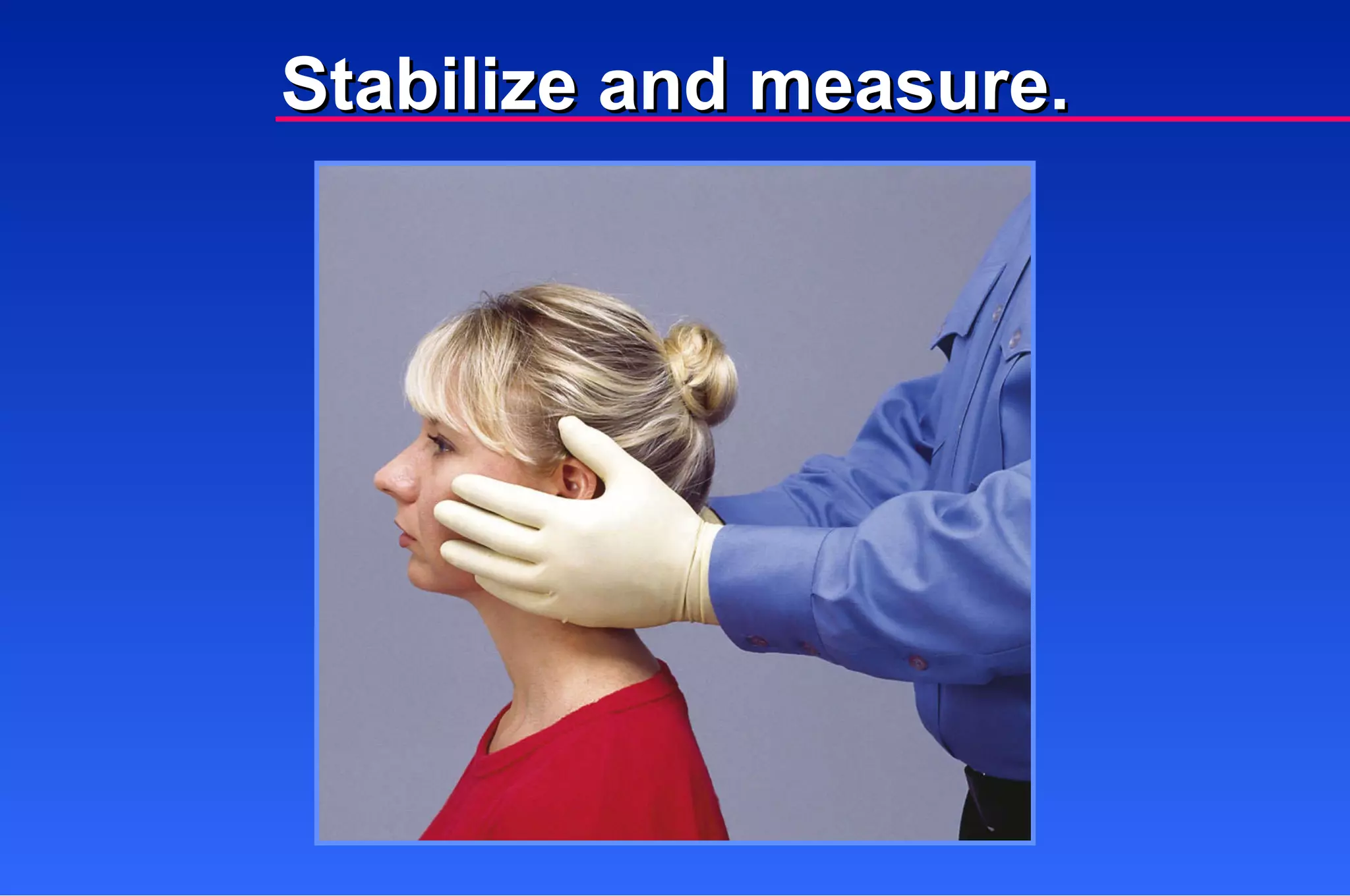
Stabilize and measure.
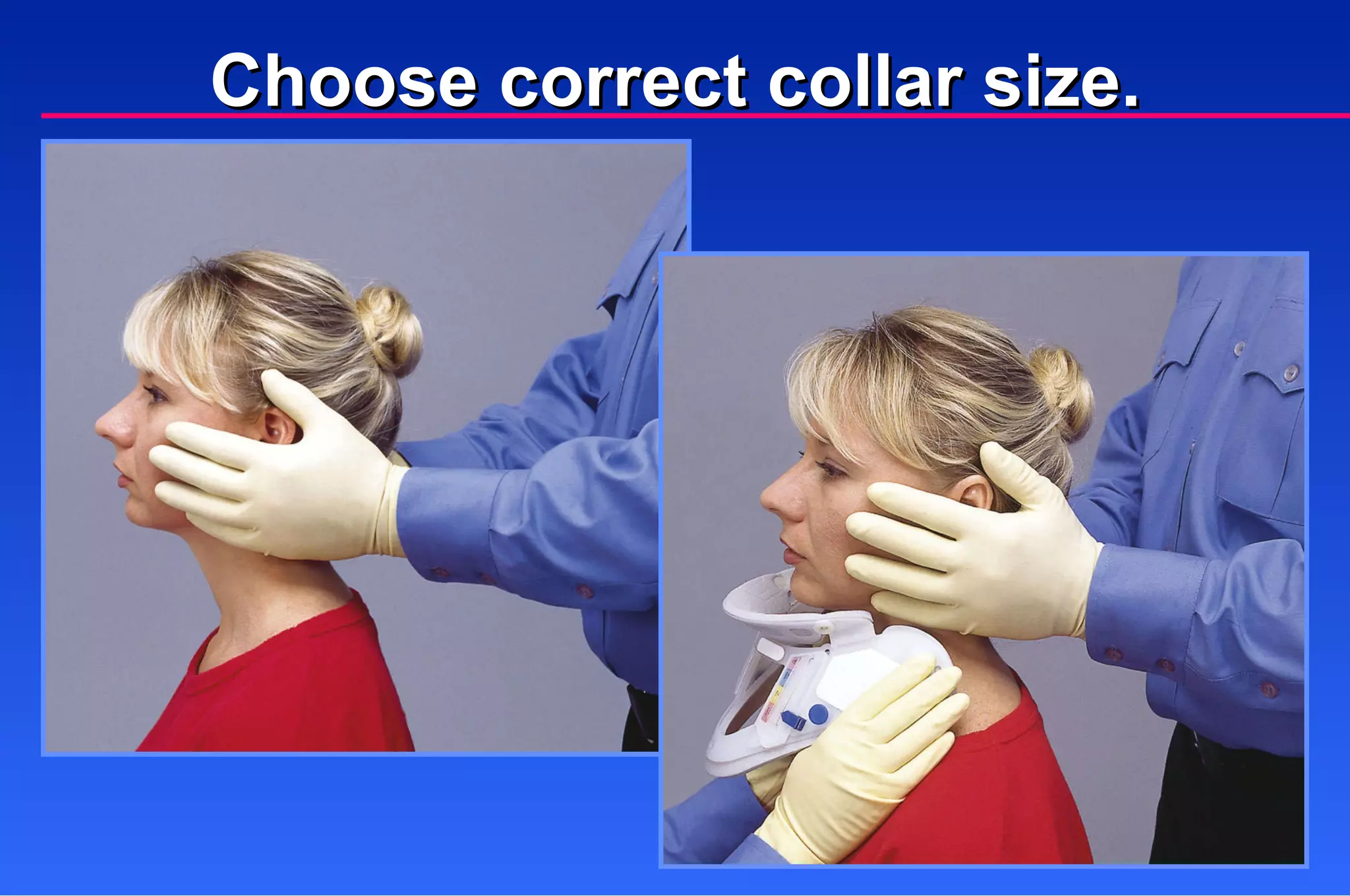
Choose correct collar size.
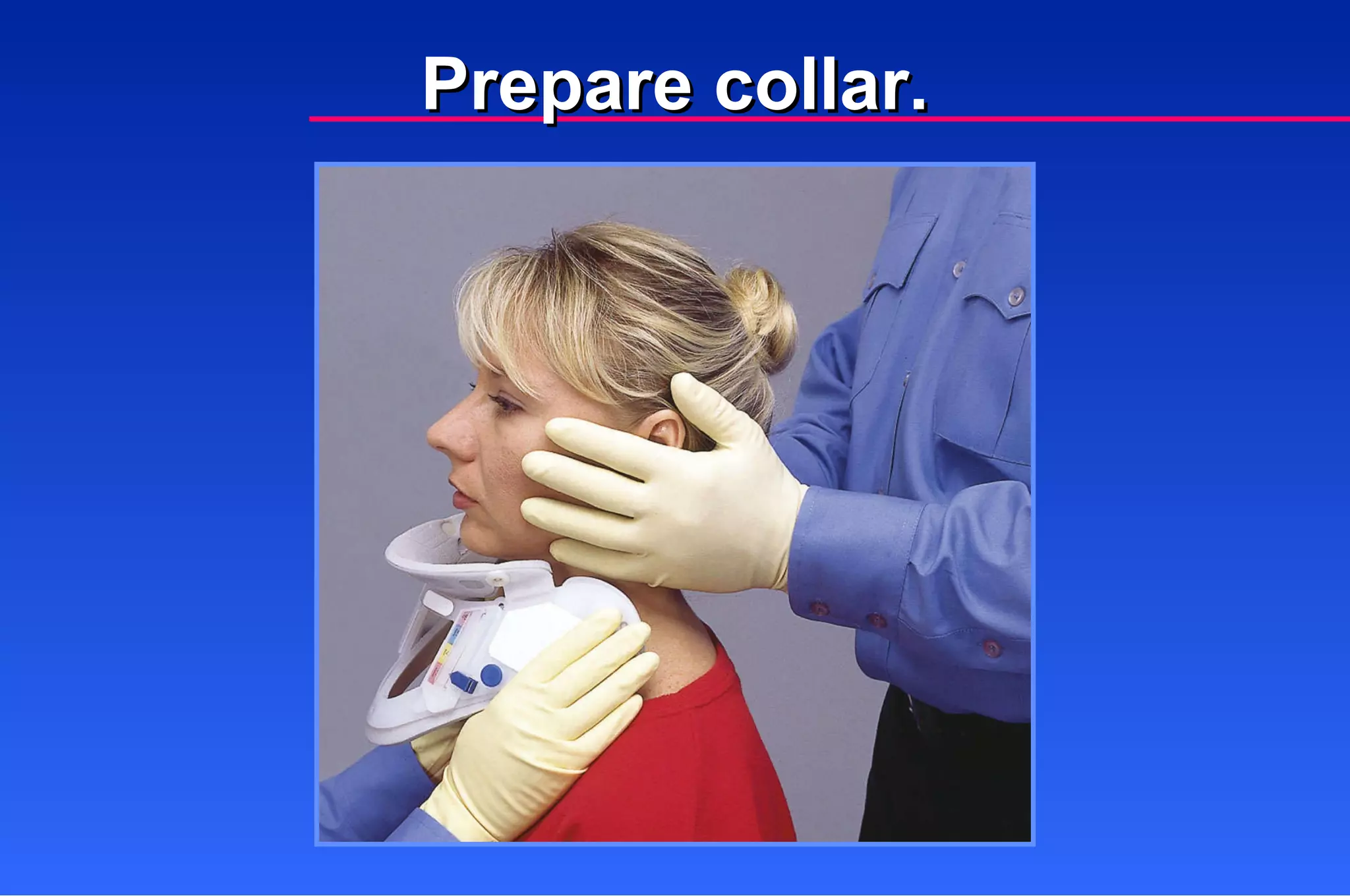
Prepare collar.
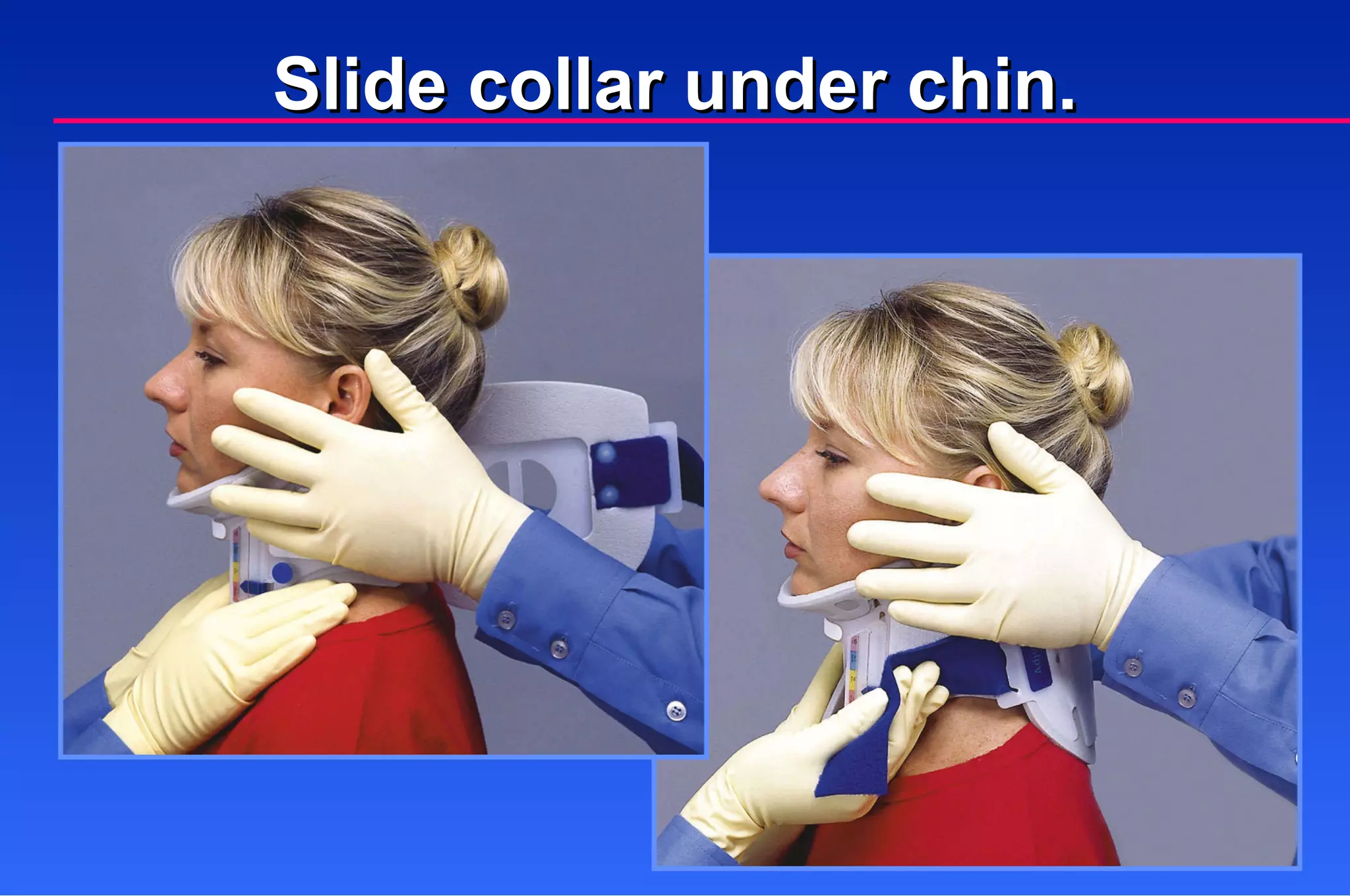
Slide collar under chin.
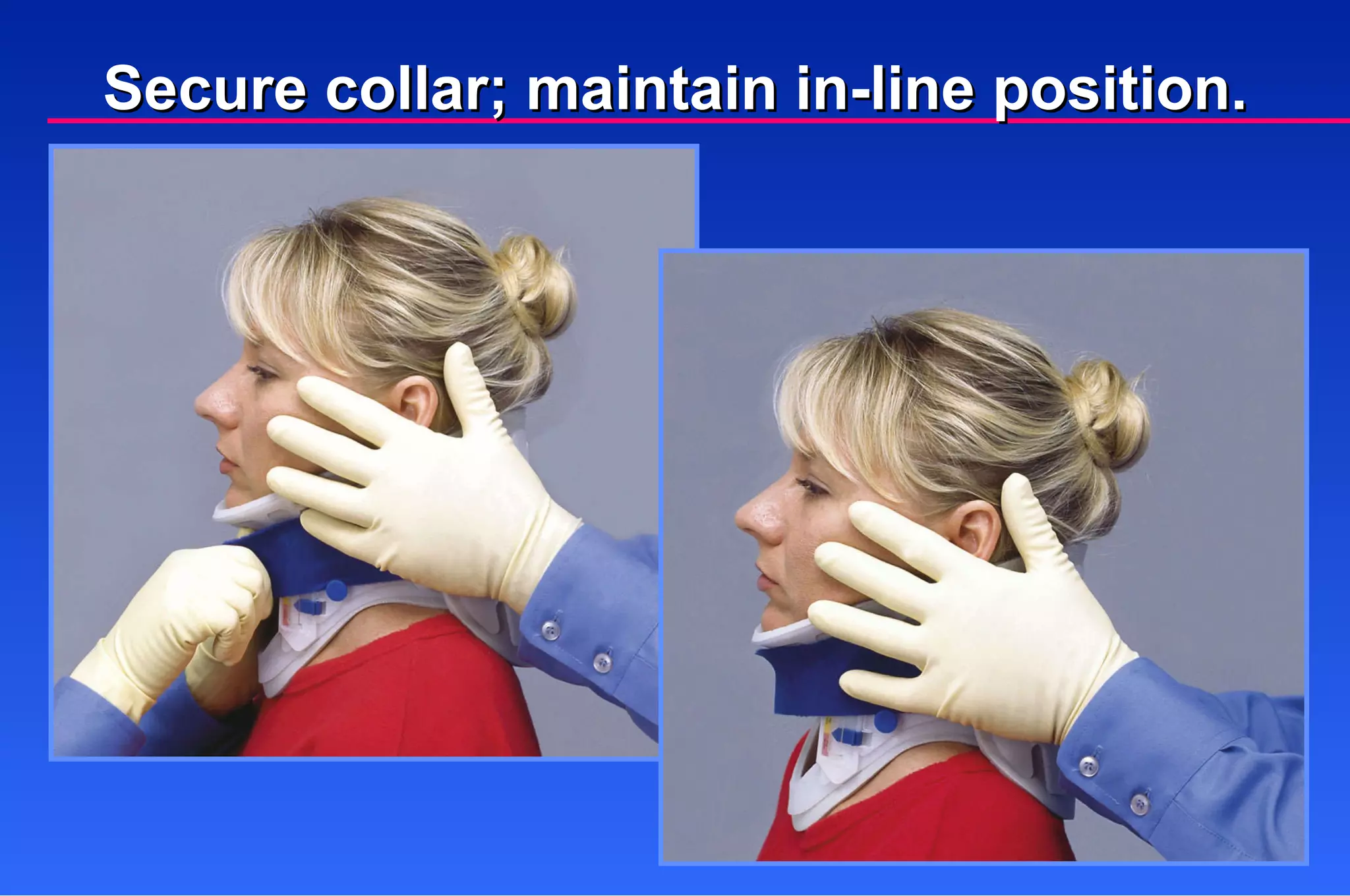
Secure collar; maintain in-line position.
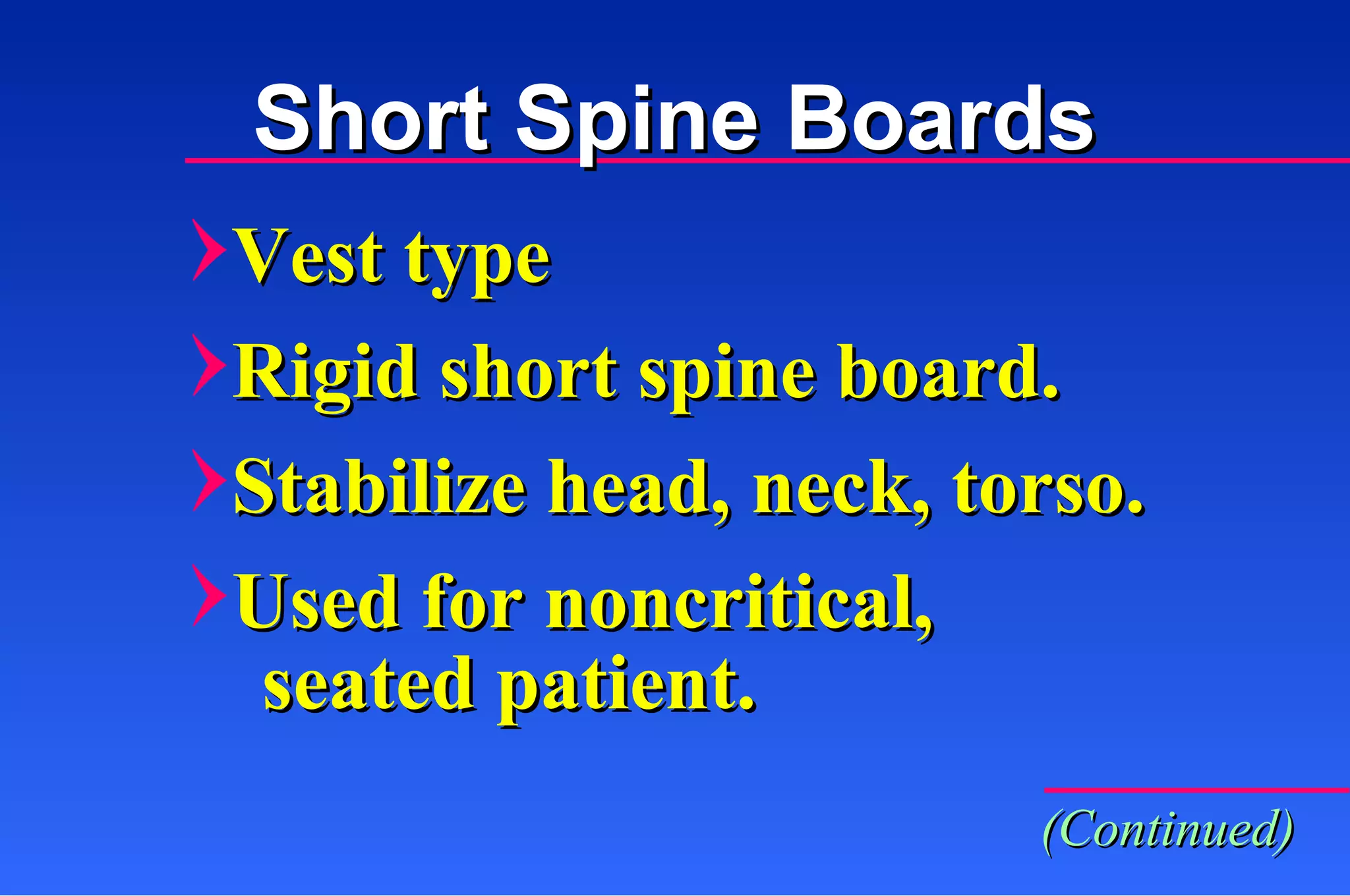
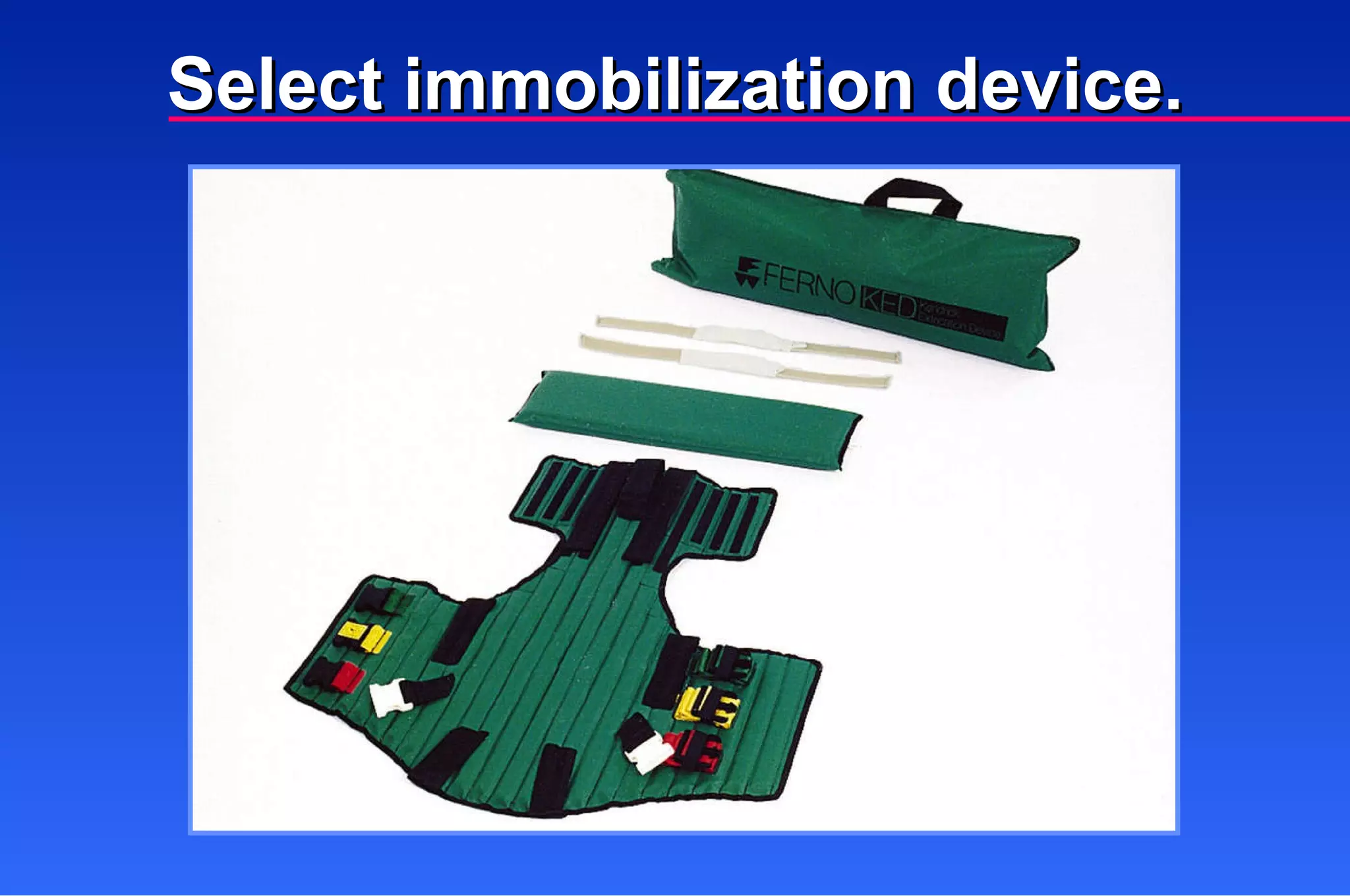
Vest type Rigid short spine board. Stabilize head, neck, torso. Used for noncritical,  seated patient. (Continued) Short Spine Boards
Select immobilization device.
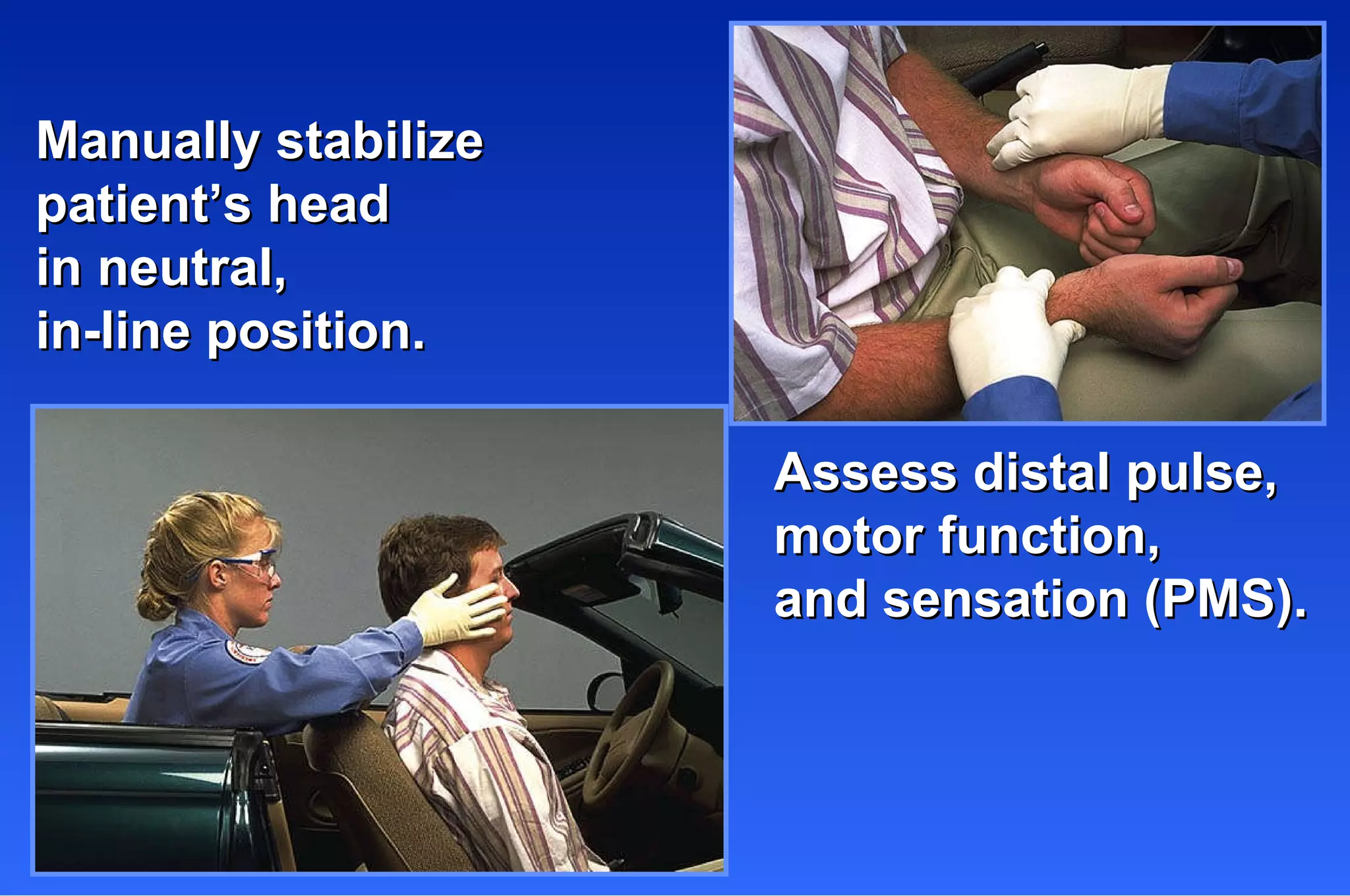
Manually stabilize  patient’s head in neutral,  in-line position. Assess distal pulse, motor function,  and sensation (PMS).
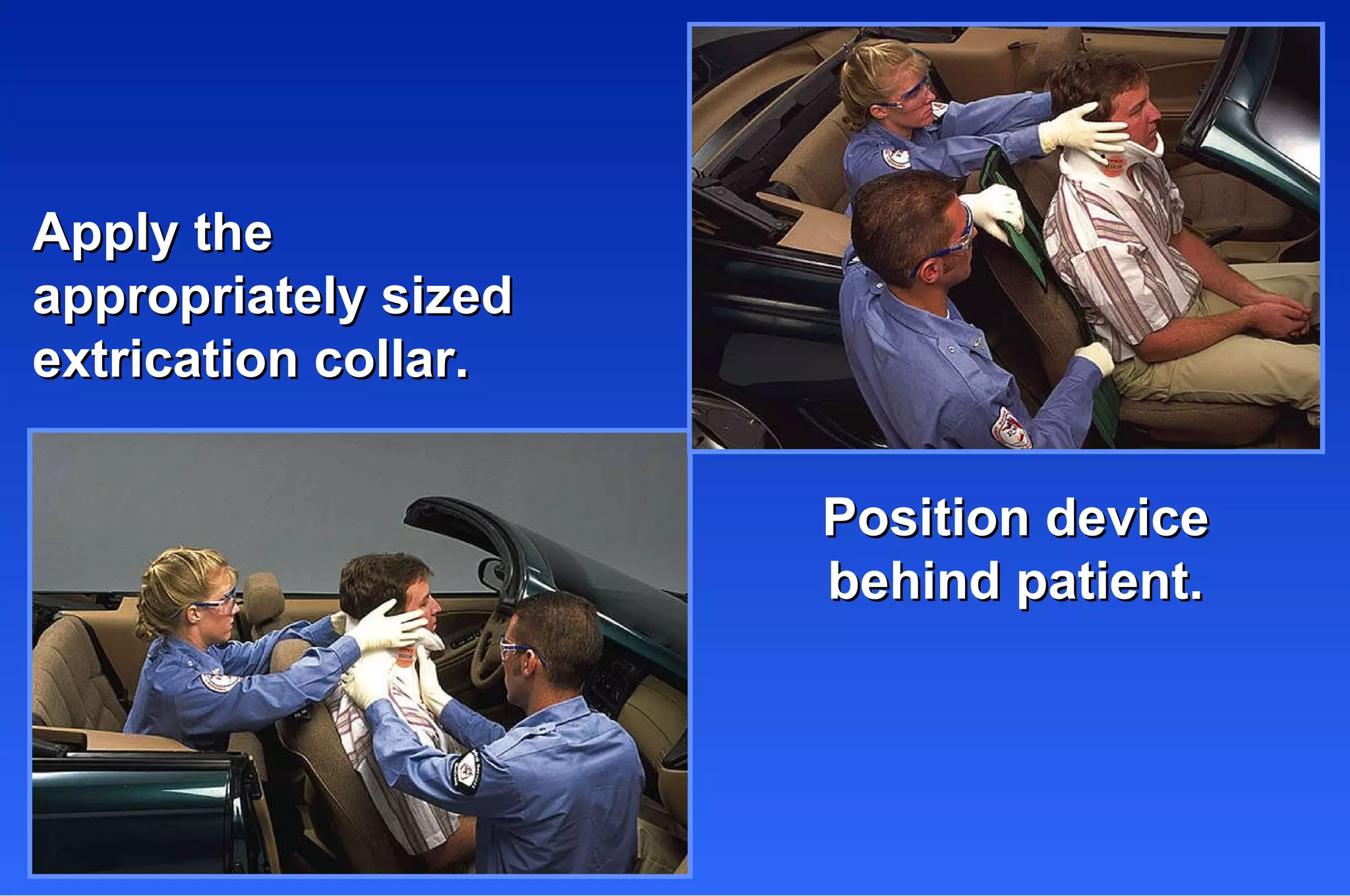
Apply the  appropriately sized  extrication collar. Position device behind patient.
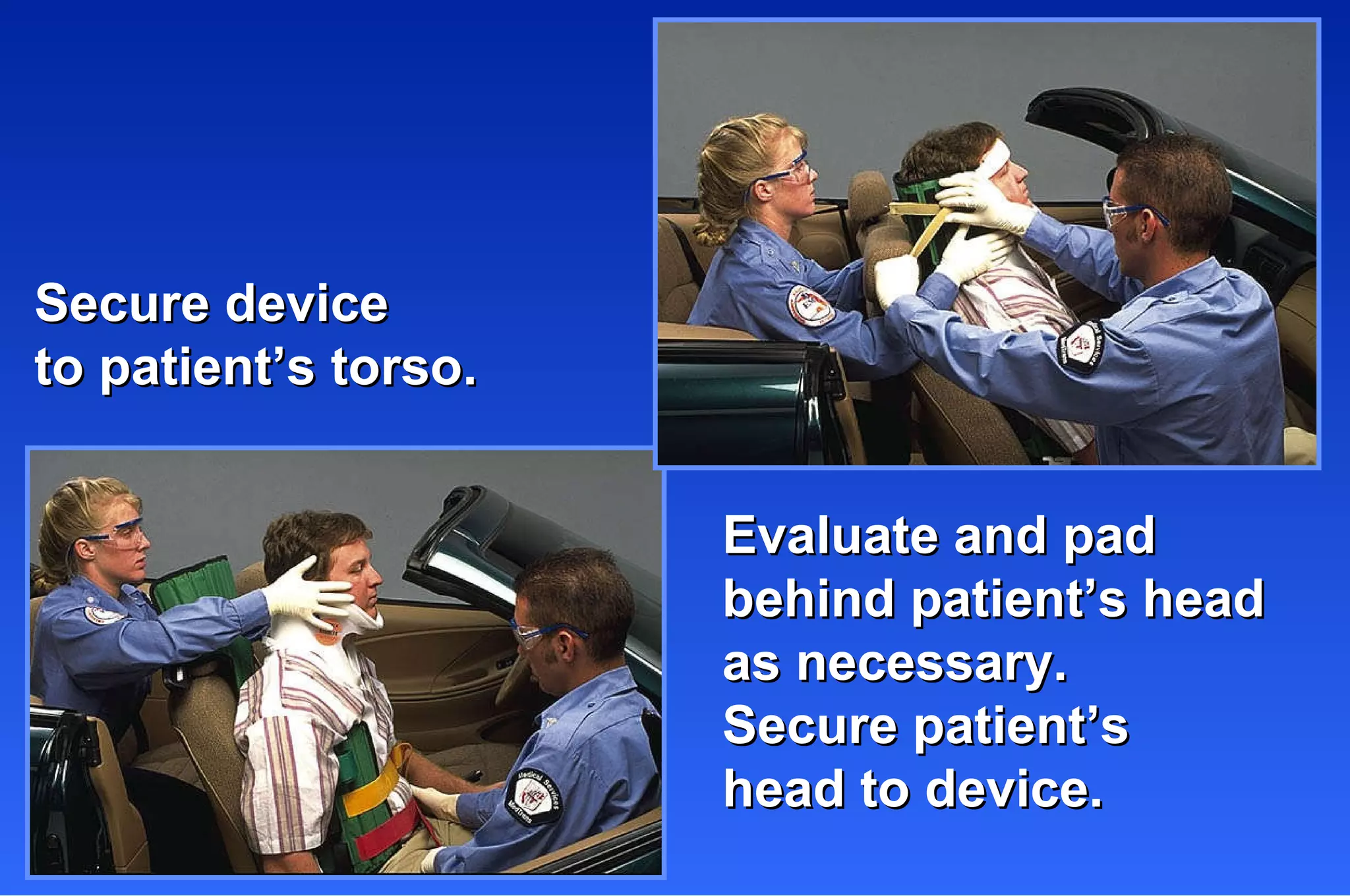
Secure device to patient’s torso. Evaluate and pad  behind patient’s head as necessary.  Secure patient’s  head to device.
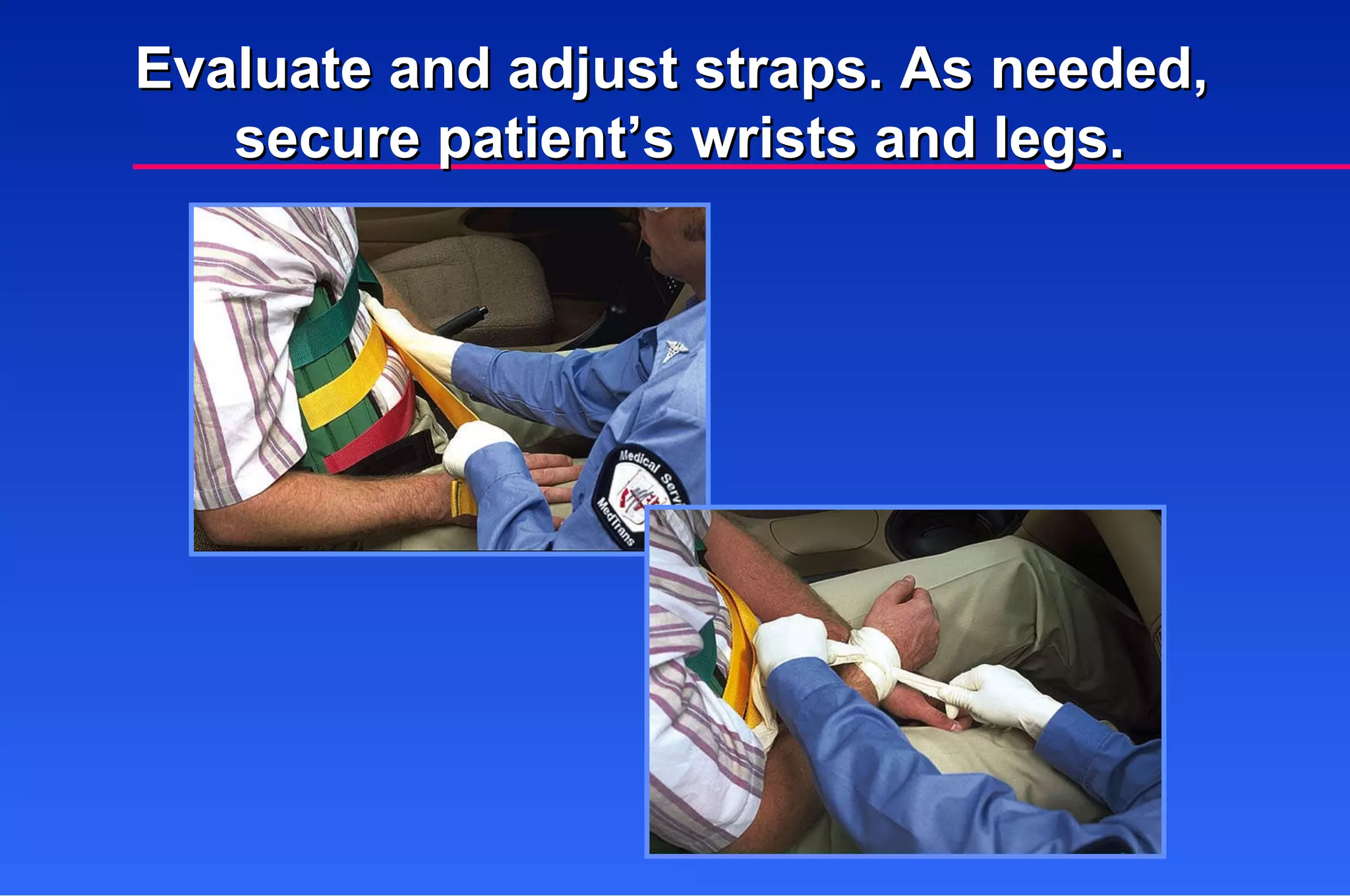
Evaluate and adjust straps. As needed,  secure patient’s wrists and legs.
Stabilize head, neck, torso, pelvis, and extremities. May be applied in: Lying, standing, and sitting positions Conjunction with short spine boards (Continued) Long Spine Boards
Maintain stabilization; apply collar.
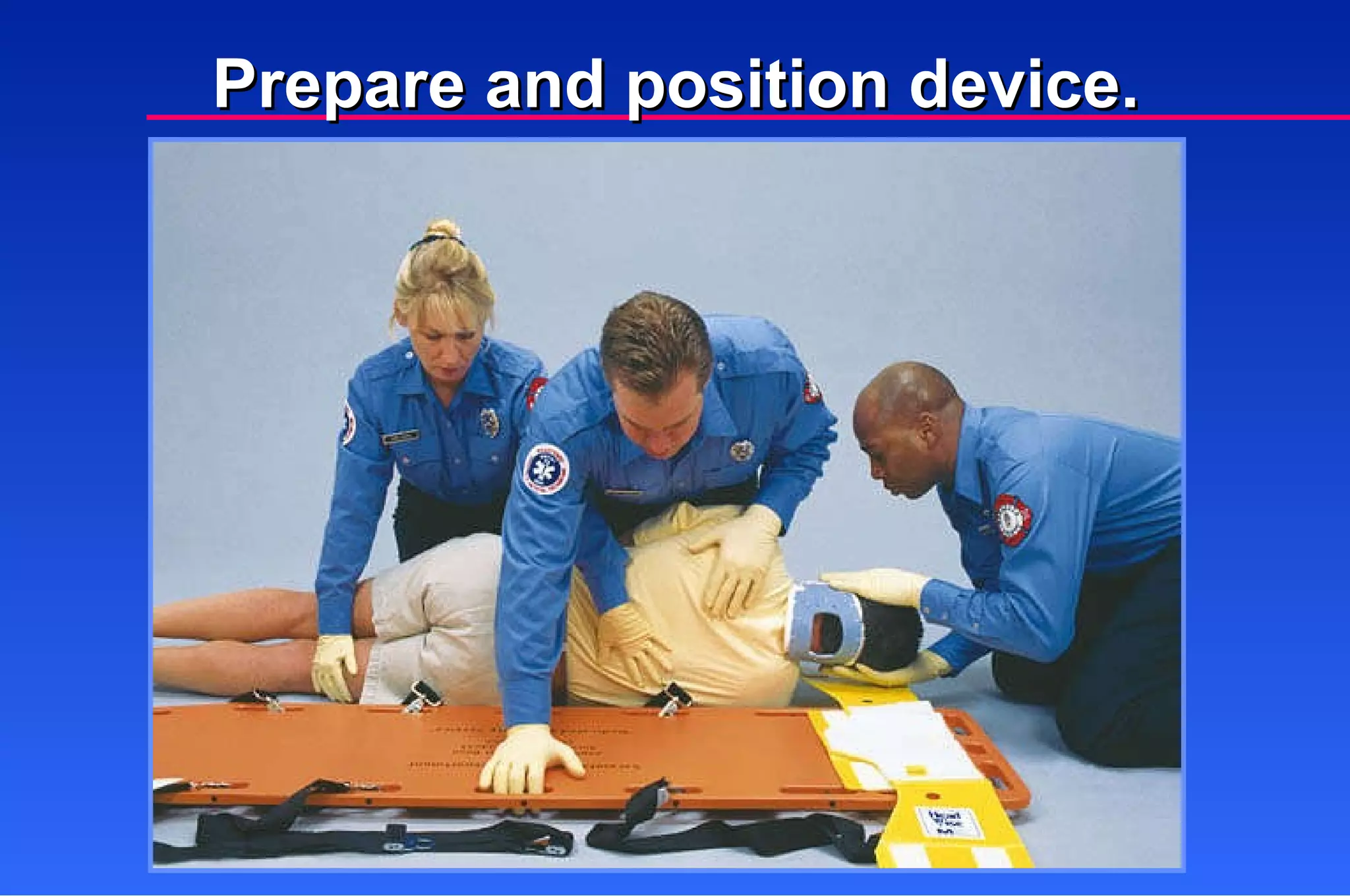
Prepare and position device.
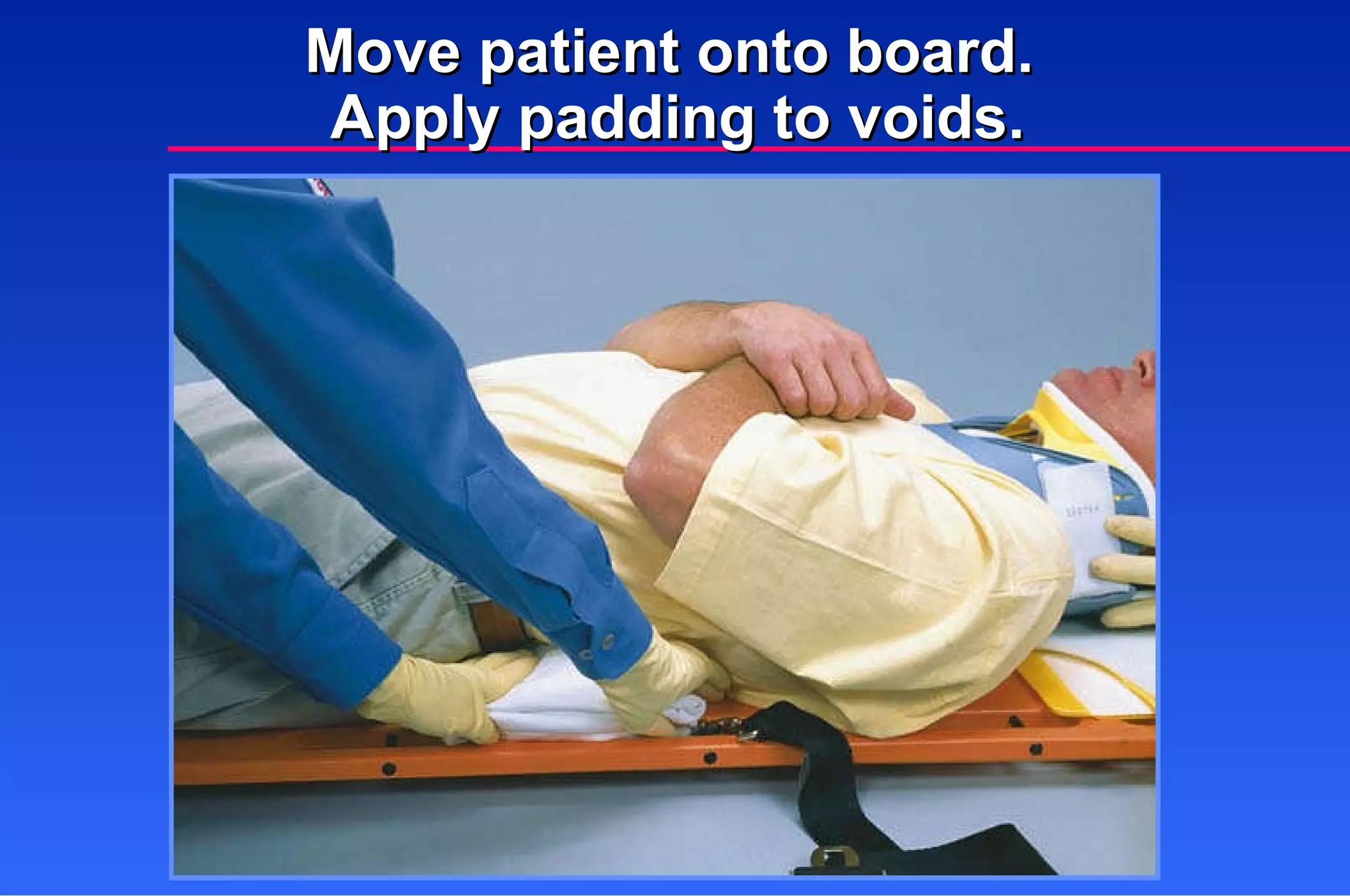
Move patient onto board.  Apply padding to voids.
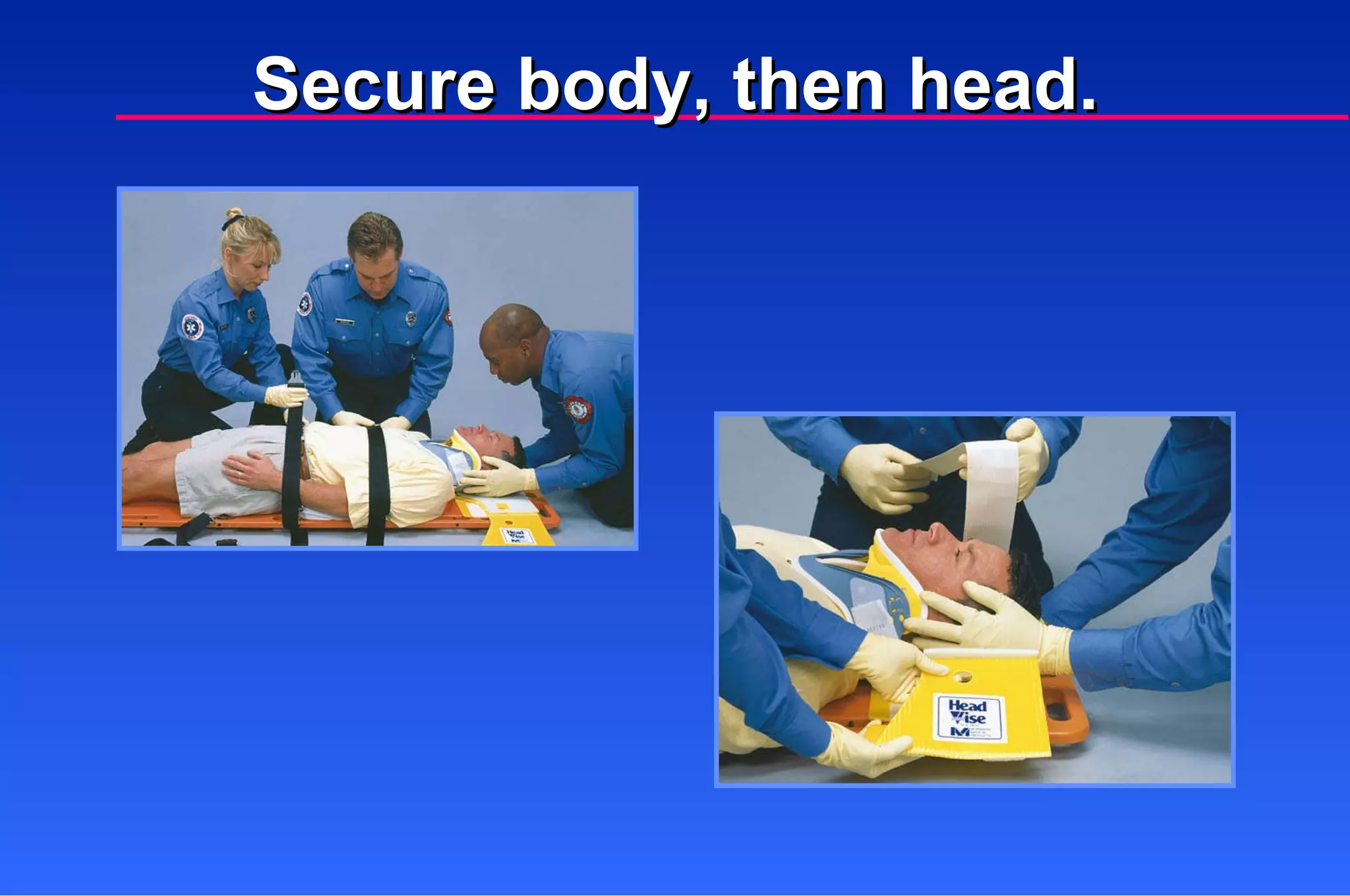
Secure body, then head.
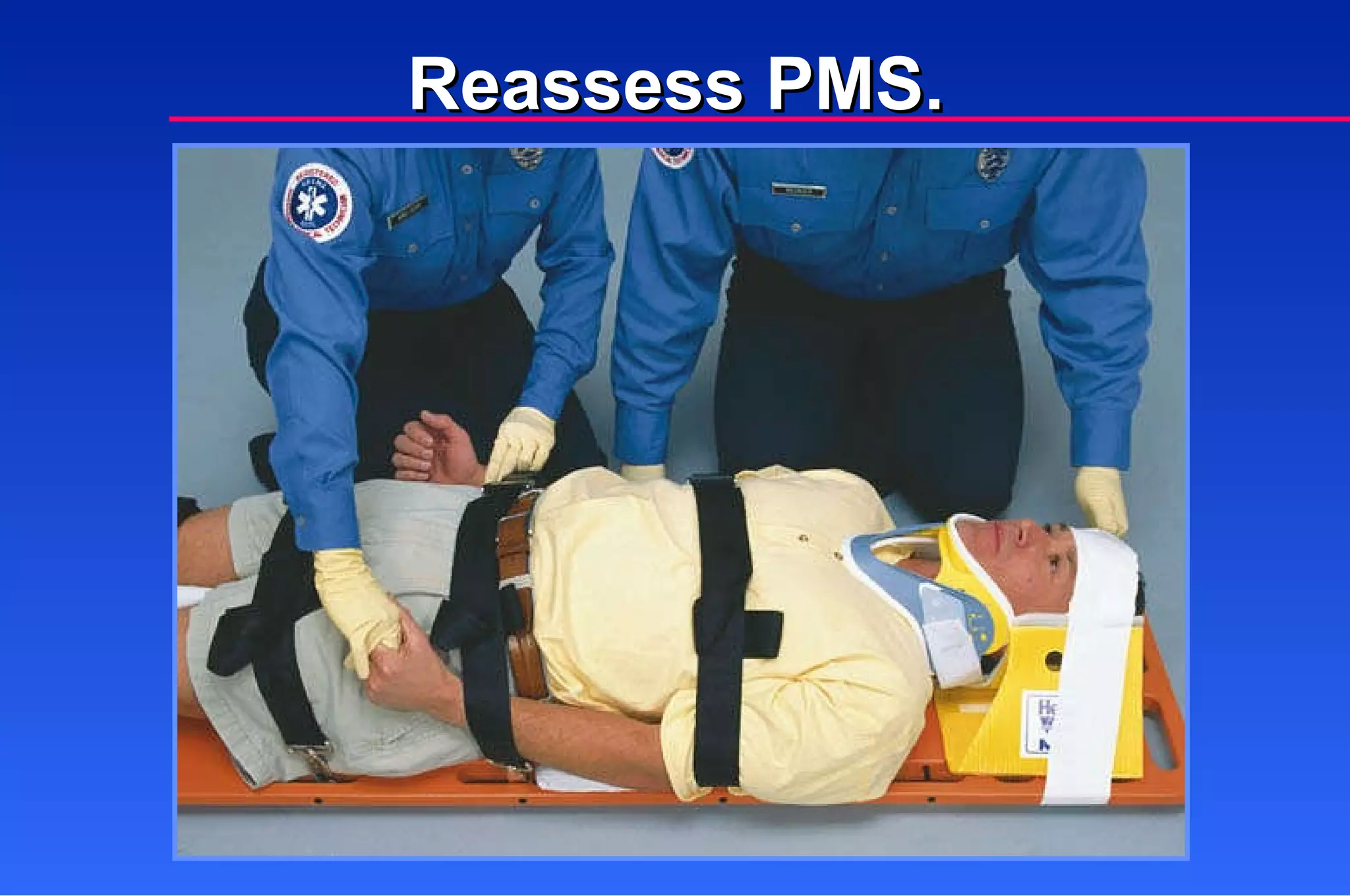
Reassess PMS.
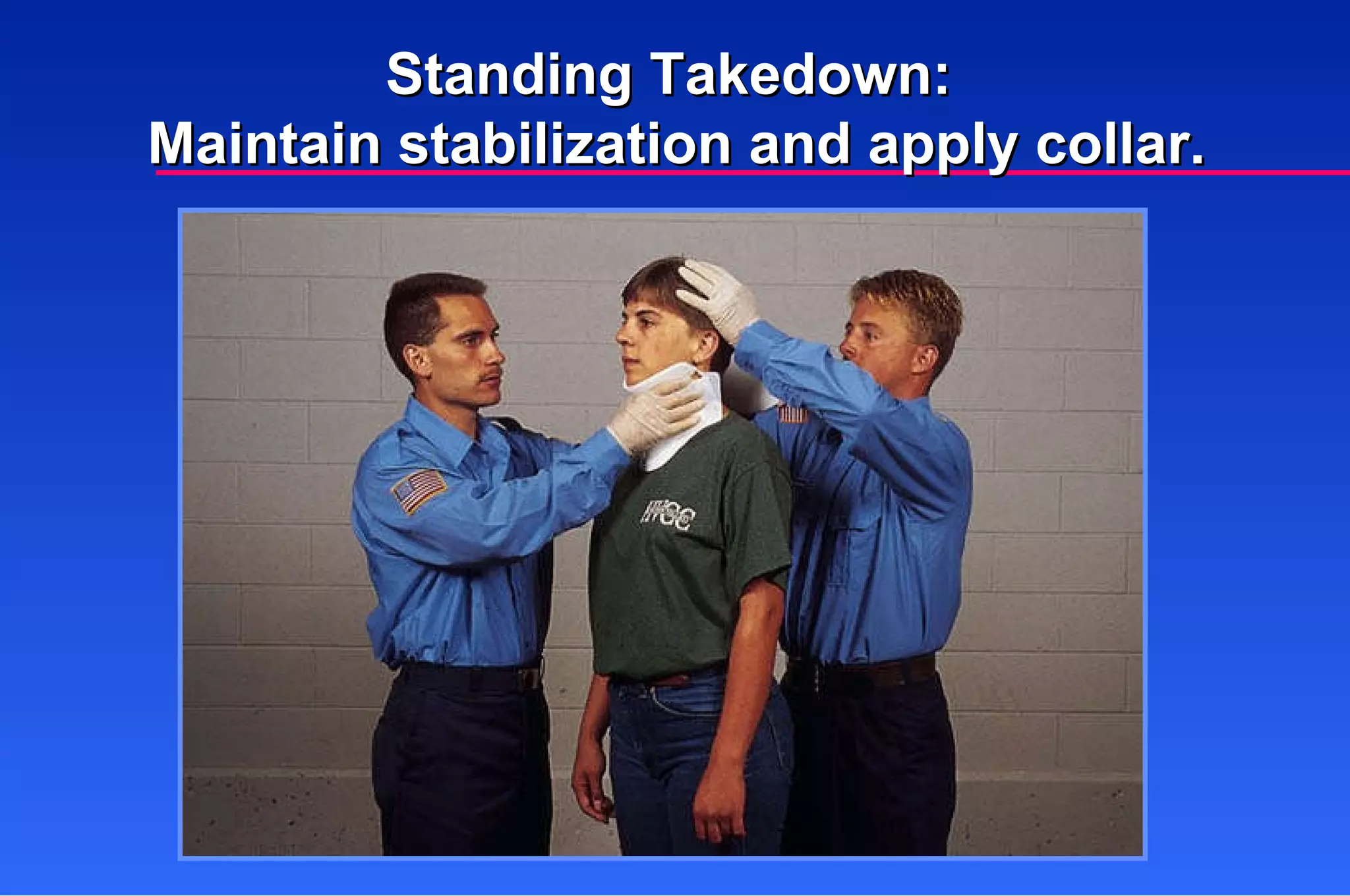
Standing Takedown:  Maintain stabilization and apply collar.
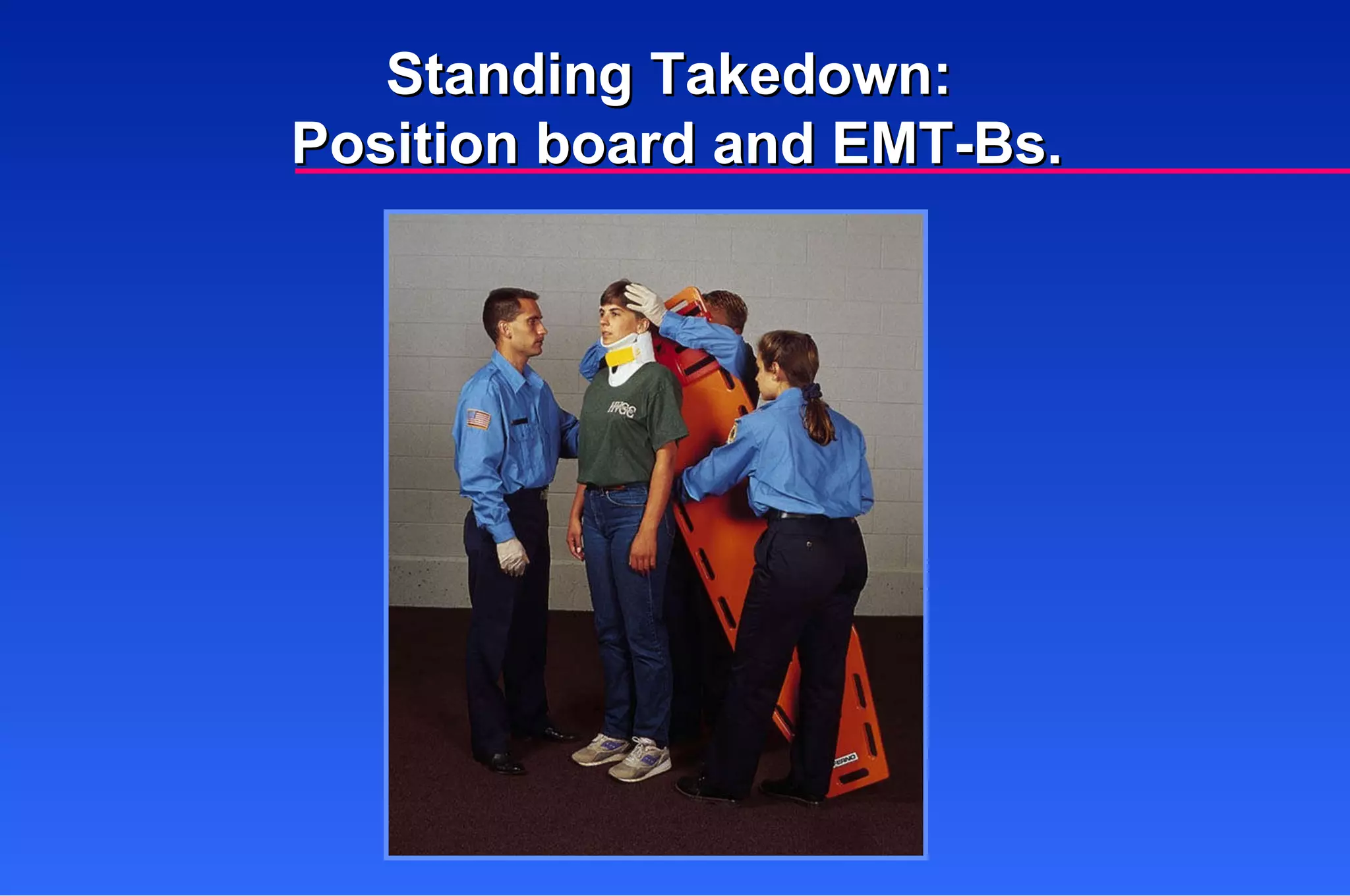
Standing Takedown:  Position board and EMT-Bs.
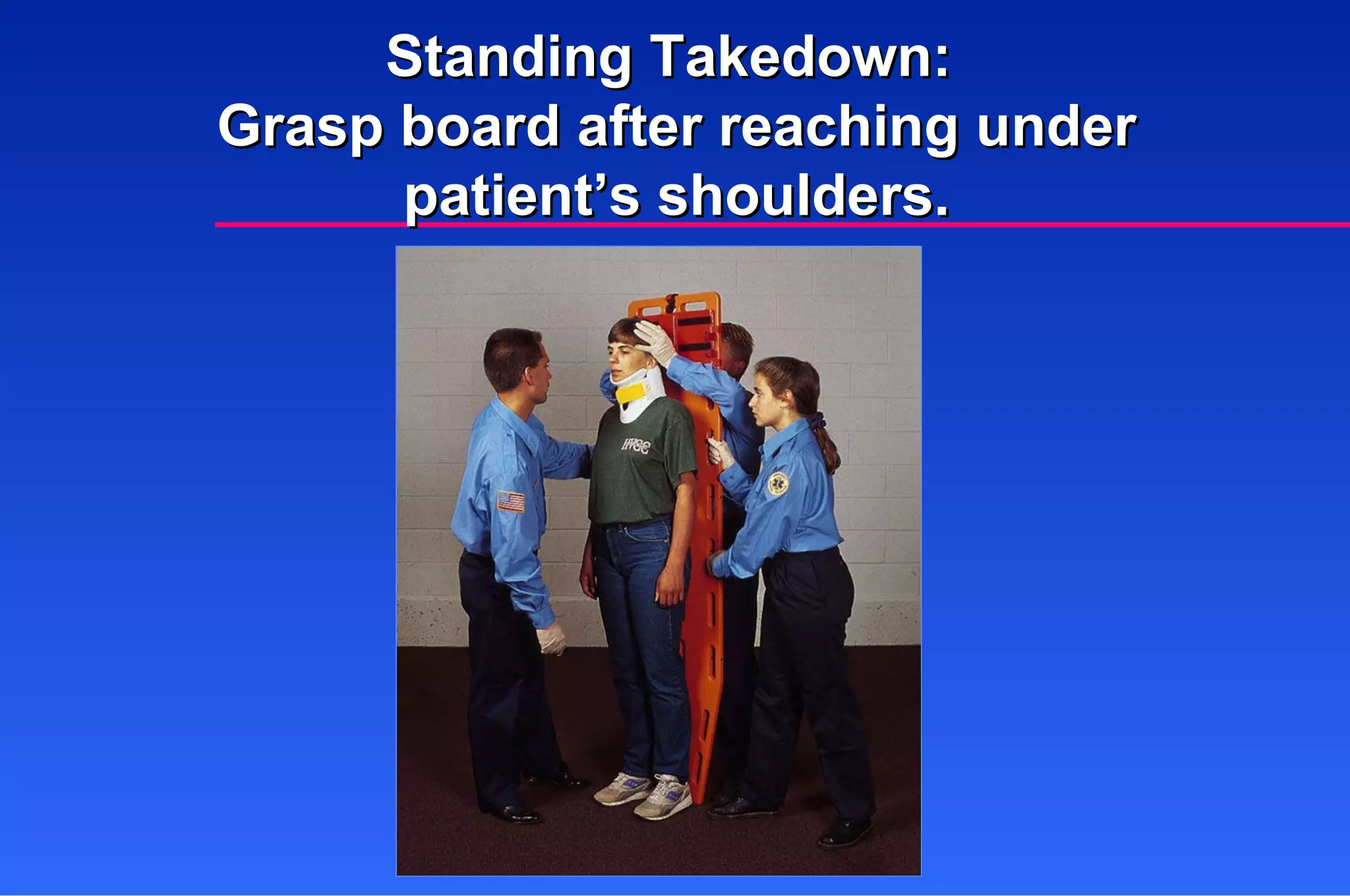
Standing Takedown:  Grasp board after reaching under patient’s shoulders.
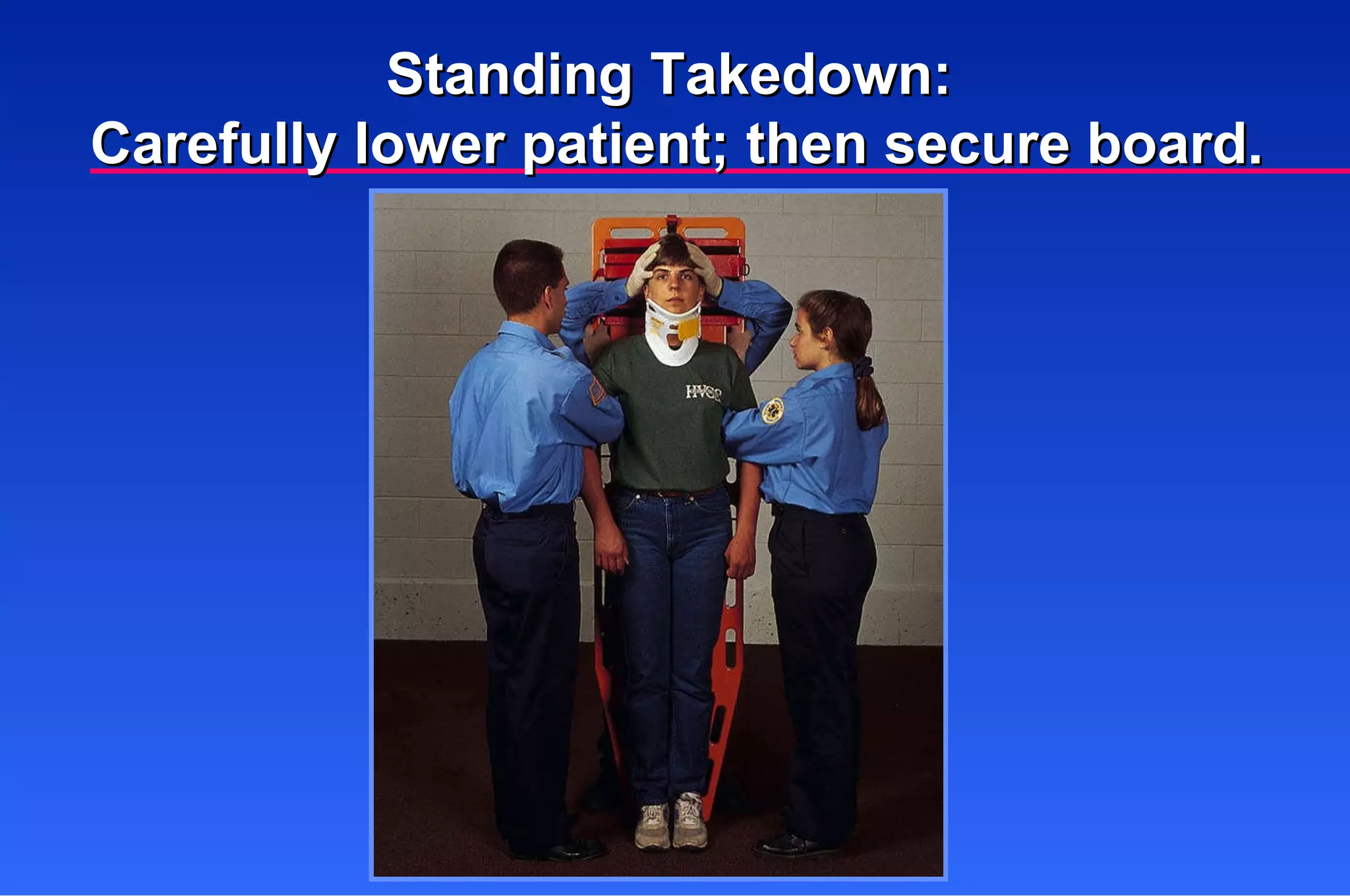
Standing Takedown:  Carefully lower patient; then secure board.
Unsafe scene Unstable patient condition Patient blocks EMT-B’s Indications access to an unstable patient (Continued) Rapid Extrication
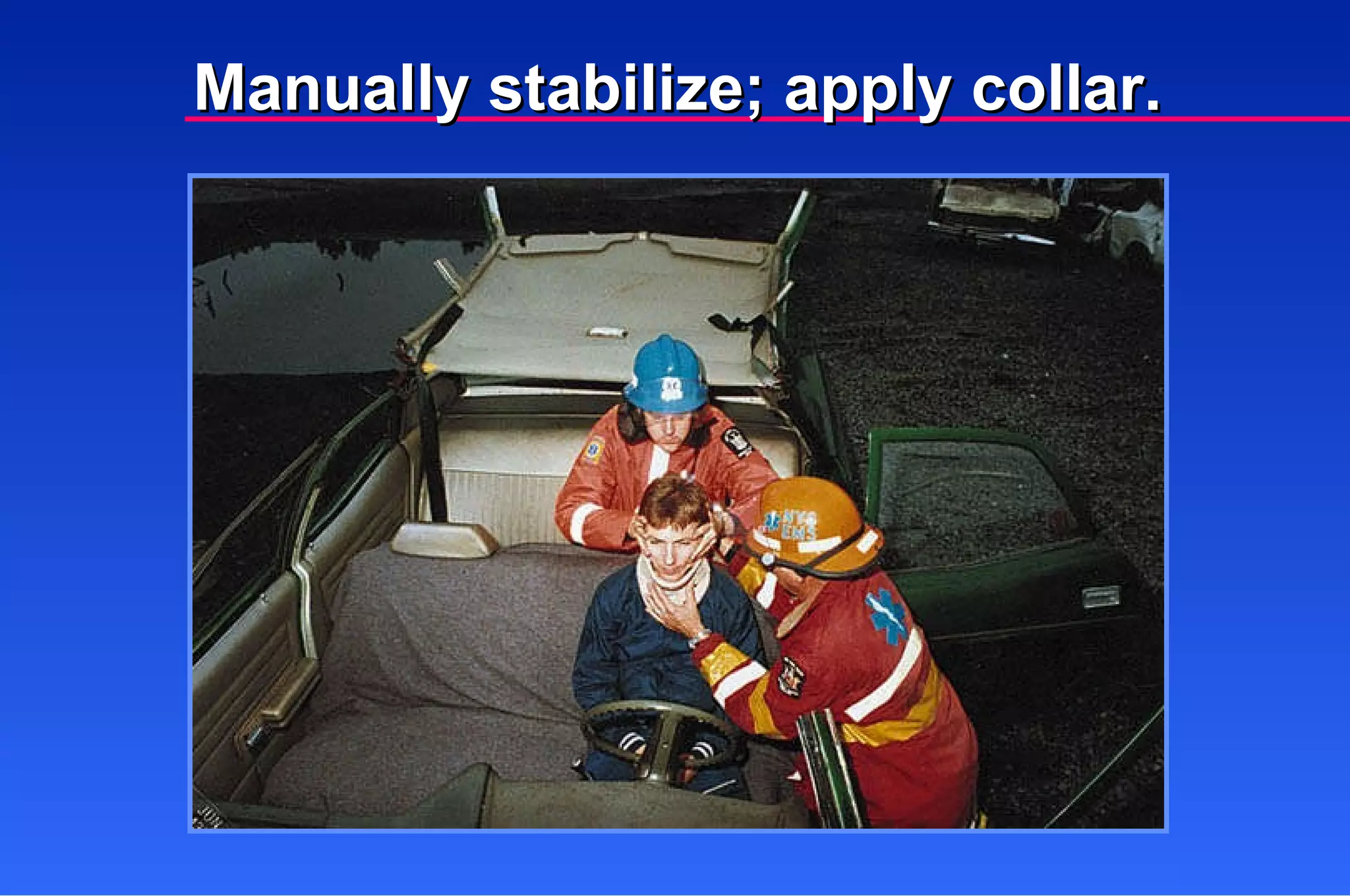
Manually stabilize; apply collar.
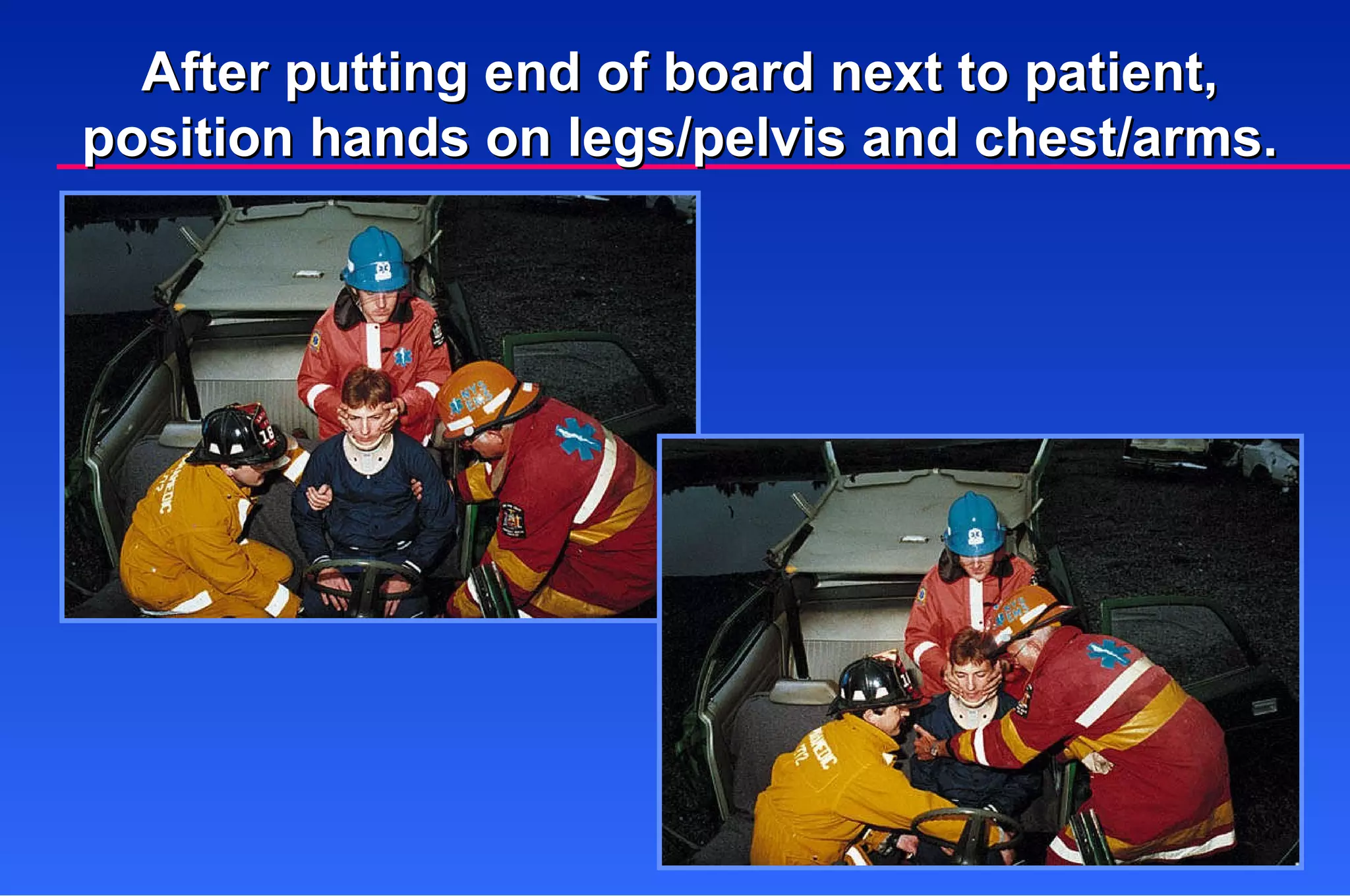
After putting end of board next to patient, position hands on legs/pelvis and chest/arms.
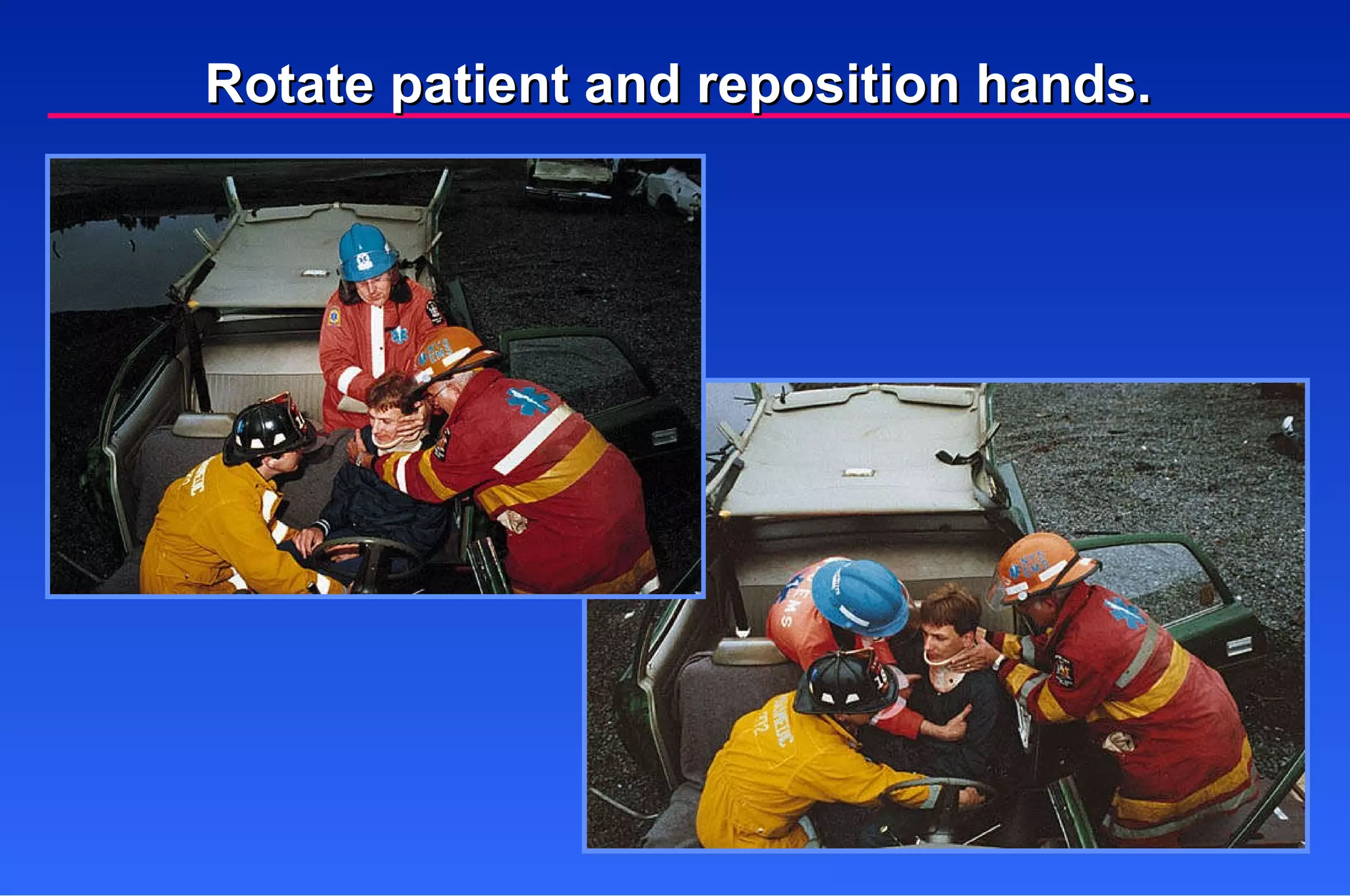
Rotate patient and reposition hands.
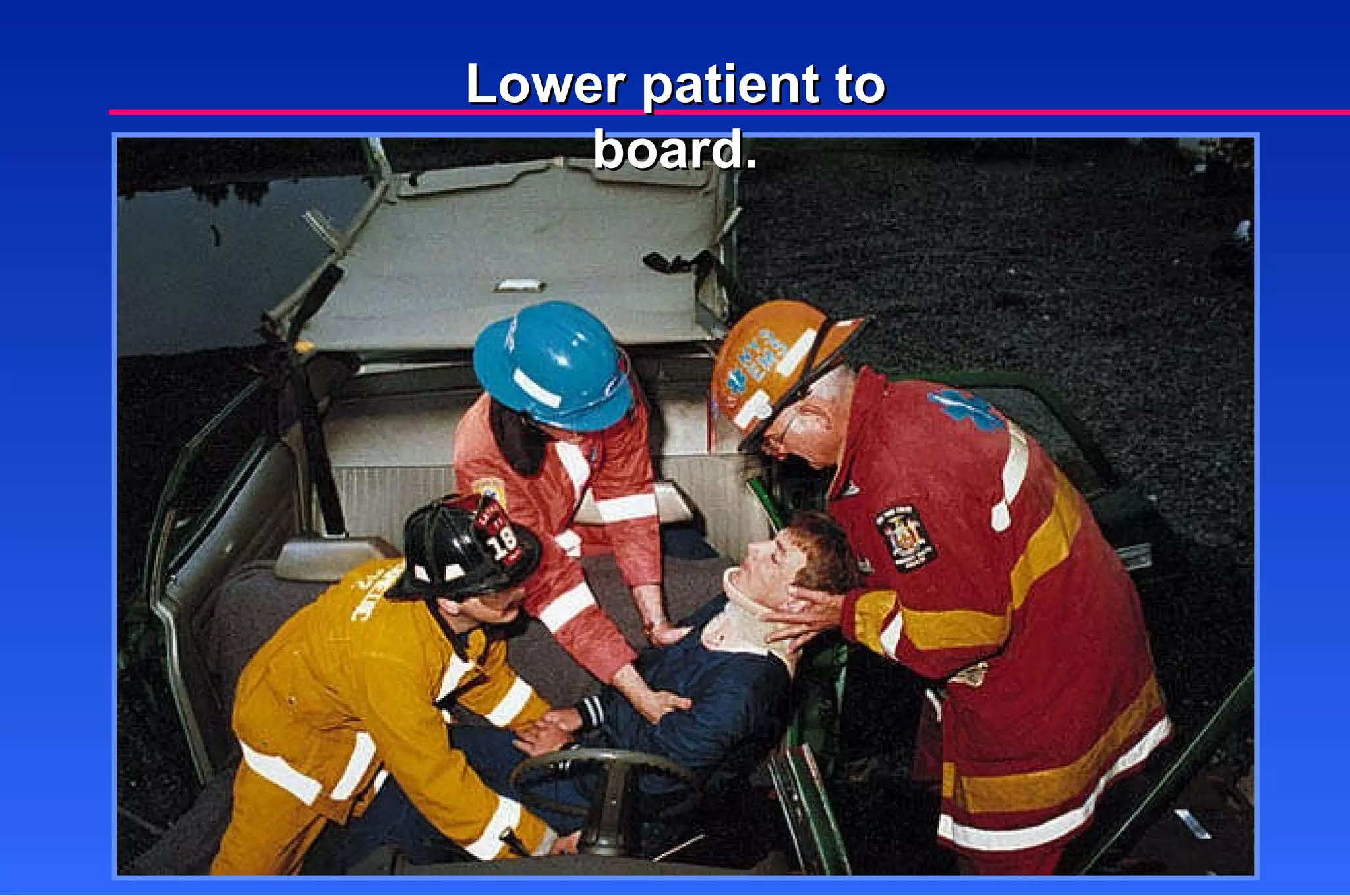
Lower patient to board.
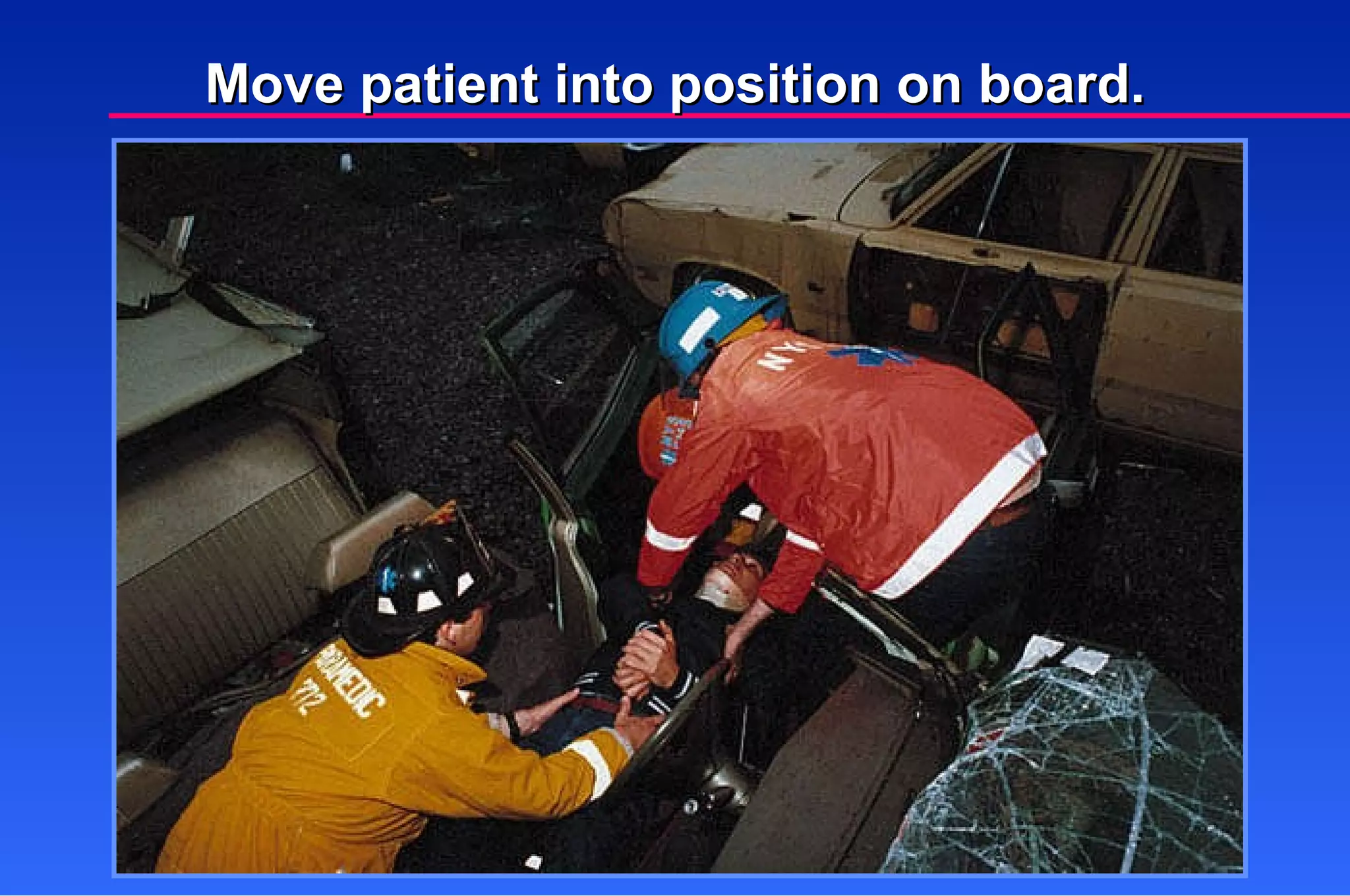
Move patient into position on board.
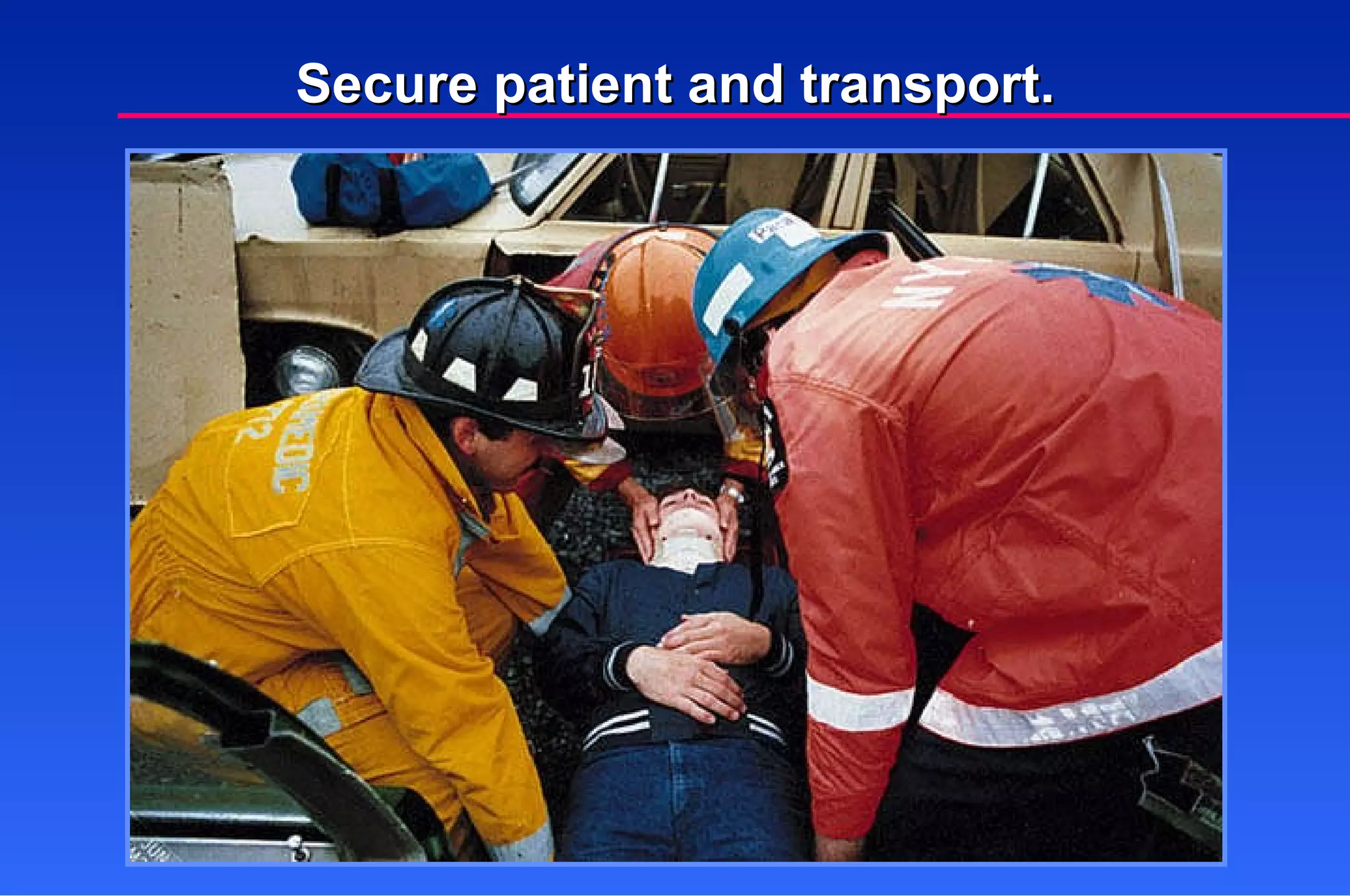
Secure patient and transport.
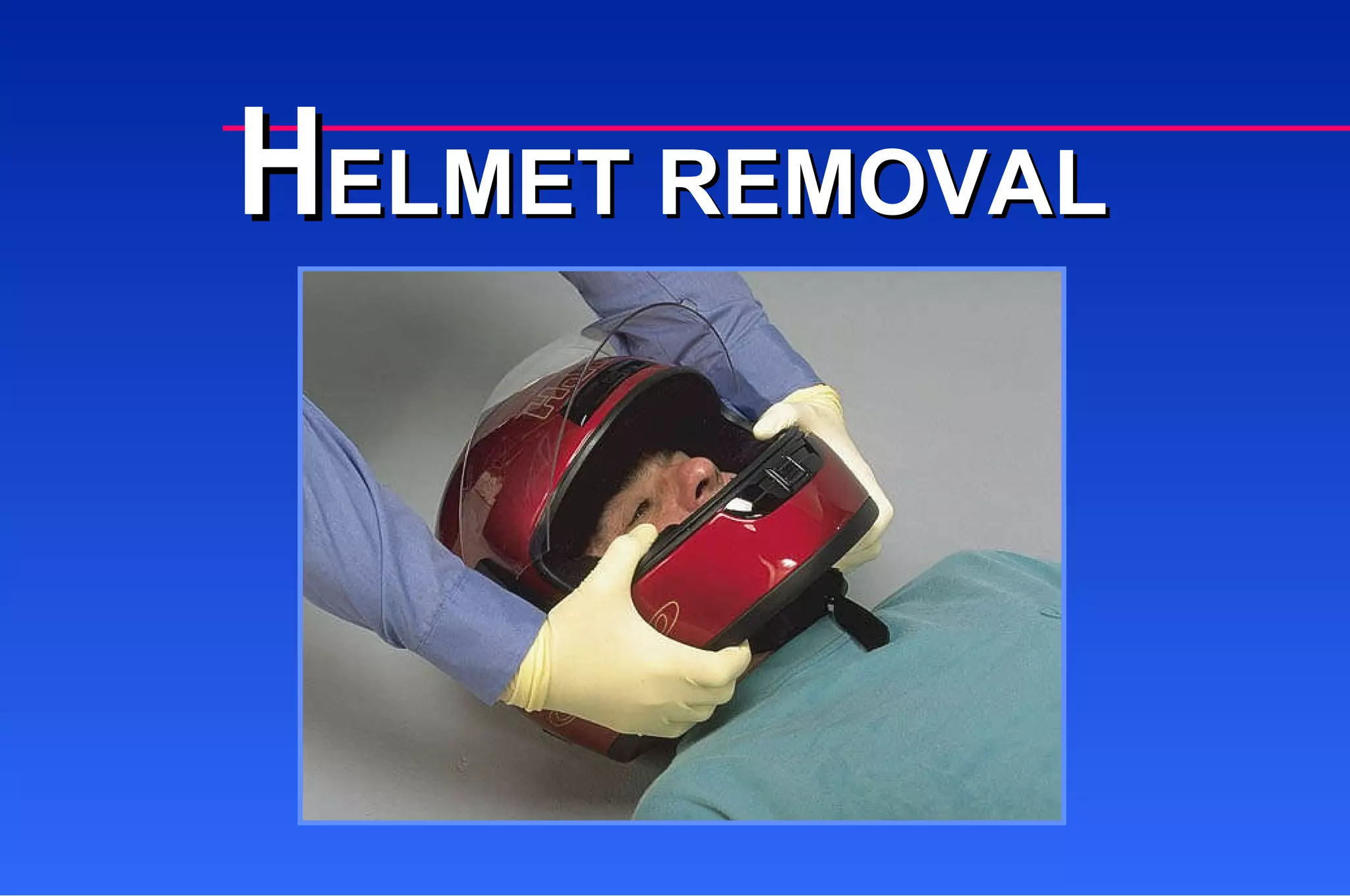
H ELMET REMOVAL
Patient  ASSESSMENT Helmet Removal Signs and Symptoms Decision to remove helmet is Airway and breathing concerns Fit of helmet, movement within helmet Access for airway and ventilation based on:
Good fit, little movement. No current or expected  airway problems. Removal would cause further injury. Indications to Leave Helmet in Place (Continued)
Proper immobilization may be performed. No interference with ongoing assessment. Indications to Leave Helmet in Place
Inability to assess or treat airway and breathing Improper fit/movement within helmet Indications for Removing Helmet (Continued)
Inability to immobilize spine Cardiac arrest Indications for Removing Helmet
Tell new EMT-Bs that many EMS providers put the controversy of helmet removal vs. nonremoval into the following perspective:  If your child’s neck was injured in a football accident, would you want the trainer and the EMT-B to remove the helmet at the scene or would you prefer that this be left to the emergency department staff, who probably will not have the assistance of the trainer or the benefit of frequent practice in the helmet removal technique?  P RECEPTOR  P EARL
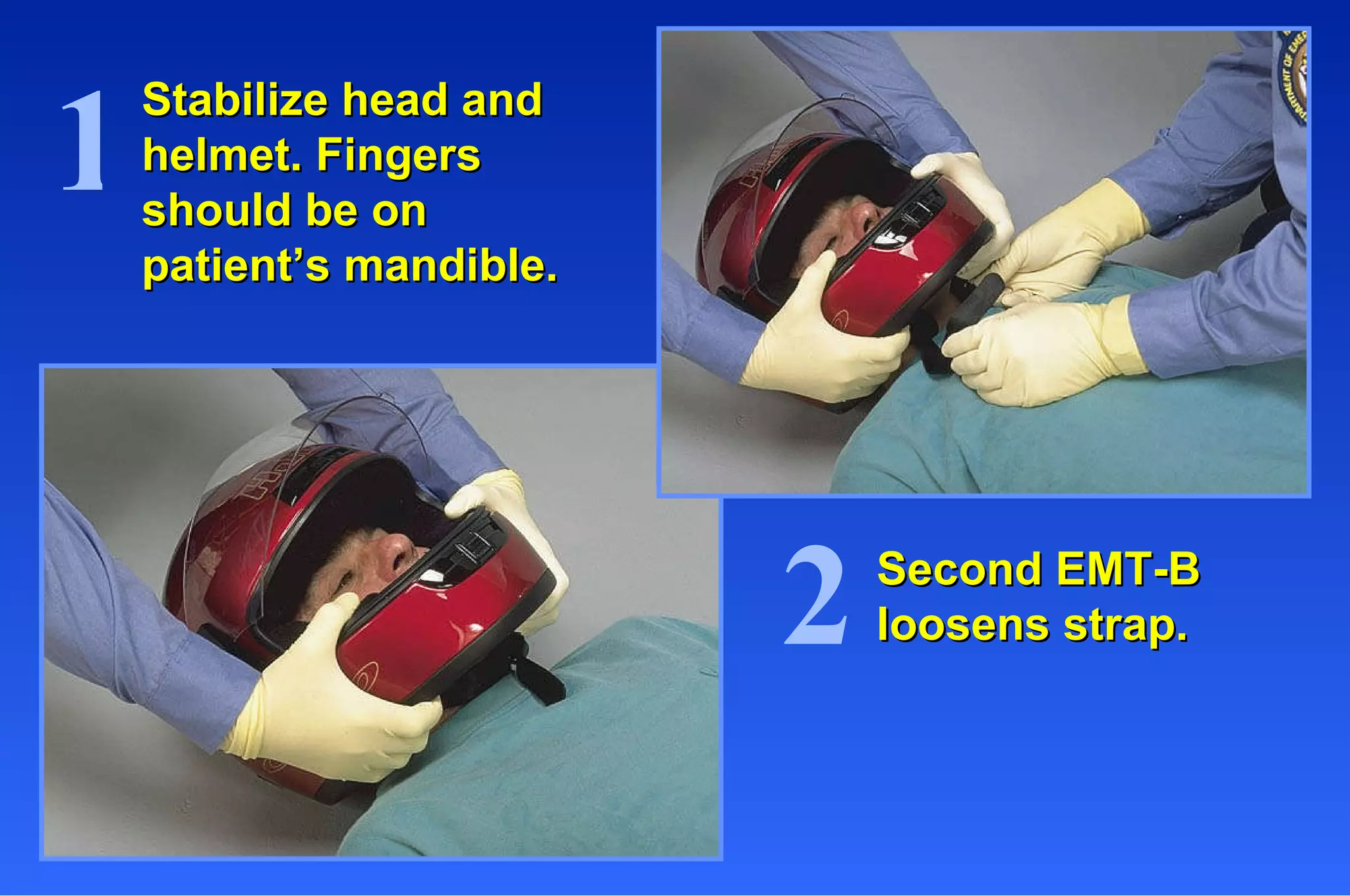
Stabilize head and  helmet. Fingers  should be on  patient’s mandible. Second EMT-B  loosens strap. 1 2
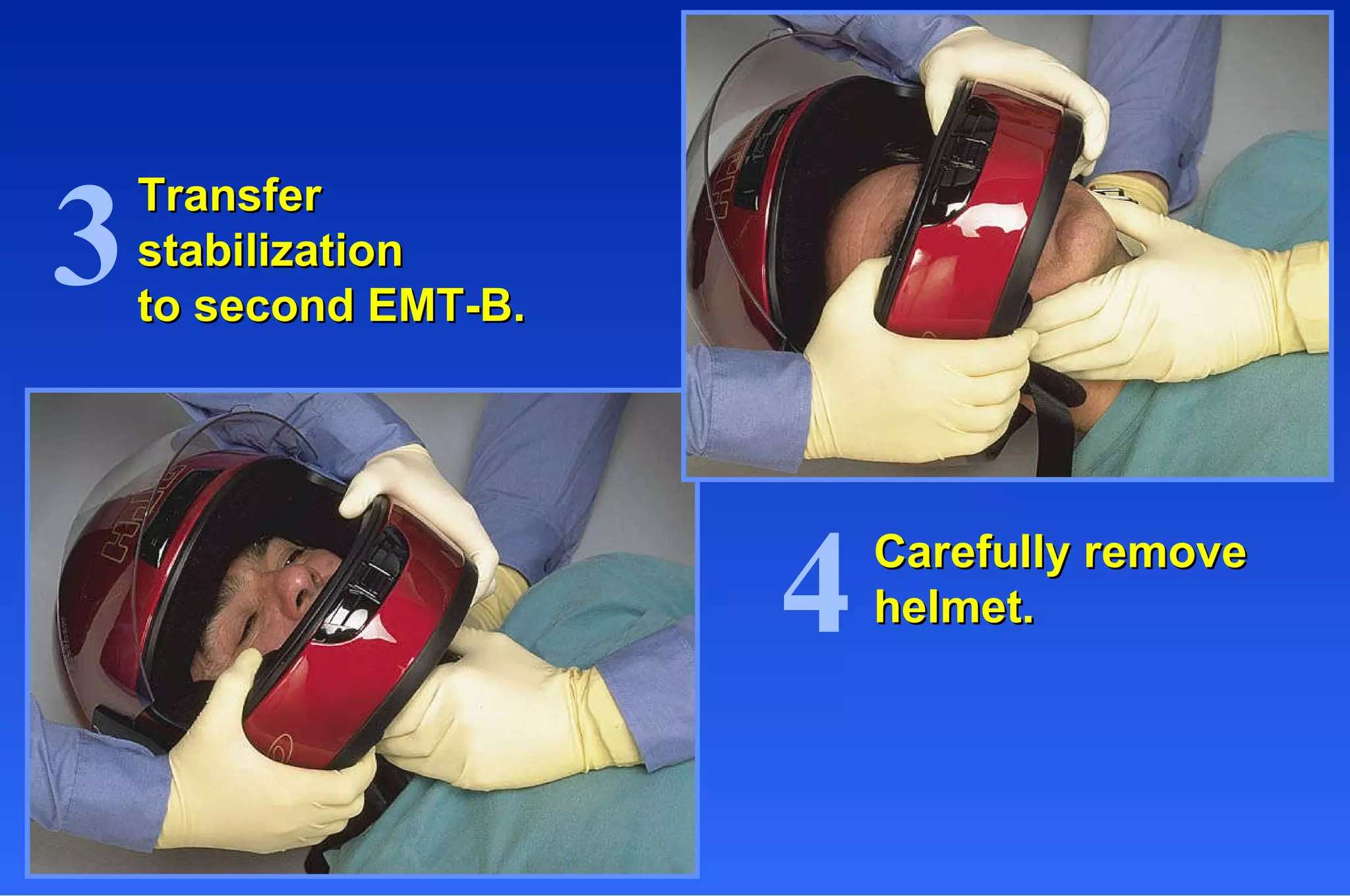
Transfer stabilization to second EMT-B. Carefully remove helmet. 3 4
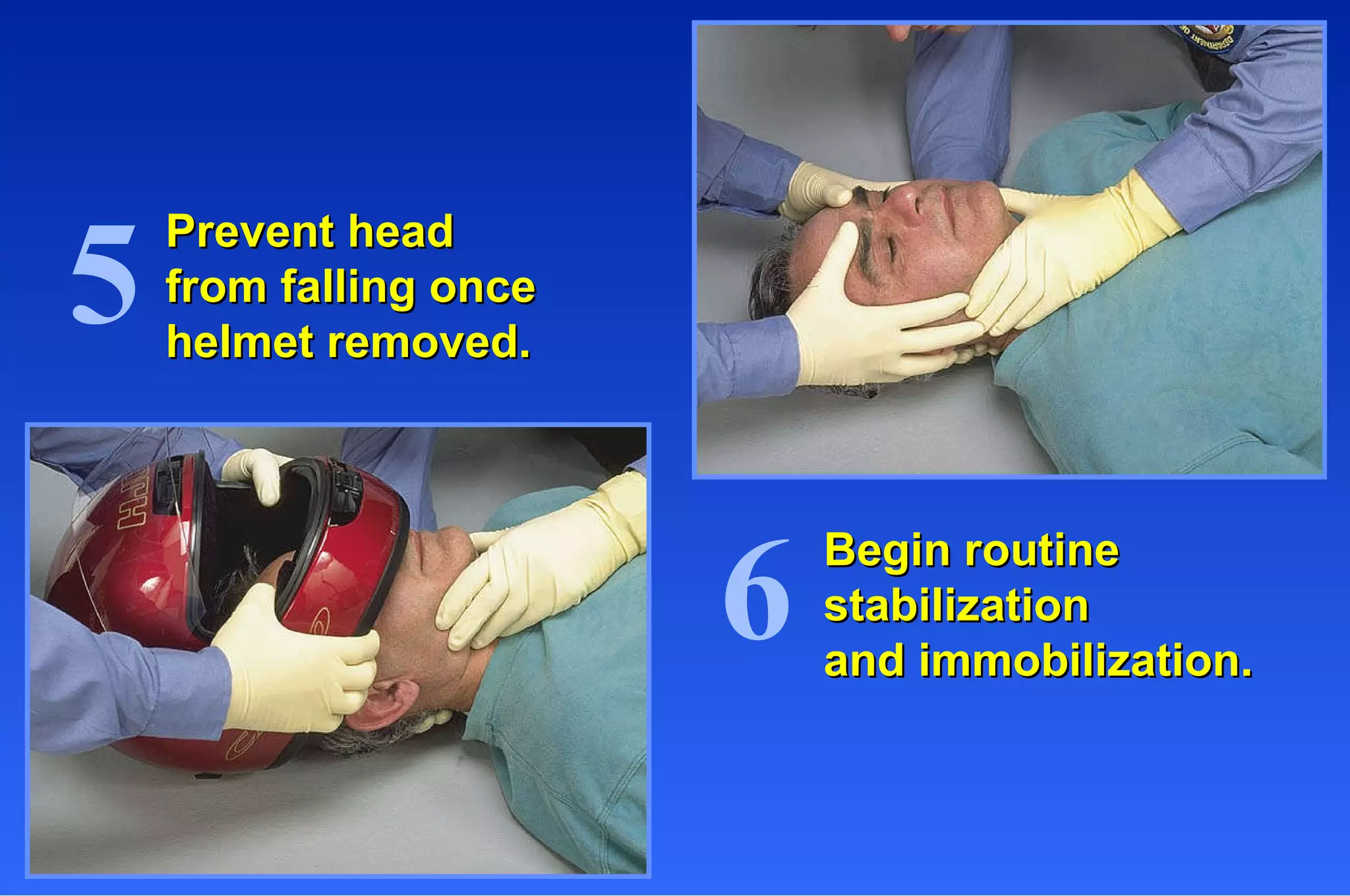
Prevent head from falling once  helmet removed. Begin routine  stabilization and immobilization. 5 6
Immobilizing a Child  in or Out of Car Seat The car seat is a good place to    immobilize the child. The child will need to be “rapid   extricated” out of the seat if it becomes    necessary to lay the child down in    management.
1. Describe the mechanisms of head and   spinal injury. 2. When should rapid extrication be used? 3. Describe the steps in helmet removal. 4. When is it appropriate to remove a child   from a car seat as opposed to    immobilizing the child in the seat? R EVIEW QUESTIONS

Injuries to the Head and Spine

  • 1.
    Chapter Injuries tothe Head and Spine Twenty-Four
  • 2.
    Chapter Mechanism ofhead and spine injury How to stabilize the cervical spine Proper application of a cervical spine immobilization device for patients found standing, seated, or supine How and when to do rapid extrication Procedures for helmet removal Proper immobilization of child in car seat Twenty-Four CORE CONCEPTS
  • 3.
  • 4.
  • 5.
    Anatomy Review: Skulland Facial Bones
  • 6.
    Bone Dura materArachnoid Pia mater Subarachnoid space Subdural space Intracerebral Dura mater Arachnoid Skull Pia mater Contents of the Skull Epidural space (potential)
  • 7.
    I NJURIES TOTHE HEAD
  • 8.
    Soft tissue injuriesmay Injuries to brain cause internal bleed profusely. bleeding and increased intracranial pressure. Head Injuries Overview
  • 9.
    Direct Occurs when the brain is lacerated, punctured, or bruised by the broken bones of the skull, by bone fragments, or by foreign objects. Brain Injury Indirect Can be the result of closed injuries to the skull and certain types of open skull injuries.
  • 10.
    May occur dueto clot Can cause altered mental status. or hemorrhage. Signs and symptoms are similar to traumatic injury (but no trauma) . Brain Injury Nontraumatic
  • 11.
    Patient ASSESSMENTHead Injury Signs and Symptoms Altered or decreased mental status Irregular breathing patterns Mechanism of injury present (Continued)
  • 12.
    Patient ASSESSMENTHead Injury Signs and Symptoms Contusions, lacerations, or hematomas Deformity of skull Blood/fluid from ears or nose Bruising around eyes, behind ears (Continued)
  • 13.
    Patient ASSESSMENTHead Injury Signs and Symptoms Neurologic disability Nausea and/or vomiting Unequal pupil size with altered mental status Seizures
  • 14.
    Patient CAREHead Injury Emergency Care Steps Body substance isolation Airway, ventilation, oxygen Initial assessment with C-spine stabilization (Continued)
  • 15.
    Patient CAREHead Injury Emergency Care Steps Complete assessment. Immobilize spine. Monitor airway, breathing, pulse, mental status closely. (Continued)
  • 16.
    Patient CAREHead Injury Emergency Care Steps Control bleeding. Do not apply pressure to open or depressed skull injury. Dress and bandage wound. (Continued)
  • 17.
    Patient CAREHead Injury Emergency Care Steps Be prepared for changes in Transport immediately. Monitor vital signs every 5 minutes patient condition. en route.
  • 18.
    Tell new EMT-Bsthat an epidural hematoma is often associated with severe blows to the temporal regions of the head. If they recognize an epidural hematoma in its early stages and promptly transport the patient to a trauma center, it can make the difference between life and death. Tell them to be aggressive if they suspect an epidural hematoma may be developing. P RECEPTOR P EARL
  • 19.
    I NJURIES TO THE SPINE
  • 20.
    Motor vehicle crashesAuto-pedestrian collisions Falls Blunt or penetrating trauma Motorcycle crashes Hangings Diving accidents Unconscious trauma patients Mechanisms of Spinal Injury
  • 21.
  • 22.
  • 23.
    Tell new EMT-Bsthat as a rule of thumb, they should assume any fall three times the patient’s height or with enough force to cause open PSDEs to the ankles will also be accompanied by a spine injury. P RECEPTOR P EARL
  • 24.
    Compression Distraction (pulling apart) Lateral bending Flexion, rotation, extension Types of Spinal Injuries
  • 25.
    Patient ASSESSMENTSpinal Injury Signs and Symptoms Pain and tenderness Deformity of spine upon palpation Numbness, weakness, or tingling in extremities (Continued)
  • 26.
    Patient ASSESSMENTSpinal Injury Signs and Symptoms Pain upon movement: Never move or allow a patient to move in order to elicit a pain response. (Continued)
  • 27.
    Patient ASSESSMENTSpinal Injury Signs and Symptoms Loss of sensation or paralysis In extremities Below level of injury (Continued)
  • 28.
    Patient ASSESSMENTSpinal Injury Signs and Symptoms (Continued) Impaired breathing: “ C-3, -4, -5 keep the diaphragm alive”
  • 29.
    Patient ASSESSMENTSpinal Injury Signs and Symptoms Soft-tissue injuries associated with trauma Incontinence (Continued) Priapism
  • 30.
    Patient ASSESSMENTSpinal Injury Signs and Symptoms Instruct the patient not to move. Stabilize cervical spine during initial assessment. Evaluate mechanism of injury. (Continued)
  • 31.
    Patient ASSESSMENTSpinal Injury Signs and Symptoms Ask: What happened? Where does it hurt? Does your neck or back hurt? (Continued)
  • 32.
    Patient ASSESSMENTSpinal Injury Signs and Symptoms Ask: Can you move your hands and feet? Can you feel me touching your fingers? Toes?
  • 33.
    Assess sensation inall extremities.
  • 34.
  • 35.
  • 36.
    Patient ASSESSMENTSpinal Injury Signs and Symptoms Inspect. Palpate. Assess strength of extremities. Complications of spinal injury: May cause paralysis. May affect respiratory effort.
  • 37.
    Patient CARESpinal Injury Emergency Care Steps Use BSI procedures. Maintain in-line stabilization. Care for airway with in-line stabilization when possible.
  • 38.
    Patient CAREBreathing Adequacy Emergency Care Steps Assess pulse, movement, and sensation in extremities. Assess the neck and spine. Administer oxygen via nonrebreather mask.
  • 39.
    Patient CARESpinal Injury Emergency Care Steps Apply properly sized cervical spine immobilization device. Apply and secure patient to appropriate immobilization device. (Continued)
  • 40.
    Patient CARESpinal Injury Emergency Care Steps If proper size collar is not available, use rolled towel and tape. Pad around child as necessary to maintain stabilization.
  • 41.
  • 42.
  • 43.
  • 44.
  • 45.
  • 46.
    Secure collar; maintainin-line position.
  • 47.
    Vest type Rigidshort spine board. Stabilize head, neck, torso. Used for noncritical, seated patient. (Continued) Short Spine Boards
  • 48.
  • 49.
    Manually stabilize patient’s head in neutral, in-line position. Assess distal pulse, motor function, and sensation (PMS).
  • 50.
    Apply the appropriately sized extrication collar. Position device behind patient.
  • 51.
    Secure device topatient’s torso. Evaluate and pad behind patient’s head as necessary. Secure patient’s head to device.
  • 52.
    Evaluate and adjuststraps. As needed, secure patient’s wrists and legs.
  • 53.
    Stabilize head, neck,torso, pelvis, and extremities. May be applied in: Lying, standing, and sitting positions Conjunction with short spine boards (Continued) Long Spine Boards
  • 54.
  • 55.
  • 56.
    Move patient ontoboard. Apply padding to voids.
  • 57.
  • 58.
  • 59.
    Standing Takedown: Maintain stabilization and apply collar.
  • 60.
    Standing Takedown: Position board and EMT-Bs.
  • 61.
    Standing Takedown: Grasp board after reaching under patient’s shoulders.
  • 62.
    Standing Takedown: Carefully lower patient; then secure board.
  • 63.
    Unsafe scene Unstablepatient condition Patient blocks EMT-B’s Indications access to an unstable patient (Continued) Rapid Extrication
  • 64.
  • 65.
    After putting endof board next to patient, position hands on legs/pelvis and chest/arms.
  • 66.
    Rotate patient andreposition hands.
  • 67.
  • 68.
    Move patient intoposition on board.
  • 69.
  • 70.
  • 71.
    Patient ASSESSMENTHelmet Removal Signs and Symptoms Decision to remove helmet is Airway and breathing concerns Fit of helmet, movement within helmet Access for airway and ventilation based on:
  • 72.
    Good fit, littlemovement. No current or expected airway problems. Removal would cause further injury. Indications to Leave Helmet in Place (Continued)
  • 73.
    Proper immobilization maybe performed. No interference with ongoing assessment. Indications to Leave Helmet in Place
  • 74.
    Inability to assessor treat airway and breathing Improper fit/movement within helmet Indications for Removing Helmet (Continued)
  • 75.
    Inability to immobilizespine Cardiac arrest Indications for Removing Helmet
  • 76.
    Tell new EMT-Bsthat many EMS providers put the controversy of helmet removal vs. nonremoval into the following perspective: If your child’s neck was injured in a football accident, would you want the trainer and the EMT-B to remove the helmet at the scene or would you prefer that this be left to the emergency department staff, who probably will not have the assistance of the trainer or the benefit of frequent practice in the helmet removal technique? P RECEPTOR P EARL
  • 77.
    Stabilize head and helmet. Fingers should be on patient’s mandible. Second EMT-B loosens strap. 1 2
  • 78.
    Transfer stabilization tosecond EMT-B. Carefully remove helmet. 3 4
  • 79.
    Prevent head fromfalling once helmet removed. Begin routine stabilization and immobilization. 5 6
  • 80.
    Immobilizing a Child in or Out of Car Seat The car seat is a good place to immobilize the child. The child will need to be “rapid extricated” out of the seat if it becomes necessary to lay the child down in management.
  • 81.
    1. Describe themechanisms of head and spinal injury. 2. When should rapid extrication be used? 3. Describe the steps in helmet removal. 4. When is it appropriate to remove a child from a car seat as opposed to immobilizing the child in the seat? R EVIEW QUESTIONS