


Sources for Technical Know –howSources for Technical Know –how
- Focus on Plastics Industries- Focus on Plastics Industries
Dr. K. Padmanabhan FIIPE, FIEDr. K. Padmanabhan FIIPE, FIE
ProfessorProfessor
Mechanical EngineeringMechanical Engineering
SVCE, Sri PerumbudurSVCE, Sri Perumbudur
ContentsContents
 Plastics, Classifications, ConsumptionPlastics, Classifications, Consumption
 Important Properties:Important Properties: Designer, Manufacturer, CustomerDesigner, Manufacturer, Customer
 Materials and Manufacturing MethodsMaterials and Manufacturing Methods
 Strategies for ImprovementStrategies for Improvement
 Basic EconomicsBasic Economics
 High Flying Projects- Case StudiesHigh Flying Projects- Case Studies
 TANSTIA FNF Service CentreTANSTIA FNF Service Centre
ProductsProducts
 Consumer ProductsConsumer Products
 Engineering ProductsEngineering Products
Metal based productsMetal based products
Ceramic based productsCeramic based products
Polymer based productsPolymer based products
Polymer and PlasticPolymer and Plastic
 A Plastic should be aA Plastic should be a
Solid in finished formSolid in finished form
Should be organic in structureShould be organic in structure
Must have been capable of flow atMust have been capable of flow at
some stage in processingsome stage in processing
(ASTM Definition)(ASTM Definition)
Focus on PlasticsFocus on Plastics
 Plastics and Reinforced PlasticsPlastics and Reinforced Plastics
 The Rising ImportanceThe Rising Importance
 Present ConsumptionPresent Consumption
 StatisticsStatistics
 ScopeScope
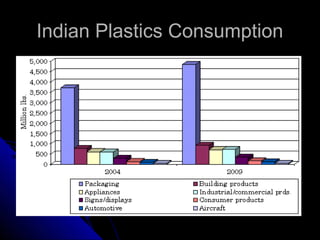
Indian Plastics ConsumptionIndian Plastics Consumption
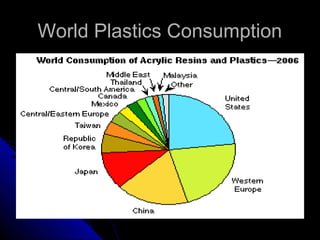
World Plastics ConsumptionWorld Plastics Consumption
Plastic ProductsPlastic Products
 Commodity PlasticsCommodity Plastics
TypesTypes
ApplicationsApplications
Consumption and DemandConsumption and Demand
 Engineering PlasticsEngineering Plastics
TypesTypes
ApplicationsApplications
Consumption and DemandConsumption and Demand
Plastic ProductsPlastic Products
 Properties important to theProperties important to the
DesignerDesigner
ManufacturerManufacturer
Customer/ UserCustomer/ User
Design PropertiesDesign Properties
 Strength, Stiffness, Toughness, Fatigue,Strength, Stiffness, Toughness, Fatigue,
Creep and ImpactCreep and Impact
 Dimensions, Weight, TolerancesDimensions, Weight, Tolerances
 Judicious use of drafts, radii, fillets, webs,Judicious use of drafts, radii, fillets, webs,
ribs, blends, chamfers and curves forribs, blends, chamfers and curves for
specific propertiesspecific properties
 Ease of assembly, disassembly andEase of assembly, disassembly and
serviceservice
 Aesthetics, colouring and texturingAesthetics, colouring and texturing
Manufacturing PropertiesManufacturing Properties
 Forming temperature, Glass transition, MeltingForming temperature, Glass transition, Melting
point, Rate of solidificationpoint, Rate of solidification
 Energy required to form, Whether batch processEnergy required to form, Whether batch process
possible? , Pressure requiredpossible? , Pressure required
 Flow behaviour, Viscosity, Melt flow indexFlow behaviour, Viscosity, Melt flow index
 Mouldability and Castability, WorkabilityMouldability and Castability, Workability
 Fabrication of Complex Parts, TimeFabrication of Complex Parts, Time
 Curing/Solidification Shrinkage in the MouldCuring/Solidification Shrinkage in the Mould
 Materials properties, Availability, ToxicityMaterials properties, Availability, Toxicity
Customer/User RequirementsCustomer/User Requirements
 Quality, Cost, Durability ( low moistureQuality, Cost, Durability ( low moisture
absorption), Reliability ( low degradation ofabsorption), Reliability ( low degradation of
properties with time)properties with time)
 Efficiency : Better properties at lighterEfficiency : Better properties at lighter
weight and less money, Valueweight and less money, Value
 Flexibility : Multi functionalityFlexibility : Multi functionality
 Low maintenance costLow maintenance cost
 Aesthetics, textures in DesignAesthetics, textures in Design
Material CostsMaterial Costs
 An OverviewAn Overview
 Commodity thermoplastics are the cheapest.Commodity thermoplastics are the cheapest.
Commodity thermosets are costlierCommodity thermosets are costlier
 Entry level engineering thermoplastics areEntry level engineering thermoplastics are
cheaper than advanced engineeringcheaper than advanced engineering
thermoplasticsthermoplastics
 High end blends, alloys and IPNs ofHigh end blends, alloys and IPNs of
thermoplastics and thermosets are expensivethermoplastics and thermosets are expensive
( used in aircrafts, marine industry, luxury /sports( used in aircrafts, marine industry, luxury /sports
cars, Sports equipment etc.)cars, Sports equipment etc.)
Manufacturing MethodsManufacturing Methods
 For Plastics and Reinforced PlasticsFor Plastics and Reinforced Plastics
Calendaring, Autoclave vacuum bagging,Calendaring, Autoclave vacuum bagging,
Vacuum resin infusion moulding,Vacuum resin infusion moulding,
Reinforced reaction injection moulding,Reinforced reaction injection moulding,
Casting, Pultrusion, Extrusion, Hand layCasting, Pultrusion, Extrusion, Hand lay
up contact mouldingup contact moulding
Blow MouldingBlow Moulding
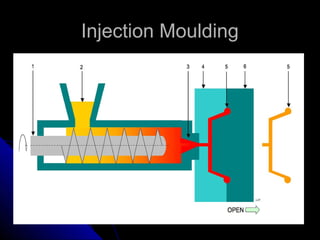
Injection MouldingInjection Moulding
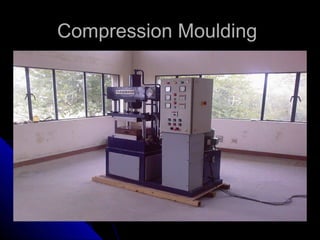
Compression MouldingCompression Moulding
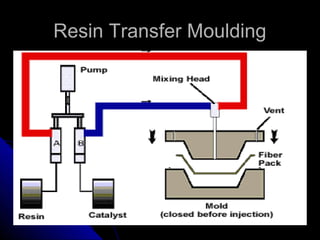
Resin Transfer MouldingResin Transfer Moulding
ThermoformingThermoforming
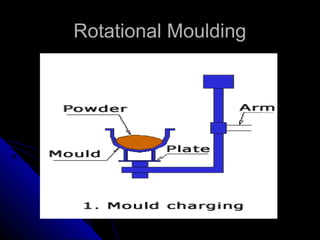
Rotational MouldingRotational Moulding
Relative Margins in ManufacturingRelative Margins in Manufacturing
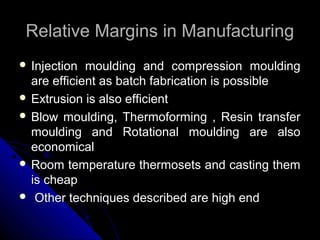
 Injection moulding and compression mouldingInjection moulding and compression moulding
are efficient as batch fabrication is possibleare efficient as batch fabrication is possible
 Extrusion is also efficientExtrusion is also efficient
 Blow moulding, Thermoforming , Resin transferBlow moulding, Thermoforming , Resin transfer
moulding and Rotational moulding are alsomoulding and Rotational moulding are also
economicaleconomical
 Room temperature thermosets and casting themRoom temperature thermosets and casting them
is cheapis cheap
 Other techniques described are high endOther techniques described are high end
Choice of Manufacturing MethodChoice of Manufacturing Method
 Shape, Size, Finish and Design complexityShape, Size, Finish and Design complexity
 Desired mechanical propertiesDesired mechanical properties
 Materials selectionMaterials selection
 Batch processing requirementBatch processing requirement
 Tooling, fixturing requiredTooling, fixturing required
 Cost per pieceCost per piece
 Demand and local availabilityDemand and local availability
 Overall reliability and durability of the methodOverall reliability and durability of the method
 SafetySafety
Plastics and StandardsPlastics and Standards
 Raw Materials, semi finished and finishedRaw Materials, semi finished and finished
materials/productsmaterials/products
 Processes, methodsProcesses, methods
 Testing , specimen dimensionsTesting , specimen dimensions
 Voluntary consensus standards, industryVoluntary consensus standards, industry
standards, company standardsstandards, company standards
 Standards making bodiesStandards making bodies
ASTM, ASC, ISO,BIS,ISI, DIN….ASTM, ASC, ISO,BIS,ISI, DIN….
Design for ManufacturingDesign for Manufacturing
 A practice for designing products, keepingA practice for designing products, keeping
manufacturing in mind.manufacturing in mind.
 Minimise the number of parts through aMinimise the number of parts through a
more compliant designmore compliant design
 Multifunctional partsMultifunctional parts
 Minimize part variationsMinimize part variations
 Ease of handling, assembly and repairEase of handling, assembly and repair
 Optimum design for manufactureOptimum design for manufacture
Single Minute Exchange of DieSingle Minute Exchange of Die
 A Japanese concept by Shigeo ShingoA Japanese concept by Shigeo Shingo
 Quick change of die for a different partQuick change of die for a different part
Design for clampabilityDesign for clampability
Use of same machine for different partsUse of same machine for different parts
 Switching Resins, transferring resins inSwitching Resins, transferring resins in
tankstanks
 SMED reduces costsSMED reduces costs
Other Productivity StrategiesOther Productivity Strategies
 Computer Aided Design, ManufacturingComputer Aided Design, Manufacturing
and Engineering (CAD/CAM/CAE)and Engineering (CAD/CAM/CAE)
 Product design validation through finiteProduct design validation through finite
element analysiselement analysis
 Feed back FEA results to design stagesFeed back FEA results to design stages
 Iterative design process, avoid overIterative design process, avoid over
designdesign
 Cost effective design optimizationCost effective design optimization
 First attempt at production- to be aFirst attempt at production- to be a
success !success !
Estimated Cost of the ProjectEstimated Cost of the Project
 Land and BuildingLand and Building
 Plant and MachineryPlant and Machinery
 Erection and CommissioningErection and Commissioning
 Office EquipmentOffice Equipment
 Pre-operative ExpensesPre-operative Expenses
 Working Capital for Three MonthsWorking Capital for Three Months
 Identification of Clients, CustomersIdentification of Clients, Customers
Basic EconomicsBasic Economics
 Working CapitalWorking Capital
 Cost of the ProjectCost of the Project
 Net Profit Per YearNet Profit Per Year
 Net Profit RatioNet Profit Ratio
 Rate of Return on Total InvestmentRate of Return on Total Investment
 Breakeven PointBreakeven Point
High Flying ProjectsHigh Flying Projects
 High Returns/Profit ProjectsHigh Returns/Profit Projects
Compression moulded plastic goodsCompression moulded plastic goods
Blow moulded containersBlow moulded containers
FRP Products- Helmets and PanelsFRP Products- Helmets and Panels
Automatic injection moulded industrialAutomatic injection moulded industrial
componentscomponents
PTFE bushesPTFE bushes
Reprocessing of plasticsReprocessing of plastics
(contd…)(contd…)
High Flying ProjectsHigh Flying Projects
Keyboard switchesKeyboard switches
Plastic flash light torch casesPlastic flash light torch cases
Nylon zip fastenersNylon zip fasteners
Fevicol type adhesivesFevicol type adhesives
PET bottles from preformsPET bottles from preforms
Rigid PVC pipesRigid PVC pipes
PP/HDPE woven sacksPP/HDPE woven sacks
Present Status and FuturePresent Status and Future
Prospects of PlasticsProspects of Plastics
 Production and demand patternProduction and demand pattern
 Imports and exportsImports and exports
 Application areasApplication areas
Electronics and telecommunication, Consumer goods,Electronics and telecommunication, Consumer goods,
Automobile industry, Structural Engineering, EnergyAutomobile industry, Structural Engineering, Energy
Sector, Sports and leisure, Medicine and MarineSector, Sports and leisure, Medicine and Marine
 Scope for innovationScope for innovation
 Manpower and employment potentialManpower and employment potential
 Future prospectsFuture prospects
TANSTIA-FNF Service CentreTANSTIA-FNF Service Centre
www.tanstiafnf.comwww.tanstiafnf.com,, www.tanstia.org.inwww.tanstia.org.in
 Tamil Nadu Small and Tiny IndustriesTamil Nadu Small and Tiny Industries
Association-Friedrich Naumann FoundationAssociation-Friedrich Naumann Foundation
(Germany) Service Centre, Estd 1992(Germany) Service Centre, Estd 1992
 Situated at Guindy Indl. EstateSituated at Guindy Indl. Estate
 Offers services in information, consultancy,Offers services in information, consultancy,
training programmes, seminars, studies andtraining programmes, seminars, studies and
publicationspublications
 Assists to obtain subsidies, concessions andAssists to obtain subsidies, concessions and
benefits of various schemes by the governmentbenefits of various schemes by the government
Thank youThank you
Questions ?Questions ?

Opportunities in engineering products -Plastics industries

  • 1.
    Sources for TechnicalKnow –howSources for Technical Know –how - Focus on Plastics Industries- Focus on Plastics Industries Dr. K. Padmanabhan FIIPE, FIEDr. K. Padmanabhan FIIPE, FIE ProfessorProfessor Mechanical EngineeringMechanical Engineering SVCE, Sri PerumbudurSVCE, Sri Perumbudur
  • 2.
    ContentsContents  Plastics, Classifications,ConsumptionPlastics, Classifications, Consumption  Important Properties:Important Properties: Designer, Manufacturer, CustomerDesigner, Manufacturer, Customer  Materials and Manufacturing MethodsMaterials and Manufacturing Methods  Strategies for ImprovementStrategies for Improvement  Basic EconomicsBasic Economics  High Flying Projects- Case StudiesHigh Flying Projects- Case Studies  TANSTIA FNF Service CentreTANSTIA FNF Service Centre
  • 3.
    ProductsProducts  Consumer ProductsConsumerProducts  Engineering ProductsEngineering Products Metal based productsMetal based products Ceramic based productsCeramic based products Polymer based productsPolymer based products
  • 4.
    Polymer and PlasticPolymerand Plastic  A Plastic should be aA Plastic should be a Solid in finished formSolid in finished form Should be organic in structureShould be organic in structure Must have been capable of flow atMust have been capable of flow at some stage in processingsome stage in processing (ASTM Definition)(ASTM Definition)
  • 5.
    Focus on PlasticsFocuson Plastics  Plastics and Reinforced PlasticsPlastics and Reinforced Plastics  The Rising ImportanceThe Rising Importance  Present ConsumptionPresent Consumption  StatisticsStatistics  ScopeScope
  • 6.
  • 7.
    World Plastics ConsumptionWorldPlastics Consumption
  • 8.
    Plastic ProductsPlastic Products Commodity PlasticsCommodity Plastics TypesTypes ApplicationsApplications Consumption and DemandConsumption and Demand  Engineering PlasticsEngineering Plastics TypesTypes ApplicationsApplications Consumption and DemandConsumption and Demand
  • 9.
    Plastic ProductsPlastic Products Properties important to theProperties important to the DesignerDesigner ManufacturerManufacturer Customer/ UserCustomer/ User
  • 10.
    Design PropertiesDesign Properties Strength, Stiffness, Toughness, Fatigue,Strength, Stiffness, Toughness, Fatigue, Creep and ImpactCreep and Impact  Dimensions, Weight, TolerancesDimensions, Weight, Tolerances  Judicious use of drafts, radii, fillets, webs,Judicious use of drafts, radii, fillets, webs, ribs, blends, chamfers and curves forribs, blends, chamfers and curves for specific propertiesspecific properties  Ease of assembly, disassembly andEase of assembly, disassembly and serviceservice  Aesthetics, colouring and texturingAesthetics, colouring and texturing
  • 11.
    Manufacturing PropertiesManufacturing Properties Forming temperature, Glass transition, MeltingForming temperature, Glass transition, Melting point, Rate of solidificationpoint, Rate of solidification  Energy required to form, Whether batch processEnergy required to form, Whether batch process possible? , Pressure requiredpossible? , Pressure required  Flow behaviour, Viscosity, Melt flow indexFlow behaviour, Viscosity, Melt flow index  Mouldability and Castability, WorkabilityMouldability and Castability, Workability  Fabrication of Complex Parts, TimeFabrication of Complex Parts, Time  Curing/Solidification Shrinkage in the MouldCuring/Solidification Shrinkage in the Mould  Materials properties, Availability, ToxicityMaterials properties, Availability, Toxicity
  • 12.
    Customer/User RequirementsCustomer/User Requirements Quality, Cost, Durability ( low moistureQuality, Cost, Durability ( low moisture absorption), Reliability ( low degradation ofabsorption), Reliability ( low degradation of properties with time)properties with time)  Efficiency : Better properties at lighterEfficiency : Better properties at lighter weight and less money, Valueweight and less money, Value  Flexibility : Multi functionalityFlexibility : Multi functionality  Low maintenance costLow maintenance cost  Aesthetics, textures in DesignAesthetics, textures in Design
  • 13.
    Material CostsMaterial Costs An OverviewAn Overview  Commodity thermoplastics are the cheapest.Commodity thermoplastics are the cheapest. Commodity thermosets are costlierCommodity thermosets are costlier  Entry level engineering thermoplastics areEntry level engineering thermoplastics are cheaper than advanced engineeringcheaper than advanced engineering thermoplasticsthermoplastics  High end blends, alloys and IPNs ofHigh end blends, alloys and IPNs of thermoplastics and thermosets are expensivethermoplastics and thermosets are expensive ( used in aircrafts, marine industry, luxury /sports( used in aircrafts, marine industry, luxury /sports cars, Sports equipment etc.)cars, Sports equipment etc.)
  • 14.
    Manufacturing MethodsManufacturing Methods For Plastics and Reinforced PlasticsFor Plastics and Reinforced Plastics Calendaring, Autoclave vacuum bagging,Calendaring, Autoclave vacuum bagging, Vacuum resin infusion moulding,Vacuum resin infusion moulding, Reinforced reaction injection moulding,Reinforced reaction injection moulding, Casting, Pultrusion, Extrusion, Hand layCasting, Pultrusion, Extrusion, Hand lay up contact mouldingup contact moulding
  • 15.
  • 16.
  • 17.
  • 18.
  • 19.
  • 20.
  • 21.
    Relative Margins inManufacturingRelative Margins in Manufacturing  Injection moulding and compression mouldingInjection moulding and compression moulding are efficient as batch fabrication is possibleare efficient as batch fabrication is possible  Extrusion is also efficientExtrusion is also efficient  Blow moulding, Thermoforming , Resin transferBlow moulding, Thermoforming , Resin transfer moulding and Rotational moulding are alsomoulding and Rotational moulding are also economicaleconomical  Room temperature thermosets and casting themRoom temperature thermosets and casting them is cheapis cheap  Other techniques described are high endOther techniques described are high end
  • 22.
    Choice of ManufacturingMethodChoice of Manufacturing Method  Shape, Size, Finish and Design complexityShape, Size, Finish and Design complexity  Desired mechanical propertiesDesired mechanical properties  Materials selectionMaterials selection  Batch processing requirementBatch processing requirement  Tooling, fixturing requiredTooling, fixturing required  Cost per pieceCost per piece  Demand and local availabilityDemand and local availability  Overall reliability and durability of the methodOverall reliability and durability of the method  SafetySafety
  • 23.
    Plastics and StandardsPlasticsand Standards  Raw Materials, semi finished and finishedRaw Materials, semi finished and finished materials/productsmaterials/products  Processes, methodsProcesses, methods  Testing , specimen dimensionsTesting , specimen dimensions  Voluntary consensus standards, industryVoluntary consensus standards, industry standards, company standardsstandards, company standards  Standards making bodiesStandards making bodies ASTM, ASC, ISO,BIS,ISI, DIN….ASTM, ASC, ISO,BIS,ISI, DIN….
  • 24.
    Design for ManufacturingDesignfor Manufacturing  A practice for designing products, keepingA practice for designing products, keeping manufacturing in mind.manufacturing in mind.  Minimise the number of parts through aMinimise the number of parts through a more compliant designmore compliant design  Multifunctional partsMultifunctional parts  Minimize part variationsMinimize part variations  Ease of handling, assembly and repairEase of handling, assembly and repair  Optimum design for manufactureOptimum design for manufacture
  • 25.
    Single Minute Exchangeof DieSingle Minute Exchange of Die  A Japanese concept by Shigeo ShingoA Japanese concept by Shigeo Shingo  Quick change of die for a different partQuick change of die for a different part Design for clampabilityDesign for clampability Use of same machine for different partsUse of same machine for different parts  Switching Resins, transferring resins inSwitching Resins, transferring resins in tankstanks  SMED reduces costsSMED reduces costs
  • 26.
    Other Productivity StrategiesOtherProductivity Strategies  Computer Aided Design, ManufacturingComputer Aided Design, Manufacturing and Engineering (CAD/CAM/CAE)and Engineering (CAD/CAM/CAE)  Product design validation through finiteProduct design validation through finite element analysiselement analysis  Feed back FEA results to design stagesFeed back FEA results to design stages  Iterative design process, avoid overIterative design process, avoid over designdesign  Cost effective design optimizationCost effective design optimization  First attempt at production- to be aFirst attempt at production- to be a success !success !
  • 27.
    Estimated Cost ofthe ProjectEstimated Cost of the Project  Land and BuildingLand and Building  Plant and MachineryPlant and Machinery  Erection and CommissioningErection and Commissioning  Office EquipmentOffice Equipment  Pre-operative ExpensesPre-operative Expenses  Working Capital for Three MonthsWorking Capital for Three Months  Identification of Clients, CustomersIdentification of Clients, Customers
  • 28.
    Basic EconomicsBasic Economics Working CapitalWorking Capital  Cost of the ProjectCost of the Project  Net Profit Per YearNet Profit Per Year  Net Profit RatioNet Profit Ratio  Rate of Return on Total InvestmentRate of Return on Total Investment  Breakeven PointBreakeven Point
  • 29.
    High Flying ProjectsHighFlying Projects  High Returns/Profit ProjectsHigh Returns/Profit Projects Compression moulded plastic goodsCompression moulded plastic goods Blow moulded containersBlow moulded containers FRP Products- Helmets and PanelsFRP Products- Helmets and Panels Automatic injection moulded industrialAutomatic injection moulded industrial componentscomponents PTFE bushesPTFE bushes Reprocessing of plasticsReprocessing of plastics (contd…)(contd…)
  • 30.
    High Flying ProjectsHighFlying Projects Keyboard switchesKeyboard switches Plastic flash light torch casesPlastic flash light torch cases Nylon zip fastenersNylon zip fasteners Fevicol type adhesivesFevicol type adhesives PET bottles from preformsPET bottles from preforms Rigid PVC pipesRigid PVC pipes PP/HDPE woven sacksPP/HDPE woven sacks
  • 31.
    Present Status andFuturePresent Status and Future Prospects of PlasticsProspects of Plastics  Production and demand patternProduction and demand pattern  Imports and exportsImports and exports  Application areasApplication areas Electronics and telecommunication, Consumer goods,Electronics and telecommunication, Consumer goods, Automobile industry, Structural Engineering, EnergyAutomobile industry, Structural Engineering, Energy Sector, Sports and leisure, Medicine and MarineSector, Sports and leisure, Medicine and Marine  Scope for innovationScope for innovation  Manpower and employment potentialManpower and employment potential  Future prospectsFuture prospects
  • 32.
    TANSTIA-FNF Service CentreTANSTIA-FNFService Centre www.tanstiafnf.comwww.tanstiafnf.com,, www.tanstia.org.inwww.tanstia.org.in  Tamil Nadu Small and Tiny IndustriesTamil Nadu Small and Tiny Industries Association-Friedrich Naumann FoundationAssociation-Friedrich Naumann Foundation (Germany) Service Centre, Estd 1992(Germany) Service Centre, Estd 1992  Situated at Guindy Indl. EstateSituated at Guindy Indl. Estate  Offers services in information, consultancy,Offers services in information, consultancy, training programmes, seminars, studies andtraining programmes, seminars, studies and publicationspublications  Assists to obtain subsidies, concessions andAssists to obtain subsidies, concessions and benefits of various schemes by the governmentbenefits of various schemes by the government
  • 33.