Algorithm Selection for Preferred 
Extensions Enumeration 
Federico Cerutti, Massimiliano Giacomin, Mauro Vallati 
COMMA-2014 —Wednesday 10th September, 2014
Background on Dung’s AF 
Current Approaches for Preferred Extensions Enum. 
Features 
Empirical Results 
Conclusions
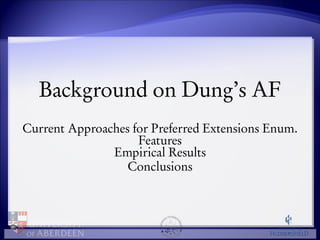
Background 
Definition 
Given an AF  = hA,Ri, with R  AA: 
a set S  A is conflict–free if @ a,b 2 S s.t. a!b; 
an argument a 2 A is acceptable with respect to a set S  A if 8b 2 A s.t. 
b!a, 9 c 2 S s.t. c!b; 
a set S  A is admissible if S is conflict–free and every element of S is 
acceptable with respect to S; 
a set S  A is a complete extension, i.e. S 2 ECO(), iff S is admissible and 
8a 2 A s.t. a is acceptable w.r.t. S, a 2 S; 
a set S  A is the grounded extensions, i.e. S 2 EGR(), iff S is the minimal 
(w.r.t. set inclusion) complete set; 
a set S  A is a preferred extension, i.e. S 2 EPR(), iff S is a maximal (w.r.t. set 
inclusion) complete set.
Background on Dung’s AF 
Current Approaches for 
Preferred Extensions Enum. 
Features 
Empirical Results 
Conclusions
AspartixM: [Dvoˇrák et al., 2011] 
Expresses argumentation semantics in Answer Set Programming 
(ASP); 
Tests for subset-maximality exploiting the metasp optimisation 
frontend for the ASP-package gringo/claspD; 
Database of the form: 
farg(a) j a 2 Ag[fdefeat(a,b) j ha,bi 2 Rg 
Example of program for checking the conflict–freeness: 
cf = f in(X) not out(X), arg(X); 
out(X) not in(X), arg(X); 
 in(X), in(Y), defeat(X,Y)g.
NAD-Alg: [Nofal et al., 2014] 
Several improvements in [Nofal et al., 2014]
PrefSAT: [TAFA2013] 
 is a boolean formula such that each 
satisfying assignment of the formula 
corresponds to a complete extension.
SCC-P: [KR2014]
SCC-P: [KR2014]
SCC-P: [KR2014]
AspartixM // NAD-Alg // PrefSAT [DARe2014] 
% Solved Average CPU-Time 
Density 25% 50% 75% 25% 50% 75% 
AspartixM 98.3 100.0 100.0 56.5 14.7 10.0 
NAD-Alg 100.0 100.0 100.0 18.9 0.2 0.2 
PrefSAT 100.0 100.0 100.0 5.1 1.6 2.2 
% Solved Average CPU-Time 
Density RAND RAND 
AspartixM 98.9 34.0 
NAD-Alg 93.9 70.6 
PrefSAT 100.0 4.2
PrefSAT // SCC-P [KR2014] 
720 AFs varying jSCC 
j in 5:5:45. Size of SCCs N( = 20 : 5 : 40,  = 5); 
attacks among SCCs N( = 20 : 5 : 40,  = 5) 
100 
90 
80 
70 
60 
50 
40 
IPC value (normalised) for SCC-P and SAT-P when 5  |SCC|  45 
For jSCC 
j = 35, Md(SCC-P) = 8.81, 
Md(SAT-P) = 8.53, z = 0.35, p = 0.73; 
0 10 20 30 40 50 
|SCC| 
SCC-P SAT-P
Background on Dung’s AF 
Current Approaches for Preferred Extensions Enum. 
Features 
Empirical Results 
Conclusions
Features from an Argumentation Graph  = hA,Ri 
— improvement from [ECAI2014] 
Directed Graph (26 features) 
Structure: 
# vertices ( jAj ) 
# edges ( jRj ) 
# vertices / #edges ( jAj=jRj ) 
# edges / #vertices ( jRj=jAj ) 
density 
average 
Degree: stdev 
attackers max 
min 
# average 
stdev 
max 
SCCs: 
min 
Structure: 
# self-def 
# unattacked 
flow hierarchy 
Eulerian 
aperiodic 
CPU-time: . . . 
Undirected Graph (24 features) 
Structure: 
# edges 
# vertices / #edges 
# edges / #vertices 
density 
Degree: 
average 
stdev 
max 
min 
SCCs: 
# average 
stdev 
max 
min 
Structure: Transitivity 
3-cycles: 
# average 
stdev 
max 
min 
CPU-time: . . .
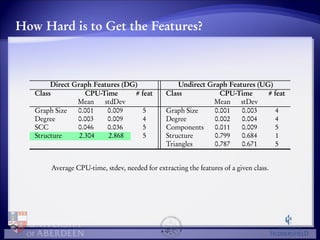
How Hard is to Get the Features? 
Direct Graph Features (DG) Undirect Graph Features (UG) 
Class CPU-Time # feat Class CPU-Time # feat 
Mean stdDev Mean stDev 
Graph Size 0.001 0.009 5 Graph Size 0.001 0.003 4 
Degree 0.003 0.009 4 Degree 0.002 0.004 4 
SCC 0.046 0.036 5 Components 0.011 0.009 5 
Structure 2.304 2.868 5 Structure 0.799 0.684 1 
Triangles 0.787 0.671 5 
Average CPU-time, stdev, needed for extracting the features of a given class.
Background on Dung’s AF 
Current Approaches for Preferred Extensions Enum. 
Features 
Empirical Results 
Conclusions
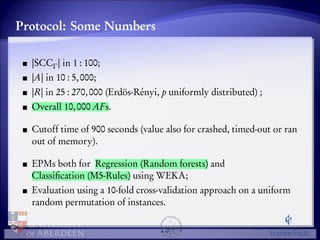
Protocol: Some Numbers 
jSCC 
j in 1 : 100; 
jAj in 10 : 5, 000; 
jRj in 25 : 270, 000 (Erdös-Rényi, p uniformly distributed) ; 
Overall 10, 000 AFs. 
Cutoff time of 900 seconds (value also for crashed, timed-out or ran 
out of memory). 
EPMs both for Regression (Random forests) and 
Classification (M5-Rules) using WEKA; 
Evaluation using a 10-fold cross-validation approach on a uniform 
random permutation of instances.
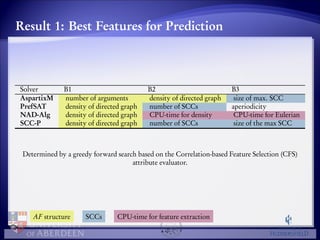
Result 1: Best Features for Prediction 
Solver B1 B2 B3 
AspartixM number of arguments density of directed graph size of max. SCC 
PrefSAT density of directed graph number of SCCs aperiodicity 
NAD-Alg density of directed graph CPU-time for density CPU-time for Eulerian 
SCC-P density of directed graph number of SCCs size of the max SCC 
Determined by a greedy forward search based on the Correlation-based Feature Selection (CFS) 
attribute evaluator. 
AF structure SCCs CPU-time for feature extraction
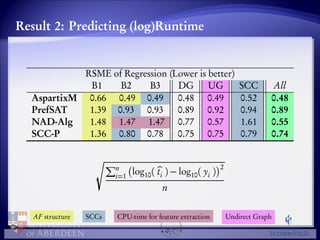
Result 2: Predicting (log)Runtime 
RSME of Regression (Lower is better) 
B1 B2 B3 DG UG SCC All 
AspartixM 0.66 0.49 0.49 0.48 0.49 0.52 0.48 
PrefSAT 1.39 0.93 0.93 0.89 0.92 0.94 0.89 
NAD-Alg 1.48 1.47 1.47 0.77 0.57 1.61 0.55 
SCC-P 1.36 0.80 0.78 0.75 0.75 0.79 0.74 
sPni 
=1 
 
log10( bti )log10( yi ) 
2 
n 
AF structure SCCs CPU-time for feature extraction Undirect Graph
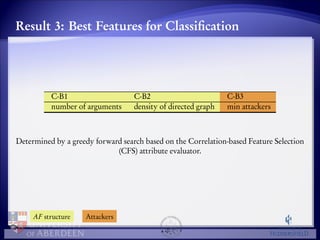
Result 3: Best Features for Classification 
C-B1 C-B2 C-B3 
number of arguments density of directed graph min attackers 
Determined by a greedy forward search based on the Correlation-based Feature Selection 
(CFS) attribute evaluator. 
AF structure Attackers
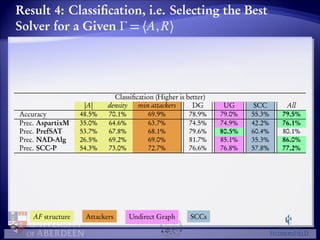
Result 4: Classification, i.e. Selecting the Best 
Solver for a Given  = hA,Ri 
Classification (Higher is better) 
jAj density min attackers DG UG SCC All 
Accuracy 48.5% 70.1% 69.9% 78.9% 79.0% 55.3% 79.5% 
Prec. AspartixM 35.0% 64.6% 63.7% 74.5% 74.9% 42.2% 76.1% 
Prec. PrefSAT 53.7% 67.8% 68.1% 79.6% 80.5% 60.4% 80.1% 
Prec. NAD-Alg 26.5% 69.2% 69.0% 81.7% 85.1% 35.3% 86.0% 
Prec. SCC-P 54.3% 73.0% 72.7% 76.6% 76.8% 57.8% 77.2% 
AF structure Attackers Undirect Graph SCCs
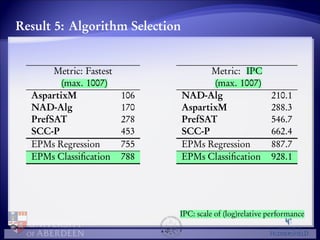
Result 5: Algorithm Selection 
Metric: Fastest 
(max. 1007) 
AspartixM 106 
NAD-Alg 170 
PrefSAT 278 
SCC-P 453 
EPMs Regression 755 
EPMs Classification 788 
Metric: IPC 
(max. 1007) 
NAD-Alg 210.1 
AspartixM 288.3 
PrefSAT 546.7 
SCC-P 662.4 
EPMs Regression 887.7 
EPMs Classification 928.1 
IPC: scale of (log)relative performance
Background on Dung’s AF 
Current Approaches for Preferred Extensions Enum. 
Features 
Empirical Results 
Conclusions
Conclusions 
50 features 
Best algorithm selection accuracy: 80% 
Algorithm selection performance: 2 times better than the best 
single-solver; 3 times better than the second-best single-solver; 
Consistency with previous explorations: density is among the most 
informative features. 
Undirect Graph Features: 
AspartixM, often around [800 . . . 899] seconds — predictable?; 
NAD-Alg, often time-out — predictable?; 
PrefSAT, SAT-solver performance?; 
SCC-P, little difference, significant?.
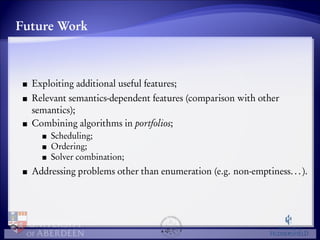
Future Work 
Exploiting additional useful features; 
Relevant semantics-dependent features (comparison with other 
semantics); 
Combining algorithms in portfolios; 
Scheduling; 
Ordering; 
Solver combination; 
Addressing problems other than enumeration (e.g. non-emptiness. . . ).
Acknowledgements 
The authors would like to acknowledge the use of the University 
of Huddersfield Queensgate Grid in carrying out this work.
References I 
[Dvoˇrák et al., 2011] Dvoˇrák,W., Gaggl, S. A.,Wallner, J., andWoltran, S. (2011). 
Making Use of Advances in Answer-Set Programming for Abstract Argumentation Systems. 
In Proceedings of the 19th International Conference on Applications of Declarative Programming and Knowledge Management (INAP 
2011). 
[Nofal et al., 2014] Nofal, S., Atkinson, K., and Dunne, P. E. (2014). 
Algorithms for decision problems in argument systems under preferred semantics. 
Artificial Intelligence, 207:23–51.

Algorithm Selection for Preferred Extensions Enumeration

  • 1.
    Algorithm Selection forPreferred Extensions Enumeration Federico Cerutti, Massimiliano Giacomin, Mauro Vallati COMMA-2014 —Wednesday 10th September, 2014
  • 2.
    Background on Dung’sAF Current Approaches for Preferred Extensions Enum. Features Empirical Results Conclusions
  • 3.
    Background Definition Givenan AF = hA,Ri, with R AA: a set S A is conflict–free if @ a,b 2 S s.t. a!b; an argument a 2 A is acceptable with respect to a set S A if 8b 2 A s.t. b!a, 9 c 2 S s.t. c!b; a set S A is admissible if S is conflict–free and every element of S is acceptable with respect to S; a set S A is a complete extension, i.e. S 2 ECO(), iff S is admissible and 8a 2 A s.t. a is acceptable w.r.t. S, a 2 S; a set S A is the grounded extensions, i.e. S 2 EGR(), iff S is the minimal (w.r.t. set inclusion) complete set; a set S A is a preferred extension, i.e. S 2 EPR(), iff S is a maximal (w.r.t. set inclusion) complete set.
  • 4.
    Background on Dung’sAF Current Approaches for Preferred Extensions Enum. Features Empirical Results Conclusions
  • 5.
    AspartixM: [Dvoˇrák etal., 2011] Expresses argumentation semantics in Answer Set Programming (ASP); Tests for subset-maximality exploiting the metasp optimisation frontend for the ASP-package gringo/claspD; Database of the form: farg(a) j a 2 Ag[fdefeat(a,b) j ha,bi 2 Rg Example of program for checking the conflict–freeness: cf = f in(X) not out(X), arg(X); out(X) not in(X), arg(X); in(X), in(Y), defeat(X,Y)g.
  • 6.
    NAD-Alg: [Nofal etal., 2014] Several improvements in [Nofal et al., 2014]
  • 7.
    PrefSAT: [TAFA2013] is a boolean formula such that each satisfying assignment of the formula corresponds to a complete extension.
  • 8.
  • 9.
  • 10.
  • 11.
    AspartixM // NAD-Alg// PrefSAT [DARe2014] % Solved Average CPU-Time Density 25% 50% 75% 25% 50% 75% AspartixM 98.3 100.0 100.0 56.5 14.7 10.0 NAD-Alg 100.0 100.0 100.0 18.9 0.2 0.2 PrefSAT 100.0 100.0 100.0 5.1 1.6 2.2 % Solved Average CPU-Time Density RAND RAND AspartixM 98.9 34.0 NAD-Alg 93.9 70.6 PrefSAT 100.0 4.2
  • 12.
    PrefSAT // SCC-P[KR2014] 720 AFs varying jSCC j in 5:5:45. Size of SCCs N( = 20 : 5 : 40, = 5); attacks among SCCs N( = 20 : 5 : 40, = 5) 100 90 80 70 60 50 40 IPC value (normalised) for SCC-P and SAT-P when 5 |SCC| 45 For jSCC j = 35, Md(SCC-P) = 8.81, Md(SAT-P) = 8.53, z = 0.35, p = 0.73; 0 10 20 30 40 50 |SCC| SCC-P SAT-P
  • 13.
    Background on Dung’sAF Current Approaches for Preferred Extensions Enum. Features Empirical Results Conclusions
  • 14.
    Features from anArgumentation Graph = hA,Ri — improvement from [ECAI2014] Directed Graph (26 features) Structure: # vertices ( jAj ) # edges ( jRj ) # vertices / #edges ( jAj=jRj ) # edges / #vertices ( jRj=jAj ) density average Degree: stdev attackers max min # average stdev max SCCs: min Structure: # self-def # unattacked flow hierarchy Eulerian aperiodic CPU-time: . . . Undirected Graph (24 features) Structure: # edges # vertices / #edges # edges / #vertices density Degree: average stdev max min SCCs: # average stdev max min Structure: Transitivity 3-cycles: # average stdev max min CPU-time: . . .
  • 15.
    How Hard isto Get the Features? Direct Graph Features (DG) Undirect Graph Features (UG) Class CPU-Time # feat Class CPU-Time # feat Mean stdDev Mean stDev Graph Size 0.001 0.009 5 Graph Size 0.001 0.003 4 Degree 0.003 0.009 4 Degree 0.002 0.004 4 SCC 0.046 0.036 5 Components 0.011 0.009 5 Structure 2.304 2.868 5 Structure 0.799 0.684 1 Triangles 0.787 0.671 5 Average CPU-time, stdev, needed for extracting the features of a given class.
  • 16.
    Background on Dung’sAF Current Approaches for Preferred Extensions Enum. Features Empirical Results Conclusions
  • 17.
    Protocol: Some Numbers jSCC j in 1 : 100; jAj in 10 : 5, 000; jRj in 25 : 270, 000 (Erdös-Rényi, p uniformly distributed) ; Overall 10, 000 AFs. Cutoff time of 900 seconds (value also for crashed, timed-out or ran out of memory). EPMs both for Regression (Random forests) and Classification (M5-Rules) using WEKA; Evaluation using a 10-fold cross-validation approach on a uniform random permutation of instances.
  • 18.
    Result 1: BestFeatures for Prediction Solver B1 B2 B3 AspartixM number of arguments density of directed graph size of max. SCC PrefSAT density of directed graph number of SCCs aperiodicity NAD-Alg density of directed graph CPU-time for density CPU-time for Eulerian SCC-P density of directed graph number of SCCs size of the max SCC Determined by a greedy forward search based on the Correlation-based Feature Selection (CFS) attribute evaluator. AF structure SCCs CPU-time for feature extraction
  • 19.
    Result 2: Predicting(log)Runtime RSME of Regression (Lower is better) B1 B2 B3 DG UG SCC All AspartixM 0.66 0.49 0.49 0.48 0.49 0.52 0.48 PrefSAT 1.39 0.93 0.93 0.89 0.92 0.94 0.89 NAD-Alg 1.48 1.47 1.47 0.77 0.57 1.61 0.55 SCC-P 1.36 0.80 0.78 0.75 0.75 0.79 0.74 sPni =1 log10( bti )log10( yi ) 2 n AF structure SCCs CPU-time for feature extraction Undirect Graph
  • 20.
    Result 3: BestFeatures for Classification C-B1 C-B2 C-B3 number of arguments density of directed graph min attackers Determined by a greedy forward search based on the Correlation-based Feature Selection (CFS) attribute evaluator. AF structure Attackers
  • 21.
    Result 4: Classification,i.e. Selecting the Best Solver for a Given = hA,Ri Classification (Higher is better) jAj density min attackers DG UG SCC All Accuracy 48.5% 70.1% 69.9% 78.9% 79.0% 55.3% 79.5% Prec. AspartixM 35.0% 64.6% 63.7% 74.5% 74.9% 42.2% 76.1% Prec. PrefSAT 53.7% 67.8% 68.1% 79.6% 80.5% 60.4% 80.1% Prec. NAD-Alg 26.5% 69.2% 69.0% 81.7% 85.1% 35.3% 86.0% Prec. SCC-P 54.3% 73.0% 72.7% 76.6% 76.8% 57.8% 77.2% AF structure Attackers Undirect Graph SCCs
  • 22.
    Result 5: AlgorithmSelection Metric: Fastest (max. 1007) AspartixM 106 NAD-Alg 170 PrefSAT 278 SCC-P 453 EPMs Regression 755 EPMs Classification 788 Metric: IPC (max. 1007) NAD-Alg 210.1 AspartixM 288.3 PrefSAT 546.7 SCC-P 662.4 EPMs Regression 887.7 EPMs Classification 928.1 IPC: scale of (log)relative performance
  • 23.
    Background on Dung’sAF Current Approaches for Preferred Extensions Enum. Features Empirical Results Conclusions
  • 24.
    Conclusions 50 features Best algorithm selection accuracy: 80% Algorithm selection performance: 2 times better than the best single-solver; 3 times better than the second-best single-solver; Consistency with previous explorations: density is among the most informative features. Undirect Graph Features: AspartixM, often around [800 . . . 899] seconds — predictable?; NAD-Alg, often time-out — predictable?; PrefSAT, SAT-solver performance?; SCC-P, little difference, significant?.
  • 25.
    Future Work Exploitingadditional useful features; Relevant semantics-dependent features (comparison with other semantics); Combining algorithms in portfolios; Scheduling; Ordering; Solver combination; Addressing problems other than enumeration (e.g. non-emptiness. . . ).
  • 26.
    Acknowledgements The authorswould like to acknowledge the use of the University of Huddersfield Queensgate Grid in carrying out this work.
  • 27.
    References I [Dvoˇráket al., 2011] Dvoˇrák,W., Gaggl, S. A.,Wallner, J., andWoltran, S. (2011). Making Use of Advances in Answer-Set Programming for Abstract Argumentation Systems. In Proceedings of the 19th International Conference on Applications of Declarative Programming and Knowledge Management (INAP 2011). [Nofal et al., 2014] Nofal, S., Atkinson, K., and Dunne, P. E. (2014). Algorithms for decision problems in argument systems under preferred semantics. Artificial Intelligence, 207:23–51.