An Empirical Evaluation of
Geometric Subjective Logic
Operators
Federico Cerutti, Alice Toniolo, Nir Oren, Timothy J. Norman
AT-2013
Friday 2nd
August, 2013
c 2013 Federico Cerutti <f.cerutti@abdn.ac.uk>
Summary
Basic concepts of Subjective Logic and its usage in Trust Systems
Proposal of two new operators for Subjective Logic
Description of the designed experiment
Results of the empirical evaluation
c 2013 Federico Cerutti <f.cerutti@abdn.ac.uk> 2 of 19
Trustworthiness and Reputation
Trust, trustworthiness, and reputation have different meanings in
different approaches [Castelfranchi and Falcone, 2010]
Trustworthiness: property of an agent representing its willingness
to share information in a trustworthy manner
Reputation: property of an agent representing the subjective view
of its trustworthiness obtained from an agent with which we can
directly communicate
Subjective Logic as the way for expressing both the degree of
trustworthiness and the degree of reputation
c 2013 Federico Cerutti <f.cerutti@abdn.ac.uk> 3 of 19
Introduction to Subjective Logic
A subjective logic opinion is a triple ωX = bX, dX, uX
bX: belief that X holds;
dX: disbelief that X holds;
uX: uncertainty that X holds;
bX, dX, uX ∈ [0, 1] and bX + dX + uX = 1.
c 2013 Federico Cerutti <f.cerutti@abdn.ac.uk> 4 of 19
Opinions and Beta Distribution
Beta(p|α, β) =
Γ(α + β)
Γ(α) Γ(β)
pα−1
ββ−1
α = r + 1
β = s + 1
r: number of observations
for x
s: number of observations
for ¬x
Derived subjective logic
opinion:


b = r
r+s+2
d = s
r+s+2
u = 2
r+s+2
c 2013 Federico Cerutti <f.cerutti@abdn.ac.uk> 5 of 19
p
Subjective Logic Opinions and Trust Modelling:
Bootstrap
Alice has a history of interactions with Bob
Alice counts the positive (r) and negative (s) interactions with
Bob
Alice derives the trustworthiness degree of Bob as
OBob
Alice



b = r
r+s+2
d = s
r+s+2
u = 2
r+s+2
Similarly with John (OJohn
Alice)
Similarly the other agents
Bob derives OAlice
Bob and OBill
Bob
John derives OAlice
John and OBill
John
Bill derives OJohn
Bill and OBob
Bill
c 2013 Federico Cerutti <f.cerutti@abdn.ac.uk> 6 of 19
Alice
Bob
John
BillBob
John
Alice Bill
John
Bob
BillAlice
Subjective Logic Opinions and Trust Modelling:
Transitivity
Alice wants to know what is the reputation degree for Bill
Alice asks Bob and John what is the reputation degree of Bill
(their opinion on his trustworthiness)
Either Bob or John can:
answer that he does not know Bill
respectively return OBill
Bob or OBill
John,
each of which can be
either the actual opinion
they have on Bill, or
something different
That’s why Alice should
discount what she receives
given the trustworthiness
degree of Bob and John she derived:
OBill
Alice = (OBob
Alice ⊗ OBill
Bob ) ⊕ (OJohn
Alice ⊗ OBill
John).
c 2013 Federico Cerutti <f.cerutti@abdn.ac.uk> 7 of 19
Alice
Bob
John
Bill
Subjective Logic Opinions and Trust Modelling:
Transitivity operators
Definition (Former Def. 5 of [Jøsang et al., 2006])
Let A, B be two agents where A’s opinion about B’s recommendations is
expressed as ωA
B = bA
B, dA
B, uA
B, aA
B and let x be a proposition where B’s
opinion about x (e.g. the degree of trustworthiness of a third agent [ed.]) is
recommended to A with the opinion ωB
X = bB
x , dB
x , uB
x , aB
x . Let
ωA:B
x = bA:B
x , dA:B
x , uA:B
x , aA:B
x be the opinion such that:



bA:B
x = bA
B bB
x
dA:B
x = bA
B dB
x
uA:B
x = dA
B + uA
B + bA
B uB
x
aA:B
x = aB
x
then ωA:B
x is called the uncertainty favouring discounted opinion of A. By
using the symbol ⊗ to designate this operation, we get ωA:B
x = ωA
B ⊗ ωB
x .
c 2013 Federico Cerutti <f.cerutti@abdn.ac.uk> 8 of 19
Subjective Logic Opinions and Trust Modelling:
Transitivity operators
Definition (Former Thm. 1 of [Jøsang et al., 2006])
Let ωA
x = bA
x , dA
x , uA
x , aA
x and ωB
x = bB
x , dB
x , uB
x , aB
x be trust in x from A
and B respectively. The opinion ωA B
x = bA B
x , dA B
x , uA B
x , aA B
x is then
called the consensus between ωA
x and ωB
x , denoting the trust that an
imaginary agent [A, B] would have in x, as if that agent represented both A
and B. In case of Bayesian (totally certain) opinions, their relative weight
can be defined as γA/B
= lim (uB
x /uA
x ).
Case I: uA
x + uB
x − uA
x uB
x = 0


bA B
x =
bA
x uB
x +bB
x uA
x
uA
x +uB
x −uA
x uB
x
dA B
x =
dA
x uB
x +dB
x uA
x
uA
x +uB
x −uA
x uB
x
uA B
x =
uA
x uB
x
uA
x +uB
x −uA
x uB
x
aA B
x =
aA
x uB
x +aB
x uA
x −(aA
x +aB
x ) uA
x uB
x
uA
x +uB
x −2 uA
x uB
x
Case II: uA
x + uB
x − uA
x uB
x = 0


bA B
x =
(γA/B
bA
x +bB
x )
(γA/B+1)
dA B
x =
(γA/B
dA
x +dB
x )
(γA/B+1)
uA B
x = 0
aA B
x =
(γA/B
aA
x +aB
x )
(γA/B+1)
By using the symbol ‘⊕’ to designate this operator, we can write
ωA B
x = ωA
x ⊕ ωB
x .
c 2013 Federico Cerutti <f.cerutti@abdn.ac.uk> 8 of 19
An Alternative Perspective
xO
dO + uO cos(π
3 )
sin(π
3 )
yO uO
c 2013 Federico Cerutti <f.cerutti@abdn.ac.uk> 9 of 19
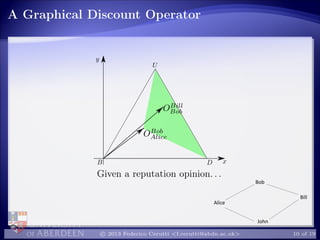
A Graphical Discount Operator
Admissible space of opinions
c 2013 Federico Cerutti <f.cerutti@abdn.ac.uk> 10 of 19
Alice
Bob
John
Bill
A Graphical Discount Operator
Given a reputation opinion. . .
c 2013 Federico Cerutti <f.cerutti@abdn.ac.uk> 10 of 19
Alice
Bob
John
Bill
A Graphical Discount Operator
. . . we project it into the admissible space of opinions s.t.
τ ∝ α and |
# »
OBob
AliceOBill
Bob | ∝ |
# »
BOBill
Bob |
c 2013 Federico Cerutti <f.cerutti@abdn.ac.uk> 10 of 19
Alice
Bob
John
Bill
A Graphical Discount Operator
Finally the discounted opinion is the sum of the two vectors
c 2013 Federico Cerutti <f.cerutti@abdn.ac.uk> 10 of 19
Alice
Bob
John
Bill
A Graphical Fusion Operator of Discounted
Opinions
Requirements:
the fusion of an opinion Wi = Ti ◦ Ci must be balanced using
Ki = f(Ti) for some function f(·): e.g. if Alice trusts Bob more
than John, then it seems reasonable that the received opinions
are evaluated differently;
if ∀i, j Ki = Kj, then the graphical fusion operator on
W1, W2, . . . , Wn, F(W1, W2, . . . , Wn) is the centroid of the
polygon determined by n opinions;
if ∃i Ki = 0, then
F(W1, . . . , Wn) = F(W1, . . . , Wi−1, Wi+1, . . . , Wn).
c 2013 Federico Cerutti <f.cerutti@abdn.ac.uk> 11 of 19
Alice
Bob
John
Bill
A Graphical Fusion Operator of Discounted
Opinions
Formally:
bF(W1,...,Wn) =
1
n
i=1 Ki
n
i=1
Ki bWi
dF(W1,...,Wn) =
1
n
i=1 Ki
n
i=1
Ki dWi
uF(W1,...,Wn) =
1
n
i=1 Ki
n
i=1
Ki uWi
We considered only the case Ki = bTi +
uTi
2 .
c 2013 Federico Cerutti <f.cerutti@abdn.ac.uk> 11 of 19
Alice
Bob
John
Bill
Empirical Evaluation: Trust System Construction
Set of 50 agents A = {ag1, . . . , ag50}
Each agent agx is characterised by the probability of responding
truthfully to another agent’s query, namely PT
agx
∈ [0 . . . 1]
(randomly selected)
Each agent knows Ω =
For each agent agx, we determine if it can communicate with
agy = agx according to PL: if agy is connected to agx, then we
say that agy is a connection of agx (agy ∈ Nagx ).
c 2013 Federico Cerutti <f.cerutti@abdn.ac.uk> 12 of 19
Empirical Evaluation: Bootstrapping
Following [Ismail and Jøsang, 2002] a Beta distribution is used
for analysing repetitive experiments and deriving a subjective
logic opinion
Each agent agx asks each agent agy ∈ Nagx about Ω #B times
Given the number of exchanges when agent agy answered
truthfully (# ) and when it lied (#⊥)
O
agy
agx =
#
#B + 2
,
#⊥
#B + 2
,
2
#B + 2
Opinion derived by the (omniscient) experimenter
O
agy
Exp = PT
agy
, (1 − PT
agy
), 0
c 2013 Federico Cerutti <f.cerutti@abdn.ac.uk> 13 of 19
Empirical Evaluation: Network Exploration
An “explorer” agS ∈ A is randomly selected
agS asks each agent in its connections about the trustworthiness
it has of its connections (e.g. Alice asks both Bob and John
(separately) about which agents they know and what is their
opinion of them)
For each agent agz they claim to know (e.g. Bill), agS computes
Oagz
agS |J = (O
agy1
agS ⊗ Oagz
agy1
) ⊕ . . . ⊕ (O
agyn
agS ⊗ Oagz
agyn
) (Jøsang
operators), and Oagz
agS |G = F((O
agy1
agS ◦ Oagz
agy1
), . . . , (O
agyn
agS ◦ Oagz
agyn
)
(the graphical operators)
Now agz is known and can be directly questioned about other
agents it might now
The explorations ends when no new agents are discovered
c 2013 Federico Cerutti <f.cerutti@abdn.ac.uk> 14 of 19
Empirical Evaluation: Comparison
r(agz) =



− log
d(Oagz
agS |G, Oagz
Exp)
d(Oagz
agS |J , Oagz
Exp)
d(Oagz
agS |G, Oagz
Exp) > d(Oagz
agS |J , Oagz
Exp)
log
d(Oagz
agS |J , Oagz
Exp)
d(Oagz
agS |G, Oagz
Exp)
d(Oagz
agS |J , Oagz
Exp) ≥ d(Oagz
agS |G, Oagz
Exp)
where:
d(O1, O2) = (bO2 − bO1 )2 + (dO2 − dO1 )2 + (uO2 − uO1 )2
c 2013 Federico Cerutti <f.cerutti@abdn.ac.uk> 15 of 19
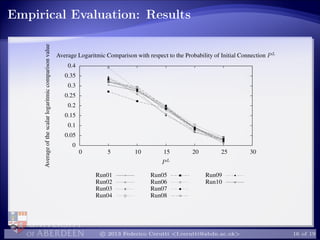
Empirical Evaluation: Results
For each run, for each value of PL, 250 explorations over 10
different networks were carried out (overall 12500 explorations
across 500 different networks)
For small values of PL, the graphical operators return opinions
closer to the “ideal” one than Jøsang’s by a factor 2 (on the
average dJ
dG
2), or, in other terms, approx. 50% closer;
The greater the PL, the more similar the performance of the two
sets of operators, the smaller the standard deviation on the
results obtained by the experiments;
The overall average on the logarithmic scale is 1.56 (36% on the
linear scale).
c 2013 Federico Cerutti <f.cerutti@abdn.ac.uk> 16 of 19
Empirical Evaluation: Results
0
0.05
0.1
0.15
0.2
0.25
0.3
0.35
0.4
0 5 10 15 20 25 30
Averageofthescalarlogaritmiccomparisonvalue
PL
Average Logaritmic Comparison with respect to the Probability of Initial Connection PL
Run01
Run02
Run03
Run04
Run05
Run06
Run07
Run08
Run09
Run10
c 2013 Federico Cerutti <f.cerutti@abdn.ac.uk> 16 of 19
Conclusions
Empirical investigation on discount and fusion operators for
Subjective Logic
Proposal of two new operators for Subjective Logic based on
graphical properties
Empirical comparison of the new proposal w.r.t. Jøsang
operators, with improving of the results of 36% (on the average)
What’s next:
Study of random graph generation (e.g. scale-free networks. . . )
Experimental evaluation in presence of more uncertainty (lowering
the number of interactions in the bootstrap phase)
Reaching a common methodology with [Kaplan et al., 2013]
c 2013 Federico Cerutti <f.cerutti@abdn.ac.uk> 17 of 19
Acknowledgement
Research was sponsored by US Army Research laboratory
and the UK Ministry of Defence and was accomplished under
Agreement Number W911NF-06-3-0001. The views and
conclusions contained in this document are those of the
authors and should not be interpreted as representing the
official policies, either expressed or implied, of the US Army
Research Laboratory, the U.S. Government, the UK Ministry
of Defense, or the UK Government. The US and UK
Governments are authorized to reproduce and distribute
reprints for Government purposes notwithstanding any
copyright notation hereon.
c 2013 Federico Cerutti <f.cerutti@abdn.ac.uk> 18 of 19
References I
[Castelfranchi and Falcone, 2010] Castelfranchi, C. and Falcone, R. (2010).
Trust theory: A socio-cognitive and computational model.
Wiley Series in Agent Technology.
[Ismail and Jøsang, 2002] Ismail, R. and Jøsang, A. (2002).
The beta reputation system.
In Prooceedings of BLED 2002.
[Jøsang et al., 2006] Jøsang, A., Pope, S., and Marsh, S. (2006).
Exploring different types of trust propagation.
In Proceedings of the 4th International Conference on Trust Management (iTrust’06).
[Kaplan et al., 2013] Kaplan, L. M., Sensoy, M., Tang, Y., Chakraborty, S., Bisdikian, C., and de Mel,
G. (2013).
Reasoning under uncertainty: Variations of subjective logic deduction.
In Proceedings of the Sixteenth International Conference on Information Fusion.
c 2013 Federico Cerutti <f.cerutti@abdn.ac.uk> 19 of 19

Cerutti-AT2013-Graphical Subjective Logic

  • 1.
    An Empirical Evaluationof Geometric Subjective Logic Operators Federico Cerutti, Alice Toniolo, Nir Oren, Timothy J. Norman AT-2013 Friday 2nd August, 2013 c 2013 Federico Cerutti <f.cerutti@abdn.ac.uk>
  • 2.
    Summary Basic concepts ofSubjective Logic and its usage in Trust Systems Proposal of two new operators for Subjective Logic Description of the designed experiment Results of the empirical evaluation c 2013 Federico Cerutti <f.cerutti@abdn.ac.uk> 2 of 19
  • 3.
    Trustworthiness and Reputation Trust,trustworthiness, and reputation have different meanings in different approaches [Castelfranchi and Falcone, 2010] Trustworthiness: property of an agent representing its willingness to share information in a trustworthy manner Reputation: property of an agent representing the subjective view of its trustworthiness obtained from an agent with which we can directly communicate Subjective Logic as the way for expressing both the degree of trustworthiness and the degree of reputation c 2013 Federico Cerutti <f.cerutti@abdn.ac.uk> 3 of 19
  • 4.
    Introduction to SubjectiveLogic A subjective logic opinion is a triple ωX = bX, dX, uX bX: belief that X holds; dX: disbelief that X holds; uX: uncertainty that X holds; bX, dX, uX ∈ [0, 1] and bX + dX + uX = 1. c 2013 Federico Cerutti <f.cerutti@abdn.ac.uk> 4 of 19
  • 5.
    Opinions and BetaDistribution Beta(p|α, β) = Γ(α + β) Γ(α) Γ(β) pα−1 ββ−1 α = r + 1 β = s + 1 r: number of observations for x s: number of observations for ¬x Derived subjective logic opinion:   b = r r+s+2 d = s r+s+2 u = 2 r+s+2 c 2013 Federico Cerutti <f.cerutti@abdn.ac.uk> 5 of 19 p
  • 6.
    Subjective Logic Opinionsand Trust Modelling: Bootstrap Alice has a history of interactions with Bob Alice counts the positive (r) and negative (s) interactions with Bob Alice derives the trustworthiness degree of Bob as OBob Alice    b = r r+s+2 d = s r+s+2 u = 2 r+s+2 Similarly with John (OJohn Alice) Similarly the other agents Bob derives OAlice Bob and OBill Bob John derives OAlice John and OBill John Bill derives OJohn Bill and OBob Bill c 2013 Federico Cerutti <f.cerutti@abdn.ac.uk> 6 of 19 Alice Bob John BillBob John Alice Bill John Bob BillAlice
  • 7.
    Subjective Logic Opinionsand Trust Modelling: Transitivity Alice wants to know what is the reputation degree for Bill Alice asks Bob and John what is the reputation degree of Bill (their opinion on his trustworthiness) Either Bob or John can: answer that he does not know Bill respectively return OBill Bob or OBill John, each of which can be either the actual opinion they have on Bill, or something different That’s why Alice should discount what she receives given the trustworthiness degree of Bob and John she derived: OBill Alice = (OBob Alice ⊗ OBill Bob ) ⊕ (OJohn Alice ⊗ OBill John). c 2013 Federico Cerutti <f.cerutti@abdn.ac.uk> 7 of 19 Alice Bob John Bill
  • 8.
    Subjective Logic Opinionsand Trust Modelling: Transitivity operators Definition (Former Def. 5 of [Jøsang et al., 2006]) Let A, B be two agents where A’s opinion about B’s recommendations is expressed as ωA B = bA B, dA B, uA B, aA B and let x be a proposition where B’s opinion about x (e.g. the degree of trustworthiness of a third agent [ed.]) is recommended to A with the opinion ωB X = bB x , dB x , uB x , aB x . Let ωA:B x = bA:B x , dA:B x , uA:B x , aA:B x be the opinion such that:    bA:B x = bA B bB x dA:B x = bA B dB x uA:B x = dA B + uA B + bA B uB x aA:B x = aB x then ωA:B x is called the uncertainty favouring discounted opinion of A. By using the symbol ⊗ to designate this operation, we get ωA:B x = ωA B ⊗ ωB x . c 2013 Federico Cerutti <f.cerutti@abdn.ac.uk> 8 of 19
  • 9.
    Subjective Logic Opinionsand Trust Modelling: Transitivity operators Definition (Former Thm. 1 of [Jøsang et al., 2006]) Let ωA x = bA x , dA x , uA x , aA x and ωB x = bB x , dB x , uB x , aB x be trust in x from A and B respectively. The opinion ωA B x = bA B x , dA B x , uA B x , aA B x is then called the consensus between ωA x and ωB x , denoting the trust that an imaginary agent [A, B] would have in x, as if that agent represented both A and B. In case of Bayesian (totally certain) opinions, their relative weight can be defined as γA/B = lim (uB x /uA x ). Case I: uA x + uB x − uA x uB x = 0   bA B x = bA x uB x +bB x uA x uA x +uB x −uA x uB x dA B x = dA x uB x +dB x uA x uA x +uB x −uA x uB x uA B x = uA x uB x uA x +uB x −uA x uB x aA B x = aA x uB x +aB x uA x −(aA x +aB x ) uA x uB x uA x +uB x −2 uA x uB x Case II: uA x + uB x − uA x uB x = 0   bA B x = (γA/B bA x +bB x ) (γA/B+1) dA B x = (γA/B dA x +dB x ) (γA/B+1) uA B x = 0 aA B x = (γA/B aA x +aB x ) (γA/B+1) By using the symbol ‘⊕’ to designate this operator, we can write ωA B x = ωA x ⊕ ωB x . c 2013 Federico Cerutti <f.cerutti@abdn.ac.uk> 8 of 19
  • 10.
    An Alternative Perspective xO dO+ uO cos(π 3 ) sin(π 3 ) yO uO c 2013 Federico Cerutti <f.cerutti@abdn.ac.uk> 9 of 19
  • 11.
    A Graphical DiscountOperator Admissible space of opinions c 2013 Federico Cerutti <f.cerutti@abdn.ac.uk> 10 of 19 Alice Bob John Bill
  • 12.
    A Graphical DiscountOperator Given a reputation opinion. . . c 2013 Federico Cerutti <f.cerutti@abdn.ac.uk> 10 of 19 Alice Bob John Bill
  • 13.
    A Graphical DiscountOperator . . . we project it into the admissible space of opinions s.t. τ ∝ α and | # » OBob AliceOBill Bob | ∝ | # » BOBill Bob | c 2013 Federico Cerutti <f.cerutti@abdn.ac.uk> 10 of 19 Alice Bob John Bill
  • 14.
    A Graphical DiscountOperator Finally the discounted opinion is the sum of the two vectors c 2013 Federico Cerutti <f.cerutti@abdn.ac.uk> 10 of 19 Alice Bob John Bill
  • 15.
    A Graphical FusionOperator of Discounted Opinions Requirements: the fusion of an opinion Wi = Ti ◦ Ci must be balanced using Ki = f(Ti) for some function f(·): e.g. if Alice trusts Bob more than John, then it seems reasonable that the received opinions are evaluated differently; if ∀i, j Ki = Kj, then the graphical fusion operator on W1, W2, . . . , Wn, F(W1, W2, . . . , Wn) is the centroid of the polygon determined by n opinions; if ∃i Ki = 0, then F(W1, . . . , Wn) = F(W1, . . . , Wi−1, Wi+1, . . . , Wn). c 2013 Federico Cerutti <f.cerutti@abdn.ac.uk> 11 of 19 Alice Bob John Bill
  • 16.
    A Graphical FusionOperator of Discounted Opinions Formally: bF(W1,...,Wn) = 1 n i=1 Ki n i=1 Ki bWi dF(W1,...,Wn) = 1 n i=1 Ki n i=1 Ki dWi uF(W1,...,Wn) = 1 n i=1 Ki n i=1 Ki uWi We considered only the case Ki = bTi + uTi 2 . c 2013 Federico Cerutti <f.cerutti@abdn.ac.uk> 11 of 19 Alice Bob John Bill
  • 17.
    Empirical Evaluation: TrustSystem Construction Set of 50 agents A = {ag1, . . . , ag50} Each agent agx is characterised by the probability of responding truthfully to another agent’s query, namely PT agx ∈ [0 . . . 1] (randomly selected) Each agent knows Ω = For each agent agx, we determine if it can communicate with agy = agx according to PL: if agy is connected to agx, then we say that agy is a connection of agx (agy ∈ Nagx ). c 2013 Federico Cerutti <f.cerutti@abdn.ac.uk> 12 of 19
  • 18.
    Empirical Evaluation: Bootstrapping Following[Ismail and Jøsang, 2002] a Beta distribution is used for analysing repetitive experiments and deriving a subjective logic opinion Each agent agx asks each agent agy ∈ Nagx about Ω #B times Given the number of exchanges when agent agy answered truthfully (# ) and when it lied (#⊥) O agy agx = # #B + 2 , #⊥ #B + 2 , 2 #B + 2 Opinion derived by the (omniscient) experimenter O agy Exp = PT agy , (1 − PT agy ), 0 c 2013 Federico Cerutti <f.cerutti@abdn.ac.uk> 13 of 19
  • 19.
    Empirical Evaluation: NetworkExploration An “explorer” agS ∈ A is randomly selected agS asks each agent in its connections about the trustworthiness it has of its connections (e.g. Alice asks both Bob and John (separately) about which agents they know and what is their opinion of them) For each agent agz they claim to know (e.g. Bill), agS computes Oagz agS |J = (O agy1 agS ⊗ Oagz agy1 ) ⊕ . . . ⊕ (O agyn agS ⊗ Oagz agyn ) (Jøsang operators), and Oagz agS |G = F((O agy1 agS ◦ Oagz agy1 ), . . . , (O agyn agS ◦ Oagz agyn ) (the graphical operators) Now agz is known and can be directly questioned about other agents it might now The explorations ends when no new agents are discovered c 2013 Federico Cerutti <f.cerutti@abdn.ac.uk> 14 of 19
  • 20.
    Empirical Evaluation: Comparison r(agz)=    − log d(Oagz agS |G, Oagz Exp) d(Oagz agS |J , Oagz Exp) d(Oagz agS |G, Oagz Exp) > d(Oagz agS |J , Oagz Exp) log d(Oagz agS |J , Oagz Exp) d(Oagz agS |G, Oagz Exp) d(Oagz agS |J , Oagz Exp) ≥ d(Oagz agS |G, Oagz Exp) where: d(O1, O2) = (bO2 − bO1 )2 + (dO2 − dO1 )2 + (uO2 − uO1 )2 c 2013 Federico Cerutti <f.cerutti@abdn.ac.uk> 15 of 19
  • 21.
    Empirical Evaluation: Results Foreach run, for each value of PL, 250 explorations over 10 different networks were carried out (overall 12500 explorations across 500 different networks) For small values of PL, the graphical operators return opinions closer to the “ideal” one than Jøsang’s by a factor 2 (on the average dJ dG 2), or, in other terms, approx. 50% closer; The greater the PL, the more similar the performance of the two sets of operators, the smaller the standard deviation on the results obtained by the experiments; The overall average on the logarithmic scale is 1.56 (36% on the linear scale). c 2013 Federico Cerutti <f.cerutti@abdn.ac.uk> 16 of 19
  • 22.
    Empirical Evaluation: Results 0 0.05 0.1 0.15 0.2 0.25 0.3 0.35 0.4 05 10 15 20 25 30 Averageofthescalarlogaritmiccomparisonvalue PL Average Logaritmic Comparison with respect to the Probability of Initial Connection PL Run01 Run02 Run03 Run04 Run05 Run06 Run07 Run08 Run09 Run10 c 2013 Federico Cerutti <f.cerutti@abdn.ac.uk> 16 of 19
  • 23.
    Conclusions Empirical investigation ondiscount and fusion operators for Subjective Logic Proposal of two new operators for Subjective Logic based on graphical properties Empirical comparison of the new proposal w.r.t. Jøsang operators, with improving of the results of 36% (on the average) What’s next: Study of random graph generation (e.g. scale-free networks. . . ) Experimental evaluation in presence of more uncertainty (lowering the number of interactions in the bootstrap phase) Reaching a common methodology with [Kaplan et al., 2013] c 2013 Federico Cerutti <f.cerutti@abdn.ac.uk> 17 of 19
  • 24.
    Acknowledgement Research was sponsoredby US Army Research laboratory and the UK Ministry of Defence and was accomplished under Agreement Number W911NF-06-3-0001. The views and conclusions contained in this document are those of the authors and should not be interpreted as representing the official policies, either expressed or implied, of the US Army Research Laboratory, the U.S. Government, the UK Ministry of Defense, or the UK Government. The US and UK Governments are authorized to reproduce and distribute reprints for Government purposes notwithstanding any copyright notation hereon. c 2013 Federico Cerutti <f.cerutti@abdn.ac.uk> 18 of 19
  • 25.
    References I [Castelfranchi andFalcone, 2010] Castelfranchi, C. and Falcone, R. (2010). Trust theory: A socio-cognitive and computational model. Wiley Series in Agent Technology. [Ismail and Jøsang, 2002] Ismail, R. and Jøsang, A. (2002). The beta reputation system. In Prooceedings of BLED 2002. [Jøsang et al., 2006] Jøsang, A., Pope, S., and Marsh, S. (2006). Exploring different types of trust propagation. In Proceedings of the 4th International Conference on Trust Management (iTrust’06). [Kaplan et al., 2013] Kaplan, L. M., Sensoy, M., Tang, Y., Chakraborty, S., Bisdikian, C., and de Mel, G. (2013). Reasoning under uncertainty: Variations of subjective logic deduction. In Proceedings of the Sixteenth International Conference on Information Fusion. c 2013 Federico Cerutti <f.cerutti@abdn.ac.uk> 19 of 19