Argumentation-Based Decision Making and
Structural Models of Personality
Pietro Baroni and Federico Cerutti and Massimiliano
Giacomin and Giovanni Guida
Dipartimento di Ingegneria dell’Informazione, Universit`a di Brescia
Via Branze 38, I-25123 Brescia, Italy
December 3, 2010
ARGAIP 2010
c 2010 Federico Cerutti <federico.cerutti@ing.unibs.it>
“Good Advice”
The advice should be presented in a form which can be readily
understood by decision makers
There should be ready access to both information and reasoning
underpinning the advice
If decision support involves details which are unusual to the
decision maker, it is of primary importance that s/he can discuss
these details with his advisor [Girle et al., 2003]
c 2010 Federico Cerutti <federico.cerutti@ing.unibs.it> December 2010 2
Practical Reasoning about “What to do”
Knowledge Representation Computation of Outcomes
Knowledge Representation
Computation of Outcomes
Conclusions and Future works
c 2010 Federico Cerutti <federico.cerutti@ing.unibs.it> December 2010 3
Argument (and Attack) schemes
Argument schemes for knowledge representation [Walton, 1996]
Structure which contains the information supporting a given
conclusion
Modelling conflicts by “attack scheme”
Structure which contains the information supporting a given
conflict
c 2010 Federico Cerutti <federico.cerutti@ing.unibs.it> December 2010 4
The main concepts
Circumstance: a state of the world
Fact: a particular circumstance assumed to be true
Goal: a state of the world we want to achieve
Action: support for the achievement of a goal
Emotion: “a strong feeling deriving from one’s circumstances,
[or] mood[. . . ]”
Preference: “[. . . ] a greater liking for one alternative over
another or others [. . . ]”
Value: “Worth or worthiness [. . . ] in respect of rank or personal
qualities”
Must Value: a value that we are committed to promote
c 2010 Federico Cerutti <federico.cerutti@ing.unibs.it> December 2010 5
A scenario (1)
I have to go to the
Amazon Rainforest
I want to help people!
c 2010 Federico Cerutti <federico.cerutti@ing.unibs.it> December 2010 6
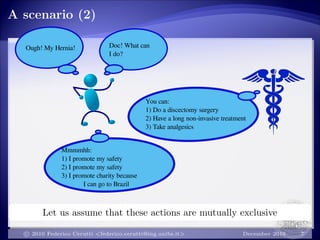
A scenario (2)
Ough! My Hernia! Doc! What can
I do?
You can:
1) Do a discectomy surgery
2) Have a long non-invasive treatment
3) Take analgesics
Mmmmhh:
1) I promote my safety
2) I promote my safety
3) I promote charity because
I can go to Brazil
Let us assume that these actions are mutually exclusive
c 2010 Federico Cerutti <federico.cerutti@ing.unibs.it> December 2010 7
A scenario (2): practical arguments
A2: circumstance: in my situation,
action: discectomy surgery,
goal: reducing disc herniation,
value: safety,
sign: +.
[Greenwood et al., 2003]
c 2010 Federico Cerutti <federico.cerutti@ing.unibs.it> December 2010 8
Mumble
A scenario (2): practical arguments
α [PAtS1]: source: A1,
target: A2,
conditions: A1.action and A2.action
are incompatible.
c 2010 Federico Cerutti <federico.cerutti@ing.unibs.it> December 2010 8
Mumble
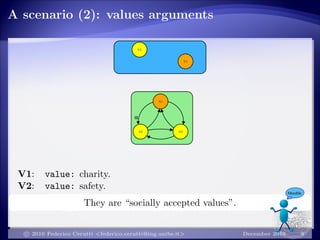
A scenario (2): values arguments
V1: value: charity.
V2: value: safety.
They are “socially accepted values”.
c 2010 Federico Cerutti <federico.cerutti@ing.unibs.it> December 2010 9
Mumble
A scenario (2): values defence (i)
β [VDes1]: source: V2,
target: α,
conditions: α.target.value = V2.value and
α.source.value = A2.value.
Each value is committed to protect each practical
argument that promotes it! And. . .
c 2010 Federico Cerutti <federico.cerutti@ing.unibs.it> December 2010 10
Mumble
A scenario (2): values defence (ii)
γ [VDes2]: source: V1,
target: β,
conditions: β.source = V1 and
β.target.source.value = V1.value.
Each value is committed to protect each attack
grounded on each practical argument that promotes it!
c 2010 Federico Cerutti <federico.cerutti@ing.unibs.it> December 2010 11
Mumble
A scenario (2): values defence (ii)
β [VDefence]: defending: A2,
defended: V2,
conditions: defending.value =
defended.value and defended.sign = +.
c 2010 Federico Cerutti <federico.cerutti@ing.unibs.it> December 2010 11
Mumble
A scenario (2): values defence (ii)
γ [VDefence]: defending: A1,
defended: V1,
conditions: defending.value =
defended.value and defended.sign = +.
c 2010 Federico Cerutti <federico.cerutti@ing.unibs.it> December 2010 11
Mumble
A scenario (3)
But I can't do a discetomy
surgery since I have a history
of anaesthesia allergy
c 2010 Federico Cerutti <federico.cerutti@ing.unibs.it> December 2010 12
A scenario (3): contradictory pract. arg. (i)
A4: circumstance: alternative anaesthesia not available
for discectomy,
action: not discectomy surgery,
goal: risk of shock,
value: safety,
sign: −.
c 2010 Federico Cerutti <federico.cerutti@ing.unibs.it> December 2010 13
Mumble
A scenario (3): contradictory pract. arg. (i)
δ [PAtS2]: source: A4,
target: A2,
conditions: A4.action = ¬ A2.action.
c 2010 Federico Cerutti <federico.cerutti@ing.unibs.it> December 2010 13
Mumble
A scenario (3): contradictory pract. arg. (ii)
[VAAtS]: source: A4,
target: β,
conditions: A4.action = ¬ β.defended.action
and A4.value = β.defended.value and
A4.sign = − and β.defended.sign = +.
c 2010 Federico Cerutti <federico.cerutti@ing.unibs.it> December 2010 14
Mumble
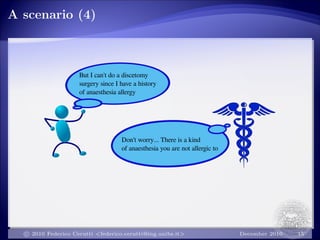
A scenario (4)
But I can't do a discetomy
surgery since I have a history
of anaesthesia allergy
Don't worry... There is a kind
of anaesthesia you are not allergic to
c 2010 Federico Cerutti <federico.cerutti@ing.unibs.it> December 2010 15
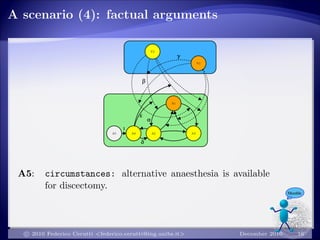
A scenario (4): factual arguments
A5: circumstances: alternative anaesthesia is available
for discectomy.
c 2010 Federico Cerutti <federico.cerutti@ing.unibs.it> December 2010 16
Mumble
A scenario (4): factual arguments
ι [FAtS1]: source: A5,
target: A4,
conditions: A5.circumstances =
¬ A4.circumstances.
c 2010 Federico Cerutti <federico.cerutti@ing.unibs.it> December 2010 16
Mumble
A scenario (5)
OK. With surgery I will get
over my illness in very few
days. But I'm frightened by surgery...
Noo... I categorically reject
the idea!
c 2010 Federico Cerutti <federico.cerutti@ing.unibs.it> December 2010 17
A scenario (5): preferences. . .
P1: preferred: A2,
notpreferred: A3.
c 2010 Federico Cerutti <federico.cerutti@ing.unibs.it> December 2010 18
Mumble
A scenario (5): preferences. . .
λ [PRAtS]: source: P1,
target: κ,
conditions: P1.preferred = κ.target
and P1.notpreferred = κ.source.
c 2010 Federico Cerutti <federico.cerutti@ing.unibs.it> December 2010 18
Mumble
A scenario (5): . . . and emotions
E1: emotion: surgery frightening.
Are emotions rational?
c 2010 Federico Cerutti <federico.cerutti@ing.unibs.it> December 2010 19
Mumble
A scenario (5): . . . and emotions
µ [EAtS1]: source: E1,
target: A2,
conditions: e(E1,A2) = −.
with e(E1, A2) = −
c 2010 Federico Cerutti <federico.cerutti@ing.unibs.it> December 2010 19
Mumble
A scenario (6)
OK. I must care about my health.
Then, I will help people again!
c 2010 Federico Cerutti <federico.cerutti@ing.unibs.it> December 2010 20
A scenario (6): Must Value
MUST V2: value: safety.
This is again a rational choice!
c 2010 Federico Cerutti <federico.cerutti@ing.unibs.it> December 2010 21
Mumble
A scenario (6): Must Value
ν [MAtS2]: source: MUST V2,
target: γ,
conditions: MUST V2.value =
γ.target.source.value and
MUST V2.value = γ.source.value.
c 2010 Federico Cerutti <federico.cerutti@ing.unibs.it> December 2010 21
Mumble
Why three boxes?
c 2010 Federico Cerutti <federico.cerutti@ing.unibs.it> December 2010 22
Why three boxes?
1 The set of arguments that take into account
values;
VAS arguments.
2 The set of arguments whose bases are not rational;
EAS arguments.
3 The set of arguments that deal with both facts and values;
FAS, PAS, PRAS, and MAS.
c 2010 Federico Cerutti <federico.cerutti@ing.unibs.it> December 2010 22
Look familiar?
c 2010 Federico Cerutti <federico.cerutti@ing.unibs.it> December 2010 23
Look familiar?
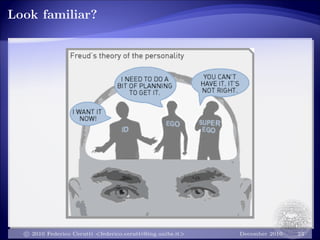
1 The Superego strives to act in a socially appropriate manner.
2 The Id is the innate part of our personality and is based on the
pleasure principle.
3 The Ego represents what may be
called reason and common sense
and has to conciliate the innate
instincts and the social constraints.
c 2010 Federico Cerutti <federico.cerutti@ing.unibs.it> December 2010 23
Knowledge Representation
Computation of Outcomes
Conclusions and Future works
c 2010 Federico Cerutti <federico.cerutti@ing.unibs.it> December 2010 24
Argumentation Framework for Decision Support
Problem
An Argumentation Framework for Decision Support Problem
(AFDSP) is a 12-ple APAS, APRAS, AEAS, AV AS, AFAS,
AMAS, RPAS, RPRAS, REAS, RV AS, RFAS, RMAS s.t.:
APAS is a set of instances of PAS;
APRAS is a set of instances of PRAS;
AEAS is the set of instances of EAS;
AV AS is a set of instances of VAS;
AFAS is a set of instances of FAS;
AMAS is a set of instances of MAS;
RPAS is a set of instances of PAtS1 and PAtS2;
RPRAS is a set of instances of PRAtS;
REAS is a set of instances of EAtS1 and EDefence;
RV AS is a set of instances of VAtS, VDeS1, VDeS2, VAAtS;
RFAS is a set of instances of FAtS;
RMAS is a set of instances of MAtS1, and MAtS2.
c 2010 Federico Cerutti <federico.cerutti@ing.unibs.it> December 2010 25
Argumentation Framework with Recursive
Attacks (AFRA)
An Argumentation Framework with Recursive Attacks (AFRA) is a
pair A, R where A is a set of arguments and R is a set of attacks,
namely pairs (A, X ) s.t. A ∈ A and (X ∈ R or X ∈ A).
Given an attack α = (A, X ) ∈ R, we will say that A is the source of
α, denoted as src(α) = A and X is the target of α, denoted as
trg(α) = X . [Baroni et al., 2009b]
c 2010 Federico Cerutti <federico.cerutti@ing.unibs.it> December 2010 26
From AFDSP to AFRA
The instances of argument schemes in AFDSP compose the set of
arguments in AFRA and the instances of attack schemes in AFDSP
give rise to the attack relation in AFRA.
Let Φ = APAS, APRAS, AEAS, AV AS, AFAS, AMAS, RPAS, RPRAS,
REAS, RV AS, RFAS, RMAS be an AFDSP, the corresponding
AFRA is defined as Γ = A, R s.t.
A = APAS ∪ APRAS ∪ AEAS ∪ AV AS ∪ AFAS ∪ AMAS; and
R = RPAS ∪ RPRAS ∪ REAS ∪ RV AS ∪ RFAS ∪ RMAS.
c 2010 Federico Cerutti <federico.cerutti@ing.unibs.it> December 2010 27
Defeat relation
Definition (Direct Defeat)
Let A, R be an AFRA, V ∈ R, W ∈ A ∪ R, then V directly defeats
W iff W = trg(V ).
Definition (Indirect Defeat)
Let A, R be an AFRA, V ∈ R, W ∈ A, if V directly defeats W
then ∀α ∈ R s.t. src(α) = W , V indirectly defeats α.
Definition (Defeat)
Let A, R be an AFRA, V ∈ R, W ∈ A ∪ R, then V defeats W ,
denoted as V →R W , iff V directly or indirectly defeats W .
c 2010 Federico Cerutti <federico.cerutti@ing.unibs.it> December 2010 28
Semantics notions
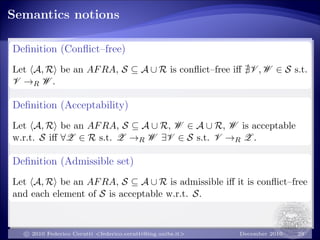
Definition (Conflict–free)
Let A, R be an AFRA, S ⊆ A ∪ R is conflict–free iff V , W ∈ S s.t.
V →R W .
Definition (Acceptability)
Let A, R be an AFRA, S ⊆ A ∪ R, W ∈ A ∪ R, W is acceptable
w.r.t. S iff ∀Z ∈ R s.t. Z →R W ∃V ∈ S s.t. V →R Z .
Definition (Admissible set)
Let A, R be an AFRA, S ⊆ A ∪ R is admissible iff it is conflict–free
and each element of S is acceptable w.r.t. S.
c 2010 Federico Cerutti <federico.cerutti@ing.unibs.it> December 2010 29
Preferred Extension
A preferred extension is a maximal (w.r.t. set inclusion) admissible
set.
c 2010 Federico Cerutti <federico.cerutti@ing.unibs.it> December 2010 30
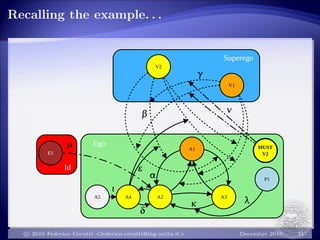
Recalling the example. . .
A1
A2 A3A4
V2
V1
d
a
b
g
e
A5
i
P1
E1
k l
m MUST
V2
n
Ego
Superego
Id
c 2010 Federico Cerutti <federico.cerutti@ing.unibs.it> December 2010 31
. . . and the preferred extension
A3
V2
V1
b
A5
i
P1
E1
l
m MUST
V2
n
Ego
Superego
Id
c 2010 Federico Cerutti <federico.cerutti@ing.unibs.it> December 2010 32
Knowledge Representation
Computation of Outcomes
Conclusions and Future
works
c 2010 Federico Cerutti <federico.cerutti@ing.unibs.it> December 2010 33
Conclusions
Extension of a previous proposal [Baroni et al., 2009a]
Human emotions in decision making process
Main contribution: preliminary description of a mapping between
argumentation based decision process and Freud’s three entities
model of personality
c 2010 Federico Cerutti <federico.cerutti@ing.unibs.it> December 2010 34
Future works
Fill the gap between attack schemes and critical questions
Deep analysis on Superego and Id:
Enhancing the relevant argument schemes
More articulated personality models
c 2010 Federico Cerutti <federico.cerutti@ing.unibs.it> December 2010 35
Thank you
c 2010 Federico Cerutti <federico.cerutti@ing.unibs.it>
References
[Baroni et al., 2009a] Baroni, P., Cerutti, F., Giacomin, M., and
Guida, G. (2009a).
An argumentation-based approach to modeling decision support
contexts with what-if capabilities.
In AAAI Fall Symposium. Technical Report SS-09-06, pages 2–7.
AAAI Press.
[Baroni et al., 2009b] Baroni, P., Cerutti, F., Giacomin, M., and
Guida, G. (2009b).
Encompassing attacks to attacks in abstract argumentation
frameworks.
In Proc. of ECSQARU 2009, pages 83–94, Verona, I.
[Girle et al., 2003] Girle, R., Hitchcock, D. L., McBurney, P., and
Verheij, B. (2003).
Decision support for practical reasoning: A theoretical and
computational perspective.
In Reed, C. and Norman, T. J., editors, Argumentation Machines.
New Frontiers in Argument and Computation, pages 55–84. Kluwer.c 2010 Federico Cerutti <federico.cerutti@ing.unibs.it> December 2010 37

Cerutti--ARGAIP 2010

  • 1.
    Argumentation-Based Decision Makingand Structural Models of Personality Pietro Baroni and Federico Cerutti and Massimiliano Giacomin and Giovanni Guida Dipartimento di Ingegneria dell’Informazione, Universit`a di Brescia Via Branze 38, I-25123 Brescia, Italy December 3, 2010 ARGAIP 2010 c 2010 Federico Cerutti <federico.cerutti@ing.unibs.it>
  • 2.
    “Good Advice” The adviceshould be presented in a form which can be readily understood by decision makers There should be ready access to both information and reasoning underpinning the advice If decision support involves details which are unusual to the decision maker, it is of primary importance that s/he can discuss these details with his advisor [Girle et al., 2003] c 2010 Federico Cerutti <federico.cerutti@ing.unibs.it> December 2010 2 Practical Reasoning about “What to do” Knowledge Representation Computation of Outcomes
  • 3.
    Knowledge Representation Computation ofOutcomes Conclusions and Future works c 2010 Federico Cerutti <federico.cerutti@ing.unibs.it> December 2010 3
  • 4.
    Argument (and Attack)schemes Argument schemes for knowledge representation [Walton, 1996] Structure which contains the information supporting a given conclusion Modelling conflicts by “attack scheme” Structure which contains the information supporting a given conflict c 2010 Federico Cerutti <federico.cerutti@ing.unibs.it> December 2010 4
  • 5.
    The main concepts Circumstance:a state of the world Fact: a particular circumstance assumed to be true Goal: a state of the world we want to achieve Action: support for the achievement of a goal Emotion: “a strong feeling deriving from one’s circumstances, [or] mood[. . . ]” Preference: “[. . . ] a greater liking for one alternative over another or others [. . . ]” Value: “Worth or worthiness [. . . ] in respect of rank or personal qualities” Must Value: a value that we are committed to promote c 2010 Federico Cerutti <federico.cerutti@ing.unibs.it> December 2010 5
  • 6.
    A scenario (1) Ihave to go to the Amazon Rainforest I want to help people! c 2010 Federico Cerutti <federico.cerutti@ing.unibs.it> December 2010 6
  • 7.
    A scenario (2) Ough!My Hernia! Doc! What can I do? You can: 1) Do a discectomy surgery 2) Have a long non-invasive treatment 3) Take analgesics Mmmmhh: 1) I promote my safety 2) I promote my safety 3) I promote charity because I can go to Brazil Let us assume that these actions are mutually exclusive c 2010 Federico Cerutti <federico.cerutti@ing.unibs.it> December 2010 7
  • 8.
    A scenario (2):practical arguments A2: circumstance: in my situation, action: discectomy surgery, goal: reducing disc herniation, value: safety, sign: +. [Greenwood et al., 2003] c 2010 Federico Cerutti <federico.cerutti@ing.unibs.it> December 2010 8 Mumble
  • 9.
    A scenario (2):practical arguments α [PAtS1]: source: A1, target: A2, conditions: A1.action and A2.action are incompatible. c 2010 Federico Cerutti <federico.cerutti@ing.unibs.it> December 2010 8 Mumble
  • 10.
    A scenario (2):values arguments V1: value: charity. V2: value: safety. They are “socially accepted values”. c 2010 Federico Cerutti <federico.cerutti@ing.unibs.it> December 2010 9 Mumble
  • 11.
    A scenario (2):values defence (i) β [VDes1]: source: V2, target: α, conditions: α.target.value = V2.value and α.source.value = A2.value. Each value is committed to protect each practical argument that promotes it! And. . . c 2010 Federico Cerutti <federico.cerutti@ing.unibs.it> December 2010 10 Mumble
  • 12.
    A scenario (2):values defence (ii) γ [VDes2]: source: V1, target: β, conditions: β.source = V1 and β.target.source.value = V1.value. Each value is committed to protect each attack grounded on each practical argument that promotes it! c 2010 Federico Cerutti <federico.cerutti@ing.unibs.it> December 2010 11 Mumble
  • 13.
    A scenario (2):values defence (ii) β [VDefence]: defending: A2, defended: V2, conditions: defending.value = defended.value and defended.sign = +. c 2010 Federico Cerutti <federico.cerutti@ing.unibs.it> December 2010 11 Mumble
  • 14.
    A scenario (2):values defence (ii) γ [VDefence]: defending: A1, defended: V1, conditions: defending.value = defended.value and defended.sign = +. c 2010 Federico Cerutti <federico.cerutti@ing.unibs.it> December 2010 11 Mumble
  • 15.
    A scenario (3) ButI can't do a discetomy surgery since I have a history of anaesthesia allergy c 2010 Federico Cerutti <federico.cerutti@ing.unibs.it> December 2010 12
  • 16.
    A scenario (3):contradictory pract. arg. (i) A4: circumstance: alternative anaesthesia not available for discectomy, action: not discectomy surgery, goal: risk of shock, value: safety, sign: −. c 2010 Federico Cerutti <federico.cerutti@ing.unibs.it> December 2010 13 Mumble
  • 17.
    A scenario (3):contradictory pract. arg. (i) δ [PAtS2]: source: A4, target: A2, conditions: A4.action = ¬ A2.action. c 2010 Federico Cerutti <federico.cerutti@ing.unibs.it> December 2010 13 Mumble
  • 18.
    A scenario (3):contradictory pract. arg. (ii) [VAAtS]: source: A4, target: β, conditions: A4.action = ¬ β.defended.action and A4.value = β.defended.value and A4.sign = − and β.defended.sign = +. c 2010 Federico Cerutti <federico.cerutti@ing.unibs.it> December 2010 14 Mumble
  • 19.
    A scenario (4) ButI can't do a discetomy surgery since I have a history of anaesthesia allergy Don't worry... There is a kind of anaesthesia you are not allergic to c 2010 Federico Cerutti <federico.cerutti@ing.unibs.it> December 2010 15
  • 20.
    A scenario (4):factual arguments A5: circumstances: alternative anaesthesia is available for discectomy. c 2010 Federico Cerutti <federico.cerutti@ing.unibs.it> December 2010 16 Mumble
  • 21.
    A scenario (4):factual arguments ι [FAtS1]: source: A5, target: A4, conditions: A5.circumstances = ¬ A4.circumstances. c 2010 Federico Cerutti <federico.cerutti@ing.unibs.it> December 2010 16 Mumble
  • 22.
    A scenario (5) OK.With surgery I will get over my illness in very few days. But I'm frightened by surgery... Noo... I categorically reject the idea! c 2010 Federico Cerutti <federico.cerutti@ing.unibs.it> December 2010 17
  • 23.
    A scenario (5):preferences. . . P1: preferred: A2, notpreferred: A3. c 2010 Federico Cerutti <federico.cerutti@ing.unibs.it> December 2010 18 Mumble
  • 24.
    A scenario (5):preferences. . . λ [PRAtS]: source: P1, target: κ, conditions: P1.preferred = κ.target and P1.notpreferred = κ.source. c 2010 Federico Cerutti <federico.cerutti@ing.unibs.it> December 2010 18 Mumble
  • 25.
    A scenario (5):. . . and emotions E1: emotion: surgery frightening. Are emotions rational? c 2010 Federico Cerutti <federico.cerutti@ing.unibs.it> December 2010 19 Mumble
  • 26.
    A scenario (5):. . . and emotions µ [EAtS1]: source: E1, target: A2, conditions: e(E1,A2) = −. with e(E1, A2) = − c 2010 Federico Cerutti <federico.cerutti@ing.unibs.it> December 2010 19 Mumble
  • 27.
    A scenario (6) OK.I must care about my health. Then, I will help people again! c 2010 Federico Cerutti <federico.cerutti@ing.unibs.it> December 2010 20
  • 28.
    A scenario (6):Must Value MUST V2: value: safety. This is again a rational choice! c 2010 Federico Cerutti <federico.cerutti@ing.unibs.it> December 2010 21 Mumble
  • 29.
    A scenario (6):Must Value ν [MAtS2]: source: MUST V2, target: γ, conditions: MUST V2.value = γ.target.source.value and MUST V2.value = γ.source.value. c 2010 Federico Cerutti <federico.cerutti@ing.unibs.it> December 2010 21 Mumble
  • 30.
    Why three boxes? c2010 Federico Cerutti <federico.cerutti@ing.unibs.it> December 2010 22
  • 31.
    Why three boxes? 1The set of arguments that take into account values; VAS arguments. 2 The set of arguments whose bases are not rational; EAS arguments. 3 The set of arguments that deal with both facts and values; FAS, PAS, PRAS, and MAS. c 2010 Federico Cerutti <federico.cerutti@ing.unibs.it> December 2010 22
  • 32.
    Look familiar? c 2010Federico Cerutti <federico.cerutti@ing.unibs.it> December 2010 23
  • 33.
    Look familiar? 1 TheSuperego strives to act in a socially appropriate manner. 2 The Id is the innate part of our personality and is based on the pleasure principle. 3 The Ego represents what may be called reason and common sense and has to conciliate the innate instincts and the social constraints. c 2010 Federico Cerutti <federico.cerutti@ing.unibs.it> December 2010 23
  • 34.
    Knowledge Representation Computation ofOutcomes Conclusions and Future works c 2010 Federico Cerutti <federico.cerutti@ing.unibs.it> December 2010 24
  • 35.
    Argumentation Framework forDecision Support Problem An Argumentation Framework for Decision Support Problem (AFDSP) is a 12-ple APAS, APRAS, AEAS, AV AS, AFAS, AMAS, RPAS, RPRAS, REAS, RV AS, RFAS, RMAS s.t.: APAS is a set of instances of PAS; APRAS is a set of instances of PRAS; AEAS is the set of instances of EAS; AV AS is a set of instances of VAS; AFAS is a set of instances of FAS; AMAS is a set of instances of MAS; RPAS is a set of instances of PAtS1 and PAtS2; RPRAS is a set of instances of PRAtS; REAS is a set of instances of EAtS1 and EDefence; RV AS is a set of instances of VAtS, VDeS1, VDeS2, VAAtS; RFAS is a set of instances of FAtS; RMAS is a set of instances of MAtS1, and MAtS2. c 2010 Federico Cerutti <federico.cerutti@ing.unibs.it> December 2010 25
  • 36.
    Argumentation Framework withRecursive Attacks (AFRA) An Argumentation Framework with Recursive Attacks (AFRA) is a pair A, R where A is a set of arguments and R is a set of attacks, namely pairs (A, X ) s.t. A ∈ A and (X ∈ R or X ∈ A). Given an attack α = (A, X ) ∈ R, we will say that A is the source of α, denoted as src(α) = A and X is the target of α, denoted as trg(α) = X . [Baroni et al., 2009b] c 2010 Federico Cerutti <federico.cerutti@ing.unibs.it> December 2010 26
  • 37.
    From AFDSP toAFRA The instances of argument schemes in AFDSP compose the set of arguments in AFRA and the instances of attack schemes in AFDSP give rise to the attack relation in AFRA. Let Φ = APAS, APRAS, AEAS, AV AS, AFAS, AMAS, RPAS, RPRAS, REAS, RV AS, RFAS, RMAS be an AFDSP, the corresponding AFRA is defined as Γ = A, R s.t. A = APAS ∪ APRAS ∪ AEAS ∪ AV AS ∪ AFAS ∪ AMAS; and R = RPAS ∪ RPRAS ∪ REAS ∪ RV AS ∪ RFAS ∪ RMAS. c 2010 Federico Cerutti <federico.cerutti@ing.unibs.it> December 2010 27
  • 38.
    Defeat relation Definition (DirectDefeat) Let A, R be an AFRA, V ∈ R, W ∈ A ∪ R, then V directly defeats W iff W = trg(V ). Definition (Indirect Defeat) Let A, R be an AFRA, V ∈ R, W ∈ A, if V directly defeats W then ∀α ∈ R s.t. src(α) = W , V indirectly defeats α. Definition (Defeat) Let A, R be an AFRA, V ∈ R, W ∈ A ∪ R, then V defeats W , denoted as V →R W , iff V directly or indirectly defeats W . c 2010 Federico Cerutti <federico.cerutti@ing.unibs.it> December 2010 28
  • 39.
    Semantics notions Definition (Conflict–free) LetA, R be an AFRA, S ⊆ A ∪ R is conflict–free iff V , W ∈ S s.t. V →R W . Definition (Acceptability) Let A, R be an AFRA, S ⊆ A ∪ R, W ∈ A ∪ R, W is acceptable w.r.t. S iff ∀Z ∈ R s.t. Z →R W ∃V ∈ S s.t. V →R Z . Definition (Admissible set) Let A, R be an AFRA, S ⊆ A ∪ R is admissible iff it is conflict–free and each element of S is acceptable w.r.t. S. c 2010 Federico Cerutti <federico.cerutti@ing.unibs.it> December 2010 29
  • 40.
    Preferred Extension A preferredextension is a maximal (w.r.t. set inclusion) admissible set. c 2010 Federico Cerutti <federico.cerutti@ing.unibs.it> December 2010 30
  • 41.
    Recalling the example.. . A1 A2 A3A4 V2 V1 d a b g e A5 i P1 E1 k l m MUST V2 n Ego Superego Id c 2010 Federico Cerutti <federico.cerutti@ing.unibs.it> December 2010 31
  • 42.
    . . .and the preferred extension A3 V2 V1 b A5 i P1 E1 l m MUST V2 n Ego Superego Id c 2010 Federico Cerutti <federico.cerutti@ing.unibs.it> December 2010 32
  • 43.
    Knowledge Representation Computation ofOutcomes Conclusions and Future works c 2010 Federico Cerutti <federico.cerutti@ing.unibs.it> December 2010 33
  • 44.
    Conclusions Extension of aprevious proposal [Baroni et al., 2009a] Human emotions in decision making process Main contribution: preliminary description of a mapping between argumentation based decision process and Freud’s three entities model of personality c 2010 Federico Cerutti <federico.cerutti@ing.unibs.it> December 2010 34
  • 45.
    Future works Fill thegap between attack schemes and critical questions Deep analysis on Superego and Id: Enhancing the relevant argument schemes More articulated personality models c 2010 Federico Cerutti <federico.cerutti@ing.unibs.it> December 2010 35
  • 46.
    Thank you c 2010Federico Cerutti <federico.cerutti@ing.unibs.it>
  • 47.
    References [Baroni et al.,2009a] Baroni, P., Cerutti, F., Giacomin, M., and Guida, G. (2009a). An argumentation-based approach to modeling decision support contexts with what-if capabilities. In AAAI Fall Symposium. Technical Report SS-09-06, pages 2–7. AAAI Press. [Baroni et al., 2009b] Baroni, P., Cerutti, F., Giacomin, M., and Guida, G. (2009b). Encompassing attacks to attacks in abstract argumentation frameworks. In Proc. of ECSQARU 2009, pages 83–94, Verona, I. [Girle et al., 2003] Girle, R., Hitchcock, D. L., McBurney, P., and Verheij, B. (2003). Decision support for practical reasoning: A theoretical and computational perspective. In Reed, C. and Norman, T. J., editors, Argumentation Machines. New Frontiers in Argument and Computation, pages 55–84. Kluwer.c 2010 Federico Cerutti <federico.cerutti@ing.unibs.it> December 2010 37