Practical Spherical Harmonics
Based PRT Methods
          Manny Ko
          Naughty Dog


          Jerome Ko
          UCSD / Bunkspeed
Outline

  Background  ambient occlusion, HL2
  Spherical Harmonics theory
  Pre-processing
  PRT compression – 4 to 6 bytes per
   sample
  Conclusion and game scene demo
Background

  Many  variants of Precomputed
   Radiance Transfer – self-shadow,
   interreflections, diffuse vs. glossy
  Power of PRT best understood in the
   context of ambient occlusion (AO)
   and HL2 basis
Goals

  Diffuse  self-shadowing for rigid
   bodies (aka neighborhood transfer)
  Generalizes easily to interreflections
  Decouples visibility calculation from
   lighting
  Pre-integrate surface variations
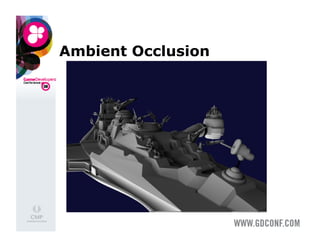
Ambient Occlusion


  Pioneered   by ILM
  Accessibility shading
Ambient Occlusion
Ambient Occlusion Flavors

 Single  scalar – cheap but no
  directional response
 Bent Normal
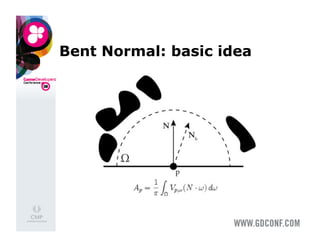
Bent Normal: basic idea
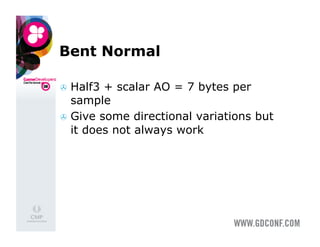
Bent Normal

  Half3 + scalar AO = 7 bytes per
   sample
  Give some directional variations but
   it does not always work
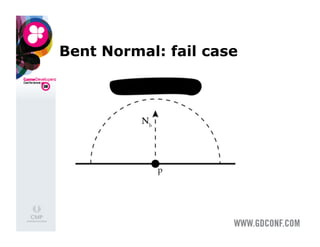
Bent Normal: fail case
Bent Normal: next step

  Overcome the single direction,
 single weight limitation
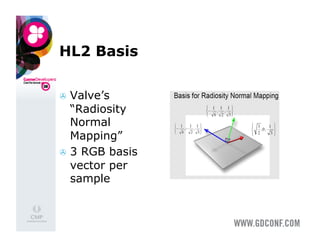
HL2 Basis

  Valve’s
   “Radiosity
   Normal
   Mapping”
  3 RGB basis
   vector per
   sample
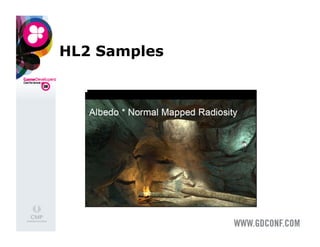
HL2 Samples
HL2 Strengths

    Successfully integrated GI with surface-
     details
    Surface details respond to runtime lights
    1st attempt in games to use a ‘lighting
     basis’
    Orthonormal basis
    Good for normal-maps
HL2 Weakness

  Lots of storage – 3 RGB maps per sample
   plus UVs
  3 texture lookup + 3 dotp/ pixel after
   rotating basis into tangent space. Shader
   cost can be a problem.
  Incomplete coverage of the hemisphere,
   3 directions not enough?
Key Ideas for PRT

  Visibilityis the key bottleneck since
   it involves sampling the scene
  Take advantage of off-line compute
  Separate pre-integration of visibility
   from that of incoming light
  Find a basis to store these functions
Key Ideas for PRT

    SH is a good starting point for a basis
    We do not trace rays using the GPU! Nor
     do we take tons of samples inside the
     pixel shader
    Better quality than AO or HL2 but more
     efficient than later
    Work well for static scene + moving lights
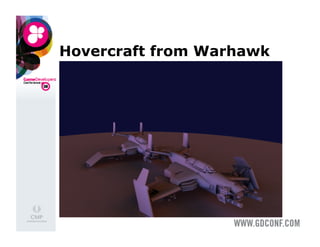
Hovercraft from Warhawk
Demo

  Buddha    – 1.08 m triangles
    33 fps on ATI X700
    250 fps on G8800 GTS
    Vertex shader only method
    Vertex buffer not optimized, could be
     faster
  Dragon    – 871k triangles
    40.7   fps on ATI X700
Implementation

    Jerome Ko
  UCSD / Bunkspeed
Outline

  Short introduction to SH (very
   short!)
  Environment map projection
  PRT coefficient generation
  Runtime reconstruction in vertex
   shader
Spherical Harmonics

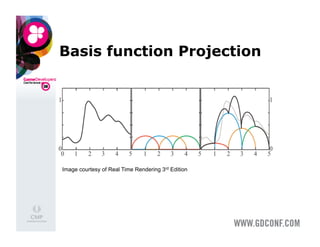
  2D  Fourier series on the sphere
  Represent 2D signals as scaled and
   shifted Fourier basis.
  Perfect for spherical functions
Basis function Projection


Image courtesy of Real Time Rendering 3rd Edition
Spherical Harmonics Characteristics


  Orthonormal basis ->
     convolution as dot products
     simple projection

  Multi-resolution/band-limited,
   related to Fourier decomposition
  Solid math foundation
  Stable rotation no wobbling lights
  Can add/subtract, lerp.
SH: bands (l,m)
    SH-order: order is the number of bands.
     ‘l’ is the order
    0th order: just a constant (DC) which is
     your AO term
    1st order: 3 linear terms which is your
     ‘bent normal’ term
    2nd order: 5 terms – these give the extra
     directional response we want
    In general (2l+1) terms
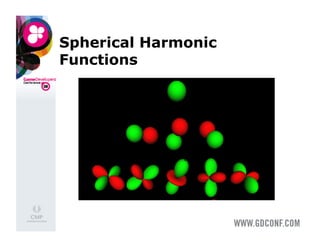
Spherical Harmonic
Functions
Spherical Harmonics - Issues

  Scary  math!
  Looks difficult to implement
  Lots of coefficients, too much
   storage?
  Difficult or time consuming to
   generate?
Environment Map Projection

  First we need a light source
  Ravi R. introduced a technique to
   light diffuse surfaces with distant
   environment map illumination
  Code available on Ravi’s site, we
   integrated it into our demo app
Environment Map Projection

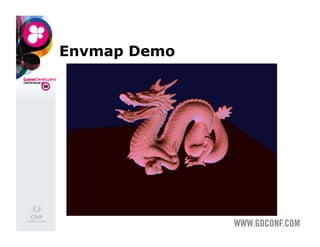
  9 SH-compressed coefficients
  Instead of a large cubemap you
   only need 27 numbers!
  Secret lies in the solid angle formula
  For each pixel evaluate the SH basis
   then weighted it by the solid angle
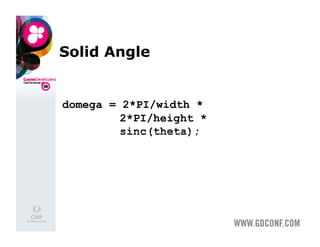
Solid Angle


domega = 2*PI/width *
         2*PI/height *
       = (2*PI/width)*(2*PI/height)*sinc(theta);


         sinc(theta);
Envmap Demo
PRT Coefficient Generation

  We  have simplified the light source,
   now we must also project the
   visibility function using SH
  This gives us compact storage of
   self-shadowing information
  Encodes the directional variations
   more accurately than AO or HL2
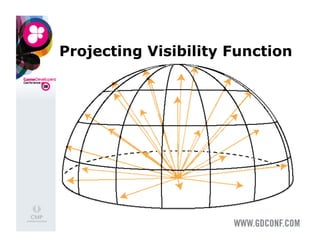
Projecting Visibility Function
for all samples {
    stratified2D( u1, u2 ); //stratified random numbers
    sampleHemisphere( shadowray, u1, u2, pdf[j] );
    H = dot(shadowray.direction, vertexnormal);

    if (H > 0) { //only use samples in upper hemisphere
        if (!occludedByGeometry(shadowray)) {
            for (int k = 0; k < bands; ++k) {
                RGBCoeff& coeff = coeffentry[k];
                //project onto SH basis
                grayness = H * shcoeffs[j*bands + k];
                grayness /= pdfs[j];
                coeff += grayness; //sum up contribution
            }
        }
    }
}
Projecting Visibility Function

    100-400 shadow rays per vertex are
     sufficient
    Use your best acceleration structures
    Vertex normal is accounted for in
     computation of H, thus no need for
     normal in shader
    Full visibility function is preserved
    Group objects together in acceleration
     structure to get inter-object shadowing
Runtime Reconstruction in
Vertex Shader
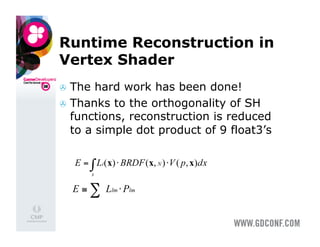
  The  hard work has been done!
  Thanks to the orthogonality of SH
   functions, reconstruction is reduced
   to a simple dot product of 9 float3’s
Runtime Reconstruction in
Vertex Shader
uniform vec3 Li[9];
attribute vec3 prt0;
attribute vec3 prt1;
attribute vec3 prt2;

color = Li[0]*(prt0.xxx) + Li[1]*
  (prt0.yyy) + Li[2]*(prt0.zzz);
color += Li[3]*(prt1.xxx) + Li[4]*
  (prt1.yyy) + Li[5]*(prt1.zzz);
color += Li[6]*(prt2.xxx) + Li[7]*
  (prt2.yyy) + Li[8]*(prt2.zzz);
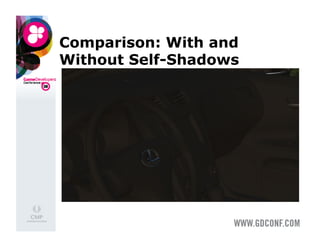
Comparison: With and
Without Self-Shadows
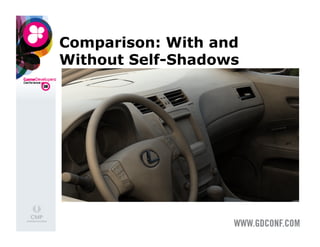
Comparison: With and
Without Self-Shadows
PRT in HyperDrive™
PRT Compression

    Manny Ko
    Naughty Dog
PRT Compression

    3rd order SH occupies 36 bytes per
     sample
    Normals encoded as Lambertian response
     during pre-processing
    World-space => no tangent space
     needed.
    Bandwidth is key to GPU performance.
    PRT data size is key to pervasive usage in
     game scenes.
Previous Work in PRT
Compression
    Sloan introduced CPCA
        Break mesh into small clusters
        PCA applied to each cluster to obtain a
         reduced set of basis
    Fairly effective if the clusters are small but
     that will add draw call overhead
    Hard to apply your vertex cache optimizer
Our PRT Compression

  M  1: 9 bytes using scale-bias
  M 2: 6 bytes (8; 6,6,6; 6,4,4,4,4)
  M 3: 6 bytes using Lloyd-Max
   relaxation
  M 4: 4 bytes (5; 4,4,4 ;3,3,3,3,3)
  All very simple to implement
Scalar Quantizer and Scale-
Bias
  How   to convert floats to bytes?
  Scan each sets of coefficients to get
   range
  Ci = (Pi – Biasi) * Scalei ?
  We are dealing with a scalar
   quantizer
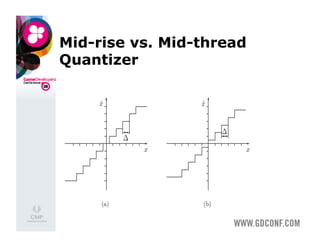
Mid-rise vs. Mid-thread
Quantizer
Mid-rise Quantizer

  A 2 bit mid-rise quantizer has only 3
   decision levels
  Advantage: can construct the DC-
   level exactly. This can be critical in
   some cases
Mid-thread Quantizer

  Even  number of levels – e.g. 4
   levels for a 2 bit code
  More accurate overall but cannot
   reconstruct the DC-level
  For 4 bit codes we improved the
   PSNR by ≈1db
ScalarQuantizer

float half = (qkind == PRT::kMidRise) ?
  0.5f : 0.f;

  for (int i=0; i < nc; i++) {
    float delta = scalars[i] – bias[i];
    p[i] = delta * scales[i];
    output[i] = floor(p[i] + half);
  }
Method 1: 9 Bytes

  Use  Mid-rise quantizer
  Remove 4PI factor from coefficients
  ¼ the memory and 2X improvement
   in speed
  No visible quality lost, PSNR > 78db
Method 2: 48 Bits

    Method 1 takes us down to 9 bytes. Can
     we do better?
    (8,6,6,6,6) (4,4,4,4) – bit fields
    Choice of bit allocation motivated by
     •    - Fourier theory => energy compaction
         - shader efficiency
    Cannot be optimal but try to be close
Square Norms by Band
  Energies   by band
    [0]: 34.8%
    [1]: 17.1%
    [2]: 15.3%
    [3]: 17.1%


  85%      of energies in 1st 4 bands
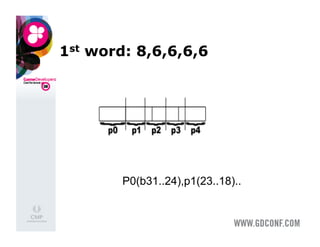
1st word: 8,6,6,6,6


        P0(b31..24),p1(23..18)..
Vertex Shader: Method 2

    Coefficients   will straddle input
     registers
    No bit operation in shaders – use
     floating point ops to simulate
    Mul/div by power-of-2 for L/R shifts
    Fract and trunc() to isolate the 2
     pieces. Add for ‘or’
    Tries to take advantage of SIMD
vertex shader

    // rshft(s[0], 1/4, 1/16, 1/64)
    p14 = prt0 * rshft;
    lhs3.yzw = fract(p14.yzw);
     // lshft(0, 16.*4., 4.*16., 64.);
    lhs3 *= lshft;
 
    //p[0]:
    pp0 = p14.x + bias0;
    //p[1..4]:
    p14.xyz = (lhs3.xyz + floor(p14.yzw)) *   scales.xyz
     + bias.xyz;

    p14.w = lhs3.w * scales.w + bias.w;
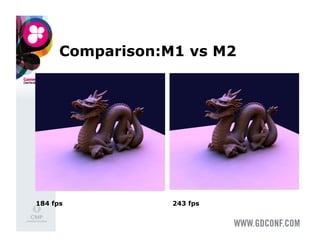
Comparison:M1 vs M2


184 fps           243 fps
Method 2: Demo and
Discussion
    Improved fps by ~17% compared with M1
    Reduced memory usage by 33%. More
     with alignment restrictions
    Reduced the number of streams by 1 with
     room to spare
    GFLOPS for modern GPU going up much
     faster than bandwidth
    Looking for more mathops per byte?
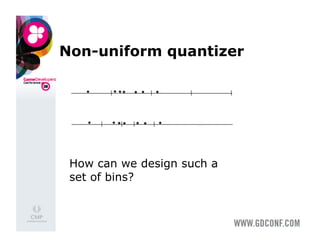
Uniform vs. Non-Uniform
Quantizer
  A uniform quantizer divides the
   range evenly
  Optimal only if all the inputs are
   equally probable
  Intuitively in regions of low
   probability the bin should be wider
Non-uniform quantizer


 How can we design such a
 set of bins?
Lloyd-Max Algorithm

    A version of k-means clustering algorithm
    Given a fixed number of bins iteratively
     solves for an optimal set of bins
    Converges quickly
    Key is a probability distribution table (pdf)
    Applied to all 9 bands separatedly
    Details in ShaderX6
Lloyd-Max Iteration

    Given an initial set of bins tk..tk+1
    Find qk such that it is the centroid of tk..tk
     +1
    Find tk so that it is the mid-point of qk..qk
     +1
    Repeat for all the bins
    Check for convergence
    qks become the reconstruction levels.
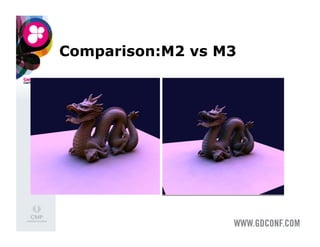
Comparison:M2 vs M3
Quality increase for LM


 Improved the PSNR by 1.3
- 1.5db
Shader for Lloyd-Max

    Almost the same as M2 since we are using
     the same bit-allocation scheme
    Decoded bit-fields used to index a table of
     reconstruction levels recon[]- the
     centroids of the bins used in the quantizer
    can be constants or a small vertex texture
    Only used for 4 of the 2nd order terms
Lloyd-Max demo

    Fps is about the same or a little slower on
     older GPUs. Same speed on new GPUs
    Better quality
    Sensitive to initial condition see paper for
     literature references.
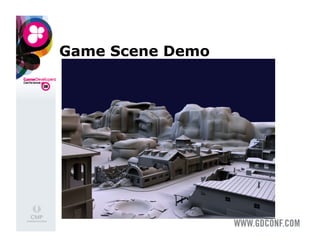
Game Scene Demo
Limitations

  Methods   equally good for a
   map based approach
  Distant Illumination
  •  Good for smaller objects
    For large objects either split them
     or blend multiple Lis within
     shader to avoid seams
Generalize to Interreflections

    Instead of sampling visibility gather
     indirect illumination
    Use a photonmap or irradiance cache or
     iteratively gather using visibility PRTs
    Use 3x48 or 3x32 bits per sample
    Or pack a 5,6,5 color with one of the 48
     bit PRT methods.
Light Sources

  Not limited to environment maps
  Pre-integrate any kind of light
   sources – preferable area lights or a
   large collection of lights or use
   probes
  Runtime methods to generate Lis
  Add or subtract lights easily – just
   add/sub the Lis.
  Rotating lights is cheap
Normal maps

  Bake  the normal variations and fine
   surface details into the PRT
  Or use Peter-Pike’s [06] method
Good tool

 DirectX SDK comes with
 an offline PRT tool
Conclusions

    Demonstrate how to implement all key
     elements of a SH-based PRT shader
     system
    Compact and efficient even for older GPUs
     and no tangent space required
    Better than simple AO and bent-normal
    Smaller than bent-normal
    Groundwork for more GI effects
More on SH and PRT

  Peter-Pike’s talk Wed. 2:30pm
  Hao’s talk Thu. 4pm
  Yaohua’s talk Fri. 2:30pm
Contact Info

  Manny Ko – man961.great@gmail.com
  Jerome Ko – submatrix@gmail.com
Credits
  Matthias   Zwicker for his guidance
   and advising on the PRT research
  Ravi for all his help and generosity
  Peter-Pike S. for sharing his insights
  Incognito Studio for game assets
  Eric H. and Naty H. for figures
  Bunkspeed for screenshots
  All our friends
References

    [Green 07] “Surface Detail Maps with Soft
     Self-Shadowing”, Siggraph 2007 Course.
    [Ko,Ko 08] “Practical Spherical Harmonics
     based PRT Methods”, ShaderX6 2008.
    [McTaggart 04] “Half-Life 2 / Valve Source
     Shading”, GDC 2004.
    [Mueller,Haines,Hoffman] Real Time
     Rendering 3rd Edition.
References

  [Landis02]  Production-Ready Global
   Illumination, Siggraph 2002 Course.
  [Pharr 04] ”Ambient occlusion”,
   GDC 2004.

Practical Spherical Harmonics Based PRT Methods

  • 2.
    Practical Spherical Harmonics BasedPRT Methods Manny Ko Naughty Dog Jerome Ko UCSD / Bunkspeed
  • 3.
    Outline   Background ambient occlusion, HL2   Spherical Harmonics theory   Pre-processing   PRT compression – 4 to 6 bytes per sample   Conclusion and game scene demo
  • 4.
    Background   Many variants of Precomputed Radiance Transfer – self-shadow, interreflections, diffuse vs. glossy   Power of PRT best understood in the context of ambient occlusion (AO) and HL2 basis
  • 5.
    Goals   Diffuse self-shadowing for rigid bodies (aka neighborhood transfer)   Generalizes easily to interreflections   Decouples visibility calculation from lighting   Pre-integrate surface variations
  • 6.
    Ambient Occlusion   Pioneered by ILM   Accessibility shading
  • 7.
  • 8.
    Ambient Occlusion Flavors  Single scalar – cheap but no directional response  Bent Normal
  • 9.
  • 10.
    Bent Normal   Half3+ scalar AO = 7 bytes per sample   Give some directional variations but it does not always work
  • 11.
  • 12.
    Bent Normal: nextstep   Overcome the single direction, single weight limitation
  • 13.
    HL2 Basis   Valve’s “Radiosity Normal Mapping”   3 RGB basis vector per sample
  • 14.
  • 15.
    HL2 Strengths   Successfully integrated GI with surface- details   Surface details respond to runtime lights   1st attempt in games to use a ‘lighting basis’   Orthonormal basis   Good for normal-maps
  • 16.
    HL2 Weakness   Lotsof storage – 3 RGB maps per sample plus UVs   3 texture lookup + 3 dotp/ pixel after rotating basis into tangent space. Shader cost can be a problem.   Incomplete coverage of the hemisphere, 3 directions not enough?
  • 17.
    Key Ideas forPRT   Visibilityis the key bottleneck since it involves sampling the scene   Take advantage of off-line compute   Separate pre-integration of visibility from that of incoming light   Find a basis to store these functions
  • 18.
    Key Ideas forPRT   SH is a good starting point for a basis   We do not trace rays using the GPU! Nor do we take tons of samples inside the pixel shader   Better quality than AO or HL2 but more efficient than later   Work well for static scene + moving lights
  • 19.
  • 20.
    Demo   Buddha – 1.08 m triangles   33 fps on ATI X700   250 fps on G8800 GTS   Vertex shader only method   Vertex buffer not optimized, could be faster   Dragon – 871k triangles   40.7 fps on ATI X700
  • 21.
    Implementation Jerome Ko UCSD / Bunkspeed
  • 22.
    Outline   Short introductionto SH (very short!)   Environment map projection   PRT coefficient generation   Runtime reconstruction in vertex shader
  • 23.
    Spherical Harmonics   2D Fourier series on the sphere   Represent 2D signals as scaled and shifted Fourier basis.   Perfect for spherical functions
  • 24.
    Basis function Projection Imagecourtesy of Real Time Rendering 3rd Edition
  • 25.
    Spherical Harmonics Characteristics  Orthonormal basis ->   convolution as dot products   simple projection   Multi-resolution/band-limited, related to Fourier decomposition   Solid math foundation   Stable rotation no wobbling lights   Can add/subtract, lerp.
  • 26.
    SH: bands (l,m)   SH-order: order is the number of bands. ‘l’ is the order   0th order: just a constant (DC) which is your AO term   1st order: 3 linear terms which is your ‘bent normal’ term   2nd order: 5 terms – these give the extra directional response we want   In general (2l+1) terms
  • 27.
  • 28.
    Spherical Harmonics -Issues   Scary math!   Looks difficult to implement   Lots of coefficients, too much storage?   Difficult or time consuming to generate?
  • 29.
    Environment Map Projection  First we need a light source   Ravi R. introduced a technique to light diffuse surfaces with distant environment map illumination   Code available on Ravi’s site, we integrated it into our demo app
  • 30.
    Environment Map Projection  9 SH-compressed coefficients   Instead of a large cubemap you only need 27 numbers!   Secret lies in the solid angle formula   For each pixel evaluate the SH basis then weighted it by the solid angle
  • 31.
    Solid Angle domega =2*PI/width * 2*PI/height * = (2*PI/width)*(2*PI/height)*sinc(theta); sinc(theta);
  • 32.
  • 33.
    PRT Coefficient Generation  We have simplified the light source, now we must also project the visibility function using SH   This gives us compact storage of self-shadowing information   Encodes the directional variations more accurately than AO or HL2
  • 34.
  • 35.
    Projecting Visibility Function forall samples { stratified2D( u1, u2 ); //stratified random numbers sampleHemisphere( shadowray, u1, u2, pdf[j] ); H = dot(shadowray.direction, vertexnormal); if (H > 0) { //only use samples in upper hemisphere if (!occludedByGeometry(shadowray)) { for (int k = 0; k < bands; ++k) { RGBCoeff& coeff = coeffentry[k]; //project onto SH basis grayness = H * shcoeffs[j*bands + k]; grayness /= pdfs[j]; coeff += grayness; //sum up contribution } } } }
  • 36.
    Projecting Visibility Function   100-400 shadow rays per vertex are sufficient   Use your best acceleration structures   Vertex normal is accounted for in computation of H, thus no need for normal in shader   Full visibility function is preserved   Group objects together in acceleration structure to get inter-object shadowing
  • 37.
    Runtime Reconstruction in VertexShader   The hard work has been done!   Thanks to the orthogonality of SH functions, reconstruction is reduced to a simple dot product of 9 float3’s
  • 38.
    Runtime Reconstruction in VertexShader uniform vec3 Li[9]; attribute vec3 prt0; attribute vec3 prt1; attribute vec3 prt2; color = Li[0]*(prt0.xxx) + Li[1]* (prt0.yyy) + Li[2]*(prt0.zzz); color += Li[3]*(prt1.xxx) + Li[4]* (prt1.yyy) + Li[5]*(prt1.zzz); color += Li[6]*(prt2.xxx) + Li[7]* (prt2.yyy) + Li[8]*(prt2.zzz);
  • 39.
  • 40.
  • 41.
  • 42.
    PRT Compression Manny Ko Naughty Dog
  • 43.
    PRT Compression   3rd order SH occupies 36 bytes per sample   Normals encoded as Lambertian response during pre-processing   World-space => no tangent space needed.   Bandwidth is key to GPU performance.   PRT data size is key to pervasive usage in game scenes.
  • 44.
    Previous Work inPRT Compression   Sloan introduced CPCA   Break mesh into small clusters   PCA applied to each cluster to obtain a reduced set of basis   Fairly effective if the clusters are small but that will add draw call overhead   Hard to apply your vertex cache optimizer
  • 45.
    Our PRT Compression  M 1: 9 bytes using scale-bias   M 2: 6 bytes (8; 6,6,6; 6,4,4,4,4)   M 3: 6 bytes using Lloyd-Max relaxation   M 4: 4 bytes (5; 4,4,4 ;3,3,3,3,3)   All very simple to implement
  • 46.
    Scalar Quantizer andScale- Bias   How to convert floats to bytes?   Scan each sets of coefficients to get range   Ci = (Pi – Biasi) * Scalei ?   We are dealing with a scalar quantizer
  • 47.
  • 48.
    Mid-rise Quantizer   A2 bit mid-rise quantizer has only 3 decision levels   Advantage: can construct the DC- level exactly. This can be critical in some cases
  • 49.
    Mid-thread Quantizer   Even number of levels – e.g. 4 levels for a 2 bit code   More accurate overall but cannot reconstruct the DC-level   For 4 bit codes we improved the PSNR by ≈1db
  • 50.
    ScalarQuantizer float half =(qkind == PRT::kMidRise) ? 0.5f : 0.f; for (int i=0; i < nc; i++) { float delta = scalars[i] – bias[i]; p[i] = delta * scales[i]; output[i] = floor(p[i] + half); }
  • 51.
    Method 1: 9Bytes   Use Mid-rise quantizer   Remove 4PI factor from coefficients   ¼ the memory and 2X improvement in speed   No visible quality lost, PSNR > 78db
  • 52.
    Method 2: 48Bits   Method 1 takes us down to 9 bytes. Can we do better?   (8,6,6,6,6) (4,4,4,4) – bit fields   Choice of bit allocation motivated by •  - Fourier theory => energy compaction   - shader efficiency   Cannot be optimal but try to be close
  • 53.
    Square Norms byBand   Energies by band   [0]: 34.8%   [1]: 17.1%   [2]: 15.3%   [3]: 17.1%   85% of energies in 1st 4 bands
  • 54.
    1st word: 8,6,6,6,6 P0(b31..24),p1(23..18)..
  • 55.
    Vertex Shader: Method2   Coefficients will straddle input registers   No bit operation in shaders – use floating point ops to simulate   Mul/div by power-of-2 for L/R shifts   Fract and trunc() to isolate the 2 pieces. Add for ‘or’   Tries to take advantage of SIMD
  • 56.
    vertex shader   // rshft(s[0], 1/4, 1/16, 1/64)   p14 = prt0 * rshft;   lhs3.yzw = fract(p14.yzw); // lshft(0, 16.*4., 4.*16., 64.);   lhs3 *= lshft;     //p[0]:   pp0 = p14.x + bias0;   //p[1..4]:   p14.xyz = (lhs3.xyz + floor(p14.yzw)) * scales.xyz + bias.xyz;   p14.w = lhs3.w * scales.w + bias.w;
  • 57.
  • 58.
    Method 2: Demoand Discussion   Improved fps by ~17% compared with M1   Reduced memory usage by 33%. More with alignment restrictions   Reduced the number of streams by 1 with room to spare   GFLOPS for modern GPU going up much faster than bandwidth   Looking for more mathops per byte?
  • 59.
    Uniform vs. Non-Uniform Quantizer  A uniform quantizer divides the range evenly   Optimal only if all the inputs are equally probable   Intuitively in regions of low probability the bin should be wider
  • 60.
    Non-uniform quantizer Howcan we design such a set of bins?
  • 61.
    Lloyd-Max Algorithm   A version of k-means clustering algorithm   Given a fixed number of bins iteratively solves for an optimal set of bins   Converges quickly   Key is a probability distribution table (pdf)   Applied to all 9 bands separatedly   Details in ShaderX6
  • 62.
    Lloyd-Max Iteration   Given an initial set of bins tk..tk+1   Find qk such that it is the centroid of tk..tk +1   Find tk so that it is the mid-point of qk..qk +1   Repeat for all the bins   Check for convergence   qks become the reconstruction levels.
  • 63.
  • 64.
    Quality increase forLM  Improved the PSNR by 1.3 - 1.5db
  • 65.
    Shader for Lloyd-Max   Almost the same as M2 since we are using the same bit-allocation scheme   Decoded bit-fields used to index a table of reconstruction levels recon[]- the centroids of the bins used in the quantizer   can be constants or a small vertex texture   Only used for 4 of the 2nd order terms
  • 66.
    Lloyd-Max demo   Fps is about the same or a little slower on older GPUs. Same speed on new GPUs   Better quality   Sensitive to initial condition see paper for literature references.
  • 67.
  • 68.
    Limitations   Methods equally good for a map based approach   Distant Illumination •  Good for smaller objects   For large objects either split them or blend multiple Lis within shader to avoid seams
  • 69.
    Generalize to Interreflections   Instead of sampling visibility gather indirect illumination   Use a photonmap or irradiance cache or iteratively gather using visibility PRTs   Use 3x48 or 3x32 bits per sample   Or pack a 5,6,5 color with one of the 48 bit PRT methods.
  • 70.
    Light Sources   Notlimited to environment maps   Pre-integrate any kind of light sources – preferable area lights or a large collection of lights or use probes   Runtime methods to generate Lis   Add or subtract lights easily – just add/sub the Lis.   Rotating lights is cheap
  • 71.
    Normal maps   Bake the normal variations and fine surface details into the PRT   Or use Peter-Pike’s [06] method
  • 72.
    Good tool  DirectX SDKcomes with an offline PRT tool
  • 73.
    Conclusions   Demonstrate how to implement all key elements of a SH-based PRT shader system   Compact and efficient even for older GPUs and no tangent space required   Better than simple AO and bent-normal   Smaller than bent-normal   Groundwork for more GI effects
  • 74.
    More on SHand PRT   Peter-Pike’s talk Wed. 2:30pm   Hao’s talk Thu. 4pm   Yaohua’s talk Fri. 2:30pm
  • 75.
    Contact Info   MannyKo – man961.great@gmail.com   Jerome Ko – submatrix@gmail.com
  • 76.
    Credits   Matthias Zwicker for his guidance and advising on the PRT research   Ravi for all his help and generosity   Peter-Pike S. for sharing his insights   Incognito Studio for game assets   Eric H. and Naty H. for figures   Bunkspeed for screenshots   All our friends
  • 77.
    References   [Green 07] “Surface Detail Maps with Soft Self-Shadowing”, Siggraph 2007 Course.   [Ko,Ko 08] “Practical Spherical Harmonics based PRT Methods”, ShaderX6 2008.   [McTaggart 04] “Half-Life 2 / Valve Source Shading”, GDC 2004.   [Mueller,Haines,Hoffman] Real Time Rendering 3rd Edition.
  • 78.
    References   [Landis02] Production-Ready Global Illumination, Siggraph 2002 Course.   [Pharr 04] ”Ambient occlusion”, GDC 2004.