A SAT-based Approach for
Computing Extensions in
Abstract Argumentation
Federico Cerutti, Paul E. Dunne, Massimiliano Giacomin, Mauro Vallati
TAFA-2013
Sunday 4th
August, 2013
c 2013 Federico Cerutti <f.cerutti@abdn.ac.uk>
Summary
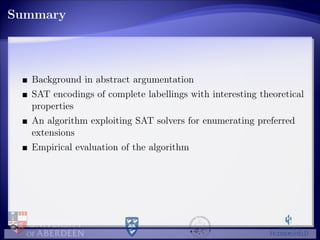
Background in abstract argumentation
SAT encodings of complete labellings with interesting theoretical
properties
An algorithm exploiting SAT solvers for enumerating preferred
extensions
Empirical evaluation of the algorithm
Background
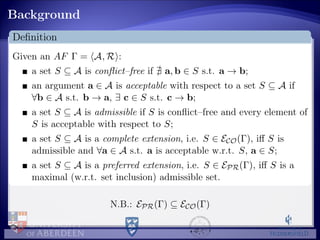
Definition
Given an AF Γ = A, R :
a set S ⊆ A is conflict–free if a, b ∈ S s.t. a → b;
an argument a ∈ A is acceptable with respect to a set S ⊆ A if
∀b ∈ A s.t. b → a, ∃ c ∈ S s.t. c → b;
a set S ⊆ A is admissible if S is conflict–free and every element of
S is acceptable with respect to S;
a set S ⊆ A is a complete extension, i.e. S ∈ ECO(Γ), iff S is
admissible and ∀a ∈ A s.t. a is acceptable w.r.t. S, a ∈ S;
a set S ⊆ A is a preferred extension, i.e. S ∈ EPR(Γ), iff S is a
maximal (w.r.t. set inclusion) admissible set.
N.B.: EPR(Γ) ⊆ ECO(Γ)
Background
Definition
Let A, R be an argumentation framework. A total function
Lab : A → {in, out, undec} is a complete labelling iff it satisfies the
following conditions for any a ∈ A:
Lab(a) = in ⇔ ∀b ∈ a−Lab(b) = out;
Lab(a) = out ⇔ ∃b ∈ a− : Lab(b) = in;
Lab(a) = undec ⇔ ∀b ∈ a−Lab(b) = in ∧ ∃c ∈ a− : Lab(c) =
undec;
From [Caminada, 2006], preferred extensions are in one-to-one
correspondence with those complete labellings maximizing the set of
arguments labelled in.
An Approach for Expressing the Complete
Labelling as a SAT Problem
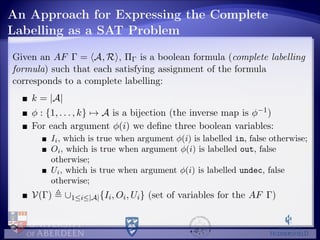
Given an AF Γ = A, R , ΠΓ is a boolean formula (complete labelling
formula) such that each satisfying assignment of the formula
corresponds to a complete labelling:
k = |A|
φ : {1, . . . , k} → A is a bijection (the inverse map is φ−1)
For each argument φ(i) we define three boolean variables:
Ii, which is true when argument φ(i) is labelled in, false otherwise;
Oi, which is true when argument φ(i) is labelled out, false
otherwise;
Ui, which is true when argument φ(i) is labelled undec, false
otherwise;
V(Γ) ∪1≤i≤|A|{Ii, Oi, Ui} (set of variables for the AF Γ)
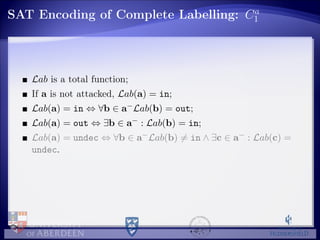
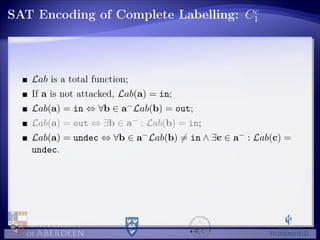
SAT Encoding of Complete Labelling: C1
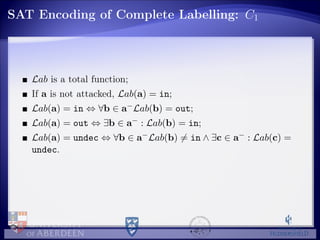
Lab is a total function;
If a is not attacked, Lab(a) = in;
Lab(a) = in ⇔ ∀b ∈ a−Lab(b) = out;
Lab(a) = out ⇔ ∃b ∈ a− : Lab(b) = in;
Lab(a) = undec ⇔ ∀b ∈ a−Lab(b) = in ∧ ∃c ∈ a− : Lab(c) =
undec.
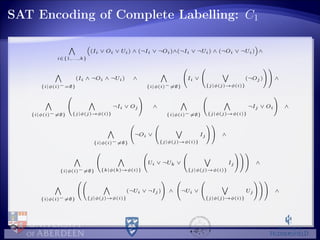
SAT Encoding of Complete Labelling: C1
i∈{1,...,k}
(Ii ∨ Oi ∨ Ui) ∧ (¬Ii ∨ ¬Oi)∧(¬Ii ∨ ¬Ui) ∧ (¬Oi ∨ ¬Ui) ∧
{i|φ(i)−=∅}
(Ii ∧ ¬Oi ∧ ¬Ui) ∧
{i|φ(i)−=∅}

Ii ∨


{j|φ(j)→φ(i)}
(¬Oj )



 ∧
{i|φ(i)−=∅}


{j|φ(j)→φ(i)}
¬Ii ∨ Oj

 ∧
{i|φ(i)−=∅}


{j|φ(j)→φ(i)}
¬Ij ∨ Oi

 ∧
{i|φ(i)−=∅}

¬Oi ∨


{j|φ(j)→φ(i)}
Ij



 ∧
{i|φ(i)−=∅}


{k|φ(k)→φ(i)}

Ui ∨ ¬Uk ∨


{j|φ(j)→φ(i)}
Ij





 ∧
{i|φ(i)−=∅}




{j|φ(j)→φ(i)}
(¬Ui ∨ ¬Ij )

 ∧

¬Ui ∨


{j|φ(j)→φ(i)}
Uj





 ∧
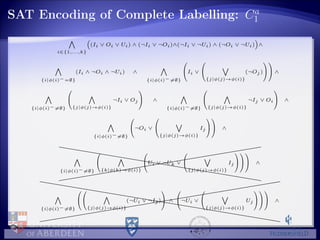
SAT Encoding of Complete Labelling: Ca
1
Lab is a total function;
If a is not attacked, Lab(a) = in;
Lab(a) = in ⇔ ∀b ∈ a−Lab(b) = out;
Lab(a) = out ⇔ ∃b ∈ a− : Lab(b) = in;
Lab(a) = undec ⇔ ∀b ∈ a−Lab(b) = in ∧ ∃c ∈ a− : Lab(c) =
undec.
SAT Encoding of Complete Labelling: Ca
1
i∈{1,...,k}
(Ii ∨ Oi ∨ Ui) ∧ (¬Ii ∨ ¬Oi)∧(¬Ii ∨ ¬Ui) ∧ (¬Oi ∨ ¬Ui) ∧
{i|φ(i)−=∅}
(Ii ∧ ¬Oi ∧ ¬Ui) ∧
{i|φ(i)−=∅}

Ii ∨


{j|φ(j)→φ(i)}
(¬Oj )



 ∧
{i|φ(i)−=∅}


{j|φ(j)→φ(i)}
¬Ii ∨ Oj

 ∧
{i|φ(i)−=∅}


{j|φ(j)→φ(i)}
¬Ij ∨ Oi

 ∧
{i|φ(i)−=∅}

¬Oi ∨


{j|φ(j)→φ(i)}
Ij



 ∧
(((((((((((((((((((((((hhhhhhhhhhhhhhhhhhhhhhh
{i|φ(i)−=∅}


{k|φ(k)→φ(i)}

Ui ∨ ¬Uk ∨


{j|φ(j)→φ(i)}
Ij





 ∧
((((((((((((((((((((((((((((hhhhhhhhhhhhhhhhhhhhhhhhhhhh
{i|φ(i)−=∅}




{j|φ(j)→φ(i)}
(¬Ui ∨ ¬Ij )

 ∧

¬Ui ∨


{j|φ(j)→φ(i)}
Uj





 ∧
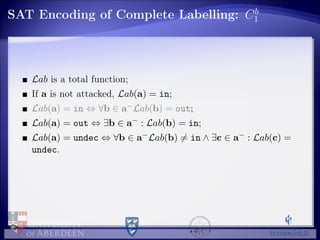
SAT Encoding of Complete Labelling: Cb
1
Lab is a total function;
If a is not attacked, Lab(a) = in;
Lab(a) = in ⇔ ∀b ∈ a−Lab(b) = out;
Lab(a) = out ⇔ ∃b ∈ a− : Lab(b) = in;
Lab(a) = undec ⇔ ∀b ∈ a−Lab(b) = in ∧ ∃c ∈ a− : Lab(c) =
undec.
SAT Encoding of Complete Labelling: Cc
1
Lab is a total function;
If a is not attacked, Lab(a) = in;
Lab(a) = in ⇔ ∀b ∈ a−Lab(b) = out;
Lab(a) = out ⇔ ∃b ∈ a− : Lab(b) = in;
Lab(a) = undec ⇔ ∀b ∈ a−Lab(b) = in ∧ ∃c ∈ a− : Lab(c) =
undec.
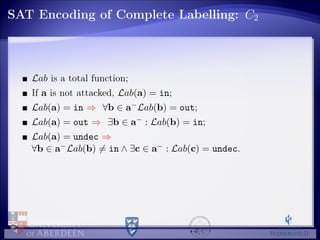
SAT Encoding of Complete Labelling: C2
Lab is a total function;
If a is not attacked, Lab(a) = in;
Lab(a) = in ⇒ ∀b ∈ a−Lab(b) = out;
Lab(a) = out ⇒ ∃b ∈ a− : Lab(b) = in;
Lab(a) = undec ⇒
∀b ∈ a−Lab(b) = in ∧ ∃c ∈ a− : Lab(c) = undec.
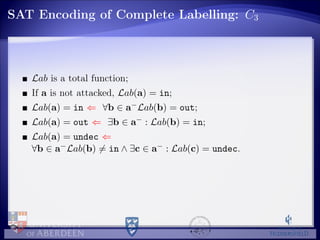
SAT Encoding of Complete Labelling: C3
Lab is a total function;
If a is not attacked, Lab(a) = in;
Lab(a) = in ⇐ ∀b ∈ a−Lab(b) = out;
Lab(a) = out ⇐ ∃b ∈ a− : Lab(b) = in;
Lab(a) = undec ⇐
∀b ∈ a−Lab(b) = in ∧ ∃c ∈ a− : Lab(c) = undec.
Equivalence of the Encodings
Proposition
The encodings C1, Ca
1 , Cb
1, Cc
1, C2, C3 are equivalent.
Let us note that Ca
1 and C2 correspond to the alternative definitions
of complete labellings in [Caminada and Gabbay, 2009], where a proof
of their equivalence is provided.
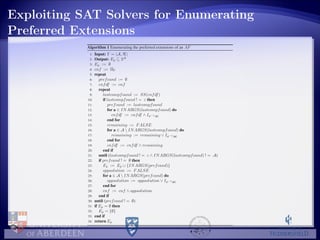
Exploiting SAT Solvers for Enumerating
Preferred Extensions
Algorithm 1 Enumerating the preferred extensions of an AF
1: Input: Γ = A, R
2: Output: Ep ⊆ 2A
3: Ep := ∅
4: cnf := ΠΓ
5: repeat
6: prefcand := ∅
7: cnfdf := cnf
8: repeat
9: lastcompfound := SS(cnfdf)
10: if lastcompfound ! = ε then
11: prefcand := lastcompfound
12: for a ∈ INARGS(lastcompfound) do
13: cnfdf := cnfdf ∧ Iφ−1(a)
14: end for
15: remaining := FALSE
16: for a ∈ A  INARGS(lastcompfound) do
17: remaining := remaining ∨ Iφ−1(a)
18: end for
19: cnfdf := cnfdf ∧ remaining
20: end if
21: until (lastcompfound ! = ε ∧ INARGS(lastcompfound) ! = A)
22: if prefcand ! = ∅ then
23: Ep := Ep ∪ {INARGS(prefcand)}
24: oppsolution := FALSE
25: for a ∈ A  INARGS(prefcand) do
26: oppsolution := oppsolution ∨ Iφ−1(a)
27: end for
28: cnf := cnf ∧ oppsolution
29: end if
30: until (prefcand ! = ∅)
31: if Ep = ∅ then
32: Ep = {∅}
33: end if
34: return Ep
Exploiting SAT Solvers for Enumerating
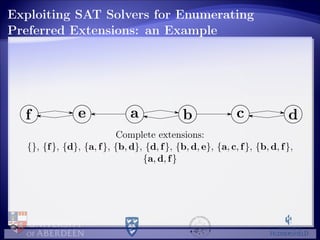
Preferred Extensions: an Example
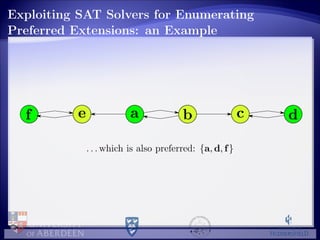
Complete extensions:
{}, {f}, {d}, {a, f}, {b, d}, {d, f}, {b, d, e}, {a, c, f}, {b, d, f},
{a, d, f}
Exploiting SAT Solvers for Enumerating
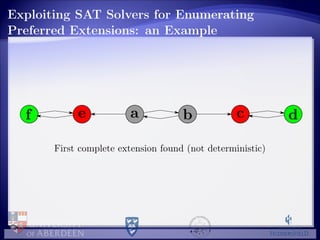
Preferred Extensions: an Example
First complete extension found (not deterministic)
Exploiting SAT Solvers for Enumerating
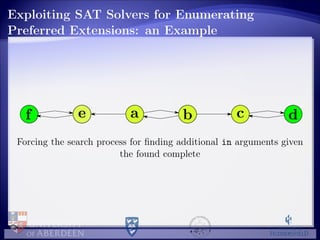
Preferred Extensions: an Example
Forcing the search process for finding additional in arguments given
the found complete
Exploiting SAT Solvers for Enumerating
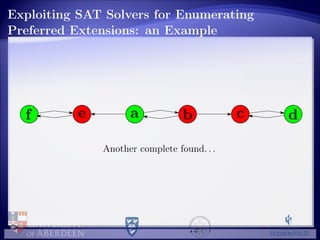
Preferred Extensions: an Example
Another complete found. . .
Exploiting SAT Solvers for Enumerating
Preferred Extensions: an Example
. . . which is also preferred: {a, d, f}
Exploiting SAT Solvers for Enumerating
Preferred Extensions: an Example
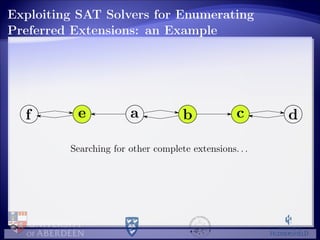
Searching for other complete extensions. . .
Exploiting SAT Solvers for Enumerating
Preferred Extensions: an Example
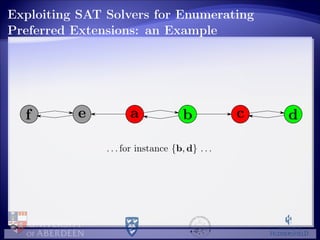
. . . for instance {b, d} . . .
Exploiting SAT Solvers for Enumerating
Preferred Extensions: an Example
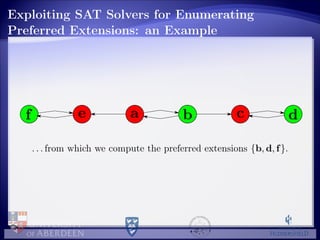
. . . from which we compute the preferred extensions {b, d, f}.
Empirical Evaluation: the Experiment
Two SAT solvers considered (separately):
PrecoSAT [Biere, 2009], SAT Competition 2009 winner
(Application track) → PS-PRE;
Glucose
[Audemard and Simon, 2009, Audemard and Simon, 2012] SAT
Competition 2011 and SAT Challenge 2012 winner (Application
track) → PS-GLU
Random generated 2816 AFs divided in different classes according to two
dimensions:
|A|: ranging from 25 to 200 with a step of 25;
generation of the attack relations:
fixing the probability patt that there is an attack for each ordered
pair of arguments (self-attacks are included), step of 0.25
selecting randomly the number natt of attacks in it
the extreme cases of empty attack relation (patt = natt = 0) and of
fully connected attack relation (patt = 1, natt = |A|2
)
Empirical Evaluation: the Analysis Using the
International Planning Competition (IPC) Score
For each test case (in our case, each test AF) let T∗ be the best
execution time among the compared systems (if no system
produces the solution within the time limit, the test case is not
considered valid and ignored).
For each valid case, each system gets a score of
1/(1 + log10(T/T∗)), where T is its execution time, or a score of 0
if it fails in that case. Runtimes below 1 sec get by default the
maximal score of 1.
The (non normalized) IPC score for a system is the sum of its
scores over all the valid test cases. The normalised IPC score
ranges from 0 to 100 and is defined as
(IPC/# of valid cases) ∗ 100.
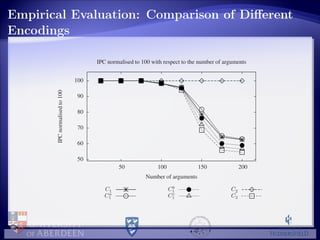
Empirical Evaluation: Comparison of Different
Encodings
50
60
70
80
90
100
50 100 150 200
IPCnormalisedto100
Number of arguments
IPC normalised to 100 with respect to the number of arguments
C1
Ca
1
Cb
1
Cc
1
C2
C3
Empirical Evaluation: Comparison with Aspartix,
Aspartix Meta, [Nofal et al., 2012]
60
65
70
75
80
85
90
95
100
50 100 150 200
%ofsuccess
Number of arguments
Percentage of success
ASP
ASP-META
NOF
PS-PRE
PS-GLU
Empirical Evaluation: Comparison with Aspartix,
Aspartix Meta, [Nofal et al., 2012]
20
30
40
50
60
70
80
90
100
50 100 150 200
IPCnormalisedto100
Number of arguments
IPC normalised to 100 with respect to the number of arguments
ASP
ASP-META
NOF
PS-PRE
PS-GLU
Conclusions
Novel SAT-based approach for preferred extension enumeration in
abstract argumentation
Assessed its performances by an empirical comparison with
well-known state-of-the-art systems
Evidence that different encodings, although theoretically
equivalent, lead to very different empirical results
The proposed approach outperforms the state-of-the-art
Future works (currently ongoing):
Implementation of the other Labelling-based semantics
(Grounded, Complete, Stable, Semi-stable)
Evaluating different SAT-based search schema
Integrate the proposed approach in the SCC-recursive schema
(encouraging preliminary results!)
Wider empirical investigation
References I
[Audemard and Simon, 2009] Audemard, G. and Simon, L. (2009).
Predicting learnt clauses quality in modern sat solvers.
In Proceedings of IJCAI 2009, pages 399–404.
[Audemard and Simon, 2012] Audemard, G. and Simon, L. (2012).
Glucose 2.1.
http://www.lri.fr/~simon/?page=glucose.
[Biere, 2009] Biere, A. (2009).
P{re,ic}osat@sc’09.
In SAT Competition 2009.
[Caminada, 2006] Caminada, M. (2006).
On the issue of reinstatement in argumentation.
In Proceedings of JELIA 2006, pages 111–123.
[Caminada and Gabbay, 2009] Caminada, M. and Gabbay, D. M. (2009).
A logical account of formal argumentation.
Studia Logica (Special issue: new ideas in argumentation theory), 93(2–3):109–145.
[Nofal et al., 2012] Nofal, S., Dunne, P. E., and Atkinson, K. (2012).
On preferred extension enumeration in abstract argumentation.
In Proceedings of COMMA 2012, pages 205–216.

Cerutti -- TAFA2013

  • 1.
    A SAT-based Approachfor Computing Extensions in Abstract Argumentation Federico Cerutti, Paul E. Dunne, Massimiliano Giacomin, Mauro Vallati TAFA-2013 Sunday 4th August, 2013 c 2013 Federico Cerutti <f.cerutti@abdn.ac.uk>
  • 2.
    Summary Background in abstractargumentation SAT encodings of complete labellings with interesting theoretical properties An algorithm exploiting SAT solvers for enumerating preferred extensions Empirical evaluation of the algorithm
  • 3.
    Background Definition Given an AFΓ = A, R : a set S ⊆ A is conflict–free if a, b ∈ S s.t. a → b; an argument a ∈ A is acceptable with respect to a set S ⊆ A if ∀b ∈ A s.t. b → a, ∃ c ∈ S s.t. c → b; a set S ⊆ A is admissible if S is conflict–free and every element of S is acceptable with respect to S; a set S ⊆ A is a complete extension, i.e. S ∈ ECO(Γ), iff S is admissible and ∀a ∈ A s.t. a is acceptable w.r.t. S, a ∈ S; a set S ⊆ A is a preferred extension, i.e. S ∈ EPR(Γ), iff S is a maximal (w.r.t. set inclusion) admissible set. N.B.: EPR(Γ) ⊆ ECO(Γ)
  • 4.
    Background Definition Let A, Rbe an argumentation framework. A total function Lab : A → {in, out, undec} is a complete labelling iff it satisfies the following conditions for any a ∈ A: Lab(a) = in ⇔ ∀b ∈ a−Lab(b) = out; Lab(a) = out ⇔ ∃b ∈ a− : Lab(b) = in; Lab(a) = undec ⇔ ∀b ∈ a−Lab(b) = in ∧ ∃c ∈ a− : Lab(c) = undec; From [Caminada, 2006], preferred extensions are in one-to-one correspondence with those complete labellings maximizing the set of arguments labelled in.
  • 5.
    An Approach forExpressing the Complete Labelling as a SAT Problem Given an AF Γ = A, R , ΠΓ is a boolean formula (complete labelling formula) such that each satisfying assignment of the formula corresponds to a complete labelling: k = |A| φ : {1, . . . , k} → A is a bijection (the inverse map is φ−1) For each argument φ(i) we define three boolean variables: Ii, which is true when argument φ(i) is labelled in, false otherwise; Oi, which is true when argument φ(i) is labelled out, false otherwise; Ui, which is true when argument φ(i) is labelled undec, false otherwise; V(Γ) ∪1≤i≤|A|{Ii, Oi, Ui} (set of variables for the AF Γ)
  • 6.
    SAT Encoding ofComplete Labelling: C1 Lab is a total function; If a is not attacked, Lab(a) = in; Lab(a) = in ⇔ ∀b ∈ a−Lab(b) = out; Lab(a) = out ⇔ ∃b ∈ a− : Lab(b) = in; Lab(a) = undec ⇔ ∀b ∈ a−Lab(b) = in ∧ ∃c ∈ a− : Lab(c) = undec.
  • 7.
    SAT Encoding ofComplete Labelling: C1 i∈{1,...,k} (Ii ∨ Oi ∨ Ui) ∧ (¬Ii ∨ ¬Oi)∧(¬Ii ∨ ¬Ui) ∧ (¬Oi ∨ ¬Ui) ∧ {i|φ(i)−=∅} (Ii ∧ ¬Oi ∧ ¬Ui) ∧ {i|φ(i)−=∅}  Ii ∨   {j|φ(j)→φ(i)} (¬Oj )     ∧ {i|φ(i)−=∅}   {j|φ(j)→φ(i)} ¬Ii ∨ Oj   ∧ {i|φ(i)−=∅}   {j|φ(j)→φ(i)} ¬Ij ∨ Oi   ∧ {i|φ(i)−=∅}  ¬Oi ∨   {j|φ(j)→φ(i)} Ij     ∧ {i|φ(i)−=∅}   {k|φ(k)→φ(i)}  Ui ∨ ¬Uk ∨   {j|φ(j)→φ(i)} Ij       ∧ {i|φ(i)−=∅}     {j|φ(j)→φ(i)} (¬Ui ∨ ¬Ij )   ∧  ¬Ui ∨   {j|φ(j)→φ(i)} Uj       ∧
  • 8.
    SAT Encoding ofComplete Labelling: Ca 1 Lab is a total function; If a is not attacked, Lab(a) = in; Lab(a) = in ⇔ ∀b ∈ a−Lab(b) = out; Lab(a) = out ⇔ ∃b ∈ a− : Lab(b) = in; Lab(a) = undec ⇔ ∀b ∈ a−Lab(b) = in ∧ ∃c ∈ a− : Lab(c) = undec.
  • 9.
    SAT Encoding ofComplete Labelling: Ca 1 i∈{1,...,k} (Ii ∨ Oi ∨ Ui) ∧ (¬Ii ∨ ¬Oi)∧(¬Ii ∨ ¬Ui) ∧ (¬Oi ∨ ¬Ui) ∧ {i|φ(i)−=∅} (Ii ∧ ¬Oi ∧ ¬Ui) ∧ {i|φ(i)−=∅}  Ii ∨   {j|φ(j)→φ(i)} (¬Oj )     ∧ {i|φ(i)−=∅}   {j|φ(j)→φ(i)} ¬Ii ∨ Oj   ∧ {i|φ(i)−=∅}   {j|φ(j)→φ(i)} ¬Ij ∨ Oi   ∧ {i|φ(i)−=∅}  ¬Oi ∨   {j|φ(j)→φ(i)} Ij     ∧ (((((((((((((((((((((((hhhhhhhhhhhhhhhhhhhhhhh {i|φ(i)−=∅}   {k|φ(k)→φ(i)}  Ui ∨ ¬Uk ∨   {j|φ(j)→φ(i)} Ij       ∧ ((((((((((((((((((((((((((((hhhhhhhhhhhhhhhhhhhhhhhhhhhh {i|φ(i)−=∅}     {j|φ(j)→φ(i)} (¬Ui ∨ ¬Ij )   ∧  ¬Ui ∨   {j|φ(j)→φ(i)} Uj       ∧
  • 10.
    SAT Encoding ofComplete Labelling: Cb 1 Lab is a total function; If a is not attacked, Lab(a) = in; Lab(a) = in ⇔ ∀b ∈ a−Lab(b) = out; Lab(a) = out ⇔ ∃b ∈ a− : Lab(b) = in; Lab(a) = undec ⇔ ∀b ∈ a−Lab(b) = in ∧ ∃c ∈ a− : Lab(c) = undec.
  • 11.
    SAT Encoding ofComplete Labelling: Cc 1 Lab is a total function; If a is not attacked, Lab(a) = in; Lab(a) = in ⇔ ∀b ∈ a−Lab(b) = out; Lab(a) = out ⇔ ∃b ∈ a− : Lab(b) = in; Lab(a) = undec ⇔ ∀b ∈ a−Lab(b) = in ∧ ∃c ∈ a− : Lab(c) = undec.
  • 12.
    SAT Encoding ofComplete Labelling: C2 Lab is a total function; If a is not attacked, Lab(a) = in; Lab(a) = in ⇒ ∀b ∈ a−Lab(b) = out; Lab(a) = out ⇒ ∃b ∈ a− : Lab(b) = in; Lab(a) = undec ⇒ ∀b ∈ a−Lab(b) = in ∧ ∃c ∈ a− : Lab(c) = undec.
  • 13.
    SAT Encoding ofComplete Labelling: C3 Lab is a total function; If a is not attacked, Lab(a) = in; Lab(a) = in ⇐ ∀b ∈ a−Lab(b) = out; Lab(a) = out ⇐ ∃b ∈ a− : Lab(b) = in; Lab(a) = undec ⇐ ∀b ∈ a−Lab(b) = in ∧ ∃c ∈ a− : Lab(c) = undec.
  • 14.
    Equivalence of theEncodings Proposition The encodings C1, Ca 1 , Cb 1, Cc 1, C2, C3 are equivalent. Let us note that Ca 1 and C2 correspond to the alternative definitions of complete labellings in [Caminada and Gabbay, 2009], where a proof of their equivalence is provided.
  • 15.
    Exploiting SAT Solversfor Enumerating Preferred Extensions Algorithm 1 Enumerating the preferred extensions of an AF 1: Input: Γ = A, R 2: Output: Ep ⊆ 2A 3: Ep := ∅ 4: cnf := ΠΓ 5: repeat 6: prefcand := ∅ 7: cnfdf := cnf 8: repeat 9: lastcompfound := SS(cnfdf) 10: if lastcompfound ! = ε then 11: prefcand := lastcompfound 12: for a ∈ INARGS(lastcompfound) do 13: cnfdf := cnfdf ∧ Iφ−1(a) 14: end for 15: remaining := FALSE 16: for a ∈ A INARGS(lastcompfound) do 17: remaining := remaining ∨ Iφ−1(a) 18: end for 19: cnfdf := cnfdf ∧ remaining 20: end if 21: until (lastcompfound ! = ε ∧ INARGS(lastcompfound) ! = A) 22: if prefcand ! = ∅ then 23: Ep := Ep ∪ {INARGS(prefcand)} 24: oppsolution := FALSE 25: for a ∈ A INARGS(prefcand) do 26: oppsolution := oppsolution ∨ Iφ−1(a) 27: end for 28: cnf := cnf ∧ oppsolution 29: end if 30: until (prefcand ! = ∅) 31: if Ep = ∅ then 32: Ep = {∅} 33: end if 34: return Ep
  • 16.
    Exploiting SAT Solversfor Enumerating Preferred Extensions: an Example Complete extensions: {}, {f}, {d}, {a, f}, {b, d}, {d, f}, {b, d, e}, {a, c, f}, {b, d, f}, {a, d, f}
  • 17.
    Exploiting SAT Solversfor Enumerating Preferred Extensions: an Example First complete extension found (not deterministic)
  • 18.
    Exploiting SAT Solversfor Enumerating Preferred Extensions: an Example Forcing the search process for finding additional in arguments given the found complete
  • 19.
    Exploiting SAT Solversfor Enumerating Preferred Extensions: an Example Another complete found. . .
  • 20.
    Exploiting SAT Solversfor Enumerating Preferred Extensions: an Example . . . which is also preferred: {a, d, f}
  • 21.
    Exploiting SAT Solversfor Enumerating Preferred Extensions: an Example Searching for other complete extensions. . .
  • 22.
    Exploiting SAT Solversfor Enumerating Preferred Extensions: an Example . . . for instance {b, d} . . .
  • 23.
    Exploiting SAT Solversfor Enumerating Preferred Extensions: an Example . . . from which we compute the preferred extensions {b, d, f}.
  • 24.
    Empirical Evaluation: theExperiment Two SAT solvers considered (separately): PrecoSAT [Biere, 2009], SAT Competition 2009 winner (Application track) → PS-PRE; Glucose [Audemard and Simon, 2009, Audemard and Simon, 2012] SAT Competition 2011 and SAT Challenge 2012 winner (Application track) → PS-GLU Random generated 2816 AFs divided in different classes according to two dimensions: |A|: ranging from 25 to 200 with a step of 25; generation of the attack relations: fixing the probability patt that there is an attack for each ordered pair of arguments (self-attacks are included), step of 0.25 selecting randomly the number natt of attacks in it the extreme cases of empty attack relation (patt = natt = 0) and of fully connected attack relation (patt = 1, natt = |A|2 )
  • 25.
    Empirical Evaluation: theAnalysis Using the International Planning Competition (IPC) Score For each test case (in our case, each test AF) let T∗ be the best execution time among the compared systems (if no system produces the solution within the time limit, the test case is not considered valid and ignored). For each valid case, each system gets a score of 1/(1 + log10(T/T∗)), where T is its execution time, or a score of 0 if it fails in that case. Runtimes below 1 sec get by default the maximal score of 1. The (non normalized) IPC score for a system is the sum of its scores over all the valid test cases. The normalised IPC score ranges from 0 to 100 and is defined as (IPC/# of valid cases) ∗ 100.
  • 26.
    Empirical Evaluation: Comparisonof Different Encodings 50 60 70 80 90 100 50 100 150 200 IPCnormalisedto100 Number of arguments IPC normalised to 100 with respect to the number of arguments C1 Ca 1 Cb 1 Cc 1 C2 C3
  • 27.
    Empirical Evaluation: Comparisonwith Aspartix, Aspartix Meta, [Nofal et al., 2012] 60 65 70 75 80 85 90 95 100 50 100 150 200 %ofsuccess Number of arguments Percentage of success ASP ASP-META NOF PS-PRE PS-GLU
  • 28.
    Empirical Evaluation: Comparisonwith Aspartix, Aspartix Meta, [Nofal et al., 2012] 20 30 40 50 60 70 80 90 100 50 100 150 200 IPCnormalisedto100 Number of arguments IPC normalised to 100 with respect to the number of arguments ASP ASP-META NOF PS-PRE PS-GLU
  • 29.
    Conclusions Novel SAT-based approachfor preferred extension enumeration in abstract argumentation Assessed its performances by an empirical comparison with well-known state-of-the-art systems Evidence that different encodings, although theoretically equivalent, lead to very different empirical results The proposed approach outperforms the state-of-the-art Future works (currently ongoing): Implementation of the other Labelling-based semantics (Grounded, Complete, Stable, Semi-stable) Evaluating different SAT-based search schema Integrate the proposed approach in the SCC-recursive schema (encouraging preliminary results!) Wider empirical investigation
  • 30.
    References I [Audemard andSimon, 2009] Audemard, G. and Simon, L. (2009). Predicting learnt clauses quality in modern sat solvers. In Proceedings of IJCAI 2009, pages 399–404. [Audemard and Simon, 2012] Audemard, G. and Simon, L. (2012). Glucose 2.1. http://www.lri.fr/~simon/?page=glucose. [Biere, 2009] Biere, A. (2009). P{re,ic}osat@sc’09. In SAT Competition 2009. [Caminada, 2006] Caminada, M. (2006). On the issue of reinstatement in argumentation. In Proceedings of JELIA 2006, pages 111–123. [Caminada and Gabbay, 2009] Caminada, M. and Gabbay, D. M. (2009). A logical account of formal argumentation. Studia Logica (Special issue: new ideas in argumentation theory), 93(2–3):109–145. [Nofal et al., 2012] Nofal, S., Dunne, P. E., and Atkinson, K. (2012). On preferred extension enumeration in abstract argumentation. In Proceedings of COMMA 2012, pages 205–216.