ALCOHOL
Mr. Amit Z Chaudhari
Dept. of Pharma Chemistry,
L. M. College of Pharmacy,
Ahmedabad - 380009 India
C O N T E N T
2
- Introduction
- Properties
- Preparation
- Reactions
- Uses
I N T R O D U C T I O N
3
※ Morrison & Boyd ※ Bahl & Bahl ※ Finar Volume 1 ※ Mehta & Mehta ※ Francis A. Carey ※
P R O P E R T I E S
Classification:
※ Morrison & Boyd ※ Bahl & Bahl ※ Mehta & Mehta ※ 4
P R O P E R T I E S
Boiling point:
b.p. of alcohols are much higher than those of corresponding
alkanes
※ Morrison & Boyd ※ Bahl & Bahl ※ Mehta & Mehta ※ 5
P R O P E R T I E S
Boiling point:
b.p. increases as MW increase in alcohols
※ Morrison & Boyd ※ Bahl & Bahl ※ Mehta & Mehta ※ https://chem.libretexts.org ※ 6
P R O P E R T I E S
Boiling point:
b.p. decreases as branching increase in alcohols
※ Morrison & Boyd ※ Mehta & Mehta ※ 7
P R O P E R T I E S
Solubility:
Solubility decreases as MW increases in alcohols
※ Morrison & Boyd ※ Bahl & Bahl ※ Mehta & Mehta ※ 8
- Hydrolysis of alkyl halide / Substitution Nucleophilic reaction
P R E P A R A T I O N
9
※ Morrison & Boyd ※ Bahl & Bahl ※
Hydroxylation of alkene
P R E P A R A T I O N
Baeyers’ test
10
※ Morrison & Boyd ※
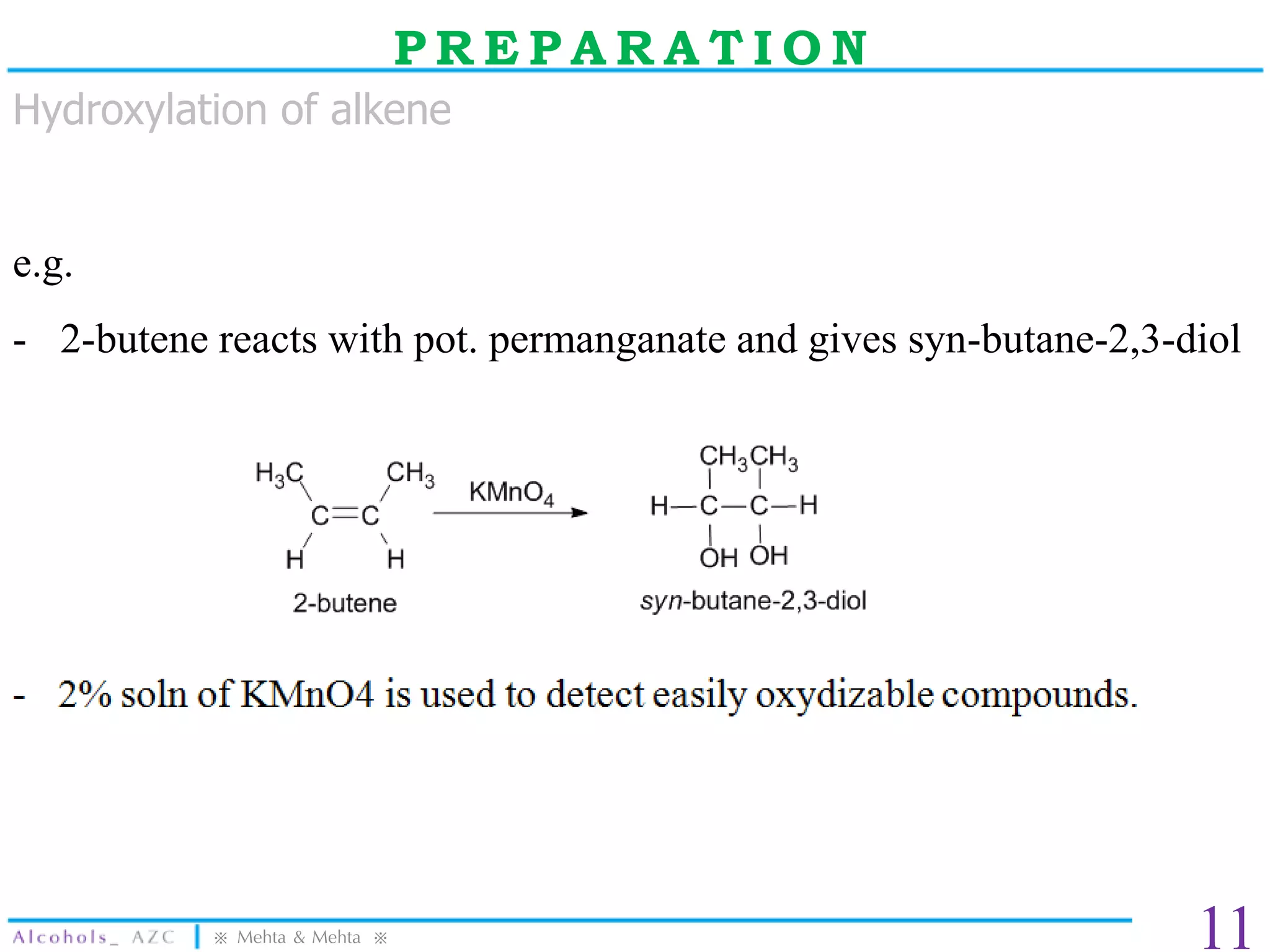
Hydroxylation of alkene
e.g.
- 2-butene reacts with pot. permanganate and gives syn-butane-2,3-diol
P R E P A R A T I O N
11
※ Mehta & Mehta ※
Hydroboration-oxidation (Antimarkovnikov's addition)
P R E P A R A T I O N
12
※ Morrison & Boyd ※ Francis A. Carey ※
synthesis of 1°, 2° and 3° alcohol using Grignard reagent
Reaction with ethylene oxide gives 1° alcohol
P R E P A R A T I O N
13
※ Bahl & Bahl ※ Mehta & Mehta ※ Francis A. Carey ※
synthesis of 1°, 2° and 3° alcohol using Grignard reagent
1° 2° & 3° alcohol
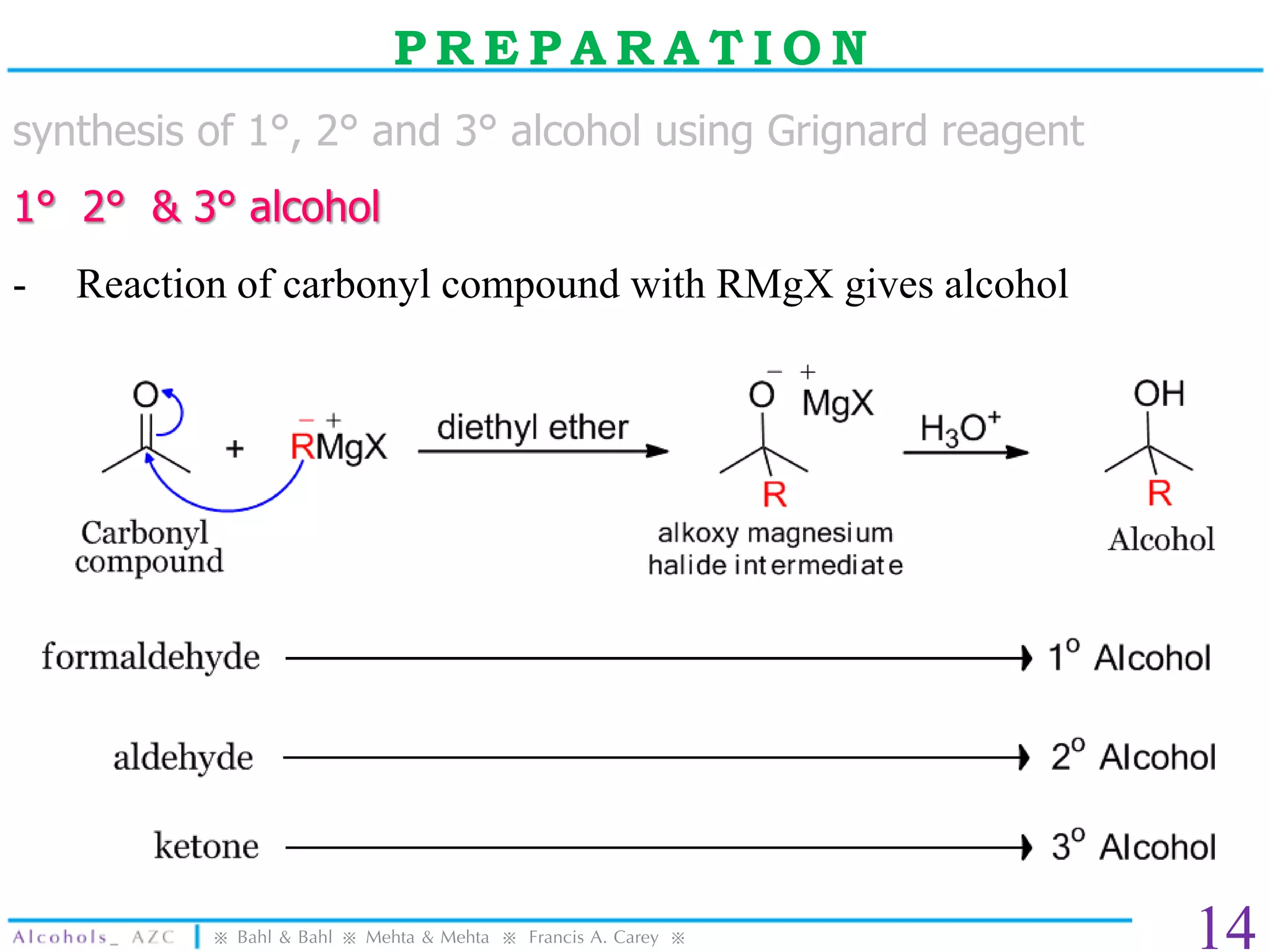
- Reaction of carbonyl compound with RMgX gives alcohol
P R E P A R A T I O N
14
※ Bahl & Bahl ※ Mehta & Mehta ※ Francis A. Carey ※
synthesis of 1°, 2° and 3° alcohol using Grignard reagent
1° alcohol
P R E P A R A T I O N
15
※ Bahl & Bahl ※ Mehta & Mehta ※ Francis A. Carey ※
synthesis of 1°, 2° and 3° alcohol using Grignard reagent
2° & 3° alcohol
E.g.
P R E P A R A T I O N
16
※ Bahl & Bahl ※ Mehta & Mehta ※ Francis A. Carey ※
DEHYDRATION OF ALCOHOLS – synthesis of Alkene
R E A C T I O N
17
※ Morrison & Boyd ※ Bahl & Bahl ※ Mehta & Mehta ※
DEHYDRATION OF ALCOHOLS
Mechanism:
R E A C T I O N
18
※ Morrison & Boyd ※ Bahl & Bahl ※ Mehta & Mehta ※
DEHYDRATION OF ALCOHOLS
R E A C T I O N
Zaitsev’s product
Major pdct
19
※ Morrison & Boyd ※ Mehta & Mehta ※
OXIDATION OF ALCOHOLS
- Using oxidizing agents Mn(VII), Cr(VI).
R E A C T I O N
20
※ Morrison & Boyd ※
Qualitative tests - Esterification test
To identify alcoholic compounds
R E A C T I O N
21
※ Hitesh Raval ※
Qualitative tests - Lucas test
- Lucas reagent = Zinc chloride in conc. HCl
- used to distinguish tests to differentiate between primary, secondary
and tertiary alcohols of alcohols
R E A C T I O N
22
※ Hitesh Raval ※
Qualitative tests - Lucas test
- Mechanism
R E A C T I O N
23
※ Hitesh Raval ※
Qualitative tests - Jones oxidation test
- The Jones test utilizes chromium trioxide (orange-red colour) in the
presence of sulfuric acid to act as a powerful oxidizing agent.
R E A C T I O N
24
※ Hitesh Raval ※
Qualitative tests - Jones oxidation test
- Primary alcohol is first converted into an aldehyde and then into a
carboxylic acid, with bluish-green colour
- Secondary alcohol will be oxidized into a ketone , with bluish-green
colour
- Tertiary alcohols do not react with chromium,, keeping the solution
orange-red.
- used for distinguishing primary and secondary alcohols from
tertiary alcohols.
R E A C T I O N
25
※ Hitesh Raval ※
Structure and Uses
Structure and Uses
1. Methyl alcohol
Synonym: wood alcohol
- Solvent in analytical and organic laboratory
- To denature ethyl alcohol
- Mfg. of formaldehyde
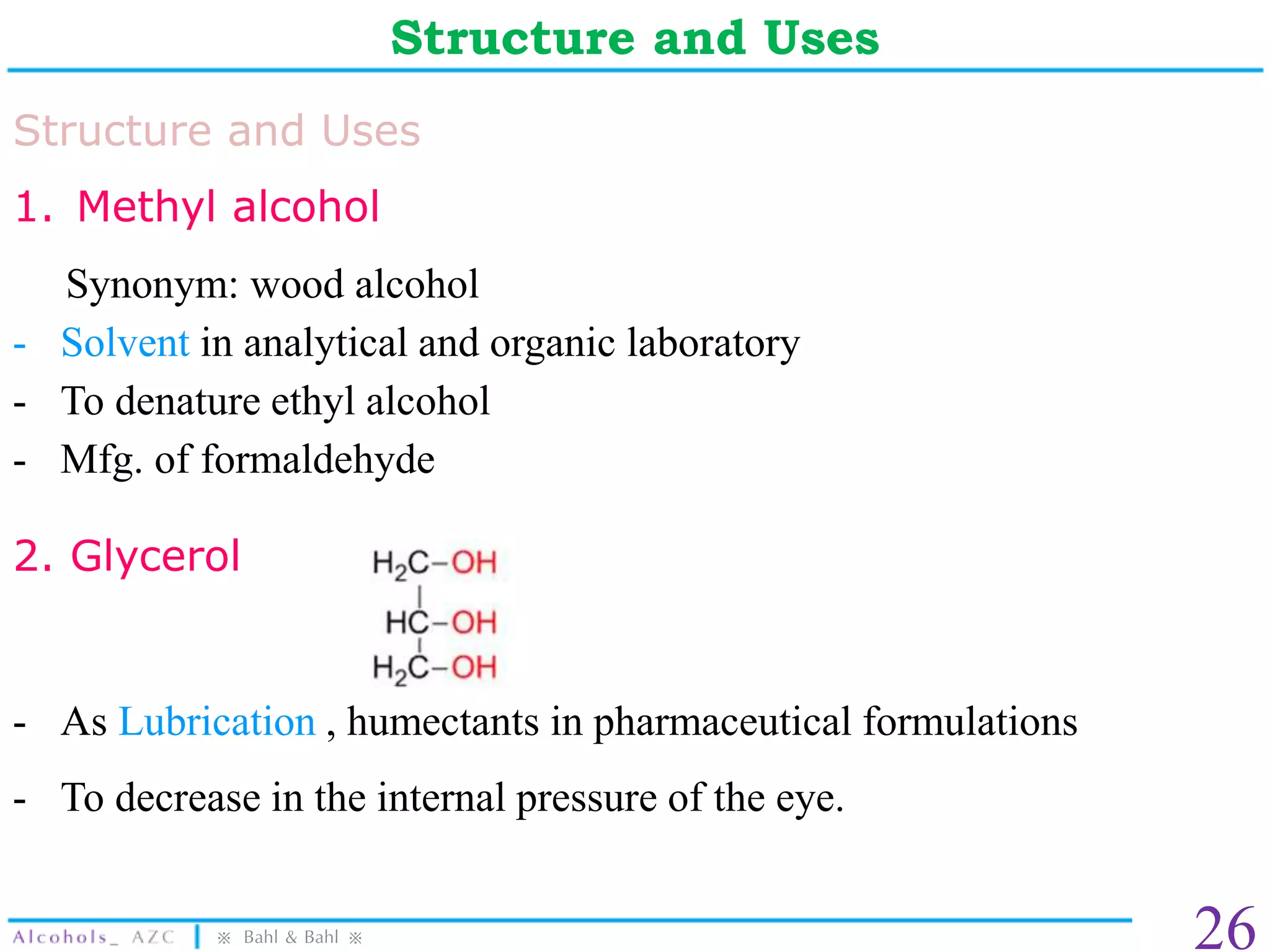
2. Glycerol
- As Lubrication , humectants in pharmaceutical formulations
- To decrease in the internal pressure of the eye.
26
※ Bahl & Bahl ※
Structure and Uses
Structure and Uses
3. Ethyl alcohol
- Synonym: Grain alcohol
- Mfg. of drugs, flavoring extracts and perfumes
- Antiseptic
- preserve biological specimens
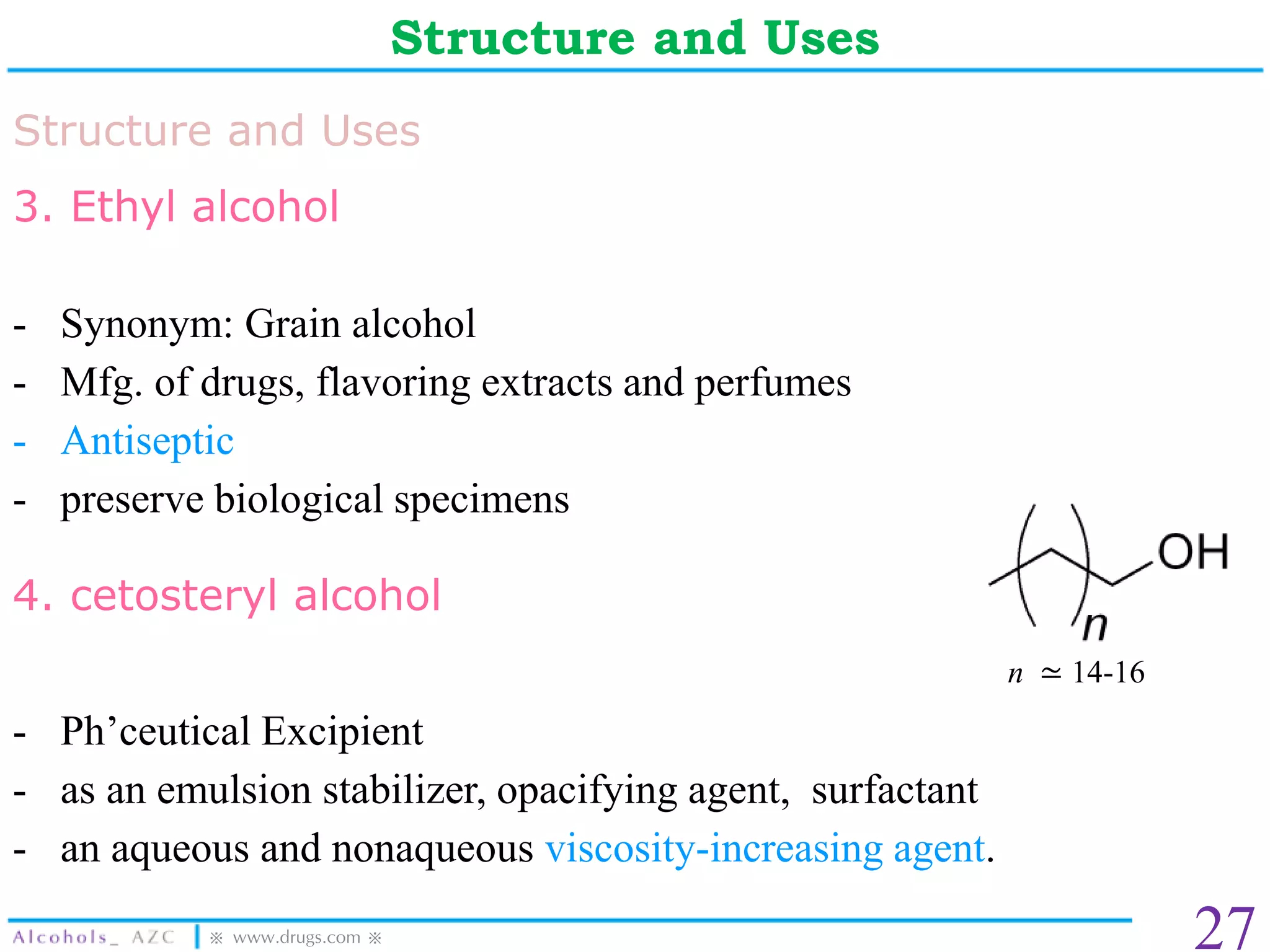
4. cetosteryl alcohol
- Ph’ceutical Excipient
- as an emulsion stabilizer, opacifying agent, surfactant
- an aqueous and nonaqueous viscosity-increasing agent.
n ≃ 14-16
27
※ www.drugs.com ※
Structure and Uses
Structure and Uses
5. propylene glycol
- Ph’ceutical Excipient
- as a humectant
- as a solvent in many pharmaceutical formulations
6. Benzyl alcohol
- Used as Topical anti-infectives - Benzyl Alcohol Lotion 5%
- as a humectant
- as a solvent in many pharmaceutical formulations
28
※ www.drugs.com ※
Structure and Uses
Structure and Uses
7. Chlorobutanol
- Veterinary use
- Antiemetic agent, Antiseptic agent, local Anesthetic,
- Pharmaceutical aid: Preservative
29
※ www.drugs.com ※
of the topic
End
Reference:
Organic Chemistry– Morrison & boyd
Textbook of org. chem. – Bahl & Bahl
Organic Chemistry – Francis A. Carey

ALCOHOL_Organic Chemistry _ B. Pharm.pptx

  • 1.
    ALCOHOL Mr. Amit ZChaudhari Dept. of Pharma Chemistry, L. M. College of Pharmacy, Ahmedabad - 380009 India
  • 2.
    C O NT E N T 2 - Introduction - Properties - Preparation - Reactions - Uses
  • 3.
    I N TR O D U C T I O N 3 ※ Morrison & Boyd ※ Bahl & Bahl ※ Finar Volume 1 ※ Mehta & Mehta ※ Francis A. Carey ※
  • 4.
    P R OP E R T I E S Classification: ※ Morrison & Boyd ※ Bahl & Bahl ※ Mehta & Mehta ※ 4
  • 5.
    P R OP E R T I E S Boiling point: b.p. of alcohols are much higher than those of corresponding alkanes ※ Morrison & Boyd ※ Bahl & Bahl ※ Mehta & Mehta ※ 5
  • 6.
    P R OP E R T I E S Boiling point: b.p. increases as MW increase in alcohols ※ Morrison & Boyd ※ Bahl & Bahl ※ Mehta & Mehta ※ https://chem.libretexts.org ※ 6
  • 7.
    P R OP E R T I E S Boiling point: b.p. decreases as branching increase in alcohols ※ Morrison & Boyd ※ Mehta & Mehta ※ 7
  • 8.
    P R OP E R T I E S Solubility: Solubility decreases as MW increases in alcohols ※ Morrison & Boyd ※ Bahl & Bahl ※ Mehta & Mehta ※ 8
  • 9.
    - Hydrolysis ofalkyl halide / Substitution Nucleophilic reaction P R E P A R A T I O N 9 ※ Morrison & Boyd ※ Bahl & Bahl ※
  • 10.
    Hydroxylation of alkene PR E P A R A T I O N Baeyers’ test 10 ※ Morrison & Boyd ※
  • 11.
    Hydroxylation of alkene e.g. -2-butene reacts with pot. permanganate and gives syn-butane-2,3-diol P R E P A R A T I O N 11 ※ Mehta & Mehta ※
  • 12.
    Hydroboration-oxidation (Antimarkovnikov's addition) PR E P A R A T I O N 12 ※ Morrison & Boyd ※ Francis A. Carey ※
  • 13.
    synthesis of 1°,2° and 3° alcohol using Grignard reagent Reaction with ethylene oxide gives 1° alcohol P R E P A R A T I O N 13 ※ Bahl & Bahl ※ Mehta & Mehta ※ Francis A. Carey ※
  • 14.
    synthesis of 1°,2° and 3° alcohol using Grignard reagent 1° 2° & 3° alcohol - Reaction of carbonyl compound with RMgX gives alcohol P R E P A R A T I O N 14 ※ Bahl & Bahl ※ Mehta & Mehta ※ Francis A. Carey ※
  • 15.
    synthesis of 1°,2° and 3° alcohol using Grignard reagent 1° alcohol P R E P A R A T I O N 15 ※ Bahl & Bahl ※ Mehta & Mehta ※ Francis A. Carey ※
  • 16.
    synthesis of 1°,2° and 3° alcohol using Grignard reagent 2° & 3° alcohol E.g. P R E P A R A T I O N 16 ※ Bahl & Bahl ※ Mehta & Mehta ※ Francis A. Carey ※
  • 17.
    DEHYDRATION OF ALCOHOLS– synthesis of Alkene R E A C T I O N 17 ※ Morrison & Boyd ※ Bahl & Bahl ※ Mehta & Mehta ※
  • 18.
    DEHYDRATION OF ALCOHOLS Mechanism: RE A C T I O N 18 ※ Morrison & Boyd ※ Bahl & Bahl ※ Mehta & Mehta ※
  • 19.
    DEHYDRATION OF ALCOHOLS RE A C T I O N Zaitsev’s product Major pdct 19 ※ Morrison & Boyd ※ Mehta & Mehta ※
  • 20.
    OXIDATION OF ALCOHOLS -Using oxidizing agents Mn(VII), Cr(VI). R E A C T I O N 20 ※ Morrison & Boyd ※
  • 21.
    Qualitative tests -Esterification test To identify alcoholic compounds R E A C T I O N 21 ※ Hitesh Raval ※
  • 22.
    Qualitative tests -Lucas test - Lucas reagent = Zinc chloride in conc. HCl - used to distinguish tests to differentiate between primary, secondary and tertiary alcohols of alcohols R E A C T I O N 22 ※ Hitesh Raval ※
  • 23.
    Qualitative tests -Lucas test - Mechanism R E A C T I O N 23 ※ Hitesh Raval ※
  • 24.
    Qualitative tests -Jones oxidation test - The Jones test utilizes chromium trioxide (orange-red colour) in the presence of sulfuric acid to act as a powerful oxidizing agent. R E A C T I O N 24 ※ Hitesh Raval ※
  • 25.
    Qualitative tests -Jones oxidation test - Primary alcohol is first converted into an aldehyde and then into a carboxylic acid, with bluish-green colour - Secondary alcohol will be oxidized into a ketone , with bluish-green colour - Tertiary alcohols do not react with chromium,, keeping the solution orange-red. - used for distinguishing primary and secondary alcohols from tertiary alcohols. R E A C T I O N 25 ※ Hitesh Raval ※
  • 26.
    Structure and Uses Structureand Uses 1. Methyl alcohol Synonym: wood alcohol - Solvent in analytical and organic laboratory - To denature ethyl alcohol - Mfg. of formaldehyde 2. Glycerol - As Lubrication , humectants in pharmaceutical formulations - To decrease in the internal pressure of the eye. 26 ※ Bahl & Bahl ※
  • 27.
    Structure and Uses Structureand Uses 3. Ethyl alcohol - Synonym: Grain alcohol - Mfg. of drugs, flavoring extracts and perfumes - Antiseptic - preserve biological specimens 4. cetosteryl alcohol - Ph’ceutical Excipient - as an emulsion stabilizer, opacifying agent, surfactant - an aqueous and nonaqueous viscosity-increasing agent. n ≃ 14-16 27 ※ www.drugs.com ※
  • 28.
    Structure and Uses Structureand Uses 5. propylene glycol - Ph’ceutical Excipient - as a humectant - as a solvent in many pharmaceutical formulations 6. Benzyl alcohol - Used as Topical anti-infectives - Benzyl Alcohol Lotion 5% - as a humectant - as a solvent in many pharmaceutical formulations 28 ※ www.drugs.com ※
  • 29.
    Structure and Uses Structureand Uses 7. Chlorobutanol - Veterinary use - Antiemetic agent, Antiseptic agent, local Anesthetic, - Pharmaceutical aid: Preservative 29 ※ www.drugs.com ※
  • 30.
    of the topic End Reference: OrganicChemistry– Morrison & boyd Textbook of org. chem. – Bahl & Bahl Organic Chemistry – Francis A. Carey

Editor's Notes

  • #5 Sorbitol and mannitol molecule, are isomers, are two types of sugar alcohols used as sweeteners. Sorbitol and mannitol are epimers