METROLOGY
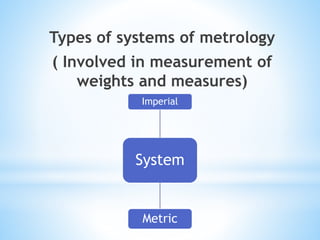
Types of systems of metrology
( Involved in measurement of
weights and measures)
System
Imperial
Metric
IMPERIAL SYSTEM
Types of imperial system
1
•Avoirdupois
2
•Apothecaries
*
AVOIRDUPOIS SYSTEM
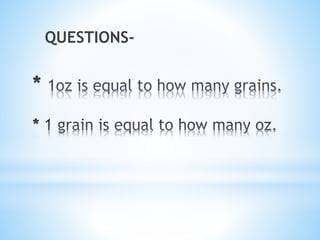
QUESTIONS-
*
APOTHECARIES SYSTEM
QUESTIONS
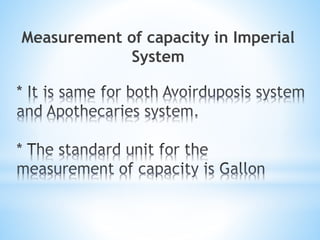
Measurement of capacity in Imperial
System
1 gallon (c) = 160 fluid ounce
1/4th of a gallon= 1 quart
1/8th of a gallon= 1 pint (o)
1/160th of a gallon= 1 fl ounce
1/8th of a fl ounce= 1 fl drachm
1/60th of a fl drachm= 1 minim (m)
1 quart= 40 fl ounces
1 pint= 20 fl ounces
1 fl ounce= 480 minims
1 fl drachm= 60 minims
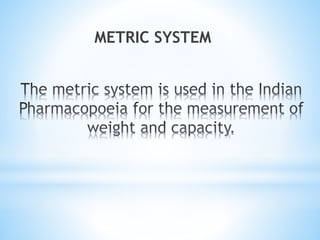
METRIC SYSTEM
*
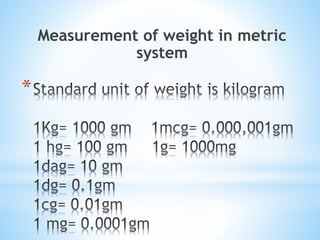
Measurement of weight in metric
system
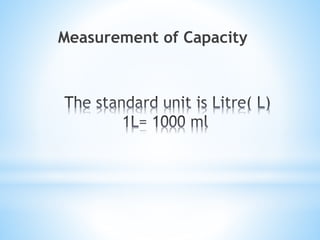
Measurement of Capacity
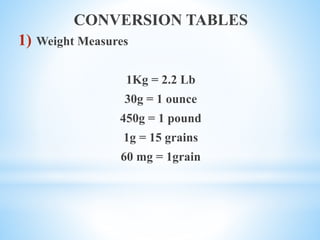
CONVERSION TABLES
1) Weight Measures
1Kg = 2.2 Lb
30g = 1 ounce
450g = 1 pound
1g = 15 grains
60 mg = 1grain
2) Capacity Measures
1000ml = 1 quart
500ml = 1pint
30 ml = 1 fluid ounce
4ml = 1 fluid drachm
1ml = 15 minimus
1ml = 15 minims
0.06 ml = 1 minim
Conversion table for domestic measures
Domestic
measure
Metric system Imperial system
1 drop
1 teaspoonful
1 desert spoonful
1 tablespoonful
2 tablespoonful
1 wine glassful
1 teacupful
1 tumblerful
0.06 ml
4 ml
8ml
15 ml
30 ml
60 ml
120 ml
240 ml
1 minimum
1 fluid drachm
2 fluid drachm
4 fluid drachm
1 fluid ounce
2 fluid ounce
4 fluid ounce
8 fluid ounce
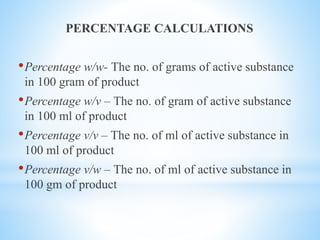
PERCENTAGE CALCULATIONS
•Percentage w/w- The no. of grams of active substance
in 100 gram of product
•Percentage w/v – The no. of gram of active substance
in 100 ml of product
•Percentage v/v – The no. of ml of active substance in
100 ml of product
•Percentage v/w – The no. of ml of active substance in
100 gm of product
Common formulae used in % calculations
•Preparation of 1% w/v solution in the imperial system
a) Solid- 1gr; solvent to produce 110m
b) Solid- 4.375 gr, solvent to produce 1 fluid ounce
c) Solid- 35 gr, solvent to produce 8 fluid ounce
• Prepartion of 1% w/v solution in metric system
Solid-1g and solvent to produce 100 ml
Questions-
1) Calculate the quantity of dextrose requires to
prepare 1 fl oz of a 10% solution
2) Calculate the quantity of dextrose required to
prepare 8 fl oz of a 5% solution
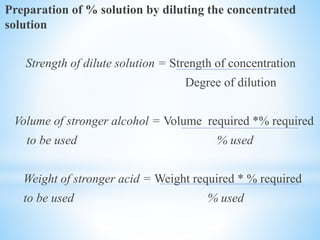
Preparation of % solution by diluting the concentrated
solution
Strength of dilute solution = Strength of concentration
Degree of dilution
Volume of stronger alcohol = Volume required *% required
to be used % used
Weight of stronger acid = Weight required * % required
to be used % used
RULES-
Rule1- g may be read as oz ( avoir)
ml may be read as fl oz
Rule2- g may be read as grain
ml may be read as minim after adding 10%
Questions-
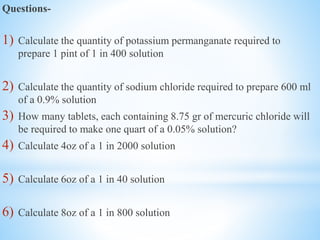
1) Calculate the quantity of potassium permanganate required to
prepare 1 pint of 1 in 400 solution
2) Calculate the quantity of sodium chloride required to prepare 600 ml
of a 0.9% solution
3) How many tablets, each containing 8.75 gr of mercuric chloride will
be required to make one quart of a 0.05% solution?
4) Calculate 4oz of a 1 in 2000 solution
5) Calculate 6oz of a 1 in 40 solution
6) Calculate 8oz of a 1 in 800 solution
7) Prepare 8 oz of a solution so that two teaspoonful
diluted to a quart, will make 1 in 2500 solution
8) Calculate the number of grains required to make 12 oz,
so that 1 teaspoonful diluted to half a pint will make
0.04% solution.
9) Prepare 5oz of a solution so that 1 tablespoonful to 1
quart makes 1 in 500 solution
10) Prepare 8 oz of 60% alcohol from 95% alcohol
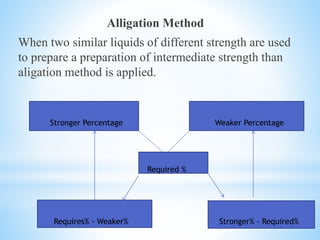
Alligation Method
When two similar liquids of different strength are used
to prepare a preparation of intermediate strength than
aligation method is applied.
Stronger Percentage Weaker Percentage
Required %
Requires% - Weaker% Stronger% - Required%
Question-
Prepare 600 ml of 70% alcohol from 95% alcohol
Solution- Required % = 70
% used = 95
Alcohol Water
95 0
70
70-0 95-70
70 25
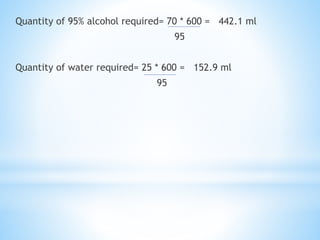
Quantity of 95% alcohol required= 70 * 600 = 442.1 ml
95
Quantity of water required= 25 * 600 = 152.9 ml
95
ISOTONIC SOLUTION
Diffusion- When a solute moves from a region of higher
concentration to a lower concentration is called diffusion.
Osmosis- When two different solution are separated by a
semi-permeable memberane and moves from lower to
higher concentration is called osmosis.
Osmotic Pressure- Pressure exerted during the process of
osmosis is called osmotic pressure.
Osmotic pressure ∞ No. of solute units
Isotonic solution- It refers to two solutions having the same
osmotic pressure across a semi-permeable memberane is
called isotonic solutions.
Types of Solutions-
1) Isotonic solution- Solution having same osmotic
pressure with the blood plasma is called isotonic
solution
Eg- Solution containing 0.9% of NaCl with the
blood plasma
2) Hypertonic solution- Solution having greater
osmotic pressure with the blood plasma is called
hypertonic solution
Eg- Solution containing more than 0.9% of NaCl with
the blood plasma
3) Hypotonic solution- Solution having lower osmotic
pressure with the blood plasma is called hypotonic
solution
Eg- Solution containing less than 0.9% of NaCl with
the blood plasma
Measurement of method for isotonicity
1) Method based on freezing point data
2) Method based on molecular concentration
3) Graphic method based on vapour pressure
and freezing point depression
4) Method based on sodium chloride equivalent
Presentation on metrology.pptx

Presentation on metrology.pptx

  • 2.
  • 3.
    Types of systemsof metrology ( Involved in measurement of weights and measures) System Imperial Metric
  • 4.
  • 5.
    Types of imperialsystem 1 •Avoirdupois 2 •Apothecaries
  • 6.
  • 7.
  • 8.
  • 9.
  • 10.
    Measurement of capacityin Imperial System
  • 11.
    1 gallon (c)= 160 fluid ounce 1/4th of a gallon= 1 quart 1/8th of a gallon= 1 pint (o) 1/160th of a gallon= 1 fl ounce 1/8th of a fl ounce= 1 fl drachm 1/60th of a fl drachm= 1 minim (m) 1 quart= 40 fl ounces 1 pint= 20 fl ounces 1 fl ounce= 480 minims 1 fl drachm= 60 minims
  • 12.
  • 13.
    * Measurement of weightin metric system
  • 14.
  • 15.
    CONVERSION TABLES 1) WeightMeasures 1Kg = 2.2 Lb 30g = 1 ounce 450g = 1 pound 1g = 15 grains 60 mg = 1grain
  • 16.
    2) Capacity Measures 1000ml= 1 quart 500ml = 1pint 30 ml = 1 fluid ounce 4ml = 1 fluid drachm 1ml = 15 minimus 1ml = 15 minims 0.06 ml = 1 minim
  • 17.
    Conversion table fordomestic measures Domestic measure Metric system Imperial system 1 drop 1 teaspoonful 1 desert spoonful 1 tablespoonful 2 tablespoonful 1 wine glassful 1 teacupful 1 tumblerful 0.06 ml 4 ml 8ml 15 ml 30 ml 60 ml 120 ml 240 ml 1 minimum 1 fluid drachm 2 fluid drachm 4 fluid drachm 1 fluid ounce 2 fluid ounce 4 fluid ounce 8 fluid ounce
  • 18.
    PERCENTAGE CALCULATIONS •Percentage w/w-The no. of grams of active substance in 100 gram of product •Percentage w/v – The no. of gram of active substance in 100 ml of product •Percentage v/v – The no. of ml of active substance in 100 ml of product •Percentage v/w – The no. of ml of active substance in 100 gm of product
  • 19.
    Common formulae usedin % calculations •Preparation of 1% w/v solution in the imperial system a) Solid- 1gr; solvent to produce 110m b) Solid- 4.375 gr, solvent to produce 1 fluid ounce c) Solid- 35 gr, solvent to produce 8 fluid ounce • Prepartion of 1% w/v solution in metric system Solid-1g and solvent to produce 100 ml
  • 20.
    Questions- 1) Calculate thequantity of dextrose requires to prepare 1 fl oz of a 10% solution 2) Calculate the quantity of dextrose required to prepare 8 fl oz of a 5% solution
  • 21.
    Preparation of %solution by diluting the concentrated solution Strength of dilute solution = Strength of concentration Degree of dilution Volume of stronger alcohol = Volume required *% required to be used % used Weight of stronger acid = Weight required * % required to be used % used
  • 22.
    RULES- Rule1- g maybe read as oz ( avoir) ml may be read as fl oz Rule2- g may be read as grain ml may be read as minim after adding 10%
  • 23.
    Questions- 1) Calculate thequantity of potassium permanganate required to prepare 1 pint of 1 in 400 solution 2) Calculate the quantity of sodium chloride required to prepare 600 ml of a 0.9% solution 3) How many tablets, each containing 8.75 gr of mercuric chloride will be required to make one quart of a 0.05% solution? 4) Calculate 4oz of a 1 in 2000 solution 5) Calculate 6oz of a 1 in 40 solution 6) Calculate 8oz of a 1 in 800 solution
  • 24.
    7) Prepare 8oz of a solution so that two teaspoonful diluted to a quart, will make 1 in 2500 solution 8) Calculate the number of grains required to make 12 oz, so that 1 teaspoonful diluted to half a pint will make 0.04% solution. 9) Prepare 5oz of a solution so that 1 tablespoonful to 1 quart makes 1 in 500 solution 10) Prepare 8 oz of 60% alcohol from 95% alcohol
  • 25.
    Alligation Method When twosimilar liquids of different strength are used to prepare a preparation of intermediate strength than aligation method is applied. Stronger Percentage Weaker Percentage Required % Requires% - Weaker% Stronger% - Required%
  • 26.
    Question- Prepare 600 mlof 70% alcohol from 95% alcohol Solution- Required % = 70 % used = 95 Alcohol Water 95 0 70 70-0 95-70 70 25
  • 27.
    Quantity of 95%alcohol required= 70 * 600 = 442.1 ml 95 Quantity of water required= 25 * 600 = 152.9 ml 95
  • 28.
    ISOTONIC SOLUTION Diffusion- Whena solute moves from a region of higher concentration to a lower concentration is called diffusion. Osmosis- When two different solution are separated by a semi-permeable memberane and moves from lower to higher concentration is called osmosis. Osmotic Pressure- Pressure exerted during the process of osmosis is called osmotic pressure. Osmotic pressure ∞ No. of solute units Isotonic solution- It refers to two solutions having the same osmotic pressure across a semi-permeable memberane is called isotonic solutions.
  • 29.
    Types of Solutions- 1)Isotonic solution- Solution having same osmotic pressure with the blood plasma is called isotonic solution Eg- Solution containing 0.9% of NaCl with the blood plasma 2) Hypertonic solution- Solution having greater osmotic pressure with the blood plasma is called hypertonic solution Eg- Solution containing more than 0.9% of NaCl with the blood plasma
  • 30.
    3) Hypotonic solution-Solution having lower osmotic pressure with the blood plasma is called hypotonic solution Eg- Solution containing less than 0.9% of NaCl with the blood plasma
  • 31.
    Measurement of methodfor isotonicity 1) Method based on freezing point data 2) Method based on molecular concentration 3) Graphic method based on vapour pressure and freezing point depression 4) Method based on sodium chloride equivalent