Airway Management
Anupam Ghimire
GP-EM Resident
Objectives
• Case scenario
• Airway management
• Challenges in difficult airway management
Case scenario
• 70 yr/F
- COPD , HTN and Post TB fibrosis of Lung
• Coughing up of blood for 2 hrs
- Around 750 ml , fresh red
- Similar episode 1 day back ~ 50 ml
• No history of :
- Fever
- Chest pain
- Weight loss, anorexia
- Rashes , bleeding from other sites
- Antiplatelet or Anticoagulant
• Former Smoker
Examination
• Anxious , alert , short stature and obese
• Pallor +, ILCCOD-
• Vitals :
Bp : 80/40 mmhg Pulse : 120 bpm
RR: 20 breath/min Spo2: 91 % on RA
T: Afebrile
• Chest examination
- Air entry – decreased in lt side
- Vesicular Breath sound
- Conducted sound over lt lung field
• Other system examinations grossly normal
Emergency Management
- Airway
- Breathing
- Circulation
- Position: Lt lateral decubitus
- Fluid resustication
- Drugs : Tranxemic acid , Ondansetron
- Blood arranged and cross-matched
After 10 min
• Hemoptysis continues  next 250 ml
• Drowsy , Sweating
• MAP : 60 , P: 136-140/min
Spo2 : 88% on 10 L Oxygen
ECG : Sinus Tachycardia
WHAT NEXT ….
• Discussion on airway management strategy
• Equipments : Oxygen
- Mask - Monitoring
- Airway ( Oral and nasal ) - Emergency Drugs
- Laryngoscope - Suction
- Endotracheal tube - Self inflating bag
valve resusticator
• Airway assessment:
– L- Look externally ( No facial trauma, large incisors,
large tongue)
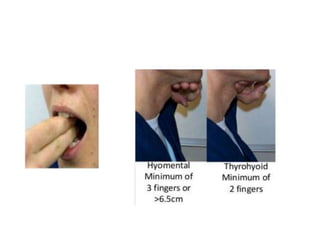
– E- Evaluate the 3-3-2 rule
• Incisor opening distance: 2 fingerbreadths
• Hyoid-mental distance: 2 fingerbreadths
• Thyroid-to-mouth distance: 1 fingerbreadths
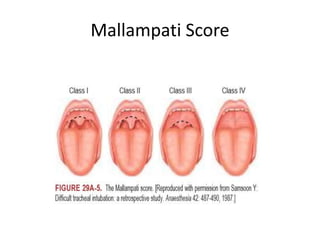
– M- Mallampati score 4
– O- Obstruction: No epiglottitis, peritonsillar abscess,
or trauma
– N- Neck mobility ( neck mobility)
• Preoxygenation , Positioning
• Sedative agent :
- Ketamine 50 mg
• Immediately followed by Muscle relaxant
- Succinylcholine 50 mg
• Intubation field not seen despite suctioning
• Intubation with size 7 ET tube done  failed
- Cormack Lehane grade 4
• Second attempt done with Preloaded stylet
- Glottic exposure : BURP manaeuver
- Rt lung intubation done , confirmed
- Tube fixed at 28 cm, secured
- Kept in lateral decubitis position
• Post intubation sedation given, Bag and mask
ventillation continued
• Spo2 – 97 % with 10 L oxygen
• BP : 110/80 mmhg
• Pulse : 100/ min
• Urine output : 300 ml , clear
After 10 min
• Spo2: 34 % on 15 L oxygen
• Bp : ??
• HR: 38 bpm , decreasing
• Pulse : not palpable
What NEXT……
• CPR Started, ET tube suctioning done in between
• Injection Adrenaline every 5 min ( 3 doses )
• Injection Atropine 1ml ( 2doses )
• Noradrenaline started
• NO Improvement
What NEXT…..
• Flushing of ET tube done
- NS 10 ml
• After 2 minute
- Sp02 : 98% on 10 L oxygen, P: 92 bpm
- ROSC , CPR stopped
- Post resustication care done
- Referred to CTVS center
Learning points
• Airway assessment :
– L- Look externally (facial trauma, large incisors, beard,
large tongue)
– E- Evaluate the 3-3-2 rule
• Incisor opening distance: 3 fingerbreadths
• Hyoid-mental distance: 3 fingerbreadths
• Thyroid-to-mouth distance: 2 fingerbreadths
– M- Mallampati score ≥3
– O- Obstruction: Presence of condition such as
epiglottitis, peritonsillar abscess, or trauma
– N- Neck mobility (limited neck mobility)
Mallampati Score
Rapid Sequence Induction (RSI)
• Sequential administration of an induction
agent and neuromuscular blocking agent to
facilitate endotracheal intubation
• The goal of RSI- facilitate rapid insertion of the
ETT while minimizing physiologic
perturbations
RSI Steps
• Discuss airway management strategy with the team
• Set up IV access, cardiac monitor, oximetry, and
capnography/capnometry
• Plan procedure. Assess physiologic status and airway
difficulty.
• Prepare equipment, suction, and potential rescue devices
• Preoxygenate
• Consider pretreatment agents
• Give sedative agent immediately followed by neuromuscular
blocking agent.
• Intubate trachea
• Confirm tube placement.
• Secure tube
• Adjust mechanical ventilation and provide postintubation
sedation.
RSI
• Pre treatment agents- Lidocaine, Fentanyl
• Induction agents- Etomidate, Propofol,
Ketamine
• Neuromuscular Blocking- Rocuronium,
Vecuronium, Succinylcholine
PEA causes:
• M: massive pulmonary embolism
• A: acidosis
• D: drug overdose
• H: HYPOXIA/hypothermia
• H: hypovolemia
• H: hypokalemia/hyperkalemia
• C: cardiac tamponade
• A: acute MI
• T: tension pneumothorax
Troubleshooters: Post intubation
• D - Displacement of tube or cuff
– Auscultate / look etco2
• O - Obstruction of tube/circuit
– Use suction catheter to remove mucus/blood, or
make sure patient not biting down, look for kink in
tube
• P - Pneumothorax
– Verify via USG , CXR, or Needle
thoracocenthesis (high suspicion)
• E - Equipment failure
– ReConnect to Bag mask ventillator
Summary
• Anticipation of difficult airway
• Single lung ventillation
• Emergency intubation : RSI
• Troubleshooters of postintubation should be
promptly managed
THANK YOU

Airway management

  • 1.
  • 2.
    Objectives • Case scenario •Airway management • Challenges in difficult airway management
  • 3.
    Case scenario • 70yr/F - COPD , HTN and Post TB fibrosis of Lung • Coughing up of blood for 2 hrs - Around 750 ml , fresh red - Similar episode 1 day back ~ 50 ml
  • 4.
    • No historyof : - Fever - Chest pain - Weight loss, anorexia - Rashes , bleeding from other sites - Antiplatelet or Anticoagulant • Former Smoker
  • 5.
    Examination • Anxious ,alert , short stature and obese • Pallor +, ILCCOD- • Vitals : Bp : 80/40 mmhg Pulse : 120 bpm RR: 20 breath/min Spo2: 91 % on RA T: Afebrile
  • 6.
    • Chest examination -Air entry – decreased in lt side - Vesicular Breath sound - Conducted sound over lt lung field • Other system examinations grossly normal
  • 7.
    Emergency Management - Airway -Breathing - Circulation - Position: Lt lateral decubitus - Fluid resustication - Drugs : Tranxemic acid , Ondansetron - Blood arranged and cross-matched
  • 8.
    After 10 min •Hemoptysis continues  next 250 ml • Drowsy , Sweating • MAP : 60 , P: 136-140/min Spo2 : 88% on 10 L Oxygen ECG : Sinus Tachycardia WHAT NEXT ….
  • 9.
    • Discussion onairway management strategy • Equipments : Oxygen - Mask - Monitoring - Airway ( Oral and nasal ) - Emergency Drugs - Laryngoscope - Suction - Endotracheal tube - Self inflating bag valve resusticator
  • 10.
    • Airway assessment: –L- Look externally ( No facial trauma, large incisors, large tongue) – E- Evaluate the 3-3-2 rule • Incisor opening distance: 2 fingerbreadths • Hyoid-mental distance: 2 fingerbreadths • Thyroid-to-mouth distance: 1 fingerbreadths – M- Mallampati score 4 – O- Obstruction: No epiglottitis, peritonsillar abscess, or trauma – N- Neck mobility ( neck mobility)
  • 11.
    • Preoxygenation ,Positioning • Sedative agent : - Ketamine 50 mg • Immediately followed by Muscle relaxant - Succinylcholine 50 mg
  • 12.
    • Intubation fieldnot seen despite suctioning • Intubation with size 7 ET tube done  failed - Cormack Lehane grade 4 • Second attempt done with Preloaded stylet - Glottic exposure : BURP manaeuver - Rt lung intubation done , confirmed - Tube fixed at 28 cm, secured - Kept in lateral decubitis position
  • 13.
    • Post intubationsedation given, Bag and mask ventillation continued • Spo2 – 97 % with 10 L oxygen • BP : 110/80 mmhg • Pulse : 100/ min • Urine output : 300 ml , clear
  • 14.
    After 10 min •Spo2: 34 % on 15 L oxygen • Bp : ?? • HR: 38 bpm , decreasing • Pulse : not palpable What NEXT……
  • 15.
    • CPR Started,ET tube suctioning done in between • Injection Adrenaline every 5 min ( 3 doses ) • Injection Atropine 1ml ( 2doses ) • Noradrenaline started • NO Improvement What NEXT…..
  • 16.
    • Flushing ofET tube done - NS 10 ml • After 2 minute - Sp02 : 98% on 10 L oxygen, P: 92 bpm - ROSC , CPR stopped - Post resustication care done - Referred to CTVS center
  • 17.
    Learning points • Airwayassessment : – L- Look externally (facial trauma, large incisors, beard, large tongue) – E- Evaluate the 3-3-2 rule • Incisor opening distance: 3 fingerbreadths • Hyoid-mental distance: 3 fingerbreadths • Thyroid-to-mouth distance: 2 fingerbreadths – M- Mallampati score ≥3 – O- Obstruction: Presence of condition such as epiglottitis, peritonsillar abscess, or trauma – N- Neck mobility (limited neck mobility)
  • 18.
  • 20.
    Rapid Sequence Induction(RSI) • Sequential administration of an induction agent and neuromuscular blocking agent to facilitate endotracheal intubation • The goal of RSI- facilitate rapid insertion of the ETT while minimizing physiologic perturbations
  • 21.
    RSI Steps • Discussairway management strategy with the team • Set up IV access, cardiac monitor, oximetry, and capnography/capnometry • Plan procedure. Assess physiologic status and airway difficulty. • Prepare equipment, suction, and potential rescue devices • Preoxygenate • Consider pretreatment agents • Give sedative agent immediately followed by neuromuscular blocking agent. • Intubate trachea • Confirm tube placement. • Secure tube • Adjust mechanical ventilation and provide postintubation sedation.
  • 22.
    RSI • Pre treatmentagents- Lidocaine, Fentanyl • Induction agents- Etomidate, Propofol, Ketamine • Neuromuscular Blocking- Rocuronium, Vecuronium, Succinylcholine
  • 23.
    PEA causes: • M:massive pulmonary embolism • A: acidosis • D: drug overdose • H: HYPOXIA/hypothermia • H: hypovolemia • H: hypokalemia/hyperkalemia • C: cardiac tamponade • A: acute MI • T: tension pneumothorax
  • 24.
    Troubleshooters: Post intubation •D - Displacement of tube or cuff – Auscultate / look etco2 • O - Obstruction of tube/circuit – Use suction catheter to remove mucus/blood, or make sure patient not biting down, look for kink in tube • P - Pneumothorax – Verify via USG , CXR, or Needle thoracocenthesis (high suspicion) • E - Equipment failure – ReConnect to Bag mask ventillator
  • 25.
    Summary • Anticipation ofdifficult airway • Single lung ventillation • Emergency intubation : RSI • Troubleshooters of postintubation should be promptly managed
  • 26.

Editor's Notes

  • #5 5 causes of hemoptysis : Infective , Vascular (PE), Neoplastic , Autoimmune , Drug related