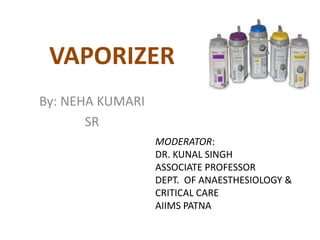
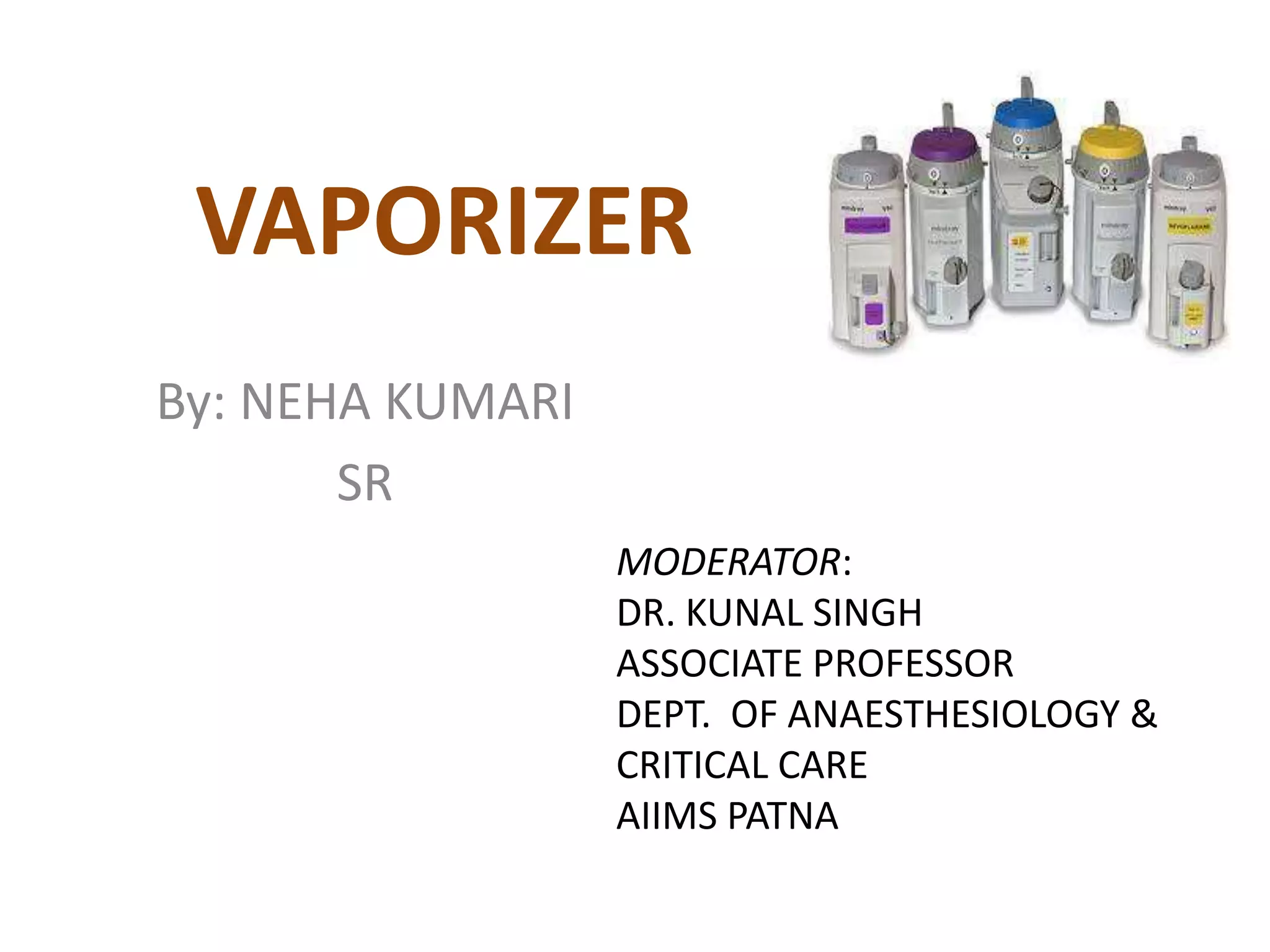
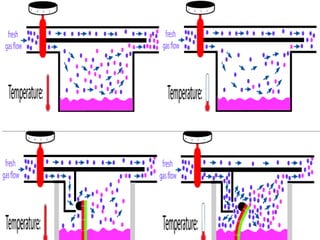
VAPORIZER
By: NEHA KUMARI
SR
MODERATOR:
DR. KUNAL SINGH
ASSOCIATE PROFESSOR
DEPT. OF ANAESTHESIOLOGY &
CRITICAL CARE
AIIMS PATNA
• DEFINITION
• VAPORIZER= Anesthetic agent delivery system OR Vapor
delivery system
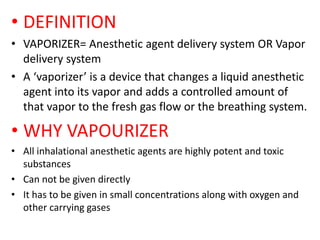
• A ‘vaporizer’ is a device that changes a liquid anesthetic
agent into its vapor and adds a controlled amount of
that vapor to the fresh gas flow or the breathing system.
• WHY VAPOURIZER
• All inhalational anesthetic agents are highly potent and toxic
substances
• Can not be given directly
• It has to be given in small concentrations along with oxygen and
other carrying gases
CHARACTERISTIC OF IDEAL VAPOURIZER
• Performance not affected by changes in FGF, volume
of liquid agent, ambient temperature & pressure.
• Low resistance to flow
• Light wt with small liquid requirement
• Economical & safety in use
• Corrosion & solvent resistant
• Vaporizer Concentration:
- Denotes concentration delivered by vaporizer, when
FG containing no vapor passes through it.
- In out of system, vaporizer output = vap. Conc
- In in system, vaporizer output exceed vap. Conc. (as
expired gases contains some volatile anesthetic)
• Vaporizer capability:
- Maximum conc. that can be delivered by a vaporizer at
the highest setting of the conc. Dial.
- Manufacturers decide it on the basis of MAC. eg. Sevo
has high MAC than Iso, hence sevo needs high capability
vaporizer(max.8) as compared to Iso(max.5).
• Vaporizer efficiency:
- Ability of a vaporizer to saturate the carrier gas passing
into the vaporizing chamber.
- Increased by using wicks, baffles & longer vaporizing
chamber to increase surface area available for
vaporization.
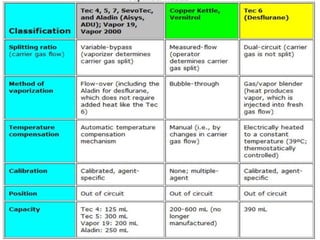
Classification of vaporizer with examples
Dorsch & Dorsch classification
• Method of regulating output :
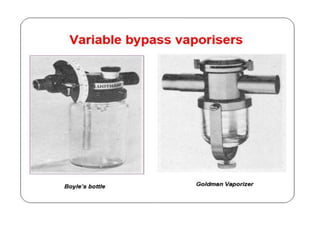
1. Variable bypass: Ether bottle, TEC vaporizer
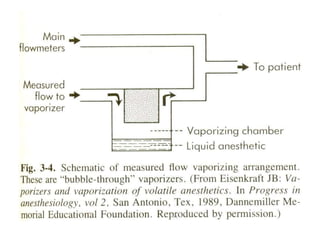
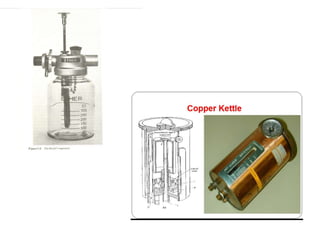
2. Measured flow: Copper kettle
• Method of vaporization
1. Flow over:
- With wick: TEC vaporizer
- Without wick: Goldman bottle
1. Bubble through: Copper kettle
2. Injection: Desflurane ( Gas-vapor blender)
• Temperature compensation
1.Thermocompensated
- By altered flow- TEC vaporizer
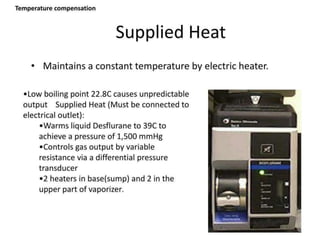
- By supplied heat- Copper kettle
- BY both altered flow & supplied heat- EMO
2. Non-compensated- Ether bottle
• Specificity
1. Agent specific: TEC vaporizer
2. Multiagent: Goldman bottle
• Resistance
1. Plenum(high resistance):TEC vaporizer
2. Draw over(low resistance):Goldmann bottle,EMO
• Location:
1. In circuit: VIC-EMO, Goldman
2. Out of circuit: VOC- TEC vaporizer
Other:
Concentration caliberated: Desflurane vaporizer
Not be concentration caliberated: Goldman
Splitting Ratio
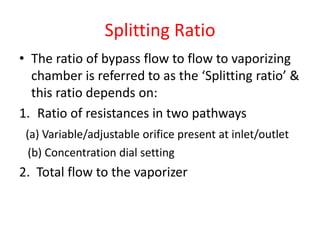
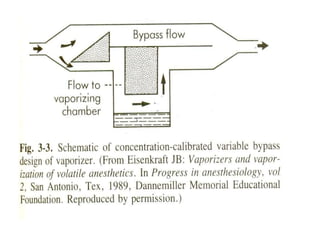
• The ratio of bypass flow to flow to vaporizing
chamber is referred to as the ‘Splitting ratio’ &
this ratio depends on:
1. Ratio of resistances in two pathways
(a) Variable/adjustable orifice present at inlet/outlet
(b) Concentration dial setting
2. Total flow to the vaporizer
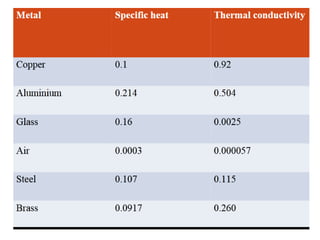
Thermal conductivity
• Vaporizers are made up of metals that have relatively
higher thermal conductivity to minimize temperature
changes when vaporizer is in use, thus
thermostabilization achieved.
• Copper has a moderately high specific heat and a
very high thermal conductivity. Hence, it is used in
the construction of a number of vaporizers.
Agent specific
• Concentration caliberated vaporizers are agent
specific & therefore only particular anesthetic agent
for which the vaporizer has been designed &
caliberated may be safely used.
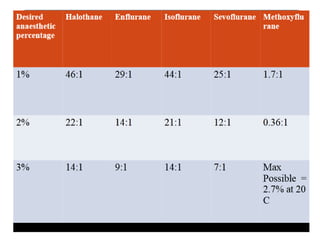
• eg. If an enflurane vaporizer was set to deliver 1 %
agent but had been inadvertently filled with
halothane the splitting ratio would be 46:29, yeilding
an actual halothane vapor not of 1% but rather of
1.6%.
Features of modern vapourizer
• Variable bypass
- Fresh gas splits into bypass gas & carrier gas
• Flow over
- Carrier gas flows over the surface of the liquid volatile
agent in the vaporizing chamber.
• Temperature compensated
- Eqipped with automatic devices that ensures steady
vaporizer output over a wide range of ambient
temperature.
• Agent specific
- Only caliberated for a single gas, usually with keyed
fillers
• Out of circuit
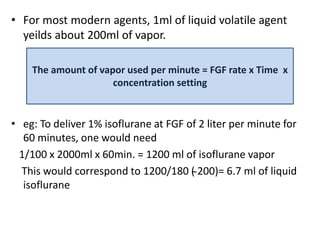
• For most modern agents, 1ml of liquid volatile agent
yeilds about 200ml of vapor.
• eg: To deliver 1% isoflurane at FGF of 2 liter per minute for
60 minutes, one would need
1/100 x 2000ml x 60min. = 1200 ml of isoflurane vapor
This would correspond to 1200/180 ( ̴200)= 6.7 ml of liquid
isoflurane
The amount of vapor used per minute = FGF rate x Time x
concentration setting
Hazards of vaporizer
• Incorrect concentration delivered:
High conc -1. Pumping effect 2. Reversal flow
Low conc -1.Pressurizing effect 2. Very low/ high flow
3. cooling of liquid
• Incorrect agent:
Minimizes by agent-specific filling system
• Tipping
-It can lead to entry of liquid agent into bypass chamber,
results dangerous high conc. of vapor will be delivered when
vaporizer is turned on.
Prevention of tipping:
1.Mounting vaporizers on the manifold
2. Draining the vaporizer before being moved
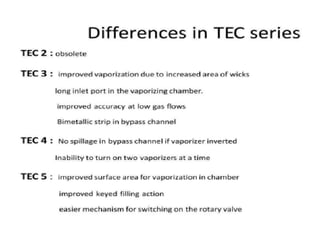
3.Newer vaporizer are designed to avoid spillage even turned 180
degree(TEC4)
4. If tipping is suspected, vaporizer should be flushed with high gas
flows for 15- 20 mints.
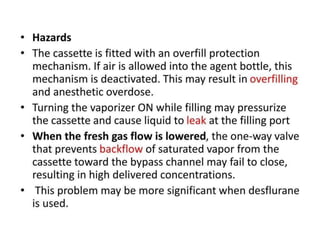
• Overfilling: Low level filling port
• Reversal of flow: Mounting vaporizer on manifold
• Leaks: Machine check
It leads to: 1. wastage of agent 2.Delivery of wrong agent
3. OT pollution
Safety features of vaporizer
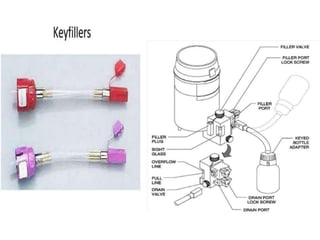
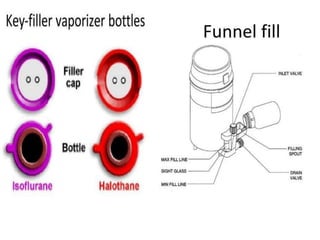
• Agent-specific filling system:
KISS system- Keyed Index Safety System – To prevent
accidental filling with wrong agent
- Consists of color -coded bottle collar & a matching color -
coded adaptor
• Low filling port: It minimizes overfilling because filler port is
located at the maximum safe liquid level.
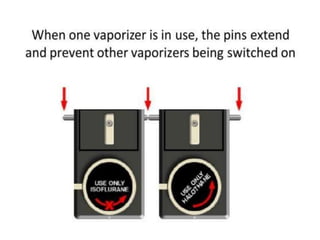
• Locking device: Prevent administration of more than
one inhaled anesthetic at a time.
• Vaporizer is constructed with ‘back flow check valve’
at common gas outlet to prevent pumping effect
• The vaporizer is constructed with ‘high thermal
conductivity’ & ‘high specific heat material’.
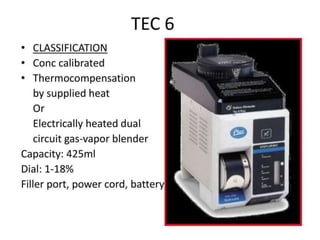
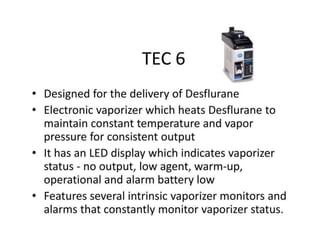
TEC VAPORIZERS
• Classification (TEC 1-7)
1.Variable bypass
2.Flow over with wick
3.Out of system
4. Temperature compensated by automatic flow
alteration
5.Concentration caliberated
6. Agent specific
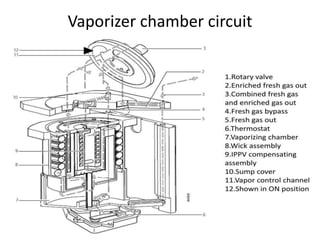
Vaporizer chamber circuit
Vaporizer Mounting System
●Permanent mounting and Detachable mounting
●Permanent means it requires tools to remove or install
a vaporizer.
●Advantages are: vaporizers will not be dropped or
abused, leaks will be less
Filling device
• Funnel filler
• Quick filler
• Key filler
• Easy filler
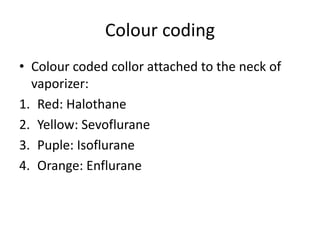
Colour coding
• Colour coded collor attached to the neck of
vaporizer:
1. Red: Halothane
2. Yellow: Sevoflurane
3. Puple: Isoflurane
4. Orange: Enflurane
Effects of altered brometric pressure
• Most vaporizers are calibrated at sea level (standard
atmospheric pressure). Anesthetic agents with low
boiling points are more susceptible to variations in
barometric pressure.
•ASTM machine standard requires that the effects of
changes in ambient pressure on vaporizer performance
be stated in operation manuals.
• High altitude(Hypobaric condition)
- Increases vaporizer output
• Low altitude(Hyperbaric condition)
- Decreases vaporizer output, because increased
atmospheric pressure changes density of gases
& creates more resistance to flow through
vaporizing chamber.
- At 2 atm, the conc. In volume percentage
becomes half.
Effects of intermittent back pressure
●Pumping effect – increase the output
●Pressurizing effect – decrease the output
●Sources of back pressure
•during assisted/controlled ventilation, the positive
pressure generated during inspiration is transmitted from
the breathing system back to machine and vaporizer.
•use of O2 flush valve, the output from O2 flush enters
the circuit downstream of vaporizers and its activation
produces high pressure.
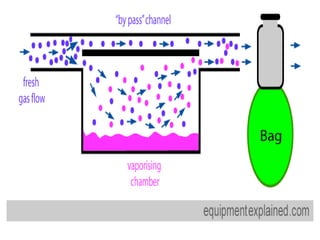
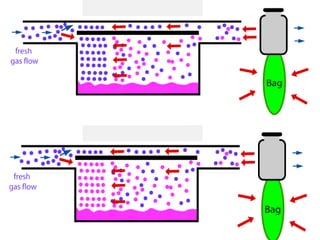
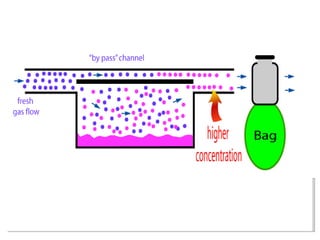
Pumping effect
●This adds to the vaporizer output to increase
the final vapor output.
●This change is most pronounced when there is
less agent in the vaporizing chamber, carrier gas
flow is low, high and frequent pressure
fluctuations, low dial setting.
●When resistance is applied to the outlet of the
anesthetic machine, as during assisted or
controlled ventilation, there is an increase in the
anesthetic gas pressure which is transmitted
back to the vaporizer.
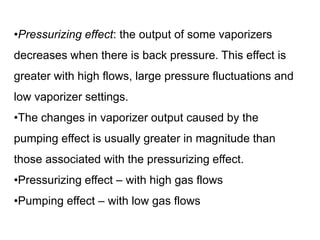
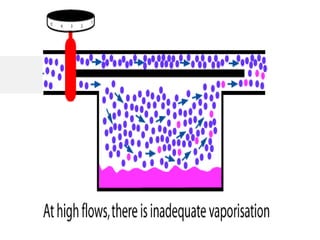
•Pressurizing effect: the output of some vaporizers
decreases when there is back pressure. This effect is
greater with high flows, large pressure fluctuations and
low vaporizer settings.
•The changes in vaporizer output caused by the
pumping effect is usually greater in magnitude than
those associated with the pressurizing effect.
•Pressurizing effect – with high gas flows
•Pumping effect – with low gas flows
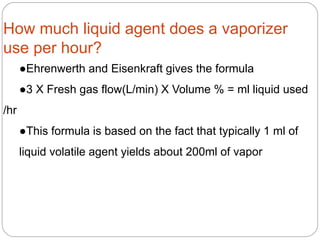
How much liquid agent does a vaporizer
use per hour?
●Ehrenwerth and Eisenkraft gives the formula
●3 X Fresh gas flow(L/min) X Volume % = ml liquid used
/hr
●This formula is based on the fact that typically 1 ml of
liquid volatile agent yields about 200ml of vapor
history
• Flagg’s can- KEM bottle
• Schimmelbusch mask, Yankauer’s mask
• Ogston’s inhaler
• Boyle’s bottle: 1. broad 2. Narrow
• EMO inhale
• Oxford miniature vaporizer
• Goldman vaporizer
• Copper kettle
• TEC vaporizer: I - VII
• Dragor Vaporizer
• Drager D Vaporizer
• Penlon Sigma PPV
• Penlon Sigma Delta
• Penlon Sigma Alpha
• Blease Datum
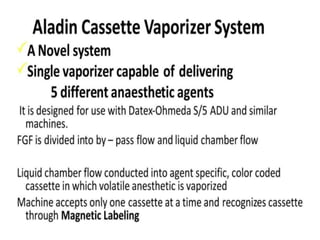
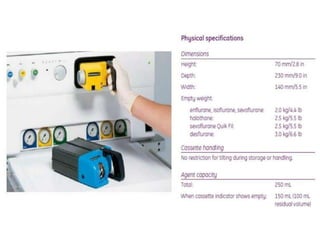
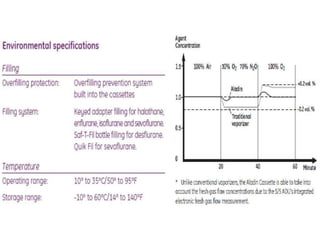
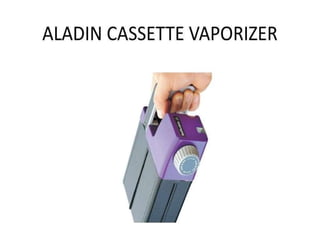
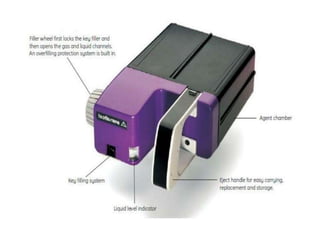
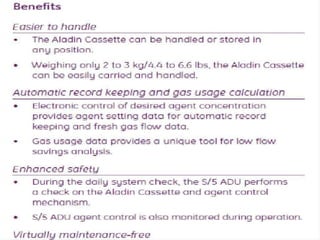
• Aladdin cassate – newer one
• Currently, the commonly used vaporizers
(eg.GE-Datex-Ohmeda Tec 4, Tec 5, Tec 7;
Drager vapor 19.n and 2000 series) are
described as having all of the following
features EXCEPT:
1. Agent specificity
2. Variable bypass
3. Bubble through
4. Temperature compensated
• For any given concentration of volatile
anesthetic, the splitting ratio is dependent on
which of the following characteristics of that
volatile anesthetic?
1. Vapor pressure
2. Molecular weight
3. Specific heat
4. MAC at 1 atm
• Which of the following combinations would
result in delivery of a lower than expected
concentration of volatile anesthetic to the
patient?
1. Sevoflurane vaporizer filled with desflurane
2. Isoflurane(240) vaporizer filled with sevoflurane(160)
3. Sevoflurane vaporizer filled with isoflurane
4. All of the above would result in less than the dialed
concentration
- The bypass flow is adjusted such that for each vaporizer,
putting a volatile anesthetic with higher SVP would lead to
higher delivery & putting volatile anesthetic with lower SVP
lead to lower delivery.
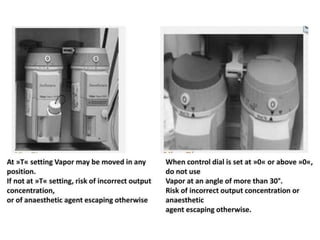
• A Datex-Ohmeda Tec 4 vaporizer is tipped
over while being attached to the anesthesia
machine but is placed upright & installed. The
soonest it can be safely used is:
1. After 30 minutes of flushing with dial set to ‘’off’’
2. After 6 hrs of flushing with dial set to ‘’off’’
3. After 30 minutes with dial turned on
4. Immediately
-‘T’ transport dial setting isolates bypass from vaporizer
chamber, hence no chance of high conc.
Aladdin cassate vaporizer doesnot have bypass flow
chamber & has no tipping hazard.
• Acceptable locations for a vaporizer on the
anesthesia machine include:
1.Between the check valve & common gas outlet
2. Between the common gas outlet & breathing system
3. Between the oxygen flush & breathing system
4. Between the flowmeters & machine outlet
• How do changes in back pressure affect the
output of a vaporizer?
1.The pumping effect will increase vaporizer output
2.A check valve at the machine outlet is not an effective
solution to the pumping effect
3.The pressurizing effect will decrease vaporizer output
4.The pumping effect is greater with LFG flows, large
pressure fluctuations, & low vaporizer settings.
VAPORIZER.pptx

VAPORIZER.pptx

  • 1.
    VAPORIZER By: NEHA KUMARI SR MODERATOR: DR.KUNAL SINGH ASSOCIATE PROFESSOR DEPT. OF ANAESTHESIOLOGY & CRITICAL CARE AIIMS PATNA
  • 2.
    • DEFINITION • VAPORIZER=Anesthetic agent delivery system OR Vapor delivery system • A ‘vaporizer’ is a device that changes a liquid anesthetic agent into its vapor and adds a controlled amount of that vapor to the fresh gas flow or the breathing system. • WHY VAPOURIZER • All inhalational anesthetic agents are highly potent and toxic substances • Can not be given directly • It has to be given in small concentrations along with oxygen and other carrying gases
  • 3.
    CHARACTERISTIC OF IDEALVAPOURIZER • Performance not affected by changes in FGF, volume of liquid agent, ambient temperature & pressure. • Low resistance to flow • Light wt with small liquid requirement • Economical & safety in use • Corrosion & solvent resistant • Vaporizer Concentration: - Denotes concentration delivered by vaporizer, when FG containing no vapor passes through it. - In out of system, vaporizer output = vap. Conc - In in system, vaporizer output exceed vap. Conc. (as expired gases contains some volatile anesthetic)
  • 4.
    • Vaporizer capability: -Maximum conc. that can be delivered by a vaporizer at the highest setting of the conc. Dial. - Manufacturers decide it on the basis of MAC. eg. Sevo has high MAC than Iso, hence sevo needs high capability vaporizer(max.8) as compared to Iso(max.5). • Vaporizer efficiency: - Ability of a vaporizer to saturate the carrier gas passing into the vaporizing chamber. - Increased by using wicks, baffles & longer vaporizing chamber to increase surface area available for vaporization.
  • 5.
    Classification of vaporizerwith examples Dorsch & Dorsch classification • Method of regulating output : 1. Variable bypass: Ether bottle, TEC vaporizer 2. Measured flow: Copper kettle • Method of vaporization 1. Flow over: - With wick: TEC vaporizer - Without wick: Goldman bottle 1. Bubble through: Copper kettle 2. Injection: Desflurane ( Gas-vapor blender)
  • 6.
    • Temperature compensation 1.Thermocompensated -By altered flow- TEC vaporizer - By supplied heat- Copper kettle - BY both altered flow & supplied heat- EMO 2. Non-compensated- Ether bottle • Specificity 1. Agent specific: TEC vaporizer 2. Multiagent: Goldman bottle • Resistance 1. Plenum(high resistance):TEC vaporizer 2. Draw over(low resistance):Goldmann bottle,EMO
  • 7.
    • Location: 1. Incircuit: VIC-EMO, Goldman 2. Out of circuit: VOC- TEC vaporizer Other: Concentration caliberated: Desflurane vaporizer Not be concentration caliberated: Goldman
  • 9.
    Splitting Ratio • Theratio of bypass flow to flow to vaporizing chamber is referred to as the ‘Splitting ratio’ & this ratio depends on: 1. Ratio of resistances in two pathways (a) Variable/adjustable orifice present at inlet/outlet (b) Concentration dial setting 2. Total flow to the vaporizer
  • 12.
    Thermal conductivity • Vaporizersare made up of metals that have relatively higher thermal conductivity to minimize temperature changes when vaporizer is in use, thus thermostabilization achieved. • Copper has a moderately high specific heat and a very high thermal conductivity. Hence, it is used in the construction of a number of vaporizers.
  • 14.
    Agent specific • Concentrationcaliberated vaporizers are agent specific & therefore only particular anesthetic agent for which the vaporizer has been designed & caliberated may be safely used. • eg. If an enflurane vaporizer was set to deliver 1 % agent but had been inadvertently filled with halothane the splitting ratio would be 46:29, yeilding an actual halothane vapor not of 1% but rather of 1.6%.
  • 16.
    Features of modernvapourizer • Variable bypass - Fresh gas splits into bypass gas & carrier gas • Flow over - Carrier gas flows over the surface of the liquid volatile agent in the vaporizing chamber. • Temperature compensated - Eqipped with automatic devices that ensures steady vaporizer output over a wide range of ambient temperature. • Agent specific - Only caliberated for a single gas, usually with keyed fillers • Out of circuit
  • 17.
    • For mostmodern agents, 1ml of liquid volatile agent yeilds about 200ml of vapor. • eg: To deliver 1% isoflurane at FGF of 2 liter per minute for 60 minutes, one would need 1/100 x 2000ml x 60min. = 1200 ml of isoflurane vapor This would correspond to 1200/180 ( ̴200)= 6.7 ml of liquid isoflurane The amount of vapor used per minute = FGF rate x Time x concentration setting
  • 18.
    Hazards of vaporizer •Incorrect concentration delivered: High conc -1. Pumping effect 2. Reversal flow Low conc -1.Pressurizing effect 2. Very low/ high flow 3. cooling of liquid • Incorrect agent: Minimizes by agent-specific filling system • Tipping -It can lead to entry of liquid agent into bypass chamber, results dangerous high conc. of vapor will be delivered when vaporizer is turned on.
  • 19.
    Prevention of tipping: 1.Mountingvaporizers on the manifold 2. Draining the vaporizer before being moved 3.Newer vaporizer are designed to avoid spillage even turned 180 degree(TEC4) 4. If tipping is suspected, vaporizer should be flushed with high gas flows for 15- 20 mints. • Overfilling: Low level filling port • Reversal of flow: Mounting vaporizer on manifold • Leaks: Machine check It leads to: 1. wastage of agent 2.Delivery of wrong agent 3. OT pollution
  • 20.
    Safety features ofvaporizer • Agent-specific filling system: KISS system- Keyed Index Safety System – To prevent accidental filling with wrong agent - Consists of color -coded bottle collar & a matching color - coded adaptor • Low filling port: It minimizes overfilling because filler port is located at the maximum safe liquid level. • Locking device: Prevent administration of more than one inhaled anesthetic at a time. • Vaporizer is constructed with ‘back flow check valve’ at common gas outlet to prevent pumping effect • The vaporizer is constructed with ‘high thermal conductivity’ & ‘high specific heat material’.
  • 21.
    TEC VAPORIZERS • Classification(TEC 1-7) 1.Variable bypass 2.Flow over with wick 3.Out of system 4. Temperature compensated by automatic flow alteration 5.Concentration caliberated 6. Agent specific
  • 26.
  • 42.
    Vaporizer Mounting System ●Permanentmounting and Detachable mounting ●Permanent means it requires tools to remove or install a vaporizer. ●Advantages are: vaporizers will not be dropped or abused, leaks will be less
  • 43.
    Filling device • Funnelfiller • Quick filler • Key filler • Easy filler
  • 47.
    Colour coding • Colourcoded collor attached to the neck of vaporizer: 1. Red: Halothane 2. Yellow: Sevoflurane 3. Puple: Isoflurane 4. Orange: Enflurane
  • 49.
    Effects of alteredbrometric pressure • Most vaporizers are calibrated at sea level (standard atmospheric pressure). Anesthetic agents with low boiling points are more susceptible to variations in barometric pressure. •ASTM machine standard requires that the effects of changes in ambient pressure on vaporizer performance be stated in operation manuals.
  • 50.
    • High altitude(Hypobariccondition) - Increases vaporizer output • Low altitude(Hyperbaric condition) - Decreases vaporizer output, because increased atmospheric pressure changes density of gases & creates more resistance to flow through vaporizing chamber. - At 2 atm, the conc. In volume percentage becomes half.
  • 51.
    Effects of intermittentback pressure ●Pumping effect – increase the output ●Pressurizing effect – decrease the output ●Sources of back pressure •during assisted/controlled ventilation, the positive pressure generated during inspiration is transmitted from the breathing system back to machine and vaporizer. •use of O2 flush valve, the output from O2 flush enters the circuit downstream of vaporizers and its activation produces high pressure.
  • 52.
    Pumping effect ●This addsto the vaporizer output to increase the final vapor output. ●This change is most pronounced when there is less agent in the vaporizing chamber, carrier gas flow is low, high and frequent pressure fluctuations, low dial setting. ●When resistance is applied to the outlet of the anesthetic machine, as during assisted or controlled ventilation, there is an increase in the anesthetic gas pressure which is transmitted back to the vaporizer.
  • 56.
    •Pressurizing effect: theoutput of some vaporizers decreases when there is back pressure. This effect is greater with high flows, large pressure fluctuations and low vaporizer settings. •The changes in vaporizer output caused by the pumping effect is usually greater in magnitude than those associated with the pressurizing effect. •Pressurizing effect – with high gas flows •Pumping effect – with low gas flows
  • 58.
    How much liquidagent does a vaporizer use per hour? ●Ehrenwerth and Eisenkraft gives the formula ●3 X Fresh gas flow(L/min) X Volume % = ml liquid used /hr ●This formula is based on the fact that typically 1 ml of liquid volatile agent yields about 200ml of vapor
  • 59.
    history • Flagg’s can-KEM bottle • Schimmelbusch mask, Yankauer’s mask • Ogston’s inhaler • Boyle’s bottle: 1. broad 2. Narrow • EMO inhale • Oxford miniature vaporizer • Goldman vaporizer • Copper kettle • TEC vaporizer: I - VII
  • 60.
    • Dragor Vaporizer •Drager D Vaporizer • Penlon Sigma PPV • Penlon Sigma Delta • Penlon Sigma Alpha • Blease Datum • Aladdin cassate – newer one
  • 65.
    • Currently, thecommonly used vaporizers (eg.GE-Datex-Ohmeda Tec 4, Tec 5, Tec 7; Drager vapor 19.n and 2000 series) are described as having all of the following features EXCEPT: 1. Agent specificity 2. Variable bypass 3. Bubble through 4. Temperature compensated
  • 66.
    • For anygiven concentration of volatile anesthetic, the splitting ratio is dependent on which of the following characteristics of that volatile anesthetic? 1. Vapor pressure 2. Molecular weight 3. Specific heat 4. MAC at 1 atm
  • 67.
    • Which ofthe following combinations would result in delivery of a lower than expected concentration of volatile anesthetic to the patient? 1. Sevoflurane vaporizer filled with desflurane 2. Isoflurane(240) vaporizer filled with sevoflurane(160) 3. Sevoflurane vaporizer filled with isoflurane 4. All of the above would result in less than the dialed concentration - The bypass flow is adjusted such that for each vaporizer, putting a volatile anesthetic with higher SVP would lead to higher delivery & putting volatile anesthetic with lower SVP lead to lower delivery.
  • 68.
    • A Datex-OhmedaTec 4 vaporizer is tipped over while being attached to the anesthesia machine but is placed upright & installed. The soonest it can be safely used is: 1. After 30 minutes of flushing with dial set to ‘’off’’ 2. After 6 hrs of flushing with dial set to ‘’off’’ 3. After 30 minutes with dial turned on 4. Immediately -‘T’ transport dial setting isolates bypass from vaporizer chamber, hence no chance of high conc. Aladdin cassate vaporizer doesnot have bypass flow chamber & has no tipping hazard.
  • 69.
    • Acceptable locationsfor a vaporizer on the anesthesia machine include: 1.Between the check valve & common gas outlet 2. Between the common gas outlet & breathing system 3. Between the oxygen flush & breathing system 4. Between the flowmeters & machine outlet
  • 70.
    • How dochanges in back pressure affect the output of a vaporizer? 1.The pumping effect will increase vaporizer output 2.A check valve at the machine outlet is not an effective solution to the pumping effect 3.The pressurizing effect will decrease vaporizer output 4.The pumping effect is greater with LFG flows, large pressure fluctuations, & low vaporizer settings.