
Tetanus : Case Presentation
Anupam Ghimire
GP/EM Resident
PAHS
Patient Details
Name: Motilal Tamang
Age/sex: 50yr/M
Address: Ramechap
Occupation : Farmer
Date of Admisson : 2075- 1- 15
Chief complain
• Cut Injury over Right leg 7 days back
HOPI
• Cut injury over Right calf region while he was
ploughing field, active bleed and muscles were
exposed
• Due to pain , he couldnot walk
• No swelling , injury to other areas
• At Local Health center, suturing was done . No
history of TT vaccination
• Pus discharge was present- yellowish , non
foul smelling
• Arrived in Hospital , kathmandu , suture was
removed and dressing done
• No history of fever, headache, Shortness of
breathe or altered bowel/bladder habits
• Past history – Not significant
• Family history – Not significant
• Personal history
- Consumes alcohol occassionally
- Non- smoker
Physical Examination
• GC : Fair
• No PILCCOD
• Vitals – Stable
• Systemic Examination : Grossly normal
Local examination
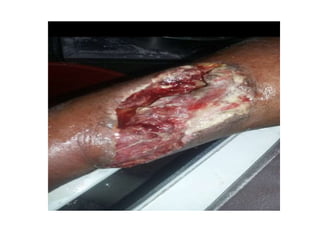
• Cut injury of 15x10 cm over left calf, vertically
oriented with sharp margin and yellowish non
foulsmelling discharge
• Brownish slough were present at margin of
wound
• Local temp. raised , Tender
• DNVS intact
• ROM : Painful on ankle movement
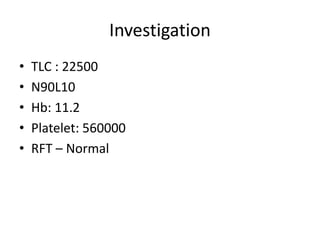
Investigation
• TLC : 22500
• N90L10
• Hb: 11.2
• Platelet: 560000
• RFT – Normal
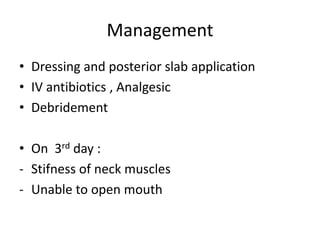
Management
• Dressing and posterior slab application
• IV antibiotics , Analgesic
• Debridement
• On 3rd day :
- Stifness of neck muscles
- Unable to open mouth
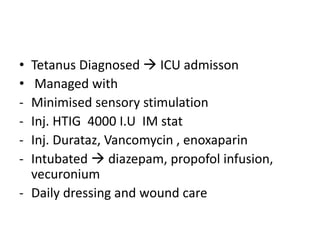
• Tetanus Diagnosed  ICU admisson
• Managed with
- Minimised sensory stimulation
- Inj. HTIG 4000 I.U IM stat
- Inj. Durataz, Vancomycin , enoxaparin
- Intubated  diazepam, propofol infusion,
vecuronium
- Daily dressing and wound care
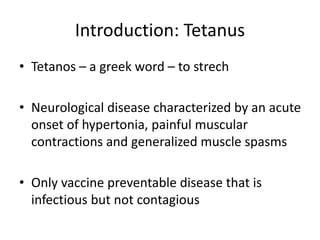
Introduction: Tetanus
• Tetanos – a greek word – to strech
• Neurological disease characterized by an acute
onset of hypertonia, painful muscular
contractions and generalized muscle spasms
• Only vaccine preventable disease that is
infectious but not contagious
• Caused by Clostridium Tetani
• Anaerobic, Motile, Gram positive bacilli
• Oval, colourless, terminal spores – tennis
racket or drumstick shape.
• It is found worldwide in soil, in inanimate
environment, in animal faeces & occasionally
human faeces.
Epidemiology
• International health problem, as spores are
ubiquitous.
• Occurs almost exclusively in persons who are
unvaccinated or inadequately immunized.
• Tetanus occurs worldwide but is more
common in hot, damp climates with soil rich
in organic matter
Risk Factors
• Age : Active age (5-40 years),
• Sex : Higher incidence in males
• Occupation : Agricultural workers are at higher
risk
• Immunity : Herd immunity does not protect
the individual
• Environmental and social factors: Unhygienic
habits, Unhygienic delivery practices
Tetanus prone wound
• A wound sustained more than 6 hr before
surgical treatment
• A wound sustained at any interval after injury
which is puncture type or shows much
devitalised tissue or is septic or is
contaminated with soil or manure
Pathogenesis
• Spores gain entry  persist in normal tissue
for months to years under anaerobic
conditions.
• When the oxygen levels in the surrounding
tissue is sufficiently low  the implanted C.
tetani spore then germinates into a new,
active vegetative cell  grows and multiplies
and produces tetanus toxin - tetanospasmin
and tetanolysin.
• Tetanolysin is not believed to be of any
significance in the clinical course of tetanus
• Tetanospasmin is a neurotoxin and causes the
clinical manifestations of tetanus
• Toxin migrates across the synapse  binds to
presynaptic nerve terminals  inhibits release
of certain inhibitory neurotransmitters
(glycine and gamma-amino butyric acid)
• Loss of inhibition of preganglionic sym
neurons – sympathetic hyperactivity
• Neurons, which release gammaaminobutyric
acid (GABA) and glycine, the major inhibitory
neurotransmitters, are particularly sensitive to
tetanospasmin, leading to failure of inhibition
of motor reflex responses to sensory
stimulation.
• Once the toxin becomes fixed to neurons, it
cannot be neutralized with antitoxin
• Recovery of nerve function from tetanus
toxins requires sprouting of new nerve
terminals and formation of new synapses.
Clinical Features
• IP : Ranges from 3-21 days
• In general the further the injury site is from
the central nervous system, the longer the
incubation period
• The shorter the incubation period, the higher
the chance of death
• Triad of muscle rigidity, spasms & autonomic
dysfunction
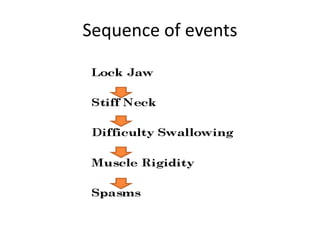
• Early symptoms are neck stiffness, sore throat
and poor mouth opening.
• Patients with generalized tetanus present with
trismus (ie, lockjaw) in 75% of cases.
• Other presenting complaints include stiffness,
neck rigidity, dysphagia, restlessness, and reflex
spasms.
• Spasms usually continue for 3-4 weeks.
• Subsequently, muscle rigidity becomes the
major manifestation. Rigid Abdomen.
• Muscle rigidity spreads in a descending
pattern from the jaw and facial muscles over
the next 24-48 hours to the extensor muscles
of the limbs – stiff proximal limb muscles &
relatively sparing hand & feet.
• Risus sardonicus: Sustained contraction of
facial musculature at the angle of mouth and
frontalis
• Trismus (Lock Jaw): Spasm of Masseter
muscles
• Opisthotonus: Spasm of extensor of the neck,
back and legs to form a backward curvature
Sequence of events
Diagnosis
• No blood tests that can be used to diagnose
tetanus
• Diagnosis is done clinically
• Laboratory studies may demonstrate a moderate
peripheral leukocytosis
• Cerebrospinal fluid (CSF) study findings are
usually within normal limits.
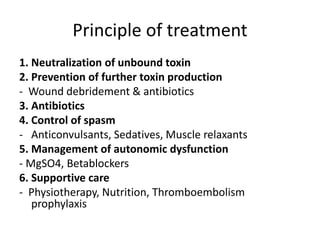
Principle of treatment
1. Neutralization of unbound toxin
2. Prevention of further toxin production
- Wound debridement & antibiotics
3. Antibiotics
4. Control of spasm
- Anticonvulsants, Sedatives, Muscle relaxants
5. Management of autonomic dysfunction
- MgSO4, Betablockers
6. Supportive care
- Physiotherapy, Nutrition, Thromboembolism
prophylaxis
Management
• Admit patients to the intensive care unit (ICU).
• Because of the risk of reflex spasms, maintain
a dark and quiet environment for the patient.
• Avoid unnecessary procedures and
manipulations.
• Attempting endotracheal intubation may
induce severe reflex laryngospasm; prepare
for emergency tracheostomy
Immunogloulin
• A single intramuscular dose of 3000-5000
units is generally recommended for children
and adults, with part of the dose infiltrated
around the wound if it can be identified.
• The WHO recommends TIG 500 units by IM/IV
(depending on the available preparation) as
soon as possible; in addition, administer TT-
containing vaccine , 0.5 cc by intramuscular
injection at separate site with HTIG.
• TIG can only help remove unbound tetanus
toxin, but it cannot affect toxin bound to
nerve endings.
Prevention of further toxin production
• Debridement of Wound to remove organisms
and to create an aerobic environment
• Current recommendation is to excise at least 2
cm of normal viable-appearing tissue around
the wound margins
• Incise and drain abscesses.
Antibiotics
• Penicillin G aqueous : (10-12 MU IV in 2-4
divided doses- 2-4 MU IV every 4 to 6 hrs)
- 10- to 14-d course of treatment is
recommended
• Metronidazole: (5oomg 6 hrly or 1gm 12 hrly)
Summary
• Tetanus : Vaccine preventable
• Diagnosis clinically
• High index of suspicion
• Significant mortality and morbidity
• Harrison’s PRINCIPLES OF INTERNAL MEDICINE
: Eighteenth Edition
• UpToDate (http://www.uptodate.com)
• Current recommendations for treatment of
tetanus during humanitarian emergencies :
WHO Technical note
THANK YOU

Tetanus: Case Presentation

  • 1.
    Tetanus : CasePresentation Anupam Ghimire GP/EM Resident PAHS
  • 2.
    Patient Details Name: MotilalTamang Age/sex: 50yr/M Address: Ramechap Occupation : Farmer Date of Admisson : 2075- 1- 15
  • 3.
    Chief complain • CutInjury over Right leg 7 days back HOPI • Cut injury over Right calf region while he was ploughing field, active bleed and muscles were exposed • Due to pain , he couldnot walk • No swelling , injury to other areas
  • 4.
    • At LocalHealth center, suturing was done . No history of TT vaccination • Pus discharge was present- yellowish , non foul smelling • Arrived in Hospital , kathmandu , suture was removed and dressing done • No history of fever, headache, Shortness of breathe or altered bowel/bladder habits
  • 5.
    • Past history– Not significant • Family history – Not significant • Personal history - Consumes alcohol occassionally - Non- smoker
  • 6.
    Physical Examination • GC: Fair • No PILCCOD • Vitals – Stable • Systemic Examination : Grossly normal
  • 7.
    Local examination • Cutinjury of 15x10 cm over left calf, vertically oriented with sharp margin and yellowish non foulsmelling discharge • Brownish slough were present at margin of wound • Local temp. raised , Tender • DNVS intact • ROM : Painful on ankle movement
  • 9.
    Investigation • TLC :22500 • N90L10 • Hb: 11.2 • Platelet: 560000 • RFT – Normal
  • 10.
    Management • Dressing andposterior slab application • IV antibiotics , Analgesic • Debridement • On 3rd day : - Stifness of neck muscles - Unable to open mouth
  • 11.
    • Tetanus Diagnosed ICU admisson • Managed with - Minimised sensory stimulation - Inj. HTIG 4000 I.U IM stat - Inj. Durataz, Vancomycin , enoxaparin - Intubated  diazepam, propofol infusion, vecuronium - Daily dressing and wound care
  • 12.
    Introduction: Tetanus • Tetanos– a greek word – to strech • Neurological disease characterized by an acute onset of hypertonia, painful muscular contractions and generalized muscle spasms • Only vaccine preventable disease that is infectious but not contagious
  • 13.
    • Caused byClostridium Tetani • Anaerobic, Motile, Gram positive bacilli • Oval, colourless, terminal spores – tennis racket or drumstick shape. • It is found worldwide in soil, in inanimate environment, in animal faeces & occasionally human faeces.
  • 14.
    Epidemiology • International healthproblem, as spores are ubiquitous. • Occurs almost exclusively in persons who are unvaccinated or inadequately immunized. • Tetanus occurs worldwide but is more common in hot, damp climates with soil rich in organic matter
  • 15.
    Risk Factors • Age: Active age (5-40 years), • Sex : Higher incidence in males • Occupation : Agricultural workers are at higher risk • Immunity : Herd immunity does not protect the individual • Environmental and social factors: Unhygienic habits, Unhygienic delivery practices
  • 16.
    Tetanus prone wound •A wound sustained more than 6 hr before surgical treatment • A wound sustained at any interval after injury which is puncture type or shows much devitalised tissue or is septic or is contaminated with soil or manure
  • 17.
    Pathogenesis • Spores gainentry  persist in normal tissue for months to years under anaerobic conditions. • When the oxygen levels in the surrounding tissue is sufficiently low  the implanted C. tetani spore then germinates into a new, active vegetative cell  grows and multiplies and produces tetanus toxin - tetanospasmin and tetanolysin.
  • 18.
    • Tetanolysin isnot believed to be of any significance in the clinical course of tetanus • Tetanospasmin is a neurotoxin and causes the clinical manifestations of tetanus
  • 19.
    • Toxin migratesacross the synapse  binds to presynaptic nerve terminals  inhibits release of certain inhibitory neurotransmitters (glycine and gamma-amino butyric acid) • Loss of inhibition of preganglionic sym neurons – sympathetic hyperactivity
  • 20.
    • Neurons, whichrelease gammaaminobutyric acid (GABA) and glycine, the major inhibitory neurotransmitters, are particularly sensitive to tetanospasmin, leading to failure of inhibition of motor reflex responses to sensory stimulation.
  • 21.
    • Once thetoxin becomes fixed to neurons, it cannot be neutralized with antitoxin • Recovery of nerve function from tetanus toxins requires sprouting of new nerve terminals and formation of new synapses.
  • 22.
    Clinical Features • IP: Ranges from 3-21 days • In general the further the injury site is from the central nervous system, the longer the incubation period • The shorter the incubation period, the higher the chance of death
  • 23.
    • Triad ofmuscle rigidity, spasms & autonomic dysfunction • Early symptoms are neck stiffness, sore throat and poor mouth opening. • Patients with generalized tetanus present with trismus (ie, lockjaw) in 75% of cases. • Other presenting complaints include stiffness, neck rigidity, dysphagia, restlessness, and reflex spasms. • Spasms usually continue for 3-4 weeks.
  • 24.
    • Subsequently, musclerigidity becomes the major manifestation. Rigid Abdomen. • Muscle rigidity spreads in a descending pattern from the jaw and facial muscles over the next 24-48 hours to the extensor muscles of the limbs – stiff proximal limb muscles & relatively sparing hand & feet.
  • 25.
    • Risus sardonicus:Sustained contraction of facial musculature at the angle of mouth and frontalis • Trismus (Lock Jaw): Spasm of Masseter muscles • Opisthotonus: Spasm of extensor of the neck, back and legs to form a backward curvature
  • 26.
  • 27.
    Diagnosis • No bloodtests that can be used to diagnose tetanus • Diagnosis is done clinically • Laboratory studies may demonstrate a moderate peripheral leukocytosis • Cerebrospinal fluid (CSF) study findings are usually within normal limits.
  • 28.
    Principle of treatment 1.Neutralization of unbound toxin 2. Prevention of further toxin production - Wound debridement & antibiotics 3. Antibiotics 4. Control of spasm - Anticonvulsants, Sedatives, Muscle relaxants 5. Management of autonomic dysfunction - MgSO4, Betablockers 6. Supportive care - Physiotherapy, Nutrition, Thromboembolism prophylaxis
  • 29.
    Management • Admit patientsto the intensive care unit (ICU). • Because of the risk of reflex spasms, maintain a dark and quiet environment for the patient. • Avoid unnecessary procedures and manipulations. • Attempting endotracheal intubation may induce severe reflex laryngospasm; prepare for emergency tracheostomy
  • 30.
    Immunogloulin • A singleintramuscular dose of 3000-5000 units is generally recommended for children and adults, with part of the dose infiltrated around the wound if it can be identified. • The WHO recommends TIG 500 units by IM/IV (depending on the available preparation) as soon as possible; in addition, administer TT- containing vaccine , 0.5 cc by intramuscular injection at separate site with HTIG.
  • 31.
    • TIG canonly help remove unbound tetanus toxin, but it cannot affect toxin bound to nerve endings.
  • 32.
    Prevention of furthertoxin production • Debridement of Wound to remove organisms and to create an aerobic environment • Current recommendation is to excise at least 2 cm of normal viable-appearing tissue around the wound margins • Incise and drain abscesses.
  • 33.
    Antibiotics • Penicillin Gaqueous : (10-12 MU IV in 2-4 divided doses- 2-4 MU IV every 4 to 6 hrs) - 10- to 14-d course of treatment is recommended • Metronidazole: (5oomg 6 hrly or 1gm 12 hrly)
  • 34.
    Summary • Tetanus :Vaccine preventable • Diagnosis clinically • High index of suspicion • Significant mortality and morbidity
  • 35.
    • Harrison’s PRINCIPLESOF INTERNAL MEDICINE : Eighteenth Edition • UpToDate (http://www.uptodate.com) • Current recommendations for treatment of tetanus during humanitarian emergencies : WHO Technical note
  • 36.