Managing Large Classes
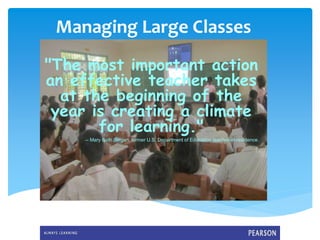
"The most important action
an effective teacher takes
at the beginning of the
year is creating a climate
for learning."
-- Mary Beth Blegan, former U.S. Department of Education teacher-in-residence.
In a country with over 1 billion people,trains
unsurprisingly are very crowded. Here
commuters queue to buy tickets.
 Draw a rough diagram of the layout of such a place.
(Suggest an organization for these people)
 Discuss the following questions and write down your
ideas:
 1. How are such places physically organized?
 2. In your experience, how are they effective at moving
large numbers of people quickly?
 3. Do they encourage people to communicate with each
other? Why?
 4. Is there a set of logistics that are common to such
situations? If so, list some. If not, list some that you
think might be useful.
What to do to …?
A security officer stands guard as passengers line up
and wait for a security check during morning rush hour
at Tiantongyuan North Station in Beijing
 1. Does it shows a culture? Why?
 2. Is there an airport or railway station or marketplace
culture?
 3. If so, what are some characteristics of it that
contribute to successful travel?
 4. If not, is there a way such a thing could be
established to facilitate travel?
 5. What would be its characteristics?
What is it different here?
 Give an answer.
 Give one relevant characteristic.
 Do you think some of the answers to
the last pictures might apply to
this situation?
 Explain your answer. Try to use
specific examples.
What are large classes?
The goal of this module is to have
participants begin thinking about
alternative management techniques
that they might use in their large
classes.
Managing Large Classes
 Teacher’s worries:
 How do large classes
affect students
learning?
 How do large classes
affect an instructor’s
ability to teach?
 How do large classes
affect the quality of
education? (Take 5’ to
answer according to
personal experience)
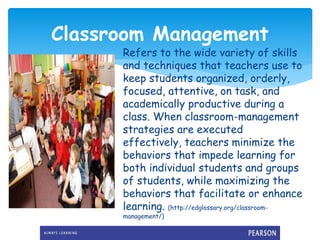
Refers to the wide variety of skills
and techniques that teachers use to
keep students organized, orderly,
focused, attentive, on task, and
academically productive during a
class. When classroom-management
strategies are executed
effectively, teachers minimize the
behaviors that impede learning for
both individual students and groups
of students, while maximizing the
behaviors that facilitate or enhance
learning. (http://edglossary.org/classroom-
management/)
Classroom Management
 Effective teachers
tend to display
strong classroom-
management skills .
Large Classes Managing
The inexperienced teacher
has a disorderly classroom
filled with students who are
not working or paying
attention.
Managing large classes.
 Shaping the Way We Teach-Module 6
https://www.youtube.com/watch?v=RqvBjvbsUxs
How to deal with the large
class managing problems?
Managing large classes.
 Pedagogical planning:
 Get diagnostic test to discover each student’s strengths and needs.
 Help students set their own learning goals and develop learning
strategies that work well for them.
 Think of students as having a range of abilities and as “works in
progress.” Avoiding labeling them such as, “That student is smart.
That one is stupid. That one never listens.”
 Individualize interactions learning students names to make them
feel important
 Create a plan that allows us to give individual attention to a
particular set of students each day: rotate students or students
group.
 Update the curriculum to meet student needs.
 Allowie students freedom to make choices, to help with classroom
logistics, and to help each other.
Managing Large Classes from the perspective of …
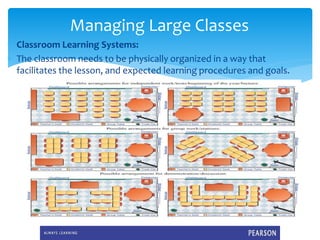
 Classroom Learning Systems:
 The classroom needs to be physically organized in a way that
facilitates the lesson, and expected learning procedures and goals.
Managing Large Classes
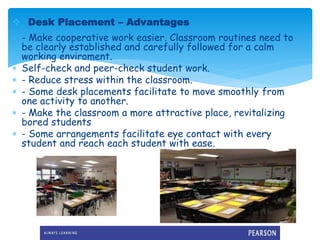
 Desk Placement – Advantages
 - Make cooperative work easier. Classroom routines need to
be clearly established and carefully followed for a calm
working enviroment.
 Self-check and peer-check student work.
 - Reduce stress within the classroom.
 - Some desk placements facilitate to move smoothly from
one activity to another.
 - Make the classroom a more attractive place, revitalizing
bored students
 - Some arrangements facilitate eye contact with every
student and reach each student with ease.
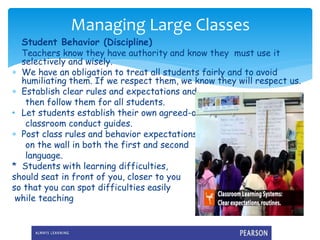
 Student Behavior (Discipline)
 Teachers know they have authority and know they must use it
selectively and wisely.
 We have an obligation to treat all students fairly and to avoid
humiliating them. If we respect them, we know they will respect us.
 Establish clear rules and expectations and
then follow them for all students.
• Let students establish their own agreed-on
classroom conduct guides.
 Post class rules and behavior expectations
on the wall in both the first and second
language.
* Students with learning difficulties,
should seat in front of you, closer to you
so that you can spot difficulties easily
while teaching
Managing Large Classes
 Pedagogical planning refers to advance and
overall planning of the curriculum and planned
application of deliberate teacher behaviors that
can facilitate learning.
 Classroom learning systems are clear routines,
expectations, and physical arrangements the teacher
can set up to save time; enable learners to know
what is expected of them, thus adding to their
feelings of security; and ensure the smooth running
of the class and classroom activities.
 Discipline management refers to a fair and even-handed
system of discipline. Students are clearly told what
behavior is expected and what the consequences of
negative behavior will be.
SUMMARY
Outcome
At the end of the session
participants will have to present
a solution to study case about
classroom management.
Managing Large Classes
 A new EFL teacher, works for a High –School located in the north
of Bucaramanga, she has approximately 50 14 year- old teenagers
with hugely varying backgrounds in a beginner course that requires
understanding and use of a language , often new, to them and can
be quite complex. To expose students into the four communicative
skills, in a two hours class, she wants to find a way to have them
engage with different activities at the same time.
Managing Large Classes Task
 Choose a partner to work with.
 Analyse the problem
 Present a possible solution making use of the strategies studied.
 Write your proposal
 Present to the class
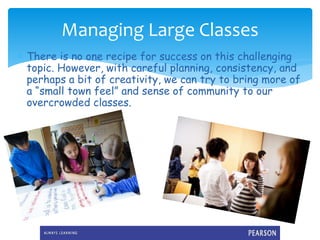
 There is no one recipe for success on this challenging
topic. However, with careful planning, consistency, and
perhaps a bit of creativity, we can try to bring more of
a “small town feel” and sense of community to our
overcrowded classes.
Managing Large Classes
 Classroom Management: Discipline & Organization, from Can Teach
in Canada. Acquire tips sheets: A List of Ways to Encourage Good
Behaviour; A List of Reward Ideas; Creating a Random Seating Plan;
"I'm Done, Now What": A List of Things to Do After Seat Work; A
List of Tried and True Theme Ideas; School/Class Pledges; A List
of Fundraising Ideas; and, A List of Bulletin Board Ideas.
 Creating a Climate for Learning, Effective Classroom
Management Techniques, from Education World.
 Classroom Management: Ten Teacher-Tested Tips! From
Education World.
 Class Routines, A Self-Rating Scale, from the Cooke Center,
NY.
Supplementary Web-based Readings
THANK YOU!

Managing large classes.pptx

  • 2.
    Managing Large Classes "Themost important action an effective teacher takes at the beginning of the year is creating a climate for learning." -- Mary Beth Blegan, former U.S. Department of Education teacher-in-residence.
  • 3.
    In a countrywith over 1 billion people,trains unsurprisingly are very crowded. Here commuters queue to buy tickets.
  • 4.
     Draw arough diagram of the layout of such a place. (Suggest an organization for these people)  Discuss the following questions and write down your ideas:  1. How are such places physically organized?  2. In your experience, how are they effective at moving large numbers of people quickly?  3. Do they encourage people to communicate with each other? Why?  4. Is there a set of logistics that are common to such situations? If so, list some. If not, list some that you think might be useful. What to do to …?
  • 5.
    A security officerstands guard as passengers line up and wait for a security check during morning rush hour at Tiantongyuan North Station in Beijing
  • 6.
     1. Doesit shows a culture? Why?  2. Is there an airport or railway station or marketplace culture?  3. If so, what are some characteristics of it that contribute to successful travel?  4. If not, is there a way such a thing could be established to facilitate travel?  5. What would be its characteristics? What is it different here?
  • 7.
     Give ananswer.  Give one relevant characteristic.  Do you think some of the answers to the last pictures might apply to this situation?  Explain your answer. Try to use specific examples. What are large classes?
  • 8.
    The goal ofthis module is to have participants begin thinking about alternative management techniques that they might use in their large classes. Managing Large Classes
  • 9.
    Managing Large Classes Teacher’s worries:  How do large classes affect students learning?  How do large classes affect an instructor’s ability to teach?  How do large classes affect the quality of education? (Take 5’ to answer according to personal experience)
  • 10.
    Refers to thewide variety of skills and techniques that teachers use to keep students organized, orderly, focused, attentive, on task, and academically productive during a class. When classroom-management strategies are executed effectively, teachers minimize the behaviors that impede learning for both individual students and groups of students, while maximizing the behaviors that facilitate or enhance learning. (http://edglossary.org/classroom- management/) Classroom Management
  • 11.
     Effective teachers tendto display strong classroom- management skills . Large Classes Managing The inexperienced teacher has a disorderly classroom filled with students who are not working or paying attention.
  • 12.
    Managing large classes. Shaping the Way We Teach-Module 6 https://www.youtube.com/watch?v=RqvBjvbsUxs
  • 13.
    How to dealwith the large class managing problems? Managing large classes.
  • 14.
     Pedagogical planning: Get diagnostic test to discover each student’s strengths and needs.  Help students set their own learning goals and develop learning strategies that work well for them.  Think of students as having a range of abilities and as “works in progress.” Avoiding labeling them such as, “That student is smart. That one is stupid. That one never listens.”  Individualize interactions learning students names to make them feel important  Create a plan that allows us to give individual attention to a particular set of students each day: rotate students or students group.  Update the curriculum to meet student needs.  Allowie students freedom to make choices, to help with classroom logistics, and to help each other. Managing Large Classes from the perspective of …
  • 15.
     Classroom LearningSystems:  The classroom needs to be physically organized in a way that facilitates the lesson, and expected learning procedures and goals. Managing Large Classes
  • 16.
     Desk Placement– Advantages  - Make cooperative work easier. Classroom routines need to be clearly established and carefully followed for a calm working enviroment.  Self-check and peer-check student work.  - Reduce stress within the classroom.  - Some desk placements facilitate to move smoothly from one activity to another.  - Make the classroom a more attractive place, revitalizing bored students  - Some arrangements facilitate eye contact with every student and reach each student with ease.
  • 17.
     Student Behavior(Discipline)  Teachers know they have authority and know they must use it selectively and wisely.  We have an obligation to treat all students fairly and to avoid humiliating them. If we respect them, we know they will respect us.  Establish clear rules and expectations and then follow them for all students. • Let students establish their own agreed-on classroom conduct guides.  Post class rules and behavior expectations on the wall in both the first and second language. * Students with learning difficulties, should seat in front of you, closer to you so that you can spot difficulties easily while teaching Managing Large Classes
  • 18.
     Pedagogical planningrefers to advance and overall planning of the curriculum and planned application of deliberate teacher behaviors that can facilitate learning.  Classroom learning systems are clear routines, expectations, and physical arrangements the teacher can set up to save time; enable learners to know what is expected of them, thus adding to their feelings of security; and ensure the smooth running of the class and classroom activities.  Discipline management refers to a fair and even-handed system of discipline. Students are clearly told what behavior is expected and what the consequences of negative behavior will be. SUMMARY
  • 19.
    Outcome At the endof the session participants will have to present a solution to study case about classroom management. Managing Large Classes
  • 20.
     A newEFL teacher, works for a High –School located in the north of Bucaramanga, she has approximately 50 14 year- old teenagers with hugely varying backgrounds in a beginner course that requires understanding and use of a language , often new, to them and can be quite complex. To expose students into the four communicative skills, in a two hours class, she wants to find a way to have them engage with different activities at the same time. Managing Large Classes Task  Choose a partner to work with.  Analyse the problem  Present a possible solution making use of the strategies studied.  Write your proposal  Present to the class
  • 21.
     There isno one recipe for success on this challenging topic. However, with careful planning, consistency, and perhaps a bit of creativity, we can try to bring more of a “small town feel” and sense of community to our overcrowded classes. Managing Large Classes
  • 22.
     Classroom Management:Discipline & Organization, from Can Teach in Canada. Acquire tips sheets: A List of Ways to Encourage Good Behaviour; A List of Reward Ideas; Creating a Random Seating Plan; "I'm Done, Now What": A List of Things to Do After Seat Work; A List of Tried and True Theme Ideas; School/Class Pledges; A List of Fundraising Ideas; and, A List of Bulletin Board Ideas.  Creating a Climate for Learning, Effective Classroom Management Techniques, from Education World.  Classroom Management: Ten Teacher-Tested Tips! From Education World.  Class Routines, A Self-Rating Scale, from the Cooke Center, NY. Supplementary Web-based Readings
  • 23.