Math Newsletter Jan/Feb 2021
Mathematical Processes
What does it mean to do mathematics and learn mathematics? The National Council of Teachers of
Mathematics, NCTM, describes “Mathematical processes” as the actions required to think mathematically.
Our Saskatchewan Curriculum recognizes these processes as crucial to the teaching, learning and doing of
mathematics.
Communication: Students need opportunities to speak and write about math in order to consolidate their
understanding. “Communication helps students organize and reflect on their own mathematical thinking”
(Glanfield, 2007). How many opportunities do we give students to talk?
Connections: Mathematics is a continuum of learning, one concept built on another. Everything we
understand in mathematics is built on our prior understanding. There is a rich and important connection
between mathematical ideas—connections between symbols and procedures, and connections between math
and the real world. If we teach math without exploring and highlighting these connections for students, we
teach a set of discreet rules, piecemeal procedures that fosters memorization rather than understanding. Do
we teach math as a series of discreet procedures and skills, or as a continuum of understanding?
Representations: Mathematical diagrams, charts, equations, manipulatives, and patterns do not only display
student reasoning, but also foster understanding. Solutions without representations may not demonstrate
understanding. In math, a picture truly is worth a thousand words, as there are many concepts that can only
be demonstrated and understood through representation. Students that construct pictures and diagrams to
solve problems add another dimension of understanding to any procedure. Our curriculum promotes
representation, as there is a move away from memorization of procedure to understanding of concepts;
therefore, our outcomes specify “concrete, pictorial (representational) and symbolic” display of
understanding. Do we take time to explore and refine students’ mathematical representations? What can we
learn about students’ mathematical understanding by sharing their reasoning?
Visualization is the discipline that allows us to conceptualize number, pattern, and shape relationships.
Visualizing mathematical meaning and connections is vital to finding an approach to a situation or problem,
yet is often not explicitly taught. Having students communicate their reasoning fosters development of
visualizing mathematical concepts. How can we use classroom dialog to explore and foster students’
visualization?
Mathematics is the discipline of reasoning. Mathematics is more than numbers: It is the language of if, then;
the language of absolutes and situations, and of evidence and proof. We need to help students develop
EMBEDDING DIFFERENTIATION
IN TODAY'S CLASSROOM
SPDU virtual workshop This
interactive session will have
participants exploring strategies
to respond to student needs by
differentiating content, process
and product in today’s classroom
environments. Feb 11, by zoom
CLASSROOM MANAGEMENT:
CREATING A POSITIVE
CLASSROOM CLIMATE Identify
foundations of a positive learning
environment that supports student
engagement and classroom
management.
Wednesday, March 24, 2021 - 1:00
pm to 4:00 pm
Wednesday, March 31, 2021 - 4:00
pm to 5:00 pm
Enrichment Ideas: What do we do for the students that are knocking it out of the park? We can’t just
“teach up” a grade, because that only leaves the next grade teacher even more stuck! As classroom
teachers, we are often scrambling to support struggling learners, and students that are mathematically
intuitive are not always a priority. If we don’t do something for these students, though, we risk boredom at
best, disengagement and escalating behaviours at worst. It’s hard or impossible to find time to differentiate
for these students…and the reward for good work can’t be more work! True enrichment means finding rich,
open tasks related to the outcome, so that students can push their thinking, and feel challenged and
engaged. The good news is, as you begin to collect a repertoire of these activities that work for you, you
build a collection that will continue to serve you at many grade levels. Here are some places to look:
From University of Cambridge, NRich maths is a site dedicated to rich math tasks.
Some are for classroom use, some can be accessed directly by students. They are
sorted by grade and can be searched by concept. This is my favourite “go to” site for
engaging math activities
https://nrich.maths.org/
https://www.youcubed.org/ is a site hosted by
mathematics researcher Jo Boaler (more about her in future issues!)
From the site: “Our main goal is to inspire, educate, and empower
teachers of mathematics, transforming the latest research on math
into accessible and practical forms….to bring about high levels of student engagement and achievement”.
Great stuff on this site!
Other ideas: NCTM’s magazines; there are elementary, middle years and high
school levels, and each one features a full page of challenge problems. There is
great variety and many students find these challenging and interesting. We have
back issues at the division office if you ever want to come have a look!
Finally, you can look up old prototypes of University of Waterloo math
competitions. https://www.cemc.uwaterloo.ca/contests/past_contests.html
I’m here to help, too! If you’re looking for enrichment for a particular outcome, send me an email, and I’ll
help you find whatever I can 😊
Reasoning: Math teachers strive to help students develop confidence in their own reasoning abilities. By
communicating, making mathematical connections, and creating representations, we foster students’ ability to
reason. Logical reasoning is integral to mathematics, but applies to logic beyond mathematics. How do we
support each student in developing an ability and desire to reason mathematically?
Problem solving refers to the ability to reason, visualize, make connections and representations to find a logical
path to solutions. Students that are proficient problem solvers demonstrate an organization of reasoning
accompanied by practiced strategies and persistence. Grit is an important attribute of successful math students
and mathematicians. What can we do to foster grit in our students?
Technology is a tool that has greatly enhanced our understanding of mathematics. NCTM encourages use of
calculators and software to explore, show relationships, provide pictorial representation, but cautions that
calculators How do we use it in the classroom to promote and support learning, rather than to replace learning?
In every issue of this newsletter, we will explore and expand on a mathematical process.
“We are a community of practice” Do you have any pictures of students
working in your classes that you could share with us?
Click the image to follow the link to register for
Sciematics
Happy Valentine’s Day! Here’s some Mathy Love!
Grading vs Assessing
Ongoing formative assessment is critical to student learning. The most effective teachers embed formative assessment
and feedback in learning at all points. Receiving feedback allows students to learn and self correct while it still matters.
Grading, on the other hand is an endpoint to learning. There is plenty of research showing how effective formative
assessments and feedback are at promoting learning, and evidence also that grading actually inhibits learning.
Here is what research says:
• -One of the top ten most effective teaching strategies is providing
feedback to students during the learning.
• -Grades alone do not increase learning.
• -Grades tend to decrease student interest in learning (Kohn, 1998)
• -Even grades accompanied by feedback do not increase learning. The
feedback must be low-stakes, not attached to performance
evaluation (William, 2011).
• -Providing feedback promotes student growth, self awareness,
efficacy and agency by helping learners self-monitor. Feedback and formative assessments, as well as an
awareness that errors are a natural and essential part of the learning process, are keys to instilling a growth
mindset.
• -Feedback that best supports student learning is specific and descriptive (Black and William 1998)
• -Receiving feedback improves students’ metacognitive and self-regulatory skills (Hattie, 2017).
• -Formative assessment is an essential component of effective teaching. It raises standards of achievement for
all students, but especially impacts low achieving students.
• -Grading reduces the achievement of students, and negatively shapes students’ views of
mathematics and themselves. (Boaler, 2016).
• -If teachers don’t help students understand that mistakes are essential to learning, students
may not be willing to take the risks necessary for learning (Davies, Herbst, Reynolds, 2011.
• -Feedback needs to be descriptive, not evaluative. A mark going into a gradebook does
nothing to improve learning (O’Connor, 2011)
• -Formative assessment also provides feedback for more effective teaching.
Of course, this doesn’t mean we don’t grade. We are responsible for providing evidence of learning to students,
parents, schools, divisions, and the province. However, we can agree that grading does not equal learning, so we
should be mindful of how much we grade (knowing that it can be detrimental to many students who define
themselves and are demotivated by grades) and also that to be effective, our time is better spent on formative
assessments and feedback.
Boaler, J. (2016). Mathematical Mindsets. San Francisco, CA. Jossey-Bass.
Davies, A., Herbst, S., Parrott Reynolds, B. (2011). Bloomington, IN. Solution Tree Press.
Davies, A., Herbst, S., and Busick, K. (2007). Canada. Higgins Book Publishing.
Hattie, J., Fischer, D., and Frey, N. (2017). Visible Learning for Mathematics. Thousand
Oaks, A. Corwin.
Keeley, P., and Tobey, C. (2011). Mathematics Formative Assessment. National
Council of Teachers of Mathematics. Thousand Oaks, CA. Corwin.
O’Connor, K. A Repair Kit for Grading. Boston, MA. Pearson.
What are some ways we give students feedback in Math class?
How about high school? Visit this padlet to share your favourite
feedback strategies or comments
https://padlet.com/smithersmath/yyti8r0b9sjsm8s3
Have you seen the new parent pamphlets on the Ministry Blackboard site?
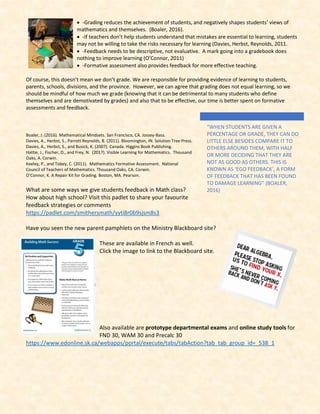
These are available in French as well.
Click the image to link to the Blackboard site.
Also available are prototype departmental exams and online study tools for
FND 30, WAM 30 and Precalc 30
https://www.edonline.sk.ca/webapps/portal/execute/tabs/tabAction?tab_tab_group_id=_538_1
“WHEN STUDENTS ARE GIVEN A
PERCENTAGE OR GRADE, THEY CAN DO
LITTLE ELSE BESIDES COMPARE IT TO
OTHERS AROUND THEM, WITH HALF
OR MORE DECIDING THAT THEY ARE
NOT AS GOOD AS OTHERS. THIS IS
KNOWN AS ‘EGO FEEDBACK’, A FORM
OF FEEDBACK THAT HAS BEEN FOUND
TO DAMAGE LEARNING” (BOALER,
2016)
Well, I’m new, so I guess there’s that!
My name is Cindy Smith, and I’ve been hired as Instruction and Learning Consultant for Mathematics in
CTTCS. I taught high school math for 11 years at YRHS, spent 5 years as math/science/and assessment
coach for GSSD, and 3 years as Principal of a Gr 5 – 12 school. Math instruction is my passion, and I’ve
been very fortunate to be saturated with PD, and have also had the privilege of providing professional
development in GSSD and also at the SUM (Sask Understands Math) conference, SABEA (Adult Basic Educators), other school
divisions, the Sciematics conference, and SPDU Leadership Workshops. I’ve belonged
to the Provincial Math Consultants working group for several years, been part of the
provincial math assessment team, and currently sit on the working group for the
SaskMath project with the ESSP partners (CTTCS is well represented on this project, as
Robin Dubiel and Joanne Sebastian are also members of this team, and Barb Mackesey
is on the committee as well!) Absolutely the highlight of my career has been the years I
was able to work side-by-side with teachers, and together explore bringing the
curriculum to life in a rich and engaging math classroom.
I believe: We are a community of practice; teachers make the biggest difference of any effect on student learning; relationships
matter most; we have a lot to learn from each other; and that teaching is personal and comes from the heart.
And that is probably the most I’ve said about myself in ages, and you will be comforted to know it’s likely the last you’ll hear
me yak about myself—but I thought you would appreciate knowing I’m here and you can call on me.
Email: smitc01@cttcs.ca
Ph: 306-783-8787
Cell: 306-621-2248
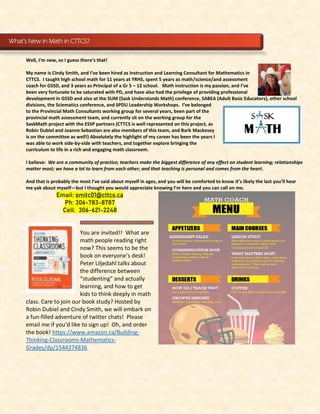
You are invited!! What are
math people reading right
now? This seems to be the
book on everyone’s desk!
Peter Liljedahl talks about
the difference between
“studenting” and actually
learning, and how to get
kids to think deeply in math
class. Care to join our book study? Hosted by
Robin Dubiel and Cindy Smith, we will embark on
a fun-filled adventure of twitter chats! Please
email me if you’d like to sign up! Oh, and order
the book! https://www.amazon.ca/Building-
Thinking-Classrooms-Mathematics-
Grades/dp/1544374836
What’s New in Math in CTTCS?

Newsletter janfeb2021

  • 1.
    Math Newsletter Jan/Feb2021 Mathematical Processes What does it mean to do mathematics and learn mathematics? The National Council of Teachers of Mathematics, NCTM, describes “Mathematical processes” as the actions required to think mathematically. Our Saskatchewan Curriculum recognizes these processes as crucial to the teaching, learning and doing of mathematics. Communication: Students need opportunities to speak and write about math in order to consolidate their understanding. “Communication helps students organize and reflect on their own mathematical thinking” (Glanfield, 2007). How many opportunities do we give students to talk? Connections: Mathematics is a continuum of learning, one concept built on another. Everything we understand in mathematics is built on our prior understanding. There is a rich and important connection between mathematical ideas—connections between symbols and procedures, and connections between math and the real world. If we teach math without exploring and highlighting these connections for students, we teach a set of discreet rules, piecemeal procedures that fosters memorization rather than understanding. Do we teach math as a series of discreet procedures and skills, or as a continuum of understanding? Representations: Mathematical diagrams, charts, equations, manipulatives, and patterns do not only display student reasoning, but also foster understanding. Solutions without representations may not demonstrate understanding. In math, a picture truly is worth a thousand words, as there are many concepts that can only be demonstrated and understood through representation. Students that construct pictures and diagrams to solve problems add another dimension of understanding to any procedure. Our curriculum promotes representation, as there is a move away from memorization of procedure to understanding of concepts; therefore, our outcomes specify “concrete, pictorial (representational) and symbolic” display of understanding. Do we take time to explore and refine students’ mathematical representations? What can we learn about students’ mathematical understanding by sharing their reasoning? Visualization is the discipline that allows us to conceptualize number, pattern, and shape relationships. Visualizing mathematical meaning and connections is vital to finding an approach to a situation or problem, yet is often not explicitly taught. Having students communicate their reasoning fosters development of visualizing mathematical concepts. How can we use classroom dialog to explore and foster students’ visualization? Mathematics is the discipline of reasoning. Mathematics is more than numbers: It is the language of if, then; the language of absolutes and situations, and of evidence and proof. We need to help students develop EMBEDDING DIFFERENTIATION IN TODAY'S CLASSROOM SPDU virtual workshop This interactive session will have participants exploring strategies to respond to student needs by differentiating content, process and product in today’s classroom environments. Feb 11, by zoom CLASSROOM MANAGEMENT: CREATING A POSITIVE CLASSROOM CLIMATE Identify foundations of a positive learning environment that supports student engagement and classroom management. Wednesday, March 24, 2021 - 1:00 pm to 4:00 pm Wednesday, March 31, 2021 - 4:00 pm to 5:00 pm
  • 2.
    Enrichment Ideas: Whatdo we do for the students that are knocking it out of the park? We can’t just “teach up” a grade, because that only leaves the next grade teacher even more stuck! As classroom teachers, we are often scrambling to support struggling learners, and students that are mathematically intuitive are not always a priority. If we don’t do something for these students, though, we risk boredom at best, disengagement and escalating behaviours at worst. It’s hard or impossible to find time to differentiate for these students…and the reward for good work can’t be more work! True enrichment means finding rich, open tasks related to the outcome, so that students can push their thinking, and feel challenged and engaged. The good news is, as you begin to collect a repertoire of these activities that work for you, you build a collection that will continue to serve you at many grade levels. Here are some places to look: From University of Cambridge, NRich maths is a site dedicated to rich math tasks. Some are for classroom use, some can be accessed directly by students. They are sorted by grade and can be searched by concept. This is my favourite “go to” site for engaging math activities https://nrich.maths.org/ https://www.youcubed.org/ is a site hosted by mathematics researcher Jo Boaler (more about her in future issues!) From the site: “Our main goal is to inspire, educate, and empower teachers of mathematics, transforming the latest research on math into accessible and practical forms….to bring about high levels of student engagement and achievement”. Great stuff on this site! Other ideas: NCTM’s magazines; there are elementary, middle years and high school levels, and each one features a full page of challenge problems. There is great variety and many students find these challenging and interesting. We have back issues at the division office if you ever want to come have a look! Finally, you can look up old prototypes of University of Waterloo math competitions. https://www.cemc.uwaterloo.ca/contests/past_contests.html I’m here to help, too! If you’re looking for enrichment for a particular outcome, send me an email, and I’ll help you find whatever I can 😊 Reasoning: Math teachers strive to help students develop confidence in their own reasoning abilities. By communicating, making mathematical connections, and creating representations, we foster students’ ability to reason. Logical reasoning is integral to mathematics, but applies to logic beyond mathematics. How do we support each student in developing an ability and desire to reason mathematically? Problem solving refers to the ability to reason, visualize, make connections and representations to find a logical path to solutions. Students that are proficient problem solvers demonstrate an organization of reasoning accompanied by practiced strategies and persistence. Grit is an important attribute of successful math students and mathematicians. What can we do to foster grit in our students? Technology is a tool that has greatly enhanced our understanding of mathematics. NCTM encourages use of calculators and software to explore, show relationships, provide pictorial representation, but cautions that calculators How do we use it in the classroom to promote and support learning, rather than to replace learning? In every issue of this newsletter, we will explore and expand on a mathematical process. “We are a community of practice” Do you have any pictures of students working in your classes that you could share with us?
  • 3.
    Click the imageto follow the link to register for Sciematics Happy Valentine’s Day! Here’s some Mathy Love! Grading vs Assessing Ongoing formative assessment is critical to student learning. The most effective teachers embed formative assessment and feedback in learning at all points. Receiving feedback allows students to learn and self correct while it still matters. Grading, on the other hand is an endpoint to learning. There is plenty of research showing how effective formative assessments and feedback are at promoting learning, and evidence also that grading actually inhibits learning. Here is what research says: • -One of the top ten most effective teaching strategies is providing feedback to students during the learning. • -Grades alone do not increase learning. • -Grades tend to decrease student interest in learning (Kohn, 1998) • -Even grades accompanied by feedback do not increase learning. The feedback must be low-stakes, not attached to performance evaluation (William, 2011). • -Providing feedback promotes student growth, self awareness, efficacy and agency by helping learners self-monitor. Feedback and formative assessments, as well as an awareness that errors are a natural and essential part of the learning process, are keys to instilling a growth mindset. • -Feedback that best supports student learning is specific and descriptive (Black and William 1998) • -Receiving feedback improves students’ metacognitive and self-regulatory skills (Hattie, 2017). • -Formative assessment is an essential component of effective teaching. It raises standards of achievement for all students, but especially impacts low achieving students.
  • 4.
    • -Grading reducesthe achievement of students, and negatively shapes students’ views of mathematics and themselves. (Boaler, 2016). • -If teachers don’t help students understand that mistakes are essential to learning, students may not be willing to take the risks necessary for learning (Davies, Herbst, Reynolds, 2011. • -Feedback needs to be descriptive, not evaluative. A mark going into a gradebook does nothing to improve learning (O’Connor, 2011) • -Formative assessment also provides feedback for more effective teaching. Of course, this doesn’t mean we don’t grade. We are responsible for providing evidence of learning to students, parents, schools, divisions, and the province. However, we can agree that grading does not equal learning, so we should be mindful of how much we grade (knowing that it can be detrimental to many students who define themselves and are demotivated by grades) and also that to be effective, our time is better spent on formative assessments and feedback. Boaler, J. (2016). Mathematical Mindsets. San Francisco, CA. Jossey-Bass. Davies, A., Herbst, S., Parrott Reynolds, B. (2011). Bloomington, IN. Solution Tree Press. Davies, A., Herbst, S., and Busick, K. (2007). Canada. Higgins Book Publishing. Hattie, J., Fischer, D., and Frey, N. (2017). Visible Learning for Mathematics. Thousand Oaks, A. Corwin. Keeley, P., and Tobey, C. (2011). Mathematics Formative Assessment. National Council of Teachers of Mathematics. Thousand Oaks, CA. Corwin. O’Connor, K. A Repair Kit for Grading. Boston, MA. Pearson. What are some ways we give students feedback in Math class? How about high school? Visit this padlet to share your favourite feedback strategies or comments https://padlet.com/smithersmath/yyti8r0b9sjsm8s3 Have you seen the new parent pamphlets on the Ministry Blackboard site? These are available in French as well. Click the image to link to the Blackboard site. Also available are prototype departmental exams and online study tools for FND 30, WAM 30 and Precalc 30 https://www.edonline.sk.ca/webapps/portal/execute/tabs/tabAction?tab_tab_group_id=_538_1 “WHEN STUDENTS ARE GIVEN A PERCENTAGE OR GRADE, THEY CAN DO LITTLE ELSE BESIDES COMPARE IT TO OTHERS AROUND THEM, WITH HALF OR MORE DECIDING THAT THEY ARE NOT AS GOOD AS OTHERS. THIS IS KNOWN AS ‘EGO FEEDBACK’, A FORM OF FEEDBACK THAT HAS BEEN FOUND TO DAMAGE LEARNING” (BOALER, 2016)
  • 5.
    Well, I’m new,so I guess there’s that! My name is Cindy Smith, and I’ve been hired as Instruction and Learning Consultant for Mathematics in CTTCS. I taught high school math for 11 years at YRHS, spent 5 years as math/science/and assessment coach for GSSD, and 3 years as Principal of a Gr 5 – 12 school. Math instruction is my passion, and I’ve been very fortunate to be saturated with PD, and have also had the privilege of providing professional development in GSSD and also at the SUM (Sask Understands Math) conference, SABEA (Adult Basic Educators), other school divisions, the Sciematics conference, and SPDU Leadership Workshops. I’ve belonged to the Provincial Math Consultants working group for several years, been part of the provincial math assessment team, and currently sit on the working group for the SaskMath project with the ESSP partners (CTTCS is well represented on this project, as Robin Dubiel and Joanne Sebastian are also members of this team, and Barb Mackesey is on the committee as well!) Absolutely the highlight of my career has been the years I was able to work side-by-side with teachers, and together explore bringing the curriculum to life in a rich and engaging math classroom. I believe: We are a community of practice; teachers make the biggest difference of any effect on student learning; relationships matter most; we have a lot to learn from each other; and that teaching is personal and comes from the heart. And that is probably the most I’ve said about myself in ages, and you will be comforted to know it’s likely the last you’ll hear me yak about myself—but I thought you would appreciate knowing I’m here and you can call on me. Email: smitc01@cttcs.ca Ph: 306-783-8787 Cell: 306-621-2248 You are invited!! What are math people reading right now? This seems to be the book on everyone’s desk! Peter Liljedahl talks about the difference between “studenting” and actually learning, and how to get kids to think deeply in math class. Care to join our book study? Hosted by Robin Dubiel and Cindy Smith, we will embark on a fun-filled adventure of twitter chats! Please email me if you’d like to sign up! Oh, and order the book! https://www.amazon.ca/Building- Thinking-Classrooms-Mathematics- Grades/dp/1544374836 What’s New in Math in CTTCS?