Chapter 1


Introduction to
    Modeling
Section 1.1


     Variables and Constants
Variables

      Definition
    A variable is a symbol which represents a quantity that can
    vary.

    For example, we can define h to be the height (in feet)
    of a specific child. Height is a quantity that varies: As
    time passes, the child’s height will increase. So, h is a
    variable. When we say h = 4, we mean that the child’s
    height is 4 feet.


Section 1.1    Lehmann, Elementary and Intermediate Algebra, 1ed   Slide 3
Variables

     Example 1
    1. Let s be a car’s speed (in miles per hour). What is
       the meaning of s = 60?
    2. Let n be the number of people (in millions) who
       work from home at least once a week during
       normal business hours. For the year 2005, n = 21.
       What does that mean in this situation?
    3. Let t be the number of years since 2005. What is
       the meaning of t = 4?

Section 1.1   Lehmann, Elementary and Intermediate Algebra, 1ed   Slide 4
Variables

       Solution
    1. Let s be a car’s speed (in miles per hour). What is
       the meaning of s = 60?
    The speed of the car is 60 miles per hour.
    2. Let n be the number of people (in millions) who
       work from home at least once a week during
       normal business hours. For the year 2005, n = 21.
       What does that mean in this situation?
    In 2005, 21 million people worked from home at
       least once a week during normal business hours.
Section 1.1   Lehmann, Elementary and Intermediate Algebra, 1ed   Slide 5
Variables

       Solution
    3. Let t be the number of years since 2005. What is
       the meaning of t = 4?
    2005 + 4 = 2009; so, t = 4 represents the year 2009.


Section 1.1   Lehmann, Elementary and Intermediate Algebra, 1ed   Slide 6
Constants

      Definition
    A constant is a symbol which represents a specific
    number (a quantity that does not vary).


Section 1.1   Lehmann, Elementary and Intermediate Algebra, 1ed   Slide 7
Constants

     Example 3
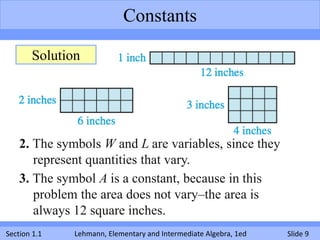
    A rectangle has an area of 12 square inches. Let W
    be the width (in inches), L be the length (in inches),
    and A be the area (in square inches).
    1. Sketch three possible rectangles of area 12
        square inches.
    2. Which of the symbols W, L, and A are variables?
        Explain.
    3. Which of the symbols W, L, and A are constants?
        Explain.
Section 1.1   Lehmann, Elementary and Intermediate Algebra, 1ed   Slide 8
Constants

       Solution


    2. The symbols W and L are variables, since they
       represent quantities that vary.
    3. The symbol A is a constant, because in this
       problem the area does not vary–the area is
       always 12 square inches.
Section 1.1   Lehmann, Elementary and Intermediate Algebra, 1ed   Slide 9
Counting Numbers

      Definition
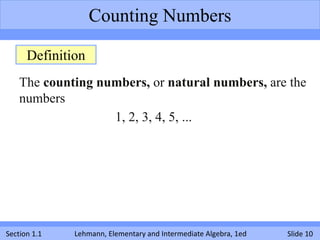
    The counting numbers, or natural numbers, are the
    numbers
                   1, 2, 3, 4, 5, ...


Section 1.1   Lehmann, Elementary and Intermediate Algebra, 1ed   Slide 10
Integers

      Definition
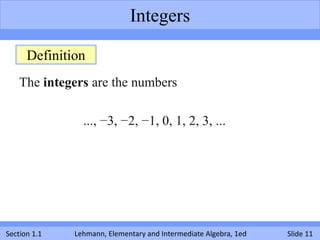
    The integers are the numbers

                ..., −3, −2, −1, 0, 1, 2, 3, ...


Section 1.1   Lehmann, Elementary and Intermediate Algebra, 1ed   Slide 11
The Number Line

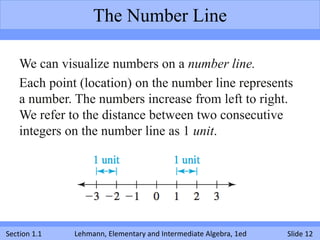
    We can visualize numbers on a number line.
    Each point (location) on the number line represents
    a number. The numbers increase from left to right.
    We refer to the distance between two consecutive
    integers on the number line as 1 unit.


Section 1.1   Lehmann, Elementary and Intermediate Algebra, 1ed   Slide 12
Rational Numbers

      Definition
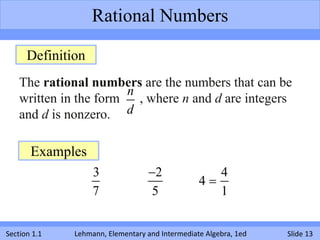
    The rational numbers are the numbers that can be
                        n
    written in the form   , where n and d are integers
    and d is nonzero. d

       Examples
                   3               2               4
                                                 4
                   7               5                1


Section 1.1   Lehmann, Elementary and Intermediate Algebra, 1ed   Slide 13
Irrational Numbers

      Definition
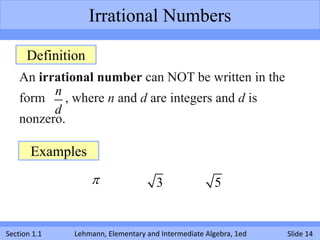
    An irrational number can NOT be written in the
          n
    form    , where n and d are integers and d is
          d
    nonzero.

       Examples
                                    3               5


Section 1.1   Lehmann, Elementary and Intermediate Algebra, 1ed   Slide 14
Decimals

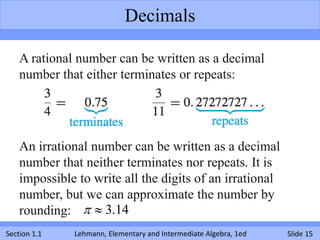
    A rational number can be written as a decimal
    number that either terminates or repeats:


    An irrational number can be written as a decimal
    number that neither terminates nor repeats. It is
    impossible to write all the digits of an irrational
    number, but we can approximate the number by
    rounding:   3.14
Section 1.1   Lehmann, Elementary and Intermediate Algebra, 1ed   Slide 15
Real Numbers

      Definition
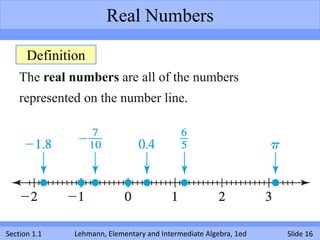
    The real numbers are all of the numbers
    represented on the number line.


Section 1.1   Lehmann, Elementary and Intermediate Algebra, 1ed   Slide 16
Real Numbers

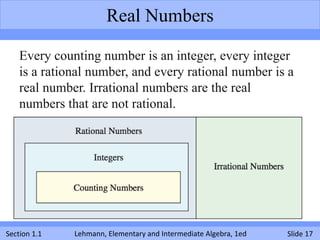
    Every counting number is an integer, every integer
    is a rational number, and every rational number is a
    real number. Irrational numbers are the real
    numbers that are not rational.


Section 1.1   Lehmann, Elementary and Intermediate Algebra, 1ed   Slide 17
Data

      Definition
    Data are values of quantities that describe authentic
    situations.

    We often can get a better sense of data by graphing
    than by just looking at the data values.


Section 1.1   Lehmann, Elementary and Intermediate Algebra, 1ed   Slide 18
Graphing Data
   Example 7
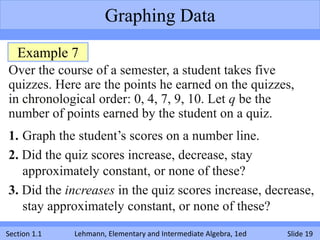
Over the course of a semester, a student takes five
quizzes. Here are the points he earned on the quizzes,
in chronological order: 0, 4, 7, 9, 10. Let q be the
number of points earned by the student on a quiz.
1. Graph the student’s scores on a number line.
2. Did the quiz scores increase, decrease, stay
   approximately constant, or none of these?
3. Did the increases in the quiz scores increase, decrease,
   stay approximately constant, or none of these?
Section 1.1   Lehmann, Elementary and Intermediate Algebra, 1ed   Slide 19
Graphing Data
     Solution
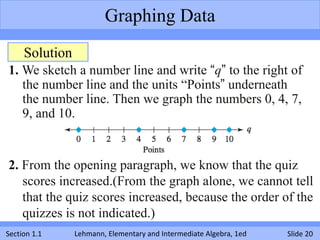
1. We sketch a number line and write “q” to the right of
   the number line and the units “Points” underneath
   the number line. Then we graph the numbers 0, 4, 7,
   9, and 10.


2. From the opening paragraph, we know that the quiz
   scores increased.(From the graph alone, we cannot tell
   that the quiz scores increased, because the order of the
   quizzes is not indicated.)
Section 1.1     Lehmann, Elementary and Intermediate Algebra, 1ed   Slide 20
Graphing Data
     Solution

3. As we look from left to right at the points plotted on
   the graph, we see that the distance between adjacent
   points decreases. This means that the increases in the
   quiz scores decreased. That is, the jump from 0 to 4
   is greater than the jump from 4 to 7, and so on.


Section 1.1     Lehmann, Elementary and Intermediate Algebra, 1ed   Slide 21
Average, mean

      Definition
    To find the average (or mean) of a group of
    numbers, we divide the sum of the numbers by the
    number of numbers in the group.
    To find the average of the quiz scores included in
    Example 7, first add the scores:
    0 + 4 + 7 + 9 + 10 = 30, then divide the total, 30,
    by the number of quiz scores, 5: 30 ÷ 5 = 6 points.
    So, the average quiz score is 6 points.

Section 1.1   Lehmann, Elementary and Intermediate Algebra, 1ed   Slide 22
Positive and Negative Numbers

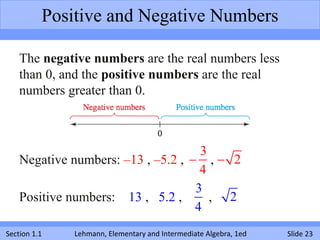
    The negative numbers are the real numbers less
    than 0, and the positive numbers are the real
    numbers greater than 0.


                                     3
    Negative numbers: –13 , –5.2 ,  ,  2
                                     4
                                    3
    Positive numbers: 13 , 5.2 ,       , 2
                                    4
Section 1.1   Lehmann, Elementary and Intermediate Algebra, 1ed   Slide 23
Positive and Negative Numbers

     Example 9
    A person bounces several checks and, as a result, is
    charged service fees. If b is the balance (in dollars)
    of the checking account, what value of b represents
    the fact that the person owes $50? Graph the
    number on a number line.


Section 1.1   Lehmann, Elementary and Intermediate Algebra, 1ed   Slide 24
Positive and Negative Numbers

       Solution
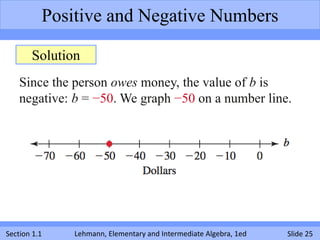
    Since the person owes money, the value of b is
    negative: b = −50. We graph −50 on a number line.


Section 1.1   Lehmann, Elementary and Intermediate Algebra, 1ed   Slide 25
Describing a Concept or Procedure

              Guidelines on Writing a Good Response
    • Create an example that illustrates the concept or
      outlines the procedure. Looking at examples or
      exercises may jump-start you into creating your
      own example.

    • Using complete sentences and correct
      terminology, describe the key ideas or steps of
      your example. You can review the text for ideas,
      but write your description in your own words.

Section 1.1       Lehmann, Elementary and Intermediate Algebra, 1ed   Slide 26
Describing a Concept or Procedure

              Guidelines on Writing a Good Response
    • Describe also the concept or the procedure in
      general without referring to your example. It
      may help to reflect on several examples and what
      they all have in common.

    • In some cases, it will be helpful to point out the
      similarities and the differences between the
      concept or the procedure and other concepts or
      procedures.

Section 1.1       Lehmann, Elementary and Intermediate Algebra, 1ed   Slide 27
Describing a Concept or Procedure

              Guidelines on Writing a Good Response
    • Describe the benefits of knowing the concept or
      the procedure.
    • If you have described the steps in a procedure,
      explain why it’s permissible to follow these
      steps.
    • Clarify any common misunderstandings about
      the concept, or discuss how to avoid making
      common mistakes when following the procedure.
Section 1.1       Lehmann, Elementary and Intermediate Algebra, 1ed   Slide 28
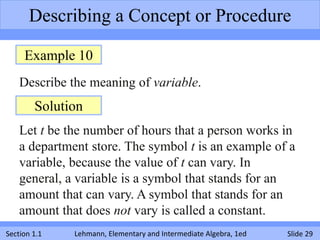
Describing a Concept or Procedure

     Example 10
    Describe the meaning of variable.
        Solution
    Let t be the number of hours that a person works in
    a department store. The symbol t is an example of a
    variable, because the value of t can vary. In
    general, a variable is a symbol that stands for an
    amount that can vary. A symbol that stands for an
    amount that does not vary is called a constant.
Section 1.1   Lehmann, Elementary and Intermediate Algebra, 1ed   Slide 29
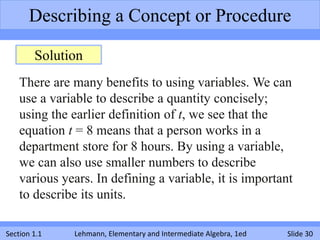
Describing a Concept or Procedure

        Solution
    There are many benefits to using variables. We can
    use a variable to describe a quantity concisely;
    using the earlier definition of t, we see that the
    equation t = 8 means that a person works in a
    department store for 8 hours. By using a variable,
    we can also use smaller numbers to describe
    various years. In defining a variable, it is important
    to describe its units.

Section 1.1   Lehmann, Elementary and Intermediate Algebra, 1ed   Slide 30

Basic Algebra Ppt 1.1

  • 1.
  • 2.
    Section 1.1 Variables and Constants
  • 3.
    Variables Definition A variable is a symbol which represents a quantity that can vary. For example, we can define h to be the height (in feet) of a specific child. Height is a quantity that varies: As time passes, the child’s height will increase. So, h is a variable. When we say h = 4, we mean that the child’s height is 4 feet. Section 1.1 Lehmann, Elementary and Intermediate Algebra, 1ed Slide 3
  • 4.
    Variables Example 1 1. Let s be a car’s speed (in miles per hour). What is the meaning of s = 60? 2. Let n be the number of people (in millions) who work from home at least once a week during normal business hours. For the year 2005, n = 21. What does that mean in this situation? 3. Let t be the number of years since 2005. What is the meaning of t = 4? Section 1.1 Lehmann, Elementary and Intermediate Algebra, 1ed Slide 4
  • 5.
    Variables Solution 1. Let s be a car’s speed (in miles per hour). What is the meaning of s = 60? The speed of the car is 60 miles per hour. 2. Let n be the number of people (in millions) who work from home at least once a week during normal business hours. For the year 2005, n = 21. What does that mean in this situation? In 2005, 21 million people worked from home at least once a week during normal business hours. Section 1.1 Lehmann, Elementary and Intermediate Algebra, 1ed Slide 5
  • 6.
    Variables Solution 3. Let t be the number of years since 2005. What is the meaning of t = 4? 2005 + 4 = 2009; so, t = 4 represents the year 2009. Section 1.1 Lehmann, Elementary and Intermediate Algebra, 1ed Slide 6
  • 7.
    Constants Definition A constant is a symbol which represents a specific number (a quantity that does not vary). Section 1.1 Lehmann, Elementary and Intermediate Algebra, 1ed Slide 7
  • 8.
    Constants Example 3 A rectangle has an area of 12 square inches. Let W be the width (in inches), L be the length (in inches), and A be the area (in square inches). 1. Sketch three possible rectangles of area 12 square inches. 2. Which of the symbols W, L, and A are variables? Explain. 3. Which of the symbols W, L, and A are constants? Explain. Section 1.1 Lehmann, Elementary and Intermediate Algebra, 1ed Slide 8
  • 9.
    Constants Solution 2. The symbols W and L are variables, since they represent quantities that vary. 3. The symbol A is a constant, because in this problem the area does not vary–the area is always 12 square inches. Section 1.1 Lehmann, Elementary and Intermediate Algebra, 1ed Slide 9
  • 10.
    Counting Numbers Definition The counting numbers, or natural numbers, are the numbers 1, 2, 3, 4, 5, ... Section 1.1 Lehmann, Elementary and Intermediate Algebra, 1ed Slide 10
  • 11.
    Integers Definition The integers are the numbers ..., −3, −2, −1, 0, 1, 2, 3, ... Section 1.1 Lehmann, Elementary and Intermediate Algebra, 1ed Slide 11
  • 12.
    The Number Line We can visualize numbers on a number line. Each point (location) on the number line represents a number. The numbers increase from left to right. We refer to the distance between two consecutive integers on the number line as 1 unit. Section 1.1 Lehmann, Elementary and Intermediate Algebra, 1ed Slide 12
  • 13.
    Rational Numbers Definition The rational numbers are the numbers that can be n written in the form , where n and d are integers and d is nonzero. d Examples 3 2 4 4 7 5 1 Section 1.1 Lehmann, Elementary and Intermediate Algebra, 1ed Slide 13
  • 14.
    Irrational Numbers Definition An irrational number can NOT be written in the n form , where n and d are integers and d is d nonzero. Examples  3 5 Section 1.1 Lehmann, Elementary and Intermediate Algebra, 1ed Slide 14
  • 15.
    Decimals A rational number can be written as a decimal number that either terminates or repeats: An irrational number can be written as a decimal number that neither terminates nor repeats. It is impossible to write all the digits of an irrational number, but we can approximate the number by rounding:   3.14 Section 1.1 Lehmann, Elementary and Intermediate Algebra, 1ed Slide 15
  • 16.
    Real Numbers Definition The real numbers are all of the numbers represented on the number line. Section 1.1 Lehmann, Elementary and Intermediate Algebra, 1ed Slide 16
  • 17.
    Real Numbers Every counting number is an integer, every integer is a rational number, and every rational number is a real number. Irrational numbers are the real numbers that are not rational. Section 1.1 Lehmann, Elementary and Intermediate Algebra, 1ed Slide 17
  • 18.
    Data Definition Data are values of quantities that describe authentic situations. We often can get a better sense of data by graphing than by just looking at the data values. Section 1.1 Lehmann, Elementary and Intermediate Algebra, 1ed Slide 18
  • 19.
    Graphing Data Example 7 Over the course of a semester, a student takes five quizzes. Here are the points he earned on the quizzes, in chronological order: 0, 4, 7, 9, 10. Let q be the number of points earned by the student on a quiz. 1. Graph the student’s scores on a number line. 2. Did the quiz scores increase, decrease, stay approximately constant, or none of these? 3. Did the increases in the quiz scores increase, decrease, stay approximately constant, or none of these? Section 1.1 Lehmann, Elementary and Intermediate Algebra, 1ed Slide 19
  • 20.
    Graphing Data Solution 1. We sketch a number line and write “q” to the right of the number line and the units “Points” underneath the number line. Then we graph the numbers 0, 4, 7, 9, and 10. 2. From the opening paragraph, we know that the quiz scores increased.(From the graph alone, we cannot tell that the quiz scores increased, because the order of the quizzes is not indicated.) Section 1.1 Lehmann, Elementary and Intermediate Algebra, 1ed Slide 20
  • 21.
    Graphing Data Solution 3. As we look from left to right at the points plotted on the graph, we see that the distance between adjacent points decreases. This means that the increases in the quiz scores decreased. That is, the jump from 0 to 4 is greater than the jump from 4 to 7, and so on. Section 1.1 Lehmann, Elementary and Intermediate Algebra, 1ed Slide 21
  • 22.
    Average, mean Definition To find the average (or mean) of a group of numbers, we divide the sum of the numbers by the number of numbers in the group. To find the average of the quiz scores included in Example 7, first add the scores: 0 + 4 + 7 + 9 + 10 = 30, then divide the total, 30, by the number of quiz scores, 5: 30 ÷ 5 = 6 points. So, the average quiz score is 6 points. Section 1.1 Lehmann, Elementary and Intermediate Algebra, 1ed Slide 22
  • 23.
    Positive and NegativeNumbers The negative numbers are the real numbers less than 0, and the positive numbers are the real numbers greater than 0. 3 Negative numbers: –13 , –5.2 ,  ,  2 4 3 Positive numbers: 13 , 5.2 , , 2 4 Section 1.1 Lehmann, Elementary and Intermediate Algebra, 1ed Slide 23
  • 24.
    Positive and NegativeNumbers Example 9 A person bounces several checks and, as a result, is charged service fees. If b is the balance (in dollars) of the checking account, what value of b represents the fact that the person owes $50? Graph the number on a number line. Section 1.1 Lehmann, Elementary and Intermediate Algebra, 1ed Slide 24
  • 25.
    Positive and NegativeNumbers Solution Since the person owes money, the value of b is negative: b = −50. We graph −50 on a number line. Section 1.1 Lehmann, Elementary and Intermediate Algebra, 1ed Slide 25
  • 26.
    Describing a Conceptor Procedure Guidelines on Writing a Good Response • Create an example that illustrates the concept or outlines the procedure. Looking at examples or exercises may jump-start you into creating your own example. • Using complete sentences and correct terminology, describe the key ideas or steps of your example. You can review the text for ideas, but write your description in your own words. Section 1.1 Lehmann, Elementary and Intermediate Algebra, 1ed Slide 26
  • 27.
    Describing a Conceptor Procedure Guidelines on Writing a Good Response • Describe also the concept or the procedure in general without referring to your example. It may help to reflect on several examples and what they all have in common. • In some cases, it will be helpful to point out the similarities and the differences between the concept or the procedure and other concepts or procedures. Section 1.1 Lehmann, Elementary and Intermediate Algebra, 1ed Slide 27
  • 28.
    Describing a Conceptor Procedure Guidelines on Writing a Good Response • Describe the benefits of knowing the concept or the procedure. • If you have described the steps in a procedure, explain why it’s permissible to follow these steps. • Clarify any common misunderstandings about the concept, or discuss how to avoid making common mistakes when following the procedure. Section 1.1 Lehmann, Elementary and Intermediate Algebra, 1ed Slide 28
  • 29.
    Describing a Conceptor Procedure Example 10 Describe the meaning of variable. Solution Let t be the number of hours that a person works in a department store. The symbol t is an example of a variable, because the value of t can vary. In general, a variable is a symbol that stands for an amount that can vary. A symbol that stands for an amount that does not vary is called a constant. Section 1.1 Lehmann, Elementary and Intermediate Algebra, 1ed Slide 29
  • 30.
    Describing a Conceptor Procedure Solution There are many benefits to using variables. We can use a variable to describe a quantity concisely; using the earlier definition of t, we see that the equation t = 8 means that a person works in a department store for 8 hours. By using a variable, we can also use smaller numbers to describe various years. In defining a variable, it is important to describe its units. Section 1.1 Lehmann, Elementary and Intermediate Algebra, 1ed Slide 30