Stavros Vassos, University of Athens, Greece   stavrosv@di.uoa.gr   May 2012


INTRODUCTION TO AI
STRIPS PLANNING
.. and Applications to Video-games!
Course overview
2


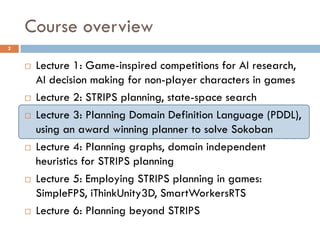
       Lecture 1: Game-inspired competitions for AI research,
        AI decision making for non-player characters in games
       Lecture 2: STRIPS planning, state-space search
       Lecture 3: Planning Domain Definition Language (PDDL),
        using an award winning planner to solve Sokoban
       Lecture 4: Planning graphs, domain independent
        heuristics for STRIPS planning
       Lecture 5: Employing STRIPS planning in games:
        SimpleFPS, iThinkUnity3D, SmartWorkersRTS
       Lecture 6: Planning beyond STRIPS
STRIPS planning
3


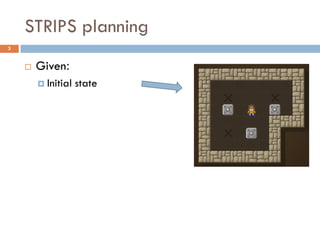
       Given:
         Initial   state
STRIPS planning
4


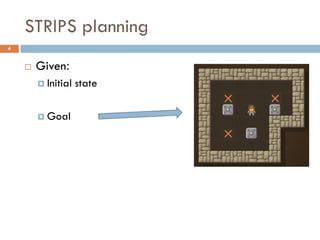
       Given:
         Initial   state

         Goal
STRIPS planning
5


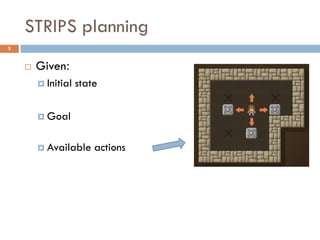
       Given:
         Initial   state

         Goal


         Available     actions
STRIPS planning
6


       Given:
         Initial   state

         Goal


         Available     actions


       Find:
        A  sequence of actions that achieves the goal
         E.g.: [Left, Down, Left, Up, …]
Planning Domain Description Language
7


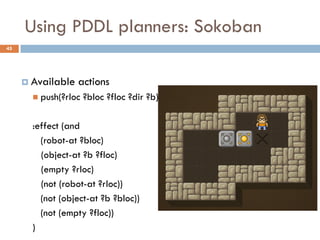
       Planning Domain Definition Language (PDDL)
         Formal  language for specifying planning problems
         Formal syntax similar to a programming language

         Includes STRIPS and ADL, and many more features


         Provides  the ground for performing a direct comparison
          between planning techniques and evaluating against
          classes of problems
Planning Domain Description Language
8


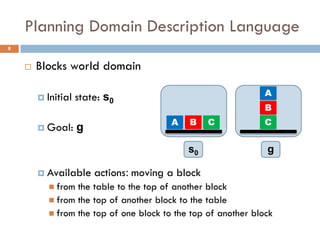
       Blocks world domain

         Initial   state: s0                                  Α
                                                               Β
                                        Α   Β     C            C
         Goal:     g
                                            s0                 g

         Available     actions: moving a block
           from the table to the top of another block
           from the top of another block to the table
           from the top of one block to the top of another block
Planning Domain Description Language
9


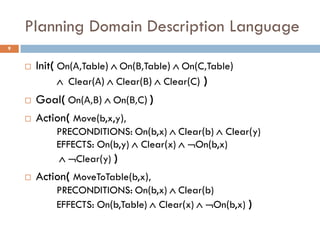
       Init( On(Α,Table)  On(Β,Table)  On(C,Table)
               Clear(Α)  Clear(Β)  Clear(C) )
       Goal( On(Α,Β)  On(Β,C) )
       Action( Move(b,x,y),
            PRECONDITIONS: On(b,x)  Clear(b)  Clear(y)
            EFFECTS: On(b,y)  Clear(x)  On(b,x)
              Clear(y) )
       Action( MoveToTable(b,x),
            PRECONDITIONS: On(b,x)  Clear(b)
            EFFECTS: On(b,Table)  Clear(x)  On(b,x) )
Planning Domain Description Language
10


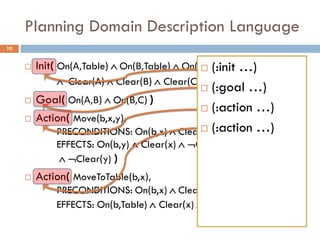
        Init( On(Α,Table)  On(Β,Table)  On(C,Table) …)
                                                (:init
                Clear(Α)  Clear(Β)  Clear(C) )
                                                (:goal …)
        Goal( On(Α,Β)  On(Β,C) )
                                                (:action …)
        Action( Move(b,x,y),
             PRECONDITIONS: On(b,x)  Clear(b)(:action …)
                                               Clear(y)
             EFFECTS: On(b,y)  Clear(x)  On(b,x)
               Clear(y) )
        Action( MoveToTable(b,x),
             PRECONDITIONS: On(b,x)  Clear(b)
             EFFECTS: On(b,Table)  Clear(x)  On(b,x) )
Planning Domain Description Language
11


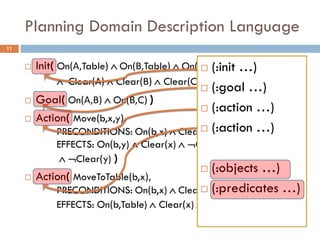
        Init( On(Α,Table)  On(Β,Table)  On(C,Table) …)
                                                (:init
                Clear(Α)  Clear(Β)  Clear(C) )
                                                (:goal …)
        Goal( On(Α,Β)  On(Β,C) )
                                                (:action …)
        Action( Move(b,x,y),
             PRECONDITIONS: On(b,x)  Clear(b)(:action …)
                                               Clear(y)
             EFFECTS: On(b,y)  Clear(x)  On(b,x)
               Clear(y) )
                                             (:objects …)
        Action( MoveToTable(b,x),
             PRECONDITIONS: On(b,x)  Clear(b)(:predicates …)
                                           
             EFFECTS: On(b,Table)  Clear(x)  On(b,x) )
Planning Domain Description Language
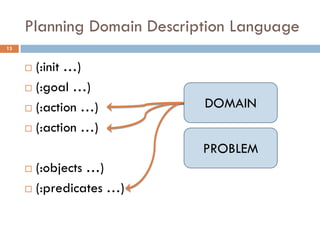
12


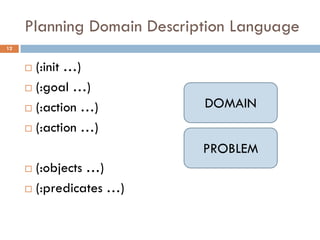
      (:init …)
      (:goal …)

      (:action …)          DOMAIN
      (:action …)

                            PROBLEM
      (:objects …)
      (:predicates …)
Planning Domain Description Language
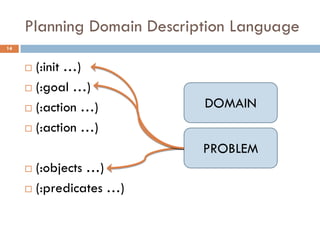
13


      (:init …)
      (:goal …)

      (:action …)          DOMAIN
      (:action …)

                            PROBLEM
      (:objects …)
      (:predicates …)
Planning Domain Description Language
14


      (:init …)
      (:goal …)

      (:action …)          DOMAIN
      (:action …)

                            PROBLEM
      (:objects …)
      (:predicates …)
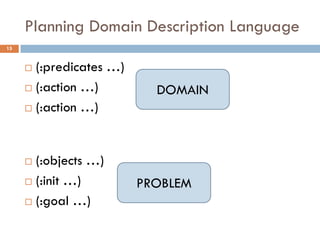
Planning Domain Description Language
15


      (:predicates …)
      (:action …)         DOMAIN
      (:action …)


      (:objects …)
      (:init …)         PROBLEM
      (:goal …)
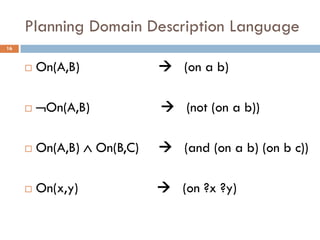
Planning Domain Description Language
16


        On(A,B)              (on a b)

        On(A,B)             (not (on a b))

        On(A,B)  On(B,C)    (and (on a b) (on b c))

        On(x,y)              (on ?x ?y)
The blocks world example in PDDL
17


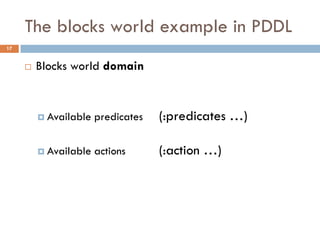
        Blocks world domain


          Available   predicates   (:predicates …)

          Available   actions      (:action …)
The blocks world example in PDDL
18


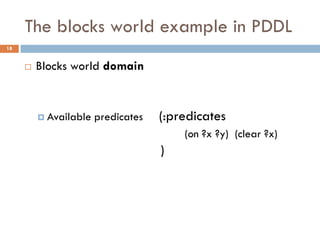
        Blocks world domain


          Available   predicates   (:predicates
                                        (on ?x ?y) (clear ?x)
                                    )
The blocks world example in PDDL
19


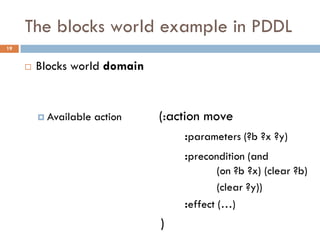
        Blocks world domain


          Available   action   (:action move
                                     :parameters (?b ?x ?y)
                                     :precondition (and
                                             (on ?b ?x) (clear ?b)
                                             (clear ?y))
                                     :effect (…)
                                )
The blocks world example in PDDL
20


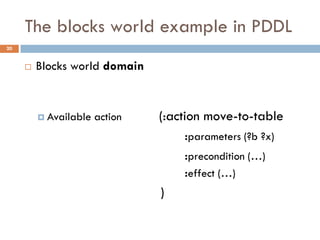
        Blocks world domain


          Available   action   (:action move-to-table
                                     :parameters (?b ?x)
                                     :precondition (…)
                                     :effect (…)
                                )
The blocks world example in PDDL
21


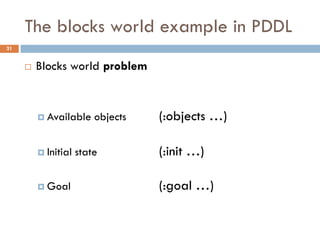
        Blocks world problem


          Available     objects   (:objects …)

          Initial   state         (:init …)

          Goal                    (:goal …)
The blocks world example in PDDL
22


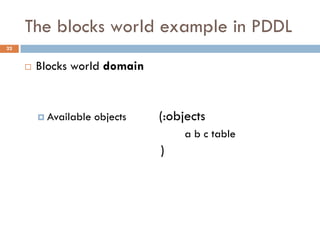
        Blocks world domain


          Available   objects   (:objects
                                     a b c table
                                 )
The blocks world example in PDDL
23


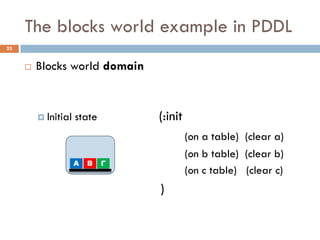
        Blocks world domain


          Initial   state       (:init
                                          (on a table) (clear a)
                                          (on b table) (clear b)
                     Α   Β   Γ
                                          (on c table) (clear c)
                                 )
The blocks world example in PDDL
24


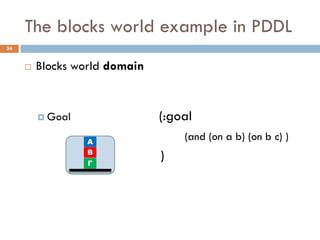
        Blocks world domain


          Goal                (:goal
                  Α
                                   (and (on a b) (on b c) )
                  Β
                  Γ
                               )
The blocks world example in PDDL
25


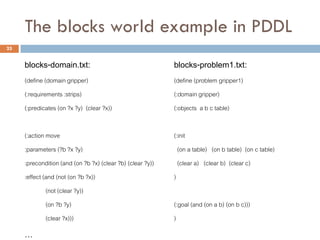
     blocks-domain.txt:                                     blocks-problem1.txt:
     (define (domain gripper)                               (define (problem gripper1)
     (:requirements :strips)                                (:domain gripper)
     (:predicates (on ?x ?y) (clear ?x))                    (:objects a b c table)


     (:action move                                          (:init
     :parameters (?b ?x ?y)                                     (on a table) (on b table) (on c table)
     :precondition (and (on ?b ?x) (clear ?b) (clear ?y))       (clear a) (clear b) (clear c)
     :effect (and (not (on ?b ?x))                          )
             (not (clear ?y))
             (on ?b ?y)                                     (:goal (and (on a b) (on b c)))
             (clear ?x)))                                   )
     …
Using PDDL planners
26


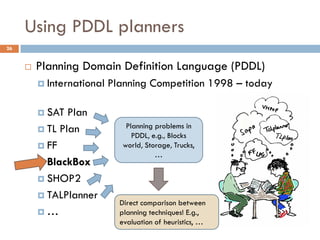
        Planning Domain Definition Language (PDDL)
          International   Planning Competition 1998 – today

          SAT  Plan
          TL Plan             Planning problems in
                                 PDDL, e.g., Blocks
          FF                 world, Storage, Trucks,
                                        …
          BlackBox

          SHOP2

          TALPlanner
                             Direct comparison between
         …                  planning techniques! E.g.,
                             evaluation of heuristics, …
Using PDDL planners: Blocks world
27


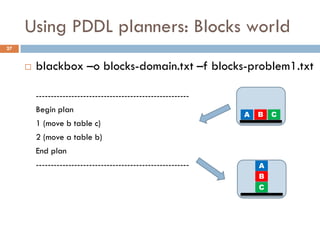
        blackbox –o blocks-domain.txt –f blocks-problem1.txt

         ----------------------------------------------------
         Begin plan
                                                                Α   Β   C
         1 (move b table c)
         2 (move a table b)
         End plan
         ----------------------------------------------------       Α
                                                                    Β
                                                                    C
Using PDDL planners: Blocks world
28


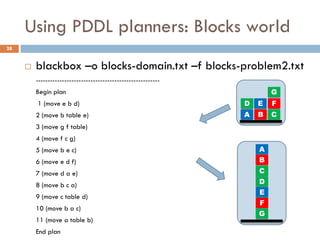
        blackbox –o blocks-domain.txt –f blocks-problem2.txt
         ----------------------------------------------------
         Begin plan                                                     G
         1 (move e b d)                                         D   E   F
         2 (move b table e)                                     Α   Β   C
         3 (move g f table)
         4 (move f c g)
         5 (move b e c)                                             Α
         6 (move e d f)                                             Β
         7 (move d a e)                                             C
         8 (move b c a)                                             D
                                                                    E
         9 (move c table d)
                                                                    F
         10 (move b a c)
                                                                    G
         11 (move a table b)
         End plan
Using PDDL planners
29


        We can use blackbox (or any other off-the-self PDDL
         planner) for any problem we can write in PDDL!
Using PDDL planners: Sokoban
30


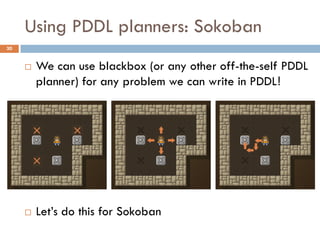
        We can use blackbox (or any other off-the-self PDDL
         planner) for any problem we can write in PDDL!


        Let’s do this for Sokoban
Using PDDL planners: Sokoban
31


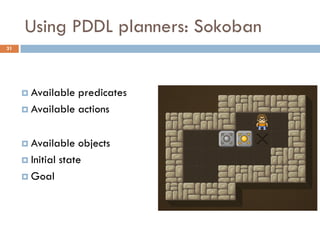
      Available predicates
      Available actions


      Available   objects
      Initial state

      Goal
Using PDDL planners: Sokoban
32


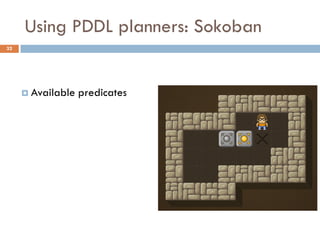
      Available   predicates
Using PDDL planners: Sokoban
33


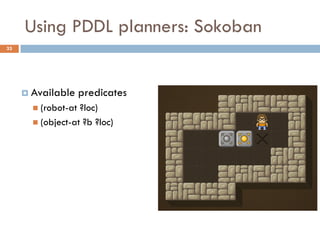
      Available     predicates
        (robot-at ?loc)
        (object-at ?b ?loc)
Using PDDL planners: Sokoban
34


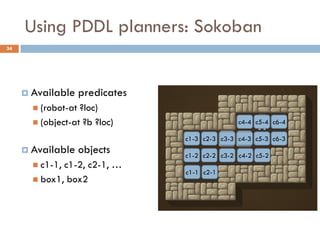
      Available     predicates
        (robot-at ?loc)
        (object-at ?b ?loc)                     c4-4 c5-4 c6-4

                                  c1-3 c2-3 c3-3 c4-3 c5-3 c6-3
      Available     objects      c1-2 c2-2 c3-2 c4-2 c5-2
        c1-1,c1-2, c2-1, …
                                  c1-1 c2-1
        box1, box2
Using PDDL planners: Sokoban
35


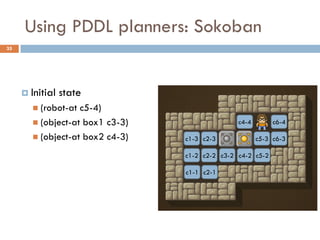
      Initial   state
        (robot-at c5-4)
        (object-at box1 c3-3)                  c4-4        c6-4

        (object-at box2 c4-3)   c1-3 c2-3             c5-3 c6-3

                                 c1-2 c2-2 c3-2 c4-2 c5-2

                                 c1-1 c2-1
Using PDDL planners: Sokoban
36


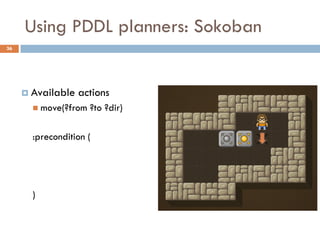
      Available   actions
        move(?from   ?to ?dir)

       :precondition (


       )
Using PDDL planners: Sokoban
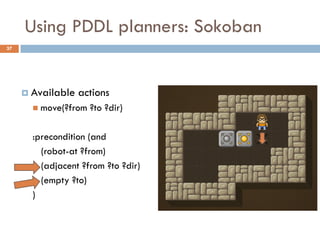
37


      Available   actions
        move(?from   ?to ?dir)

       :precondition (and
         (robot-at ?from)
         (adjacent ?from ?to ?dir)
         (empty ?to)
       )
Using PDDL planners: Sokoban
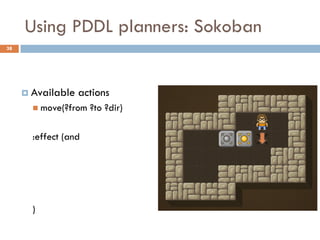
38


      Available   actions
        move(?from   ?to ?dir)

       :effect (and


       )
Using PDDL planners: Sokoban
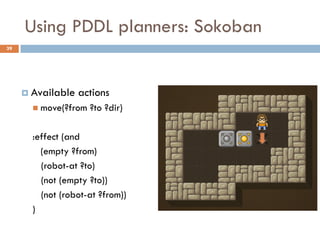
39


      Available   actions
        move(?from   ?to ?dir)

       :effect (and
         (empty ?from)
         (robot-at ?to)
         (not (empty ?to))
         (not (robot-at ?from))
       )
Using PDDL planners: Sokoban
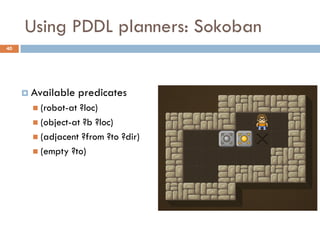
40


      Available     predicates
        (robot-at ?loc)
        (object-at ?b ?loc)
        (adjacent ?from ?to ?dir)
        (empty ?to)
Using PDDL planners: Sokoban
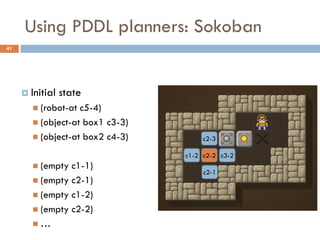
41


      Initial   state
        (robot-at c5-4)
        (object-at box1 c3-3)
        (object-at box2 c4-3)        c2-3

                                 c1-2 c2-2 c3-2
        (empty c1-1)
                                      c2-1
        (empty c2-1)
        (empty c1-2)
        (empty c2-2)
       …
Using PDDL planners: Sokoban
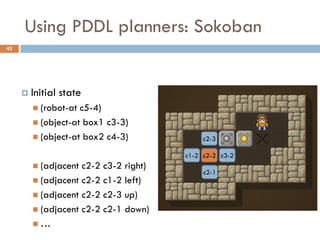
42


      Initial   state
        (robot-at c5-4)
        (object-at box1 c3-3)
        (object-at box2 c4-3)             c2-3

                                      c1-2 c2-2 c3-2
        (adjacent c2-2 c3-2 right)
                                           c2-1
        (adjacent c2-2 c1-2 left)
        (adjacent c2-2 c2-3 up)
        (adjacent c2-2 c2-1 down)
       …
Using PDDL planners: Sokoban
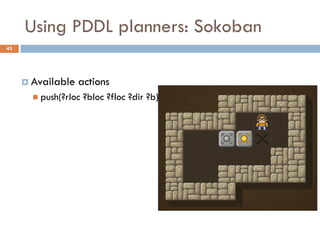
43


      Available   actions
        push(?rloc   ?bloc ?floc ?dir ?b)
Using PDDL planners: Sokoban
44


      Available   actions
        push(?rloc   ?bloc ?floc ?dir ?b)

       :precondition (and
         (robot-at ?rloc)
         (object-at ?b ?bloc)
         (adjacent ?rloc ?bloc ?dir)
         (adjacent ?bloc ?floc ?dir)
         (empty ?floc)
       )
Using PDDL planners: Sokoban
45


      Available   actions
        push(?rloc   ?bloc ?floc ?dir ?b)

       :effect (and
         (robot-at ?bloc)
         (object-at ?b ?floc)
         (empty ?rloc)
         (not (robot-at ?rloc))
         (not (object-at ?b ?bloc))
         (not (empty ?floc))
       )
Using PDDL planners: Sokoban
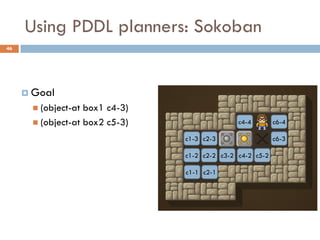
46


      Goal
        (object-at box1 c4-3)
        (object-at box2 c5-3)                  c4-4        c6-4

                                 c1-3 c2-3                  c6-3

                                 c1-2 c2-2 c3-2 c4-2 c5-2

                                 c1-1 c2-1
Using PDDL planners: Sokoban
47


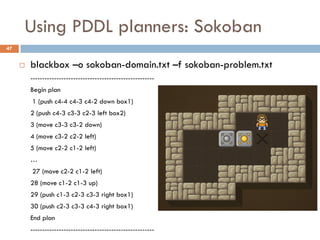
        blackbox –o sokoban-domain.txt –f sokoban-problem.txt
         ----------------------------------------------------
         Begin plan
         1 (push c4-4 c4-3 c4-2 down box1)
         2 (push c4-3 c3-3 c2-3 left box2)
         3 (move c3-3 c3-2 down)
         4 (move c3-2 c2-2 left)
         5 (move c2-2 c1-2 left)
         …
         27 (move c2-2 c1-2 left)
         28 (move c1-2 c1-3 up)
         29 (push c1-3 c2-3 c3-3 right box1)
         30 (push c2-3 c3-3 c4-3 right box1)
         End plan
         ----------------------------------------------------
Using PDDL planners: SimpleGame
48


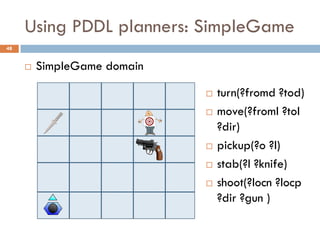
        SimpleGame domain

                                turn(?fromd ?tod)
                                move(?froml ?tol
                                 ?dir)
                                pickup(?o ?l)
                                stab(?l ?knife)
                                shoot(?locn ?locp
                                 ?dir ?gun )
Building your own PDDL planner
49


       Pyperplan
         Lightweight STRIPS planner written in Python. Developed during
          the planning course at Albert-Ludwigs-Universität Freiburg
          2010/2011, GNU General Public License 3
         https://bitbucket.org/malte/pyperplan
       Source   code of academic planners
         BlackBox:
          http://www.cs.rochester.edu/u/kautz/satplan/blackbox/
         FastForward: http://www.loria.fr/~hoffmanj/ff.html
         FastDownward: http://www.fast-downward.org/
       ANTLR    Parser Generator
         http://www.antlr.org/
         http://www.antlr.org/grammar/1222962012944/Pddl.g
Building your own PDDL planner
50


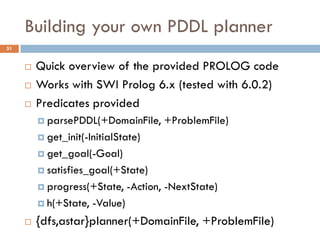
        Quick overview of the provided PROLOG code
        Good for quick prototyping ;-)
Building your own PDDL planner
51


        Quick overview of the provided PROLOG code
        Works with SWI Prolog 6.x (tested with 6.0.2)
        Predicates provided
          parsePDDL(+DomainFile,        +ProblemFile)
          get_init(-InitialState)

          get_goal(-Goal)

          satisfies_goal(+State)

          progress(+State,      -Action, -NextState)
          h(+State,   -Value)
        {dfs,astar}planner(+DomainFile, +ProblemFile)
Planning Domain Description Language
52


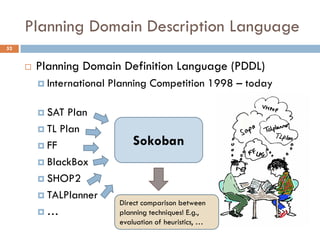
        Planning Domain Definition Language (PDDL)
          International   Planning Competition 1998 – today

          SAT  Plan
          TL Plan

          FF                    Sokoban
          BlackBox

          SHOP2

          TALPlanner
                             Direct comparison between
         …                  planning techniques! E.g.,
                             evaluation of heuristics, …
Using PDDL planners
53


        FastDownward [Helmert 2006]
          Introduced  a new type of heuristic that is not based on
           an empty list of negative actions
          Efficient implementation of all notable forward search
           methods and heuristics (including the more recent ones)
          Requires a number of preprocessing steps that
           transforms the STRIPS planning problem…
Using PDDL planners
54


        FastDownward [Helmert 2006]
          Introduced  a new type of heuristic that is not based on
           an empty list of negative actions
          Efficient implementation of all notable forward search
           methods and heuristics (including the more recent ones)
          Requires a number of preprocessing steps that
           transforms the STRIPS planning problem…

          Can be used as a framework to evaluate forward
           search planning methods
Using PDDL planners
55


        FastDownward [Helmert 2006]
          translate/translate.py   sokoban-domain.txt 
           sokoban.problem.txt
          preprocess/preprocess < output.sas

          search/downward --search SearchConfiguration < output


        http://www.fast-downward.org
Using PDDL planners: Sokoban
56


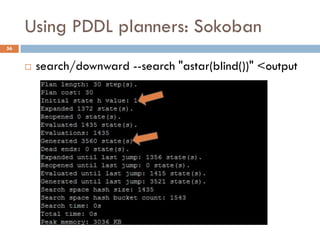
        search/downward --search "astar(blind())" <output
Using PDDL planners: Sokoban
57


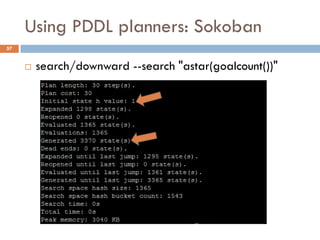
        search/downward --search "astar(goalcount())"
Using PDDL planners: Sokoban
58


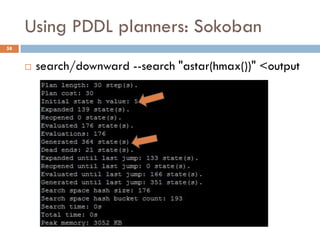
        search/downward --search "astar(hmax())" <output
Using PDDL planners: Sokoban
59


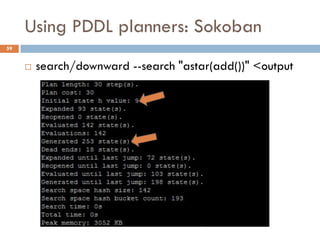
        search/downward --search "astar(add())" <output
Using PDDL planners: Sokoban
60


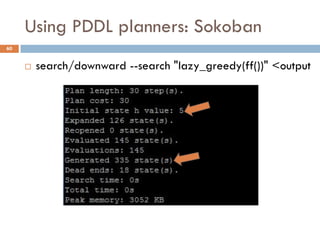
        search/downward --search "lazy_greedy(ff())" <output
Using PDDL planners: Sokoban
61


        Notice that the planner does not know anything
         about the planning problem we are solving
        The heuristics we tried are domain independent
          goal   count
          hmax

          hadd

          FF

        We will see how each one works in Lecture 4 (after
         we first go over planning graphs that are needed)
Next lecture
62


        Lecture 1: Game-inspired competitions for AI research,
         AI decision making for non-player characters in games
        Lecture 2: STRIPS planning, state-space search
        Lecture 3: Planning Domain Definition Language (PDDL),
         using an award winning planner to solve Sokoban
        Lecture 4: Planning graphs, domain independent
         heuristics for STRIPS planning
        Lecture 5: Employing STRIPS planning in games:
         SimpleFPS, iThinkUnity3D, SmartWorkersRTS
        Lecture 6: Planning beyond STRIPS
Bibliography
63


        Material
            Artificial Intelligence: A Modern Approach 2nd Ed. Stuart Russell, Peter
             Norvig. Prentice Hall, 2003 Section 11.4


        References
          PDDL - The Planning Domain Definition Language. Drew McDermott,
           Malik Ghallab, Adele Howe, Craig Knoblock, Ashwin Ram, Manuela
           Veloso, Daniel Weld, David Wilkins. Technical report, Yale Center for
           Computational Vision and Control, TR-98-003, 1998.
          Unifying SAT-Based and Graph-Based Planning. Henry Kautz, Bart
           Selman. In Proceedings of the International Joint Conference on
           Artificial Intelligence (IJCAI), 1999
          The Fast Downward Planning System. Malte Helmert. Artificial
           Intelligence Research (JAIR), Vol. 26, 2006

Intro to AI STRIPS Planning & Applications in Video-games Lecture3-Part1

  • 1.
    Stavros Vassos, Universityof Athens, Greece stavrosv@di.uoa.gr May 2012 INTRODUCTION TO AI STRIPS PLANNING .. and Applications to Video-games!
  • 2.
    Course overview 2  Lecture 1: Game-inspired competitions for AI research, AI decision making for non-player characters in games  Lecture 2: STRIPS planning, state-space search  Lecture 3: Planning Domain Definition Language (PDDL), using an award winning planner to solve Sokoban  Lecture 4: Planning graphs, domain independent heuristics for STRIPS planning  Lecture 5: Employing STRIPS planning in games: SimpleFPS, iThinkUnity3D, SmartWorkersRTS  Lecture 6: Planning beyond STRIPS
  • 3.
    STRIPS planning 3  Given:  Initial state
  • 4.
    STRIPS planning 4  Given:  Initial state  Goal
  • 5.
    STRIPS planning 5  Given:  Initial state  Goal  Available actions
  • 6.
    STRIPS planning 6  Given:  Initial state  Goal  Available actions  Find: A sequence of actions that achieves the goal  E.g.: [Left, Down, Left, Up, …]
  • 7.
    Planning Domain DescriptionLanguage 7  Planning Domain Definition Language (PDDL)  Formal language for specifying planning problems  Formal syntax similar to a programming language  Includes STRIPS and ADL, and many more features  Provides the ground for performing a direct comparison between planning techniques and evaluating against classes of problems
  • 8.
    Planning Domain DescriptionLanguage 8  Blocks world domain  Initial state: s0 Α Β Α Β C C  Goal: g s0 g  Available actions: moving a block  from the table to the top of another block  from the top of another block to the table  from the top of one block to the top of another block
  • 9.
    Planning Domain DescriptionLanguage 9  Init( On(Α,Table)  On(Β,Table)  On(C,Table)  Clear(Α)  Clear(Β)  Clear(C) )  Goal( On(Α,Β)  On(Β,C) )  Action( Move(b,x,y), PRECONDITIONS: On(b,x)  Clear(b)  Clear(y) EFFECTS: On(b,y)  Clear(x)  On(b,x)  Clear(y) )  Action( MoveToTable(b,x), PRECONDITIONS: On(b,x)  Clear(b) EFFECTS: On(b,Table)  Clear(x)  On(b,x) )
  • 10.
    Planning Domain DescriptionLanguage 10  Init( On(Α,Table)  On(Β,Table)  On(C,Table) …)  (:init  Clear(Α)  Clear(Β)  Clear(C) )  (:goal …)  Goal( On(Α,Β)  On(Β,C) )  (:action …)  Action( Move(b,x,y), PRECONDITIONS: On(b,x)  Clear(b)(:action …)   Clear(y) EFFECTS: On(b,y)  Clear(x)  On(b,x)  Clear(y) )  Action( MoveToTable(b,x), PRECONDITIONS: On(b,x)  Clear(b) EFFECTS: On(b,Table)  Clear(x)  On(b,x) )
  • 11.
    Planning Domain DescriptionLanguage 11  Init( On(Α,Table)  On(Β,Table)  On(C,Table) …)  (:init  Clear(Α)  Clear(Β)  Clear(C) )  (:goal …)  Goal( On(Α,Β)  On(Β,C) )  (:action …)  Action( Move(b,x,y), PRECONDITIONS: On(b,x)  Clear(b)(:action …)   Clear(y) EFFECTS: On(b,y)  Clear(x)  On(b,x)  Clear(y) ) (:objects …)  Action( MoveToTable(b,x), PRECONDITIONS: On(b,x)  Clear(b)(:predicates …)  EFFECTS: On(b,Table)  Clear(x)  On(b,x) )
  • 12.
    Planning Domain DescriptionLanguage 12  (:init …)  (:goal …)  (:action …) DOMAIN  (:action …) PROBLEM  (:objects …)  (:predicates …)
  • 13.
    Planning Domain DescriptionLanguage 13  (:init …)  (:goal …)  (:action …) DOMAIN  (:action …) PROBLEM  (:objects …)  (:predicates …)
  • 14.
    Planning Domain DescriptionLanguage 14  (:init …)  (:goal …)  (:action …) DOMAIN  (:action …) PROBLEM  (:objects …)  (:predicates …)
  • 15.
    Planning Domain DescriptionLanguage 15  (:predicates …)  (:action …) DOMAIN  (:action …)  (:objects …)  (:init …) PROBLEM  (:goal …)
  • 16.
    Planning Domain DescriptionLanguage 16  On(A,B)  (on a b)  On(A,B)  (not (on a b))  On(A,B)  On(B,C)  (and (on a b) (on b c))  On(x,y)  (on ?x ?y)
  • 17.
    The blocks worldexample in PDDL 17  Blocks world domain  Available predicates (:predicates …)  Available actions (:action …)
  • 18.
    The blocks worldexample in PDDL 18  Blocks world domain  Available predicates (:predicates (on ?x ?y) (clear ?x) )
  • 19.
    The blocks worldexample in PDDL 19  Blocks world domain  Available action (:action move :parameters (?b ?x ?y) :precondition (and (on ?b ?x) (clear ?b) (clear ?y)) :effect (…) )
  • 20.
    The blocks worldexample in PDDL 20  Blocks world domain  Available action (:action move-to-table :parameters (?b ?x) :precondition (…) :effect (…) )
  • 21.
    The blocks worldexample in PDDL 21  Blocks world problem  Available objects (:objects …)  Initial state (:init …)  Goal (:goal …)
  • 22.
    The blocks worldexample in PDDL 22  Blocks world domain  Available objects (:objects a b c table )
  • 23.
    The blocks worldexample in PDDL 23  Blocks world domain  Initial state (:init (on a table) (clear a) (on b table) (clear b) Α Β Γ (on c table) (clear c) )
  • 24.
    The blocks worldexample in PDDL 24  Blocks world domain  Goal (:goal Α (and (on a b) (on b c) ) Β Γ )
  • 25.
    The blocks worldexample in PDDL 25 blocks-domain.txt: blocks-problem1.txt: (define (domain gripper) (define (problem gripper1) (:requirements :strips) (:domain gripper) (:predicates (on ?x ?y) (clear ?x)) (:objects a b c table) (:action move (:init :parameters (?b ?x ?y) (on a table) (on b table) (on c table) :precondition (and (on ?b ?x) (clear ?b) (clear ?y)) (clear a) (clear b) (clear c) :effect (and (not (on ?b ?x)) ) (not (clear ?y)) (on ?b ?y) (:goal (and (on a b) (on b c))) (clear ?x))) ) …
  • 26.
    Using PDDL planners 26  Planning Domain Definition Language (PDDL)  International Planning Competition 1998 – today  SAT Plan  TL Plan Planning problems in PDDL, e.g., Blocks  FF world, Storage, Trucks, …  BlackBox  SHOP2  TALPlanner Direct comparison between … planning techniques! E.g., evaluation of heuristics, …
  • 27.
    Using PDDL planners:Blocks world 27  blackbox –o blocks-domain.txt –f blocks-problem1.txt ---------------------------------------------------- Begin plan Α Β C 1 (move b table c) 2 (move a table b) End plan ---------------------------------------------------- Α Β C
  • 28.
    Using PDDL planners:Blocks world 28  blackbox –o blocks-domain.txt –f blocks-problem2.txt ---------------------------------------------------- Begin plan G 1 (move e b d) D E F 2 (move b table e) Α Β C 3 (move g f table) 4 (move f c g) 5 (move b e c) Α 6 (move e d f) Β 7 (move d a e) C 8 (move b c a) D E 9 (move c table d) F 10 (move b a c) G 11 (move a table b) End plan
  • 29.
    Using PDDL planners 29  We can use blackbox (or any other off-the-self PDDL planner) for any problem we can write in PDDL!
  • 30.
    Using PDDL planners:Sokoban 30  We can use blackbox (or any other off-the-self PDDL planner) for any problem we can write in PDDL!  Let’s do this for Sokoban
  • 31.
    Using PDDL planners:Sokoban 31  Available predicates  Available actions  Available objects  Initial state  Goal
  • 32.
    Using PDDL planners:Sokoban 32  Available predicates
  • 33.
    Using PDDL planners:Sokoban 33  Available predicates  (robot-at ?loc)  (object-at ?b ?loc)
  • 34.
    Using PDDL planners:Sokoban 34  Available predicates  (robot-at ?loc)  (object-at ?b ?loc) c4-4 c5-4 c6-4 c1-3 c2-3 c3-3 c4-3 c5-3 c6-3  Available objects c1-2 c2-2 c3-2 c4-2 c5-2  c1-1,c1-2, c2-1, … c1-1 c2-1  box1, box2
  • 35.
    Using PDDL planners:Sokoban 35  Initial state  (robot-at c5-4)  (object-at box1 c3-3) c4-4 c6-4  (object-at box2 c4-3) c1-3 c2-3 c5-3 c6-3 c1-2 c2-2 c3-2 c4-2 c5-2 c1-1 c2-1
  • 36.
    Using PDDL planners:Sokoban 36  Available actions  move(?from ?to ?dir) :precondition ( )
  • 37.
    Using PDDL planners:Sokoban 37  Available actions  move(?from ?to ?dir) :precondition (and (robot-at ?from) (adjacent ?from ?to ?dir) (empty ?to) )
  • 38.
    Using PDDL planners:Sokoban 38  Available actions  move(?from ?to ?dir) :effect (and )
  • 39.
    Using PDDL planners:Sokoban 39  Available actions  move(?from ?to ?dir) :effect (and (empty ?from) (robot-at ?to) (not (empty ?to)) (not (robot-at ?from)) )
  • 40.
    Using PDDL planners:Sokoban 40  Available predicates  (robot-at ?loc)  (object-at ?b ?loc)  (adjacent ?from ?to ?dir)  (empty ?to)
  • 41.
    Using PDDL planners:Sokoban 41  Initial state  (robot-at c5-4)  (object-at box1 c3-3)  (object-at box2 c4-3) c2-3 c1-2 c2-2 c3-2  (empty c1-1) c2-1  (empty c2-1)  (empty c1-2)  (empty c2-2) …
  • 42.
    Using PDDL planners:Sokoban 42  Initial state  (robot-at c5-4)  (object-at box1 c3-3)  (object-at box2 c4-3) c2-3 c1-2 c2-2 c3-2  (adjacent c2-2 c3-2 right) c2-1  (adjacent c2-2 c1-2 left)  (adjacent c2-2 c2-3 up)  (adjacent c2-2 c2-1 down) …
  • 43.
    Using PDDL planners:Sokoban 43  Available actions  push(?rloc ?bloc ?floc ?dir ?b)
  • 44.
    Using PDDL planners:Sokoban 44  Available actions  push(?rloc ?bloc ?floc ?dir ?b) :precondition (and (robot-at ?rloc) (object-at ?b ?bloc) (adjacent ?rloc ?bloc ?dir) (adjacent ?bloc ?floc ?dir) (empty ?floc) )
  • 45.
    Using PDDL planners:Sokoban 45  Available actions  push(?rloc ?bloc ?floc ?dir ?b) :effect (and (robot-at ?bloc) (object-at ?b ?floc) (empty ?rloc) (not (robot-at ?rloc)) (not (object-at ?b ?bloc)) (not (empty ?floc)) )
  • 46.
    Using PDDL planners:Sokoban 46  Goal  (object-at box1 c4-3)  (object-at box2 c5-3) c4-4 c6-4 c1-3 c2-3 c6-3 c1-2 c2-2 c3-2 c4-2 c5-2 c1-1 c2-1
  • 47.
    Using PDDL planners:Sokoban 47  blackbox –o sokoban-domain.txt –f sokoban-problem.txt ---------------------------------------------------- Begin plan 1 (push c4-4 c4-3 c4-2 down box1) 2 (push c4-3 c3-3 c2-3 left box2) 3 (move c3-3 c3-2 down) 4 (move c3-2 c2-2 left) 5 (move c2-2 c1-2 left) … 27 (move c2-2 c1-2 left) 28 (move c1-2 c1-3 up) 29 (push c1-3 c2-3 c3-3 right box1) 30 (push c2-3 c3-3 c4-3 right box1) End plan ----------------------------------------------------
  • 48.
    Using PDDL planners:SimpleGame 48  SimpleGame domain  turn(?fromd ?tod)  move(?froml ?tol ?dir)  pickup(?o ?l)  stab(?l ?knife)  shoot(?locn ?locp ?dir ?gun )
  • 49.
    Building your ownPDDL planner 49  Pyperplan  Lightweight STRIPS planner written in Python. Developed during the planning course at Albert-Ludwigs-Universität Freiburg 2010/2011, GNU General Public License 3  https://bitbucket.org/malte/pyperplan  Source code of academic planners  BlackBox: http://www.cs.rochester.edu/u/kautz/satplan/blackbox/  FastForward: http://www.loria.fr/~hoffmanj/ff.html  FastDownward: http://www.fast-downward.org/  ANTLR Parser Generator  http://www.antlr.org/  http://www.antlr.org/grammar/1222962012944/Pddl.g
  • 50.
    Building your ownPDDL planner 50  Quick overview of the provided PROLOG code  Good for quick prototyping ;-)
  • 51.
    Building your ownPDDL planner 51  Quick overview of the provided PROLOG code  Works with SWI Prolog 6.x (tested with 6.0.2)  Predicates provided  parsePDDL(+DomainFile, +ProblemFile)  get_init(-InitialState)  get_goal(-Goal)  satisfies_goal(+State)  progress(+State, -Action, -NextState)  h(+State, -Value)  {dfs,astar}planner(+DomainFile, +ProblemFile)
  • 52.
    Planning Domain DescriptionLanguage 52  Planning Domain Definition Language (PDDL)  International Planning Competition 1998 – today  SAT Plan  TL Plan  FF Sokoban  BlackBox  SHOP2  TALPlanner Direct comparison between … planning techniques! E.g., evaluation of heuristics, …
  • 53.
    Using PDDL planners 53  FastDownward [Helmert 2006]  Introduced a new type of heuristic that is not based on an empty list of negative actions  Efficient implementation of all notable forward search methods and heuristics (including the more recent ones)  Requires a number of preprocessing steps that transforms the STRIPS planning problem…
  • 54.
    Using PDDL planners 54  FastDownward [Helmert 2006]  Introduced a new type of heuristic that is not based on an empty list of negative actions  Efficient implementation of all notable forward search methods and heuristics (including the more recent ones)  Requires a number of preprocessing steps that transforms the STRIPS planning problem…  Can be used as a framework to evaluate forward search planning methods
  • 55.
    Using PDDL planners 55  FastDownward [Helmert 2006]  translate/translate.py sokoban-domain.txt sokoban.problem.txt  preprocess/preprocess < output.sas  search/downward --search SearchConfiguration < output  http://www.fast-downward.org
  • 56.
    Using PDDL planners:Sokoban 56  search/downward --search "astar(blind())" <output
  • 57.
    Using PDDL planners:Sokoban 57  search/downward --search "astar(goalcount())"
  • 58.
    Using PDDL planners:Sokoban 58  search/downward --search "astar(hmax())" <output
  • 59.
    Using PDDL planners:Sokoban 59  search/downward --search "astar(add())" <output
  • 60.
    Using PDDL planners:Sokoban 60  search/downward --search "lazy_greedy(ff())" <output
  • 61.
    Using PDDL planners:Sokoban 61  Notice that the planner does not know anything about the planning problem we are solving  The heuristics we tried are domain independent  goal count  hmax  hadd  FF  We will see how each one works in Lecture 4 (after we first go over planning graphs that are needed)
  • 62.
    Next lecture 62  Lecture 1: Game-inspired competitions for AI research, AI decision making for non-player characters in games  Lecture 2: STRIPS planning, state-space search  Lecture 3: Planning Domain Definition Language (PDDL), using an award winning planner to solve Sokoban  Lecture 4: Planning graphs, domain independent heuristics for STRIPS planning  Lecture 5: Employing STRIPS planning in games: SimpleFPS, iThinkUnity3D, SmartWorkersRTS  Lecture 6: Planning beyond STRIPS
  • 63.
    Bibliography 63  Material  Artificial Intelligence: A Modern Approach 2nd Ed. Stuart Russell, Peter Norvig. Prentice Hall, 2003 Section 11.4  References  PDDL - The Planning Domain Definition Language. Drew McDermott, Malik Ghallab, Adele Howe, Craig Knoblock, Ashwin Ram, Manuela Veloso, Daniel Weld, David Wilkins. Technical report, Yale Center for Computational Vision and Control, TR-98-003, 1998.  Unifying SAT-Based and Graph-Based Planning. Henry Kautz, Bart Selman. In Proceedings of the International Joint Conference on Artificial Intelligence (IJCAI), 1999  The Fast Downward Planning System. Malte Helmert. Artificial Intelligence Research (JAIR), Vol. 26, 2006