NPCAI-2011: AIIDE Workshop on Non-Player Character AI   stavrosv@di.uoa.gr   October 2011


          The SimpleFPS Planning Domain:
          A PDDL Benchmark for Proactive NPCs


          Stavros Vassos Michail Papakonstantinou
          University of Athens, Greece
Very brief introduction
2


       Focus on first-person shooter (FPS) games and the
        non-player characters (NPCs) that act against the
        human player.

       Focus on goal-oriented action planning (GOAP) for
        NPC behavior.
Very brief introduction
3


       Focus on first-person shooter (FPS) games and the
        non-player characters (NPCs) that act against the
        human player.

       Focus on goal-oriented action planning (GOAP) for
        NPC behavior.

       SimpleFPS is a first step towards evaluating how the
        existing academic approaches for planning would
        perform if directly applied in an FPS setting.
Overview
4


       STRIPS planning and PDDL

       The SimpleFPS planning domain

       Preliminary results using award-winning planners

       Conclusions and future work
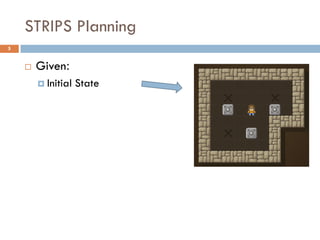
STRIPS Planning
5


       Given:
         Initial   State
STRIPS Planning
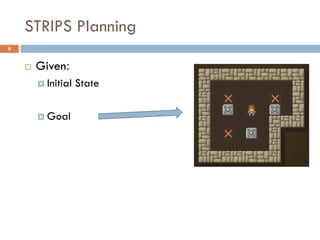
6


       Given:
         Initial   State

         Goal
STRIPS Planning
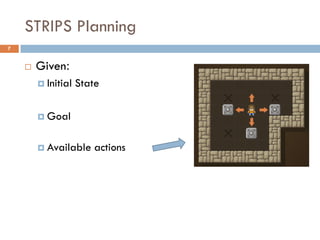
7


       Given:
         Initial   State

         Goal


         Available    actions
STRIPS Planning
8


       Given:
         Initial   State

         Goal


         Available    actions


       Find:
        A  sequence of actions that satisfy the goal
         E.g.: [Left, Down, Left, Up, …]
STRIPS Planning
9


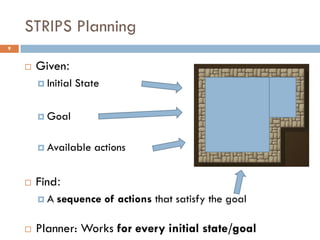
       Given:
         Initial   State

         Goal


         Available    actions


       Find:
        A   sequence of actions that satisfy the goal

       Planner: Works for every initial state/goal
STRIPS Planning
10


        Given:
          Initial   State

          Goal


          Available    actions


        Find:
         A   sequence of actions that satisfy the goal

        Planner: Works for every initial state/goal, domain
Planning Domain Description Language
11


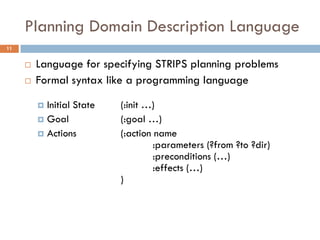
        Language for specifying STRIPS planning problems
        Formal syntax like a programming language

          Initial State   (:init …)
          Goal            (:goal …)
          Actions         (:action name
                                    :parameters (?from ?to ?dir)
                                    :preconditions (…)
                                    :effects (…)
                           )
Planning Domain Description Language
12


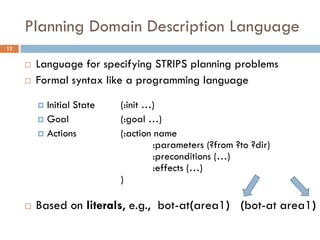
        Language for specifying STRIPS planning problems
        Formal syntax like a programming language

          Initial State   (:init …)
          Goal            (:goal …)
          Actions         (:action name
                                    :parameters (?from ?to ?dir)
                                    :preconditions (…)
                                    :effects (…)
                           )

        Based on literals, e.g., bot-at(area1) (bot-at area1)
Planning Domain Description Language
13


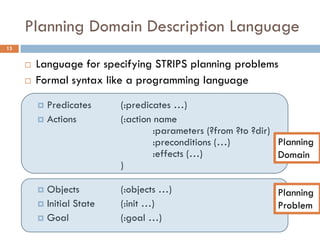
        Language for specifying STRIPS planning problems
        Formal syntax like a programming language

          Predicates      (:predicates …)
          Actions         (:action name
                                    :parameters (?from ?to ?dir)
                                    :preconditions (…)           Planning
                                    :effects (…)                 Domain
                           )

          Objects         (:objects …)                         Planning
          Initial State   (:init …)                            Problem
          Goal            (:goal …)
Planning Domain Description Language
14


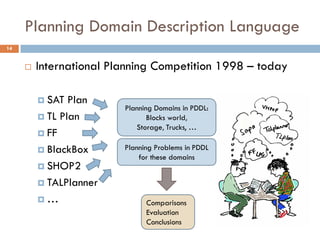
        International Planning Competition 1998 – today

          SAT  Plan
                         Planning Domains in PDDL:
          TL Plan              Blocks world,
                            Storage, Trucks, …
          FF

          BlackBox      Planning Problems in PDDL
                             for these domains
          SHOP2

          TALPlanner

         …                    Comparisons
                               Evaluation
                               Conclusions
Planning Domain Description Language
15


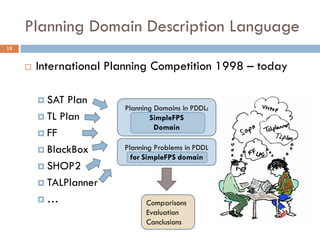
        International Planning Competition 1998 – today

          SAT  Plan
                         Planning Domains in PDDL:
          TL Plan              SimpleFPS
                                  Domain
          FF

          BlackBox      Planning Problems in PDDL
                           for SimpleFPS domain
          SHOP2

          TALPlanner

         …                    Comparisons
                               Evaluation
                               Conclusions
Motivation for SimpleFPS
16


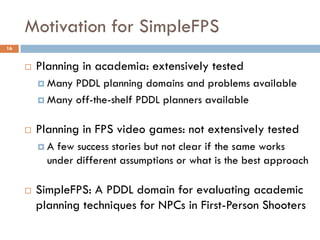
        Planning in academia: extensively tested
          Many PDDL planning domains and problems available
          Many off-the-shelf PDDL planners available


        Planning in FPS video games: not extensively tested
         A  few success stories but not clear if the same works
           under different assumptions or what is the best approach

        SimpleFPS: A PDDL domain for evaluating academic
         planning techniques for NPCs in First-Person Shooters
SimpleFPS
17


        SimpleFPS_PDDL_Domain.txt


        SimpleFPS_PDDL_ProblemGenerator.c
SimpleFPS
18


        SimpleFPS_PDDL_Domain.txt:
          Specifies   the predicates that can be used to describe
           the initial state of the game-world and the goal
           condition for the NPC.
          Specifies a list of available actions that the NPC can
           perform, along with their preconditions and effects in
           terms of the predicates of the domain.

        SimpleFPS_PDDL_ProblemGenerator.c:
         A  tool to generate problem instances, i.e., an initial
           state of the game-world and a goal for the NPC.
SimpleFPS domain
19
SimpleFPS domain
20


        Represent only very simple features:

          Game-world   consists of interconnected areas, each of
           which has a number of points of interest (POIs).

         A few types of items located at POIs (weapons, ammo,
           med-kits, keycards).

          NPC  can perform basic actions (move between areas
           or POIs, pick-up/use items, attack, take cover).
A SimpleFPS problem instance
21


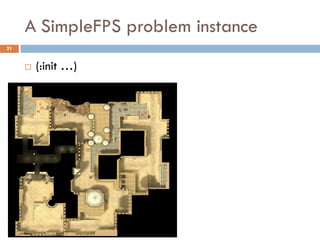
        (:init …)
A SimpleFPS problem instance
22


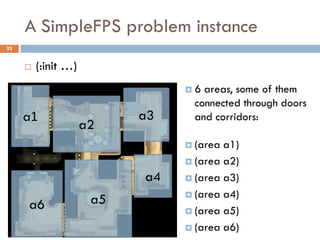
        (:init …)
                                6 areas, some of them
                                 connected through doors
     a1                    a3    and corridors:
                     a2
                                 (area a1)
                                 (area a2)

                           a4    (area a3)

                                 (area a4)
     a6               a5
                                 (area a5)

                                 (area a6)
A SimpleFPS problem instance
23


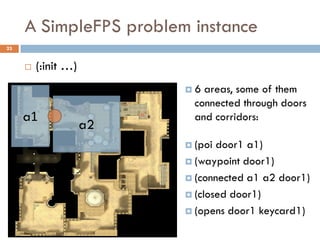
        (:init …)
                          6  areas, some of them
                            connected through doors
     a1                     and corridors:
                     a2
                           (poi door1 a1)
                           (waypoint door1)

                           (connected a1 a2 door1)

                           (closed door1)

                           (opens door1 keycard1)
A SimpleFPS problem instance
24


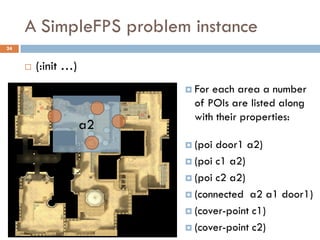
        (:init …)
                           For each area a number
                            of POIs are listed along
                            with their properties:
                     a2
                           (poi door1 a2)
                           (poi c1 a2)

                           (poi c2 a2)

                           (connected a2 a1 door1)

                           (cover-point c1)

                           (cover-point c2)
A SimpleFPS problem instance
25


        (:init …)
                           For each area a number
                            of POIs are listed along
                            with their properties:

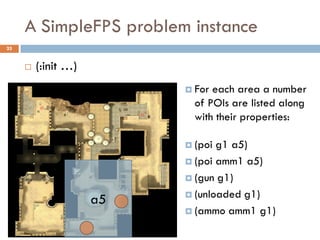
                           (poi g1 a5)
                           (poi amm1 a5)

                           (gun g1)

                           (unloaded g1)
                     a5
                           (ammo amm1 g1)
A SimpleFPS problem instance
26


        (:init …)
                                 For each area a number
                                  of POIs are listed along
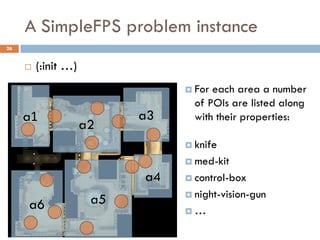
     a1                    a3     with their properties:
                     a2
                                 knife

                                 med-kit

                           a4    control-box

                                 night-vision-gun
     a6               a5
                                …
SimpleFPS domain: Predicates
27


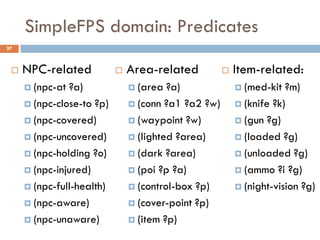
    NPC-related              Area-related             Item-related:
      (npc-at ?a)              (area  ?a)               (med-kit  ?m)
      (npc-close-to ?p)        (conn ?a1 ?a2 ?w)        (knife ?k)

      (npc-covered)            (waypoint ?w)            (gun ?g)
      (npc-uncovered)          (lighted ?area)          (loaded ?g)
      (npc-holding ?o)         (dark ?area)             (unloaded ?g)

      (npc-injured)            (poi ?p ?a)              (ammo ?i ?g)

      (npc-full-health)        (control-box ?p)         (night-vision ?g)

      (npc-aware)              (cover-point ?p)

      (npc-unaware)            (item ?p)
SimpleFPS domain: Actions
28


        (: action …)
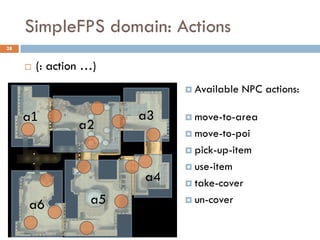
                              Available   NPC actions:

     a1                 a3    move-to-area
                 a2
                              move-to-poi

                              pick-up-item

                              use-item
                        a4    take-cover

     a6            a5         un-cover
SimpleFPS domain: move-to-point
29


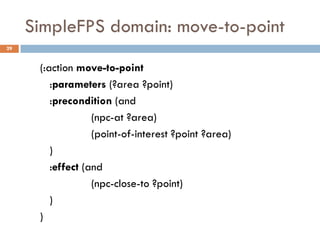
      (:action move-to-point
         :parameters (?area ?point)
         :precondition (and
                   (npc-at ?area)
                   (point-of-interest ?point ?area)
         )
         :effect (and
                   (npc-close-to ?point)
         )
      )
SimpleFPS domain: reload
30


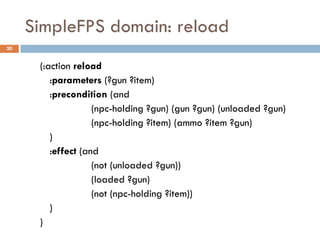
      (:action reload
         :parameters (?gun ?item)
         :precondition (and
                    (npc-holding ?gun) (gun ?gun) (unloaded ?gun)
                    (npc-holding ?item) (ammo ?item ?gun)
         )
         :effect (and
                    (not (unloaded ?gun))
                    (loaded ?gun)
                    (not (npc-holding ?item))
         )
      )
The SimpleFPS domain: Actions
31


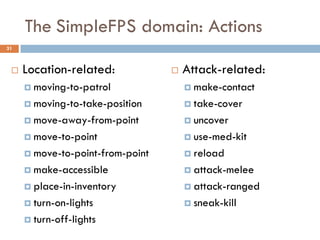
    Location-related:               Attack-related:
      moving-to-patrol                make-contact

      moving-to-take-position         take-cover

      move-away-from-point            uncover

      move-to-point                   use-med-kit

      move-to-point-from-point        reload

      make-accessible                 attack-melee

      place-in-inventory              attack-ranged

      turn-on-lights                  sneak-kill

      turn-off-lights
A SimpleFPS problem instance
32


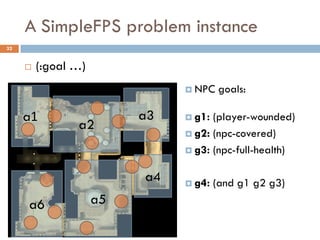
        (:goal …)
                                NPC    goals:

     a1                   a3    g1: (player-wounded)
                a2
                                g2: (npc-covered)

                                g3: (npc-full-health)


                          a4    g4:   (and g1 g2 g3)
     a6              a5
A SimpleFPS problem instance
33

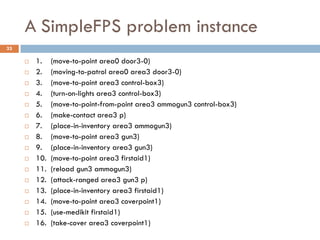
        1.    (move-to-point area0 door3-0)
        2.    (moving-to-patrol area0 area3 door3-0)
        3.    (move-to-point area3 control-box3)
        4.    (turn-on-lights area3 control-box3)
        5.    (move-to-point-from-point area3 ammogun3 control-box3)
        6.    (make-contact area3 p)
        7.    (place-in-inventory area3 ammogun3)
        8.    (move-to-point area3 gun3)
        9.    (place-in-inventory area3 gun3)
        10.   (move-to-point area3 firstaid1)
        11.   (reload gun3 ammogun3)
        12.   (attack-ranged area3 gun3 p)
        13.   (place-in-inventory area3 firstaid1)
        14.   (move-to-point area3 coverpoint1)
        15.   (use-medikit firstaid1)
        16.   (take-cover area3 coverpoint1)
SimpleFPS problem generator
34
SimpleFPS problem generator
35


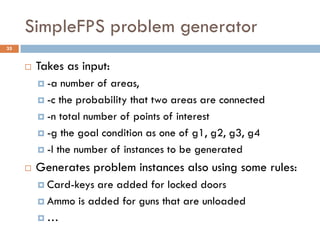
        Takes as input:
          -a  number of areas,
          -c the probability that two areas are connected

          -n total number of points of interest

          -g the goal condition as one of g1, g2, g3, g4

          -l the number of instances to be generated

        Generates problem instances also using some rules:
          Card-keysare added for locked doors
          Ammo is added for guns that are unloaded

         …
Preliminary results with SimpleFPS
36


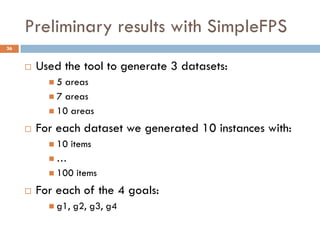
        Used the tool to generate 3 datasets:
           5  areas
            7 areas
            10 areas

        For each dataset we generated 10 instances with:
            10    items
           …
            100    items
        For each of the 4 goals:
            g1,   g2, g3, g4
Preliminary results with SimpleFPS
37


        Used three award-winning planners in these datasets:

          BlackBox   (Kauts and Selman 1999)

          FastForward   (Hoffman 2001)

          FastDownward    (Helmert 2006)


        Laptop specs
Preliminary results with SimpleFPS
38


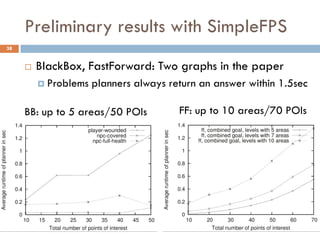
        BlackBox, FastForward: Two graphs in the paper
          Problems   planners always return an answer within 1.5sec

     BB: up to 5 areas/50 POIs          FF: up to 10 areas/70 POIs
Preliminary results with SimpleFPS
39


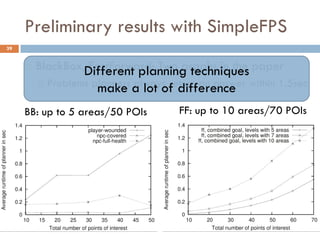
        BlackBox,Different planning techniques paper
                  FastForward: Two graphs in the
          Problems   planners a lot of difference within 1.5sec
                       make always return an answer
     BB: up to 5 areas/50 POIs         FF: up to 10 areas/70 POIs
Preliminary results with SimpleFPS
40


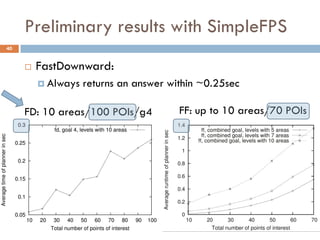
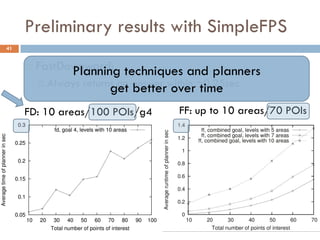
        FastDownward:
          Always   returns an answer within ~0.25sec

     FD: 10 areas/100 POIs/g4           FF: up to 10 areas/70 POIs
Preliminary results with SimpleFPS
41


        FastDownward: techniques and planners
               Planning
          Always   returns an answer within ~0.25sec
                          get better over time
     FD: 10 areas/100 POIs/g4           FF: up to 10 areas/70 POIs
Preliminary results with SimpleFPS
42


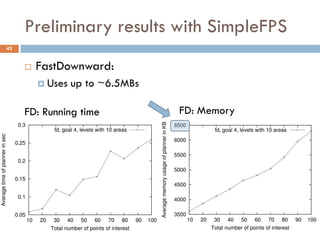
        FastDownward:
          Uses   up to ~6.5MBs

     FD: Running time             FD: Memory
Preliminary results with SimpleFPS
43


        Relatively small-sized problems wrt FPS games:
         7   areas/100 POIs

        The planner takes a lot of resources:
         A  lots of time: ~7 frames to respond using 100% of
           the CPU resources of a laptop
          A lot of memory: ~6.5MB
Preliminary results with SimpleFPS
44


        Relatively small-sized problems wrt FPS games:
         7   areas/100 POIs

        The planner takes a lot of resources:
         A  lots of time: ~7 frames to respond using 100% of
           the CPU resources of a laptop
          A lot of memory: ~6.5MB


        Different assumptions in academia and FPS games
Preliminary results with SimpleFPS
45


        Relatively small-sized problems wrt FPS games:
         7   areas/100 POIs

        The planner takes a lot of resources:
         A  lots of time: ~7 frames to respond using 100% of
           the CPU resources of a laptop
          A lot of memory: ~6.5MB


        Different assumptions in academia and FPS games
          Plan   length up to 20 actions
Conclusions
46


        BB, FF, FD more or less perform as expected:
          One of them performs poorly
          One of them is slow but not too slow

          One of them is good but not good enough for real-time
           planning
Conclusions
47


        BB, FF, FD more or less perform as expected:
          One of them performs poorly
          One of them is slow but not too slow

          One of them is good but not good enough for real-time
           planning
        But this is not necessarily bad news as these
         planners are designed to fulfill different needs:
          Find complete solutions as long lists of actions
          Optimal

          Aim for speed using memory at will
Future work
48


        Search for plans that are:
          not optimal
          not complete


        Take advantage of “propositionalization”
          6.5   MBs is too much for 1 character but how about 100?

        Combine with non-planning approaches for NPCs
         along with minimal planning capabilities
          The   Golog family of languages
The SimpleFPS benchmark
49


        Available at http://stavros.lostre.org/sFPS
          SimpleFPS_PDDL_Domain.txt

          SimpleFPS_PDDL_ProblemGenerator.c

          Datasets   with 5 areas, 7 areas, 10 areas


        Feel free to download and experiment!
        Any feedback is mostly appreciated!

        Email: stavros@cs.toronto.edu

The SimpleFPS Planning Domain: A PDDL Benchmark for Proactive NPCs

  • 1.
    NPCAI-2011: AIIDE Workshopon Non-Player Character AI stavrosv@di.uoa.gr October 2011 The SimpleFPS Planning Domain: A PDDL Benchmark for Proactive NPCs Stavros Vassos Michail Papakonstantinou University of Athens, Greece
  • 2.
    Very brief introduction 2  Focus on first-person shooter (FPS) games and the non-player characters (NPCs) that act against the human player.  Focus on goal-oriented action planning (GOAP) for NPC behavior.
  • 3.
    Very brief introduction 3  Focus on first-person shooter (FPS) games and the non-player characters (NPCs) that act against the human player.  Focus on goal-oriented action planning (GOAP) for NPC behavior.  SimpleFPS is a first step towards evaluating how the existing academic approaches for planning would perform if directly applied in an FPS setting.
  • 4.
    Overview 4  STRIPS planning and PDDL  The SimpleFPS planning domain  Preliminary results using award-winning planners  Conclusions and future work
  • 5.
    STRIPS Planning 5  Given:  Initial State
  • 6.
    STRIPS Planning 6  Given:  Initial State  Goal
  • 7.
    STRIPS Planning 7  Given:  Initial State  Goal  Available actions
  • 8.
    STRIPS Planning 8  Given:  Initial State  Goal  Available actions  Find: A sequence of actions that satisfy the goal  E.g.: [Left, Down, Left, Up, …]
  • 9.
    STRIPS Planning 9  Given:  Initial State  Goal  Available actions  Find: A sequence of actions that satisfy the goal  Planner: Works for every initial state/goal
  • 10.
    STRIPS Planning 10  Given:  Initial State  Goal  Available actions  Find: A sequence of actions that satisfy the goal  Planner: Works for every initial state/goal, domain
  • 11.
    Planning Domain DescriptionLanguage 11  Language for specifying STRIPS planning problems  Formal syntax like a programming language  Initial State (:init …)  Goal (:goal …)  Actions (:action name :parameters (?from ?to ?dir) :preconditions (…) :effects (…) )
  • 12.
    Planning Domain DescriptionLanguage 12  Language for specifying STRIPS planning problems  Formal syntax like a programming language  Initial State (:init …)  Goal (:goal …)  Actions (:action name :parameters (?from ?to ?dir) :preconditions (…) :effects (…) )  Based on literals, e.g., bot-at(area1) (bot-at area1)
  • 13.
    Planning Domain DescriptionLanguage 13  Language for specifying STRIPS planning problems  Formal syntax like a programming language  Predicates (:predicates …)  Actions (:action name :parameters (?from ?to ?dir) :preconditions (…) Planning :effects (…) Domain )  Objects (:objects …) Planning  Initial State (:init …) Problem  Goal (:goal …)
  • 14.
    Planning Domain DescriptionLanguage 14  International Planning Competition 1998 – today  SAT Plan Planning Domains in PDDL:  TL Plan Blocks world, Storage, Trucks, …  FF  BlackBox Planning Problems in PDDL for these domains  SHOP2  TALPlanner … Comparisons Evaluation Conclusions
  • 15.
    Planning Domain DescriptionLanguage 15  International Planning Competition 1998 – today  SAT Plan Planning Domains in PDDL:  TL Plan SimpleFPS Domain  FF  BlackBox Planning Problems in PDDL for SimpleFPS domain  SHOP2  TALPlanner … Comparisons Evaluation Conclusions
  • 16.
    Motivation for SimpleFPS 16  Planning in academia: extensively tested  Many PDDL planning domains and problems available  Many off-the-shelf PDDL planners available  Planning in FPS video games: not extensively tested A few success stories but not clear if the same works under different assumptions or what is the best approach  SimpleFPS: A PDDL domain for evaluating academic planning techniques for NPCs in First-Person Shooters
  • 17.
    SimpleFPS 17  SimpleFPS_PDDL_Domain.txt  SimpleFPS_PDDL_ProblemGenerator.c
  • 18.
    SimpleFPS 18  SimpleFPS_PDDL_Domain.txt:  Specifies the predicates that can be used to describe the initial state of the game-world and the goal condition for the NPC.  Specifies a list of available actions that the NPC can perform, along with their preconditions and effects in terms of the predicates of the domain.  SimpleFPS_PDDL_ProblemGenerator.c: A tool to generate problem instances, i.e., an initial state of the game-world and a goal for the NPC.
  • 19.
  • 20.
    SimpleFPS domain 20  Represent only very simple features:  Game-world consists of interconnected areas, each of which has a number of points of interest (POIs). A few types of items located at POIs (weapons, ammo, med-kits, keycards).  NPC can perform basic actions (move between areas or POIs, pick-up/use items, attack, take cover).
  • 21.
    A SimpleFPS probleminstance 21  (:init …)
  • 22.
    A SimpleFPS probleminstance 22  (:init …) 6 areas, some of them connected through doors a1 a3 and corridors: a2  (area a1)  (area a2) a4  (area a3)  (area a4) a6 a5  (area a5)  (area a6)
  • 23.
    A SimpleFPS probleminstance 23  (:init …) 6 areas, some of them connected through doors a1 and corridors: a2  (poi door1 a1)  (waypoint door1)  (connected a1 a2 door1)  (closed door1)  (opens door1 keycard1)
  • 24.
    A SimpleFPS probleminstance 24  (:init …)  For each area a number of POIs are listed along with their properties: a2  (poi door1 a2)  (poi c1 a2)  (poi c2 a2)  (connected a2 a1 door1)  (cover-point c1)  (cover-point c2)
  • 25.
    A SimpleFPS probleminstance 25  (:init …)  For each area a number of POIs are listed along with their properties:  (poi g1 a5)  (poi amm1 a5)  (gun g1)  (unloaded g1) a5  (ammo amm1 g1)
  • 26.
    A SimpleFPS probleminstance 26  (:init …)  For each area a number of POIs are listed along a1 a3 with their properties: a2  knife  med-kit a4  control-box  night-vision-gun a6 a5 …
  • 27.
    SimpleFPS domain: Predicates 27  NPC-related  Area-related  Item-related:  (npc-at ?a)  (area ?a)  (med-kit ?m)  (npc-close-to ?p)  (conn ?a1 ?a2 ?w)  (knife ?k)  (npc-covered)  (waypoint ?w)  (gun ?g)  (npc-uncovered)  (lighted ?area)  (loaded ?g)  (npc-holding ?o)  (dark ?area)  (unloaded ?g)  (npc-injured)  (poi ?p ?a)  (ammo ?i ?g)  (npc-full-health)  (control-box ?p)  (night-vision ?g)  (npc-aware)  (cover-point ?p)  (npc-unaware)  (item ?p)
  • 28.
    SimpleFPS domain: Actions 28  (: action …)  Available NPC actions: a1 a3  move-to-area a2  move-to-poi  pick-up-item  use-item a4  take-cover a6 a5  un-cover
  • 29.
    SimpleFPS domain: move-to-point 29 (:action move-to-point :parameters (?area ?point) :precondition (and (npc-at ?area) (point-of-interest ?point ?area) ) :effect (and (npc-close-to ?point) ) )
  • 30.
    SimpleFPS domain: reload 30 (:action reload :parameters (?gun ?item) :precondition (and (npc-holding ?gun) (gun ?gun) (unloaded ?gun) (npc-holding ?item) (ammo ?item ?gun) ) :effect (and (not (unloaded ?gun)) (loaded ?gun) (not (npc-holding ?item)) ) )
  • 31.
    The SimpleFPS domain:Actions 31  Location-related:  Attack-related:  moving-to-patrol  make-contact  moving-to-take-position  take-cover  move-away-from-point  uncover  move-to-point  use-med-kit  move-to-point-from-point  reload  make-accessible  attack-melee  place-in-inventory  attack-ranged  turn-on-lights  sneak-kill  turn-off-lights
  • 32.
    A SimpleFPS probleminstance 32  (:goal …)  NPC goals: a1 a3  g1: (player-wounded) a2  g2: (npc-covered)  g3: (npc-full-health) a4  g4: (and g1 g2 g3) a6 a5
  • 33.
    A SimpleFPS probleminstance 33  1. (move-to-point area0 door3-0)  2. (moving-to-patrol area0 area3 door3-0)  3. (move-to-point area3 control-box3)  4. (turn-on-lights area3 control-box3)  5. (move-to-point-from-point area3 ammogun3 control-box3)  6. (make-contact area3 p)  7. (place-in-inventory area3 ammogun3)  8. (move-to-point area3 gun3)  9. (place-in-inventory area3 gun3)  10. (move-to-point area3 firstaid1)  11. (reload gun3 ammogun3)  12. (attack-ranged area3 gun3 p)  13. (place-in-inventory area3 firstaid1)  14. (move-to-point area3 coverpoint1)  15. (use-medikit firstaid1)  16. (take-cover area3 coverpoint1)
  • 34.
  • 35.
    SimpleFPS problem generator 35  Takes as input:  -a number of areas,  -c the probability that two areas are connected  -n total number of points of interest  -g the goal condition as one of g1, g2, g3, g4  -l the number of instances to be generated  Generates problem instances also using some rules:  Card-keysare added for locked doors  Ammo is added for guns that are unloaded …
  • 36.
    Preliminary results withSimpleFPS 36  Used the tool to generate 3 datasets: 5 areas  7 areas  10 areas  For each dataset we generated 10 instances with:  10 items …  100 items  For each of the 4 goals:  g1, g2, g3, g4
  • 37.
    Preliminary results withSimpleFPS 37  Used three award-winning planners in these datasets:  BlackBox (Kauts and Selman 1999)  FastForward (Hoffman 2001)  FastDownward (Helmert 2006)  Laptop specs
  • 38.
    Preliminary results withSimpleFPS 38  BlackBox, FastForward: Two graphs in the paper  Problems planners always return an answer within 1.5sec BB: up to 5 areas/50 POIs FF: up to 10 areas/70 POIs
  • 39.
    Preliminary results withSimpleFPS 39  BlackBox,Different planning techniques paper FastForward: Two graphs in the  Problems planners a lot of difference within 1.5sec make always return an answer BB: up to 5 areas/50 POIs FF: up to 10 areas/70 POIs
  • 40.
    Preliminary results withSimpleFPS 40  FastDownward:  Always returns an answer within ~0.25sec FD: 10 areas/100 POIs/g4 FF: up to 10 areas/70 POIs
  • 41.
    Preliminary results withSimpleFPS 41  FastDownward: techniques and planners Planning  Always returns an answer within ~0.25sec get better over time FD: 10 areas/100 POIs/g4 FF: up to 10 areas/70 POIs
  • 42.
    Preliminary results withSimpleFPS 42  FastDownward:  Uses up to ~6.5MBs FD: Running time FD: Memory
  • 43.
    Preliminary results withSimpleFPS 43  Relatively small-sized problems wrt FPS games: 7 areas/100 POIs  The planner takes a lot of resources: A lots of time: ~7 frames to respond using 100% of the CPU resources of a laptop  A lot of memory: ~6.5MB
  • 44.
    Preliminary results withSimpleFPS 44  Relatively small-sized problems wrt FPS games: 7 areas/100 POIs  The planner takes a lot of resources: A lots of time: ~7 frames to respond using 100% of the CPU resources of a laptop  A lot of memory: ~6.5MB  Different assumptions in academia and FPS games
  • 45.
    Preliminary results withSimpleFPS 45  Relatively small-sized problems wrt FPS games: 7 areas/100 POIs  The planner takes a lot of resources: A lots of time: ~7 frames to respond using 100% of the CPU resources of a laptop  A lot of memory: ~6.5MB  Different assumptions in academia and FPS games  Plan length up to 20 actions
  • 46.
    Conclusions 46  BB, FF, FD more or less perform as expected:  One of them performs poorly  One of them is slow but not too slow  One of them is good but not good enough for real-time planning
  • 47.
    Conclusions 47  BB, FF, FD more or less perform as expected:  One of them performs poorly  One of them is slow but not too slow  One of them is good but not good enough for real-time planning  But this is not necessarily bad news as these planners are designed to fulfill different needs:  Find complete solutions as long lists of actions  Optimal  Aim for speed using memory at will
  • 48.
    Future work 48  Search for plans that are:  not optimal  not complete  Take advantage of “propositionalization”  6.5 MBs is too much for 1 character but how about 100?  Combine with non-planning approaches for NPCs along with minimal planning capabilities  The Golog family of languages
  • 49.
    The SimpleFPS benchmark 49  Available at http://stavros.lostre.org/sFPS  SimpleFPS_PDDL_Domain.txt  SimpleFPS_PDDL_ProblemGenerator.c  Datasets with 5 areas, 7 areas, 10 areas  Feel free to download and experiment!  Any feedback is mostly appreciated!  Email: stavros@cs.toronto.edu