Integrated Technology Design
TELECOMMUNICATION ASSOCIATIONS EIA  (Electronic Industry Association) - The standards address commercial building cabling for telecom products and services. The three standards are formally titled ANSI/TIA/EIA-568-B.1-2001, -B.2-2001, and -B.3-2001.  TIA (Telecommunications Industry Association) – A global trade association headquartered in the United States that represents about 600 companies. TIA helps create universal networking standards for the telephone, data and the convergence of these industries.  BICSI (Building Industry Consulting Services International) - The organization has membership in nearly 100 countries. This organization's certifications are considered the defacto certification for cable installers and designers who specialize in complex voice/data cable layouts.
LICENSING AND CERTIFICATIONS Registered Communications Distribution Designer (RCDD) – Certification through BICSI Telecommunications Infrastructure Layout  Technician (TLT)  - Public Act No. 01-164  of the State of Connecticut
CSI MASTERFORMAT CHANGES In effect 10/04 – MASTERFORMAT 2004 27 00 00 – Communications 27058 Pathways for Communications Systems 270536 Cable Trays for Communications 270544 Sleeves and Seals for Communications Pathways 271100 Communications Equipment Room Fittings 274133 Master Antenna Television Systems (MATV/CATV) 275116 Public Address and Mass Notification Systems 275119 Sound Masking Systems 275123 Intercommunications (Intercom) Systems 275223 Nurse Call-Code Blue Systems 275313 Master Clock Systems 275313 Educational Sound and communications Systems 28 00 00 - Electronic Safety and Security (Access Control / Video Surveillance)
Terminology OLD TERM     NEW TERM TELCO Room (DeMarc)   Entrance Facility (EF) MDF (Main Distribution Frame)   Equipment Room (ER) IDF  (Intermediate Distribution Frame)    Telecom Room  (TR) Tel/Data (Telecommunications)   Information Transport Systems (ITS)
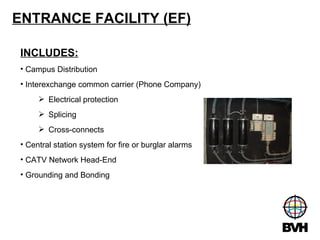
ENTRANCE FACILITY (EF) INCLUDES: Campus Distribution Interexchange common carrier (Phone Company) Electrical protection Splicing Cross-connects Central station system for fire or burglar alarms CATV Network Head-End Grounding and Bonding
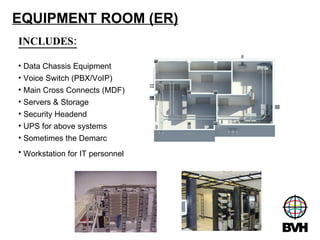
EQUIPMENT ROOM (ER) INCLUDES: Data Chassis Equipment Voice Switch (PBX/VoIP) Main Cross Connects (MDF) Servers & Storage Security Headend UPS for above systems Sometimes the Demarc Workstation for IT personnel
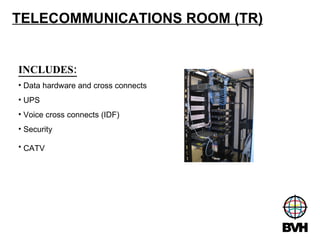
TELECOMMUNICATIONS ROOM (TR) INCLUDES: Data hardware and cross connects UPS Voice cross connects (IDF) Security CATV
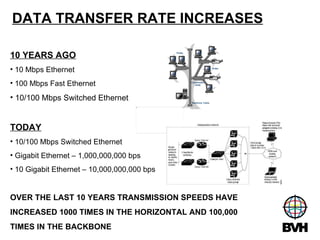
DATA TRANSFER RATE INCREASES 10 YEARS AGO   10 Mbps Ethernet 100 Mbps Fast Ethernet 10/100 Mbps Switched Ethernet TODAY 10/100 Mbps Switched Ethernet Gigabit Ethernet – 1,000,000,000 bps 10 Gigabit Ethernet – 10,000,000,000 bps OVER THE LAST 10 YEARS TRANSMISSION SPEEDS HAVE  INCREASED 1000 TIMES IN THE HORIZONTAL AND 100,000  TIMES IN THE BACKBONE
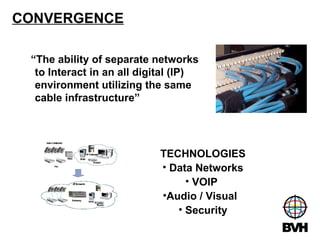
CONVERGENCE “ The ability of separate networks to Interact in an all digital (IP) environment utilizing the same cable infrastructure” TECHNOLOGIES Data Networks VOIP  Audio / Visual  Security
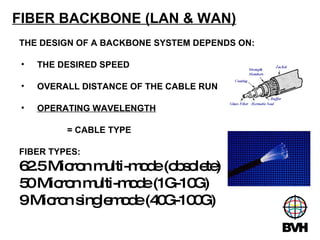
FIBER BACKBONE (LAN & WAN) THE DESIGN OF A BACKBONE SYSTEM DEPENDS ON: THE DESIRED SPEED OVERALL DISTANCE OF THE CABLE RUN OPERATING WAVELENGTH   = CABLE TYPE FIBER TYPES:   62.5 Micron multi-mode (obsolete) 50 Micron multi-mode (1G-10G) 9 Micron singlemode (40G-100G)
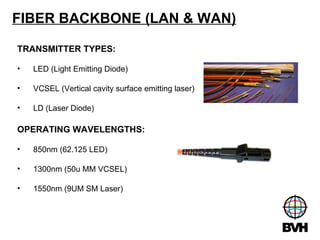
FIBER BACKBONE (LAN & WAN) TRANSMITTER TYPES: LED (Light Emitting Diode) VCSEL (Vertical cavity surface emitting laser) LD (Laser Diode) OPERATING WAVELENGTHS: 850nm (62.125 LED) 1300nm (50u MM VCSEL) 1550nm (9UM SM Laser)
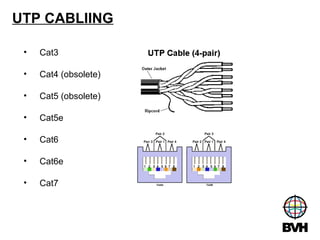
UTP CABLIING Cat3  Cat4 (obsolete) Cat5 (obsolete) Cat5e Cat6 Cat6e Cat7
BANDWIDTH FIBER OPTIC CABLE Fiber Optic Cable bandwidth varies from system to system . The end-to-end bandwidth of a fiber system is related to the respective bandwidths of its component parts. Essential elements of end-to-end bandwidth are: Transmitter (type and wavelength) Fiber Optic Cable (distance) COPPER 15 YEARS AGO   Cat3 – 16 Mhz (Telephone) Cat4 – 20 Mhz (obsolete) Cat5 – 100 Mhz (obsolete) TODAY Cat5e – 100 Mhz+ (VoIP) Cat6 – 200 Mhz (Gigabit) Cat6A – 550 Mhz (10Gigabit)) Cat7 – 600 to 700 Mhz (M.Media)
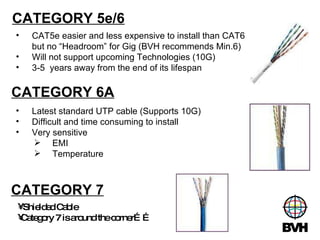
CATEGORY 5e/6 CAT5e easier and less expensive to install than CAT6 but no “Headroom” for Gig (BVH recommends Min.6) Will not support upcoming Technologies (10G) 3-5  years away from the end of its lifespan Latest standard UTP cable (Supports 10G) Difficult and time consuming to install Very sensitive  EMI Temperature CATEGORY 6A CATEGORY 7 Shielded Cable Category 7 is around the corner……
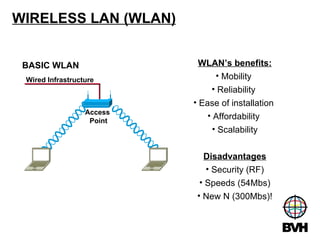
WIRELESS LAN (WLAN) BASIC WLAN WLAN’s benefits: Mobility  Reliability  Ease of installation  Affordability  Scalability Disadvantages Security (RF) Speeds (54Mbs) New N (300Mbs)! Access  Point Wired Infrastructure
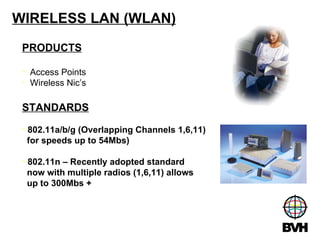
WIRELESS LAN (WLAN) PRODUCTS Access Points Wireless Nic’s STANDARDS 802.11a/b/g (Overlapping Channels 1,6,11) for speeds up to 54Mbs) 802.11n – Recently adopted standard now with multiple radios (1,6,11) allows up to 300Mbs +
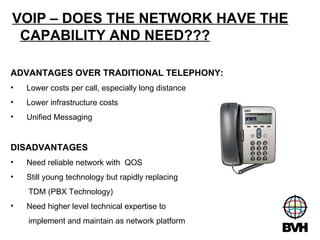
VOIP – DOES THE NETWORK HAVE THE CAPABILITY AND NEED??? ADVANTAGES OVER TRADITIONAL TELEPHONY: Lower costs per call, especially long distance Lower infrastructure costs Unified Messaging DISADVANTAGES  Need reliable network with  QOS Still young technology but rapidly replacing TDM (PBX Technology) Need higher level technical expertise to implement and maintain as network platform
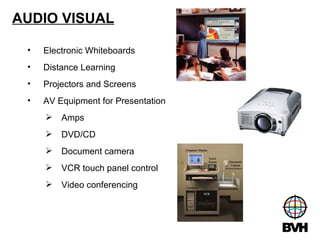
AUDIO VISUAL Electronic Whiteboards Distance Learning Projectors and Screens AV Equipment for Presentation Amps DVD/CD Document camera VCR touch panel control  Video conferencing
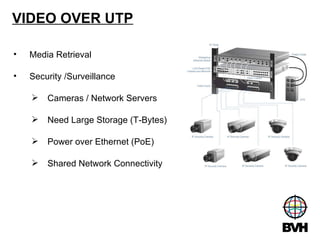
VIDEO OVER UTP Media Retrieval Security /Surveillance Cameras / Network Servers Need Large Storage (T-Bytes) Power over Ethernet (PoE) Shared Network Connectivity
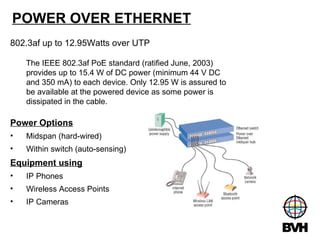
POWER OVER ETHERNET 802.3af up to 12.95Watts over UTP The IEEE 802.3af PoE standard (ratified June, 2003) provides up to 15.4 W of DC power (minimum 44 V DC and 350 mA) to each device. Only 12.95 W is assured to be available at the powered device as some power is dissipated in the cable. Power Options Midspan (hard-wired) Within switch (auto-sensing) Equipment using IP Phones Wireless Access Points IP Cameras
ITS NOT “JUST A WIRE” ANYMORE TODAYS TECHNOLOGIES IMPACT THE CABLE INFRASTRUCTURE: Gbe (Horizontal and Backbone) 10Gbe (Horizontal and Backbone) Power over Ethernet Voice Over I.P. = ADDITIONAL PATHWAYS, SPACES AND RACK SPACE!!! * The ENTIRE Cable Infrastructure Can Only Run As Fast As Its Weakest Link
SUMMARIZE TODAYS TECHNOLOGIES IMPACT THE ENTIRE CABLE INFRASTRUCTURE CAREFUL PLANNING IS REQUIRED  FUTURE TECHNOLOGIES CAN RUN SEAMLESSLY OVER A STANDARS-BASED CABLE INFRASTRUCTURE!
Q&A THANK YOU!

Network Technology Presentation Bvh V01

  • 1.
  • 2.
    TELECOMMUNICATION ASSOCIATIONS EIA (Electronic Industry Association) - The standards address commercial building cabling for telecom products and services. The three standards are formally titled ANSI/TIA/EIA-568-B.1-2001, -B.2-2001, and -B.3-2001. TIA (Telecommunications Industry Association) – A global trade association headquartered in the United States that represents about 600 companies. TIA helps create universal networking standards for the telephone, data and the convergence of these industries. BICSI (Building Industry Consulting Services International) - The organization has membership in nearly 100 countries. This organization's certifications are considered the defacto certification for cable installers and designers who specialize in complex voice/data cable layouts.
  • 3.
    LICENSING AND CERTIFICATIONSRegistered Communications Distribution Designer (RCDD) – Certification through BICSI Telecommunications Infrastructure Layout Technician (TLT) - Public Act No. 01-164 of the State of Connecticut
  • 4.
    CSI MASTERFORMAT CHANGESIn effect 10/04 – MASTERFORMAT 2004 27 00 00 – Communications 27058 Pathways for Communications Systems 270536 Cable Trays for Communications 270544 Sleeves and Seals for Communications Pathways 271100 Communications Equipment Room Fittings 274133 Master Antenna Television Systems (MATV/CATV) 275116 Public Address and Mass Notification Systems 275119 Sound Masking Systems 275123 Intercommunications (Intercom) Systems 275223 Nurse Call-Code Blue Systems 275313 Master Clock Systems 275313 Educational Sound and communications Systems 28 00 00 - Electronic Safety and Security (Access Control / Video Surveillance)
  • 5.
    Terminology OLD TERM NEW TERM TELCO Room (DeMarc) Entrance Facility (EF) MDF (Main Distribution Frame) Equipment Room (ER) IDF (Intermediate Distribution Frame) Telecom Room (TR) Tel/Data (Telecommunications) Information Transport Systems (ITS)
  • 6.
    ENTRANCE FACILITY (EF)INCLUDES: Campus Distribution Interexchange common carrier (Phone Company) Electrical protection Splicing Cross-connects Central station system for fire or burglar alarms CATV Network Head-End Grounding and Bonding
  • 7.
    EQUIPMENT ROOM (ER)INCLUDES: Data Chassis Equipment Voice Switch (PBX/VoIP) Main Cross Connects (MDF) Servers & Storage Security Headend UPS for above systems Sometimes the Demarc Workstation for IT personnel
  • 8.
    TELECOMMUNICATIONS ROOM (TR)INCLUDES: Data hardware and cross connects UPS Voice cross connects (IDF) Security CATV
  • 9.
    DATA TRANSFER RATEINCREASES 10 YEARS AGO 10 Mbps Ethernet 100 Mbps Fast Ethernet 10/100 Mbps Switched Ethernet TODAY 10/100 Mbps Switched Ethernet Gigabit Ethernet – 1,000,000,000 bps 10 Gigabit Ethernet – 10,000,000,000 bps OVER THE LAST 10 YEARS TRANSMISSION SPEEDS HAVE INCREASED 1000 TIMES IN THE HORIZONTAL AND 100,000 TIMES IN THE BACKBONE
  • 10.
    CONVERGENCE “ Theability of separate networks to Interact in an all digital (IP) environment utilizing the same cable infrastructure” TECHNOLOGIES Data Networks VOIP Audio / Visual Security
  • 11.
    FIBER BACKBONE (LAN& WAN) THE DESIGN OF A BACKBONE SYSTEM DEPENDS ON: THE DESIRED SPEED OVERALL DISTANCE OF THE CABLE RUN OPERATING WAVELENGTH = CABLE TYPE FIBER TYPES: 62.5 Micron multi-mode (obsolete) 50 Micron multi-mode (1G-10G) 9 Micron singlemode (40G-100G)
  • 12.
    FIBER BACKBONE (LAN& WAN) TRANSMITTER TYPES: LED (Light Emitting Diode) VCSEL (Vertical cavity surface emitting laser) LD (Laser Diode) OPERATING WAVELENGTHS: 850nm (62.125 LED) 1300nm (50u MM VCSEL) 1550nm (9UM SM Laser)
  • 13.
    UTP CABLIING Cat3 Cat4 (obsolete) Cat5 (obsolete) Cat5e Cat6 Cat6e Cat7
  • 14.
    BANDWIDTH FIBER OPTICCABLE Fiber Optic Cable bandwidth varies from system to system . The end-to-end bandwidth of a fiber system is related to the respective bandwidths of its component parts. Essential elements of end-to-end bandwidth are: Transmitter (type and wavelength) Fiber Optic Cable (distance) COPPER 15 YEARS AGO Cat3 – 16 Mhz (Telephone) Cat4 – 20 Mhz (obsolete) Cat5 – 100 Mhz (obsolete) TODAY Cat5e – 100 Mhz+ (VoIP) Cat6 – 200 Mhz (Gigabit) Cat6A – 550 Mhz (10Gigabit)) Cat7 – 600 to 700 Mhz (M.Media)
  • 15.
    CATEGORY 5e/6 CAT5eeasier and less expensive to install than CAT6 but no “Headroom” for Gig (BVH recommends Min.6) Will not support upcoming Technologies (10G) 3-5 years away from the end of its lifespan Latest standard UTP cable (Supports 10G) Difficult and time consuming to install Very sensitive EMI Temperature CATEGORY 6A CATEGORY 7 Shielded Cable Category 7 is around the corner……
  • 16.
    WIRELESS LAN (WLAN)BASIC WLAN WLAN’s benefits: Mobility Reliability Ease of installation Affordability Scalability Disadvantages Security (RF) Speeds (54Mbs) New N (300Mbs)! Access Point Wired Infrastructure
  • 17.
    WIRELESS LAN (WLAN)PRODUCTS Access Points Wireless Nic’s STANDARDS 802.11a/b/g (Overlapping Channels 1,6,11) for speeds up to 54Mbs) 802.11n – Recently adopted standard now with multiple radios (1,6,11) allows up to 300Mbs +
  • 18.
    VOIP – DOESTHE NETWORK HAVE THE CAPABILITY AND NEED??? ADVANTAGES OVER TRADITIONAL TELEPHONY: Lower costs per call, especially long distance Lower infrastructure costs Unified Messaging DISADVANTAGES Need reliable network with QOS Still young technology but rapidly replacing TDM (PBX Technology) Need higher level technical expertise to implement and maintain as network platform
  • 19.
    AUDIO VISUAL ElectronicWhiteboards Distance Learning Projectors and Screens AV Equipment for Presentation Amps DVD/CD Document camera VCR touch panel control Video conferencing
  • 20.
    VIDEO OVER UTPMedia Retrieval Security /Surveillance Cameras / Network Servers Need Large Storage (T-Bytes) Power over Ethernet (PoE) Shared Network Connectivity
  • 21.
    POWER OVER ETHERNET802.3af up to 12.95Watts over UTP The IEEE 802.3af PoE standard (ratified June, 2003) provides up to 15.4 W of DC power (minimum 44 V DC and 350 mA) to each device. Only 12.95 W is assured to be available at the powered device as some power is dissipated in the cable. Power Options Midspan (hard-wired) Within switch (auto-sensing) Equipment using IP Phones Wireless Access Points IP Cameras
  • 22.
    ITS NOT “JUSTA WIRE” ANYMORE TODAYS TECHNOLOGIES IMPACT THE CABLE INFRASTRUCTURE: Gbe (Horizontal and Backbone) 10Gbe (Horizontal and Backbone) Power over Ethernet Voice Over I.P. = ADDITIONAL PATHWAYS, SPACES AND RACK SPACE!!! * The ENTIRE Cable Infrastructure Can Only Run As Fast As Its Weakest Link
  • 23.
    SUMMARIZE TODAYS TECHNOLOGIESIMPACT THE ENTIRE CABLE INFRASTRUCTURE CAREFUL PLANNING IS REQUIRED FUTURE TECHNOLOGIES CAN RUN SEAMLESSLY OVER A STANDARS-BASED CABLE INFRASTRUCTURE!
  • 24.

Editor's Notes

  • #3 ANSI - The American National Standards Institute (ANSI) is a private, non-profit organization that administers and coordinates the standardization and conformity assessment system. Founded in Oct. of 1918. EIA – Electronic Industries Alliance is a national trade organization that includes the partnership of electronic and high-tech associations and companies. 2,500 member companies like Cisco 3Com Nortel etc. TIA – Telecommunications Industry Associations - represents the providers of communications and information technology products and services. They write the telecommunication standards with EIA. Formed in 1988. BICSI (Buidling INDUSTRY CONSULTING SERVICES INTERNATIONAL) WRITES THE TELECOMMUNICATIONS INDUSTRY DESIGN STANDARDS AND PROVIDES TRAINING AND MANY CERTIFICATIONS WITHIN THE INDUSTRY . FOUNDED IN 1974, CURRENTLY OVER 25000 MEMBER IN 90+ COUNTRIES
  • #4 RCDD – AN RCDD has attained exceptional excellence in the telecom industry and the RCDD designation is recognized industry-wide as indicating superior design expertise. RCDDs must attain CEC to stay ahead of any technology changes. Other BICSI Certification OSP NTS Installer TLT - An act concerning telecommunications infrastructure layout technicians and the registration of employees of telecommunications providers. First of four states (Connecticut, Minnesota, New Jersey and Rhode Island) in the USA to be licensed for design. The TLT license gives the RCDD the ability to stamp telecommunication drawings.
  • #5 To ensure that telecommunication systems are "designed into" a building during the design phase of the project versus the more traditional method of "retrofitting" it into the building 25 – Integrated Automation Terminal Devices for Facility equip., fire suppression systems, plumbing, HVAC, Electrical, Communication 27 – Communication Structure Cabling including horizontal and backbone Data communication hardware and network equipment including peripherals and software Voice communication hardware AV communications systems 28 - Electronic Safety and Security Intrusion Detection Access Control Electronic Surveillance ALL OF ABOVE IS LOCATED IN FACILITY SERVICES SUBGROUP ALONG WITH HVAC PLUMBING AND ELECTRICAL
  • #6 With the previous Maserformat changes the industry has changed the following terms. MDF and IDF old AT&T terms The reason for changing the phrase telecommunications is its no longer just voice and data running over the low voltage cable infrastructure.
  • #7 NOW LETS TALK ABOUT THE 3 MAIN ROOMS FOR TELECOMMUNICATION EQUIPMENT AND CABLING Local Area Network and Private Branch Exchange (PBX)
  • #8 1. MER housed equipment that serves the entire organization or building. The equipment within the MER is very complex in nature.
  • #9 THE ITR HOUSES EQUIPMENT THAT IS FLOOR SERVING ONLY
  • #10 NOW LETS TALK ABOUT HOW INFO IS TRANSFERRED OVER THE FIBER. DATA TRANSFER RATE IS THE AMOUNT OF DATA THAT CAN TRAVEL FROM ONE POINT TO ANOTHER, ITS EXPRESSED IN BITS PER SECOND AND REFERS PRIMARILY TO THE CAPABILITY OF THE ELECTRONICS MEGA – MILLION GIGA - BILLION 40 Gbe IS AROUND THE CORNER WITH THESE SPEED INCREASES IT’S GOTTEN TO THE POINT THAT TECHNOLOGIES ARE REALLY PUSHING THE LIMITS OF THE FIBER OPTIC CABLE. NOTE – TECHNOLOGY USUALLY INCREASES 10X
  • #11 Integrating data, email, fax, voice and video-conferencing into one network is the basis of convergence technologies. Benefits of Convergence ONE NETWORK – NO NEED TO MANAGE SEPARATE VDV NETWORK WHICH PRESENTS COST SAVINGS. ONE IT DEPT. COST EFFICIENT SERVICES FLEXIBILITY DESIGNERS NEED TO BE AWARE THAT SOME CONVERGED TECHNOLOGIES WILL NOT RUN WITH SOME OF THE CURRENT TRANSMISSION PROTOCOLS
  • #12 Let now talk about the types of cabling and whats run over them. FIBER DISTANCES CAN RANGE FROM 10 METERS TO 10 KILOMETERS SO THE PROPER SELECTION OF F/O CABLE WITH RESPECT TO NETWORK SPEEDS IS A MAJOR CONSIDERATION.
  • #13 AS DISCUSSED ON THE LAST SLIDE THE TRANSMITTER TYPE AND THE TRANSMITTED WAVELENGTH EFFECT THE FIBER DISTANCE CAPABILITIES TRANSMITTER CONVERTS ELECTRICAL SIGNAL TO LIGHT THE TRANSMITTERS EMIT LIGHT AT A SPECIFIC WAVELENGTH. THE HIGHER THE WAVELENGTH THE FURTHER THE DISTANCE AND MORE BANDWIDTH IS AVAILABLE.
  • #14 Cat3 still used for voice – primarily in the horizontal Cat5 is now obsolete CAT5e Very large installed base – Contractor knowledgeable Quick terminations and testing LESS STRINGENT INSTALLATION REQUIREMENTS Capable of running Gbe Cannot handle 10Gbe Will not be manufactured, both cable or connector Will become obsolete when 7 is standardized
  • #15 BANDWIDTH IS THE INFORMATION CARRYING CAPACITY OF A SYSTEM AND IS MEASURED IN Mhz. FIBER – BANDWIDTH IS A EXTREMELY COMPLEX MATHMATICAL EQUATION COPPER – YOU GET WHAT YOU GET WITH COPPER, THE BANDWIDTH OF COPPER IS REALLY PUSHED TO THE LIMITS WITH TODAYS TECHNOLOGIES SPEEDS ARE INCREASING MORE RAPIDLY THAN THE BANDWIDTH CAN ACCOMODATE, THUS PUSHING THE CABLE INFRASTRUCTURE TO ITS LIMITS
  • #16 The minimum standard compliant cable today CAT5e Very large installed base – Contractor knowledgeable Quick terminations and testing LESS STRINGENT INSTALLATION REQUIREMENTS Capable of running Gbe Cannot handle 10Gbe Will not be manufactured, both cable or connector Will become obsolete when 7 is standardized
  • #17 NOW LETS GET INTO SOME OF THE NEWER TECHNOLOGIES A Wireless LAN (WLAN) is a grouping of network components connected by electromagnetic (radio) waves instead of wires. Mobile- you can move around reliable - fewer wires and connectors means fewer problems ease of install - fewer cables to install, one cable per access point location affordability - installation and product life cost are lower scalability - easily configured and rearranged to meet many settings and # of users SECURITY – INFORMATION IS IN THE AIR AND HACKERS ARE FREE TO ACCESS IT. SPEEDS - SLOW AND SHARED
  • #18 802.11a 54 Mbps at the 5Ghz frequency – SAME AS CORDLESS PHONES 8 separate non overlapping channels 802.11b 11 Mbps at the 2.4 Ghz frequency 3 nonoverlapping chanells 11a and 11b are not compatible, separate networks 802.11g – NEWEST TECHNOLOGY Extension of 11b STANDARD 54 Mbps at the 2.4 Ghz frequency Backward compatible with 11b meaning device with a 11b card will interface with an 11g access point at 11 Mbps or lower 802.11n Standard end of 05 early 06 Product mid 06 100 Mbps or faster Spread sprectrum Frequency hopping
  • #19 QOS - DEFINE NEEDED WITHIN THE DATA HARDWARE INFRASTRUCTURE COSTLY UPGRADE ADVANTAGES LOWER COSTS PER CALL - IP TELEPHONY / BUILDING TO BUILDING LOWER INFRSTRUCTURE COSTS ONE CABLE INFRASTRUCTURE MOVES ADDS AND CHANGES ARE VERY SIMPLE – THE PHONES HAVE IP ADDRESS UNIFIED MESSAGING CONNECTS WORKERS TO VOICE MAIL, EMAIL, FAX WHENEVER THEY NEED THEM FROM ANY DEVICE, CELL PHONE, PDA, LAPTOP DISADVANTAGES: VERY DIFFICULT IMPLEMENTATION NETWORK OUTAGES VIRUS PROBLEMS OTHER TECHNOLOGIES WILL NOT RUN WITH VOIP Gbe AND 10Gbe
  • #20 WHITEBOARDS DIFFERENT CONNECTOR TYPES PER MANUFACTURER DIFFERENT MOUNTING ARRANGMENTS THAT EFFECT THE LOCATION ON THE PRESENTATION WALL DISTANCE LEARNING REQUIRES HIGH SPEED WAN CONNECTIVITY HIGH TECH VIDEO AND SOUND SYSTEMS PROJECTORS TODAYS PROJECTORS CAN BE NETWORKED FOR CATV AND VIDEO PRESENTATION. THEY ALSO HAVE THE CAPABILITY OF REMOTE MONIORING AND EMAIL NOTIFICATION.
  • #21 MEDIA RETRIEVAL SYSTEM – VIDEO HEADEND SYSTEM WITH THE CAPABILITY OF TRANSMITTING CD/DVD OR BROADCAST VIDEO OVER THE UTP INFRASTRUCTURE. LARGE A/V ROOM FULL OF EQUIPMENT. IN A SCHOOL ENVIRONMENT THE PRINCIPAL CAN MAKE MORNING MESSAGES OVER THE TV OR PROJECTOR, VCR AND DVD’s ARE NOT REQUIRED IN ANY CLASSROOMS SECURITY TODAYS CAMERAS ARE RUN OVER THE UTP INFRASTRUCTURE GIVING THEM THE CAPABILITY OF UTULIZING POWER OVER ETHERNET NETWORK CONNECTIVITY GIVES THE SECURITY STAFF ACCESS TO THE MEDIA RETRIEVAL SYSTEM AND DVR”s. RECORDING IS DONE ON THE HARD DRIVE, IS EASIER AND QUICKER TO ACCESS THAN A VHS TAPE SPECIALTY SYSTEMS - EXPLAIN
  • #22 THE ABILITY TO RUN POWER OVER 2 OF THE PAIRS OF THE UTP CABLE Midspan – a separate device injects power onto the unused pair UP TO 48 VOLTS
  • #23 10 YEARS AGO THROWING IN A CAT5 UTP CABLE WOULD BE SUFFICIENT TO HANDLE THE TRANSMISSION SPEEDS AND TECHNOLOGIES OF THE DAY. THE DESIGNER NEEDS TO BE AWARE OF WHAT TECHNOLOGIES ARE TO BE RUN ON THE CABLE INFRASTRUCTURE BECAUSE CERTAIN TECHNOLOGIES ARE NOT COMPATIBLE AND IF THEY DO NOT HAVE THE APPROPRIATE CABLE AND OR ELECTRONICS THE SYSTEM WILL NOT FUNCTION AS DESIRED VARYING DISTANCES WITHIN THE BACKBONE AND CAMPUS ENVIRONMENTS 3 WINDOWS OF TRANSMISSION THEY BOTH UTULIZE ALL 4 PAIRS OF THE UTP CABLE UTULIZES THE 2 UNUSED PAIRS YOU CAN’T RUN GBE OR HIGHER IN THE HORIZONTAL VOIP CANT RUN GBE OR HIGHER EFFECTS BACKBONE DESIGN (NO COPPER BACKBONE)