DR. C. V. RAMAN UNIVERSITY
KARGI ROAD KOTA BILASPUR (C.G.)
2014-15
Presentation On:
INTRODUCTION
 WiMAX:
“Worldwide Interoperability for Microwave Access”
supports point to multi-point (PMP) broadband wireless
access.
 WiMAX is basically a new shorthand term for IEEE
Standard 802.16.
 The IEEE wireless standard has a range of up to 30
miles or 50 kilometers.
WiMAX COVERAGE
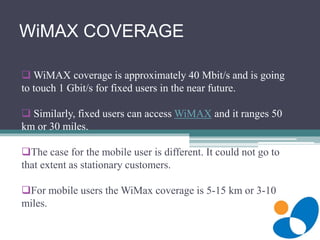
 WiMAX coverage is approximately 40 Mbit/s and is going
to touch 1 Gbit/s for fixed users in the near future.
 Similarly, fixed users can access WiMAX and it ranges 50
km or 30 miles.
The case for the mobile user is different. It could not go to
that extent as stationary customers.
For mobile users the WiMax coverage is 5-15 km or 3-10
miles.
EVOLUTION OF IEEE 802.16
STANDARDS
• Evolution of IEEE family of standard for BWA
The standard provides secification for PHY and MAC layer
IEEE 802.16-2001
ᴥ fixed BWA access in a point-to-point (PTP) topology.
ᴥ Single carrier modulation
ᴥ 10-66 GHz frequency range
ᴥ Connection oriented
6
EVOLUTION contd..
IEEE 802.16a
ᴥ Added physical layer support for 2-11 GHz
ᴥ NLOS operation becomes possible
ᴥ OFDM included as an alternative to single carrier modulation
IEEE 802.16-2004
ᴥ 2-11 GHZ frequency range
ᴥ 256 subcarriers OFDM Technique
ᴥ Fixed and Nomadic access
IEEE 802.16e
ᴥ Scalable OFDMA
ᴥ Mobile BWA
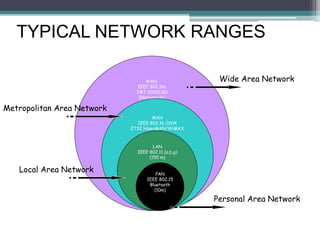
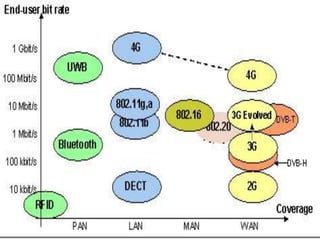
WAN
IEEE 802.16e
IMT-2000(3G)
(Nationwide)
MAN
IEEE 802.16-2004
ETSI HiperMAN/WiMAX
(50 Km)
LAN
IEEE 802.11 (a,b,g)
(150 m)
PAN
IEEE 802.15
Bluetooth
(10m)
TYPICAL NETWORK RANGES
Wide Area Network
Metropolitan Area Network
Local Area Network
Personal Area Network
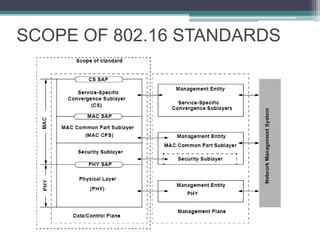
SCOPE OF 802.16 STANDARDS
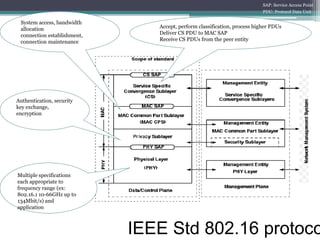
SAP: Service Access Point
PDU: Protocol Data Unit
Accept, perform classification, process higher PDUs
Deliver CS PDU to MAC SAP
Receive CS PDUs from the peer entity
System access, bandwidth
allocation
connection establishment,
connection maintenance
Authentication, security
key exchange,
encryption
IEEE Std 802.16 protoco
Multiple specifications
each appropriate to
frequency range (ex:
802.16.1 10-66GHz up to
134Mbit/s) and
application
IEEE 802.16 SPECIFICATIONS
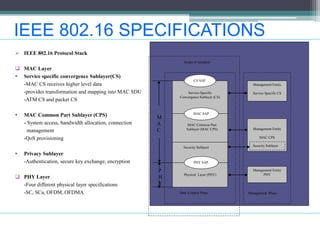
 IEEE 802.16 Protocol Stack
 MAC Layer
 Service specific convergence Sublayer(CS)
-MAC CS receives higher level data
-provides transformation and mapping into MAC SDU
-ATM CS and packet CS
 MAC Common Part Sublayer (CPS)
- System access, bandwidth allocation, connection
management
-QoS provisioning
 Privacy Sublayer
-Authentication, secure key exchange, encryption
 PHY Layer
-Four different physical layer specifications
-SC, SCa, OFDM, OFDMA
Service-Specific
Convergence Sublayer (CS)
MAC Common Part
Sublayer (MAC CPS)
Security Sublayer
Physical Layer (PHY)
CS SAP
PHY SAP
MAC SAP
Data /Control Plane
P
H
Y
M
A
C
Scope of standard
Management Entity
Service Specific CS
Management Entity
MAC CPS
Security Sublayer
Management Entity
PHY
Management Plane
IEEE 802.16 SPECIFICATIONS
Cont. .
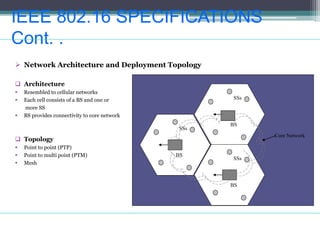
 Network Architecture and Deployment Topology
 Architecture
 Resembled to cellular networks
 Each cell consists of a BS and one or
more SS
 BS provides connectivity to core network
 Topology
 Point to point (PTP)
 Point to multi point (PTM)
 Mesh
BS
SSs
BS
SSs
BS
SSs
Core Network
WiMAX
WiMAX
WiMAX
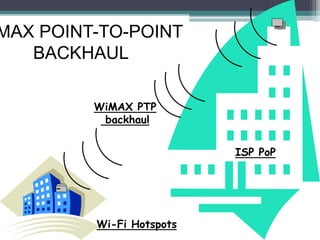
ISP PoP
Wi-Fi Hotspots
WiMAX PTP
backhaul
MAX POINT-TO-POINT
BACKHAUL
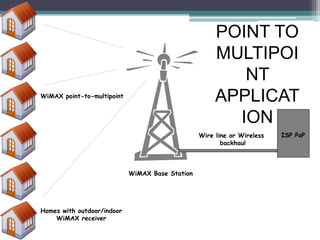
ISP PoPWire line or Wireless
backhaul
WiMAX Base Station
WiMAX point-to-multipoint
Homes with outdoor/indoor
WiMAX receiver
POINT TO
MULTIPOI
NT
APPLICAT
ION
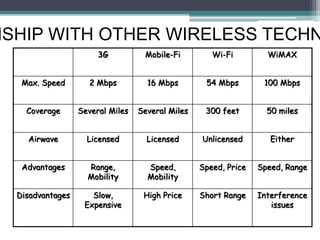
NSHIP WITH OTHER WIRELESS TECHN
3G Mobile-Fi Wi-Fi WiMAX
Max. Speed 2 Mbps 16 Mbps 54 Mbps 100 Mbps
Coverage Several Miles Several Miles 300 feet 50 miles
Airwave Licensed Licensed Unlicensed Either
Advantages Range,
Mobility
Speed,
Mobility
Speed, Price Speed, Range
Disadvantages Slow,
Expensive
High Price Short Range Interference
issues
ADVANTAGES & SECURITY
ISSUES
•HIGH SPEED
•COVERAGE
•MULTI-FUNCTIONALITY
• FLEXIBLE INFRASTRUCTURE
•MESH TOPOLOGY
•SECURITY:
1 .DES (Data Encryption Standard) or AES (Advanced Encryption
Standard)
2. PKM ( Privacy Key Management) protocol
DRAWBACKS
• Line-of-Sight is required for long distance (5-30 mile)
connections.
• Heavy rains can disrupt the service.
• Other wireless electronics in the vicinity can interfere
with the WiMAX connection and cause a reduction in
data throughput or even a total disconnect.
• Network complex security issue.
• Not many areas have 4G service yet.
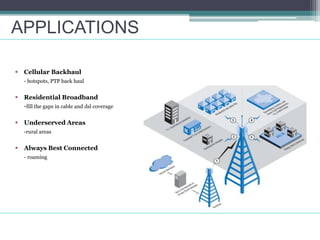
APPLICATIONS
 Cellular Backhaul
- hotspots, PTP back haul
 Residential Broadband
-fill the gaps in cable and dsl coverage
 Underserved Areas
-rural areas
 Always Best Connected
- roaming
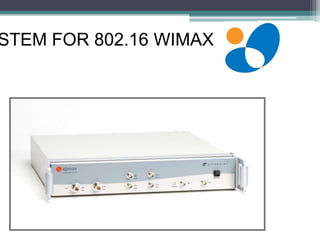
STEM FOR 802.16 WIMAX
CONCLUSION
 WiMAX will no doubt be a viable alternative to DSL
and cable connections.
 There more than 150 commercial trials WiMAX
network deployments have taken place worldwide.
 In January 2006, Samsung revealed its WiMAX
enabled M8000 handset, which connects directly to
WiMAX base stations through 802.16e.
 It will have stiff competition with already establish
broadband access technology (DSL & cable modem).
 WiMAX is the future of ‘WBA technology’.
FUTURE SCOPE
• There are some good reasons for 4G development and a
variety of current and evolving technologies to make WiMAX
a reality.
FUTURE SCOPE
• MBWA is a technology developed by IEEE 802.20 for
true WBA or 4G.
• ‘Broadband Wireless’ internet access via hotspots on
hotels, airports, convention centre, coffee shops,
restaurants etc. is a fast growing trend.
Surabhi Vaishnav
M. Tech - DC
(1st Semester, ECE
Discipline)
Presented by:
Presentation On "Wi-Max Technology"

Presentation On "Wi-Max Technology"

  • 1.
    DR. C. V.RAMAN UNIVERSITY KARGI ROAD KOTA BILASPUR (C.G.) 2014-15
  • 2.
  • 3.
    INTRODUCTION  WiMAX: “Worldwide Interoperabilityfor Microwave Access” supports point to multi-point (PMP) broadband wireless access.  WiMAX is basically a new shorthand term for IEEE Standard 802.16.  The IEEE wireless standard has a range of up to 30 miles or 50 kilometers.
  • 4.
    WiMAX COVERAGE  WiMAXcoverage is approximately 40 Mbit/s and is going to touch 1 Gbit/s for fixed users in the near future.  Similarly, fixed users can access WiMAX and it ranges 50 km or 30 miles. The case for the mobile user is different. It could not go to that extent as stationary customers. For mobile users the WiMax coverage is 5-15 km or 3-10 miles.
  • 5.
    EVOLUTION OF IEEE802.16 STANDARDS • Evolution of IEEE family of standard for BWA The standard provides secification for PHY and MAC layer IEEE 802.16-2001 ᴥ fixed BWA access in a point-to-point (PTP) topology. ᴥ Single carrier modulation ᴥ 10-66 GHz frequency range ᴥ Connection oriented
  • 6.
    6 EVOLUTION contd.. IEEE 802.16a ᴥAdded physical layer support for 2-11 GHz ᴥ NLOS operation becomes possible ᴥ OFDM included as an alternative to single carrier modulation IEEE 802.16-2004 ᴥ 2-11 GHZ frequency range ᴥ 256 subcarriers OFDM Technique ᴥ Fixed and Nomadic access IEEE 802.16e ᴥ Scalable OFDMA ᴥ Mobile BWA
  • 7.
    WAN IEEE 802.16e IMT-2000(3G) (Nationwide) MAN IEEE 802.16-2004 ETSIHiperMAN/WiMAX (50 Km) LAN IEEE 802.11 (a,b,g) (150 m) PAN IEEE 802.15 Bluetooth (10m) TYPICAL NETWORK RANGES Wide Area Network Metropolitan Area Network Local Area Network Personal Area Network
  • 8.
    SCOPE OF 802.16STANDARDS
  • 9.
    SAP: Service AccessPoint PDU: Protocol Data Unit Accept, perform classification, process higher PDUs Deliver CS PDU to MAC SAP Receive CS PDUs from the peer entity System access, bandwidth allocation connection establishment, connection maintenance Authentication, security key exchange, encryption IEEE Std 802.16 protoco Multiple specifications each appropriate to frequency range (ex: 802.16.1 10-66GHz up to 134Mbit/s) and application
  • 10.
    IEEE 802.16 SPECIFICATIONS IEEE 802.16 Protocol Stack  MAC Layer  Service specific convergence Sublayer(CS) -MAC CS receives higher level data -provides transformation and mapping into MAC SDU -ATM CS and packet CS  MAC Common Part Sublayer (CPS) - System access, bandwidth allocation, connection management -QoS provisioning  Privacy Sublayer -Authentication, secure key exchange, encryption  PHY Layer -Four different physical layer specifications -SC, SCa, OFDM, OFDMA Service-Specific Convergence Sublayer (CS) MAC Common Part Sublayer (MAC CPS) Security Sublayer Physical Layer (PHY) CS SAP PHY SAP MAC SAP Data /Control Plane P H Y M A C Scope of standard Management Entity Service Specific CS Management Entity MAC CPS Security Sublayer Management Entity PHY Management Plane
  • 11.
    IEEE 802.16 SPECIFICATIONS Cont..  Network Architecture and Deployment Topology  Architecture  Resembled to cellular networks  Each cell consists of a BS and one or more SS  BS provides connectivity to core network  Topology  Point to point (PTP)  Point to multi point (PTM)  Mesh BS SSs BS SSs BS SSs Core Network
  • 12.
  • 13.
    ISP PoP Wi-Fi Hotspots WiMAXPTP backhaul MAX POINT-TO-POINT BACKHAUL
  • 14.
    ISP PoPWire lineor Wireless backhaul WiMAX Base Station WiMAX point-to-multipoint Homes with outdoor/indoor WiMAX receiver POINT TO MULTIPOI NT APPLICAT ION
  • 15.
    NSHIP WITH OTHERWIRELESS TECHN 3G Mobile-Fi Wi-Fi WiMAX Max. Speed 2 Mbps 16 Mbps 54 Mbps 100 Mbps Coverage Several Miles Several Miles 300 feet 50 miles Airwave Licensed Licensed Unlicensed Either Advantages Range, Mobility Speed, Mobility Speed, Price Speed, Range Disadvantages Slow, Expensive High Price Short Range Interference issues
  • 17.
    ADVANTAGES & SECURITY ISSUES •HIGHSPEED •COVERAGE •MULTI-FUNCTIONALITY • FLEXIBLE INFRASTRUCTURE •MESH TOPOLOGY •SECURITY: 1 .DES (Data Encryption Standard) or AES (Advanced Encryption Standard) 2. PKM ( Privacy Key Management) protocol
  • 18.
    DRAWBACKS • Line-of-Sight isrequired for long distance (5-30 mile) connections. • Heavy rains can disrupt the service. • Other wireless electronics in the vicinity can interfere with the WiMAX connection and cause a reduction in data throughput or even a total disconnect. • Network complex security issue. • Not many areas have 4G service yet.
  • 19.
    APPLICATIONS  Cellular Backhaul -hotspots, PTP back haul  Residential Broadband -fill the gaps in cable and dsl coverage  Underserved Areas -rural areas  Always Best Connected - roaming
  • 20.
  • 21.
    CONCLUSION  WiMAX willno doubt be a viable alternative to DSL and cable connections.  There more than 150 commercial trials WiMAX network deployments have taken place worldwide.  In January 2006, Samsung revealed its WiMAX enabled M8000 handset, which connects directly to WiMAX base stations through 802.16e.  It will have stiff competition with already establish broadband access technology (DSL & cable modem).  WiMAX is the future of ‘WBA technology’.
  • 22.
    FUTURE SCOPE • Thereare some good reasons for 4G development and a variety of current and evolving technologies to make WiMAX a reality.
  • 23.
    FUTURE SCOPE • MBWAis a technology developed by IEEE 802.20 for true WBA or 4G. • ‘Broadband Wireless’ internet access via hotspots on hotels, airports, convention centre, coffee shops, restaurants etc. is a fast growing trend.
  • 24.
    Surabhi Vaishnav M. Tech- DC (1st Semester, ECE Discipline) Presented by: