
IE 20303
Personal Computer LANsClient/server communicationShared resourcesPeer-to-peer communication Low cost is high priority
Backend  & Storage Area Networks“Computer room networks”High data rateHigh-speed interfaceDistributed accessLimited distanceLimited number of devices
Storage Area Networks (SAN)Separate network to handle storage needsCreates a shared storage facilityMay include a variety of storage devices such as disks, CD arrays, tape librariesStorage devices and servers are linked direcly to the network
High-Speed Office NetworksIncreased processing and transfer requirements in many graphics-intensive applications now require significantly higher transfer ratesDecreased cost of storage space leads to program and file bloat, increased need for transfer capacityTypical office LAN runs at 1-20mbps, high-speed alternatives run at 100+
Backbone Local NetworksUsed instead of single-LAN strategyBetter reliabilityHigher capacityLower cost
Factory NetworksHigh capacityAbility to handle a variety of data trafficLarge geographic extentHigh reliabilityAbility to specify and control transmission delays
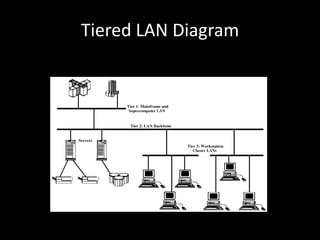
Tiered LANsCost of attachment to a LAN tends to increase with data rateAlternative to connecting all devices is to have multiple tiersMultiple advantagesHigher reliabilityGreater capacity (less saturation)Better distribution of costs based on need
Tiered LAN StrategiesBottom-up strategy: individual departments create LANs independently, eventually a backbone brings them togetherTop-down strategy: management develops an organization-wide networking plan
Tiered LAN Diagram
Transmission MediumPhysical path between transmitter and receiverGuided Media: waves are guided along a solid mediumUnguided Media: waves are transmitted through the atmosphere (wireless transmission)
Transmission Medium Design FactorsBandwidthTransmission impairmentsInterferenceNumber of receivers
Twisted Pair WiresConsists of two insulated copper wires arranged in a regular spiral pattern to minimize the electromagnetic interference between adjacent pairsOften used at customer facilities and also over distances to carry voice as well as data communicationsLow frequency transmission medium
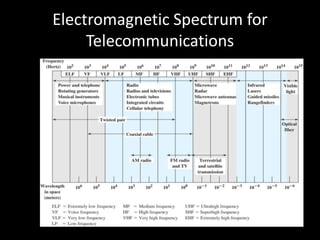
Electromagnetic Spectrum for Telecommunications
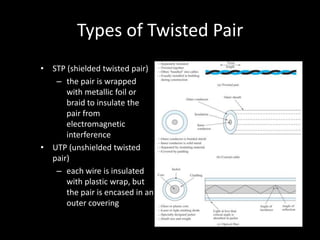
Types of Twisted PairSTP (shielded twisted pair)the pair is wrapped with metallic foil or braid to insulate the pair from electromagnetic interferenceUTP (unshielded twisted pair)each wire is insulated with plastic wrap, but the pair is encased in an outer covering
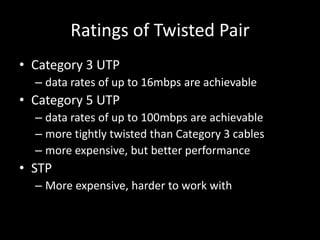
Ratings of Twisted PairCategory 3 UTPdata rates of up to 16mbps are achievableCategory 5 UTPdata rates of up to 100mbps are achievablemore tightly twisted than Category 3 cablesmore expensive, but better performanceSTPMore expensive, harder to work with
Twisted Pair AdvantagesInexpensive and readily availableFlexible and light weight Easy to work with and install
Twisted Pair DisadvantagesSusceptibility to interference and noiseAttenuation problemFor analog, repeaters needed every 5-6kmFor digital, repeaters needed every 2-3kmRelatively low bandwidth (3000Hz)
Coaxial Cable (or Coax)Used for cable television, LANs, telephonyHas an inner conductor surrounded by a braided meshBoth conductors share a common center axial, hence the term “co-axial”Traditionally used for LANs, but growth of twisted pair for local nets and optical fiber for larger nets has reduced coax use
Fiber Optic CableThin (2 to 125 µm), flexible medium capable of conducting an optical rayAdvantagesGreater capacitySmaller size/lighter weightLower attenuationElectromagnetic isolationOperate in the range of about 1014 to 1015 Hz; (portions of the infrared and visible spectrums)
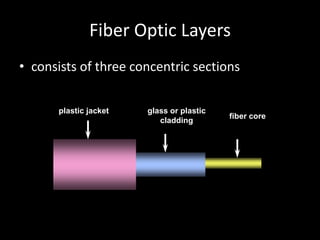
plastic jacketglass or plasticcladdingfiber coreFiber Optic Layersconsists of three concentric sections
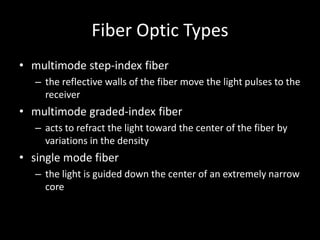
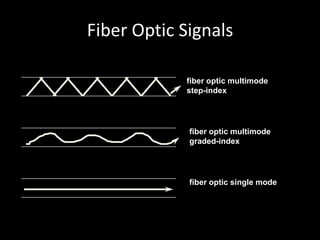
Fiber Optic Typesmultimode step-index fiberthe reflective walls of the fiber move the light pulses to the receivermultimode graded-index fiberacts to refract the light toward the center of the fiber by variations in the densitysingle mode fiberthe light is guided down the center of an extremely narrow core
fiber optic multimodestep-indexfiber optic multimodegraded-indexfiber optic single modeFiber Optic Signals
Structured Cabling SystemStandards for cabling within a building (EIA/TIA-568 and ISO 11801)Includes cabling for all applications, including LANs, voice, video, etcVendor and equipment independentDesigned to encompass entire building, so that equipment can be easily relocatedProvides guidance for pre-installation in new buildings and renovations
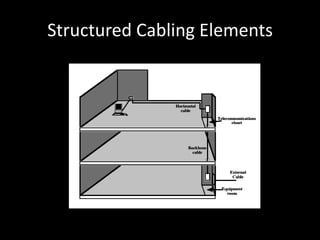
Structured Cabling Elements
LAN Protocol ArchitectureLayering of protocols that organize the structure of a LANPhysical: Medium Access Control (MAC)Logical: Logical Link Control (LLC)
Advantages of StandardsAssure sufficient volume to keep costs downEnable equipment from various sources to interconnect
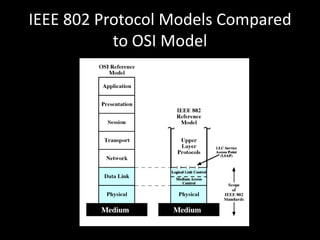
IEEE 802 Reference ModelIEEE 802 committee developed, revises, and extends standardsUse a three-layer protocol hierarchy: physical, medium access control (MAC), and logical link control (LLC)
IEEE 802 Protocol Models Compared to OSI Model
Physical LayerEncoding/decoding of signals and bit transmission/receptionSpecification of the transmission medium.Generally considered "below" the lowest layer of the OSI model. However, the choice of transmission medium is critical in LAN design, and so a specification of the medium is included
Logical Link ControlSpecifies method of addressing and controls exchange of dataIndependent of topology, medium, and medium access controlUnacknowledged connectionless service (higher layers handle error/flow control, or simple apps)Connection-mode service (devices without higher-level software)Acknowledged connectionless service (no prior connection necessary)
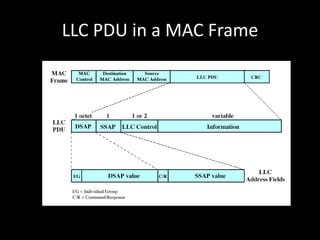
Medium Access ControlLLC frames data in a PDU (protocol data unit)MAC layer frames data againMAC control (e.g. priority level)Destination MAC addressSource MAC addressLLC PDUCRC (Cyclic Redundancy Check)
LLC PDU in a MAC Frame

Presentation7

  • 1.
  • 2.
    Personal Computer LANsClient/servercommunicationShared resourcesPeer-to-peer communication Low cost is high priority
  • 3.
    Backend &Storage Area Networks“Computer room networks”High data rateHigh-speed interfaceDistributed accessLimited distanceLimited number of devices
  • 4.
    Storage Area Networks(SAN)Separate network to handle storage needsCreates a shared storage facilityMay include a variety of storage devices such as disks, CD arrays, tape librariesStorage devices and servers are linked direcly to the network
  • 5.
    High-Speed Office NetworksIncreasedprocessing and transfer requirements in many graphics-intensive applications now require significantly higher transfer ratesDecreased cost of storage space leads to program and file bloat, increased need for transfer capacityTypical office LAN runs at 1-20mbps, high-speed alternatives run at 100+
  • 6.
    Backbone Local NetworksUsedinstead of single-LAN strategyBetter reliabilityHigher capacityLower cost
  • 7.
    Factory NetworksHigh capacityAbilityto handle a variety of data trafficLarge geographic extentHigh reliabilityAbility to specify and control transmission delays
  • 8.
    Tiered LANsCost ofattachment to a LAN tends to increase with data rateAlternative to connecting all devices is to have multiple tiersMultiple advantagesHigher reliabilityGreater capacity (less saturation)Better distribution of costs based on need
  • 9.
    Tiered LAN StrategiesBottom-upstrategy: individual departments create LANs independently, eventually a backbone brings them togetherTop-down strategy: management develops an organization-wide networking plan
  • 10.
  • 11.
    Transmission MediumPhysical pathbetween transmitter and receiverGuided Media: waves are guided along a solid mediumUnguided Media: waves are transmitted through the atmosphere (wireless transmission)
  • 12.
    Transmission Medium DesignFactorsBandwidthTransmission impairmentsInterferenceNumber of receivers
  • 13.
    Twisted Pair WiresConsistsof two insulated copper wires arranged in a regular spiral pattern to minimize the electromagnetic interference between adjacent pairsOften used at customer facilities and also over distances to carry voice as well as data communicationsLow frequency transmission medium
  • 14.
  • 15.
    Types of TwistedPairSTP (shielded twisted pair)the pair is wrapped with metallic foil or braid to insulate the pair from electromagnetic interferenceUTP (unshielded twisted pair)each wire is insulated with plastic wrap, but the pair is encased in an outer covering
  • 16.
    Ratings of TwistedPairCategory 3 UTPdata rates of up to 16mbps are achievableCategory 5 UTPdata rates of up to 100mbps are achievablemore tightly twisted than Category 3 cablesmore expensive, but better performanceSTPMore expensive, harder to work with
  • 17.
    Twisted Pair AdvantagesInexpensiveand readily availableFlexible and light weight Easy to work with and install
  • 18.
    Twisted Pair DisadvantagesSusceptibilityto interference and noiseAttenuation problemFor analog, repeaters needed every 5-6kmFor digital, repeaters needed every 2-3kmRelatively low bandwidth (3000Hz)
  • 19.
    Coaxial Cable (orCoax)Used for cable television, LANs, telephonyHas an inner conductor surrounded by a braided meshBoth conductors share a common center axial, hence the term “co-axial”Traditionally used for LANs, but growth of twisted pair for local nets and optical fiber for larger nets has reduced coax use
  • 20.
    Fiber Optic CableThin(2 to 125 µm), flexible medium capable of conducting an optical rayAdvantagesGreater capacitySmaller size/lighter weightLower attenuationElectromagnetic isolationOperate in the range of about 1014 to 1015 Hz; (portions of the infrared and visible spectrums)
  • 21.
    plastic jacketglass orplasticcladdingfiber coreFiber Optic Layersconsists of three concentric sections
  • 22.
    Fiber Optic Typesmultimodestep-index fiberthe reflective walls of the fiber move the light pulses to the receivermultimode graded-index fiberacts to refract the light toward the center of the fiber by variations in the densitysingle mode fiberthe light is guided down the center of an extremely narrow core
  • 23.
    fiber optic multimodestep-indexfiberoptic multimodegraded-indexfiber optic single modeFiber Optic Signals
  • 24.
    Structured Cabling SystemStandardsfor cabling within a building (EIA/TIA-568 and ISO 11801)Includes cabling for all applications, including LANs, voice, video, etcVendor and equipment independentDesigned to encompass entire building, so that equipment can be easily relocatedProvides guidance for pre-installation in new buildings and renovations
  • 25.
  • 26.
    LAN Protocol ArchitectureLayeringof protocols that organize the structure of a LANPhysical: Medium Access Control (MAC)Logical: Logical Link Control (LLC)
  • 27.
    Advantages of StandardsAssuresufficient volume to keep costs downEnable equipment from various sources to interconnect
  • 28.
    IEEE 802 ReferenceModelIEEE 802 committee developed, revises, and extends standardsUse a three-layer protocol hierarchy: physical, medium access control (MAC), and logical link control (LLC)
  • 29.
    IEEE 802 ProtocolModels Compared to OSI Model
  • 30.
    Physical LayerEncoding/decoding ofsignals and bit transmission/receptionSpecification of the transmission medium.Generally considered "below" the lowest layer of the OSI model. However, the choice of transmission medium is critical in LAN design, and so a specification of the medium is included
  • 31.
    Logical Link ControlSpecifiesmethod of addressing and controls exchange of dataIndependent of topology, medium, and medium access controlUnacknowledged connectionless service (higher layers handle error/flow control, or simple apps)Connection-mode service (devices without higher-level software)Acknowledged connectionless service (no prior connection necessary)
  • 32.
    Medium Access ControlLLCframes data in a PDU (protocol data unit)MAC layer frames data againMAC control (e.g. priority level)Destination MAC addressSource MAC addressLLC PDUCRC (Cyclic Redundancy Check)
  • 33.
    LLC PDU ina MAC Frame