IMT-2000
STANDARDIZATION
     Michael H. Callendar
Chairman ITU-R Task Group 8/1


       WIRELESS ACCESS
       WIRELESS ACCESS
     FOR THE 21ST CENTURY
     FOR THE 21ST CENTURY
       Anywhere --Anytime
       Anywhere Anytime


                            1
IMT-2000 OBJECTIVES


•   Global Service Capabilities in 2000s
•   Terrestrial & Satellite Components
•   Reduce the Telecommunications Gap
•   Flexible/Seamless Service Provision
•   Wider Range of Services/Terminals
•   Fixed/Mobile and Public/Private
•   Improved Operational Efficiencies

                                     2
MARKET FACTORS

• Market for IMT-2000 is truly Global
• Convergence of Wired/Wireless Networks
  Using Common Platforms
• Today’s Mobile Population Is Less Than 10%
  of That Forecast for 2015
• Regional “Footprints” Today Should Not
  Unduly Restrict Technologies for a New ITU
  Standard for the 2000s


                                   3
IMT-2000 SERVICES

•   IMT-2000 Dominated by Data Services
•   Data Communication Between Devices
•   Internet and Multimedia
•   High Quality Voice
•   Flexible Mixed/Multi-Service Provision Based on
    Compliance to ITU IMT-2000 Recommendations


                                         4
KEY EXPECTATIONS
                   OF IMT-2000
• Flexibility for Data & Multimedia Services
  (incl. Internet-based)
• Lower Cost Than 2G for “Basic” Services
  Plus New Service Capabilities
• Service Transparency/Global Roaming
• Significantly Improved Operational Efficiency
  (esp. Capacity/Spectrum Efficiency)


                                     5
FLEXIBILITY
• Service Provision
   –   Multiple Service Categories
   –   Higher Bit Rates
   –   Asymmetrical
   –   Multimedia
• Network Evolution
   – Common Platforms
   – Radio Independence
   – Mixed 2G and 3G
• Spectrum Management
   – Simple Reuse Plan
   – Bandwidth on Demand
   – Coexistence with 2G
                                     6
OPERATIONAL
                 EFFICIENCY
•Spectrum Efficiency Improvements
   –Multiplexing Gain for Mixed Services
   –Technology Improvements
   –Space Dimension - Smart Antennas
   –Interference Cancellation
•Coverage Efficiency
   –Same Sites
   –Mixed 2G and 3G
   –Range with Higher Bit Rates
•Cost Structure
   –Optimize Resource Utilization
   –Bandwidth on Demand
   –Lower Cost Floor for Basic Services.   7
3G - ROLE OF THE

• World-wide Spectrum Coordination
• Policy/Regulatory Harmonization
• International Standards for IMT-2000,
  Including Key Access and Network Interfaces
• Provide Foundation, Framework and Catalyst
  For 3G Convergence Across Regions And
  Technologies


                                 8
ROLE OF THE REGIONAL
           STANDARDS BODIES

• Teamwork with the ITU in Development of
  IMT-2000 Standards
• Harmonize Regional Input Contributions to the
  ITU
• Development of Specific Regional Requirements
  Within the IMT-2000 Family of Systems
• Evolution of Regional Pre-IMT-2000 Standards
  Towards IMT-2000 Capabilities


                                     9
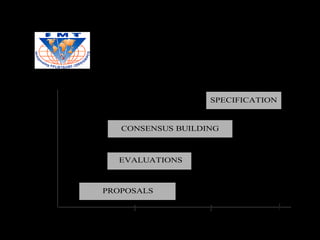
RTT STANDARDIZATION
            SCHEDULE

                          SPECIFICATION


          CONSENSUS BUILDING


         EVALUATIONS


       PROPOSALS


1997       1998         1999         2000
                               10
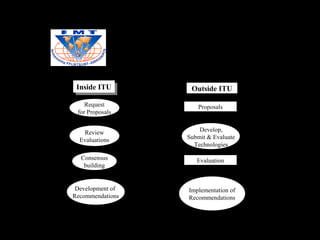
RTT SELECTION
                     PROCESS
 Inside ITU
  Inside ITU            Outside ITU

    Request               Proposals
 for Proposals


   Review                  Develop,
  Evaluations          Submit & Evaluate
                         Technologies

  Consensus               Evaluation
   building


 Development of        Implementation of
Recommendations        Recommendations


                                       11
IMPORTANCE OF RADIO
                 CONVERGENCE

• Cost Reduction via Economies of Scale
• Enabler for “Globally Capable” Terminals
  (Including Embedded “Invisible” 3G Devices)
• Minimizes Global Market Fragmentation
• Reduces Barriers to Global Service
  Provision/Roaming (Technology Islands)
• Avoids Precipitating Unnecessary Complexity of
  Global Wireless Networks and Terminals


                                      12
CHALLENGES AND
                   OPPORTUNITIES
• Coexistence with Second Generation Systems,
  Especially in North America
• Vendors’ Desire for IPR Advantage
• Negotiating Agreements between
  Regional/Technology-based “Camps”
• Intensity/Diversity of 3G Standards Activities Is
  Stretching Scarce Resources
• ITU Consensus Building Can Be a Catalyst for
  Win/Win Convergence
• Operator Agreement on Value of Convergence Is
  Key to Success
                                        13
CONCLUSIONS

• ITU/Regional Standards ‘Team ‘
• Radio Convergence - Key to Realizing Cost
  Reduction/3G Market Growth
• Significant Challenges Remain to be
  Overcome but a “Window Of Opportunity”
  Exists
• Operator Commitment to Convergence
  Needed to Ensure Window Is Not Missed

Follow IMT-2000 Standards Progress: http://www.itu.int/imt
                                                 14
CONCLUSIONS

• ITU/Regional Standards ‘Team ‘
• Radio Convergence - Key to Realizing Cost
  Reduction/3G Market Growth
• Significant Challenges Remain to be
  Overcome but a “Window Of Opportunity”
  Exists
• Operator Commitment to Convergence
  Needed to Ensure Window Is Not Missed
          YOU CAN MAKE A DIFFERENCE
Follow IMT-2000 Standards Progress: http://www.itu.int/imt
                                                 15

IMT 2000

  • 1.
    IMT-2000 STANDARDIZATION Michael H. Callendar Chairman ITU-R Task Group 8/1 WIRELESS ACCESS WIRELESS ACCESS FOR THE 21ST CENTURY FOR THE 21ST CENTURY Anywhere --Anytime Anywhere Anytime 1
  • 2.
    IMT-2000 OBJECTIVES • Global Service Capabilities in 2000s • Terrestrial & Satellite Components • Reduce the Telecommunications Gap • Flexible/Seamless Service Provision • Wider Range of Services/Terminals • Fixed/Mobile and Public/Private • Improved Operational Efficiencies 2
  • 3.
    MARKET FACTORS • Marketfor IMT-2000 is truly Global • Convergence of Wired/Wireless Networks Using Common Platforms • Today’s Mobile Population Is Less Than 10% of That Forecast for 2015 • Regional “Footprints” Today Should Not Unduly Restrict Technologies for a New ITU Standard for the 2000s 3
  • 4.
    IMT-2000 SERVICES • IMT-2000 Dominated by Data Services • Data Communication Between Devices • Internet and Multimedia • High Quality Voice • Flexible Mixed/Multi-Service Provision Based on Compliance to ITU IMT-2000 Recommendations 4
  • 5.
    KEY EXPECTATIONS OF IMT-2000 • Flexibility for Data & Multimedia Services (incl. Internet-based) • Lower Cost Than 2G for “Basic” Services Plus New Service Capabilities • Service Transparency/Global Roaming • Significantly Improved Operational Efficiency (esp. Capacity/Spectrum Efficiency) 5
  • 6.
    FLEXIBILITY • Service Provision – Multiple Service Categories – Higher Bit Rates – Asymmetrical – Multimedia • Network Evolution – Common Platforms – Radio Independence – Mixed 2G and 3G • Spectrum Management – Simple Reuse Plan – Bandwidth on Demand – Coexistence with 2G 6
  • 7.
    OPERATIONAL EFFICIENCY •Spectrum Efficiency Improvements –Multiplexing Gain for Mixed Services –Technology Improvements –Space Dimension - Smart Antennas –Interference Cancellation •Coverage Efficiency –Same Sites –Mixed 2G and 3G –Range with Higher Bit Rates •Cost Structure –Optimize Resource Utilization –Bandwidth on Demand –Lower Cost Floor for Basic Services. 7
  • 8.
    3G - ROLEOF THE • World-wide Spectrum Coordination • Policy/Regulatory Harmonization • International Standards for IMT-2000, Including Key Access and Network Interfaces • Provide Foundation, Framework and Catalyst For 3G Convergence Across Regions And Technologies 8
  • 9.
    ROLE OF THEREGIONAL STANDARDS BODIES • Teamwork with the ITU in Development of IMT-2000 Standards • Harmonize Regional Input Contributions to the ITU • Development of Specific Regional Requirements Within the IMT-2000 Family of Systems • Evolution of Regional Pre-IMT-2000 Standards Towards IMT-2000 Capabilities 9
  • 10.
    RTT STANDARDIZATION SCHEDULE SPECIFICATION CONSENSUS BUILDING EVALUATIONS PROPOSALS 1997 1998 1999 2000 10
  • 11.
    RTT SELECTION PROCESS Inside ITU Inside ITU Outside ITU Request Proposals for Proposals Review Develop, Evaluations Submit & Evaluate Technologies Consensus Evaluation building Development of Implementation of Recommendations Recommendations 11
  • 12.
    IMPORTANCE OF RADIO CONVERGENCE • Cost Reduction via Economies of Scale • Enabler for “Globally Capable” Terminals (Including Embedded “Invisible” 3G Devices) • Minimizes Global Market Fragmentation • Reduces Barriers to Global Service Provision/Roaming (Technology Islands) • Avoids Precipitating Unnecessary Complexity of Global Wireless Networks and Terminals 12
  • 13.
    CHALLENGES AND OPPORTUNITIES • Coexistence with Second Generation Systems, Especially in North America • Vendors’ Desire for IPR Advantage • Negotiating Agreements between Regional/Technology-based “Camps” • Intensity/Diversity of 3G Standards Activities Is Stretching Scarce Resources • ITU Consensus Building Can Be a Catalyst for Win/Win Convergence • Operator Agreement on Value of Convergence Is Key to Success 13
  • 14.
    CONCLUSIONS • ITU/Regional Standards‘Team ‘ • Radio Convergence - Key to Realizing Cost Reduction/3G Market Growth • Significant Challenges Remain to be Overcome but a “Window Of Opportunity” Exists • Operator Commitment to Convergence Needed to Ensure Window Is Not Missed Follow IMT-2000 Standards Progress: http://www.itu.int/imt 14
  • 15.
    CONCLUSIONS • ITU/Regional Standards‘Team ‘ • Radio Convergence - Key to Realizing Cost Reduction/3G Market Growth • Significant Challenges Remain to be Overcome but a “Window Of Opportunity” Exists • Operator Commitment to Convergence Needed to Ensure Window Is Not Missed YOU CAN MAKE A DIFFERENCE Follow IMT-2000 Standards Progress: http://www.itu.int/imt 15