Extended Range Fuel Cell Utility Vehicle: Design, Build, and DemonstrationClay HearnApril 27, 2011
IntroductionProgram GoalsTeam MembersModel Based DesignVehicle Build
Program GoalsProgram sponsored through Defense Logistics Agency (DLA) and Crane to provide extended range hydrogen fuel cell vehicles for use at Warner Robbins AFB in GeorgiaHydrogen refueling infrastructure on baseCurrently using hydrogen fuel cell fork liftsNumerous all-electric utility vehicles and NEVs Maximize on-board hydrogen storage without sacrificing vehicle performanceBuild and deliver units in 8 months to Warner Robbins AFB for 12 month evaluation
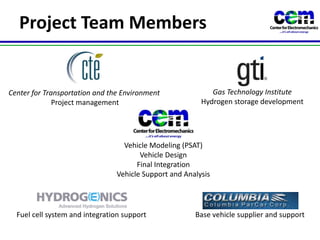
Project Team MembersCenter for Transportation and the EnvironmentProject managementVehicle Modeling (PSAT)Vehicle DesignFinal IntegrationVehicle Support and AnalysisFuel cell system and integration supportGas Technology InstituteHydrogen storage developmentBase vehicle supplier and support
Energy Storage Options
Vehicle ConfigurationsLi-Ion batteries double range of vehicle over stock lead-acid batteriesRange of hydrogen vehicle driven by onboard stored hydrogen~ 10X higher specific energy storage with 350 bar hydrogen  fuel cell over advanced Li-ion batteriesAnalysis to right assumes 2 kg on-board hydrogen storagePlug-in options increase range by 25% – 50% over fuel cell alone, but also increase vehicle mass up to 250 kgFuel cell dominant hybrids increase range 25% – 27% over fuel cell alone
Hydrogen Storage OptionsGravimetric capacityAffects overall vehicle mass Limits additional cargo bed capacityReduces vehicle economyVolumetric capacityLimits storage volumePoses integration issues
Evaluating Hydrogen StorageIncreasing on-board H2Increasing on-board H2
Vehicle Integration8-month build schedule to retrofit two vehiclesSupervisory control and data recordingNI CompactRIOLabview softwareCAN communication between fuel cell and boost converter“Rolling Benchtop” testing
Final Integration and TestingCompleted October 2010Vehicle Range Testing309 mile range demonstrated87.8 mi/kg average5 days to complete!Vehicles include 120V 1.5 kW inverter for on-site power12 month demonstration at DDWG began November 2010
Questions?

Advisory panel hearn_final

  • 1.
    Extended Range FuelCell Utility Vehicle: Design, Build, and DemonstrationClay HearnApril 27, 2011
  • 2.
  • 3.
    Program GoalsProgram sponsoredthrough Defense Logistics Agency (DLA) and Crane to provide extended range hydrogen fuel cell vehicles for use at Warner Robbins AFB in GeorgiaHydrogen refueling infrastructure on baseCurrently using hydrogen fuel cell fork liftsNumerous all-electric utility vehicles and NEVs Maximize on-board hydrogen storage without sacrificing vehicle performanceBuild and deliver units in 8 months to Warner Robbins AFB for 12 month evaluation
  • 4.
    Project Team MembersCenterfor Transportation and the EnvironmentProject managementVehicle Modeling (PSAT)Vehicle DesignFinal IntegrationVehicle Support and AnalysisFuel cell system and integration supportGas Technology InstituteHydrogen storage developmentBase vehicle supplier and support
  • 5.
  • 6.
    Vehicle ConfigurationsLi-Ion batteriesdouble range of vehicle over stock lead-acid batteriesRange of hydrogen vehicle driven by onboard stored hydrogen~ 10X higher specific energy storage with 350 bar hydrogen fuel cell over advanced Li-ion batteriesAnalysis to right assumes 2 kg on-board hydrogen storagePlug-in options increase range by 25% – 50% over fuel cell alone, but also increase vehicle mass up to 250 kgFuel cell dominant hybrids increase range 25% – 27% over fuel cell alone
  • 7.
    Hydrogen Storage OptionsGravimetriccapacityAffects overall vehicle mass Limits additional cargo bed capacityReduces vehicle economyVolumetric capacityLimits storage volumePoses integration issues
  • 8.
    Evaluating Hydrogen StorageIncreasingon-board H2Increasing on-board H2
  • 9.
    Vehicle Integration8-month buildschedule to retrofit two vehiclesSupervisory control and data recordingNI CompactRIOLabview softwareCAN communication between fuel cell and boost converter“Rolling Benchtop” testing
  • 10.
    Final Integration andTestingCompleted October 2010Vehicle Range Testing309 mile range demonstrated87.8 mi/kg average5 days to complete!Vehicles include 120V 1.5 kW inverter for on-site power12 month demonstration at DDWG began November 2010
  • 11.