HETDEX Linear Drive DesignTim Beets, PEUniversity of TexasCenter for Electromechanicst.beets@cem.utexas.edu(512) 232-4285
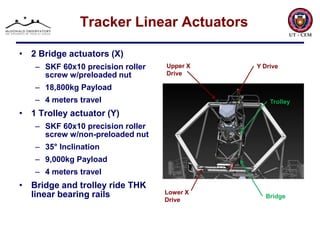
Tracker Linear Actuators2 Bridge actuators (X)SKF 60x10 precision roller screw w/preloaded nut18,800kg Payload4 meters travel1 Trolley actuator (Y)SKF 60x10 precision roller screw w/non-preloaded nut35° Inclination9,000kg Payload4 meters travelBridge and trolley ride THK linear bearing railsUpper X DriveY DriveTrolleyLower X DriveBridge
Unique Design ConsiderationsOperation:1) Slow-speed, precise positioning (tracking) and 2) high-speed, coarse positioning (slewing)Low temperatures atypical for roller screw applicationsComponents:Long roller screws are prone to rotordynamic instabilities and tend to sag along unsupported lengthHET structure is flexible with limited alignment capabilities and presents transient alignment issues under dynamic loading (i.e., tracker traverse)COTS drive componentsUpper X drive model and analysis of  screw sag
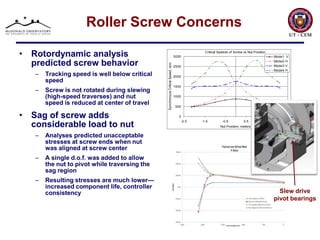
Roller Screw ConcernsRotordynamic analysis predicted screw behaviorTracking speed is well below critical speedScrew is not rotated during slewing (high-speed traverses) and nut speed is reduced at center of travelSag of screw adds considerable load to nutAnalyses predicted unacceptable stresses at screw ends when nut was aligned at screw centerA single d.o.f. was added to allow the nut to pivot while traversing the sag regionResulting stresses are much lower—increased component life, controller consistencySlew drive pivot bearings
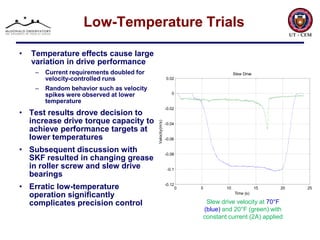
Low-Temperature TrialsTemperature effects cause large variation in drive performanceCurrent requirements doubled for velocity-controlled runsRandom behavior such as velocity spikes were observed at lower temperatureTest results drove decision to increase drive torque capacity to achieve performance targets at lower temperatures
Subsequent discussion with SKF resulted in changing grease in roller screw and slew drive bearings

Advisory panel 2011 beets

  • 1.
    HETDEX Linear DriveDesignTim Beets, PEUniversity of TexasCenter for Electromechanicst.beets@cem.utexas.edu(512) 232-4285
  • 2.
    Tracker Linear Actuators2Bridge actuators (X)SKF 60x10 precision roller screw w/preloaded nut18,800kg Payload4 meters travel1 Trolley actuator (Y)SKF 60x10 precision roller screw w/non-preloaded nut35° Inclination9,000kg Payload4 meters travelBridge and trolley ride THK linear bearing railsUpper X DriveY DriveTrolleyLower X DriveBridge
  • 3.
    Unique Design ConsiderationsOperation:1)Slow-speed, precise positioning (tracking) and 2) high-speed, coarse positioning (slewing)Low temperatures atypical for roller screw applicationsComponents:Long roller screws are prone to rotordynamic instabilities and tend to sag along unsupported lengthHET structure is flexible with limited alignment capabilities and presents transient alignment issues under dynamic loading (i.e., tracker traverse)COTS drive componentsUpper X drive model and analysis of screw sag
  • 4.
    Roller Screw ConcernsRotordynamicanalysis predicted screw behaviorTracking speed is well below critical speedScrew is not rotated during slewing (high-speed traverses) and nut speed is reduced at center of travelSag of screw adds considerable load to nutAnalyses predicted unacceptable stresses at screw ends when nut was aligned at screw centerA single d.o.f. was added to allow the nut to pivot while traversing the sag regionResulting stresses are much lower—increased component life, controller consistencySlew drive pivot bearings
  • 5.
    Low-Temperature TrialsTemperature effectscause large variation in drive performanceCurrent requirements doubled for velocity-controlled runsRandom behavior such as velocity spikes were observed at lower temperatureTest results drove decision to increase drive torque capacity to achieve performance targets at lower temperatures
  • 6.
    Subsequent discussion withSKF resulted in changing grease in roller screw and slew drive bearings

Editor's Notes

  • #3 “Tracker” is everything above HET hex. The upgrade includes bridge, trolley, hexapod, science instruments, and all actuators. There are three primary actuators 2 X and Y. The X drives move the bridge and thereby the entire tracker. The y drive moves the trolley (along the bridge) and thereby the hexapod and science instruments. The load on the X drives are primarily friction forces from the screw components (bearings, nut preload) and linear bearings (preloaded). This load is reversed when movement reverses, so a preloaded nut (0.5-2.5Nm) is necessary to eliminate backlash. The load on the Y drive is from the 9000kg payload on the 35deg inclination. This load does not reverse, so a non-preloaded nut is used—increases efficiency.5.2X increase tracker mass7.2X increase science payload6.9X increase bridge payload
  • #4 2 distinct drives providedTrack: 3mm/s max at 2micron following errorSlew: 80mm/s max at 20micron following errorTrack drive is coupled directly to screwSlew drive is coupled to nut via belt drive and gearhead (1:4.2 ratio)Min operating temp is 20F. Grease necessitated by application, but limits low-speed performance.
  • #5 1st critical speed is at 500rpm w/nut centered.As the nut moves toward either end of the screw, the critical speed increases and slew speed can be increased to maximum.
  • #6 Achieved over 100mm/s slew speed at 70F and only 10mm/sOrder of magnitude difference in peak speed at constant current.