Fuel Cells as EV Range Extenders:A Near-Term Fuel Cell Solution1501 Northpoint Parkway, Suite 101West Palm Beach, FL 33407(561) 868-6720
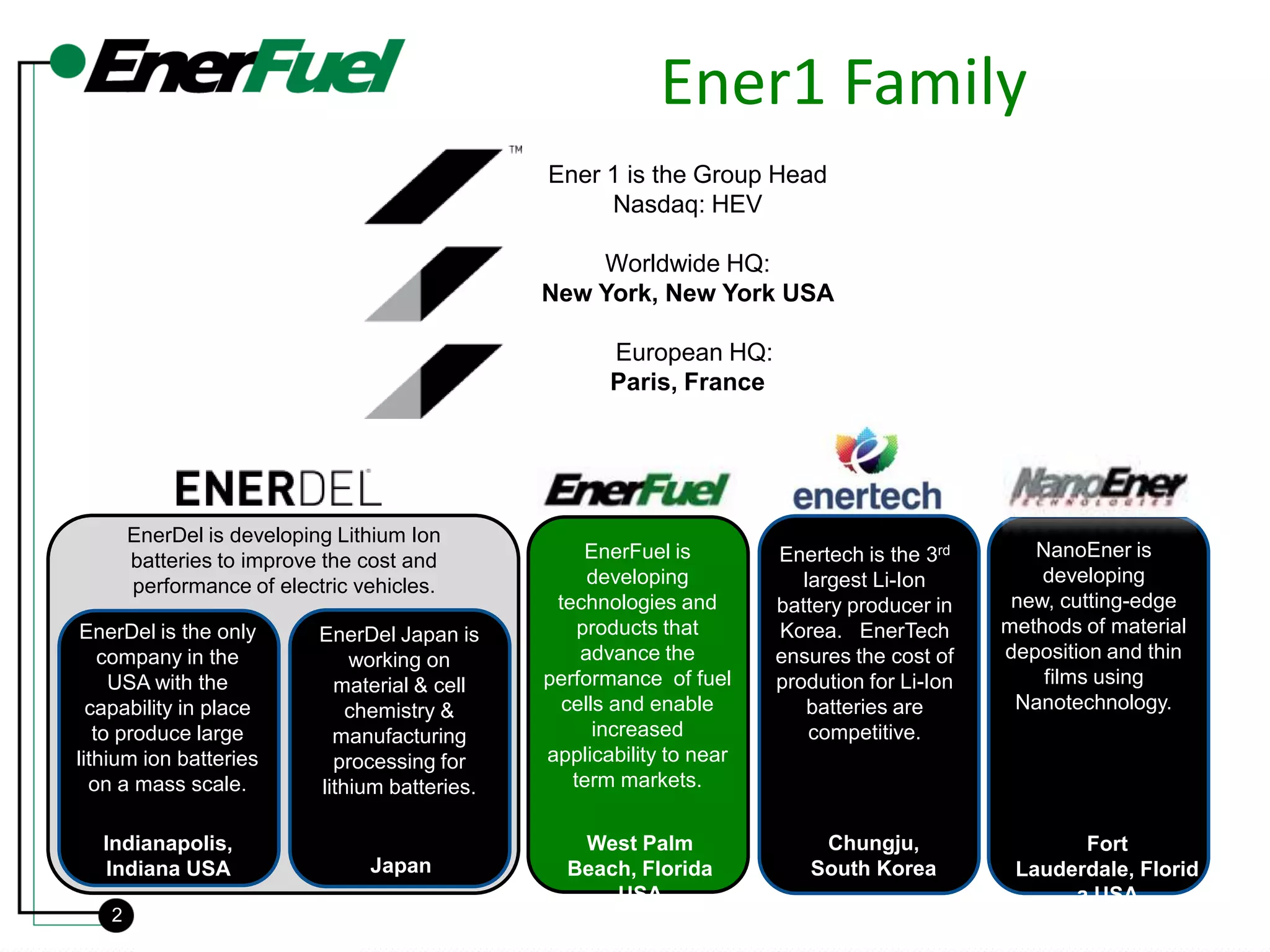
Ener1 FamilyEner 1 is the Group HeadNasdaq: HEVWorldwide HQ:New York, New York USAEuropean HQ:Paris, FranceEnerDel is developing Lithium Ion  batteries to improve the cost and performance of electric vehicles.  NanoEner is developing new, cutting-edge methods of material deposition and thin films using Nanotechnology.EnerFuel is developing technologies and products that advance the performance  of fuel cells and enable increased applicability to near term markets.Enertech is the 3rd largest Li-Ion battery producer in Korea.   EnerTech ensures the cost of prodution for Li-Ion batteries are competitive.EnerDel is the only company in the USA with the capability in place to produce large lithium ion batteries on a mass scale.EnerDel Japan is working on  material & cell chemistry & manufacturing  processing for lithium batteries. Chungju, South KoreaIndianapolis,Indiana USAWest Palm Beach, Florida USAFort Lauderdale, Florida USAJapan
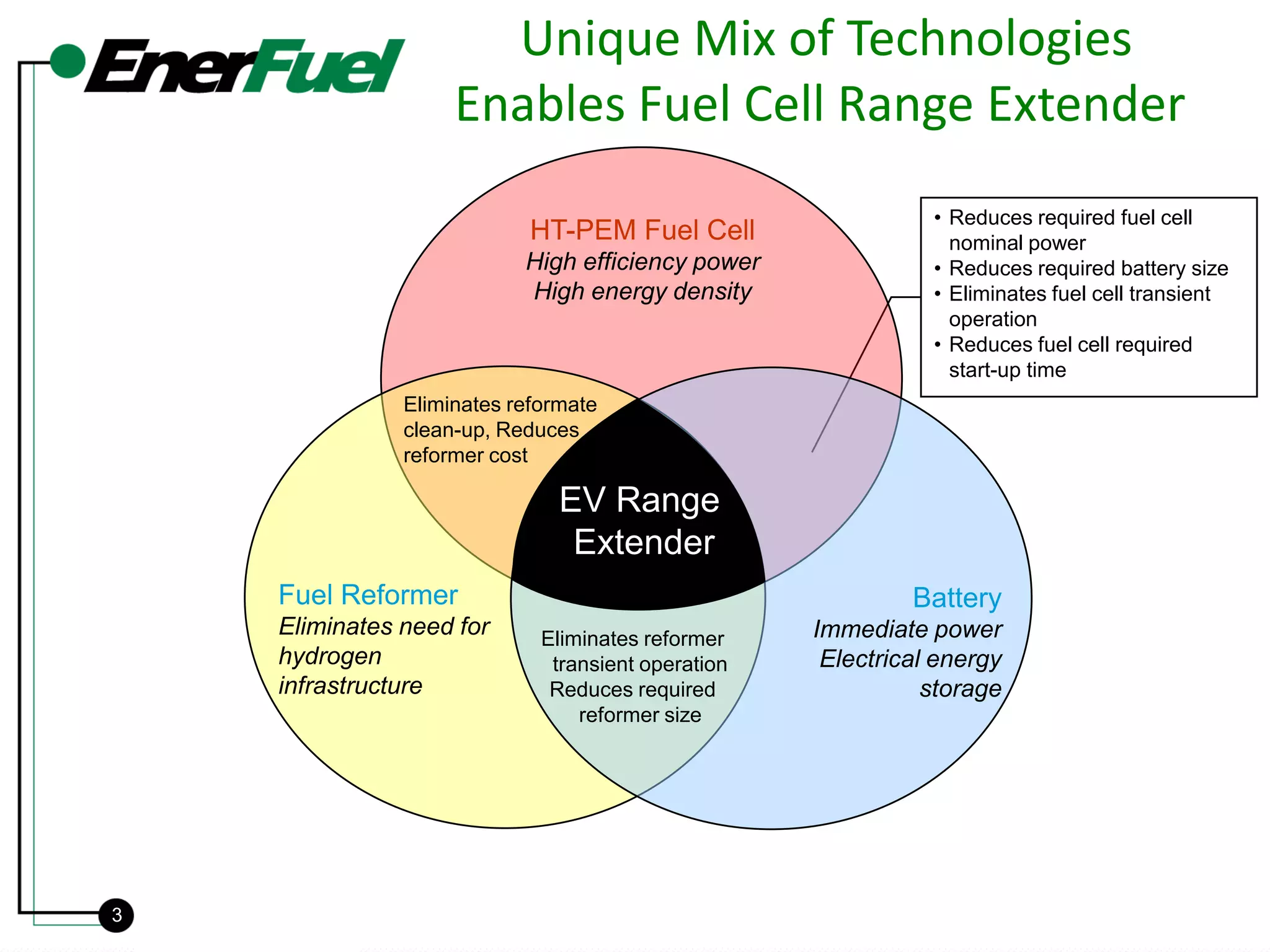
 Unique Mix of Technologies Enables Fuel Cell Range ExtenderReduces required fuel cell nominal power
Reduces required battery size
Eliminates fuel cell transient operation
Reduces fuel cell required start-up timeHT-PEM Fuel CellHigh efficiency powerHigh energy densityEliminates reformate clean-up, Reduces reformer costEV Range ExtenderFuel ReformerEliminates need for hydrogen infrastructureBatteryImmediate powerElectrical energy storageEliminates reformer transient operationReduces required reformer size
Electric Vehicle VisionFuels other than Hydrogen can be usedEV Range ExtenderGasolineDieselE-85E-100MethanolBiodieselBiobutanolDME(others)GridOpportunity Charging Stations Opportunity:EV Range Extender produces no toxic emissions.Battery can be charged by fuel cell while vehicle is parked.
Types of EV Range Extenders1-3kW fuel cell
Partial range extension
Cabin heating and cooling
Battery protection
>10kW fuel cell
Unlimited range extension
Cabin heating and cooling
Battery protection
3-10kW fuel cell
Range extension
Cabin heating and cooling
Battery protectionCharge AssistingCharge SustainingClimate Control / IdleClimate Control / IdleCharge SustainingCharge Assisting3kW10kW1kW
2008 EnerFuel Developed Range Extended EV95mph max speed8sec, 0 - 60mph (97kph)
H2AnodeCathodeAirBlower / CompressorCooling FanHT-PEM Fuel Cell Module Reduces BOPHT-PEMLT-PEMReactant humidification and cooling system.Radiator much larger than for Piston EngineGen 2.0 fuel cell module undergoing testingEnerFuel’s HT-PEM Fuel Cell Module Doesn’t Need: Reactant humidification
 Coolant loop / Coolant pumps

EnerFuel EV Range Extender

  • 1.
    Fuel Cells asEV Range Extenders:A Near-Term Fuel Cell Solution1501 Northpoint Parkway, Suite 101West Palm Beach, FL 33407(561) 868-6720
  • 2.
    Ener1 FamilyEner 1is the Group HeadNasdaq: HEVWorldwide HQ:New York, New York USAEuropean HQ:Paris, FranceEnerDel is developing Lithium Ion batteries to improve the cost and performance of electric vehicles. NanoEner is developing new, cutting-edge methods of material deposition and thin films using Nanotechnology.EnerFuel is developing technologies and products that advance the performance of fuel cells and enable increased applicability to near term markets.Enertech is the 3rd largest Li-Ion battery producer in Korea. EnerTech ensures the cost of prodution for Li-Ion batteries are competitive.EnerDel is the only company in the USA with the capability in place to produce large lithium ion batteries on a mass scale.EnerDel Japan is working on material & cell chemistry & manufacturing processing for lithium batteries. Chungju, South KoreaIndianapolis,Indiana USAWest Palm Beach, Florida USAFort Lauderdale, Florida USAJapan
  • 3.
    Unique Mixof Technologies Enables Fuel Cell Range ExtenderReduces required fuel cell nominal power
  • 4.
  • 5.
    Eliminates fuel celltransient operation
  • 6.
    Reduces fuel cellrequired start-up timeHT-PEM Fuel CellHigh efficiency powerHigh energy densityEliminates reformate clean-up, Reduces reformer costEV Range ExtenderFuel ReformerEliminates need for hydrogen infrastructureBatteryImmediate powerElectrical energy storageEliminates reformer transient operationReduces required reformer size
  • 7.
    Electric Vehicle VisionFuelsother than Hydrogen can be usedEV Range ExtenderGasolineDieselE-85E-100MethanolBiodieselBiobutanolDME(others)GridOpportunity Charging Stations Opportunity:EV Range Extender produces no toxic emissions.Battery can be charged by fuel cell while vehicle is parked.
  • 8.
    Types of EVRange Extenders1-3kW fuel cell
  • 9.
  • 10.
  • 11.
  • 12.
  • 13.
  • 14.
  • 15.
  • 16.
  • 17.
  • 18.
  • 19.
    Battery protectionCharge AssistingChargeSustainingClimate Control / IdleClimate Control / IdleCharge SustainingCharge Assisting3kW10kW1kW
  • 20.
    2008 EnerFuel DevelopedRange Extended EV95mph max speed8sec, 0 - 60mph (97kph)
  • 21.
    H2AnodeCathodeAirBlower / CompressorCoolingFanHT-PEM Fuel Cell Module Reduces BOPHT-PEMLT-PEMReactant humidification and cooling system.Radiator much larger than for Piston EngineGen 2.0 fuel cell module undergoing testingEnerFuel’s HT-PEM Fuel Cell Module Doesn’t Need: Reactant humidification
  • 22.
    Coolant loop/ Coolant pumps
  • 23.
    RadiatorOverall SystemCost% BOP% StackSystem PowerBOP and Stack Cost in the SystemBOP costs are a higher proportion of system weight, size and cost as fuel cell power is decreased.
  • 24.
    Reduction of BOPImpacts Costs of Lower Power Fuel Cells80KW System5 KW SystemPercentage of Automotive System CostPercentage of Automotive System Cost500,000 unit annual production of 80kW systemSource: “Cost Analysis of PEM Fuel Cell Systems for Transportation” NREL/SR-560-39104500,000 unit annual production of 5kW systemSource:Estimation based on 80KW system = BOP components eliminated in HT-PEM fuel cell (24% of total cost)
  • 25.
    9.99.07.75.94.42.41.90.9Energy Density ofPotential Fuels12.010.08.0/Lth6.0kWh4.02.00.0MethanolEthanolButanolConventionalU.S.HydrogenHydrogenLiquidgasolineconventional5kpsig10kpsigHydrogendiesel
  • 26.
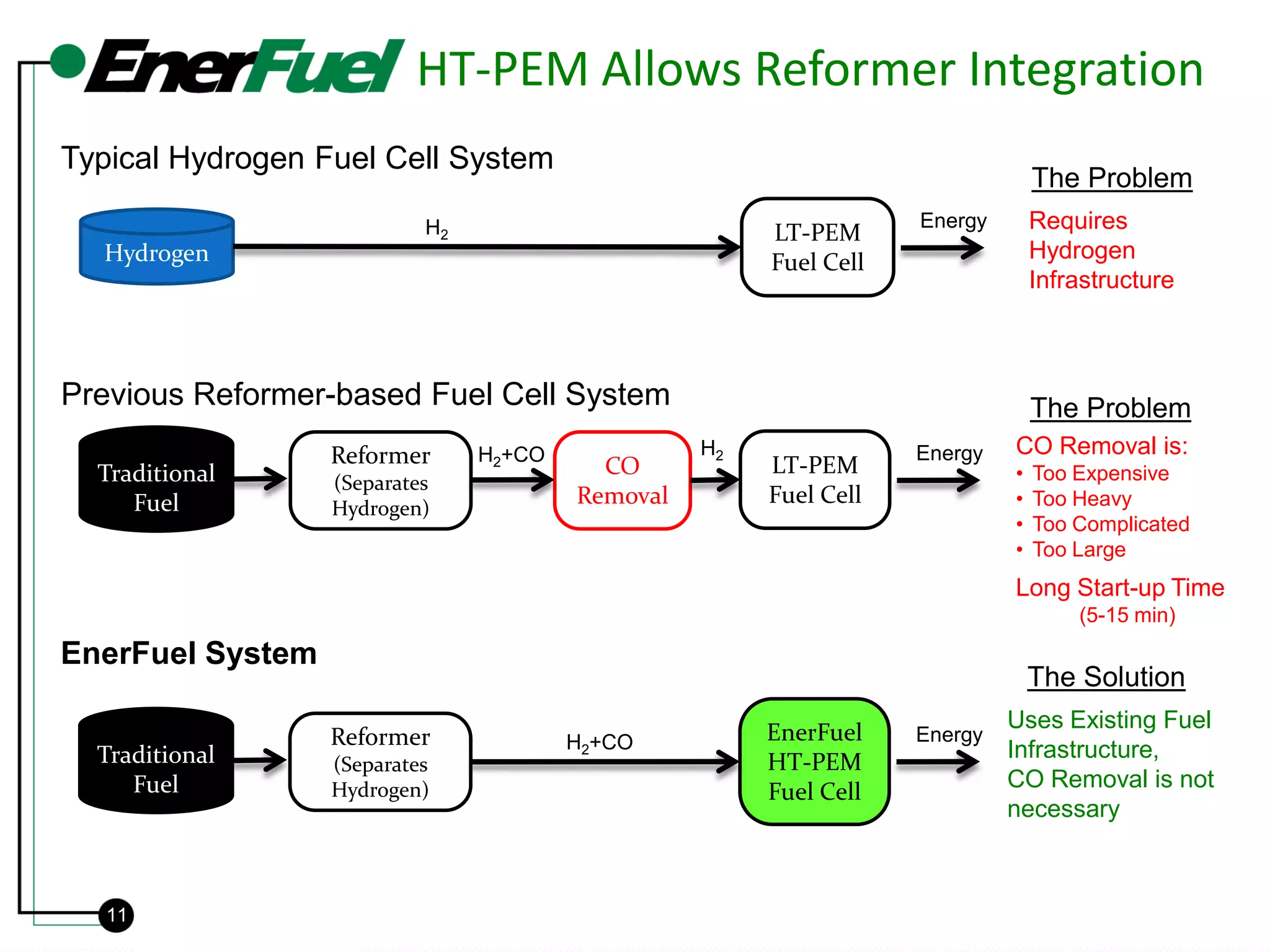
    HT-PEM Allows ReformerIntegrationTypical Hydrogen Fuel Cell SystemThe ProblemRequires Hydrogen InfrastructureLT-PEM Fuel CellEnergyH2HydrogenPrevious Reformer-based Fuel Cell SystemThe ProblemCO Removal is:Too Expensive
  • 27.
  • 28.
  • 29.
    Too LargeLong Start-upTime(5-15 min)Traditional FuelH2LT-PEM Fuel CellReformer(Separates Hydrogen)CO RemovalEnergyH2+COEnerFuel SystemThe SolutionUses Existing Fuel Infrastructure, CO Removal is not necessaryEnerFuel HT-PEM Fuel CellTraditional FuelReformer(Separates Hydrogen)EnergyH2+CO
  • 30.
    EnerFuel Can TolerateCO in Reformed HydrogenHT-PEM has much lower susceptibility to CO poisoning than LT-PEM
  • 31.
    Allows for simplifiedand low cost integration with reformers EnerFuelHT-PEM Operating TempLT-PEM Op. TempSource: Q. Lietal /Progress in Polymer Science 34 (2009) 449–477
  • 32.
    Electric Vehicle UsageModelTRIPHereThereDaily CommuteConsists of a series of trips
  • 33.
    Inputs to MonteCarlo* Analysis*Monte Carlo Analysis runs a large number of scenarios to determine the likelihood of potential outcomes. 14
  • 34.
    TRIPEVHereThereEVVehicle Energy Needs4.4kWhaverage trip energy10kWh battery can power 97% of tripsDaily CommuteConsists of a series of trips23kWh average commute energy
  • 35.
    On average, a5kW fuel cell stack would add 20kWh of range to the daily commuteA 5kW fuel cell stack could reduce battery pack size by 9kWh with minimal risk of adversely affecting vehicle driving rangeFuel Cell Adds Range and Could Reduce Battery Pack Size
  • 36.
    Fuel Cell ReducesProbability of Needing to Charge During Day20kWh Battery Only15kWh Battery Only
  • 37.
    Vehicle EfficiencyEfficiency Definitions:=72mpg 3.3 L/100km= 91mpg2.6 L/100km
  • 38.
    Fuel Cell LowersEV Driving Range Cost300$25,000$23,764250$20,000219$16,639200$15,000$15,000171Avg. Vehicle Range (mi)Powerplant Price ($)150$10,000100100$5,000500$020kWh Battery20kWh Battery + 5kW FC10kWh Battery + 5kW FCAvg. Vehicle Range (mi)Powerplant PriceAssuming 200Wh/mi average drive energy consumption, reformer based 5kW FC system at $1750/kW, battery cost is $750/kWh.
  • 39.
    MaterialHandlingStationary, Backup Power,microCHPTelecommunicationsE-Bikes<10kW System Enables Related Applications<10kWFuel CellRelated Applications Drive Economies of Scale
  • 40.
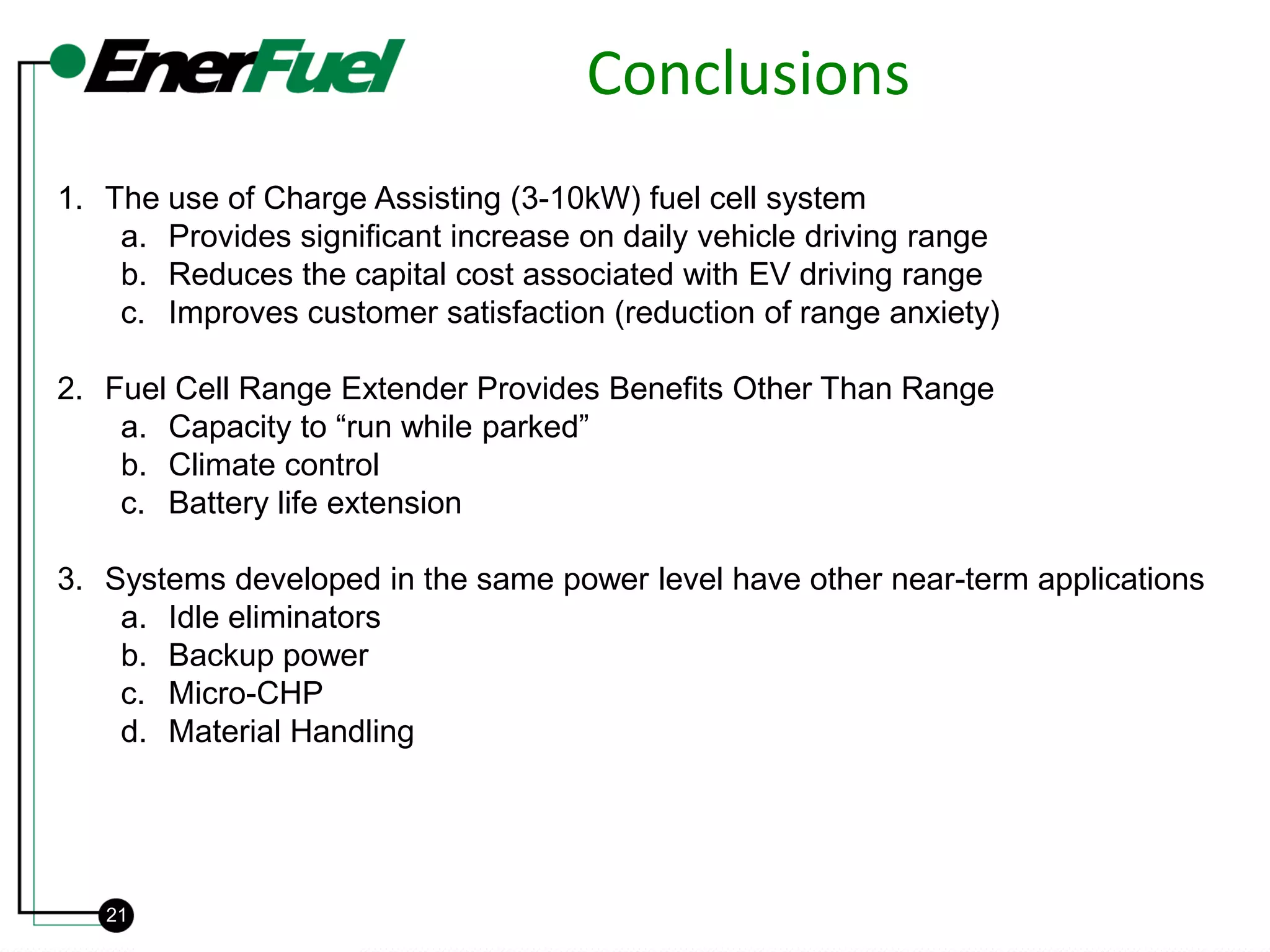
    ConclusionsThe use ofCharge Assisting (3-10kW) fuel cell systemProvides significant increase on daily vehicle driving rangeReduces the capital cost associated with EV driving rangeImproves customer satisfaction (reduction of range anxiety)Fuel Cell Range Extender Provides Benefits Other Than RangeCapacity to “run while parked”Climate controlBattery life extensionSystems developed in the same power level have other near-term applicationsIdle eliminatorsBackup powerMicro-CHPMaterial Handling
  • 41.
    Thank youQuestions andAnswersFor more information please contact:Daniel A. Betts, PhDdbetts@enerfuel.com1501 Northpoint Parkway, Suite 101West Palm Beach, FL 33407+1 (352) 258-1405

Editor's Notes

  • #14 We have effectively identified the cross over point of the battery to the fuel cell.
  • #15 We have effectively identified the cross over point of the battery to the fuel cell.
  • #16 We have effectively identified the cross over point of the battery to the fuel cell.
  • #17 We have effectively identified the cross over point of the battery to the fuel cell.
  • #18 We have effectively identified the cross over point of the battery to the fuel cell.
  • #20 We have effectively identified the cross over point of the battery to the fuel cell.