Mobile Algae Processing System	

        Demonstration Unit	


                 Robert Pearsall	

           r.pearsall@cem.utexas.edu	


                  April 27, 2011
Industry Need – Why are we doing this?	


•  Recent boom in algae biofuels industry (in both technology and
   funding)	

•  Industry is currently stifled by fragmented and unproven
   processing technologies that only address one part of the overall
   processing chain
Why CEM?	


•  Experience with process/technology
   integration	

•  Experience with multidisciplinary problems	

•  Skilled at bridging the gap between
   fundamental research and technology
   commercialization
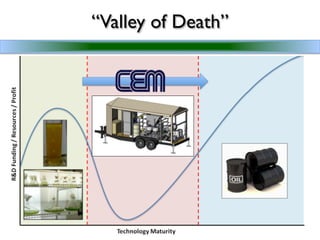
Examples of other projects
“Valley of Death”
Prior Work	


•  Scaled up growth capability up to 2,500 gal	

•  Built and tested technologies needed for ETE processing	

      –  Concentration, lysing, separation and extraction	

      –  Developed measurement and quantification techniques and
         procedures	

•  Spent over 2 years processing batches of algae between
   1000 – 3000 gal/batch ETE	

      –  Compiled mass / energy balance performed on ETE processing	


       NEXT STEP  	

Integrate all technologies
Demonstration Scale Requirements	


•  End-To-End (ETE) processing capability	

•  Capacity – up to several acres / day	

•  Modularity – Each module can be stand-alone or
   integrated	

•  Can process all variations of growth media	

•  Can process any growth method	

•  Allow grower to produce/see oil at the end of the day	

•  Mobility	

•  Demonstrate scalability	

•  Demonstrate economics
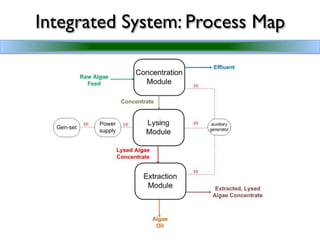
Integrated System: Process Map
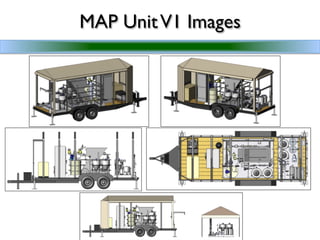
MAP Unit V1 Images
MAP Unit V1 Images
“Valley of Death”
Contact Information	

    Mr. Robert Pearsall	

    Center for Electromechanics	

    Research Engineer	

    (512) 232-1679	

    r.pearsall@cem.utexas.edu	


    Mr. Mike Werst	

    Center for Electromechanics	

    Algae Program Manager	

    (512) 232-1604	

    m.werst@cem.utexas.edu

Algae program robert pearsall - june 2011

  • 1.
    Mobile Algae ProcessingSystem Demonstration Unit Robert Pearsall r.pearsall@cem.utexas.edu April 27, 2011
  • 2.
    Industry Need –Why are we doing this? •  Recent boom in algae biofuels industry (in both technology and funding) •  Industry is currently stifled by fragmented and unproven processing technologies that only address one part of the overall processing chain
  • 3.
    Why CEM? •  Experiencewith process/technology integration •  Experience with multidisciplinary problems •  Skilled at bridging the gap between fundamental research and technology commercialization
  • 4.
  • 5.
  • 6.
    Prior Work •  Scaledup growth capability up to 2,500 gal •  Built and tested technologies needed for ETE processing –  Concentration, lysing, separation and extraction –  Developed measurement and quantification techniques and procedures •  Spent over 2 years processing batches of algae between 1000 – 3000 gal/batch ETE –  Compiled mass / energy balance performed on ETE processing NEXT STEP  Integrate all technologies
  • 7.
    Demonstration Scale Requirements • End-To-End (ETE) processing capability •  Capacity – up to several acres / day •  Modularity – Each module can be stand-alone or integrated •  Can process all variations of growth media •  Can process any growth method •  Allow grower to produce/see oil at the end of the day •  Mobility •  Demonstrate scalability •  Demonstrate economics
  • 8.
  • 9.
  • 10.
  • 11.
  • 12.
    Contact Information Mr. Robert Pearsall Center for Electromechanics Research Engineer (512) 232-1679 r.pearsall@cem.utexas.edu Mr. Mike Werst Center for Electromechanics Algae Program Manager (512) 232-1604 m.werst@cem.utexas.edu