
HYDROGEN – POLICY, REGULATION
AND STANDARDS
GLOBAL SCENARIO
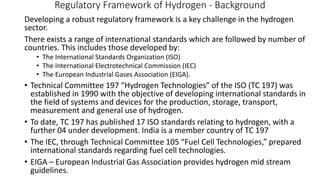
Regulatory Framework of Hydrogen - Background
Developing a robust regulatory framework is a key challenge in the hydrogen
sector.
There exists a range of international standards which are followed by number of
countries. This includes those developed by:
• The International Standards Organization (ISO)
• The International Electrotechnical Commission (IEC)
• The European Industrial Gases Association (EIGA).
• Technical Committee 197 “Hydrogen Technologies” of the ISO (TC 197) was
established in 1990 with the objective of developing international standards in
the field of systems and devices for the production, storage, transport,
measurement and general use of hydrogen.
• To date, TC 197 has published 17 ISO standards relating to hydrogen, with a
further 04 under development. India is a member country of TC 197
• The IEC, through Technical Committee 105 “Fuel Cell Technologies,” prepared
international standards regarding fuel cell technologies.
• EIGA – European Industrial Gas Association provides hydrogen mid stream
guidelines.
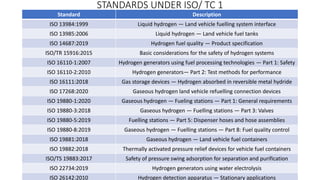
STANDARDS UNDER ISO/ TC 1
Standard Description
ISO 13984:1999 Liquid hydrogen — Land vehicle fuelling system interface
ISO 13985:2006 Liquid hydrogen — Land vehicle fuel tanks
ISO 14687:2019 Hydrogen fuel quality — Product specification
ISO/TR 15916:2015 Basic considerations for the safety of hydrogen systems
ISO 16110-1:2007 Hydrogen generators using fuel processing technologies — Part 1: Safety
ISO 16110-2:2010 Hydrogen generators— Part 2: Test methods for performance
ISO 16111:2018 Gas storage devices — Hydrogen absorbed in reversible metal hydride
ISO 17268:2020 Gaseous hydrogen land vehicle refuelling connection devices
ISO 19880-1:2020 Gaseous hydrogen — Fueling stations — Part 1: General requirements
ISO 19880-3:2018 Gaseous hydrogen — Fuelling stations — Part 3: Valves
ISO 19880-5:2019 Fuelling stations — Part 5: Dispenser hoses and hose assemblies
ISO 19880-8:2019 Gaseous hydrogen — Fuelling stations — Part 8: Fuel quality control
ISO 19881:2018 Gaseous hydrogen — Land vehicle fuel containers
ISO 19882:2018 Thermally activated pressure relief devices for vehicle fuel containers
ISO/TS 19883:2017 Safety of pressure swing adsorption for separation and purification
ISO 22734:2019 Hydrogen generators using water electrolysis
ISO 26142:2010 Hydrogen detection apparatus — Stationary applications
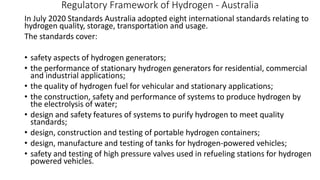
Regulatory Framework of Hydrogen - Australia
In July 2020 Standards Australia adopted eight international standards relating to
hydrogen quality, storage, transportation and usage.
The standards cover:
• safety aspects of hydrogen generators;
• the performance of stationary hydrogen generators for residential, commercial
and industrial applications;
• the quality of hydrogen fuel for vehicular and stationary applications;
• the construction, safety and performance of systems to produce hydrogen by
the electrolysis of water;
• design and safety features of systems to purify hydrogen to meet quality
standards;
• design, construction and testing of portable hydrogen containers;
• design, manufacture and testing of tanks for hydrogen-powered vehicles;
• safety and testing of high pressure valves used in refueling stations for hydrogen
powered vehicles.
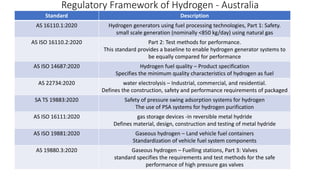
Regulatory Framework of Hydrogen - Australia
Standard Description
AS 16110.1:2020 Hydrogen generators using fuel processing technologies, Part 1: Safety.
small scale generation (nominally <850 kg/day) using natural gas
AS ISO 16110.2:2020 Part 2: Test methods for performance.
This standard provides a baseline to enable hydrogen generator systems to
be equally compared for performance
AS ISO 14687:2020 Hydrogen fuel quality – Product specification
Specifies the minimum quality characteristics of hydrogen as fuel
AS 22734:2020 water electrolysis – Industrial, commercial, and residential.
Defines the construction, safety and performance requirements of packaged
SA TS 19883:2020 Safety of pressure swing adsorption systems for hydrogen
The use of PSA systems for hydrogen purification
AS ISO 16111:2020 gas storage devices -in reversible metal hydride
Defines material, design, construction and testing of metal hydride
AS ISO 19881:2020 Gaseous hydrogen – Land vehicle fuel containers
Standardization of vehicle fuel system components
AS 19880.3:2020 Gaseous hydrogen – Fuelling stations, Part 3: Valves
standard specifies the requirements and test methods for the safe
performance of high pressure gas valves
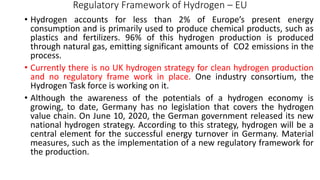
Regulatory Framework of Hydrogen – EU
• Hydrogen accounts for less than 2% of Europe’s present energy
consumption and is primarily used to produce chemical products, such as
plastics and fertilizers. 96% of this hydrogen production is produced
through natural gas, emitting significant amounts of CO2 emissions in the
process.
• Currently there is no UK hydrogen strategy for clean hydrogen production
and no regulatory frame work in place. One industry consortium, the
Hydrogen Task force is working on it.
• Although the awareness of the potentials of a hydrogen economy is
growing, to date, Germany has no legislation that covers the hydrogen
value chain. On June 10, 2020, the German government released its new
national hydrogen strategy. According to this strategy, hydrogen will be a
central element for the successful energy turnover in Germany. Material
measures, such as the implementation of a new regulatory framework for
the production.
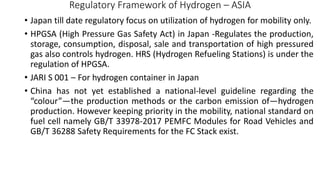
Regulatory Framework of Hydrogen – ASIA
• Japan till date regulatory focus on utilization of hydrogen for mobility only.
• HPGSA (High Pressure Gas Safety Act) in Japan -Regulates the production,
storage, consumption, disposal, sale and transportation of high pressured
gas also controls hydrogen. HRS (Hydrogen Refueling Stations) is under the
regulation of HPGSA.
• JARI S 001 – For hydrogen container in Japan
• China has not yet established a national-level guideline regarding the
“colour”—the production methods or the carbon emission of—hydrogen
production. However keeping priority in the mobility, national standard on
fuel cell namely GB/T 33978-2017 PEMFC Modules for Road Vehicles and
GB/T 36288 Safety Requirements for the FC Stack exist.
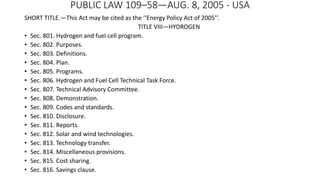
PUBLIC LAW 109–58—AUG. 8, 2005 - USA
SHORT TITLE.—This Act may be cited as the ‘‘Energy Policy Act of 2005’’.
TITLE VIII—HYDROGEN
• Sec. 801. Hydrogen and fuel cell program.
• Sec. 802. Purposes.
• Sec. 803. Definitions.
• Sec. 804. Plan.
• Sec. 805. Programs.
• Sec. 806. Hydrogen and Fuel Cell Technical Task Force.
• Sec. 807. Technical Advisory Committee.
• Sec. 808. Demonstration.
• Sec. 809. Codes and standards.
• Sec. 810. Disclosure.
• Sec. 811. Reports.
• Sec. 812. Solar and wind technologies.
• Sec. 813. Technology transfer.
• Sec. 814. Miscellaneous provisions.
• Sec. 815. Cost sharing.
• Sec. 816. Savings clause.
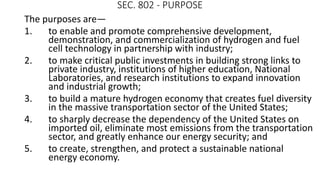
SEC. 802 - PURPOSE
The purposes are—
1. to enable and promote comprehensive development,
demonstration, and commercialization of hydrogen and fuel
cell technology in partnership with industry;
2. to make critical public investments in building strong links to
private industry, institutions of higher education, National
Laboratories, and research institutions to expand innovation
and industrial growth;
3. to build a mature hydrogen economy that creates fuel diversity
in the massive transportation sector of the United States;
4. to sharply decrease the dependency of the United States on
imported oil, eliminate most emissions from the transportation
sector, and greatly enhance our energy security; and
5. to create, strengthen, and protect a sustainable national
energy economy.
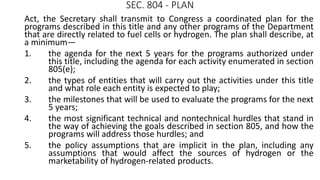
SEC. 804 - PLAN
Act, the Secretary shall transmit to Congress a coordinated plan for the
programs described in this title and any other programs of the Department
that are directly related to fuel cells or hydrogen. The plan shall describe, at
a minimum—
1. the agenda for the next 5 years for the programs authorized under
this title, including the agenda for each activity enumerated in section
805(e);
2. the types of entities that will carry out the activities under this title
and what role each entity is expected to play;
3. the milestones that will be used to evaluate the programs for the next
5 years;
4. the most significant technical and nontechnical hurdles that stand in
the way of achieving the goals described in section 805, and how the
programs will address those hurdles; and
5. the policy assumptions that are implicit in the plan, including any
assumptions that would affect the sources of hydrogen or the
marketability of hydrogen-related products.
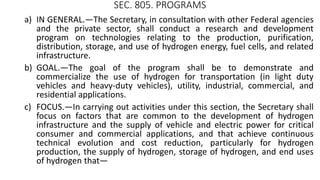
SEC. 805. PROGRAMS
a) IN GENERAL.—The Secretary, in consultation with other Federal agencies
and the private sector, shall conduct a research and development
program on technologies relating to the production, purification,
distribution, storage, and use of hydrogen energy, fuel cells, and related
infrastructure.
b) GOAL.—The goal of the program shall be to demonstrate and
commercialize the use of hydrogen for transportation (in light duty
vehicles and heavy-duty vehicles), utility, industrial, commercial, and
residential applications.
c) FOCUS.—In carrying out activities under this section, the Secretary shall
focus on factors that are common to the development of hydrogen
infrastructure and the supply of vehicle and electric power for critical
consumer and commercial applications, and that achieve continuous
technical evolution and cost reduction, particularly for hydrogen
production, the supply of hydrogen, storage of hydrogen, and end uses
of hydrogen that—
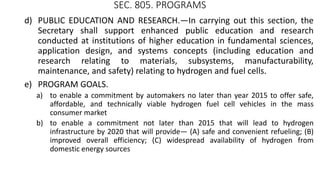
SEC. 805. PROGRAMS
d) PUBLIC EDUCATION AND RESEARCH.—In carrying out this section, the
Secretary shall support enhanced public education and research
conducted at institutions of higher education in fundamental sciences,
application design, and systems concepts (including education and
research relating to materials, subsystems, manufacturability,
maintenance, and safety) relating to hydrogen and fuel cells.
e) PROGRAM GOALS.
a) to enable a commitment by automakers no later than year 2015 to offer safe,
affordable, and technically viable hydrogen fuel cell vehicles in the mass
consumer market
b) to enable a commitment not later than 2015 that will lead to hydrogen
infrastructure by 2020 that will provide— (A) safe and convenient refueling; (B)
improved overall efficiency; (C) widespread availability of hydrogen from
domestic energy sources
SEC. 805. PROGRAMS
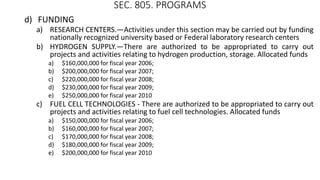
d) FUNDING
a) RESEARCH CENTERS.—Activities under this section may be carried out by funding
nationally recognized university based or Federal laboratory research centers
b) HYDROGEN SUPPLY.—There are authorized to be appropriated to carry out
projects and activities relating to hydrogen production, storage. Allocated funds
a) $160,000,000 for fiscal year 2006;
b) $200,000,000 for fiscal year 2007;
c) $220,000,000 for fiscal year 2008;
d) $230,000,000 for fiscal year 2009;
e) $250,000,000 for fiscal year 2010
c) FUEL CELL TECHNOLOGIES - There are authorized to be appropriated to carry out
projects and activities relating to fuel cell technologies. Allocated funds
a) $150,000,000 for fiscal year 2006;
b) $160,000,000 for fiscal year 2007;
c) $170,000,000 for fiscal year 2008;
d) $180,000,000 for fiscal year 2009;
e) $200,000,000 for fiscal year 2010
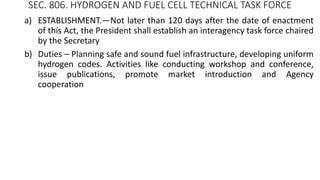
SEC. 806. HYDROGEN AND FUEL CELL TECHNICAL TASK FORCE
a) ESTABLISHMENT.—Not later than 120 days after the date of enactment
of this Act, the President shall establish an interagency task force chaired
by the Secretary
b) Duties – Planning safe and sound fuel infrastructure, developing uniform
hydrogen codes. Activities like conducting workshop and conference,
issue publications, promote market introduction and Agency
cooperation
SEC. 807. TECHNICAL ADVISORY COMMITTEE
a) ESTABLISHMENT.—The Hydrogen Technical and Fuel Cell Advisory
Committee is established to advise the Secretary on the programs and
activities under this title
b) MEMBERS – to represent domestic industry, academia, professional
societies, government agencies, Federal laboratories, previous advisory
panels, and financial, environmental, and other appropriate
organizations based on the Department’s assessment
c) TERMS – Maximum 3 years
d) BIENNIAL REPORT - The Secretary shall transmit a biennial report to
Congress describing any recommendations made by the Technical
Advisory Committee
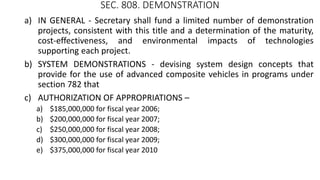
SEC. 808. DEMONSTRATION
a) IN GENERAL - Secretary shall fund a limited number of demonstration
projects, consistent with this title and a determination of the maturity,
cost-effectiveness, and environmental impacts of technologies
supporting each project.
b) SYSTEM DEMONSTRATIONS - devising system design concepts that
provide for the use of advanced composite vehicles in programs under
section 782 that
c) AUTHORIZATION OF APPROPRIATIONS –
a) $185,000,000 for fiscal year 2006;
b) $200,000,000 for fiscal year 2007;
c) $250,000,000 for fiscal year 2008;
d) $300,000,000 for fiscal year 2009;
e) $375,000,000 for fiscal year 2010
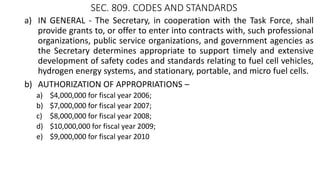
SEC. 809. CODES AND STANDARDS
a) IN GENERAL - The Secretary, in cooperation with the Task Force, shall
provide grants to, or offer to enter into contracts with, such professional
organizations, public service organizations, and government agencies as
the Secretary determines appropriate to support timely and extensive
development of safety codes and standards relating to fuel cell vehicles,
hydrogen energy systems, and stationary, portable, and micro fuel cells.
b) AUTHORIZATION OF APPROPRIATIONS –
a) $4,000,000 for fiscal year 2006;
b) $7,000,000 for fiscal year 2007;
c) $8,000,000 for fiscal year 2008;
d) $10,000,000 for fiscal year 2009;
e) $9,000,000 for fiscal year 2010
SEC. 933. LOW-COST RENEWABLE HYDROGEN AND INFRASTRUCTURE
FOR VEHICLE PROPULSION
The Secretary shall—
• Establish a research, development, and demonstration program to determine
the feasibility of using hydrogen propulsion in light-weight vehicles and the
integration of the associated hydrogen production infrastructure using off-the-
shelf components; and
• Identify universities and institutions that—
A. have expertise in researching and testing vehicles fueled by hydrogen,
methane, and other fuels;
B. have expertise in integrating off-the-shelf components to minimize cost;
and
C. within 2 years can test a vehicle based on an existing commercially
available platform with a curb weight of not less than 2,000 pounds before
modifications, that—
• (i) operates solely on hydrogen;
• (ii) qualifies as a light-duty passenger vehicle; and
SEC. 1820. OVERALL EMPLOYMENT IN A HYDROGEN ECONOMY
STUDY.—
1. IN GENERAL.—The Secretary shall carry out a study of the likely effects of a
transition to a hydrogen economy on overall employment in the United States.
2. CONTENTS.—In completing the study, the Secretary shall take into
consideration—
1. the replacement effects of new goods and services;
2. international competition;
3. workforce training requirements;
4. multiple possible fuel cycles, including usage of raw materials;
5. rates of market penetration of technologies; and
6. regional variations based on geography.
3. REPORT.—Not later than 18 months after the date of enactment of this Act,
the Secretary shall submit to Congress a report describing the findings,
conclusions, and recommendations of the study under subsection (a).
Regulatory Framework of Hydrogen – INDIA
Indian Standard HYDROGEN—CODE OF SAFETY - IS 15201 : 2002
Testing, standards, codes and regulations for hydrogen vehicles follows TC
197 standards.
CERC vide its notification No.: RA-14026(11)/4/2020-CERC on Terms and
Conditions for Tariff determination from Renewable Energy Sources,
Regulation 2020 comes out hydrogen as energy storage. Clause 76 given
guidelines for tariff determination of energy storage with renewable project
Regulatory Framework of Hydrogen – INDIA
AIS-157/DF - Automotive industry standard – safety and procedural
requirements for type approval of compressed gaseous hydrogen fuel cell
vehicles - Final draft stage.
National Hydrogen Energy Mission - aims for generation of hydrogen from
green power resources. , formally announced in the Union budget 20-21.
Draft regulations for NHM under preparation.
To put a mandate on using around 10% of domestic green hydrogen in
Industries where it is much needed, such as fertilizer, steel and oil refineries
(they are importing natural gas or ammonia for producing hydrogen)
For the current financial year, MNRE has been allotted Rs 25 crore for
research and development(R&D) in hydrogen.
There will be five key areas the government will focus on. These include
R&D, demand creation, finding uses in industry, creating an eco-system
including policies for this and integrating industry with international
partnerships.
THANK YOU

Hydrogen policy regulations and standards

  • 1.
    HYDROGEN – POLICY,REGULATION AND STANDARDS GLOBAL SCENARIO
  • 2.
    Regulatory Framework ofHydrogen - Background Developing a robust regulatory framework is a key challenge in the hydrogen sector. There exists a range of international standards which are followed by number of countries. This includes those developed by: • The International Standards Organization (ISO) • The International Electrotechnical Commission (IEC) • The European Industrial Gases Association (EIGA). • Technical Committee 197 “Hydrogen Technologies” of the ISO (TC 197) was established in 1990 with the objective of developing international standards in the field of systems and devices for the production, storage, transport, measurement and general use of hydrogen. • To date, TC 197 has published 17 ISO standards relating to hydrogen, with a further 04 under development. India is a member country of TC 197 • The IEC, through Technical Committee 105 “Fuel Cell Technologies,” prepared international standards regarding fuel cell technologies. • EIGA – European Industrial Gas Association provides hydrogen mid stream guidelines.
  • 3.
    STANDARDS UNDER ISO/TC 1 Standard Description ISO 13984:1999 Liquid hydrogen — Land vehicle fuelling system interface ISO 13985:2006 Liquid hydrogen — Land vehicle fuel tanks ISO 14687:2019 Hydrogen fuel quality — Product specification ISO/TR 15916:2015 Basic considerations for the safety of hydrogen systems ISO 16110-1:2007 Hydrogen generators using fuel processing technologies — Part 1: Safety ISO 16110-2:2010 Hydrogen generators— Part 2: Test methods for performance ISO 16111:2018 Gas storage devices — Hydrogen absorbed in reversible metal hydride ISO 17268:2020 Gaseous hydrogen land vehicle refuelling connection devices ISO 19880-1:2020 Gaseous hydrogen — Fueling stations — Part 1: General requirements ISO 19880-3:2018 Gaseous hydrogen — Fuelling stations — Part 3: Valves ISO 19880-5:2019 Fuelling stations — Part 5: Dispenser hoses and hose assemblies ISO 19880-8:2019 Gaseous hydrogen — Fuelling stations — Part 8: Fuel quality control ISO 19881:2018 Gaseous hydrogen — Land vehicle fuel containers ISO 19882:2018 Thermally activated pressure relief devices for vehicle fuel containers ISO/TS 19883:2017 Safety of pressure swing adsorption for separation and purification ISO 22734:2019 Hydrogen generators using water electrolysis ISO 26142:2010 Hydrogen detection apparatus — Stationary applications
  • 4.
    Regulatory Framework ofHydrogen - Australia In July 2020 Standards Australia adopted eight international standards relating to hydrogen quality, storage, transportation and usage. The standards cover: • safety aspects of hydrogen generators; • the performance of stationary hydrogen generators for residential, commercial and industrial applications; • the quality of hydrogen fuel for vehicular and stationary applications; • the construction, safety and performance of systems to produce hydrogen by the electrolysis of water; • design and safety features of systems to purify hydrogen to meet quality standards; • design, construction and testing of portable hydrogen containers; • design, manufacture and testing of tanks for hydrogen-powered vehicles; • safety and testing of high pressure valves used in refueling stations for hydrogen powered vehicles.
  • 5.
    Regulatory Framework ofHydrogen - Australia Standard Description AS 16110.1:2020 Hydrogen generators using fuel processing technologies, Part 1: Safety. small scale generation (nominally <850 kg/day) using natural gas AS ISO 16110.2:2020 Part 2: Test methods for performance. This standard provides a baseline to enable hydrogen generator systems to be equally compared for performance AS ISO 14687:2020 Hydrogen fuel quality – Product specification Specifies the minimum quality characteristics of hydrogen as fuel AS 22734:2020 water electrolysis – Industrial, commercial, and residential. Defines the construction, safety and performance requirements of packaged SA TS 19883:2020 Safety of pressure swing adsorption systems for hydrogen The use of PSA systems for hydrogen purification AS ISO 16111:2020 gas storage devices -in reversible metal hydride Defines material, design, construction and testing of metal hydride AS ISO 19881:2020 Gaseous hydrogen – Land vehicle fuel containers Standardization of vehicle fuel system components AS 19880.3:2020 Gaseous hydrogen – Fuelling stations, Part 3: Valves standard specifies the requirements and test methods for the safe performance of high pressure gas valves
  • 6.
    Regulatory Framework ofHydrogen – EU • Hydrogen accounts for less than 2% of Europe’s present energy consumption and is primarily used to produce chemical products, such as plastics and fertilizers. 96% of this hydrogen production is produced through natural gas, emitting significant amounts of CO2 emissions in the process. • Currently there is no UK hydrogen strategy for clean hydrogen production and no regulatory frame work in place. One industry consortium, the Hydrogen Task force is working on it. • Although the awareness of the potentials of a hydrogen economy is growing, to date, Germany has no legislation that covers the hydrogen value chain. On June 10, 2020, the German government released its new national hydrogen strategy. According to this strategy, hydrogen will be a central element for the successful energy turnover in Germany. Material measures, such as the implementation of a new regulatory framework for the production.
  • 7.
    Regulatory Framework ofHydrogen – ASIA • Japan till date regulatory focus on utilization of hydrogen for mobility only. • HPGSA (High Pressure Gas Safety Act) in Japan -Regulates the production, storage, consumption, disposal, sale and transportation of high pressured gas also controls hydrogen. HRS (Hydrogen Refueling Stations) is under the regulation of HPGSA. • JARI S 001 – For hydrogen container in Japan • China has not yet established a national-level guideline regarding the “colour”—the production methods or the carbon emission of—hydrogen production. However keeping priority in the mobility, national standard on fuel cell namely GB/T 33978-2017 PEMFC Modules for Road Vehicles and GB/T 36288 Safety Requirements for the FC Stack exist.
  • 8.
    PUBLIC LAW 109–58—AUG.8, 2005 - USA SHORT TITLE.—This Act may be cited as the ‘‘Energy Policy Act of 2005’’. TITLE VIII—HYDROGEN • Sec. 801. Hydrogen and fuel cell program. • Sec. 802. Purposes. • Sec. 803. Definitions. • Sec. 804. Plan. • Sec. 805. Programs. • Sec. 806. Hydrogen and Fuel Cell Technical Task Force. • Sec. 807. Technical Advisory Committee. • Sec. 808. Demonstration. • Sec. 809. Codes and standards. • Sec. 810. Disclosure. • Sec. 811. Reports. • Sec. 812. Solar and wind technologies. • Sec. 813. Technology transfer. • Sec. 814. Miscellaneous provisions. • Sec. 815. Cost sharing. • Sec. 816. Savings clause.
  • 9.
    SEC. 802 -PURPOSE The purposes are— 1. to enable and promote comprehensive development, demonstration, and commercialization of hydrogen and fuel cell technology in partnership with industry; 2. to make critical public investments in building strong links to private industry, institutions of higher education, National Laboratories, and research institutions to expand innovation and industrial growth; 3. to build a mature hydrogen economy that creates fuel diversity in the massive transportation sector of the United States; 4. to sharply decrease the dependency of the United States on imported oil, eliminate most emissions from the transportation sector, and greatly enhance our energy security; and 5. to create, strengthen, and protect a sustainable national energy economy.
  • 10.
    SEC. 804 -PLAN Act, the Secretary shall transmit to Congress a coordinated plan for the programs described in this title and any other programs of the Department that are directly related to fuel cells or hydrogen. The plan shall describe, at a minimum— 1. the agenda for the next 5 years for the programs authorized under this title, including the agenda for each activity enumerated in section 805(e); 2. the types of entities that will carry out the activities under this title and what role each entity is expected to play; 3. the milestones that will be used to evaluate the programs for the next 5 years; 4. the most significant technical and nontechnical hurdles that stand in the way of achieving the goals described in section 805, and how the programs will address those hurdles; and 5. the policy assumptions that are implicit in the plan, including any assumptions that would affect the sources of hydrogen or the marketability of hydrogen-related products.
  • 11.
    SEC. 805. PROGRAMS a)IN GENERAL.—The Secretary, in consultation with other Federal agencies and the private sector, shall conduct a research and development program on technologies relating to the production, purification, distribution, storage, and use of hydrogen energy, fuel cells, and related infrastructure. b) GOAL.—The goal of the program shall be to demonstrate and commercialize the use of hydrogen for transportation (in light duty vehicles and heavy-duty vehicles), utility, industrial, commercial, and residential applications. c) FOCUS.—In carrying out activities under this section, the Secretary shall focus on factors that are common to the development of hydrogen infrastructure and the supply of vehicle and electric power for critical consumer and commercial applications, and that achieve continuous technical evolution and cost reduction, particularly for hydrogen production, the supply of hydrogen, storage of hydrogen, and end uses of hydrogen that—
  • 12.
    SEC. 805. PROGRAMS d)PUBLIC EDUCATION AND RESEARCH.—In carrying out this section, the Secretary shall support enhanced public education and research conducted at institutions of higher education in fundamental sciences, application design, and systems concepts (including education and research relating to materials, subsystems, manufacturability, maintenance, and safety) relating to hydrogen and fuel cells. e) PROGRAM GOALS. a) to enable a commitment by automakers no later than year 2015 to offer safe, affordable, and technically viable hydrogen fuel cell vehicles in the mass consumer market b) to enable a commitment not later than 2015 that will lead to hydrogen infrastructure by 2020 that will provide— (A) safe and convenient refueling; (B) improved overall efficiency; (C) widespread availability of hydrogen from domestic energy sources
  • 13.
    SEC. 805. PROGRAMS d)FUNDING a) RESEARCH CENTERS.—Activities under this section may be carried out by funding nationally recognized university based or Federal laboratory research centers b) HYDROGEN SUPPLY.—There are authorized to be appropriated to carry out projects and activities relating to hydrogen production, storage. Allocated funds a) $160,000,000 for fiscal year 2006; b) $200,000,000 for fiscal year 2007; c) $220,000,000 for fiscal year 2008; d) $230,000,000 for fiscal year 2009; e) $250,000,000 for fiscal year 2010 c) FUEL CELL TECHNOLOGIES - There are authorized to be appropriated to carry out projects and activities relating to fuel cell technologies. Allocated funds a) $150,000,000 for fiscal year 2006; b) $160,000,000 for fiscal year 2007; c) $170,000,000 for fiscal year 2008; d) $180,000,000 for fiscal year 2009; e) $200,000,000 for fiscal year 2010
  • 14.
    SEC. 806. HYDROGENAND FUEL CELL TECHNICAL TASK FORCE a) ESTABLISHMENT.—Not later than 120 days after the date of enactment of this Act, the President shall establish an interagency task force chaired by the Secretary b) Duties – Planning safe and sound fuel infrastructure, developing uniform hydrogen codes. Activities like conducting workshop and conference, issue publications, promote market introduction and Agency cooperation
  • 15.
    SEC. 807. TECHNICALADVISORY COMMITTEE a) ESTABLISHMENT.—The Hydrogen Technical and Fuel Cell Advisory Committee is established to advise the Secretary on the programs and activities under this title b) MEMBERS – to represent domestic industry, academia, professional societies, government agencies, Federal laboratories, previous advisory panels, and financial, environmental, and other appropriate organizations based on the Department’s assessment c) TERMS – Maximum 3 years d) BIENNIAL REPORT - The Secretary shall transmit a biennial report to Congress describing any recommendations made by the Technical Advisory Committee
  • 16.
    SEC. 808. DEMONSTRATION a)IN GENERAL - Secretary shall fund a limited number of demonstration projects, consistent with this title and a determination of the maturity, cost-effectiveness, and environmental impacts of technologies supporting each project. b) SYSTEM DEMONSTRATIONS - devising system design concepts that provide for the use of advanced composite vehicles in programs under section 782 that c) AUTHORIZATION OF APPROPRIATIONS – a) $185,000,000 for fiscal year 2006; b) $200,000,000 for fiscal year 2007; c) $250,000,000 for fiscal year 2008; d) $300,000,000 for fiscal year 2009; e) $375,000,000 for fiscal year 2010
  • 17.
    SEC. 809. CODESAND STANDARDS a) IN GENERAL - The Secretary, in cooperation with the Task Force, shall provide grants to, or offer to enter into contracts with, such professional organizations, public service organizations, and government agencies as the Secretary determines appropriate to support timely and extensive development of safety codes and standards relating to fuel cell vehicles, hydrogen energy systems, and stationary, portable, and micro fuel cells. b) AUTHORIZATION OF APPROPRIATIONS – a) $4,000,000 for fiscal year 2006; b) $7,000,000 for fiscal year 2007; c) $8,000,000 for fiscal year 2008; d) $10,000,000 for fiscal year 2009; e) $9,000,000 for fiscal year 2010
  • 18.
    SEC. 933. LOW-COSTRENEWABLE HYDROGEN AND INFRASTRUCTURE FOR VEHICLE PROPULSION The Secretary shall— • Establish a research, development, and demonstration program to determine the feasibility of using hydrogen propulsion in light-weight vehicles and the integration of the associated hydrogen production infrastructure using off-the- shelf components; and • Identify universities and institutions that— A. have expertise in researching and testing vehicles fueled by hydrogen, methane, and other fuels; B. have expertise in integrating off-the-shelf components to minimize cost; and C. within 2 years can test a vehicle based on an existing commercially available platform with a curb weight of not less than 2,000 pounds before modifications, that— • (i) operates solely on hydrogen; • (ii) qualifies as a light-duty passenger vehicle; and
  • 19.
    SEC. 1820. OVERALLEMPLOYMENT IN A HYDROGEN ECONOMY STUDY.— 1. IN GENERAL.—The Secretary shall carry out a study of the likely effects of a transition to a hydrogen economy on overall employment in the United States. 2. CONTENTS.—In completing the study, the Secretary shall take into consideration— 1. the replacement effects of new goods and services; 2. international competition; 3. workforce training requirements; 4. multiple possible fuel cycles, including usage of raw materials; 5. rates of market penetration of technologies; and 6. regional variations based on geography. 3. REPORT.—Not later than 18 months after the date of enactment of this Act, the Secretary shall submit to Congress a report describing the findings, conclusions, and recommendations of the study under subsection (a).
  • 20.
    Regulatory Framework ofHydrogen – INDIA Indian Standard HYDROGEN—CODE OF SAFETY - IS 15201 : 2002 Testing, standards, codes and regulations for hydrogen vehicles follows TC 197 standards. CERC vide its notification No.: RA-14026(11)/4/2020-CERC on Terms and Conditions for Tariff determination from Renewable Energy Sources, Regulation 2020 comes out hydrogen as energy storage. Clause 76 given guidelines for tariff determination of energy storage with renewable project
  • 21.
    Regulatory Framework ofHydrogen – INDIA AIS-157/DF - Automotive industry standard – safety and procedural requirements for type approval of compressed gaseous hydrogen fuel cell vehicles - Final draft stage. National Hydrogen Energy Mission - aims for generation of hydrogen from green power resources. , formally announced in the Union budget 20-21. Draft regulations for NHM under preparation. To put a mandate on using around 10% of domestic green hydrogen in Industries where it is much needed, such as fertilizer, steel and oil refineries (they are importing natural gas or ammonia for producing hydrogen) For the current financial year, MNRE has been allotted Rs 25 crore for research and development(R&D) in hydrogen. There will be five key areas the government will focus on. These include R&D, demand creation, finding uses in industry, creating an eco-system including policies for this and integrating industry with international partnerships.
  • 22.