Notes
On
“Recovery, Recrystallisation and
Grain Growth”Grain Growth”
7/30/2018 1Prem Kumar Soni 9755084093
Introduction
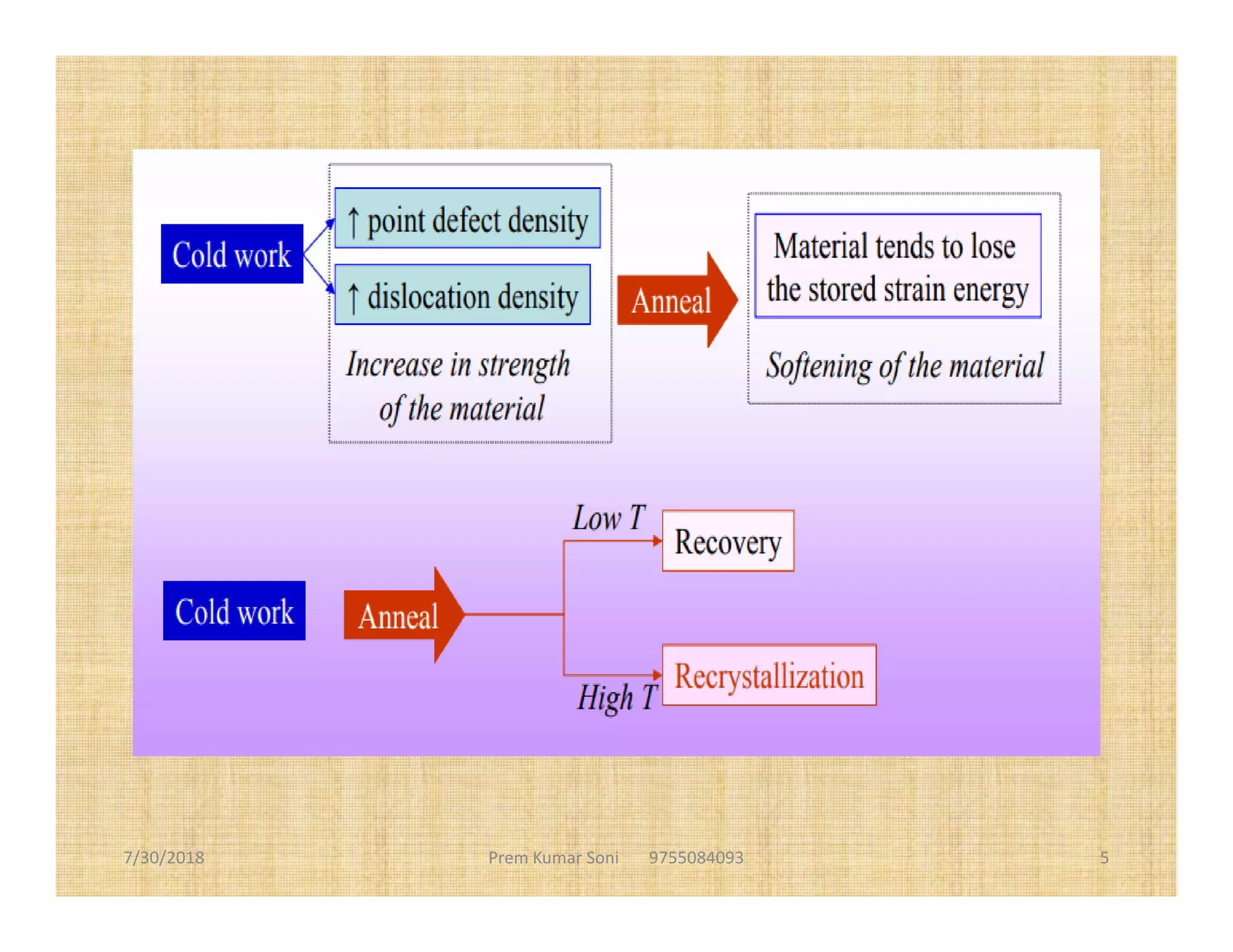
We now introduce a ‘technical term’ called Cold
Work. We will arrive at a formal definition of the
term at the end of this topic.
For now we use a working definition of cold work
as:as:
Plastic deformation in the temperature range
(0.3 – 0.5) Tm → COLD WORK
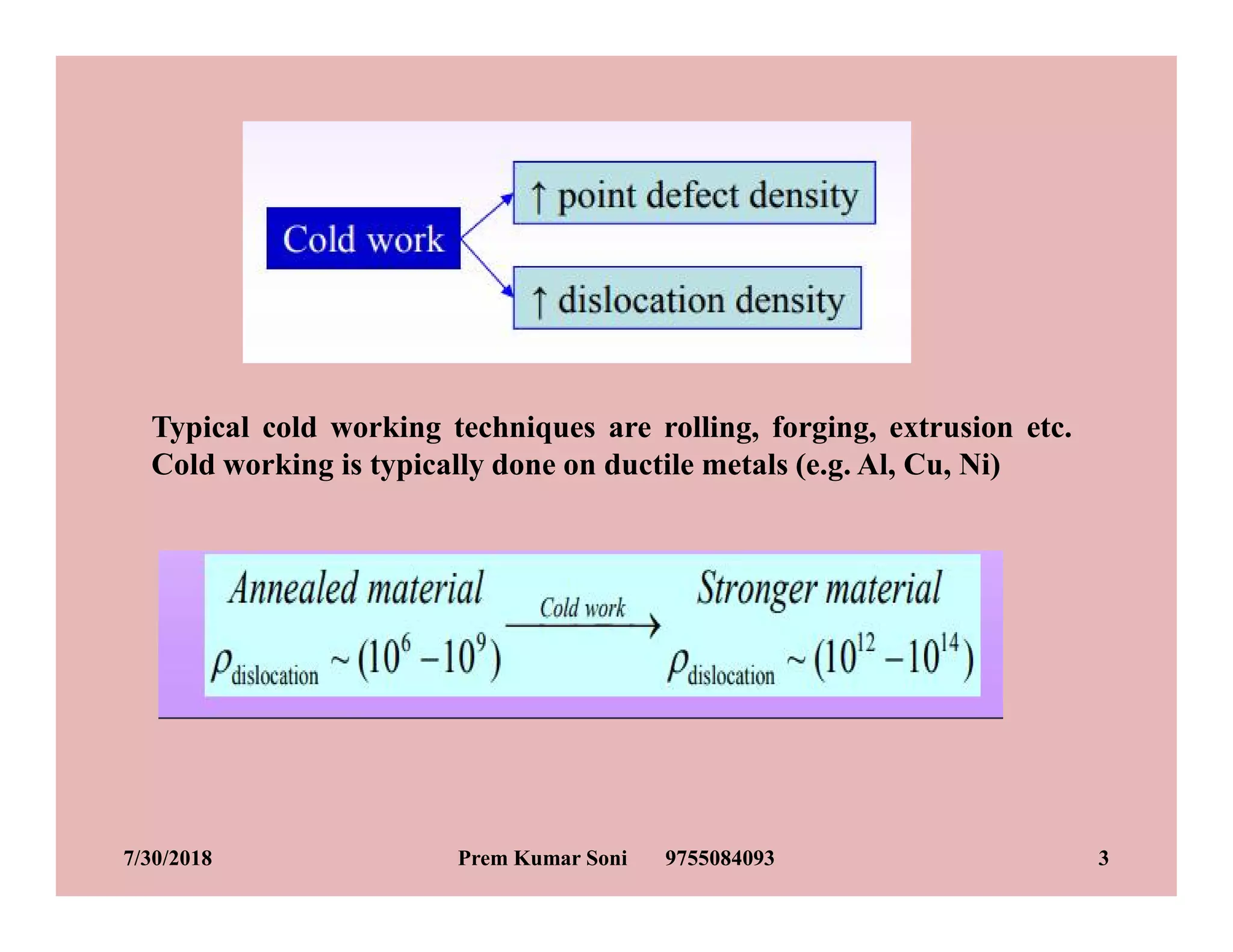
During cold work the point defect density
(vacancies, self interstitials…) and dislocation
density increase.
7/30/2018 Prem Kumar Soni 9755084093 2
Typical cold working techniques are rolling, forging, extrusion etc.
Cold working is typically done on ductile metals (e.g. Al, Cu, Ni)
7/30/2018 Prem Kumar Soni 9755084093 3
Cold working is typically done on ductile metals (e.g. Al, Cu, Ni)
The cold worked material is stronger (harder), but
is brittle (as noted before).
 Heating the material (typically below 0.5 Tm) is
and holding for sufficient time is a heat treatment
process called annealing.
Depending on the temperature of annealing
processes like Recovery (at lower temperatures)
or Recrystallisation (at higher temperatures) mayor Recrystallisation (at higher temperatures) may
take place. During these processes the material
tends to go from a microstructurally metastable
state to a lower energy state (towards a stable
state).
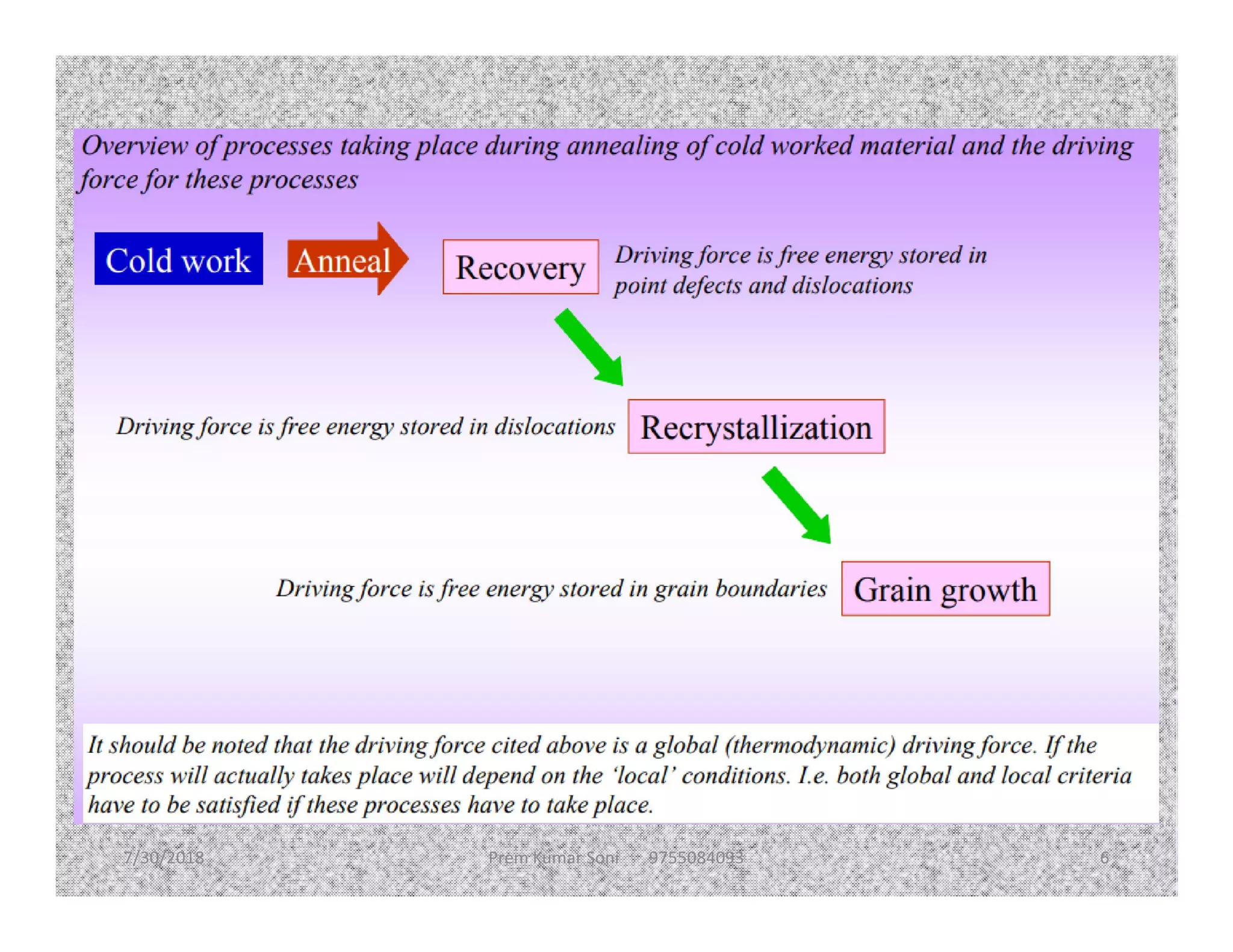
Further ‘annealing’ of the recrystallized material
can lead to grain growth.
7/30/2018 Prem Kumar Soni 9755084093 4
7/30/2018 Prem Kumar Soni 9755084093 5
7/30/2018 Prem Kumar Soni 9755084093 6
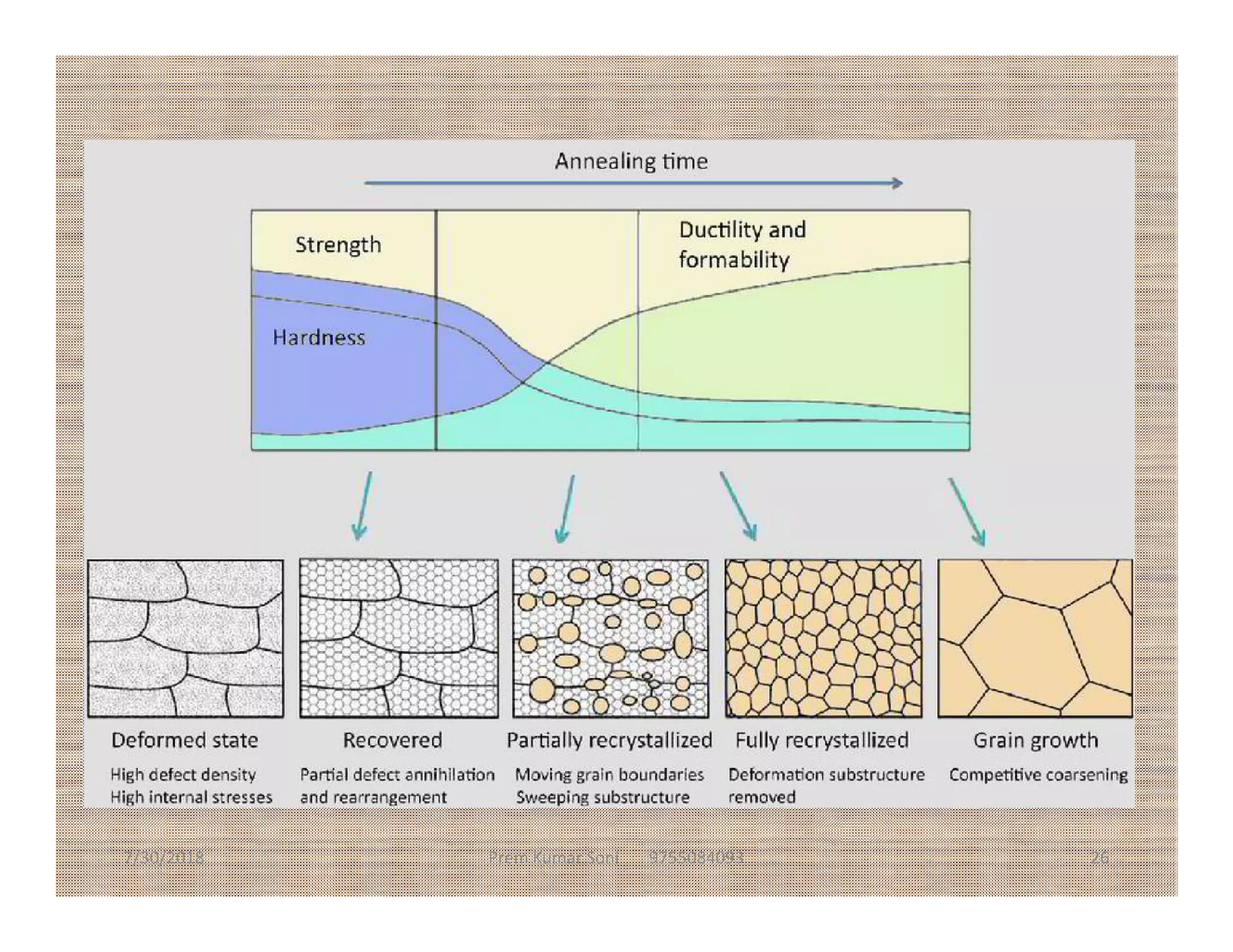
Recovery is a process by which
deformed grains can reduce their stored
energy by the removal or rearrangement of
defects in their crystal structure.
These defects, primarily dislocations, are
introduced by plastic deformation of theintroduced by plastic deformation of the
material and act to increase the yield strength
of a material.
7/30/2018 Prem Kumar Soni 9755084093 7
recovery
7/30/2018 Prem Kumar Soni 9755084093 8
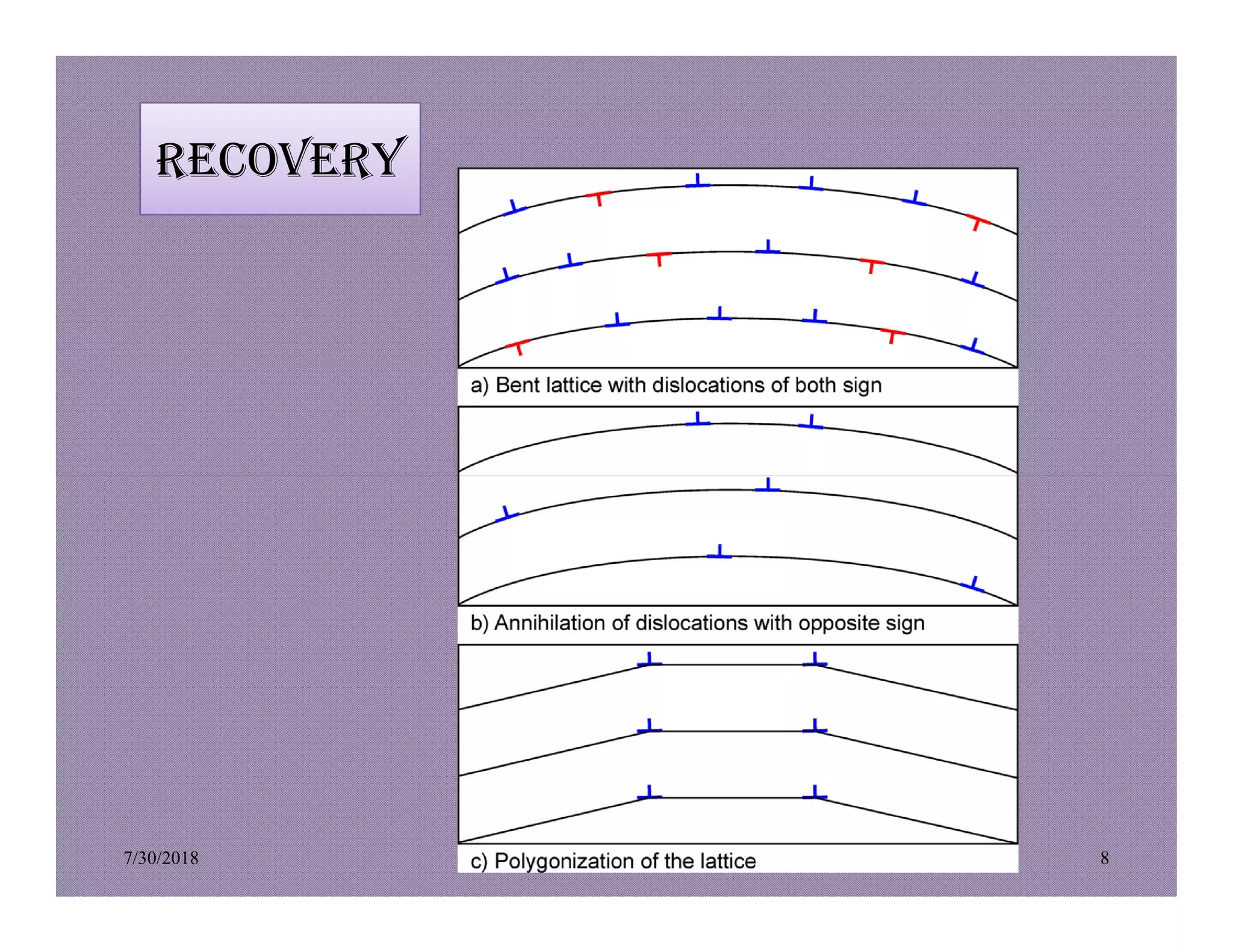
Recovery is a process that kicks in at low
temperatures; in this stage, the excess defects
are annealed out, dislocations of opposite signs
annihilate each other, and dislocations align to
form low energy configurations, namely tiltform low energy configurations, namely tilt
and twist boundaries
7/30/2018 9Prem Kumar Soni 9755084093
Basically we can say,
In Cold working
• Strength, Electrical Resistance and hardness
Increases.
• Ductility Decreases
7/30/2018 Prem Kumar Soni 9755084093 10
Summary
 Recovery takes place at low temperatures of annealing
“Apparently no change in microstructure”
 Excess point defects created during Cold work are absorbed:
 at surface or grain boundaries
 by dislocation climb
 Random dislocations of opposite sign come together and annihilate
each othereach other
 Dislocations of same sign arrange into low energy configurations:
 Edge → Tilt boundaries
 Screw → Twist boundaries
 POLYGONIZATION
 Overall reduction in dislocation density is small
7/30/2018 Prem Kumar Soni 9755084093 11
Recrystallisation
Recrystallisation is the process in which
deformed grains are replaced by strain-free
grains.
It is generally observed that higher cold workIt is generally observed that higher cold work
and smaller initial grain size lead to finer
recrystallised grains.
The driving force for recrystallisation is the
stored strain energy in the material.
7/30/2018 Prem Kumar Soni 9755084093 12
Recrystallisation is defined as the process in
which grains of a crystal structure come in a
new structure or new crystal shape.
A precise definition of recrystallisation isA precise definition of recrystallisation is
difficult to state as the process is strongly
related to several other processes, most
notably recovery and grain growth. In some
cases it is difficult to precisely define the point
at which one process begins and another ends.
7/30/2018 Prem Kumar Soni 9755084093 13
Process of Recrystallisation
7/30/2018 Prem Kumar Soni 9755084093 14
7/30/2018 Prem Kumar Soni 9755084093 15
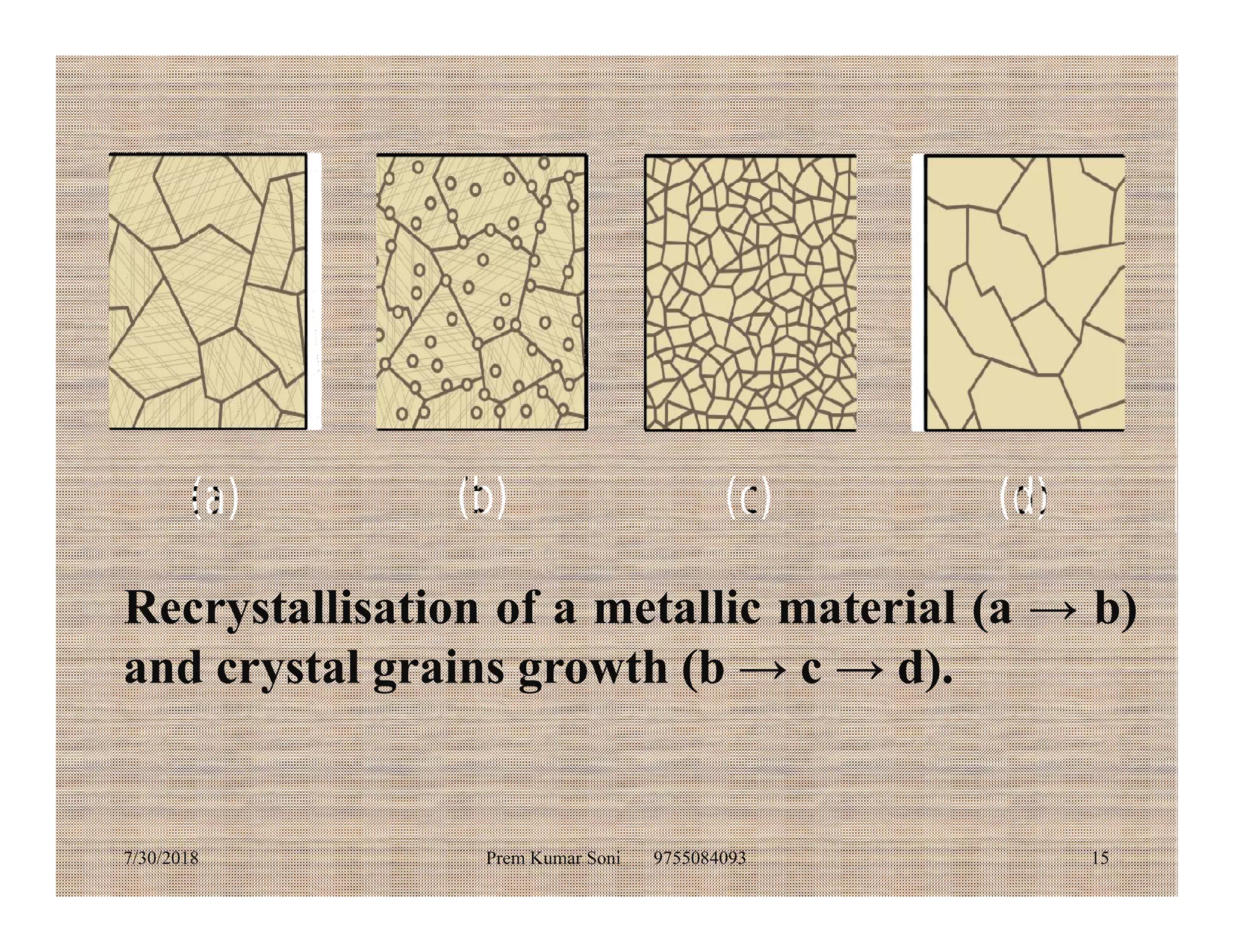
Recrystallisation of a metallic material (a → b)
and crystal grains growth (b → c → d).
7/30/2018 Prem Kumar Soni 9755084093 16
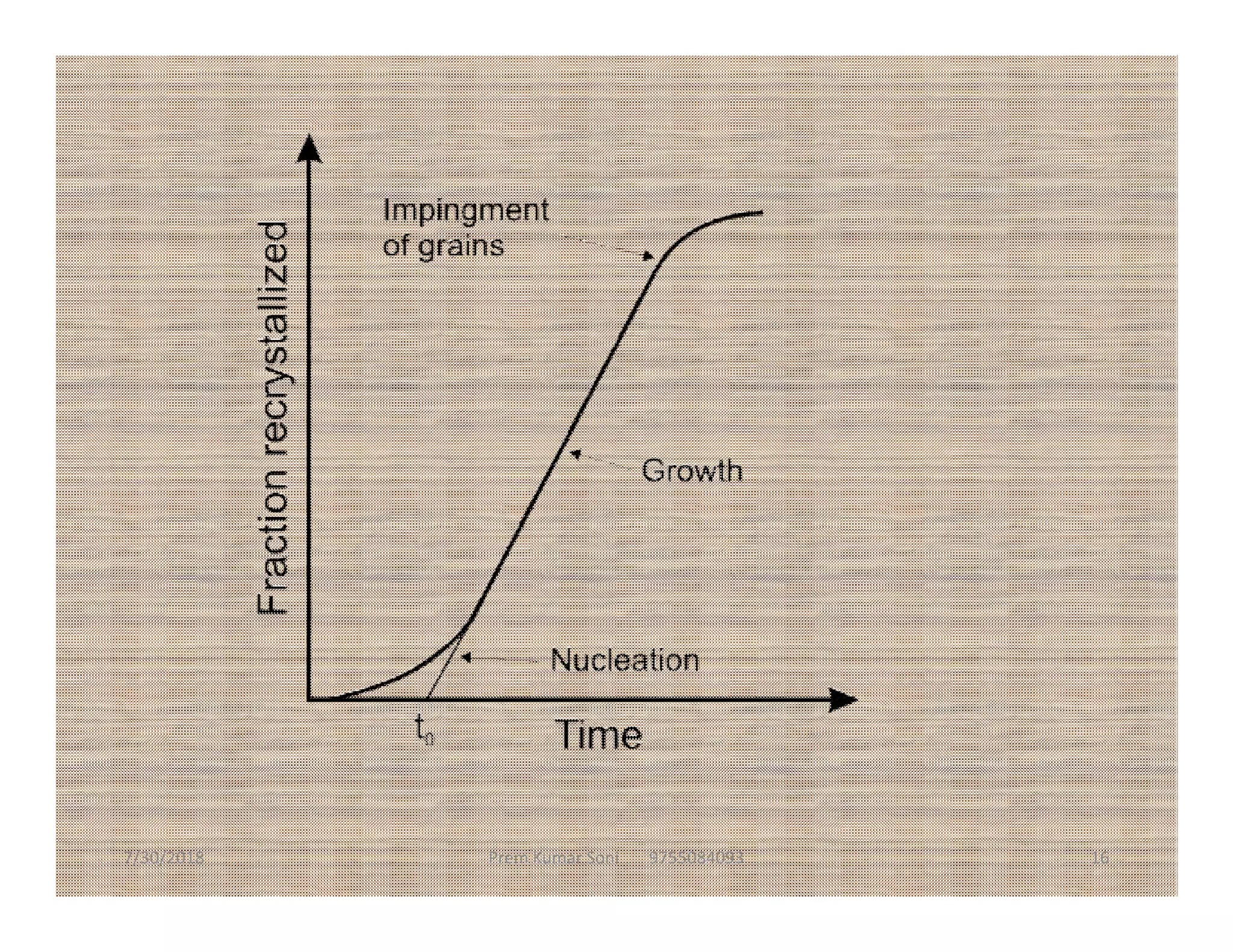
For Recrystallisation to take place, a minimum
of cold working is needed; if the deformation
is very low, recrystallisation does not occur.
During recrystallisation, the stress-free grains
nucleate and grow.
In a recrystallised system (after more thanIn a recrystallised system (after more than
about 90% deformation) the resultant
microstructure is textured; that is, most of the
grains have similar orientation.
7/30/2018 Prem Kumar Soni 9755084093 17
7/30/2018 Prem Kumar Soni 9755084093 18
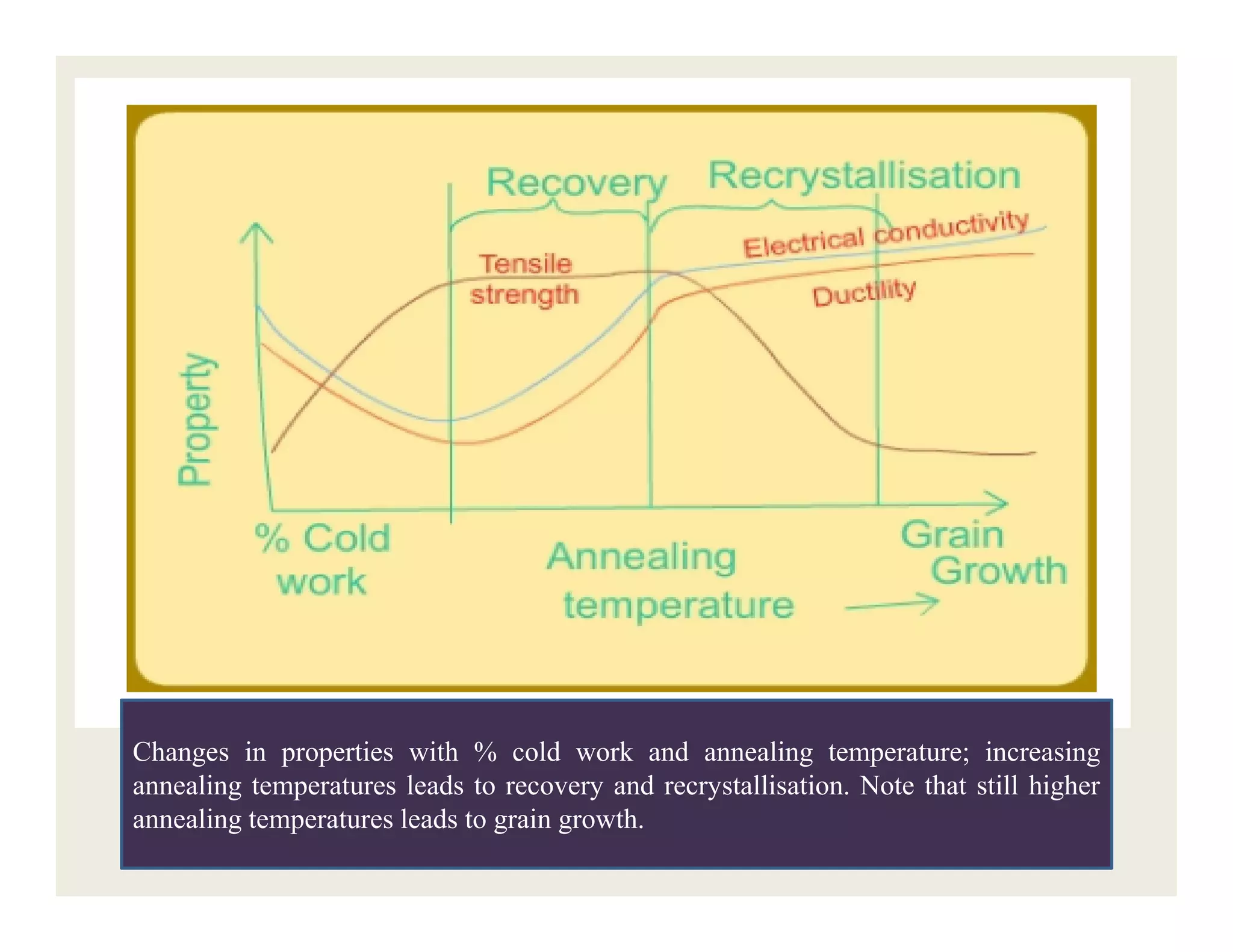
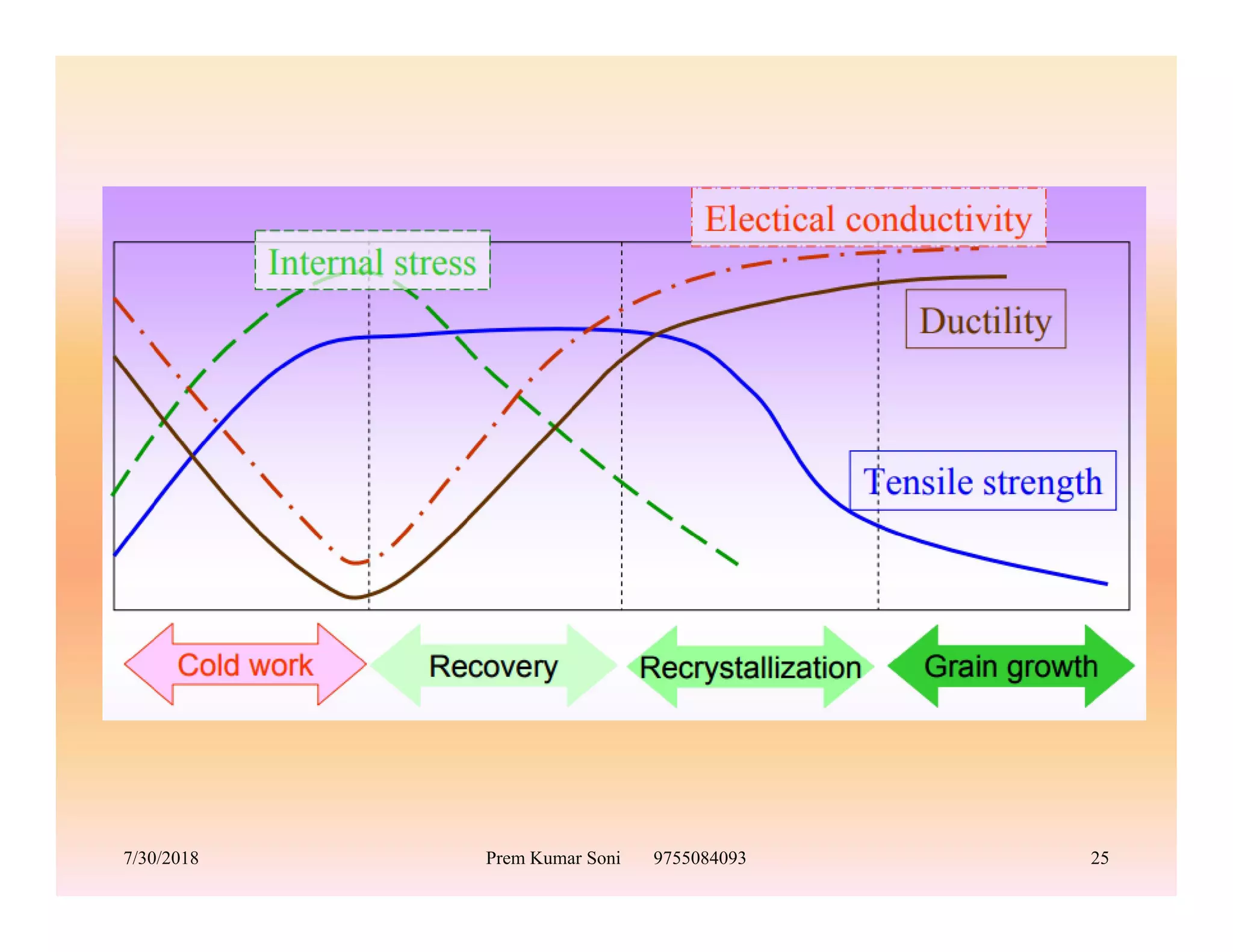
Changes in properties with % cold work and annealing temperature; increasing
annealing temperatures leads to recovery and recrystallisation. Note that still higher
annealing temperatures leads to grain growth.
The temperature at which a given material
completely recrystallises in an hour is defined as
the recrystallisation temperature.
The recrystallisation temperature is low if the
degree of deformation is high and/or if the
temperature of deformation is low and/or if the
initial grain size is small.initial grain size is small.
The recrystallisation temperature is also very
sensitive to the purity of the material; an addition
of 0.01 at.% of Te to pure copper, for example,
can increase the recrystallisation temperature by
about 240◦C.
7/30/2018 Prem Kumar Soni 9755084093 19
7/30/2018 Prem Kumar Soni 9755084093 20
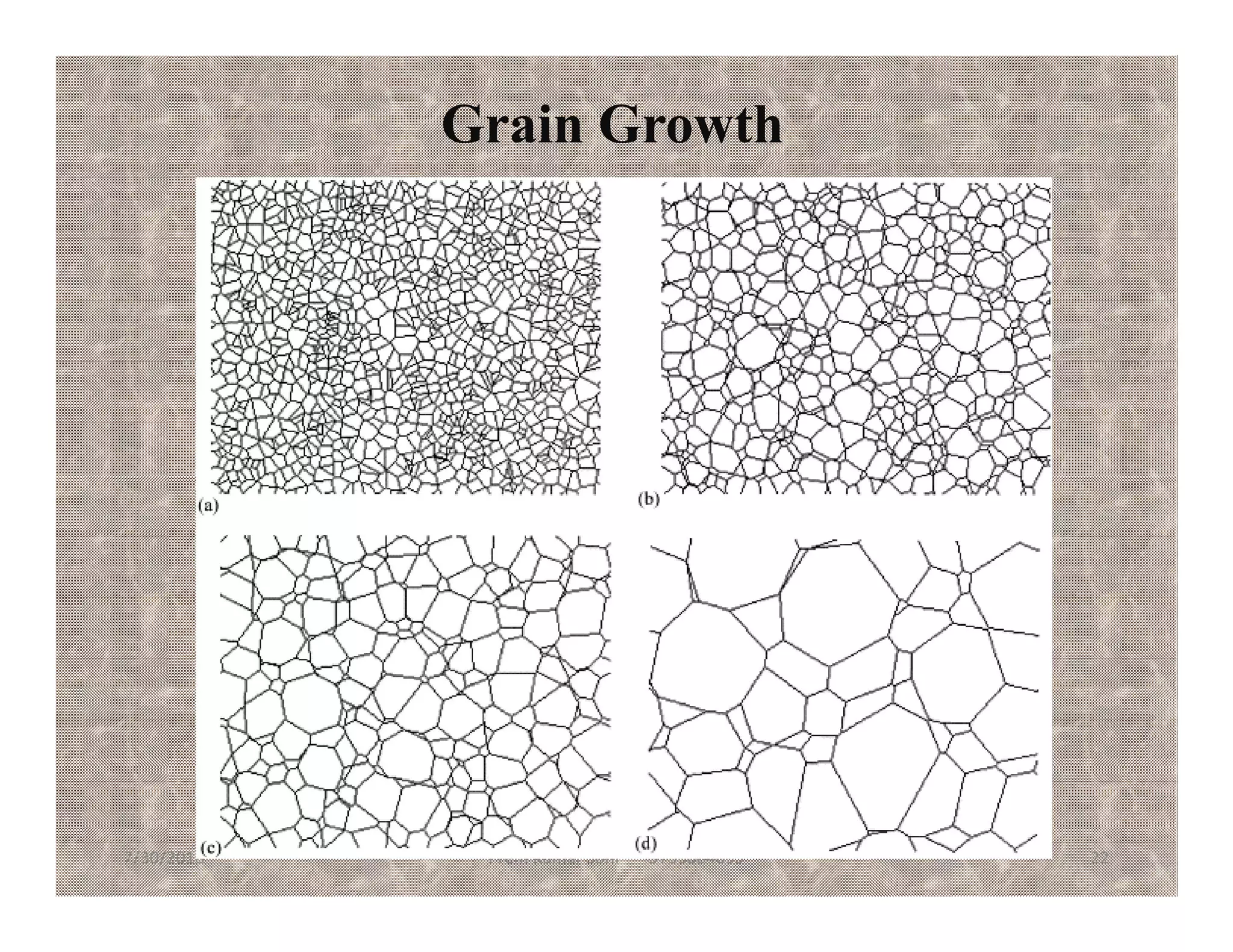
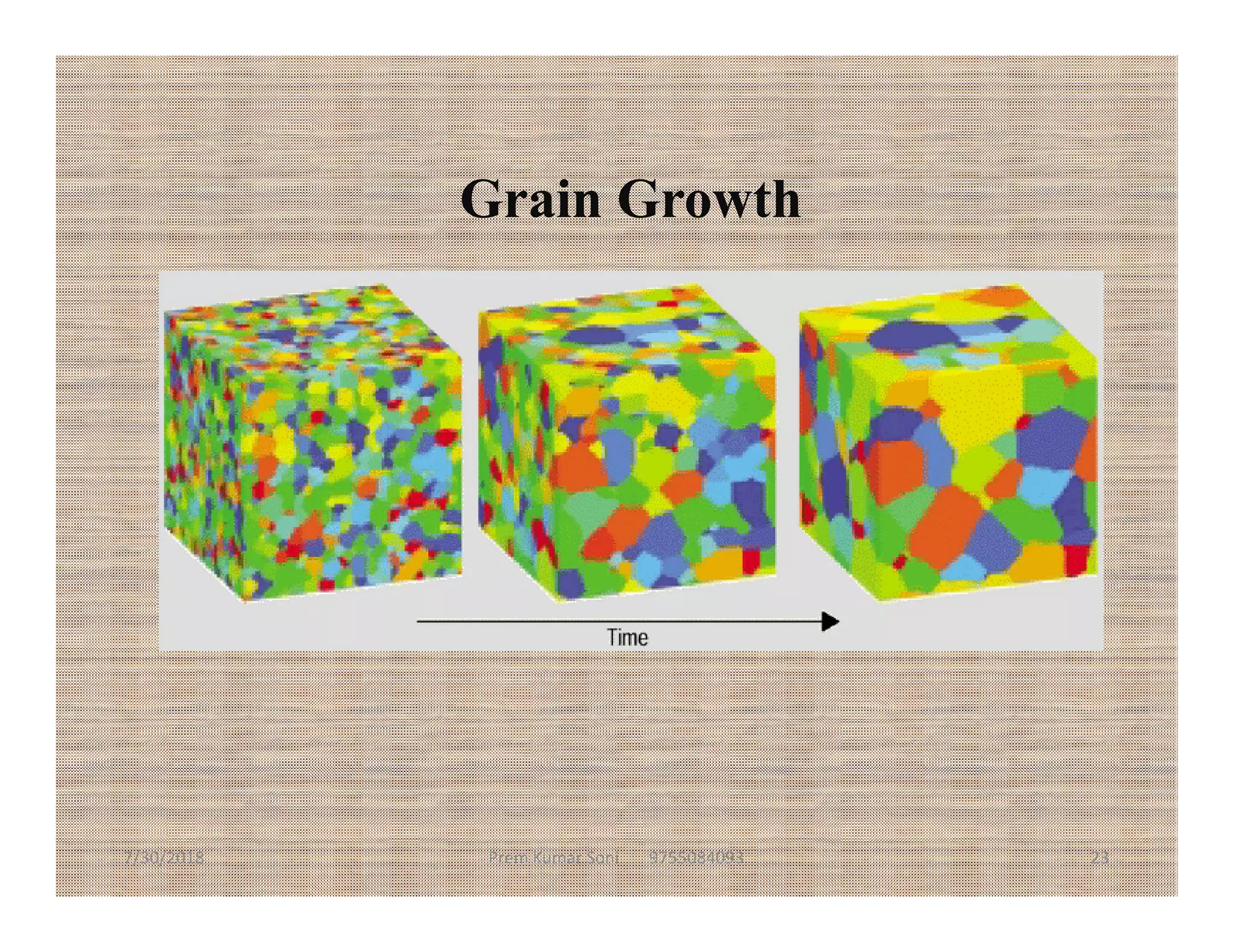
Grain Growth
• Grain growth is the increase in size of grains
(crystallites) in a material at high temperature.
• This occurs when recovery an recrystallisation
are complete and further reduction in the
internal energy can only be achieved byinternal energy can only be achieved by
reducing the total area of grain boundary.
• The term is commonly used in metallurgy but
is also used in reference to ceramics and
minerals.
7/30/2018 Prem Kumar Soni 9755084093 21
Grain Growth
7/30/2018 Prem Kumar Soni 9755084093 22
Grain Growth
7/30/2018 Prem Kumar Soni 9755084093 23
a) Grain growth occurs by the movement of grain
boundaries and not by coalescence (i.e. like water
droplets)
b) Boundary movement is discontinuous and the
direction of motion may change suddenly.
c) One grain may grow into another grain whilst being
consumed from the other side
d) The rate of consumption often increases when the
grain is nearly consumedgrain is nearly consumed
e) A curved boundary typically migrates towards its
centre of curvature
f) When grain boundaries in a single phase meet at
angles other than 120 degrees, the grain included by
the more acute angle will be consumed so that the
angles approach 120 degrees.
7/30/2018 Prem Kumar Soni 9755084093 24
7/30/2018 Prem Kumar Soni 9755084093 25
7/30/2018 Prem Kumar Soni 9755084093 26
ThanksThanks
7/30/2018 Prem Kumar Soni 9755084093 27

Recovery recrystallization and grain growth

  • 1.
    Notes On “Recovery, Recrystallisation and GrainGrowth”Grain Growth” 7/30/2018 1Prem Kumar Soni 9755084093
  • 2.
    Introduction We now introducea ‘technical term’ called Cold Work. We will arrive at a formal definition of the term at the end of this topic. For now we use a working definition of cold work as:as: Plastic deformation in the temperature range (0.3 – 0.5) Tm → COLD WORK During cold work the point defect density (vacancies, self interstitials…) and dislocation density increase. 7/30/2018 Prem Kumar Soni 9755084093 2
  • 3.
    Typical cold workingtechniques are rolling, forging, extrusion etc. Cold working is typically done on ductile metals (e.g. Al, Cu, Ni) 7/30/2018 Prem Kumar Soni 9755084093 3 Cold working is typically done on ductile metals (e.g. Al, Cu, Ni)
  • 4.
    The cold workedmaterial is stronger (harder), but is brittle (as noted before).  Heating the material (typically below 0.5 Tm) is and holding for sufficient time is a heat treatment process called annealing. Depending on the temperature of annealing processes like Recovery (at lower temperatures) or Recrystallisation (at higher temperatures) mayor Recrystallisation (at higher temperatures) may take place. During these processes the material tends to go from a microstructurally metastable state to a lower energy state (towards a stable state). Further ‘annealing’ of the recrystallized material can lead to grain growth. 7/30/2018 Prem Kumar Soni 9755084093 4
  • 5.
    7/30/2018 Prem KumarSoni 9755084093 5
  • 6.
    7/30/2018 Prem KumarSoni 9755084093 6
  • 7.
    Recovery is aprocess by which deformed grains can reduce their stored energy by the removal or rearrangement of defects in their crystal structure. These defects, primarily dislocations, are introduced by plastic deformation of theintroduced by plastic deformation of the material and act to increase the yield strength of a material. 7/30/2018 Prem Kumar Soni 9755084093 7
  • 8.
  • 9.
    Recovery is aprocess that kicks in at low temperatures; in this stage, the excess defects are annealed out, dislocations of opposite signs annihilate each other, and dislocations align to form low energy configurations, namely tiltform low energy configurations, namely tilt and twist boundaries 7/30/2018 9Prem Kumar Soni 9755084093
  • 10.
    Basically we cansay, Basically we can say, In Cold working • Strength, Electrical Resistance and hardness Increases. • Ductility Decreases 7/30/2018 Prem Kumar Soni 9755084093 10
  • 11.
    Summary  Recovery takesplace at low temperatures of annealing “Apparently no change in microstructure”  Excess point defects created during Cold work are absorbed:  at surface or grain boundaries  by dislocation climb  Random dislocations of opposite sign come together and annihilate each othereach other  Dislocations of same sign arrange into low energy configurations:  Edge → Tilt boundaries  Screw → Twist boundaries  POLYGONIZATION  Overall reduction in dislocation density is small 7/30/2018 Prem Kumar Soni 9755084093 11
  • 12.
    Recrystallisation Recrystallisation is theprocess in which deformed grains are replaced by strain-free grains. It is generally observed that higher cold workIt is generally observed that higher cold work and smaller initial grain size lead to finer recrystallised grains. The driving force for recrystallisation is the stored strain energy in the material. 7/30/2018 Prem Kumar Soni 9755084093 12
  • 13.
    Recrystallisation is definedas the process in which grains of a crystal structure come in a new structure or new crystal shape. A precise definition of recrystallisation isA precise definition of recrystallisation is difficult to state as the process is strongly related to several other processes, most notably recovery and grain growth. In some cases it is difficult to precisely define the point at which one process begins and another ends. 7/30/2018 Prem Kumar Soni 9755084093 13
  • 14.
    Process of Recrystallisation 7/30/2018Prem Kumar Soni 9755084093 14
  • 15.
    7/30/2018 Prem KumarSoni 9755084093 15 Recrystallisation of a metallic material (a → b) and crystal grains growth (b → c → d).
  • 16.
    7/30/2018 Prem KumarSoni 9755084093 16
  • 17.
    For Recrystallisation totake place, a minimum of cold working is needed; if the deformation is very low, recrystallisation does not occur. During recrystallisation, the stress-free grains nucleate and grow. In a recrystallised system (after more thanIn a recrystallised system (after more than about 90% deformation) the resultant microstructure is textured; that is, most of the grains have similar orientation. 7/30/2018 Prem Kumar Soni 9755084093 17
  • 18.
    7/30/2018 Prem KumarSoni 9755084093 18 Changes in properties with % cold work and annealing temperature; increasing annealing temperatures leads to recovery and recrystallisation. Note that still higher annealing temperatures leads to grain growth.
  • 19.
    The temperature atwhich a given material completely recrystallises in an hour is defined as the recrystallisation temperature. The recrystallisation temperature is low if the degree of deformation is high and/or if the temperature of deformation is low and/or if the initial grain size is small.initial grain size is small. The recrystallisation temperature is also very sensitive to the purity of the material; an addition of 0.01 at.% of Te to pure copper, for example, can increase the recrystallisation temperature by about 240◦C. 7/30/2018 Prem Kumar Soni 9755084093 19
  • 20.
    7/30/2018 Prem KumarSoni 9755084093 20
  • 21.
    Grain Growth • Graingrowth is the increase in size of grains (crystallites) in a material at high temperature. • This occurs when recovery an recrystallisation are complete and further reduction in the internal energy can only be achieved byinternal energy can only be achieved by reducing the total area of grain boundary. • The term is commonly used in metallurgy but is also used in reference to ceramics and minerals. 7/30/2018 Prem Kumar Soni 9755084093 21
  • 22.
    Grain Growth 7/30/2018 PremKumar Soni 9755084093 22
  • 23.
    Grain Growth 7/30/2018 PremKumar Soni 9755084093 23
  • 24.
    a) Grain growthoccurs by the movement of grain boundaries and not by coalescence (i.e. like water droplets) b) Boundary movement is discontinuous and the direction of motion may change suddenly. c) One grain may grow into another grain whilst being consumed from the other side d) The rate of consumption often increases when the grain is nearly consumedgrain is nearly consumed e) A curved boundary typically migrates towards its centre of curvature f) When grain boundaries in a single phase meet at angles other than 120 degrees, the grain included by the more acute angle will be consumed so that the angles approach 120 degrees. 7/30/2018 Prem Kumar Soni 9755084093 24
  • 25.
    7/30/2018 Prem KumarSoni 9755084093 25
  • 26.
    7/30/2018 Prem KumarSoni 9755084093 26
  • 27.