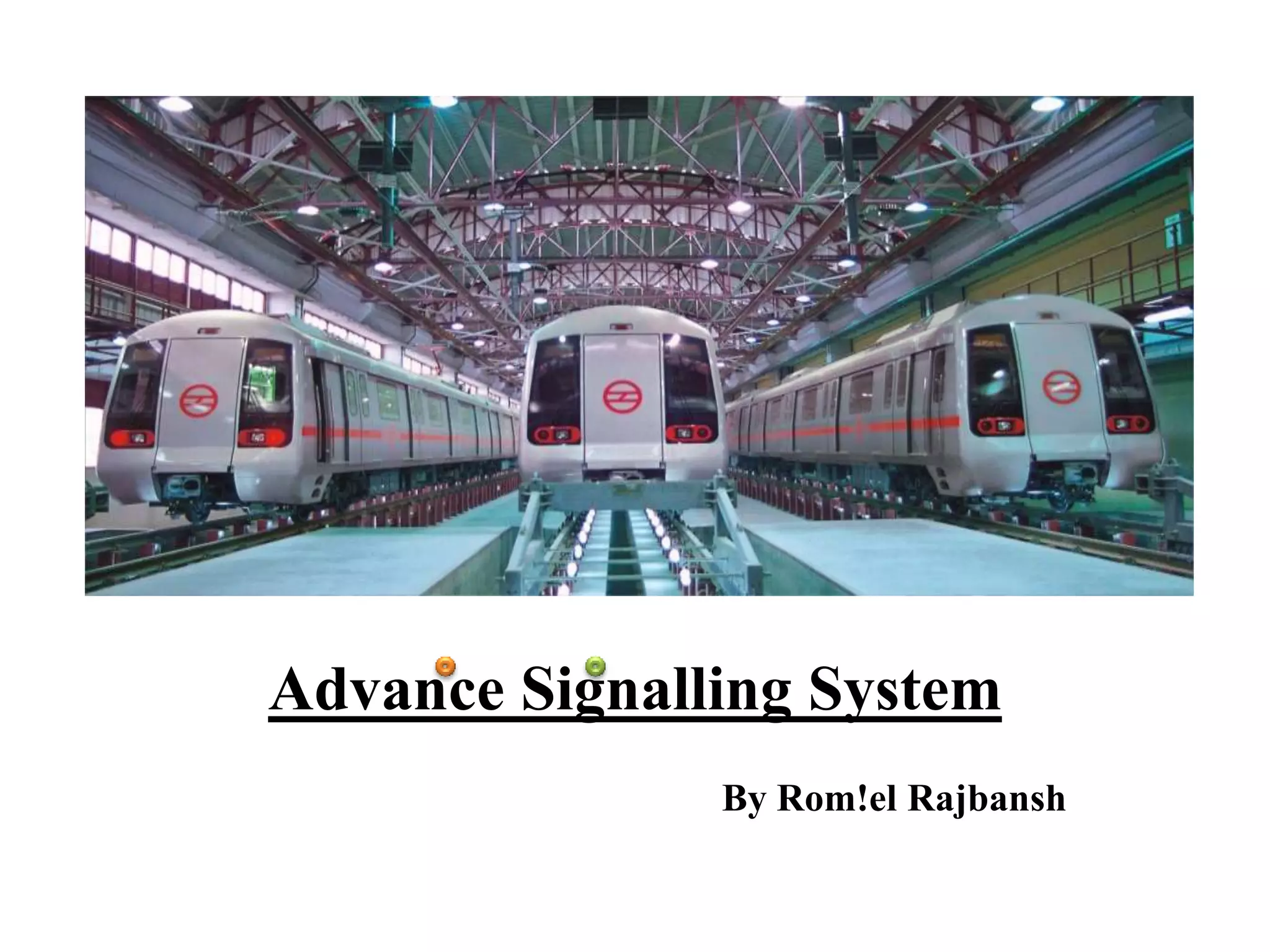
Advance Signalling System
By Rom!el Rajbansh
Kolkata Metro : The Kolkata Metro is a mass rapid transit system
serving the city of Kolkata. It was the first such form of transportation
in India, opening commercial services in 1984.
Delhi Metro : Planning for the metro started in 1984, when the
DDA and the Urban Arts Commission came up with a proposal for
developing a multi-modal transport system for the city. The
Government of India and Delhi jointly set up the Delhi Metro Rail
Corporation (DMRC) in 1995. Construction started in 1998, and the
first section, opened in 2002.
Rolling stock 179 trains, total length of track 189.63 kilometres with
142 stations of which 35 are underground.
Bangalor Metro : Opened in 2010. And Construction started for
Mumbai , Hyderabad & Chinnai Metro.
Metro Rail in India
Signalling
• For ensuring Safe train movement
• Signalling is used for increasing line capacity
• Signaling is mean of communication to
Impart Non Verbal information to Train
Operator.
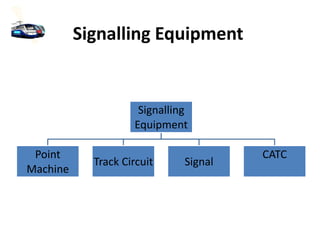
Signalling Equipment
Signalling
Equipment
Point
Machine
Track Circuit Signal
CATC
POINT MACHINE
Point means a connection used to
connect one line to another for the
purpose of making a movement for one
line to other line
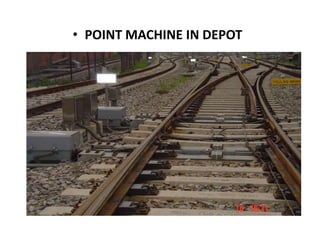
• POINT MACHINE IN DEPOT
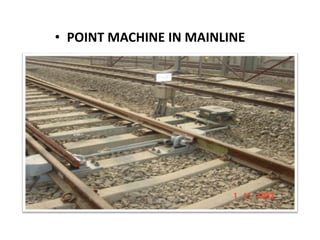
• POINT MACHINE IN MAINLINE
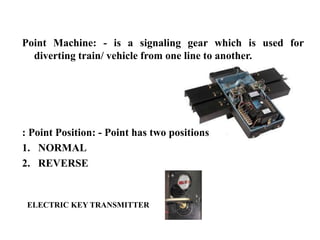
Point Machine: - is a signaling gear which is used for
diverting train/ vehicle from one line to another.
: Point Position: - Point has two positions
1. NORMAL
2. REVERSE
ELECTRIC KEY TRANSMITTER
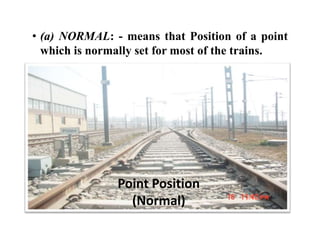
Point Position
(Normal)
• (a) NORMAL: - means that Position of a point
which is normally set for most of the trains.
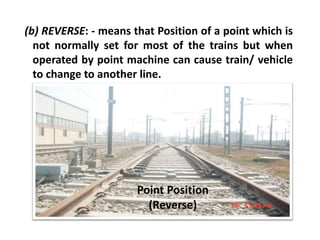
(b) REVERSE: - means that Position of a point which is
not normally set for most of the trains but when
operated by point machine can cause train/ vehicle
to change to another line.
Point Position
(Reverse)
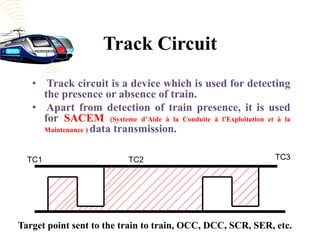
Track Circuit
• Track circuit is a device which is used for detecting
the presence or absence of train.
• Apart from detection of train presence, it is used
for SACEM (Systeme d’Aide à la Conduite à l’Exploitation et à la
Maintenance ) data transmission.
TC1 TC2 TC3
Target point sent to the train to train, OCC, DCC, SCR, SER, etc.
Track Circuit
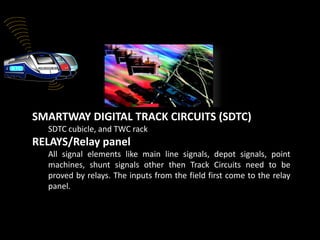
SMARTWAY DIGITAL TRACK CIRCUITS (SDTC)
SDTC cubicle, and TWC rack
RELAYS/Relay panel
All signal elements like main line signals, depot signals, point
machines, shunt signals other then Track Circuits need to be
proved by relays. The inputs from the field first come to the relay
panel.
Power supply panel7.
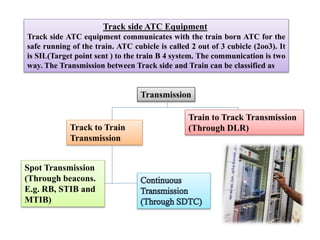
Transmission
Track to Train
Transmission
Train to Track Transmission
(Through DLR)
Spot Transmission
(Through beacons.
E.g. RB, STIB and
MTIB)
Track side ATC Equipment
Track side ATC equipment communicates with the train born ATC for the
safe running of the train. ATC cubicle is called 2 out of 3 cubicle (2oo3). It
is SIL(Target point sent ) to the train B 4 system. The communication is two
way. The Transmission between Track side and Train can be classified as
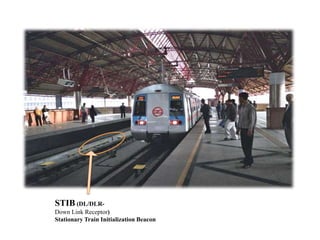
STIB (DL/DLR-
Down Link Receptor)
Stationary Train Initialization Beacon
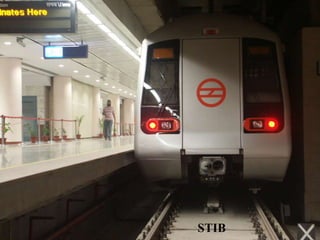
STIB
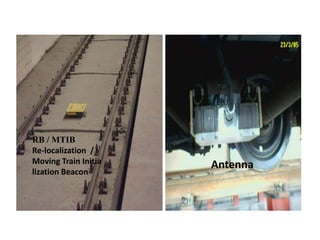
Antenna
RB / MTIB
Re-localization /
Moving Train Initia
lization Beacon
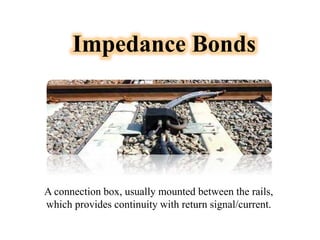
Impedance Bonds
A connection box, usually mounted between the rails,
which provides continuity with return signal/current.
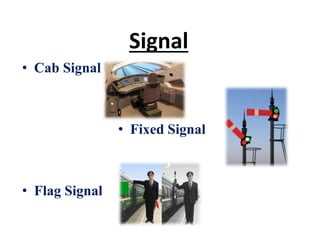
Signal
• Cab Signal
• Fixed Signal
• Flag Signal
Cab Signal
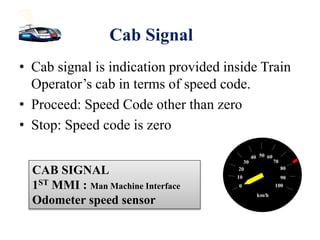
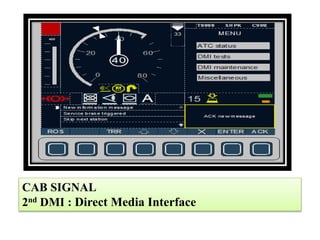
• Cab signal is indication provided inside Train
Operator’s cab in terms of speed code.
• Proceed: Speed Code other than zero
• Stop: Speed code is zero
CAB SIGNAL
1ST MMI : Man Machine Interface
Odometer speed sensor
0
20
40 60
80
km/h
100
90
70
50
30
10
CAB SIGNAL
2nd DMI : Direct Media Interface
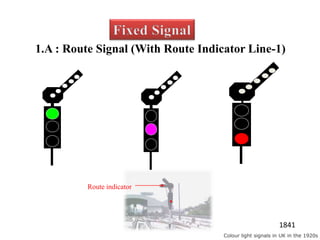
1.A : Route Signal (With Route Indicator Line-1)
Route indicator
1841
Colour light signals in UK in the 1920s
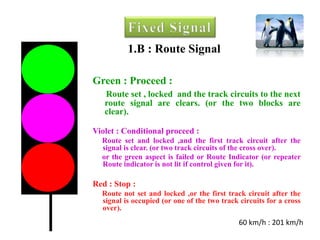
1.B : Route Signal
Green : Proceed :
Route set , locked and the track circuits to the next
route signal are clears. (or the two blocks are
clear).
Violet : Conditional proceed :
Route set and locked ,and the first track circuit after the
signal is clear. (or two track circuits of the cross over).
or the green aspect is failed or Route Indicator (or repeater
Route indicator is not lit if control given for it).
Red : Stop :
Route not set and locked ,or the first track circuit after the
signal is occupied (or one of the two track circuits for a cross
over).
60 km/h : 201 km/h
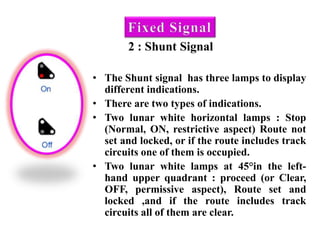
2 : Shunt Signal
• The Shunt signal has three lamps to display
different indications.
• There are two types of indications.
• Two lunar white horizontal lamps : Stop
(Normal, ON, restrictive aspect) Route not
set and locked, or if the route includes track
circuits one of them is occupied.
• Two lunar white lamps at 45°in the left-
hand upper quadrant : proceed (or Clear,
OFF, permissive aspect), Route set and
locked ,and if the route includes track
circuits all of them are clear.
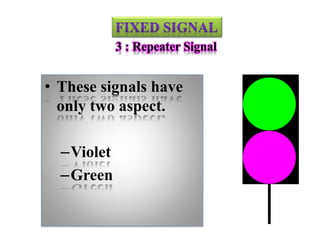
3 : Repeater Signal
• These signals have
only two aspect.
–Violet
–Green
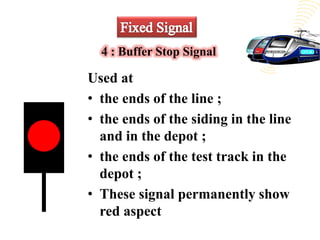
4 : Buffer Stop Signal
Used at
• the ends of the line ;
• the ends of the siding in the line
and in the depot ;
• the ends of the test track in the
depot ;
• These signal permanently show
red aspect
INTERLOCKING
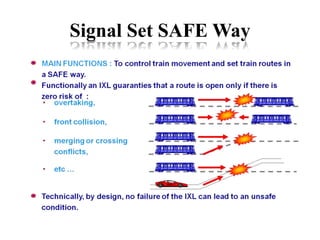
Interlocking means arrangement of signals, points
and other appliances operated from lever frame or
panel electrically, mechanically or both in such a
way that there operation must perform in proper
sequence to ensure safety.
In CBI (Computer Based Interlocking)
Monitor and Control Signaling Equipment Track Circuits,
Points, Signals, Cycles and Routes
1980s
System of working
• CATC (Continuous Automatic Train Control)
• CATC’s Subsystem :
– ATS (Automatic Train Supervision)
– ATC (Automatic Train Control)
– ATP (Automatic Train Protection )
– ATO (Automatic Train Operation )
Related Speed . Continuous monitoring of braking. Audio visual
warning and application of brakes, if necessary. Maintaining safety
distance between trains. Monitoring of stopping point. Releasing doors
on the correct side of the platform when train comes to a stop.
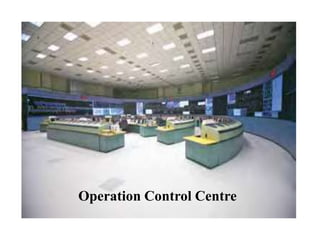
Operation Control Centre
Signal Set SAFE Way
Rail Transport in India - 1849, in
1951 Nationalized , in 1853
introduced . 135,000 km Track,
60,000 Rolling stock, 20 million
passengers per day.
Meter gauge 1,000 mm.
Narrow gauge 1,067 mm.
Broad-gauge 1435 mm.
Track gauge 1676 mm.
Advance Signalling System-Rajbansh

Advance Signalling System-Rajbansh

  • 1.
  • 2.
    Kolkata Metro :The Kolkata Metro is a mass rapid transit system serving the city of Kolkata. It was the first such form of transportation in India, opening commercial services in 1984. Delhi Metro : Planning for the metro started in 1984, when the DDA and the Urban Arts Commission came up with a proposal for developing a multi-modal transport system for the city. The Government of India and Delhi jointly set up the Delhi Metro Rail Corporation (DMRC) in 1995. Construction started in 1998, and the first section, opened in 2002. Rolling stock 179 trains, total length of track 189.63 kilometres with 142 stations of which 35 are underground. Bangalor Metro : Opened in 2010. And Construction started for Mumbai , Hyderabad & Chinnai Metro. Metro Rail in India
  • 3.
    Signalling • For ensuringSafe train movement • Signalling is used for increasing line capacity • Signaling is mean of communication to Impart Non Verbal information to Train Operator.
  • 4.
  • 5.
    POINT MACHINE Point meansa connection used to connect one line to another for the purpose of making a movement for one line to other line
  • 6.
  • 7.
    • POINT MACHINEIN MAINLINE
  • 8.
    Point Machine: -is a signaling gear which is used for diverting train/ vehicle from one line to another. : Point Position: - Point has two positions 1. NORMAL 2. REVERSE ELECTRIC KEY TRANSMITTER
  • 9.
    Point Position (Normal) • (a)NORMAL: - means that Position of a point which is normally set for most of the trains.
  • 10.
    (b) REVERSE: -means that Position of a point which is not normally set for most of the trains but when operated by point machine can cause train/ vehicle to change to another line. Point Position (Reverse)
  • 11.
    Track Circuit • Trackcircuit is a device which is used for detecting the presence or absence of train. • Apart from detection of train presence, it is used for SACEM (Systeme d’Aide à la Conduite à l’Exploitation et à la Maintenance ) data transmission. TC1 TC2 TC3 Target point sent to the train to train, OCC, DCC, SCR, SER, etc.
  • 12.
    Track Circuit SMARTWAY DIGITALTRACK CIRCUITS (SDTC) SDTC cubicle, and TWC rack RELAYS/Relay panel All signal elements like main line signals, depot signals, point machines, shunt signals other then Track Circuits need to be proved by relays. The inputs from the field first come to the relay panel. Power supply panel7.
  • 13.
    Transmission Track to Train Transmission Trainto Track Transmission (Through DLR) Spot Transmission (Through beacons. E.g. RB, STIB and MTIB) Track side ATC Equipment Track side ATC equipment communicates with the train born ATC for the safe running of the train. ATC cubicle is called 2 out of 3 cubicle (2oo3). It is SIL(Target point sent ) to the train B 4 system. The communication is two way. The Transmission between Track side and Train can be classified as
  • 14.
    STIB (DL/DLR- Down LinkReceptor) Stationary Train Initialization Beacon
  • 15.
  • 16.
    Antenna RB / MTIB Re-localization/ Moving Train Initia lization Beacon
  • 17.
    Impedance Bonds A connectionbox, usually mounted between the rails, which provides continuity with return signal/current.
  • 18.
    Signal • Cab Signal •Fixed Signal • Flag Signal
  • 19.
    Cab Signal • Cabsignal is indication provided inside Train Operator’s cab in terms of speed code. • Proceed: Speed Code other than zero • Stop: Speed code is zero CAB SIGNAL 1ST MMI : Man Machine Interface Odometer speed sensor 0 20 40 60 80 km/h 100 90 70 50 30 10
  • 20.
    CAB SIGNAL 2nd DMI: Direct Media Interface
  • 21.
    1.A : RouteSignal (With Route Indicator Line-1) Route indicator 1841 Colour light signals in UK in the 1920s
  • 22.
    1.B : RouteSignal Green : Proceed : Route set , locked and the track circuits to the next route signal are clears. (or the two blocks are clear). Violet : Conditional proceed : Route set and locked ,and the first track circuit after the signal is clear. (or two track circuits of the cross over). or the green aspect is failed or Route Indicator (or repeater Route indicator is not lit if control given for it). Red : Stop : Route not set and locked ,or the first track circuit after the signal is occupied (or one of the two track circuits for a cross over). 60 km/h : 201 km/h
  • 23.
    2 : ShuntSignal • The Shunt signal has three lamps to display different indications. • There are two types of indications. • Two lunar white horizontal lamps : Stop (Normal, ON, restrictive aspect) Route not set and locked, or if the route includes track circuits one of them is occupied. • Two lunar white lamps at 45°in the left- hand upper quadrant : proceed (or Clear, OFF, permissive aspect), Route set and locked ,and if the route includes track circuits all of them are clear.
  • 24.
    3 : RepeaterSignal • These signals have only two aspect. –Violet –Green
  • 25.
    4 : BufferStop Signal Used at • the ends of the line ; • the ends of the siding in the line and in the depot ; • the ends of the test track in the depot ; • These signal permanently show red aspect
  • 26.
    INTERLOCKING Interlocking means arrangementof signals, points and other appliances operated from lever frame or panel electrically, mechanically or both in such a way that there operation must perform in proper sequence to ensure safety. In CBI (Computer Based Interlocking) Monitor and Control Signaling Equipment Track Circuits, Points, Signals, Cycles and Routes 1980s
  • 27.
    System of working •CATC (Continuous Automatic Train Control) • CATC’s Subsystem : – ATS (Automatic Train Supervision) – ATC (Automatic Train Control) – ATP (Automatic Train Protection ) – ATO (Automatic Train Operation ) Related Speed . Continuous monitoring of braking. Audio visual warning and application of brakes, if necessary. Maintaining safety distance between trains. Monitoring of stopping point. Releasing doors on the correct side of the platform when train comes to a stop.
  • 28.
  • 29.
  • 30.
    Rail Transport inIndia - 1849, in 1951 Nationalized , in 1853 introduced . 135,000 km Track, 60,000 Rolling stock, 20 million passengers per day. Meter gauge 1,000 mm. Narrow gauge 1,067 mm. Broad-gauge 1435 mm. Track gauge 1676 mm.