BASIC CONCEPT OF SIGNAL ENGINEERING(ST-15)
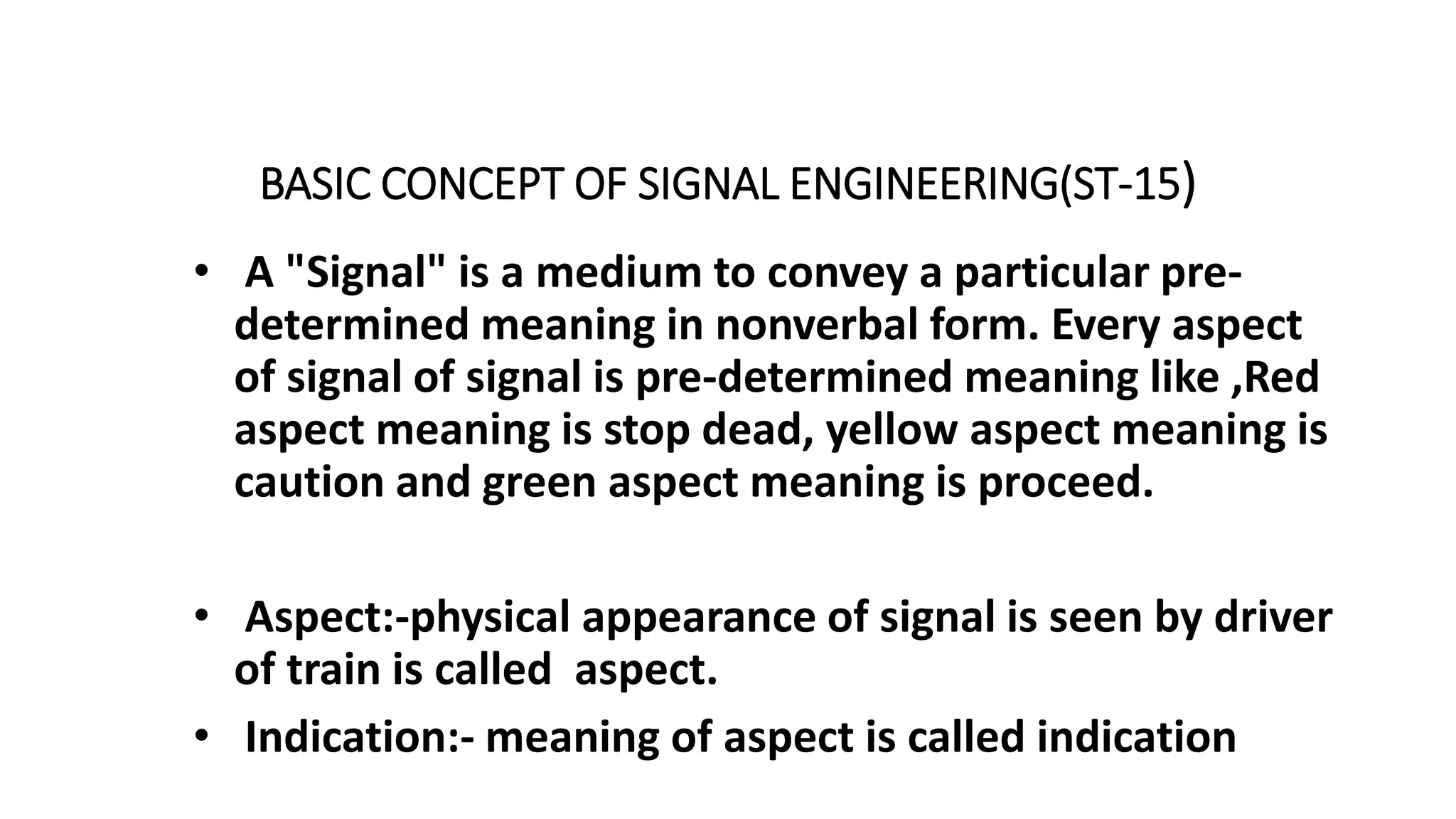
• A "Signal" is a medium to convey a particular pre-
determined meaning in nonverbal form. Every aspect
of signal of signal is pre-determined meaning like ,Red
aspect meaning is stop dead, yellow aspect meaning is
caution and green aspect meaning is proceed.
• Aspect:-physical appearance of signal is seen by driver
of train is called aspect.
• Indication:- meaning of aspect is called indication
CLASSIFICATION OF SIGNAL IN I.R
VISIUL AUDIABLE
MOVABLE
FLAG SIGNAL
FIXED
SIGNAL
FLARE
SIGNAL
DETONATOR
SIGNAL
VOICE WHISTLE
RUNNING
SIGNAL
SUBSIDARY
SIGNAL
TWO ASPECT MULTI
ASPECT SIGNAL
SEMAPHORE
SGNAL
CLS
SEMAPHORE
SGNAL CLS
MINIATURE
ARM
DISC TYPE
POSITION
LIGHT TYPE
CLS TYPE
[d1]
SIGNALS
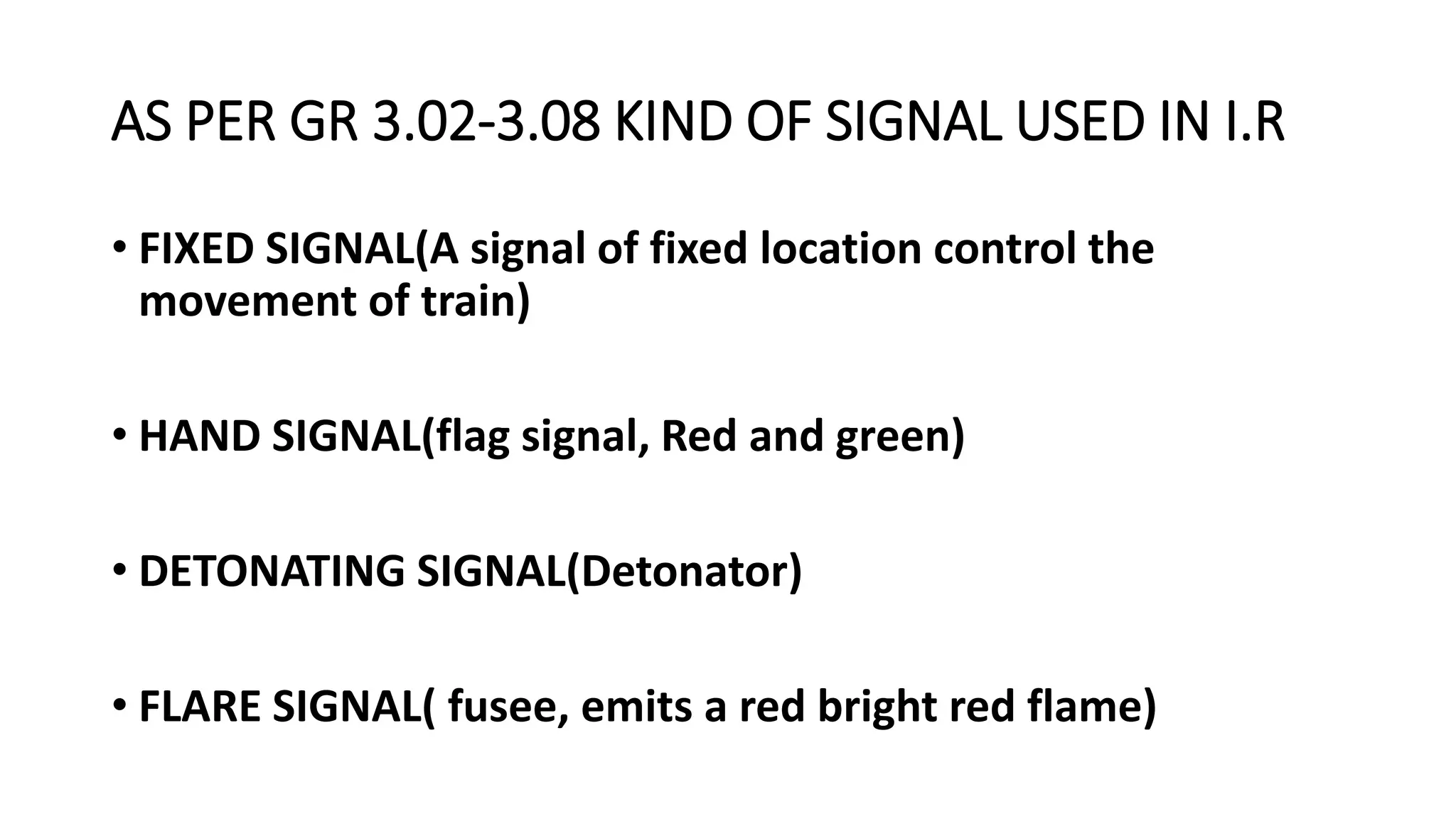
AS PER GR 3.02-3.08 KIND OF SIGNAL USED IN I.R
• FIXED SIGNAL(A signal of fixed location control the
movement of train)
• HAND SIGNAL(flag signal, Red and green)
• DETONATING SIGNAL(Detonator)
• FLARE SIGNAL( fusee, emits a red bright red flame)
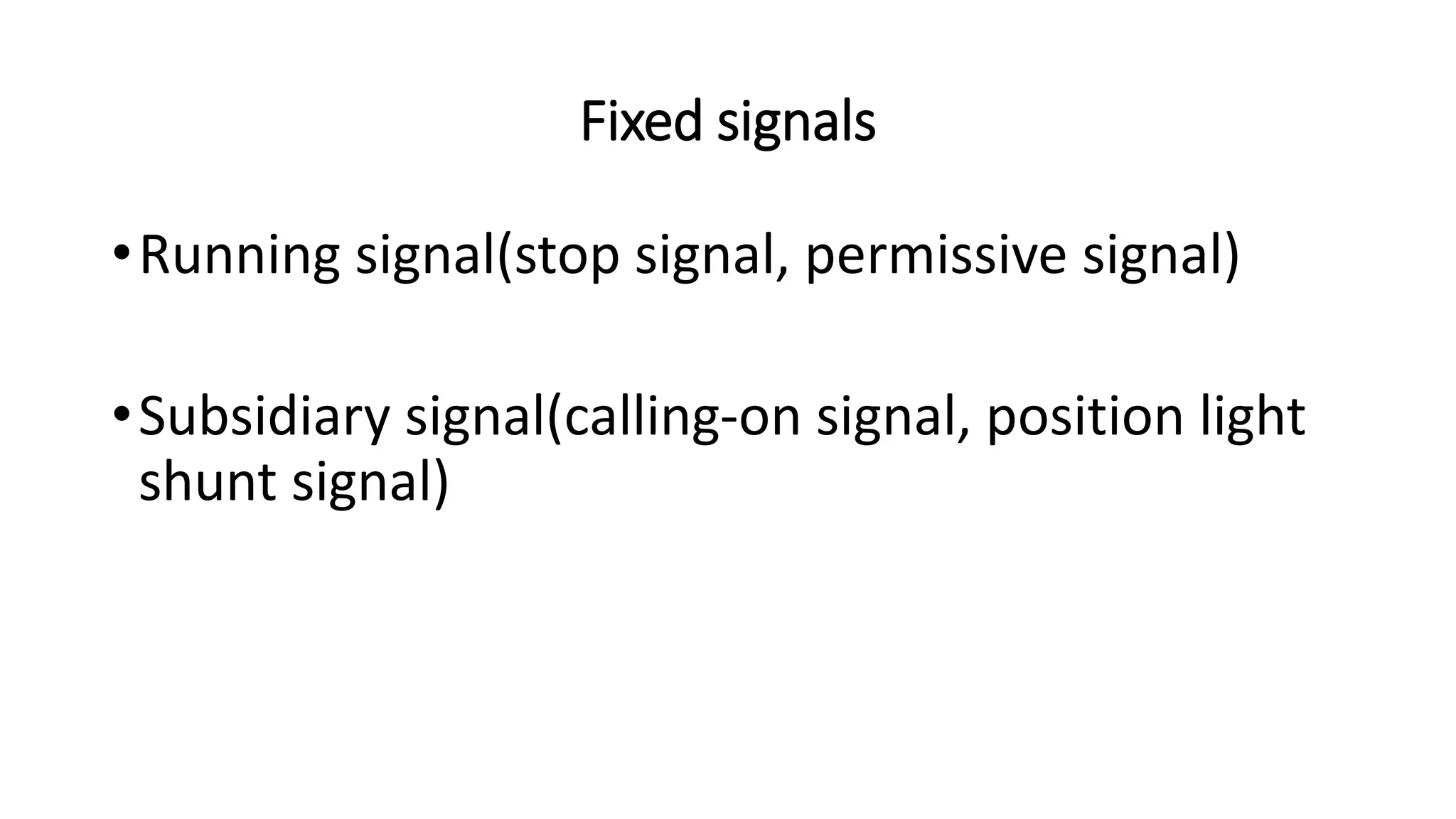
Fixed signals
•Running signal(stop signal, permissive signal)
•Subsidiary signal(calling-on signal, position light
shunt signal)
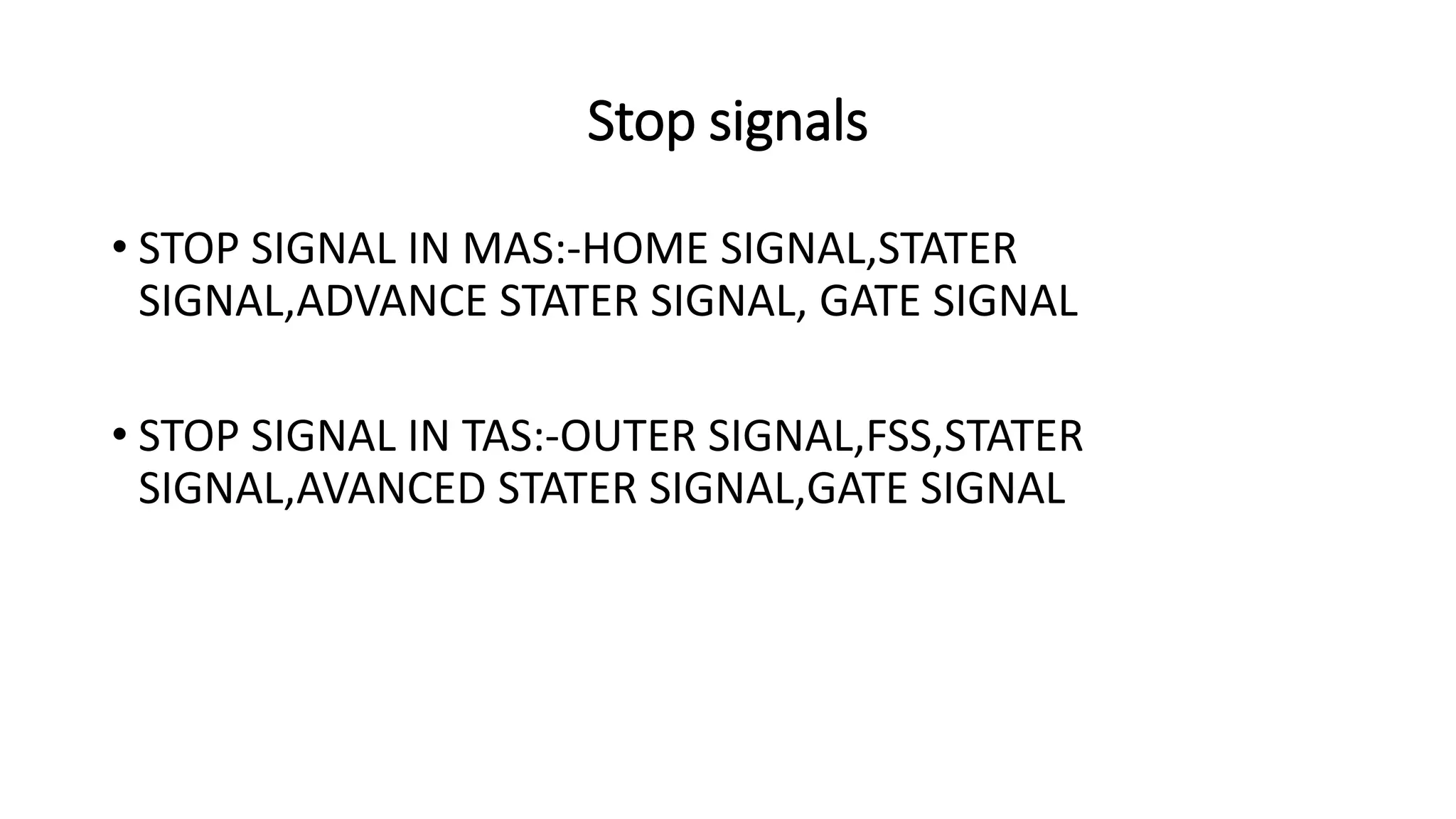
Stop signals
• STOP SIGNAL IN MAS:-HOME SIGNAL,STATER
SIGNAL,ADVANCE STATER SIGNAL, GATE SIGNAL
• STOP SIGNAL IN TAS:-OUTER SIGNAL,FSS,STATER
SIGNAL,AVANCED STATER SIGNAL,GATE SIGNAL
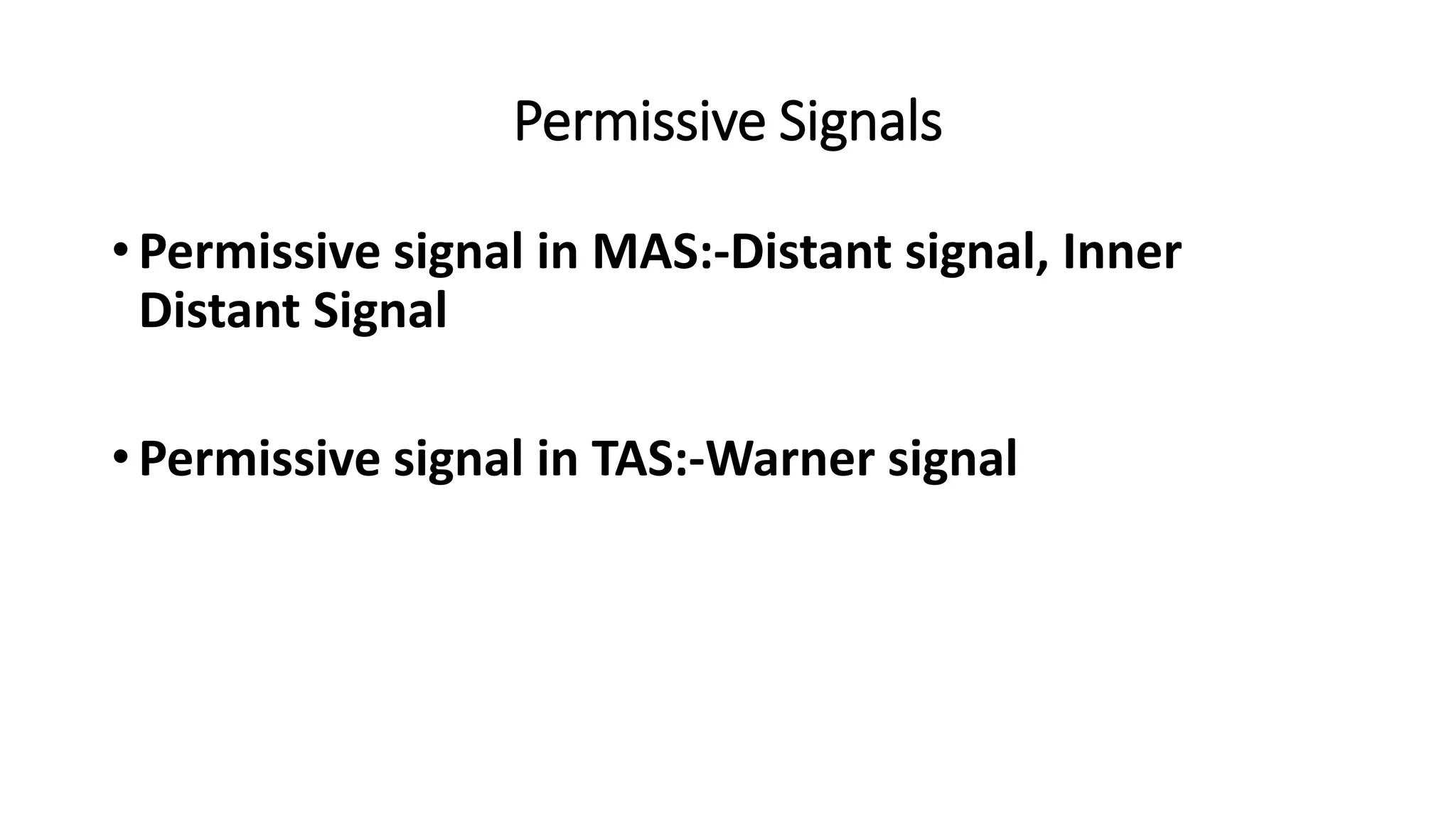
Permissive Signals
• Permissive signal in MAS:-Distant signal, Inner
Distant Signal
• Permissive signal in TAS:-Warner signal
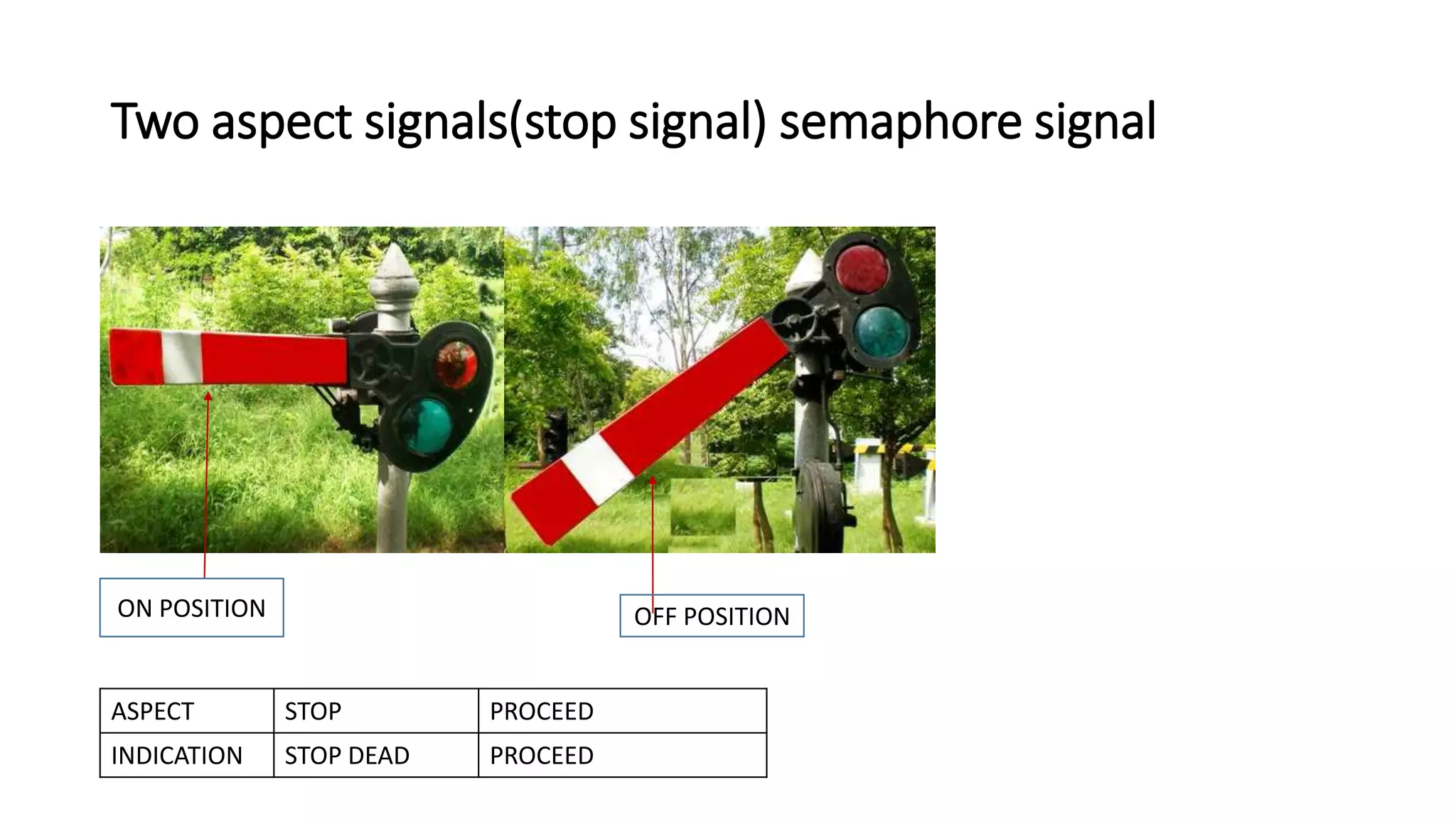
Two aspect signals(stop signal) semaphore signal
ON POSITION OFF POSITION
ASPECT STOP PROCEED
INDICATION STOP DEAD PROCEED
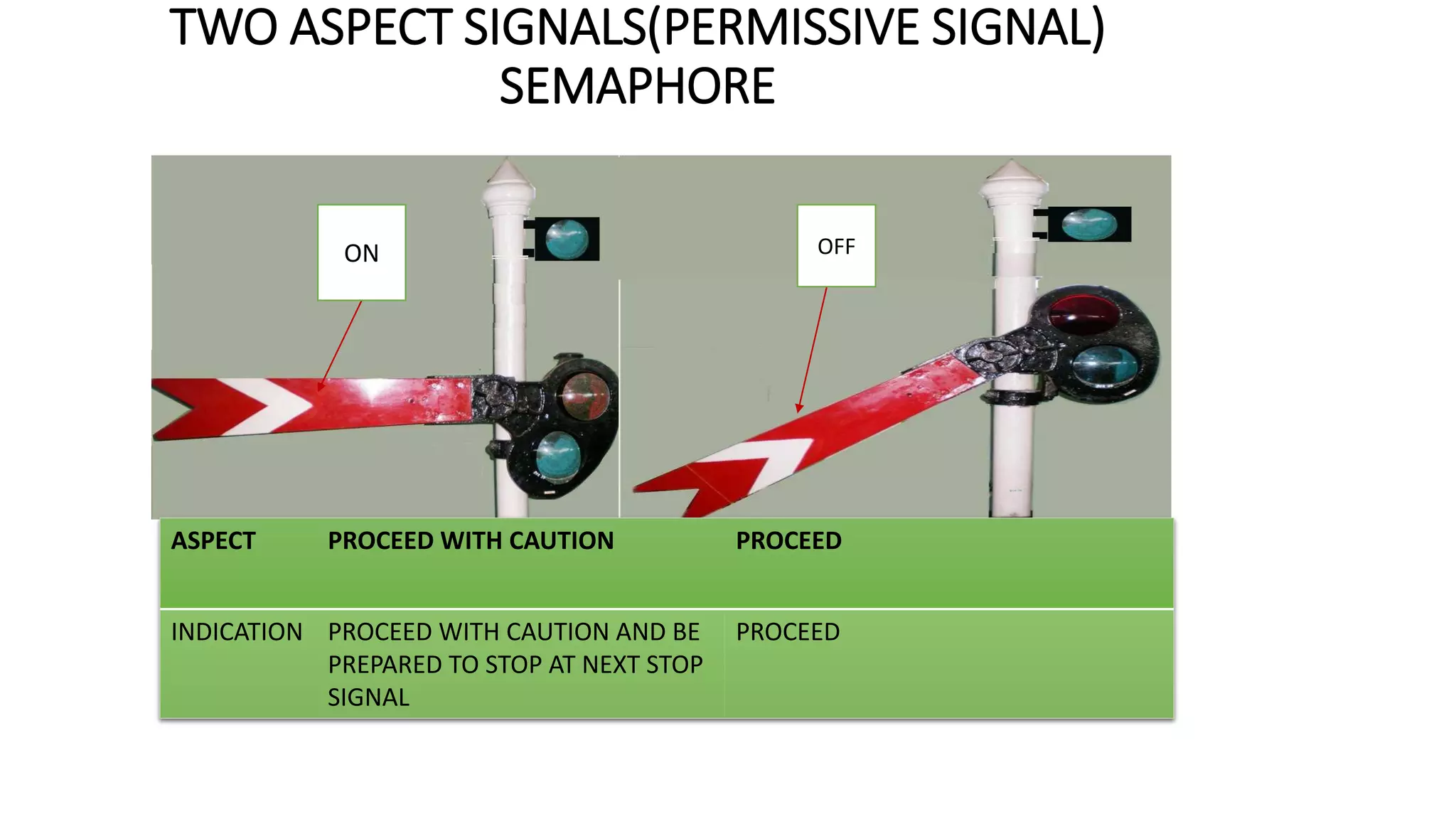
TWO ASPECT SIGNALS(PERMISSIVE SIGNAL)
SEMAPHORE
ASPECT PROCEED WITH CAUTION PROCEED
INDICATION PROCEED WITH CAUTION AND BE
PREPARED TO STOP AT NEXT STOP
SIGNAL
PROCEED
ON OFF
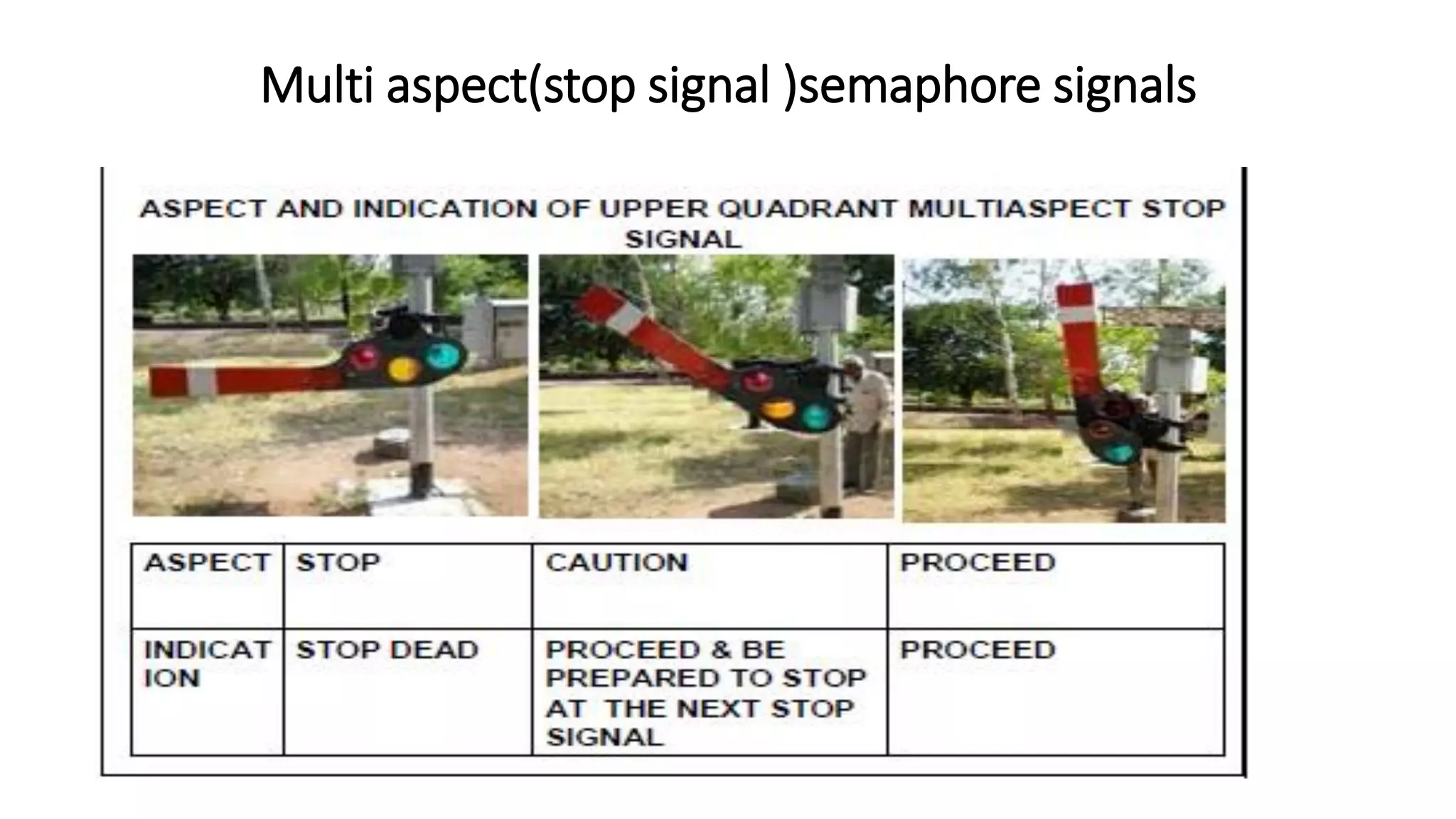
Multi aspect(stop signal )semaphore signals
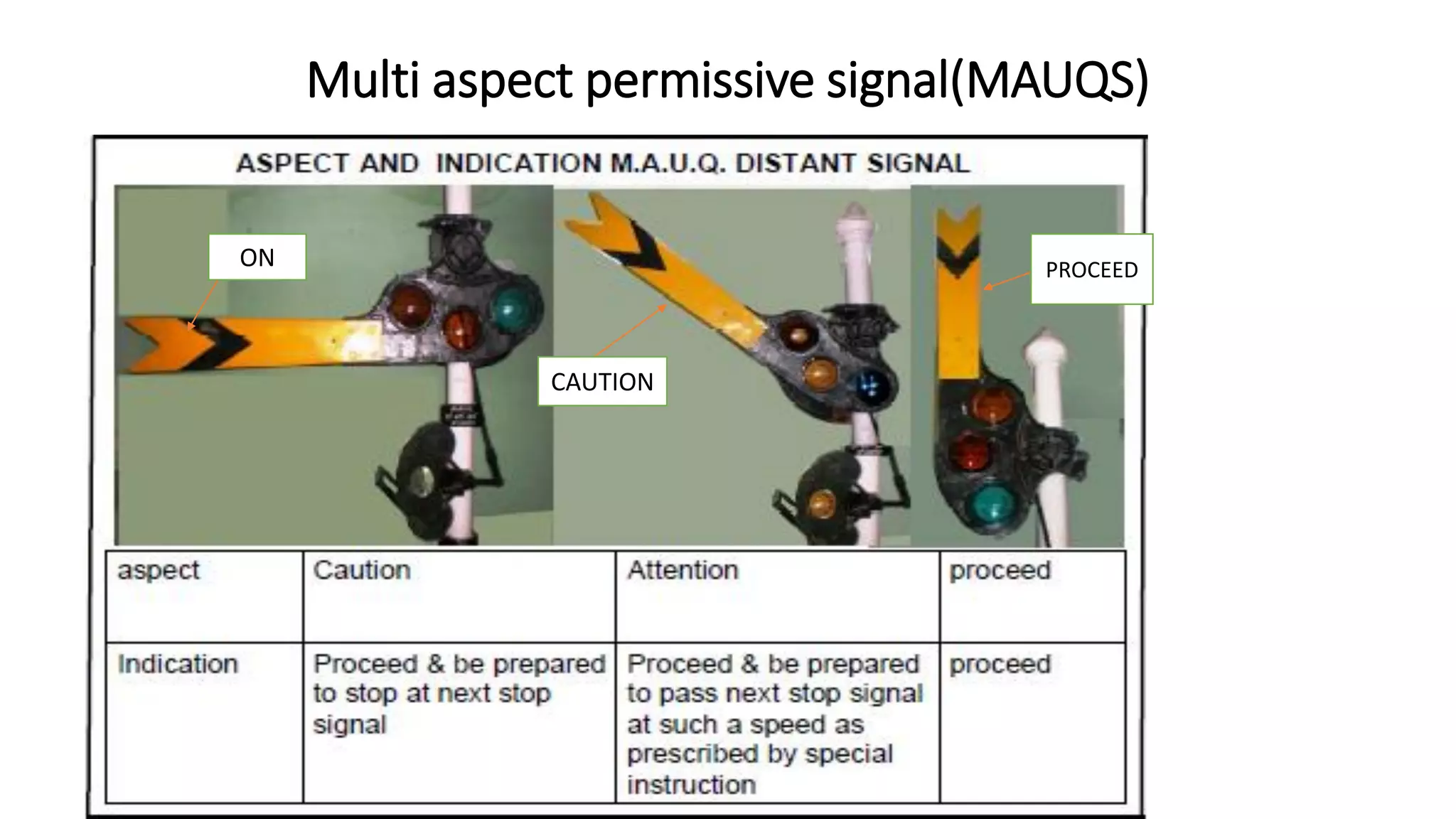
Multi aspect permissive signal(MAUQS)
CAUTION
PROCEED
ON
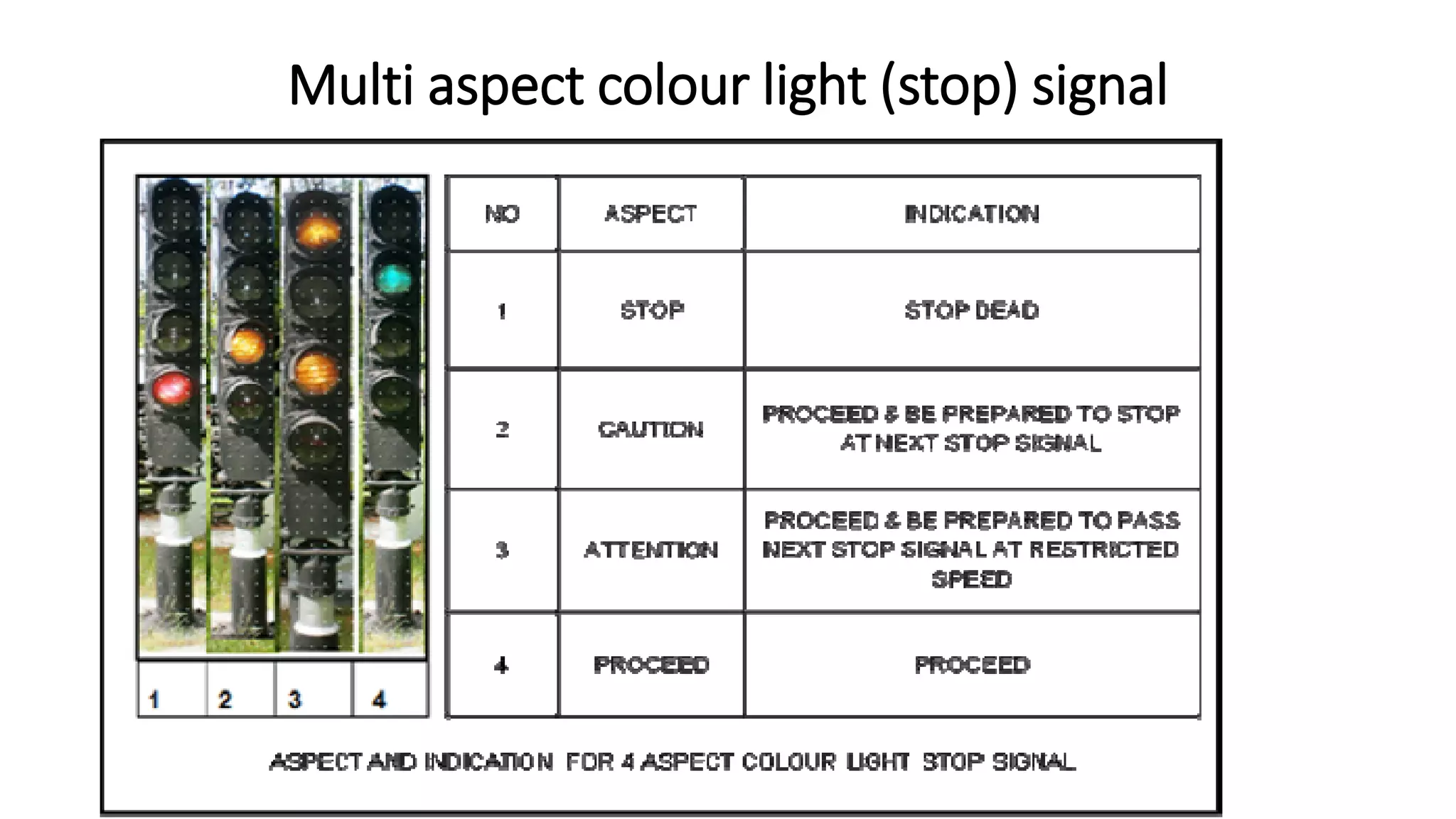
Multi aspect colour light (stop) signal
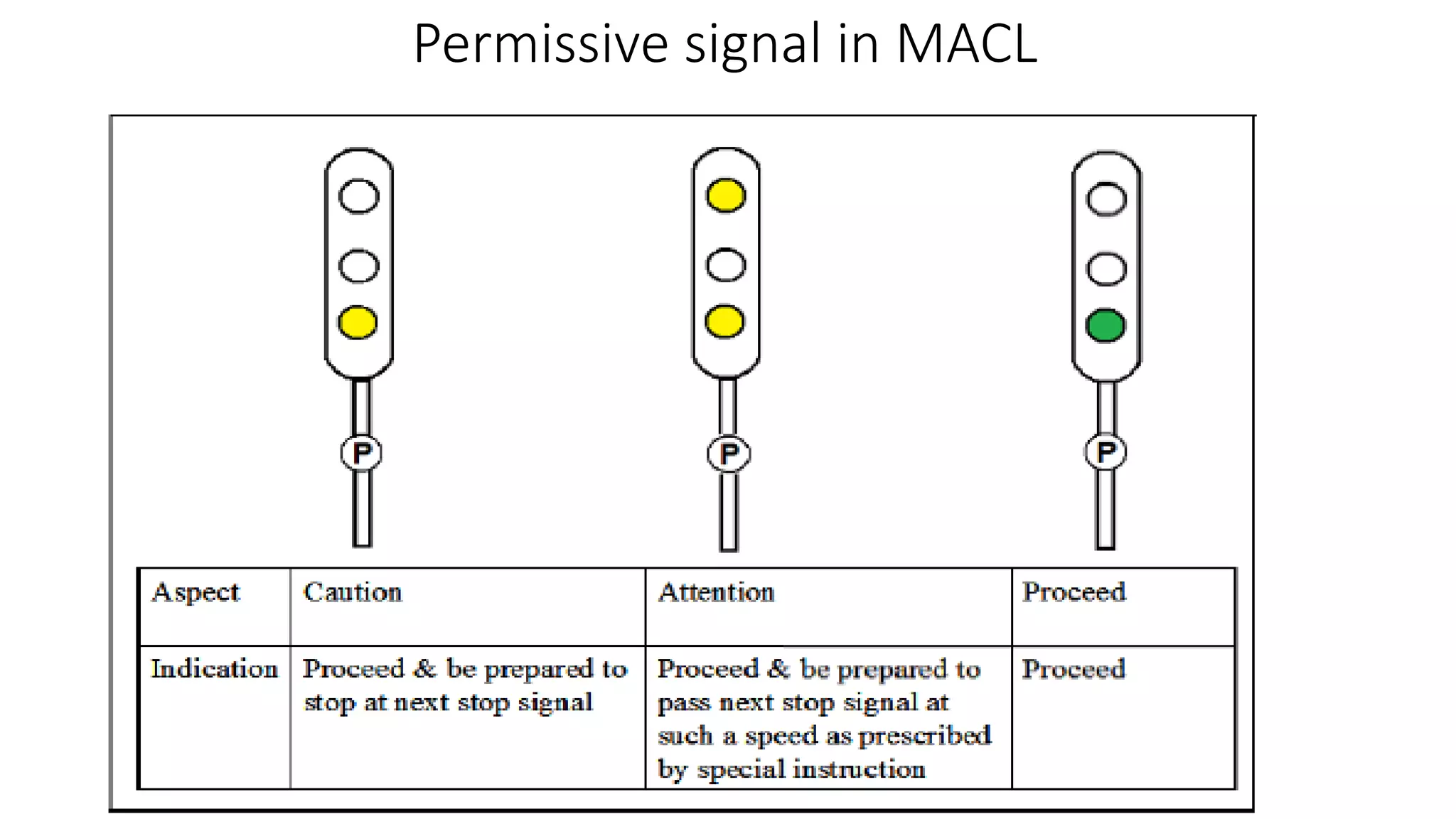
Permissive signal in MACL
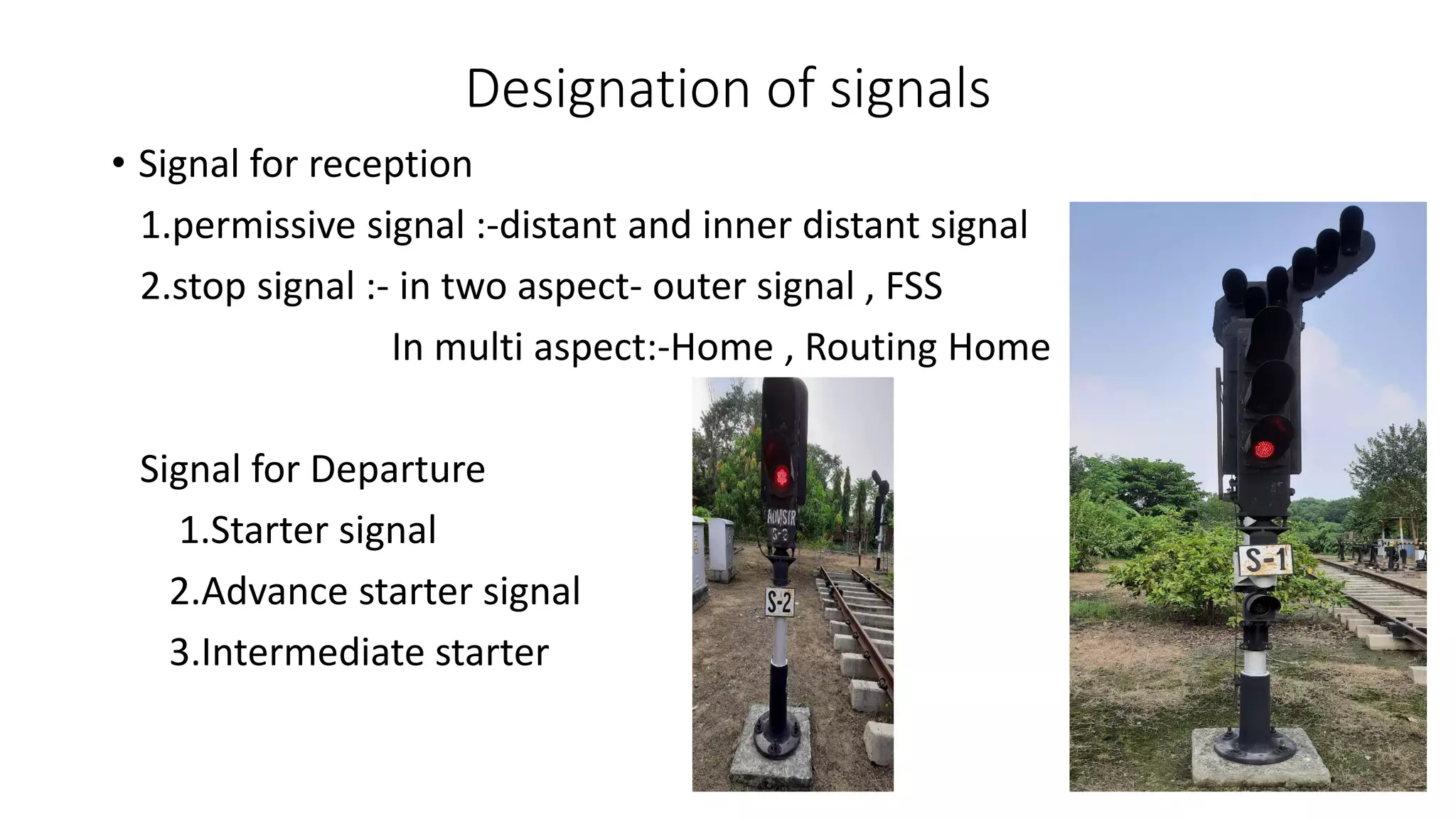
Designation of signals
• Signal for reception
1.permissive signal :-distant and inner distant signal
2.stop signal :- in two aspect- outer signal , FSS
In multi aspect:-Home , Routing Home
Signal for Departure
1.Starter signal
2.Advance starter signal
3.Intermediate starter
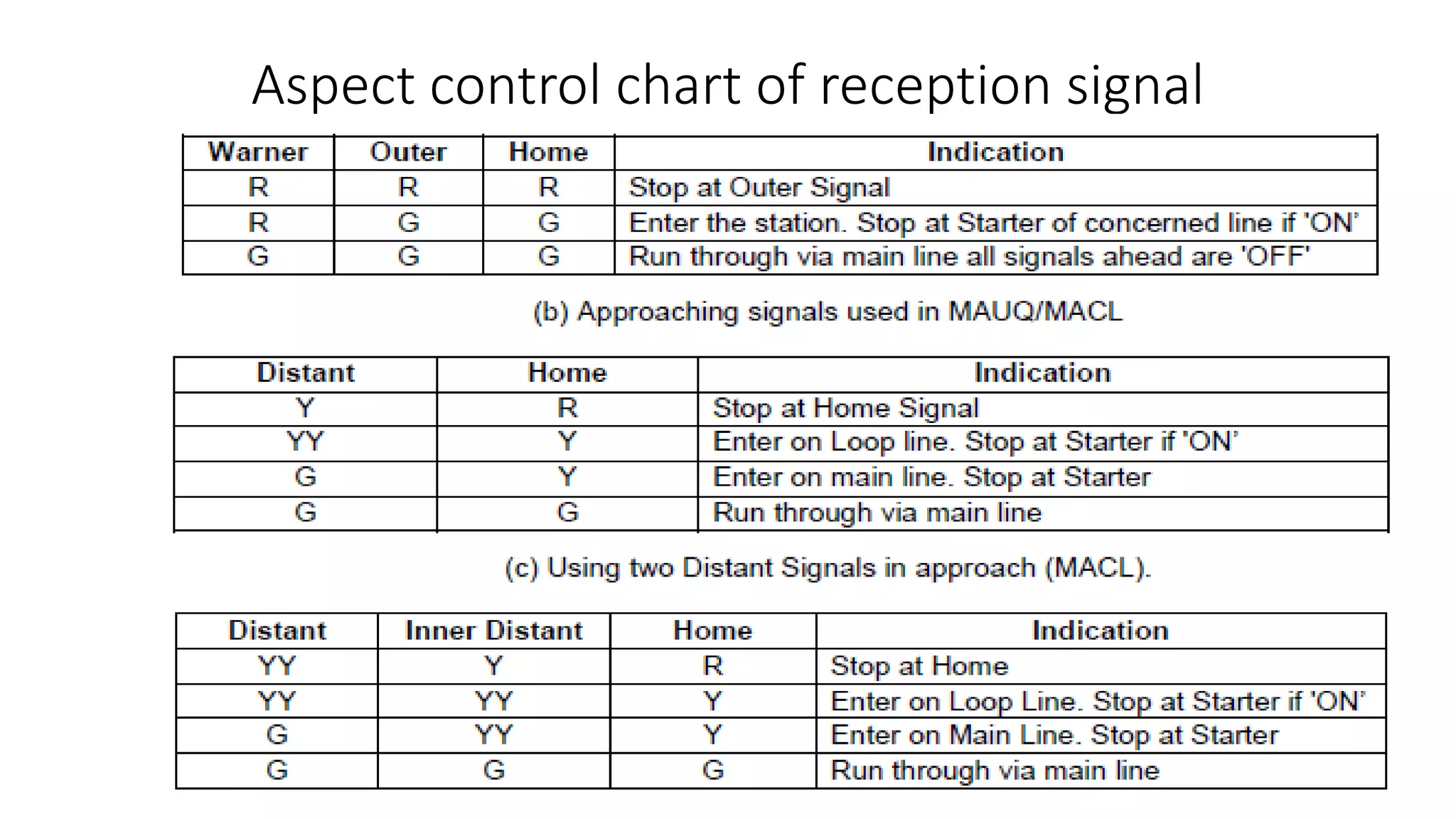
Aspect control chart of reception signal
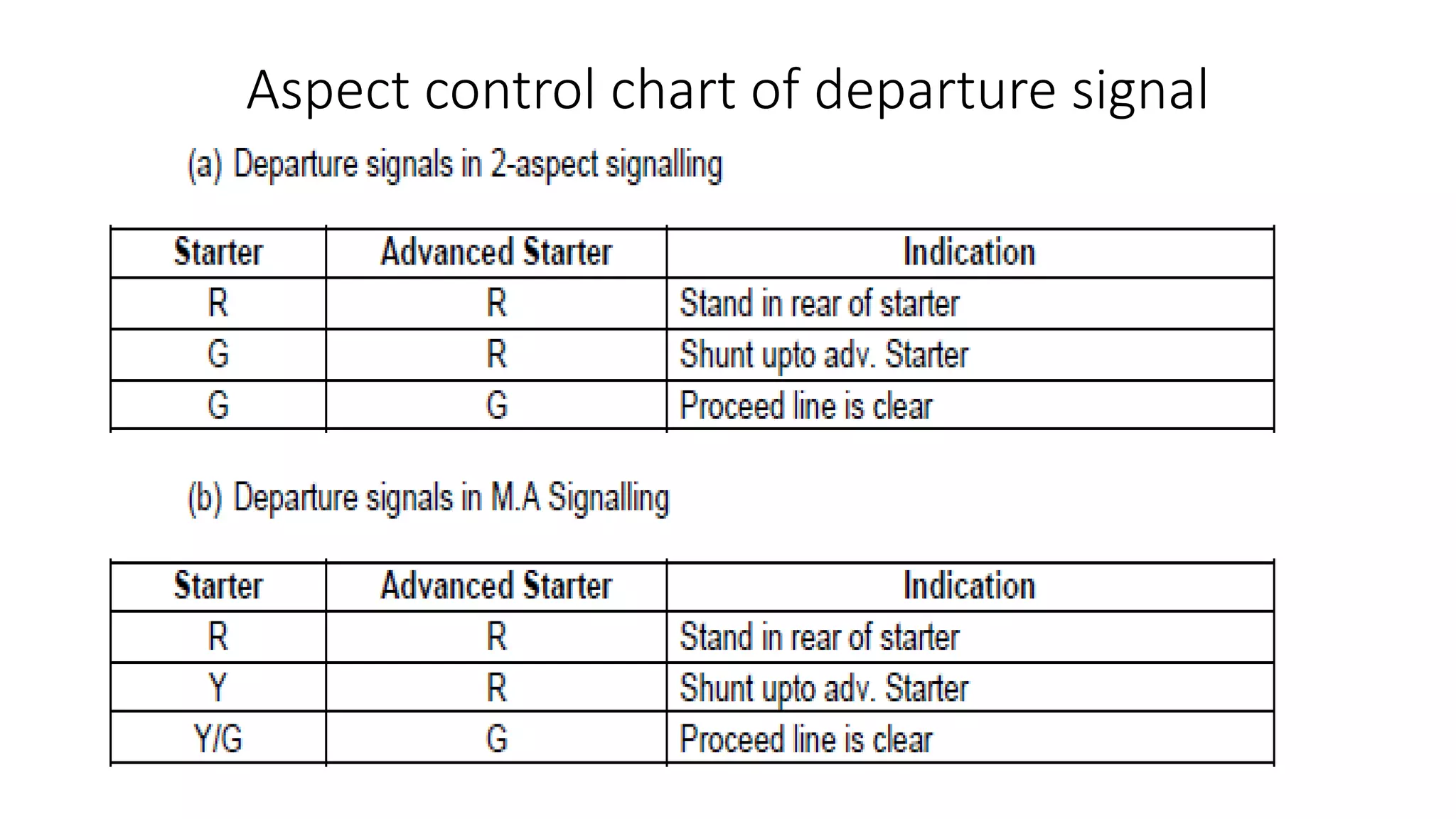
Aspect control chart of departure signal
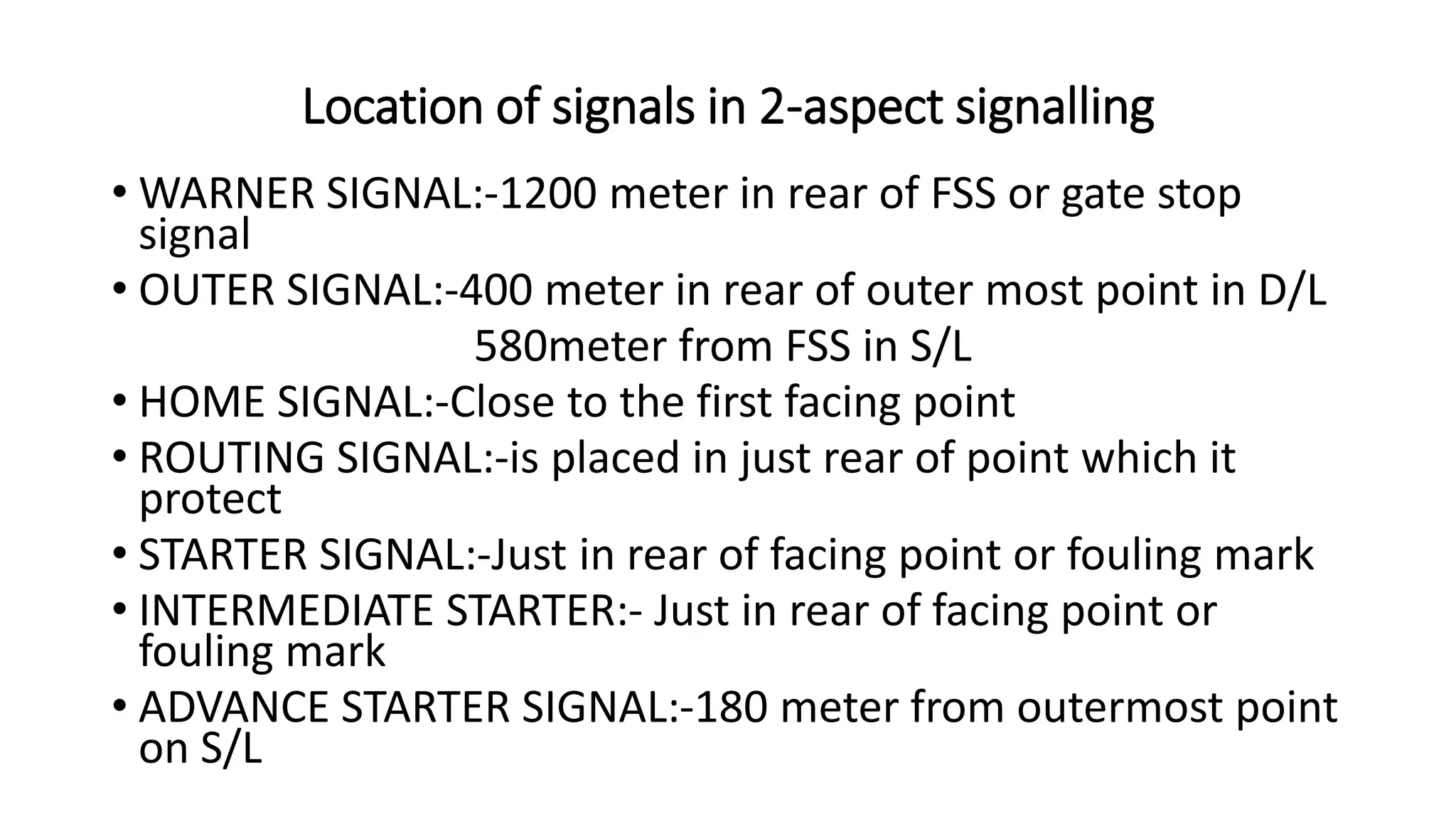
Location of signals in 2-aspect signalling
• WARNER SIGNAL:-1200 meter in rear of FSS or gate stop
signal
• OUTER SIGNAL:-400 meter in rear of outer most point in D/L
580meter from FSS in S/L
• HOME SIGNAL:-Close to the first facing point
• ROUTING SIGNAL:-is placed in just rear of point which it
protect
• STARTER SIGNAL:-Just in rear of facing point or fouling mark
• INTERMEDIATE STARTER:- Just in rear of facing point or
fouling mark
• ADVANCE STARTER SIGNAL:-180 meter from outermost point
on S/L
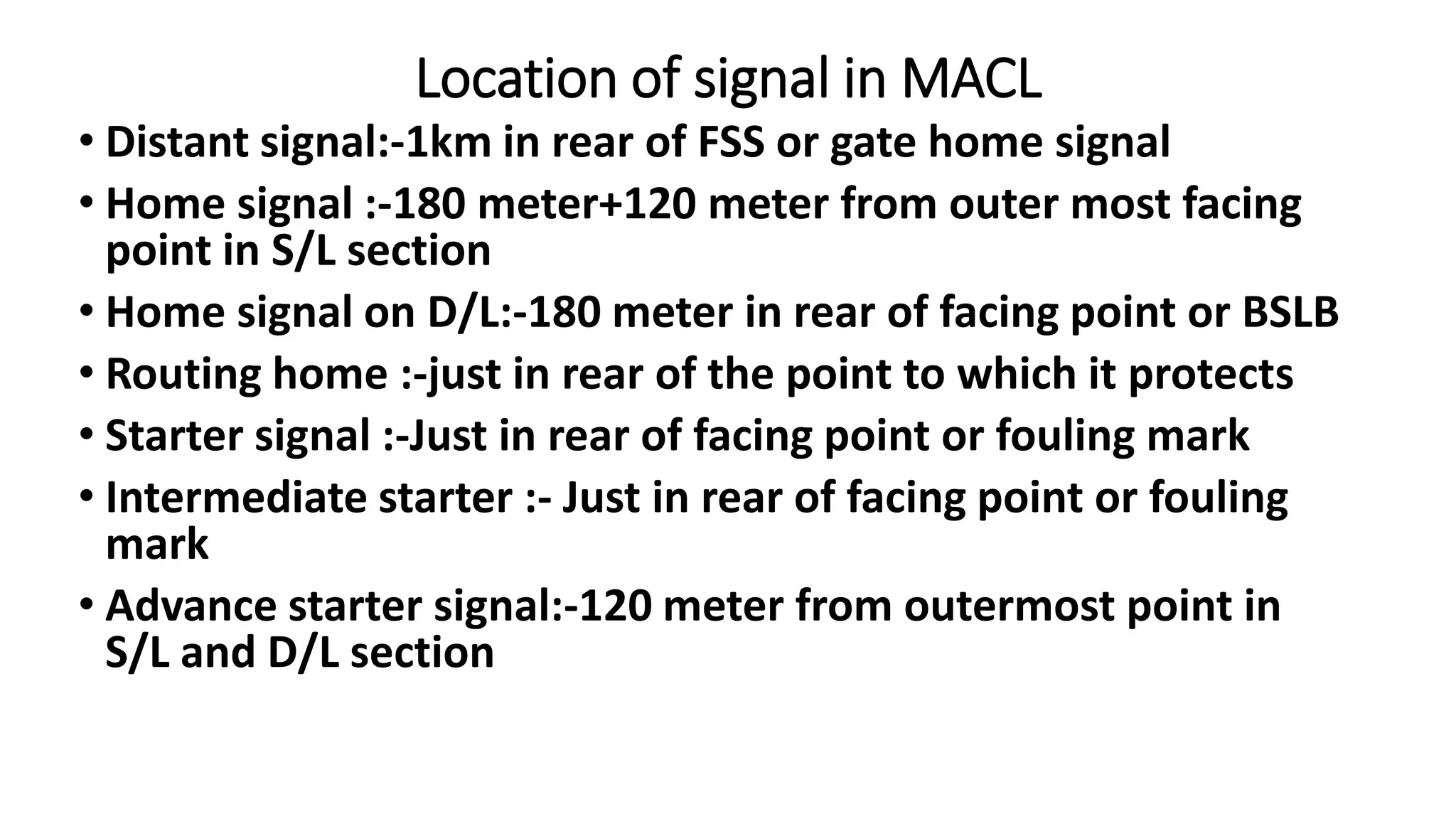
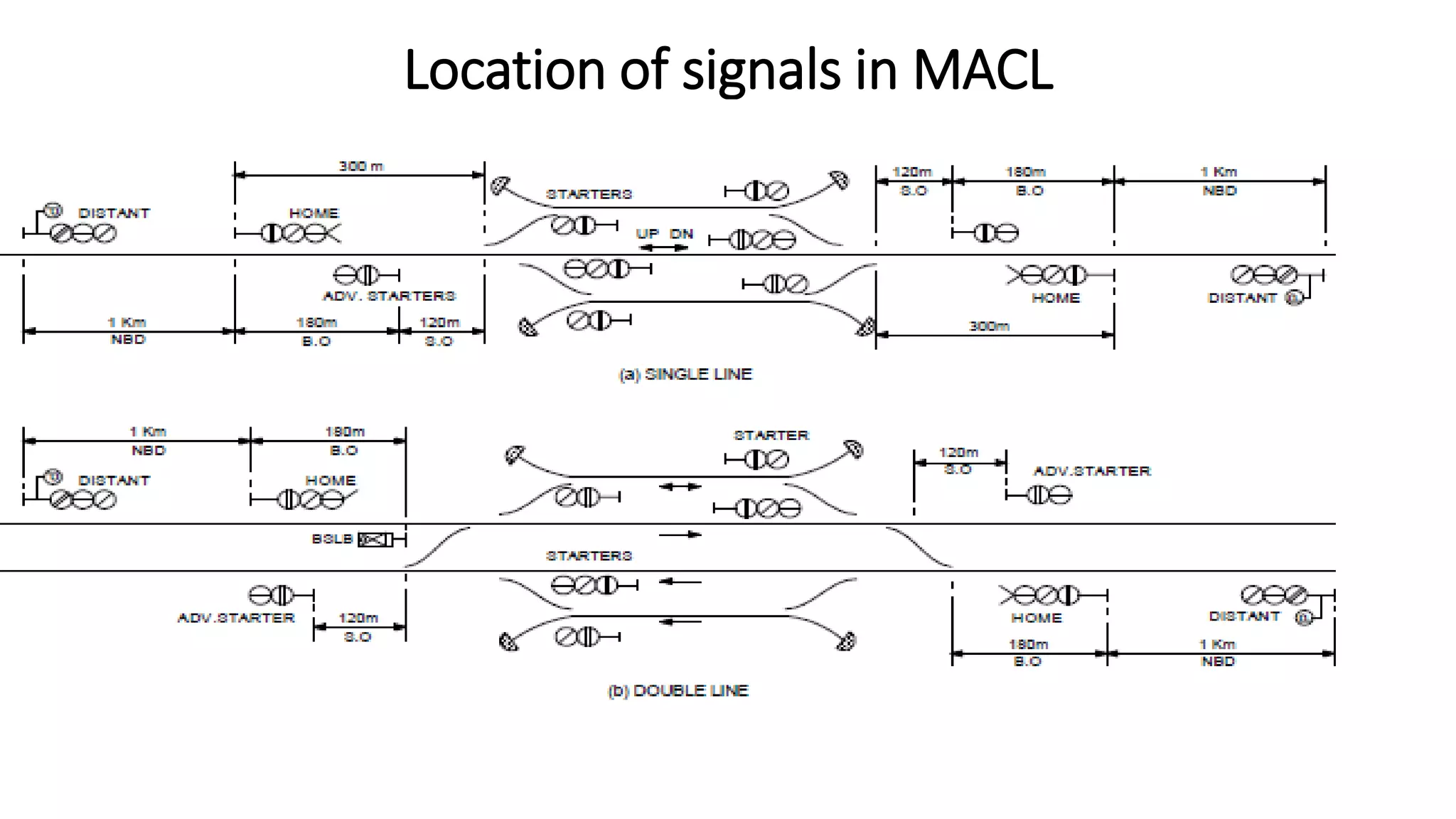
Location of signal in MACL
• Distant signal:-1km in rear of FSS or gate home signal
• Home signal :-180 meter+120 meter from outer most facing
point in S/L section
• Home signal on D/L:-180 meter in rear of facing point or BSLB
• Routing home :-just in rear of the point to which it protects
• Starter signal :-Just in rear of facing point or fouling mark
• Intermediate starter :- Just in rear of facing point or fouling
mark
• Advance starter signal:-120 meter from outermost point in
S/L and D/L section
Location of signals in MACL
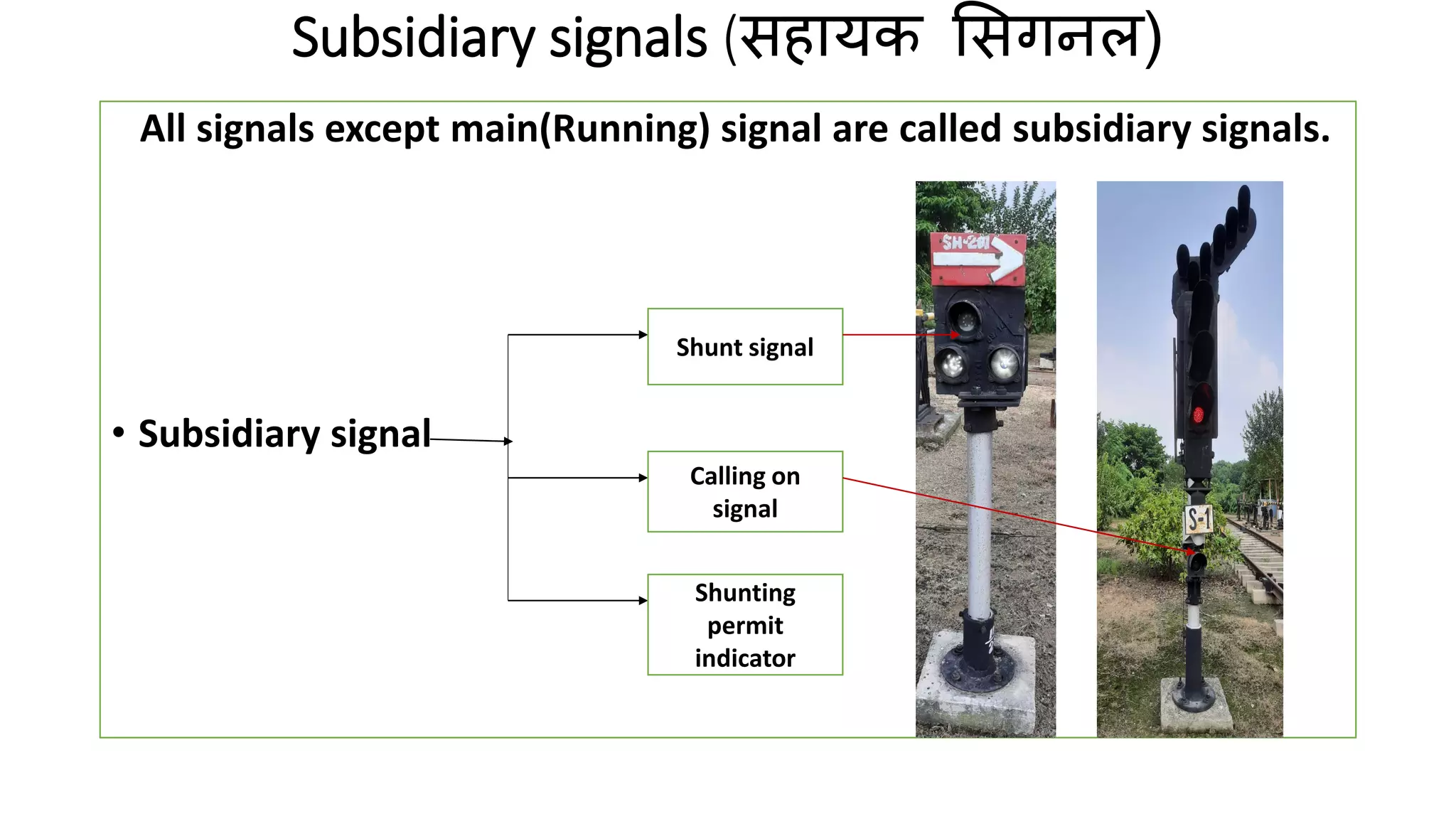
Subsidiary signals (सहायक ससगनल)
All signals except main(Running) signal are called subsidiary signals.
• Subsidiary signal
Shunt signal
Calling on
signal
Shunting
permit
indicator
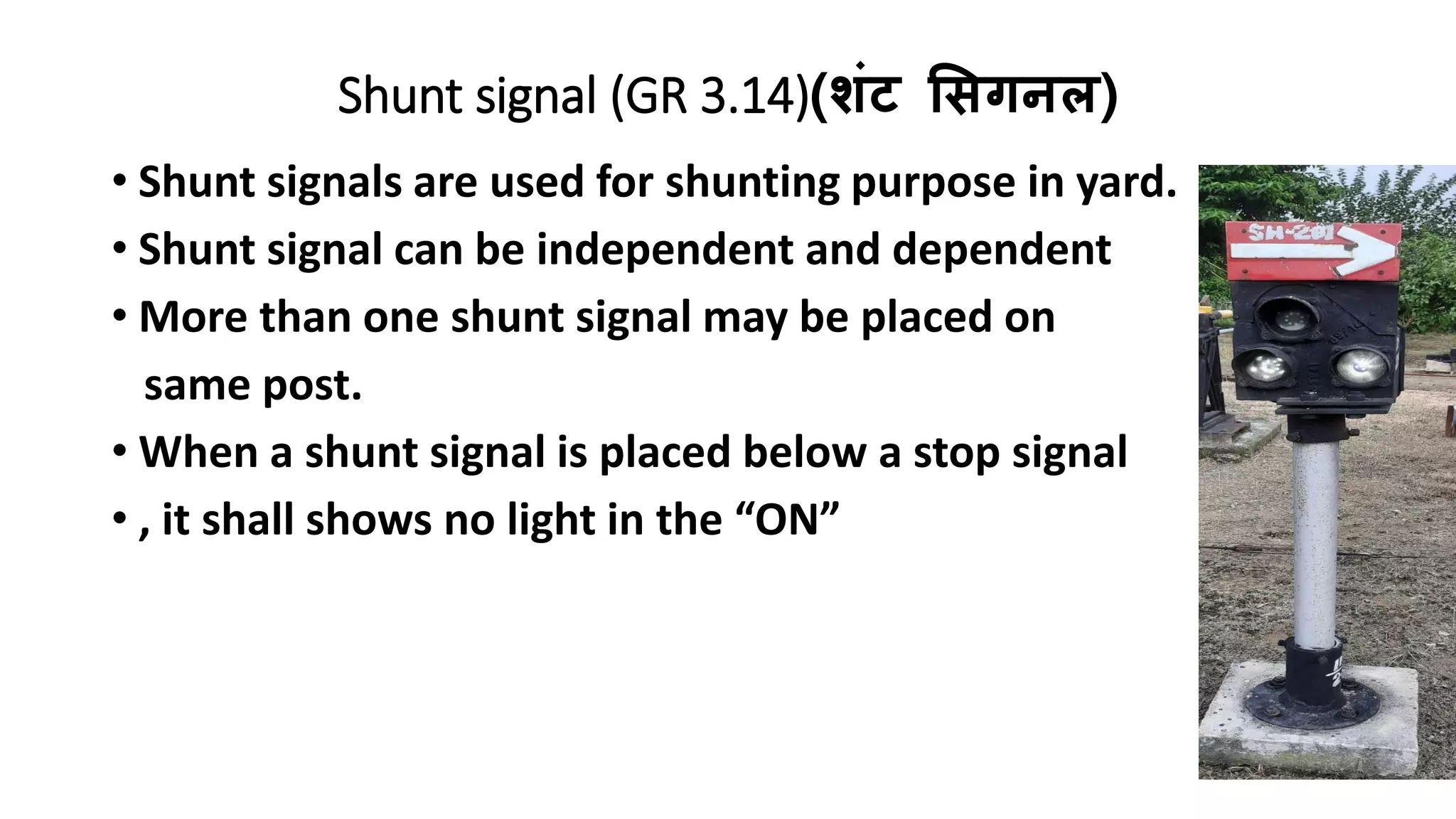
Shunt signal (GR 3.14)(शंट सिगनल)
• Shunt signals are used for shunting purpose in yard.
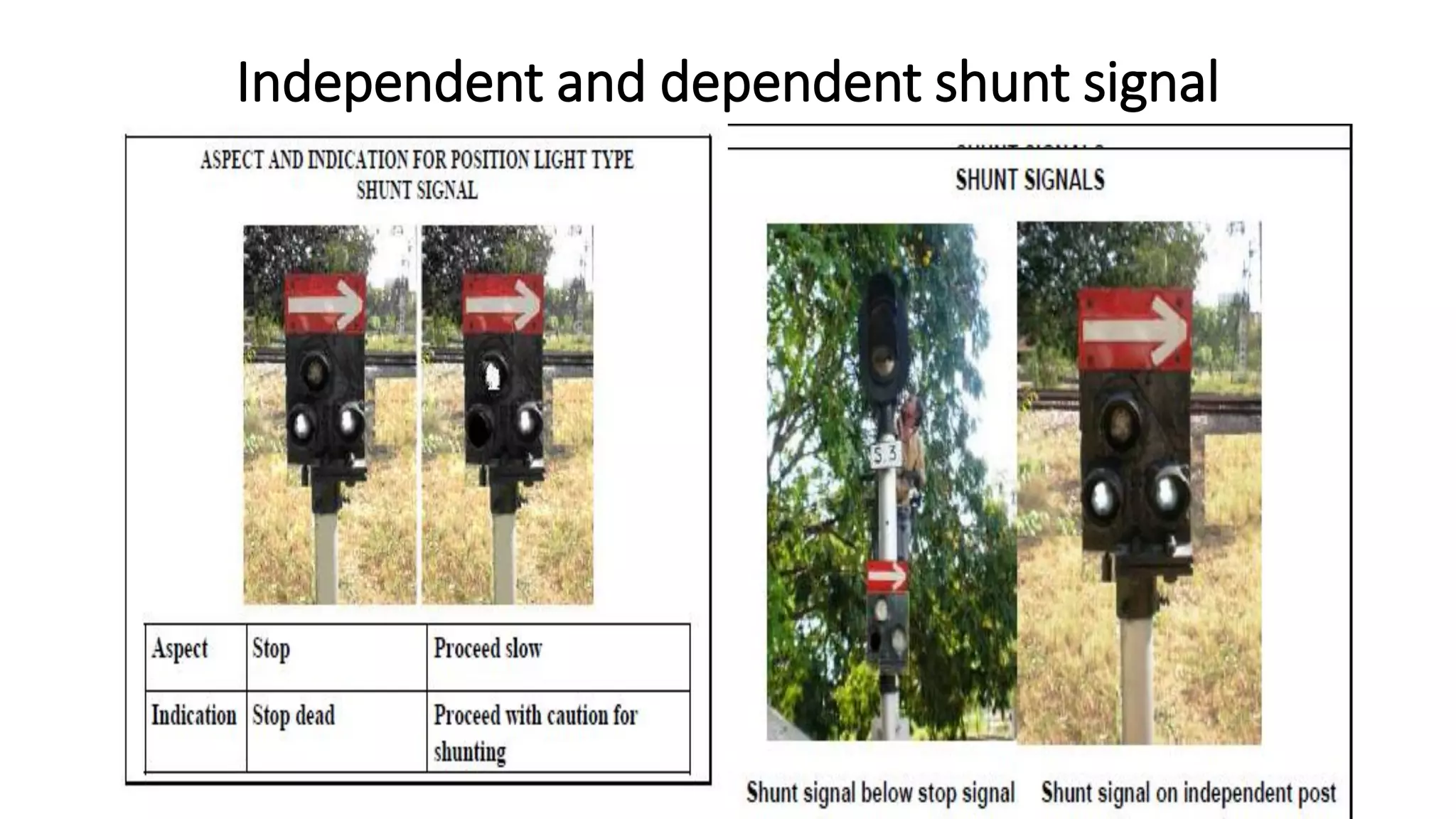
• Shunt signal can be independent and dependent
• More than one shunt signal may be placed on
same post.
• When a shunt signal is placed below a stop signal
• , it shall shows no light in the “ON”
Independent and dependent shunt signal
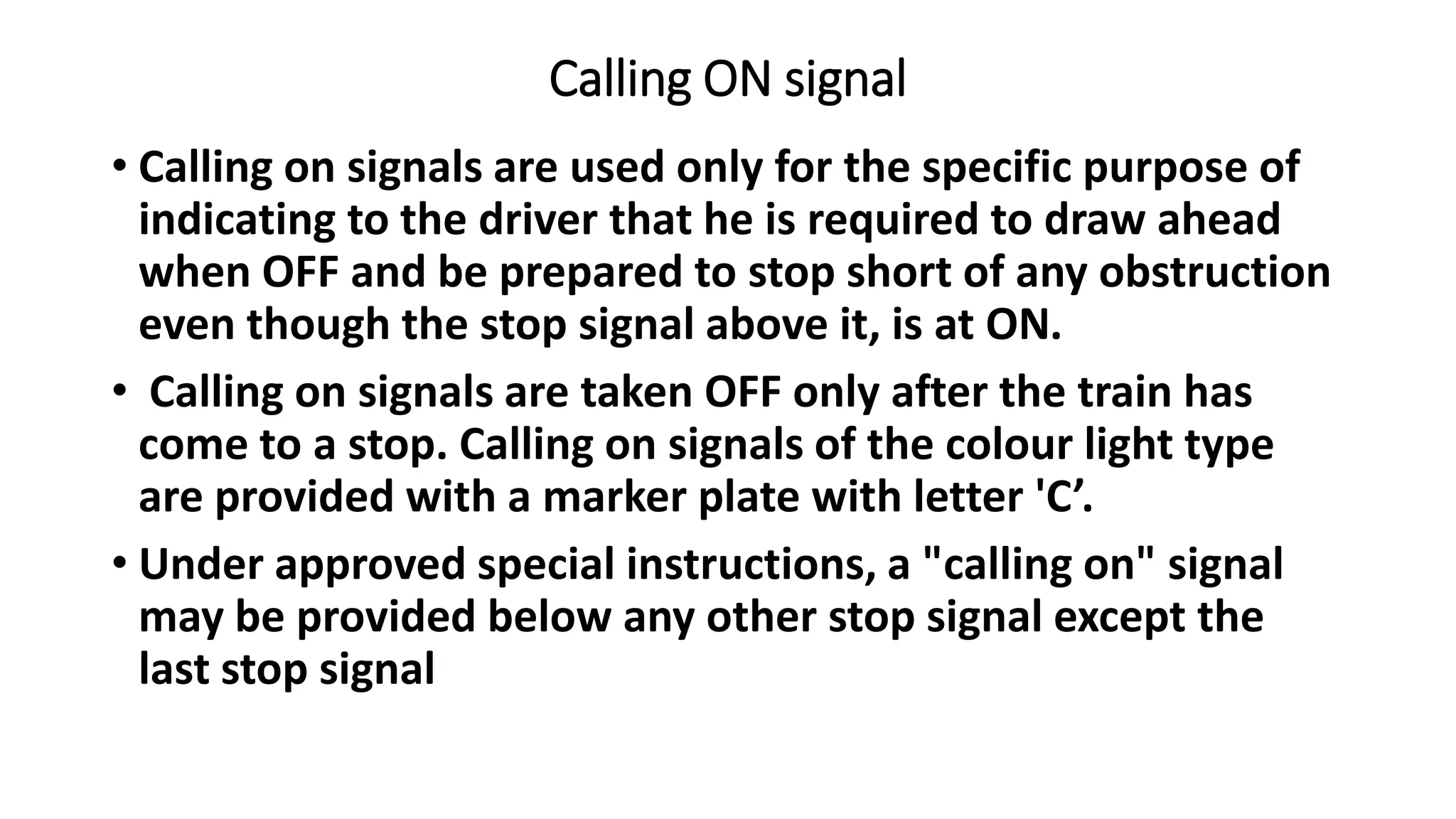
Calling ON signal
• Calling on signals are used only for the specific purpose of
indicating to the driver that he is required to draw ahead
when OFF and be prepared to stop short of any obstruction
even though the stop signal above it, is at ON.
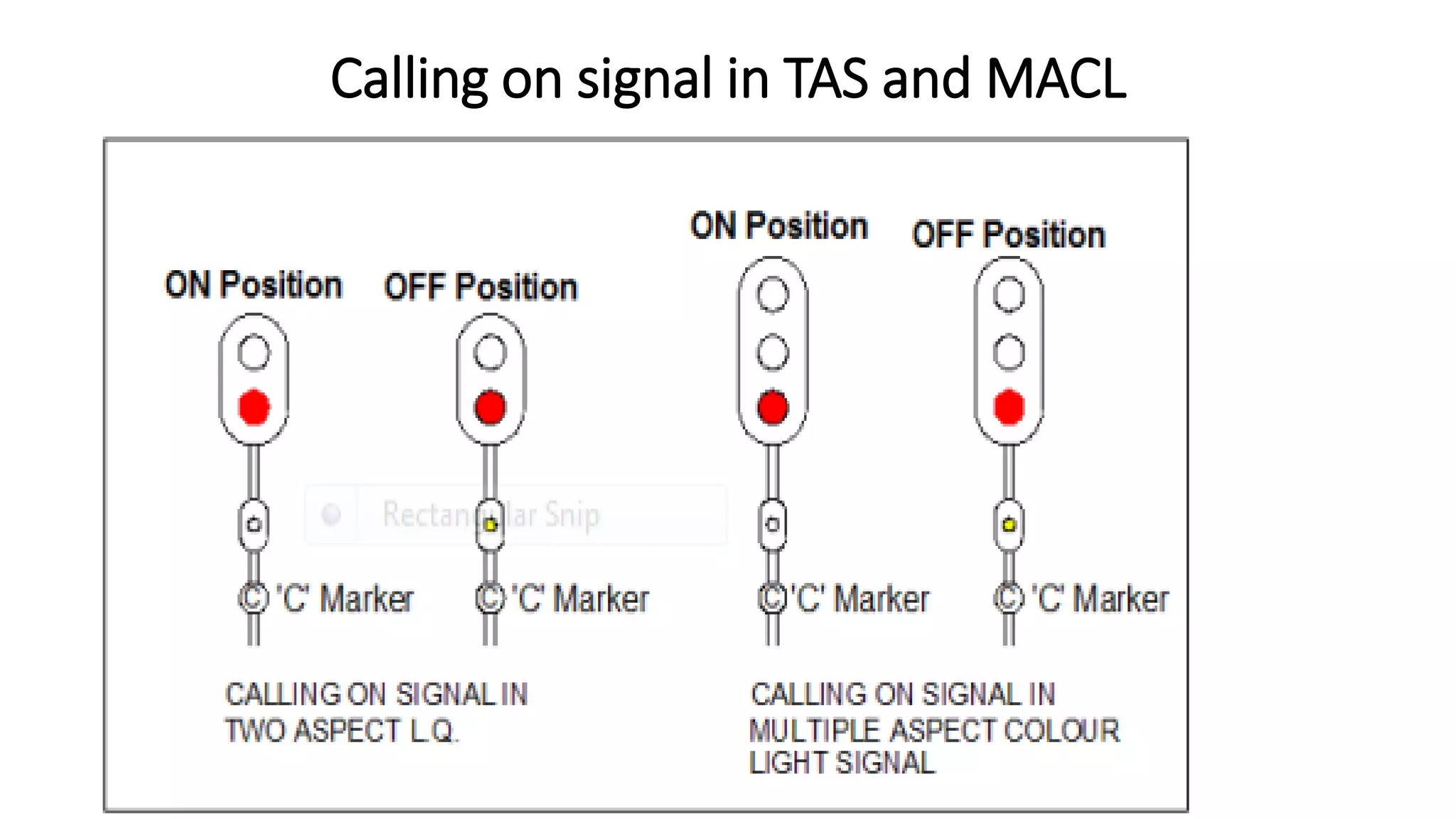
• Calling on signals are taken OFF only after the train has
come to a stop. Calling on signals of the colour light type
are provided with a marker plate with letter 'C’.
• Under approved special instructions, a "calling on" signal
may be provided below any other stop signal except the
last stop signal
Calling on signal in TAS and MACL
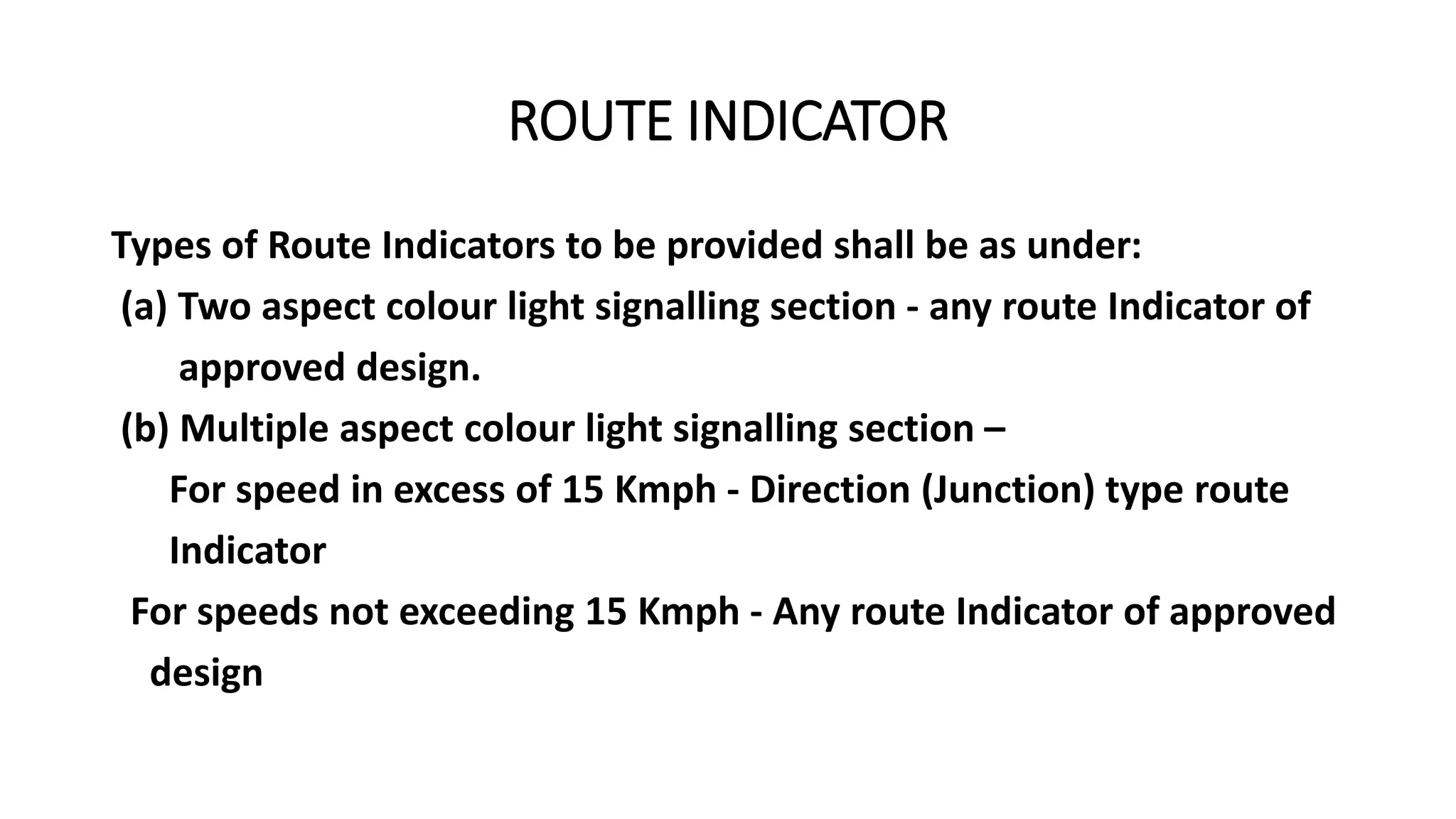
ROUTE INDICATOR
Types of Route Indicators to be provided shall be as under:
(a) Two aspect colour light signalling section - any route Indicator of
approved design.
(b) Multiple aspect colour light signalling section –
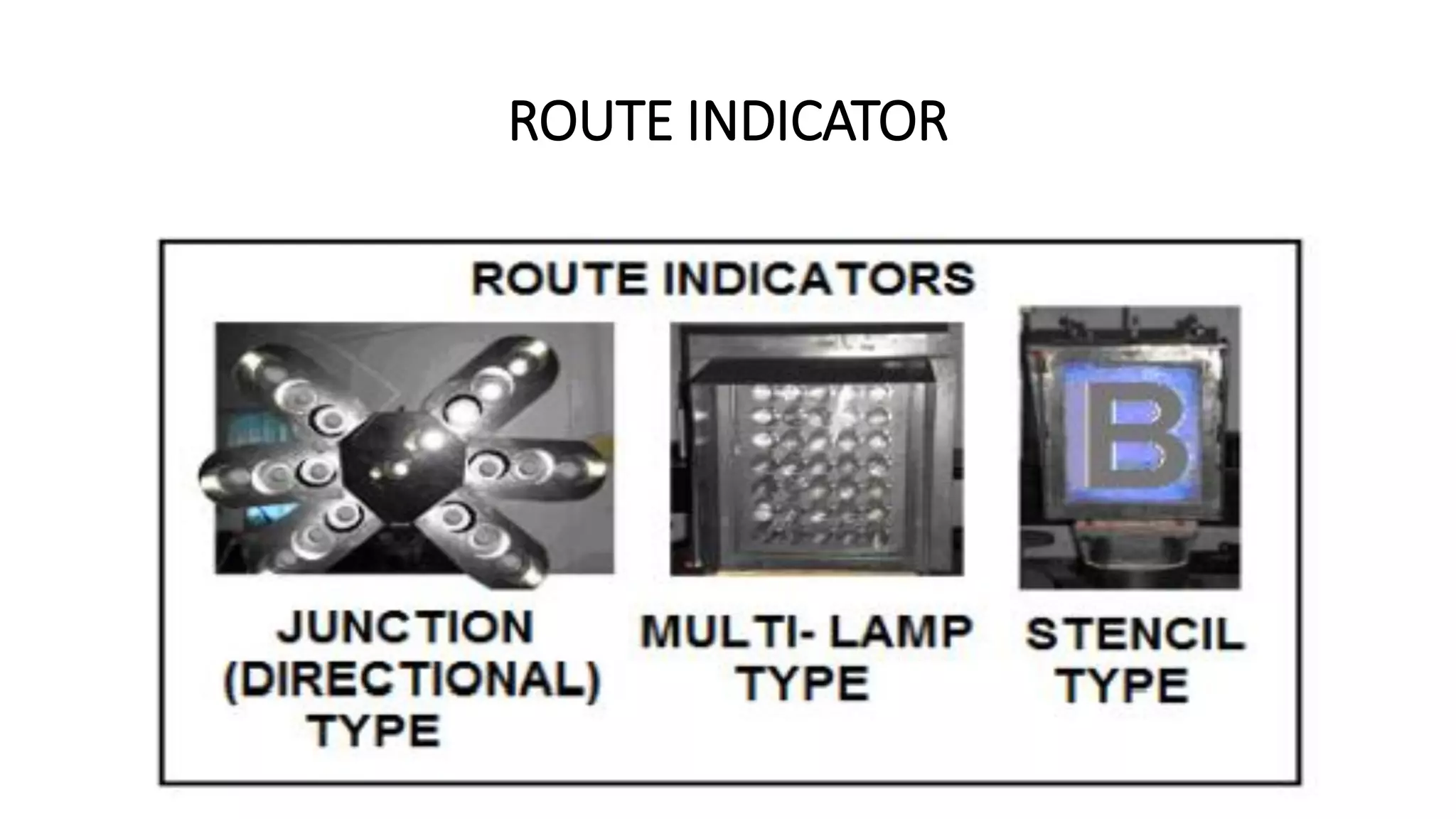
For speed in excess of 15 Kmph - Direction (Junction) type route
Indicator
For speeds not exceeding 15 Kmph - Any route Indicator of approved
design
ROUTE INDICATOR
BOARDS
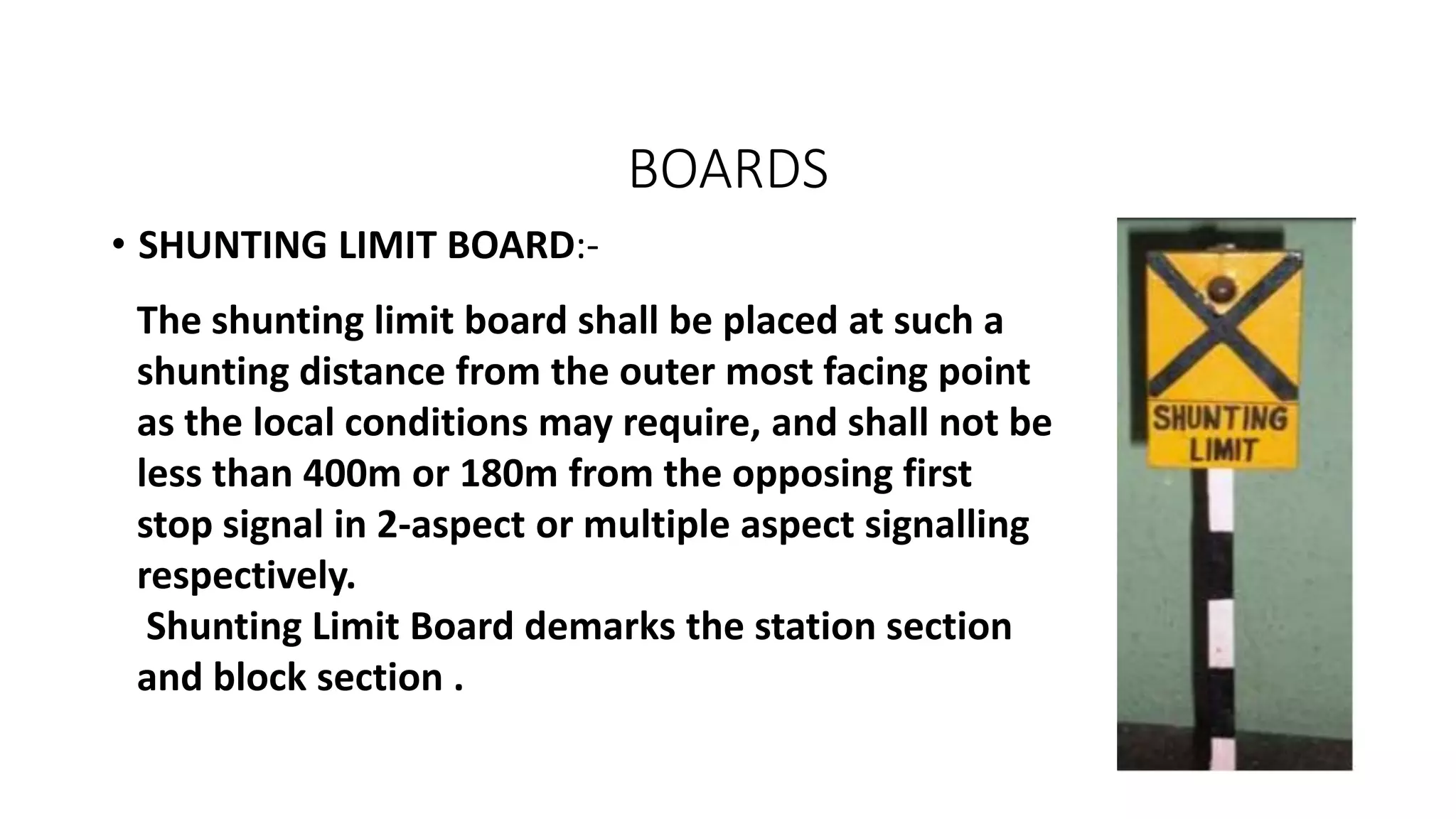
• SHUNTING LIMIT BOARD:-
The shunting limit board shall be placed at such a
shunting distance from the outer most facing point
as the local conditions may require, and shall not be
less than 400m or 180m from the opposing first
stop signal in 2-aspect or multiple aspect signalling
respectively.
Shunting Limit Board demarks the station section
and block section .
BOARDS(BSLB)
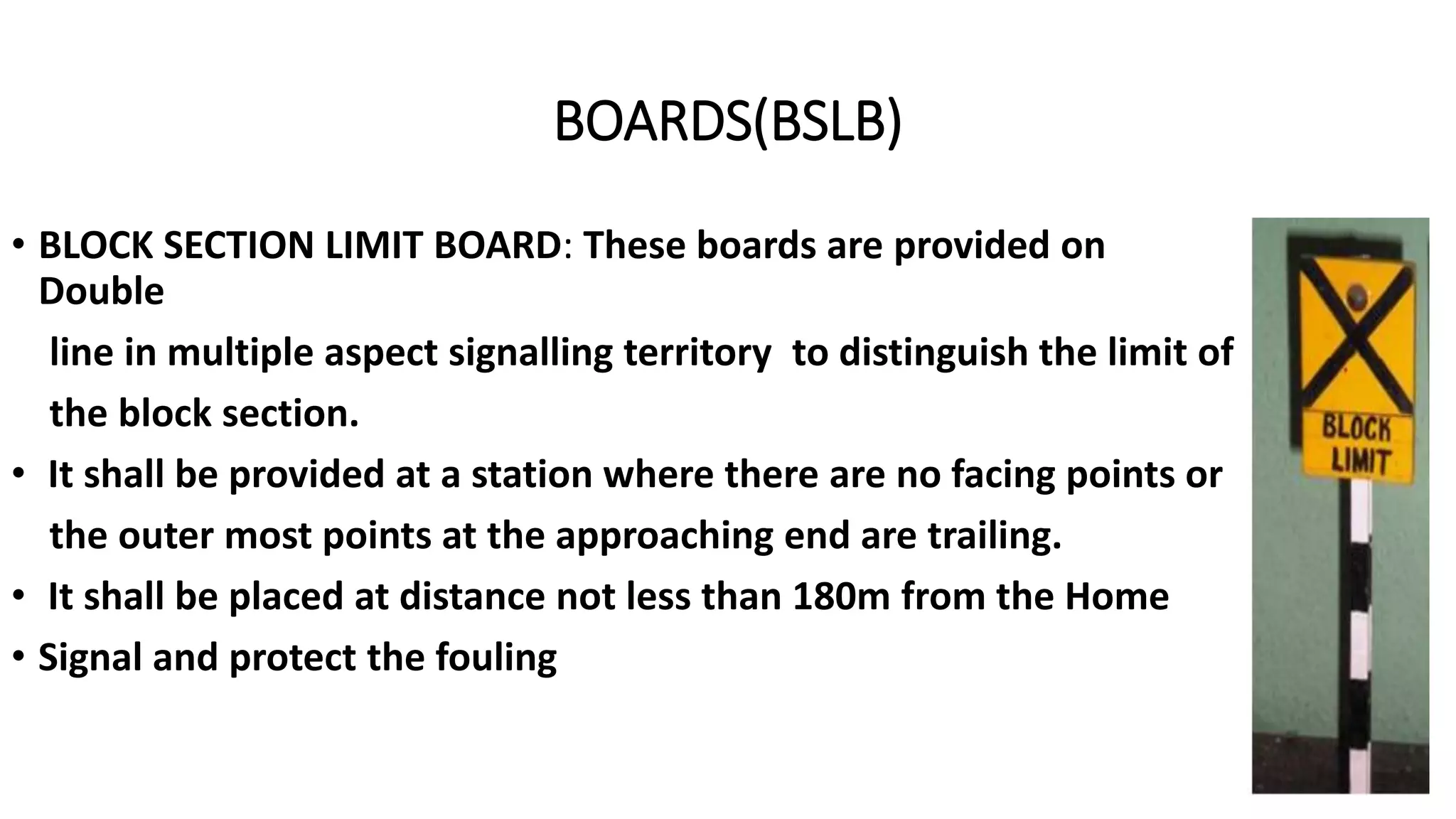
• BLOCK SECTION LIMIT BOARD: These boards are provided on
Double
line in multiple aspect signalling territory to distinguish the limit of
the block section.
• It shall be provided at a station where there are no facing points or
the outer most points at the approaching end are trailing.
• It shall be placed at distance not less than 180m from the Home
• Signal and protect the fouling
WARNING BOARDS
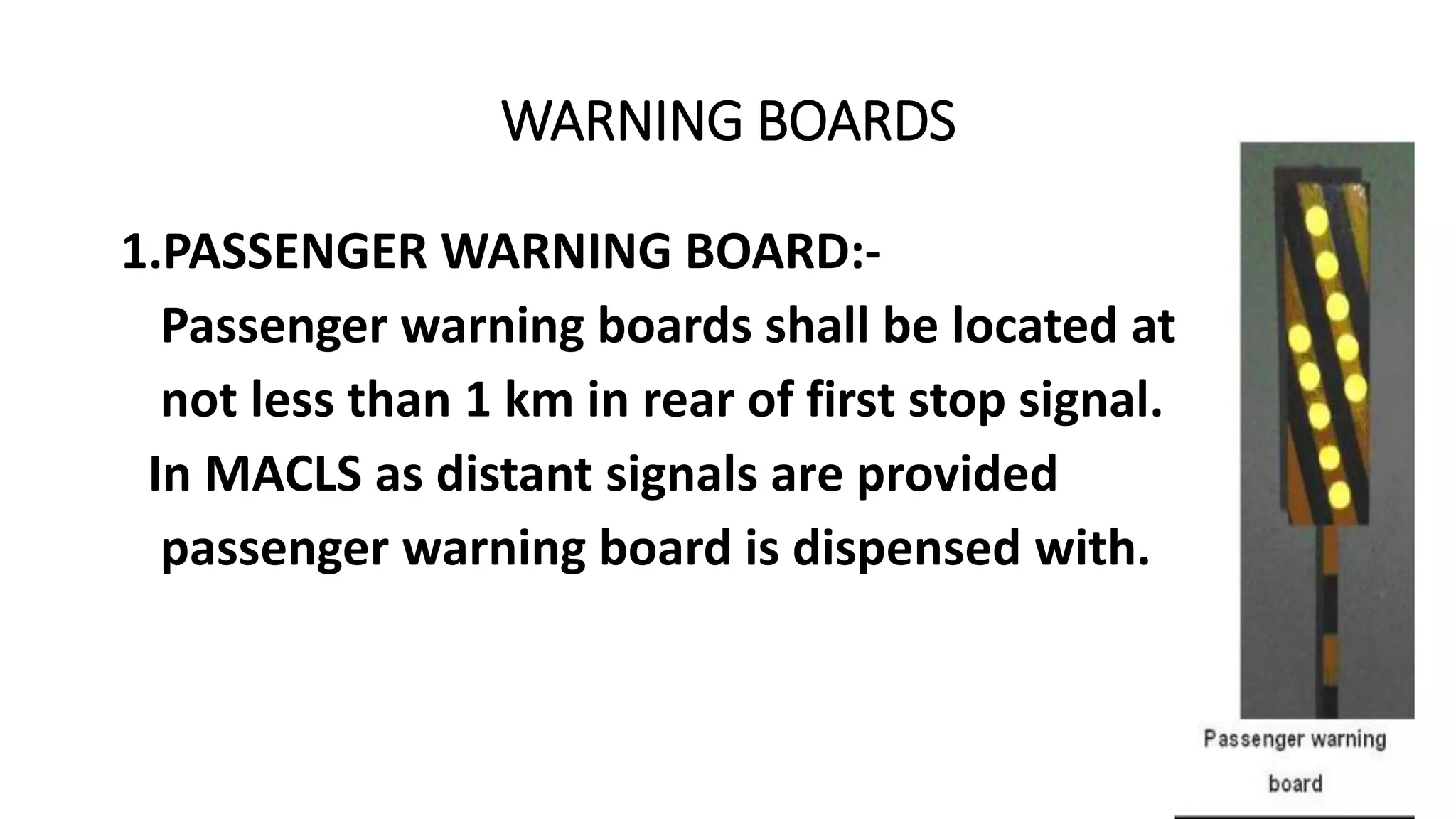
1.PASSENGER WARNING BOARD:-
Passenger warning boards shall be located at
not less than 1 km in rear of first stop signal.
In MACLS as distant signals are provided
passenger warning board is dispensed with.
WARNING BOARDS
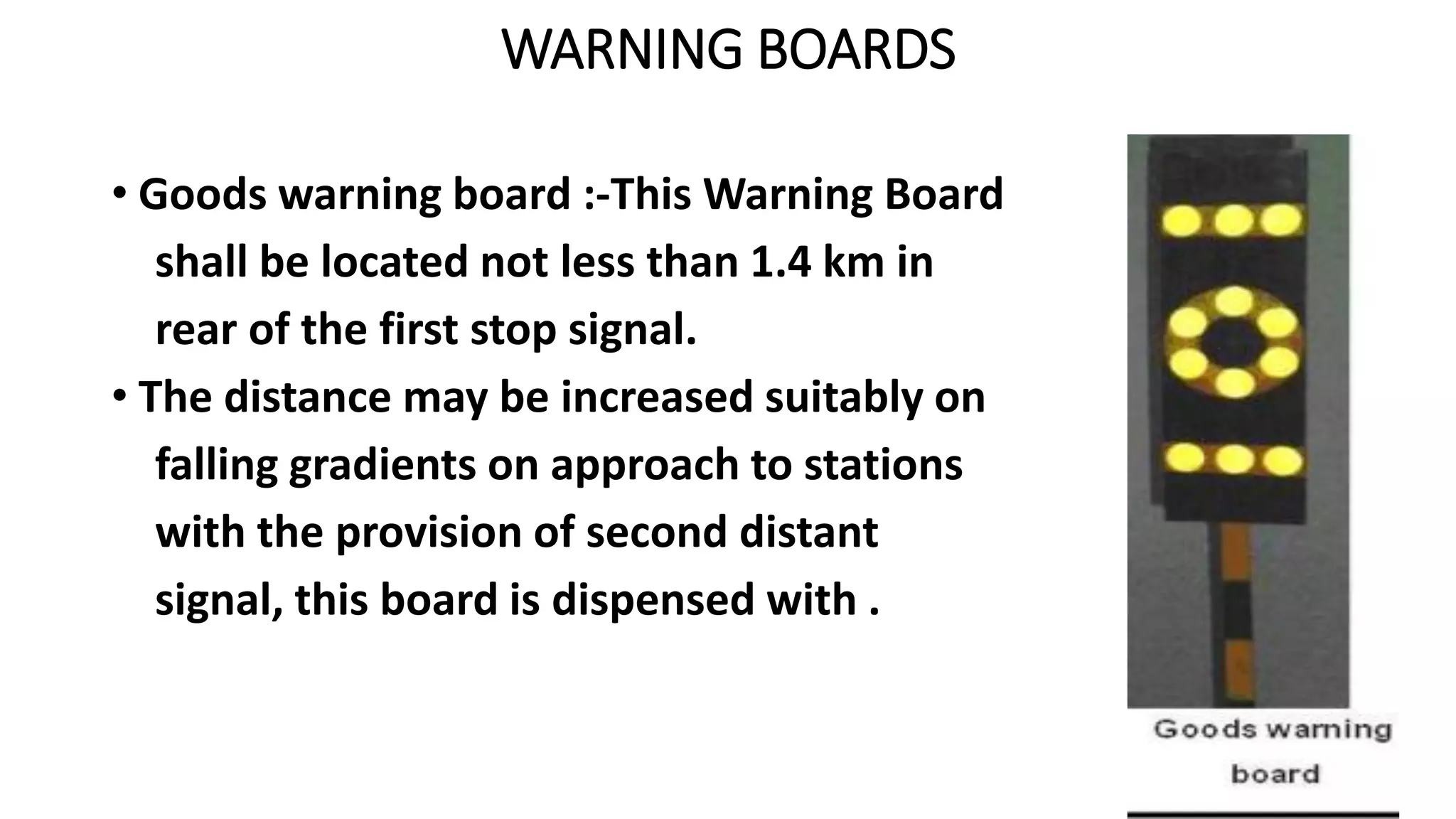
• Goods warning board :-This Warning Board
shall be located not less than 1.4 km in
rear of the first stop signal.
• The distance may be increased suitably on
falling gradients on approach to stations
with the provision of second distant
signal, this board is dispensed with .
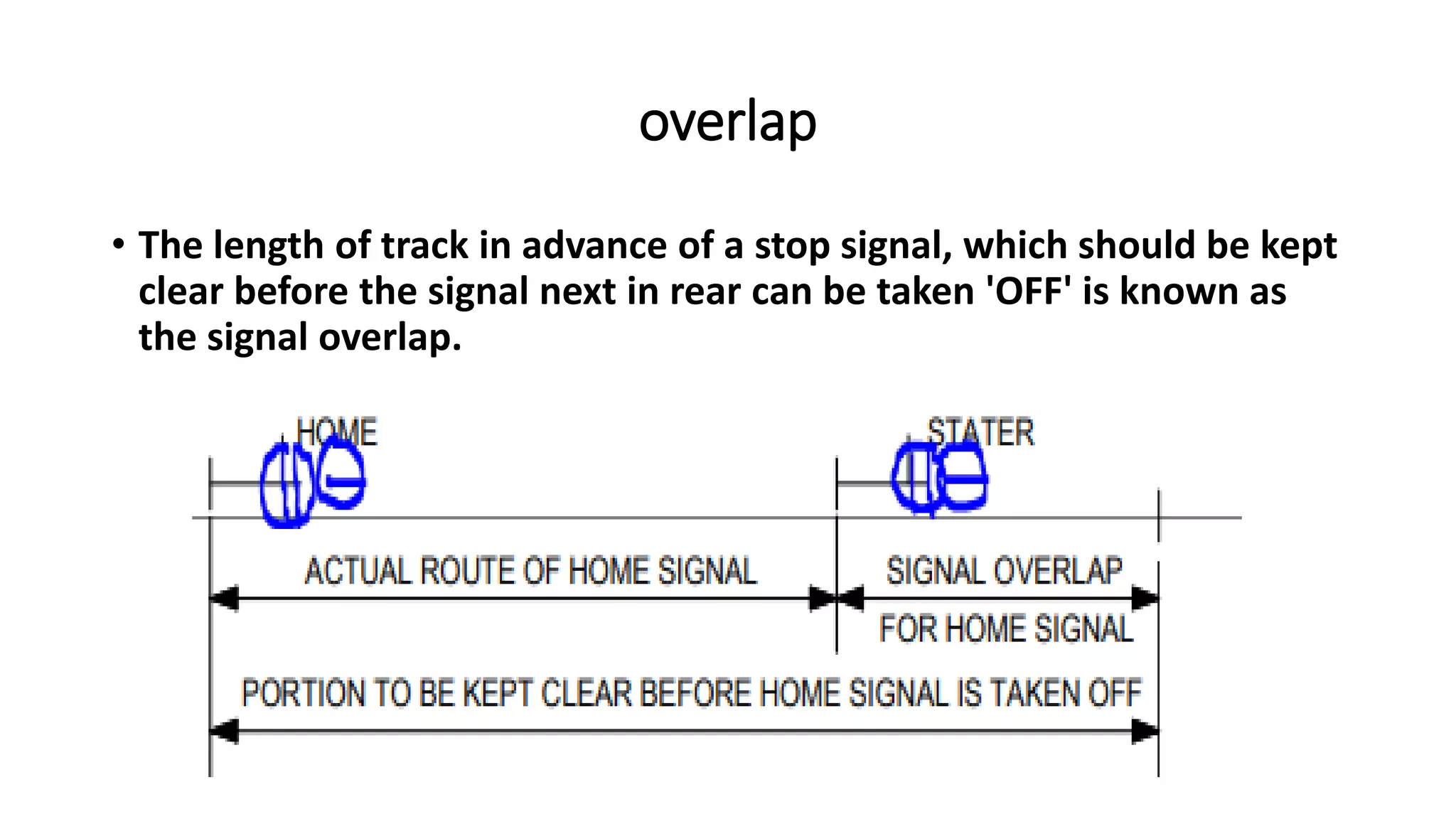
overlap
• The length of track in advance of a stop signal, which should be kept
clear before the signal next in rear can be taken 'OFF' is known as
the signal overlap.
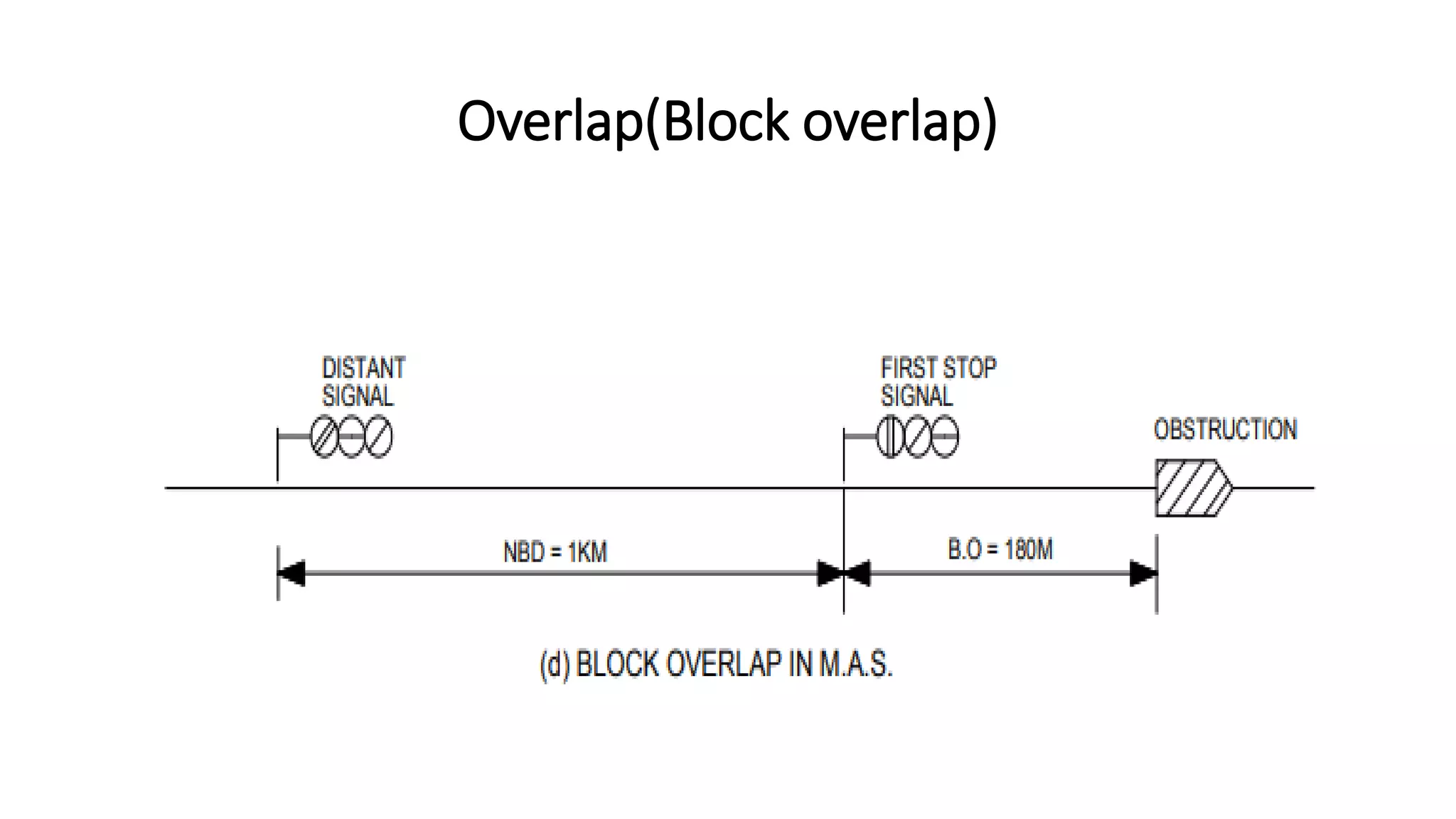
Overlap(Block overlap)
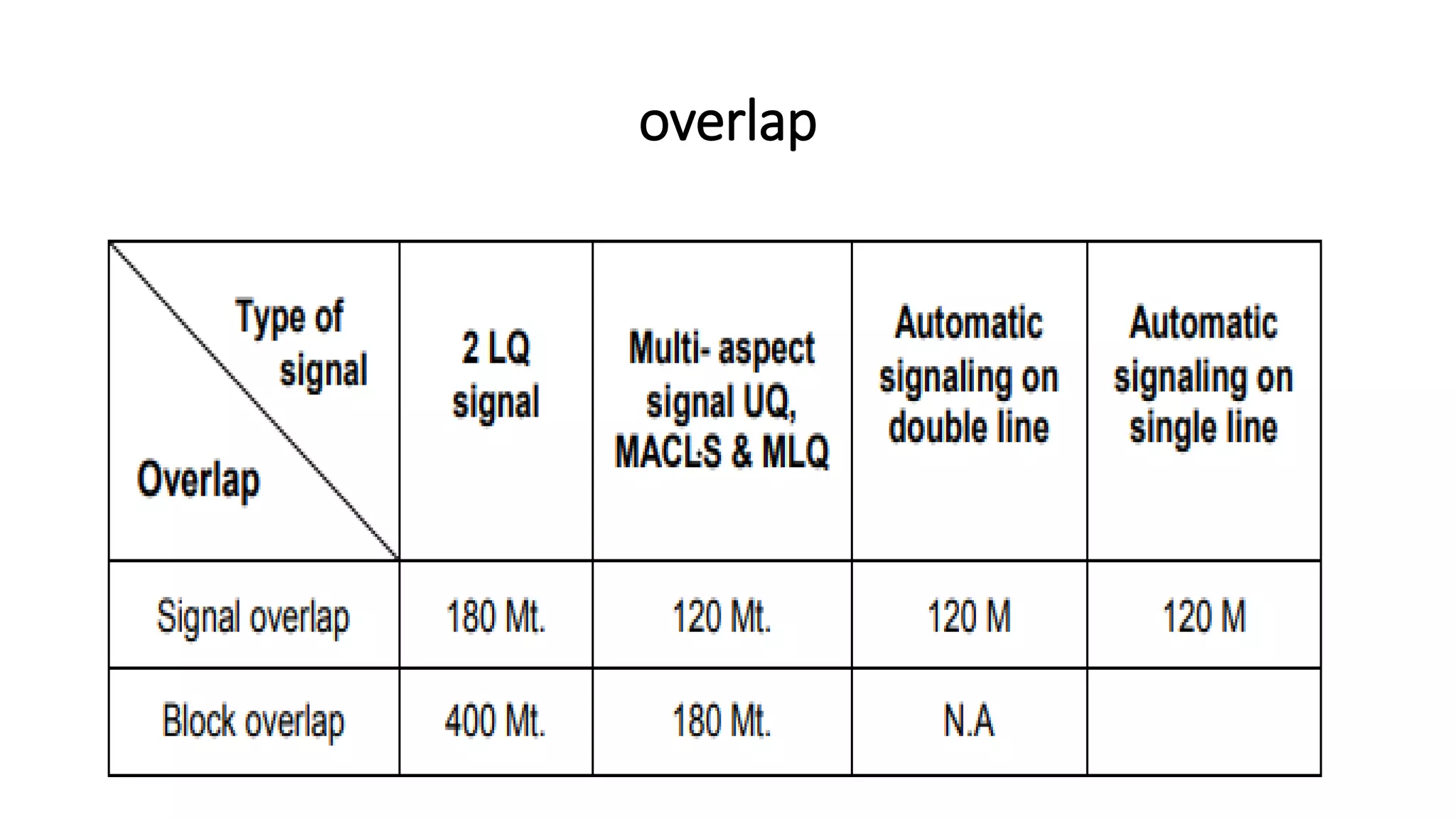
overlap
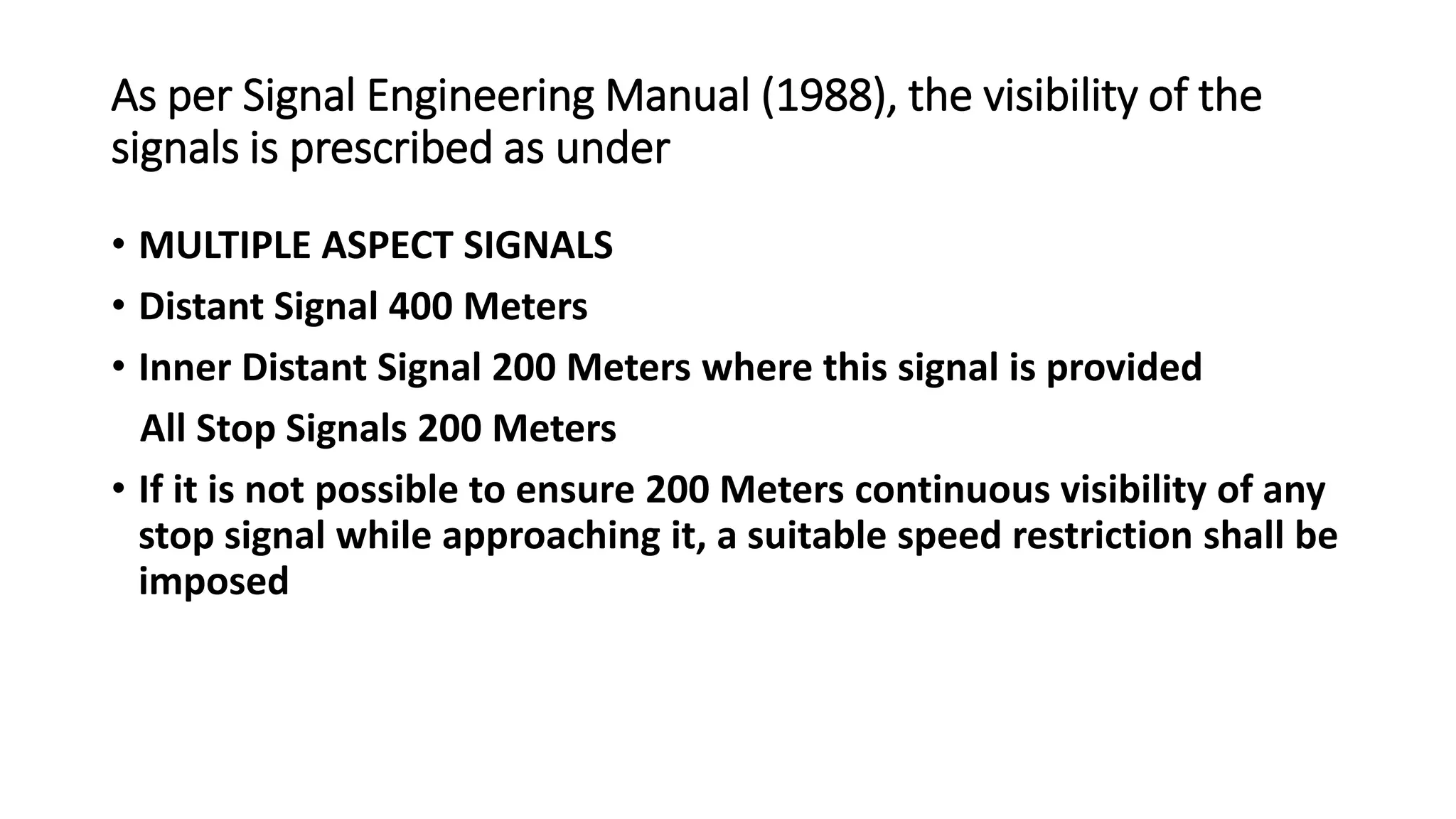
As per Signal Engineering Manual (1988), the visibility of the
signals is prescribed as under
• MULTIPLE ASPECT SIGNALS
• Distant Signal 400 Meters
• Inner Distant Signal 200 Meters where this signal is provided
All Stop Signals 200 Meters
• If it is not possible to ensure 200 Meters continuous visibility of any
stop signal while approaching it, a suitable speed restriction shall be
imposed
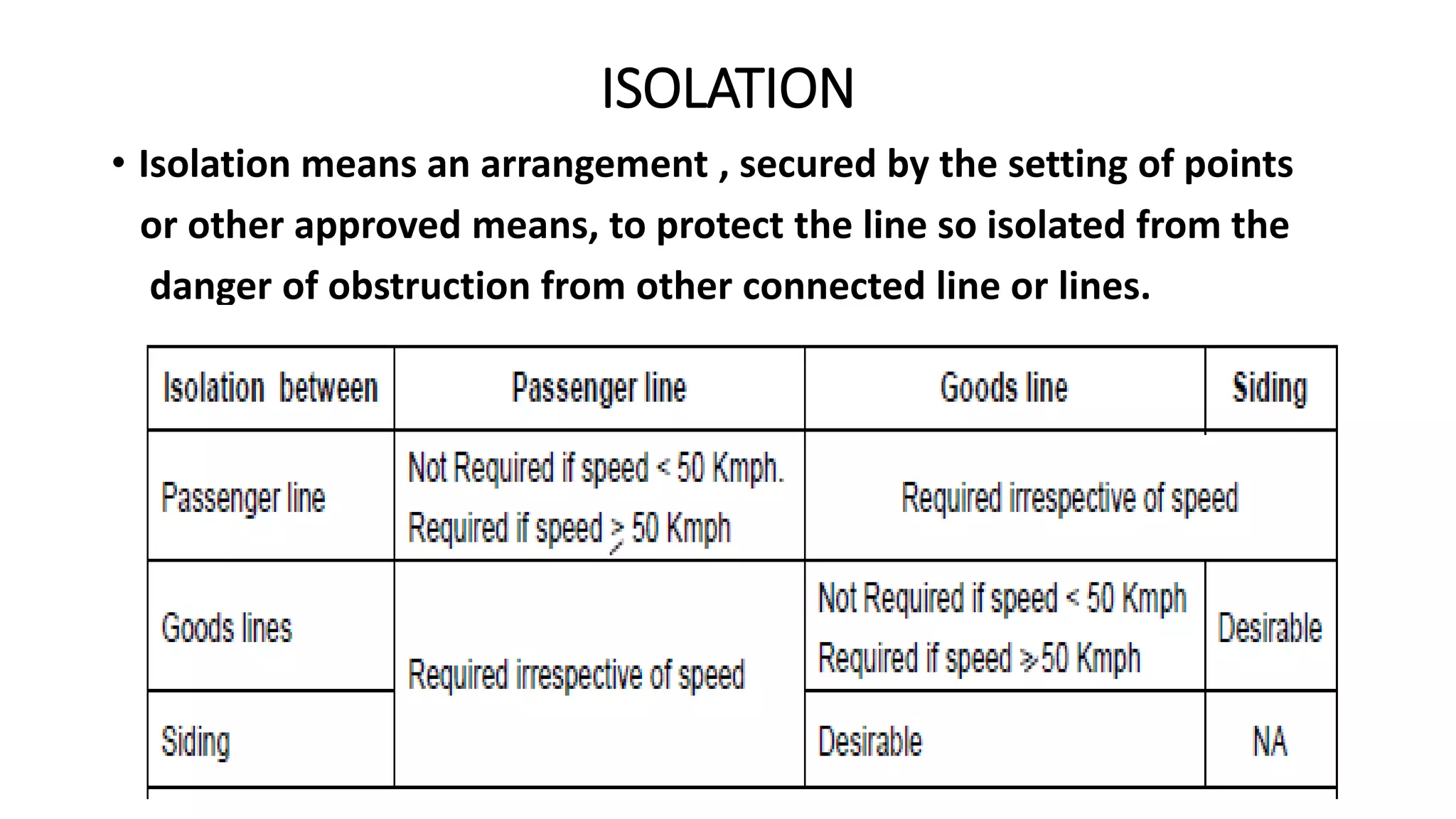
ISOLATION
• Isolation means an arrangement , secured by the setting of points
or other approved means, to protect the line so isolated from the
danger of obstruction from other connected line or lines.
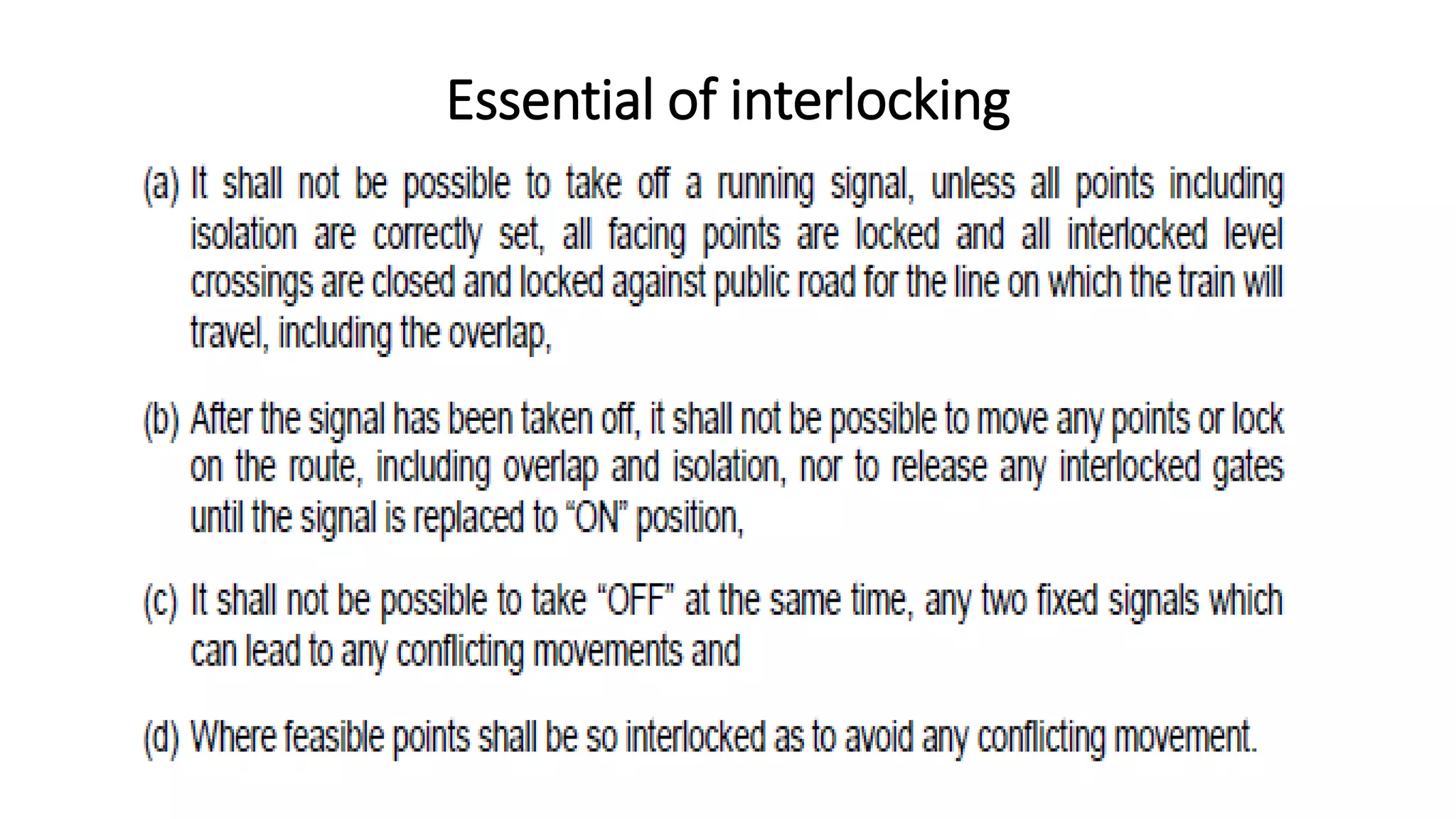
Essential of interlocking
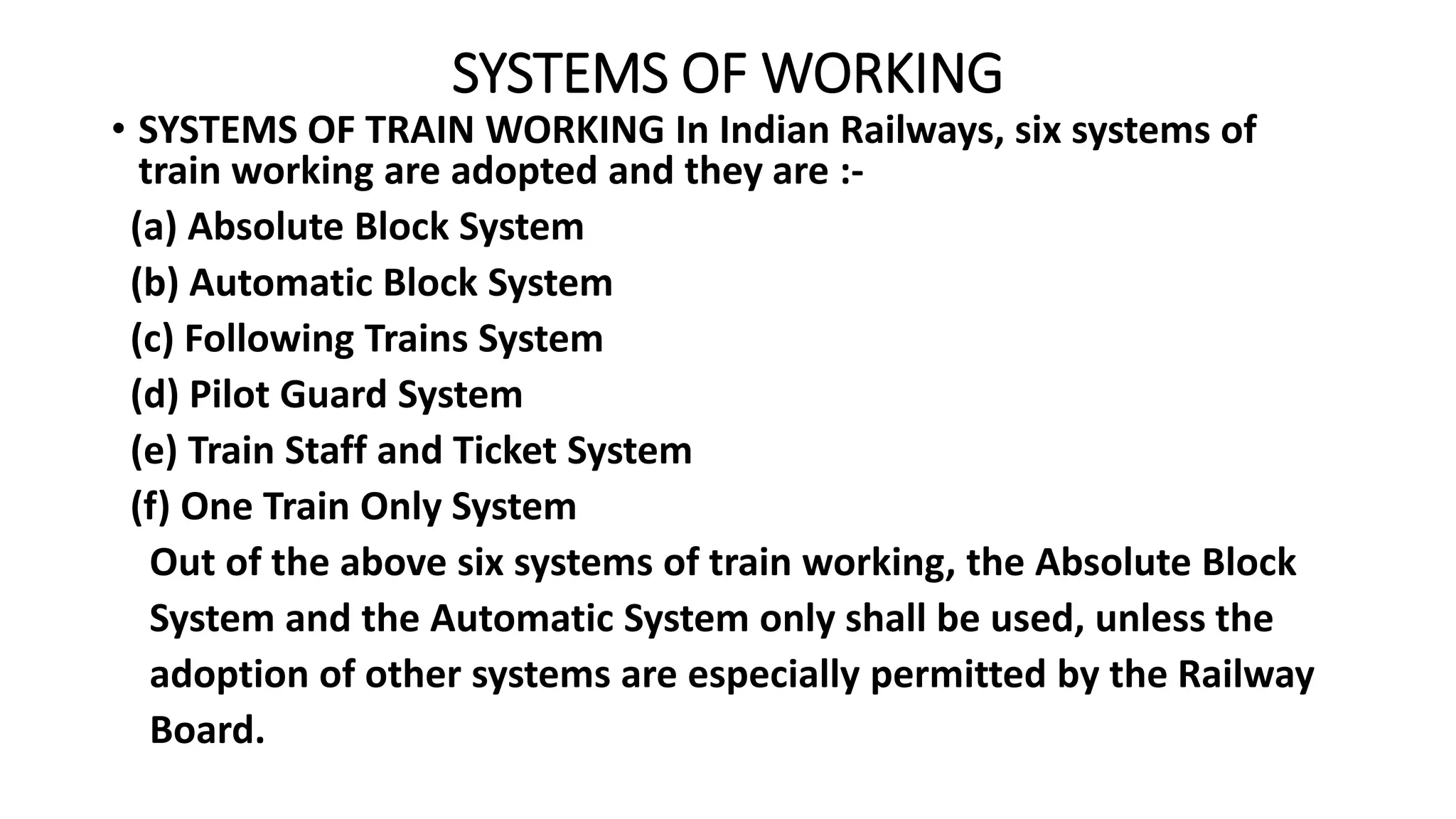
SYSTEMS OF WORKING
• SYSTEMS OF TRAIN WORKING In Indian Railways, six systems of
train working are adopted and they are :-
(a) Absolute Block System
(b) Automatic Block System
(c) Following Trains System
(d) Pilot Guard System
(e) Train Staff and Ticket System
(f) One Train Only System
Out of the above six systems of train working, the Absolute Block
System and the Automatic System only shall be used, unless the
adoption of other systems are especially permitted by the Railway
Board.
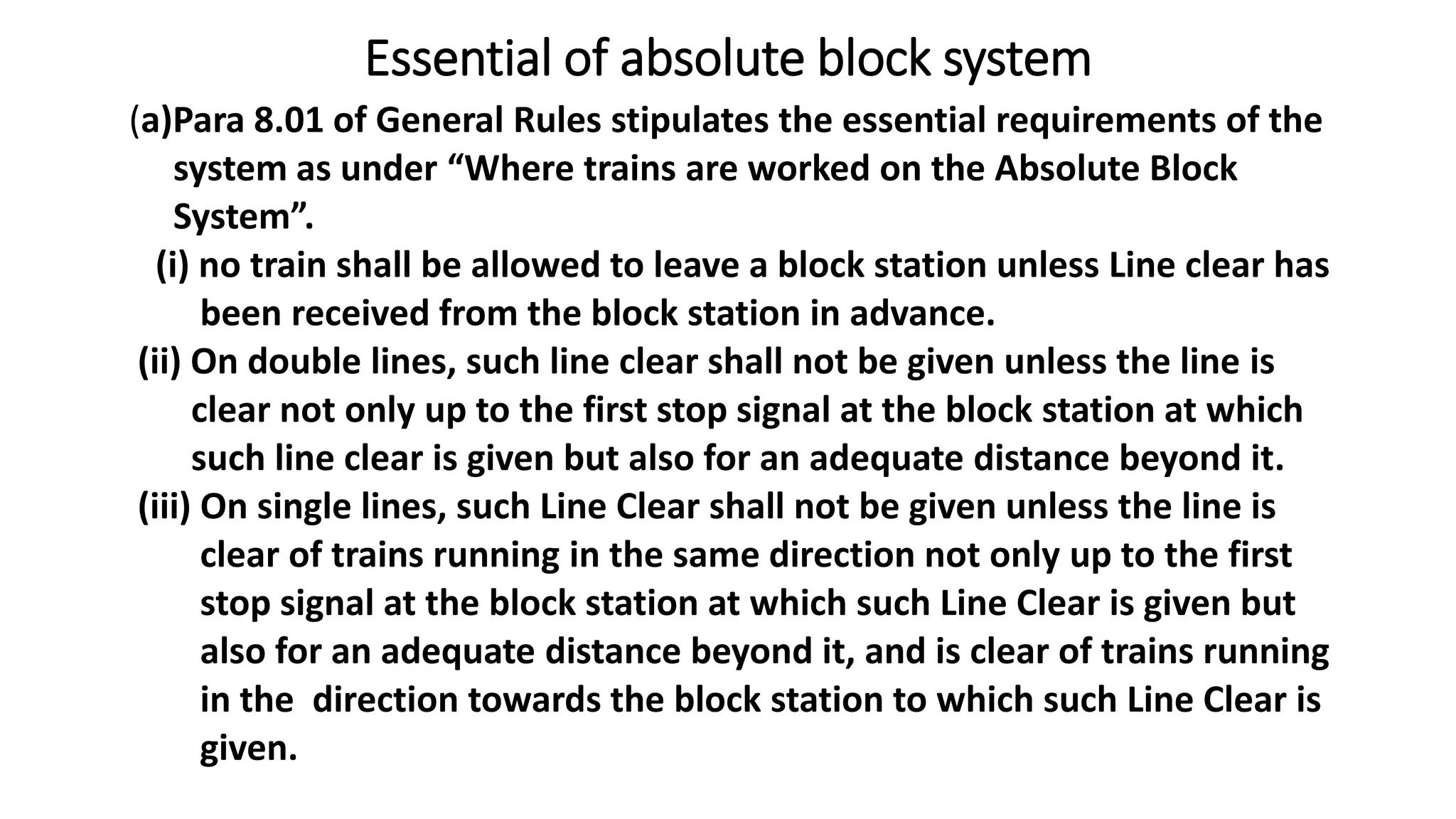
Essential of absolute block system
(a)Para 8.01 of General Rules stipulates the essential requirements of the
system as under “Where trains are worked on the Absolute Block
System”.
(i) no train shall be allowed to leave a block station unless Line clear has
been received from the block station in advance.
(ii) On double lines, such line clear shall not be given unless the line is
clear not only up to the first stop signal at the block station at which
such line clear is given but also for an adequate distance beyond it.
(iii) On single lines, such Line Clear shall not be given unless the line is
clear of trains running in the same direction not only up to the first
stop signal at the block station at which such Line Clear is given but
also for an adequate distance beyond it, and is clear of trains running
in the direction towards the block station to which such Line Clear is
given.
Essential of absolute block system
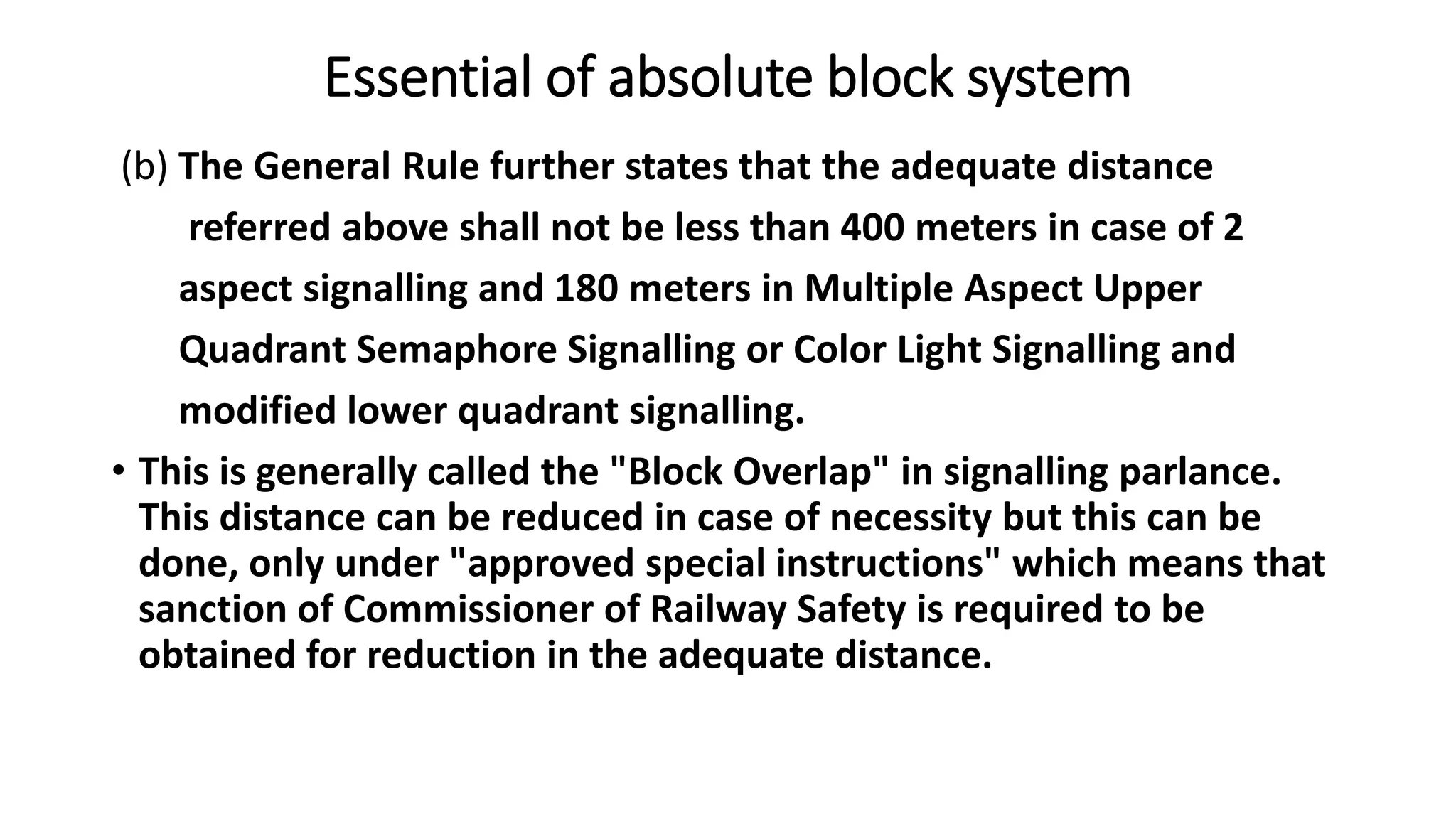
(b) The General Rule further states that the adequate distance
referred above shall not be less than 400 meters in case of 2
aspect signalling and 180 meters in Multiple Aspect Upper
Quadrant Semaphore Signalling or Color Light Signalling and
modified lower quadrant signalling.
• This is generally called the "Block Overlap" in signalling parlance.
This distance can be reduced in case of necessity but this can be
done, only under "approved special instructions" which means that
sanction of Commissioner of Railway Safety is required to be
obtained for reduction in the adequate distance.
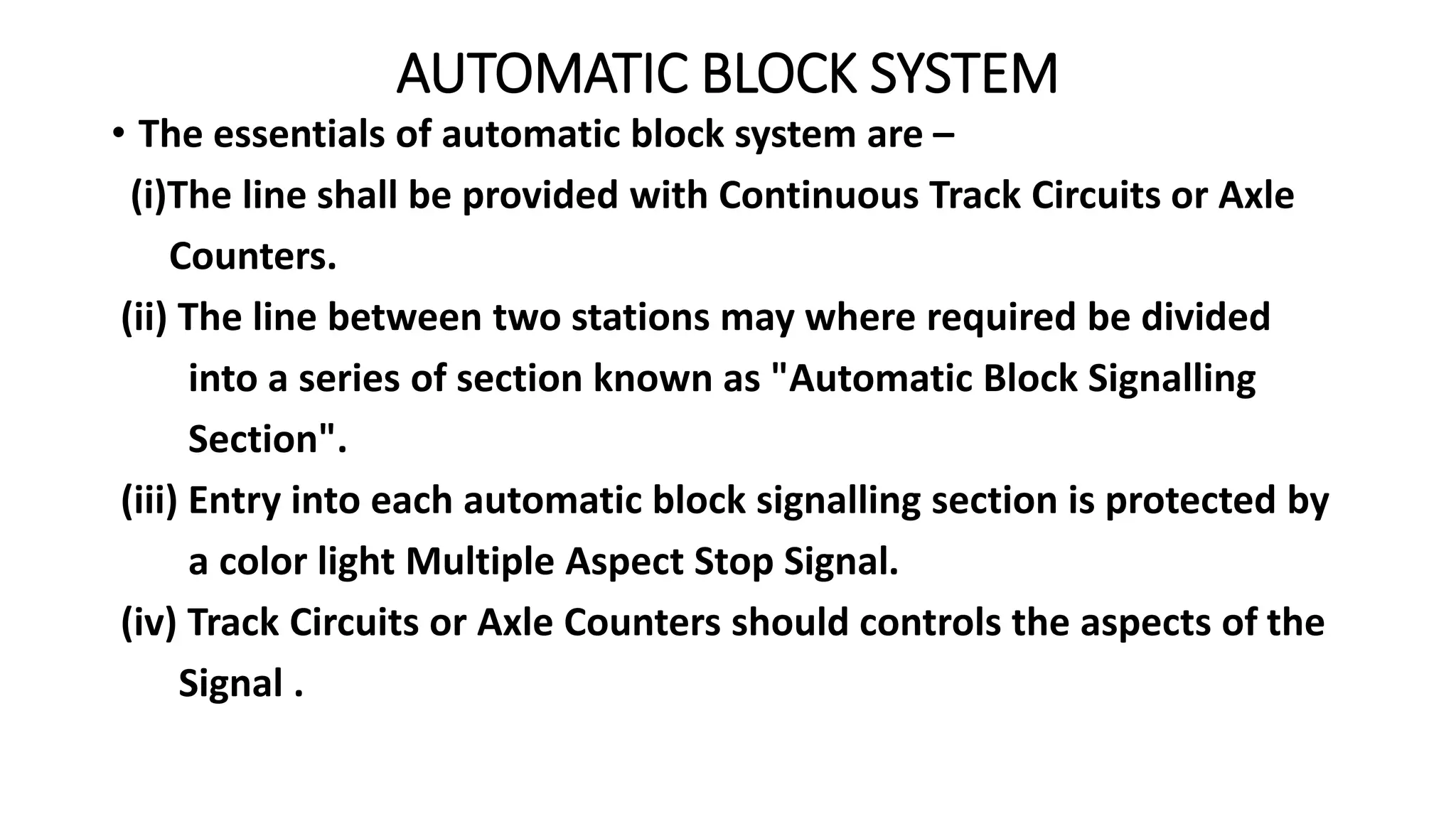
AUTOMATIC BLOCK SYSTEM
• The essentials of automatic block system are –
(i)The line shall be provided with Continuous Track Circuits or Axle
Counters.
(ii) The line between two stations may where required be divided
into a series of section known as "Automatic Block Signalling
Section".
(iii) Entry into each automatic block signalling section is protected by
a color light Multiple Aspect Stop Signal.
(iv) Track Circuits or Axle Counters should controls the aspects of the
Signal .
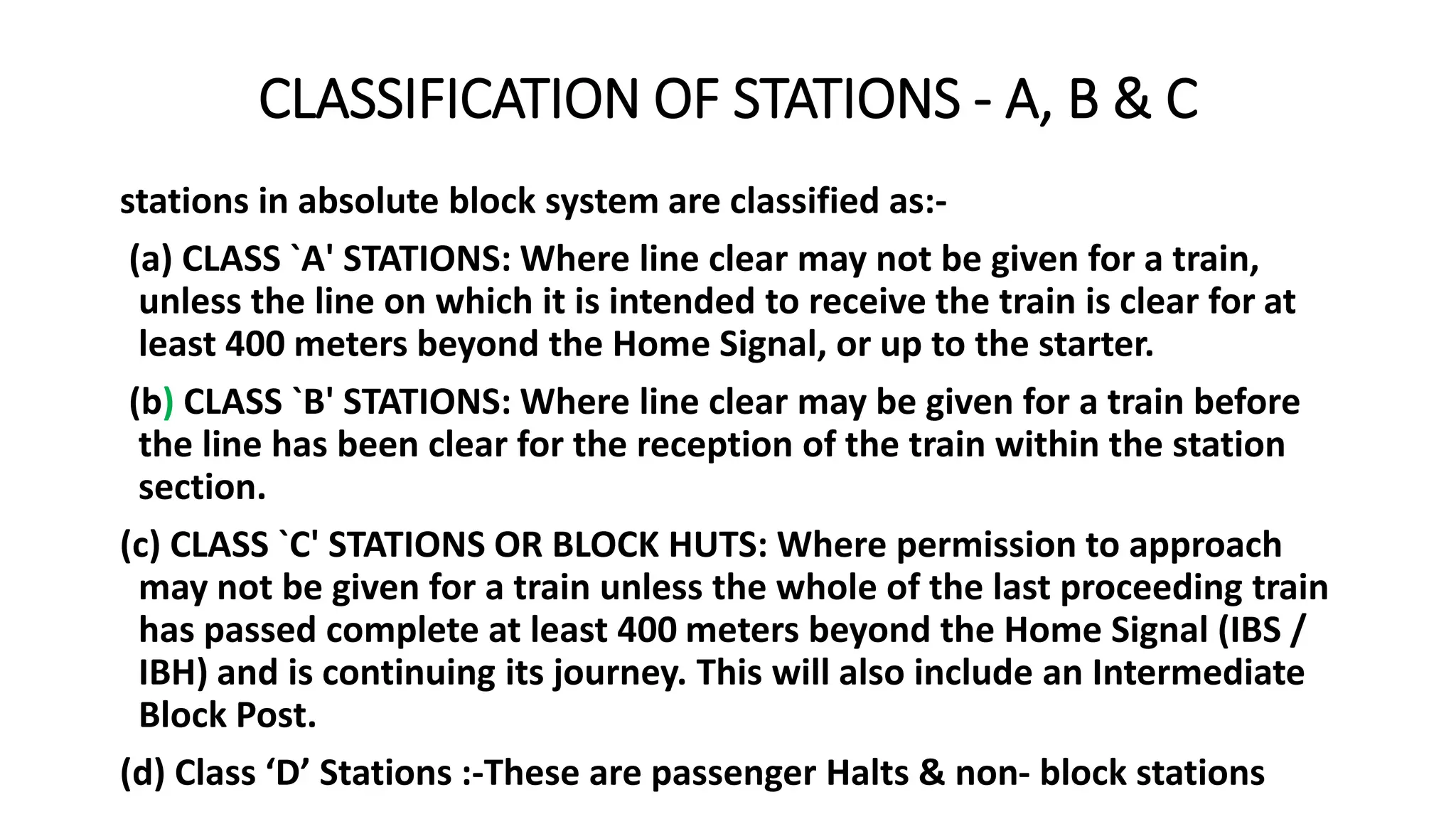
CLASSIFICATION OF STATIONS - A, B & C
stations in absolute block system are classified as:-
(a) CLASS `A' STATIONS: Where line clear may not be given for a train,
unless the line on which it is intended to receive the train is clear for at
least 400 meters beyond the Home Signal, or up to the starter.
(b) CLASS `B' STATIONS: Where line clear may be given for a train before
the line has been clear for the reception of the train within the station
section.
(c) CLASS `C' STATIONS OR BLOCK HUTS: Where permission to approach
may not be given for a train unless the whole of the last proceeding train
has passed complete at least 400 meters beyond the Home Signal (IBS /
IBH) and is continuing its journey. This will also include an Intermediate
Block Post.
(d) Class ‘D’ Stations :-These are passenger Halts & non- block stations
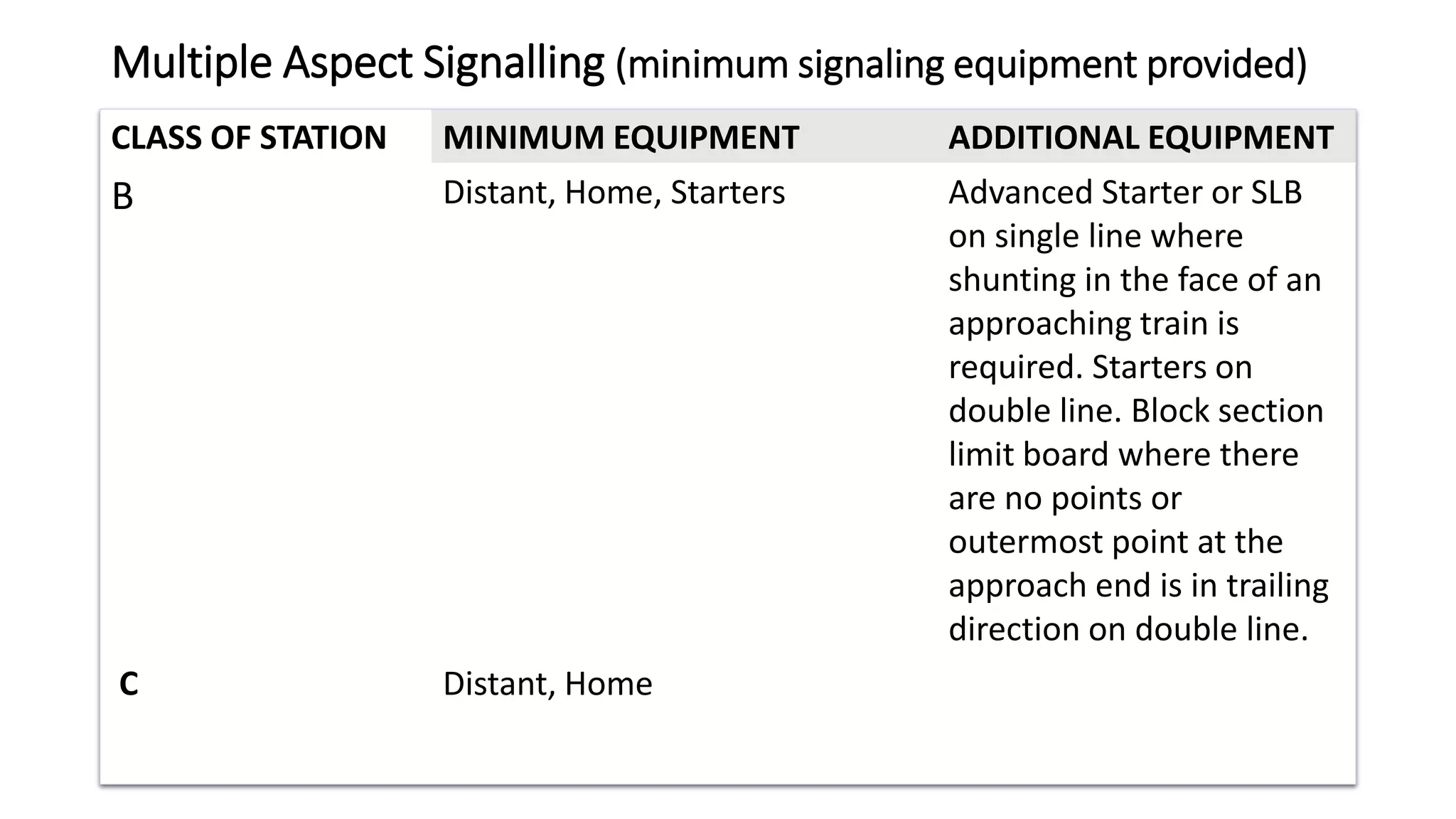
Multiple Aspect Signalling (minimum signaling equipment provided)
CLASS OF STATION MINIMUM EQUIPMENT ADDITIONAL EQUIPMENT
B Distant, Home, Starters Advanced Starter or SLB
on single line where
shunting in the face of an
approaching train is
required. Starters on
double line. Block section
limit board where there
are no points or
outermost point at the
approach end is in trailing
direction on double line.
C Distant, Home ------------
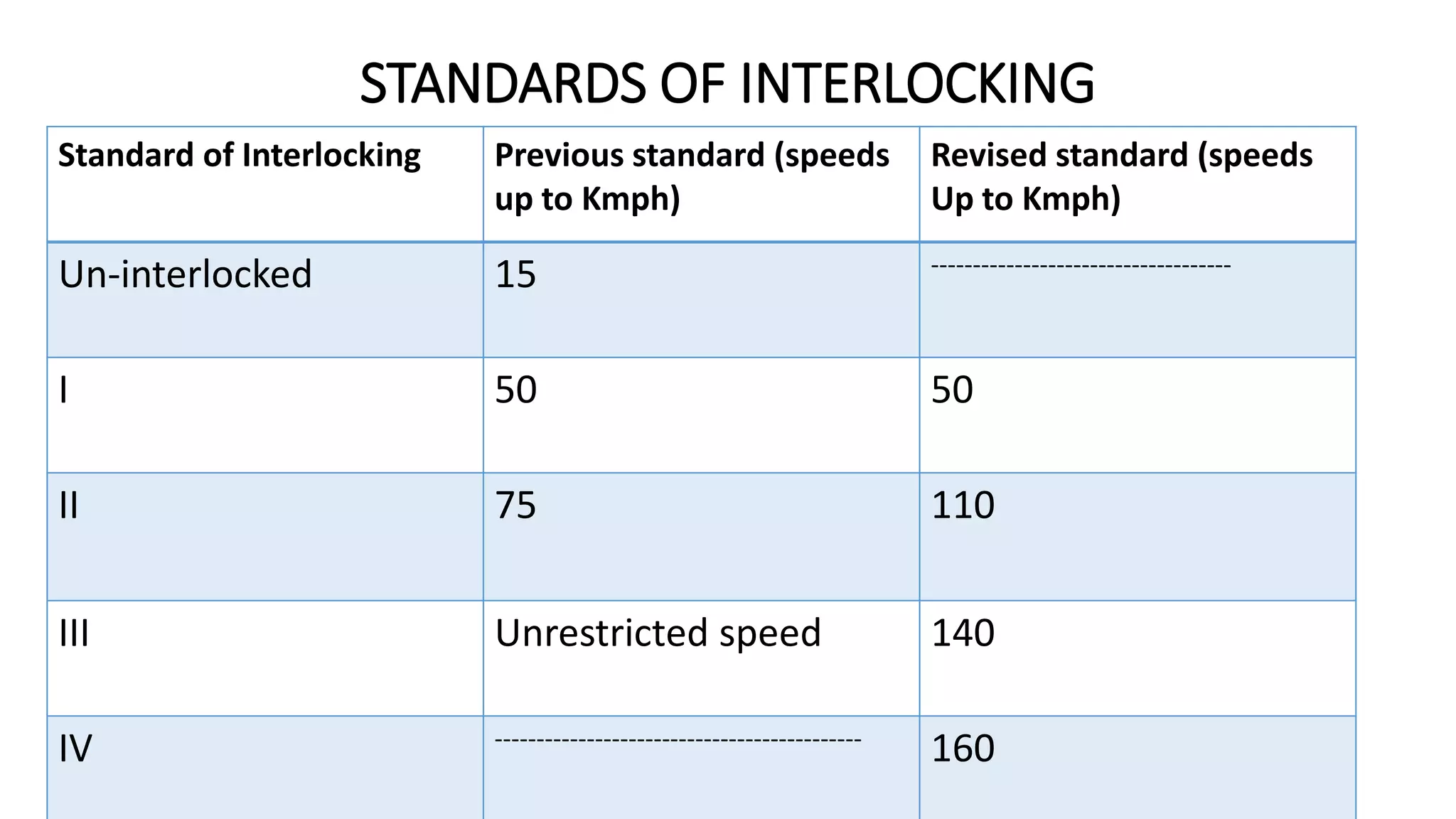
STANDARDS OF INTERLOCKING
Standard of Interlocking Previous standard (speeds
up to Kmph)
Revised standard (speeds
Up to Kmph)
Un-interlocked 15 ------------------------------------
I 50 50
II 75 110
III Unrestricted speed 140
IV --------------------------------------------
160
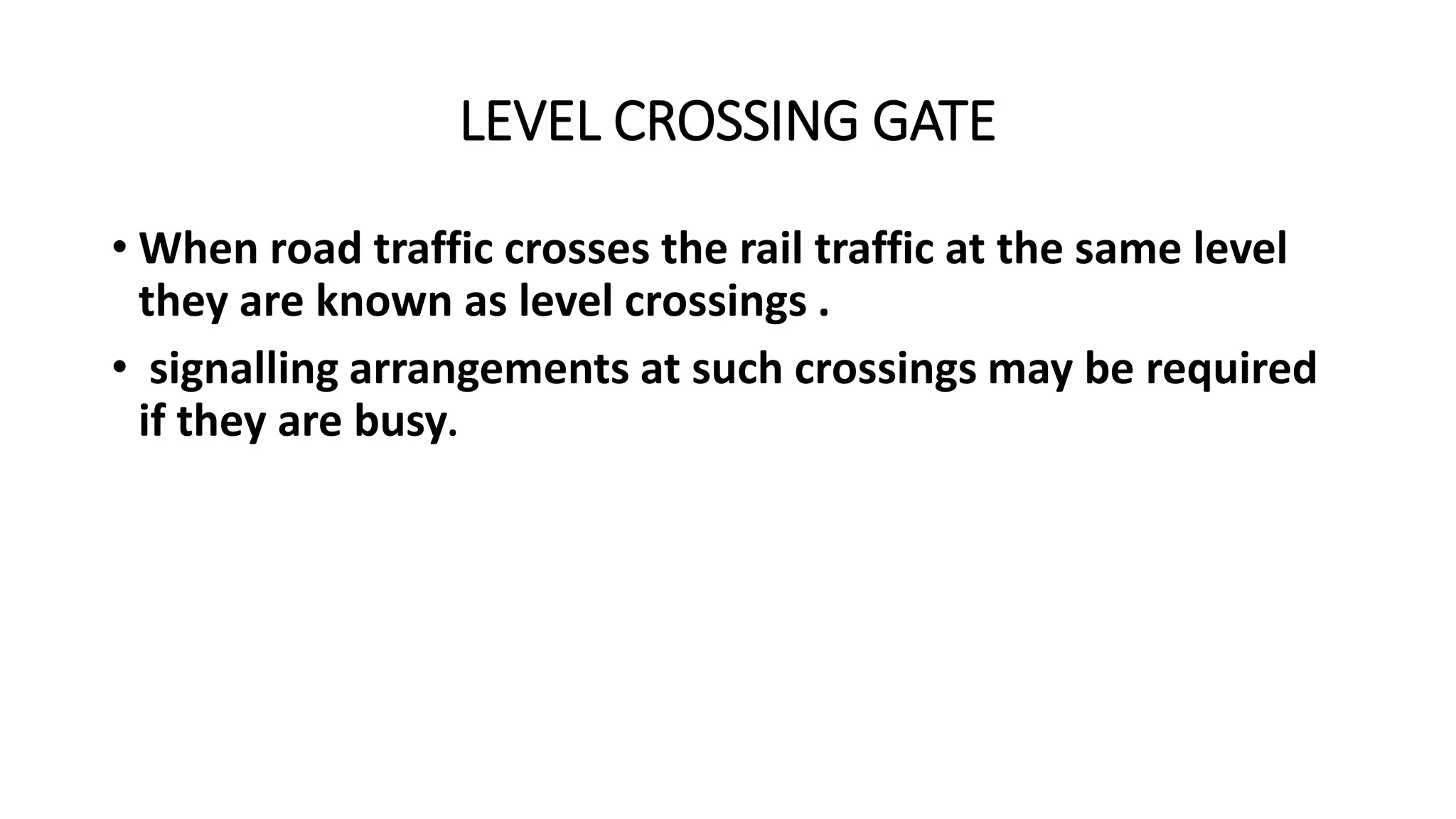
LEVEL CROSSING GATE
• When road traffic crosses the rail traffic at the same level
they are known as level crossings .
• signalling arrangements at such crossings may be required
if they are busy.
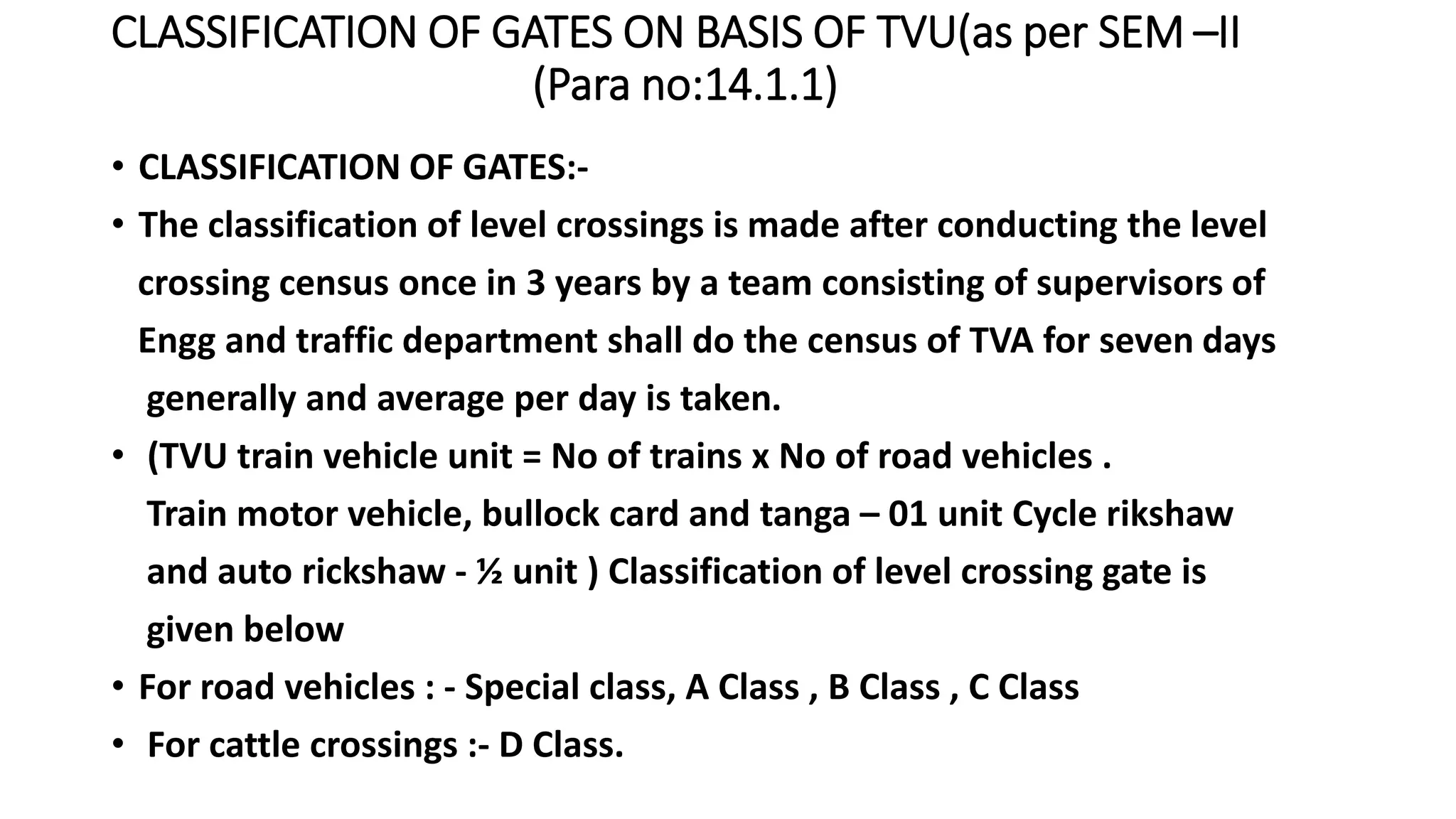
CLASSIFICATION OF GATES ON BASIS OF TVU(as per SEM –II
(Para no:14.1.1)
• CLASSIFICATION OF GATES:-
• The classification of level crossings is made after conducting the level
crossing census once in 3 years by a team consisting of supervisors of
Engg and traffic department shall do the census of TVA for seven days
generally and average per day is taken.
• (TVU train vehicle unit = No of trains x No of road vehicles .
Train motor vehicle, bullock card and tanga – 01 unit Cycle rikshaw
and auto rickshaw - ½ unit ) Classification of level crossing gate is
given below
• For road vehicles : - Special class, A Class , B Class , C Class
• For cattle crossings :- D Class.
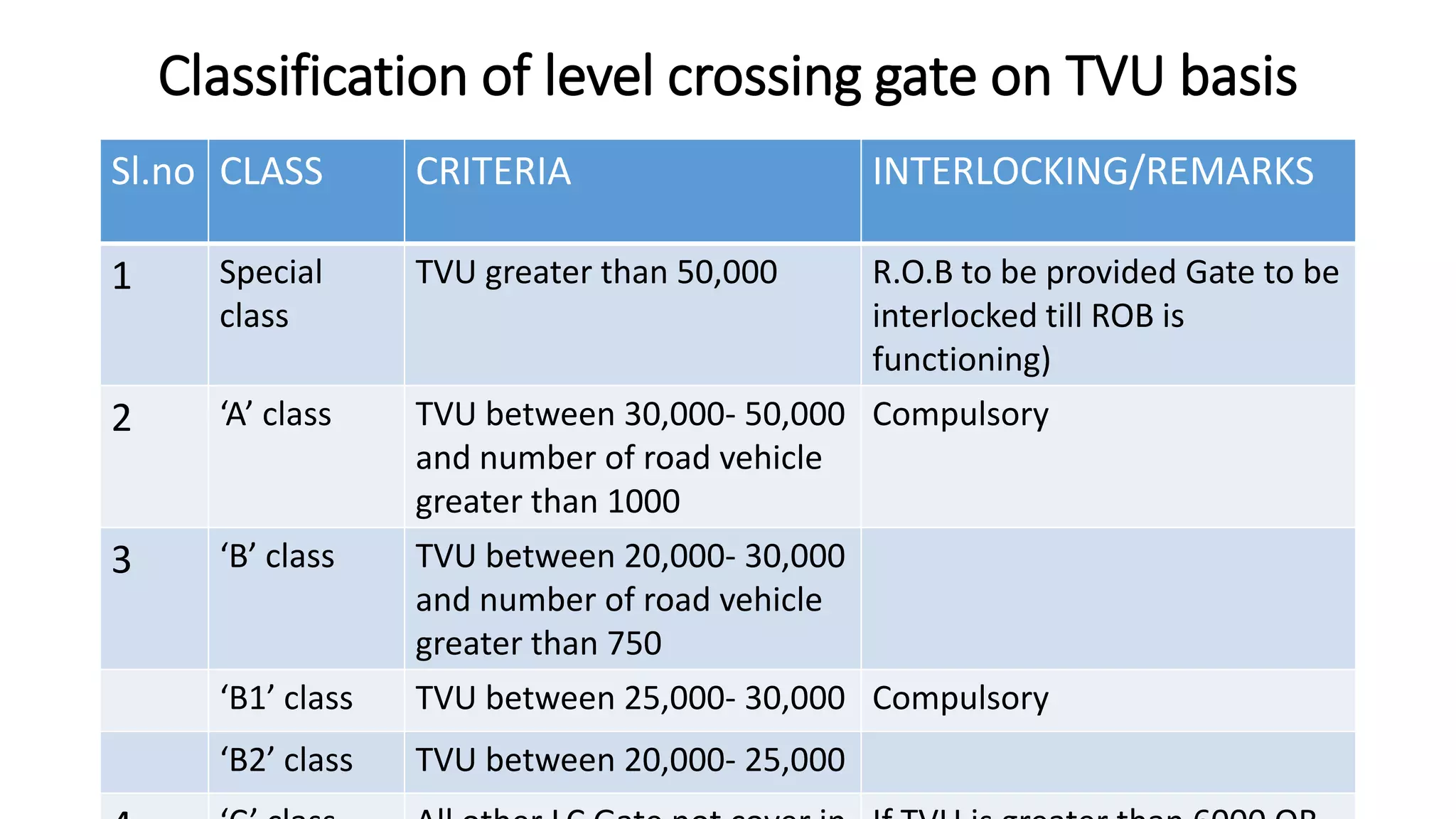
Classification of level crossing gate on TVU basis
Sl.no CLASS CRITERIA INTERLOCKING/REMARKS
1 Special
class
TVU greater than 50,000 R.O.B to be provided Gate to be
interlocked till ROB is
functioning)
2 ‘A’ class TVU between 30,000- 50,000
and number of road vehicle
greater than 1000
Compulsory
3 ‘B’ class TVU between 20,000- 30,000
and number of road vehicle
greater than 750
‘B1’ class TVU between 25,000- 30,000 Compulsory
‘B2’ class TVU between 20,000- 25,000
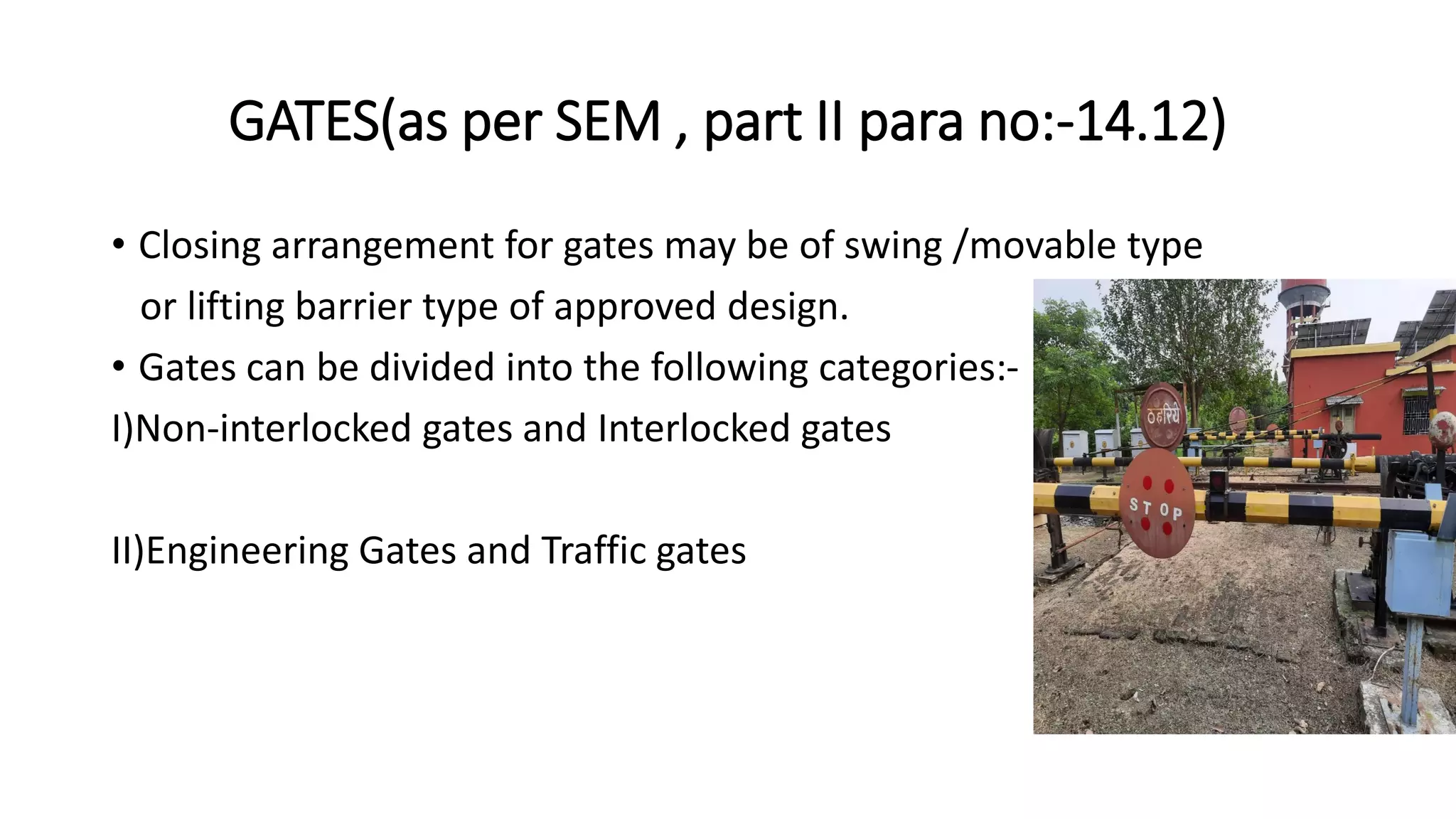
GATES(as per SEM , part II para no:-14.12)
• Closing arrangement for gates may be of swing /movable type
or lifting barrier type of approved design.
• Gates can be divided into the following categories:-
I)Non-interlocked gates and Interlocked gates
II)Engineering Gates and Traffic gates

signal system ppt basic intro.pdf

  • 1.
    BASIC CONCEPT OFSIGNAL ENGINEERING(ST-15) • A "Signal" is a medium to convey a particular pre- determined meaning in nonverbal form. Every aspect of signal of signal is pre-determined meaning like ,Red aspect meaning is stop dead, yellow aspect meaning is caution and green aspect meaning is proceed. • Aspect:-physical appearance of signal is seen by driver of train is called aspect. • Indication:- meaning of aspect is called indication
  • 2.
    CLASSIFICATION OF SIGNALIN I.R VISIUL AUDIABLE MOVABLE FLAG SIGNAL FIXED SIGNAL FLARE SIGNAL DETONATOR SIGNAL VOICE WHISTLE RUNNING SIGNAL SUBSIDARY SIGNAL TWO ASPECT MULTI ASPECT SIGNAL SEMAPHORE SGNAL CLS SEMAPHORE SGNAL CLS MINIATURE ARM DISC TYPE POSITION LIGHT TYPE CLS TYPE [d1] SIGNALS
  • 3.
    AS PER GR3.02-3.08 KIND OF SIGNAL USED IN I.R • FIXED SIGNAL(A signal of fixed location control the movement of train) • HAND SIGNAL(flag signal, Red and green) • DETONATING SIGNAL(Detonator) • FLARE SIGNAL( fusee, emits a red bright red flame)
  • 4.
    Fixed signals •Running signal(stopsignal, permissive signal) •Subsidiary signal(calling-on signal, position light shunt signal)
  • 5.
    Stop signals • STOPSIGNAL IN MAS:-HOME SIGNAL,STATER SIGNAL,ADVANCE STATER SIGNAL, GATE SIGNAL • STOP SIGNAL IN TAS:-OUTER SIGNAL,FSS,STATER SIGNAL,AVANCED STATER SIGNAL,GATE SIGNAL
  • 6.
    Permissive Signals • Permissivesignal in MAS:-Distant signal, Inner Distant Signal • Permissive signal in TAS:-Warner signal
  • 7.
    Two aspect signals(stopsignal) semaphore signal ON POSITION OFF POSITION ASPECT STOP PROCEED INDICATION STOP DEAD PROCEED
  • 8.
    TWO ASPECT SIGNALS(PERMISSIVESIGNAL) SEMAPHORE ASPECT PROCEED WITH CAUTION PROCEED INDICATION PROCEED WITH CAUTION AND BE PREPARED TO STOP AT NEXT STOP SIGNAL PROCEED ON OFF
  • 9.
    Multi aspect(stop signal)semaphore signals
  • 10.
    Multi aspect permissivesignal(MAUQS) CAUTION PROCEED ON
  • 11.
    Multi aspect colourlight (stop) signal
  • 12.
  • 13.
    Designation of signals •Signal for reception 1.permissive signal :-distant and inner distant signal 2.stop signal :- in two aspect- outer signal , FSS In multi aspect:-Home , Routing Home Signal for Departure 1.Starter signal 2.Advance starter signal 3.Intermediate starter
  • 14.
    Aspect control chartof reception signal
  • 15.
    Aspect control chartof departure signal
  • 16.
    Location of signalsin 2-aspect signalling • WARNER SIGNAL:-1200 meter in rear of FSS or gate stop signal • OUTER SIGNAL:-400 meter in rear of outer most point in D/L 580meter from FSS in S/L • HOME SIGNAL:-Close to the first facing point • ROUTING SIGNAL:-is placed in just rear of point which it protect • STARTER SIGNAL:-Just in rear of facing point or fouling mark • INTERMEDIATE STARTER:- Just in rear of facing point or fouling mark • ADVANCE STARTER SIGNAL:-180 meter from outermost point on S/L
  • 17.
    Location of signalin MACL • Distant signal:-1km in rear of FSS or gate home signal • Home signal :-180 meter+120 meter from outer most facing point in S/L section • Home signal on D/L:-180 meter in rear of facing point or BSLB • Routing home :-just in rear of the point to which it protects • Starter signal :-Just in rear of facing point or fouling mark • Intermediate starter :- Just in rear of facing point or fouling mark • Advance starter signal:-120 meter from outermost point in S/L and D/L section
  • 18.
  • 19.
    Subsidiary signals (सहायकससगनल) All signals except main(Running) signal are called subsidiary signals. • Subsidiary signal Shunt signal Calling on signal Shunting permit indicator
  • 20.
    Shunt signal (GR3.14)(शंट सिगनल) • Shunt signals are used for shunting purpose in yard. • Shunt signal can be independent and dependent • More than one shunt signal may be placed on same post. • When a shunt signal is placed below a stop signal • , it shall shows no light in the “ON”
  • 21.
  • 22.
    Calling ON signal •Calling on signals are used only for the specific purpose of indicating to the driver that he is required to draw ahead when OFF and be prepared to stop short of any obstruction even though the stop signal above it, is at ON. • Calling on signals are taken OFF only after the train has come to a stop. Calling on signals of the colour light type are provided with a marker plate with letter 'C’. • Under approved special instructions, a "calling on" signal may be provided below any other stop signal except the last stop signal
  • 23.
    Calling on signalin TAS and MACL
  • 24.
    ROUTE INDICATOR Types ofRoute Indicators to be provided shall be as under: (a) Two aspect colour light signalling section - any route Indicator of approved design. (b) Multiple aspect colour light signalling section – For speed in excess of 15 Kmph - Direction (Junction) type route Indicator For speeds not exceeding 15 Kmph - Any route Indicator of approved design
  • 25.
  • 26.
    BOARDS • SHUNTING LIMITBOARD:- The shunting limit board shall be placed at such a shunting distance from the outer most facing point as the local conditions may require, and shall not be less than 400m or 180m from the opposing first stop signal in 2-aspect or multiple aspect signalling respectively. Shunting Limit Board demarks the station section and block section .
  • 27.
    BOARDS(BSLB) • BLOCK SECTIONLIMIT BOARD: These boards are provided on Double line in multiple aspect signalling territory to distinguish the limit of the block section. • It shall be provided at a station where there are no facing points or the outer most points at the approaching end are trailing. • It shall be placed at distance not less than 180m from the Home • Signal and protect the fouling
  • 28.
    WARNING BOARDS 1.PASSENGER WARNINGBOARD:- Passenger warning boards shall be located at not less than 1 km in rear of first stop signal. In MACLS as distant signals are provided passenger warning board is dispensed with.
  • 29.
    WARNING BOARDS • Goodswarning board :-This Warning Board shall be located not less than 1.4 km in rear of the first stop signal. • The distance may be increased suitably on falling gradients on approach to stations with the provision of second distant signal, this board is dispensed with .
  • 30.
    overlap • The lengthof track in advance of a stop signal, which should be kept clear before the signal next in rear can be taken 'OFF' is known as the signal overlap.
  • 31.
  • 32.
  • 33.
    As per SignalEngineering Manual (1988), the visibility of the signals is prescribed as under • MULTIPLE ASPECT SIGNALS • Distant Signal 400 Meters • Inner Distant Signal 200 Meters where this signal is provided All Stop Signals 200 Meters • If it is not possible to ensure 200 Meters continuous visibility of any stop signal while approaching it, a suitable speed restriction shall be imposed
  • 34.
    ISOLATION • Isolation meansan arrangement , secured by the setting of points or other approved means, to protect the line so isolated from the danger of obstruction from other connected line or lines.
  • 35.
  • 36.
    SYSTEMS OF WORKING •SYSTEMS OF TRAIN WORKING In Indian Railways, six systems of train working are adopted and they are :- (a) Absolute Block System (b) Automatic Block System (c) Following Trains System (d) Pilot Guard System (e) Train Staff and Ticket System (f) One Train Only System Out of the above six systems of train working, the Absolute Block System and the Automatic System only shall be used, unless the adoption of other systems are especially permitted by the Railway Board.
  • 37.
    Essential of absoluteblock system (a)Para 8.01 of General Rules stipulates the essential requirements of the system as under “Where trains are worked on the Absolute Block System”. (i) no train shall be allowed to leave a block station unless Line clear has been received from the block station in advance. (ii) On double lines, such line clear shall not be given unless the line is clear not only up to the first stop signal at the block station at which such line clear is given but also for an adequate distance beyond it. (iii) On single lines, such Line Clear shall not be given unless the line is clear of trains running in the same direction not only up to the first stop signal at the block station at which such Line Clear is given but also for an adequate distance beyond it, and is clear of trains running in the direction towards the block station to which such Line Clear is given.
  • 38.
    Essential of absoluteblock system (b) The General Rule further states that the adequate distance referred above shall not be less than 400 meters in case of 2 aspect signalling and 180 meters in Multiple Aspect Upper Quadrant Semaphore Signalling or Color Light Signalling and modified lower quadrant signalling. • This is generally called the "Block Overlap" in signalling parlance. This distance can be reduced in case of necessity but this can be done, only under "approved special instructions" which means that sanction of Commissioner of Railway Safety is required to be obtained for reduction in the adequate distance.
  • 39.
    AUTOMATIC BLOCK SYSTEM •The essentials of automatic block system are – (i)The line shall be provided with Continuous Track Circuits or Axle Counters. (ii) The line between two stations may where required be divided into a series of section known as "Automatic Block Signalling Section". (iii) Entry into each automatic block signalling section is protected by a color light Multiple Aspect Stop Signal. (iv) Track Circuits or Axle Counters should controls the aspects of the Signal .
  • 40.
    CLASSIFICATION OF STATIONS- A, B & C stations in absolute block system are classified as:- (a) CLASS `A' STATIONS: Where line clear may not be given for a train, unless the line on which it is intended to receive the train is clear for at least 400 meters beyond the Home Signal, or up to the starter. (b) CLASS `B' STATIONS: Where line clear may be given for a train before the line has been clear for the reception of the train within the station section. (c) CLASS `C' STATIONS OR BLOCK HUTS: Where permission to approach may not be given for a train unless the whole of the last proceeding train has passed complete at least 400 meters beyond the Home Signal (IBS / IBH) and is continuing its journey. This will also include an Intermediate Block Post. (d) Class ‘D’ Stations :-These are passenger Halts & non- block stations
  • 41.
    Multiple Aspect Signalling(minimum signaling equipment provided) CLASS OF STATION MINIMUM EQUIPMENT ADDITIONAL EQUIPMENT B Distant, Home, Starters Advanced Starter or SLB on single line where shunting in the face of an approaching train is required. Starters on double line. Block section limit board where there are no points or outermost point at the approach end is in trailing direction on double line. C Distant, Home ------------
  • 42.
    STANDARDS OF INTERLOCKING Standardof Interlocking Previous standard (speeds up to Kmph) Revised standard (speeds Up to Kmph) Un-interlocked 15 ------------------------------------ I 50 50 II 75 110 III Unrestricted speed 140 IV -------------------------------------------- 160
  • 43.
    LEVEL CROSSING GATE •When road traffic crosses the rail traffic at the same level they are known as level crossings . • signalling arrangements at such crossings may be required if they are busy.
  • 44.
    CLASSIFICATION OF GATESON BASIS OF TVU(as per SEM –II (Para no:14.1.1) • CLASSIFICATION OF GATES:- • The classification of level crossings is made after conducting the level crossing census once in 3 years by a team consisting of supervisors of Engg and traffic department shall do the census of TVA for seven days generally and average per day is taken. • (TVU train vehicle unit = No of trains x No of road vehicles . Train motor vehicle, bullock card and tanga – 01 unit Cycle rikshaw and auto rickshaw - ½ unit ) Classification of level crossing gate is given below • For road vehicles : - Special class, A Class , B Class , C Class • For cattle crossings :- D Class.
  • 45.
    Classification of levelcrossing gate on TVU basis Sl.no CLASS CRITERIA INTERLOCKING/REMARKS 1 Special class TVU greater than 50,000 R.O.B to be provided Gate to be interlocked till ROB is functioning) 2 ‘A’ class TVU between 30,000- 50,000 and number of road vehicle greater than 1000 Compulsory 3 ‘B’ class TVU between 20,000- 30,000 and number of road vehicle greater than 750 ‘B1’ class TVU between 25,000- 30,000 Compulsory ‘B2’ class TVU between 20,000- 25,000
  • 46.
    GATES(as per SEM, part II para no:-14.12) • Closing arrangement for gates may be of swing /movable type or lifting barrier type of approved design. • Gates can be divided into the following categories:- I)Non-interlocked gates and Interlocked gates II)Engineering Gates and Traffic gates